http://wrap.warwick.ac.uk/
Original citation:
Beynon, W. M. (1981) On Raney's binary encoding for continued fractions, generalisations of Pell's Equation, and the theory of factorisation. Coventry, UK: Department of Computer Science. (Theory of Computation Report). CS-RR-034 Permanent WRAP url:
http://wrap.warwick.ac.uk/47220 Copyright and reuse:
The Warwick Research Archive Portal (WRAP) makes this work by researchers of the University of Warwick available open access under the following conditions. Copyright © and all moral rights to the version of the paper presented here belong to the individual author(s) and/or other copyright owners. To the extent reasonable and practicable the material made available in WRAP has been checked for eligibility before being made available.
Copies of full items can be used for personal research or study, educational, or not-for-profit purposes without prior permission or charge. Provided that the authors, title and full bibliographic details are credited, a hyperlink and/or URL is given for the original metadata page and the content is not changed in any way.
A note on versions:
The version presented in WRAP is the published version or, version of record, and may be cited as it appears here.
The
Univensity
of
Warwick
THEORY
OF
COMPUIATION
REPORT
NO.34
0N RRttey's BINARy
ENcoDING
FoR
c0.NTINUED
FRAcrIoNsr
GENERALISATI0Ns
oF
PeLL's
EOUATION, AND
THE
THEORY
OF
FACTORISATION
BY
!,1.|\1,
BeyNoH
Department of Computer Science
University of Warwick
COVENTRY CV4 7AL
ENGLAND,
(
on Raney's binary encoding for continued fractions,
nanorr'l ic>Fi.\nc n€ Doi I rc r'.!rr:rf i.in
Y!r r!! er !Jq erv
and the theorv of factorisation
by
'I
Introduction
Raney's algoritLrn for computing the cont.inued fraction expansion of
(ax+b)/cx+d) fro{r Lhe conlinued fraction expansion of x \,/as first described
i- rrr a simnle hinrrw enr-crl i no Fnr r-nnf inrre,.l FraCtiOn
air t rr\l t trr L.rcL IEr{!, q r!,rJfs !r,re!l cr/wwrrrY
expansions
is
of fundamenEal impor tance. In some sense, the study of thisencoding
-
wnichis fully
describeC in Sl below- is
the
unifying idea'rh^a-l!,ih^ .hic The first five sections of the paper cover
essent.ially the sane ground as [R], but adopt a Frspective in wtrich the
aloorithm ie fh.: .onLraf obiect of interest. As far as the mathematical racrr'l f q a16 r.nn.orno.i --" ^-:-:--1:!-' t orty \JL lYl' crr r Ly :^ ^^nfineri fo orcsenf:fiOn and
organisation, and the most. novel aspects of these sections are concerned
wiEh the formulation and justification of the algorithm and its
derivetives. Of particular interest is the use of Dijkstrars guarded
conmand notation [Di], a formalisn iCeally suited for expressing Raney's algorithun in its non-deterministic form (Algorithm 3.4).
The remaining sect.ions of the paper are only tangentially related to
Faney's algorithm, and apparently have greater originality. The main
results are concerned \rith the encodings of continued fraction expansions
of guadratic irrationals. The analysis of a modified form of Raney's
algorilhm (Algcrith,n 6.4) shows that encoCings of positive guadratic
irrationals with a negative algebraic conjugate are purely periodic, and
that the period of this encding is palindrornic if and only if the
associated guadratic irrational is the sguare root of a rational. Some
elementary classical results on the periodicity of continued fraction
expansions (see Corrs 6.4.5 and 6"4.8) and on the solution of Pellrs
eguation (Prop.7.I) appear hcre in a slightly unusuaf perspective, and
provide evidence that Raneyrs encoding is a natural representation of
conti.nued fractions. In confirmation of this, the study of necessary and
sufficient. conditions for the palindromic periods of sguare roots of
rational nunbers to b€ of odd or even length leads to apparently nevr results which relate the form of the continued fraction expansion of. l67E
to the sol-ubility of a 'generalised Pell's eguation' of the form:
Bxa - cyr = c (even length) or 2c (odd ]ength)
subject to BC=bc, and other constraints. (See Prop.ts 8.1 and 9.1). l'ihen
c=] and the encoding of J6- has palindromic period of even length, the case
B=b an<i C=1 is of special interes!, since it corresponds to the case rlfien
the nr.merical period of JE- has odd length. (See $7) .
Some elementary nunber-theoretic conseguences of these resufts are
explored in $10. The encodings of souare rooLs of primes are characLerised
(Cor.10.1.2), anC a classification of encodings of sguare roots of prducts
of the form pg, where p and q are prime. is also given. A relationship
betk'een the computation of the continued fracLion expansion of sguare roots
of integers and the problem of factorisation is also discussed, and a novel
heuristic facEorisation technigue is presented (Algorithm Ig.2). The
significant question in this context is vfiether, for large n, a multiplier
k can be chosen in such a way that the conputaLion of the periodic part of
{Ii- is a feasible cornputation leading to a non-trivial factorisation of kn.
In the spec ial case n=pc, where p and q are pr imes of the form 4t+3, the
feasibility of thc computaEion of the perioCic parL of Ji- would be
Acknowle.igements.
I wish to thank David Fowler and l4ike Paterson for nany helpful
conversations on the subject of this paper. I airr indebted to Mike Paterson
for the formulation of Raneyts algor ithm for double-balanced matrices &trich
appears as Algorithm 4.2, and for observations wl"rich led to Corollaries
9.I.4 and 5.
f am also grateful to I'like F1!mn and Pete Cameron for technical aCvi.ce
and help in preparing the paper.
Finally, I wish to thank the Nuffield Foundatj.on for funds which
enabled me to attend a series of lectures by Edsger Dijkstra at Santa Cruz
in August 1979. But for this support, this paper would most certainly have been written differentlv - if irdeed it had been written at all.
Index
$ 1. An encoding mechanism for positive reals.
$ 2. Honographic transformations and related propert.ies of 2x2 matrices.
$ 3. Raney's algorithrn and its justification,
$ 4. the structure of Rn,Cn and Dn and its operational significance.
$ 5. P.aney's transducers.
I 6. Fixpoints of R(l'l, ) and the expansions of guadratic irrational-s.
$ 7. Pel-I's equation and the parity of palindromic encodings.
$ 8. Even pal.indronic encodings.
$ 9. Odd palindromic encodings.
3
rJositive reals
The first fivc seclions of this paper, vhich sre closely based on [R] .
arc concerned with the formulation and justification of Raney's algorithm
for the solution of the folloreing problem:
Given a real nunber x as a continued fraction, anC integers a.brcrd,
finC the continueu fraction expansion of (ax + b),/(cx + d) = y .
Notation:
----TEE-se t of non-negative real numbers, together withoo witl be denoted
by n*. If t1 is the 2x2 integer matrix:
(a
\c!\
o.l
then Mlxl rvill denote (ax+b)/(cx+d) . The map I'1[] is tben a homographic
Eransformation, and x and 11[x] are hornographica l]v felatecl.
---?he-Iass of 2x2 matrices M with non-negative integer entries and a
positive determinan! (respectively Positive determinant n) will be denoted
by P (respect.ively Prl ) . The matrices:
tI I\ and /1 0\ [c rl \1 I] in P, will be denoted by U and L respectivefy.
For reasons to be discussed later (see the Remark after Prop.2.l) , it
suffices to consider the problem of computing the continued fraction
expansion of y=l'l[x], where x is in F.P, anC ]1 is in P. In this case, y is
also in Rio. P€ney's soluEion to this problem makes essential use of an encoding which assoliates with each element of lA' at least one infinite
string in the alphabet e = {u,I}
Tb definc Raney's, encoding, consider first Ehe map e:Ao +Or mapping
uolo uc . ,. (u or 1)z to [a;b,c ,...,2) ,
where a ) 0, and b,c,..,,2 > g. If p is an infinite string in the alphabet
A, and p. is the prefix consisting of the first n symbols of p, then
elementa ry" analys is witl show that e(p ) tends to a lirnit E(p) as n tends
to infinity (c.f. tDl p.88) . If A- denotes thc set of infinite strings in the alphabel A, a mip E-: 46 -> Ro is defined in this way. If x is in Rl and
E(p)=x, then p is an encoding of x.
Proposition l-II
lit .rhF im>.'a nf P iS Fo
(ii) 0,cs and all positive irrationals have a unigue encoding
(iii) A positive raEional bas precisely two encod ings, one having suffix
Iud , lhe other ulo.
$1. M encod ing mechanism for
Proof:
lj
)-and(ii) rf
xis
a positivecont.inued fracEion expansion
Thus by elenentary analys is:
x=Iim Ia";a, ,
hic€
irrational,
it
has a unique non-terminating [ao;a, ra..
...1€16r... l.
(See tD] p.88-92)....,arr] = E (u ar r4' uttt . .. ) .
If x=m,/nv.heremandnGz+, then x has a terminating continued
fracti.on expansion lao ia, ,.,. rak] , r"'here 8q131 r... rak are Ehe successive
quotienLs in Lhe division form of Euclid's algoriti'fi applied to the pair
(rn,n) , an'J ay ). 2. (See e.g. [K] p.3f6-320) . Thus
x = Iirl fao;a,r...rap,m]=lim laoiol t.'.rap-1 ,lrm]
111 + d. )h +(r
encocrings given by concatenating uoolot ... (u
or rfk-'
"itr,
and x has lwo
ulc" and I uN.
The above
other than u@
analysis cleals with all infinite strings in the alphabet A
Rerna rk :
-Tf
x = m,/n r,frere m and n are positive integers, then L\c1id's algorithm
for conputirg g = GCD (mrn), in its subtraction form, generates a sequence
of matrices 51rS1r...1Sg, where S;€{L,U}, such that
/
*\
=
s,.."
se/s\ "\ n/ \g/
If s; = (if 51 = L then l-else u), then a simple extension of the above
proof shows that. sr...sgul@ and s,...sglu@ are the two encodings of x.
t^nr 'l 1 I.
lE-p iE Tn A6, then:
(i) If
F is obtained from p by interchang irgl
ard u, then E(F)=
(E(p) )-t(ii)
E(u.p)=1+E(p)
>1(iii)
E(1.p) = E(p)/(1 + E(p)) \< 1Proof:
-li-j- ff d. =.6, then [aoiarr...ra4 ]-l = [g;acra! , ,,.rd6), so that
[0;a,,...,anJ-' = [a,;61r...,a,.,]. Thuq, intercharg ing l and u in a string q
in A* gives Q such that e(Q = (e(q))-' . But then
ntF)
=[Setpr,l
:
iT." (e(pr)
f'=
(E(p) )-l( To eliminate trivial argunents with limits, this proof may be paraphrased
" E(p) = [a;b,c,...] =>
(E(p))-r = if a ) 0 then [0;a,b,c,...] else [a;b.c,...] = E(p) "
this abbreviated form of argunent is used for (ii) and (iii) ).
(ii) E(u.p) = [aib,c, ... ] vfiere a ) 0 =1+[a-1;brc,...]
= 1 + E(p)
(ii.i) Suppose E(1.p) = lbia,b,c, ...1 where a ) I
[a;b,c, ...]-'
Then E(p) = .l [0;a-1,brc, ...] if a ) I
([b;c, ...] if a = 1
Hence (E (p) )-r = fla-l;b,c, ...1 if a > I
LIO;b,c, ...1 if a = I
P.rn€y's algoriLhm is based upon relationsirips betr^reen the homographic
lransfonnations defined by a 2x2 integer matrix 11 and the matrices Ul'l, LM,
,.'l' -i.: '.ar tc.p pr^n ? I and Aloorifh.n "-l)_ The other fesults of this
secLion will be used to qive oualitaLivc information about the behaviour of
Algor iEhn 3.1,
Dr.\n ) 1.
:-::.tr':':'
-_Lef
Ii be a 2x2 integer matrix, and xG no. Then(
i)
Ui'I [x] = 1 + la [x](ii)
u.ifxl =Ulr
+ 1/l'1[x] )(ii j.) nU txl = l'1[1 + x]
(iv) ItL [x] = Pl [x,/ (1+x) ]
Proof :
til
tll'l [x] = ((a + c1 x + (b + d) ),/(cx + d)= 1 + (ax + b) ,/(cx + d)
=
I
+ Ulxl(ii)
ul[x]
= (ax +bl/l(a
+ c)x+b+dl
=l/(r
+ I/rilxl)(iii)
llulx] = (ax+
(a+b))i/(cx + (c + d)1 = (a(x+1) + b)/(c(x+l) + d)(iv) l.ll[x] = ( (a+b)x + b)/((c+d)x + d)
= (ax + b(x+I)),2(cx + d(x+1) )
=
(a(u-/ (I+x\\
+ b) / (c(x/ (1+x))
+ d)= M [x,z (1+x) ]
Femark: Prop.2.I can be used to show that Lhe general problem
of
computingthe
continued fraction expansion of M[x] as originally presented can bereduced to the case M €
P
und"e R*. Such a reduction is- pioposed
in
[R] ,but this fails
in special cases (e.9.a=d=0andb(
0, rvhen Step (e)fails
to achieve b >, 6).
(See Appendix 1).Prop.z.ztIetM=/a
-l
(i) U'11 € P (=)
(ii) L-h€P(=) (iii) I'iui€P<=>
(iv) tll-r€ P <=>
Proof:
/:r rt
-\J,' rr. cJ /,. I ott\J LJ ,
(t !.1^-M r -r-\h i ^ Lransformations anC related
P. Then
rrralr'\6 r i r oc arf 2x2 matrices
b\€ P
-l
a)candbld
^t^^^AltA
o \ L a,,|J v \ v
a)bandc)d a(bandc(d
f"nntrarcolrr ir rr-\.r
The proofs
of (ii),
Definition: I"et t1 e
d, then url4 =
(a-c
Td)
€
P.q\€P
then H =/plr
S+s\ where p and q are > 0.sl
\ r
s/
and (iv) are egually sinple.
M is row-balanced if neither u-'1.1 nor L-r1,1 is in P.
M is colunn-balanced if neither FlU-r nor l4ft is in p.
l"t is double-balanced if it is both row- and column-balanced.
I'lotation:
TilE-GGclasses of P consisting of row-
'column-, and double-balanced
maErices will be denoLeC by RB,CB, and DB respectively. For n > 0, the
notation RB" (respectively CBh, DBn) will be used to denote the subclass of
RB (resF€.cLively CB, DB) consisting of matrices of determinant n. Lcnrna 2.3: t€L X,Y e P.
(i)
xY(ii)
xYProo[:
lll I rf
neither xYU{ nor y,ytltis
in P then neitlrer YU-rnor
YL-ri.s in
P.(i) is
sirltilar.€RB=>X€RB
6-Cor. 2.2.1: In the notation of Prop" 2.2:
- - (i) 1.1 is row-ba1anceO iit a)c and ri>b
(ii) I'i is colurnn-balanced iff a>b and d)c
Proof: Evident since ad-bc ) 0.
Cor . 2.2 .2?
-
tTi=r? x + P then r,x or rx{
e.(ii) If
X 4. P then )(U or XL.(F P.(iii) If
x e P then U-'x or L-'x € P"(iv)
If
X € P then XU'r or XL-'f P.Proof:
(i)
Each element of X appears in UX or tX, andif
X hasa
negativeentry
thenso
also does Lx or lX. Moreover, det. Ux = det tX = deE X. Thenrcrrf nf liil is similar.
(iii) Li'x and L''x € P => deE x = 0 by Prop. 2.2. The proof of (iv) is
similar.
Cor. 2.2.3: IfX€Pthen
-
(ii)
Til
r,'x u-\ €f
p e and and rirxr. u''xu € 6 P => P => t-rxl € u{xu € cBcBproof: (i). (r,'xt)l-'=f'x
4 p. But arso xr,u{
{
e (cor. 2.2,2(ii))
wtrence (rirxr,;u-' $ p.
(ii)
is
sinilarCor. 2.2.4r If M €P then
(i) 14 has a canonical expression of the form:
Sr 51 ... Sgl"ls where Ms€ RB, each S; = L or Ur and t > 0.
(ii) 14 has a canonicaL expression of the form:
Mc.T, Tr ... T" where Mc€CB, each T1 = L or U, anC s ) 0.
Proof: (i) If f"l e RB then -t=O. Otherwise, ej.ther U-rM or L-rM e P,
Elt-i'ot both, r"frence M = S(Srtt) wheqe S = L or U, and S-rtl e P. But
stm of coefficients of s'' l,t < strm of coefficients of t4
and a canonical factcricrr-i^h ^€ M 5c e q .. SrMn results from repeated
extraction of refE f;;;;;;^;; it: " -" "'"' '
(ii) is similar.
Cor. 2.2.5: (i) If M € RB then Mc € oB
(ii) If I'l € CB then I',rR e DB
Proof: (i) lt = I'l c T and 14 6 RB => tlc e RD by L,emma 2.3
lglation: 'cap' will be used to denote the unigue map from the free monoid
At to q induced by defining cap(u) = U and cap(l) = L.
Cor. 2.2.6: "cap' is an isomorphism of monoids.
Proof :
bB, = RE, = 63,
=l/1
6\lIt0
r/Jwhere s,
.
=Jl if
Si = LS3. Iianey's algorithm end its iustification
Faney's algorithm accepts as input an infinite strjng P in AF where
[(p) = xr and a matrix [i in P, and ouEpuLs q in A6, where E(o) = y, and
Ii [>:] = y. ?hus, if ;a = i a b\, then Raneyrs algorithm effectively computes
\c cl ,r
the continued fraction expansion of (ax+b),/(cx+d) fror the continued
fracEion expansion of x. The algorithlln can conveniently be described in the "guarded cor:nand " notation developcd by E.I'l.Dijkstra. (see e.9. tDil )"
Loo.c invariants are enclosed within parentheses ({..,i), and'in' and'outl are used to denote the prefix of the input currently accepted and the
prefix of the output currently given, respectively.
AlqoritLun 3.1 : "Faney's algorithn"
-1^
< p := u*I'u'...
where x =M := Ilci {r'i6 € P}
do
true
->-
clo* li{
ne
->{ I'1c .cap (in) = cap (out)
if
U-t'j €p -)
<output-B t-'t't €
P
-> <outputI1 od;
ctoR
lt
ene
-)
{ t"lc.caP(in) = cap(out) .li
(
read s, the next slmbolif s='u'-t
:= MUl"=']'+!l:=ML
fi
[a;brc, ... ] );
.H]
'u');
,1');
M :=l,t ;=
]
of p ); u t"l
I;tl4
od
od
Before proving the correctness of Raneyrs a19or ithm
' it
is
necessary toestablisb basic
facts
aboutits
behaviour. Apriori,
the algorithm mightaccept input. indefinitely without giving
an
outpuL,for
instance. Sincethere
are
tr,o possible encodings of a rationaf nurber, there is also an apriori
possibility
of
nondeterminismin the
output. (A possibility:rimi f t-arl in niiksj-rrt^ -^!-! i^- lrr_J l^ 'r^i^r. a nonteterministic choice
^o Lr q 5 rrvuaL.Lvll,
between alternatives in a do or if clause is made when more than ohe guard
is
true) .Since deL U = det L = 1, the determinant of I'1
is
invariant underall
assignlnents
to H in the
algorithnr. As this fact suggests' there is arelationship between the behaviour of Raney's algorithin and Lhe algebraic
properties of rnatrices in P lrith fixed determinant n > 0.
car. 2.?.7 (to Prop. 2.21 z For n
)
0:(i) if
tl € P'B'\,ceh or DBn then the trace of M, tr(M) \< n+land
(ii)
the classes RBh, CBh and DBh are finite.Proof:
G)rE q\ € ns
\r
s/(ii) Cnly finitely many values
), b and Ps-gr = n
). fr and n > ps-
(pl)
(s-1))0andn>I}fs-l
satisfy n > prs-l . |.r-*l^\^
Y]C'IIIJ-ZY
0ands)q
Dr^|.r 1 ,. T^ !-h6
-peff6-a-ndMeP:( i) There is no
( i i) Loop R can
^
i.,^-(iii) toop read.
(See Cor" 2.2.I) .
matrix noE in RBn
In the sequence of
is of the form:
B
execution of Raneyrs algorittun v/i th input paraneq.ers
non-deEerminisn in loop t{.
be iterated only finitely nany times without output be irol
(iv) lrhen loop W terminates, the next sy.nbol to be
particular, the next outplt will be 'u' (resp. '1')
is 'u I (resp. '1 ').
l.l can be iterated only finitely many times without input being
outprt is ambiguous. In
if the subsequent input.
Proof: Suppose that det l'4 = n ) 0.
(i) Loop W gives output non-determ ini s t ical ly only if aL some
stage both t.i',rt and L'' t'1 are in P, wfrich is impossible by Co(. 2.2.2.
(ii) Since the assigrments M := MU and M := f4L both strictly
increase the determinant of M (again usirg det M + 0) r a sequence of k
successive iterations of loop R !^/ithout output generates k distinct
matrices in RBo. Thus k is finite by Cor. 2.2.'1.
(iii)
see cor. 2.2.3(ii)
(iv) On termination of loop l{, M = /a b\r*rere a ) c and d ) b.
tc
dJ
-matrices M,MU,MU^, , the first
Cor. 3.2.1: For given input parameters p in Ao and Mn in P, Raney's
E$orTt-tur- outpuls a uniquely rietennined str ing R (r"rc , pi in a-. Hence the
algoritfm computes a well-defined fun-rction R: P x A'o -> A6.
The justification of Algorithn 3.1.
The formulation of Raneyrs algorithn given previously has conceptual
advantages wlrich will become apparent. From the point of view of proving
correctness, it is he).pful to observe that precisely the same effect is
obtained by a sirnpler version of Algorithrn 3"I, viz:
where a ) c and brra ) dfrc.
sufficiently large block
Similarly, if the subsequent
the next output synbol will
--)
€P +
<output 'ur>;eP +
(output'1');
-+
s, next symbol of p>;
'u' -* M :=
MU'1' + M :=
t4Lod
From this formulation it is apparent that
with the recursive definition:
R(M,P) = i1 14
u. R (U-rr"t,P1
't o lr {r,a ^\
r. .\\u ,trl/
R (MU, q)
R (ML,q)
MtlF = /r h+rr \
\c d+rc J
Thus if the next segment of input is a
of 'u' 's, the next outgrt symbol wilt be'ut.
input is a sufficiently large block of '1' 's,
Fa ' l l
M :=
M :=
M4ne
if
u{M-(
ftufi
M- RB
<read
ifs=
I
s=tt
do
UM
L'f"l
P /tul nl ic t-hF ol p'ncnt- Of Ao
+ If
l
i1 e 1tI
III
r'1RB+
It'rq € P
+
L{N{ € p ->
RB -'
n = rr d -) !.".-1
P=I.q +
To prove the correctness of Raneyrs algorithm is equivalent
tha! E(R(M'P)) = lltE(p)1. Fron the recursive definition of
Cor. 1.1.1 it follows that E(R(M,P) ) = r(Mrp) in R6, vtrere
+1+r(U'r"lrp).
-+
I/0
+ ]/r(C'M,p))r (MUrq)
r (ML, q)
fi
'.
Patently, this recursive equation specifies a unique nunber
r (Mrp) inR'"
for
any choiceof
M and p, namely, the limitirg value of e(p..) as n tends toinfinity,
where p,.,is
the prefix of R(Mrp) of length n. But Prop.2.I
sbows that MIE(p)l satisfies the equation. this proves:Theorem 3.3: Raney's algorithm is correct:
if
M€ P and p€ ao, then E(R(lvl,p))
= NLD(P) lRemark: The use of an
"if ...0...U...
fiu
constructin the
recursiveEEEfiftions above should
not
be confused with the altert)ative construct introduced by Dijkstra. (See[Di]
p.33-34), even thoughthe
sarnenon-deterministic selection between true guards
in
interpreting the definitionsis
intended. A more conventional recursive definition of R(M,p) is:I
R(M,P)
=if
Me1I
to proving
R above, and
+
-)
I
+RB -+
ifU.M€P
0L-'MeP
IT
6RB -)
.iE - - ,, ^
r! P- u.Y
n -- r ^
U li - r.9
fi
nM
RB then
d'u-ZT then u. R (U 'M,p) else 1 . R(L-rt"l,p) fi
Ad are such that R(1"1,p) = R (Mrg) " Then, by
vlhence E (p) = E (q) , as l',1 is non-sirgular.
od, then F=q by Prop. 1.I (ii). Suppose
and that p erds (wlog) in u6. c1ear1y. and by Prop. 3.2 (iv), the string R (l'l'p)
in u6. ey Prop. 3.2 (iv) again, q erds in
FFq by Prop. 1.1 (iii).
else
s"q and s='u' then R(MU,q) else R(MLrq)
II
which is both obscure and inelegant.
Cor. 3.2.2: If M € P, the mappirg R(M, ):Ad-t f is t-f . The string p in A
Fas sEff i? lco ( resp. {.fD) if f R (f"l,p) also does.
Proof: Suppose that p and q in
TEeoron 3.3, MIE (P)
]
= MtE(q)L
TF E/D'l is i rraiional or 0
Fh6h t.hi|- E ! \P,/ /n\ ic r-|.i^hilL a Lrvr rqr t
E(R(M,p) ) is then also rational,
ends in uE that is, R(M,q) ends
ua, wfrich suffices to prove that
Remark:
It
is
easy to show that R(1"1,)
is bijectiveiff
M is diagonal withposlETve
entries.
Ontyif
M hasthis
simple formis
the map u[]
asuri ection.
.10
It is interesting to compare Algorithm 3.1 with' the followin3
deEenninistic algor i thm:
Algorithm 3.4: r'A norrdetermi ni stic version of Raney's algorithm"
.I
< p := uolouc... where x = [a;b,c,
M := ttloi {Mo€P}
do { {o.cap( in) = .up1ora, .t,
U-ll € P + <output. 'u'); M := U-'14
I L-{M € P -t <output '1'>; M := L'M
ll true t < read s, the next symbol
ifs='u'-tM:=MU ls='1'--M:=ML
II
od
... 1
>iof p );
In this algoritfun, it is possible that. no outFrL is given at any stagei
indeed, there are execution sequences in wfrich the outplt sequence is of
any specified lergth.
Theorem 3.5: In any execution sequence of Algorithm 3.4, the outfrt is a
strlrg-e in A**, Adsuch that q ii a prefix oF n1ru,p1
Proof: First consider Algorithm 3"1, r*rich is in effect Algorithn 3.4 with
E--larticular execution sequence imposed. If pk denotes the k-th input
symbol, then l4e.cap(pr ...px) = W.MR vfiere Mae RB in canonical form (see
Cor.f s 2.2.5 and 2.2..6r, and cap{ (f^0 is a prefix of R(M,p) because the
invariant relationship Mo.cap(in) = cap(out).t'! holds in loop R ard loop t{.
f,low in a general execution sequence of Algorithn 3.4, the relation:
. tto.cap(in) = cap(out).M
is still invariant. Thus, if the input sequence 'inr so far acceptel is
P,p" ...pkr Ehen the outzut sequence 'out' is a prefix of cap (W) as
defined above. Hence 'out' is at all times a prefix of R(M,p) .
Cor.3.5"l: If an execution sequence for Algorithrn 3.4 generates an output
string-in Ao, then thaE str.ing is R(M.p)
Algorithn 3.1 is distinguished in the class of possible algorithms
derived frorn Ehe non-dete rminist ic form above in that outpjt is given as
soon as it is available. In effect, this minimises the requirement for
" renernbering" the input string, and is central to the "finite staLer nature
'I
I
RB.,CB^ and DBt, and
its
operational significance.Prop. 4..1": Lct l': =
/a
b\ 6 P. rnen\c d I
Proof:
(i)
i,-'lil, =/ a+b
b\
\c+C-a-b d-b/
Thus I;'HL e P i-f.f c+d > a+b and d > b.
Bu! ad-bc
)
0 and c+d > a+b => d > b.(ii), (iii)
and (iv) are similar.C,4 .F1-1- cl-r,r-1-rrr.! .iF
Cor . 4 .1 .l : L€t I'i € RB.
(i) t'll. €
( ii) llu €
(resp. q(M) ) rvil] denoLe d-b (resp. a-c)
a+D
a+b
M
b+d
Notation:
Tf r,t =
f
b\ 6 p€, rhen p(M)\c
dl'lnen
RD
PE
(i) g(l'1) > p (1.1) (=) a-c ) d-b
Thus i1L € RB .=> , g (l.t) > p (M) "
Conversely, L-'llL + P => Ir'MU e P
:l
*':
h"
Prop.4.l-.
by Prop.4.l _, r
by Cor.2.2.2(ii) , since U M $'P
(r1,}
4 .r.2: Let 1.1 e F!.
(i) If
t'Iu € RB then 9(1.1u) = g(M),
p(!ru) = p(!,)-
q(M) > 0.Equivalently 1p1rt1
i =
u.1e(tlu) \\g(lq)
/
\g(MU)/(ii) If
i''ll, € RB then p(ML) = p(rl),
S(ML) = g(H)-
p(Fl) > 0.Eguivalent1y /P(14)\
=
l,.lP(ltr)\\s(14)/
\q(t'll)/Proof:
(i)
llu e RBIf
t'l=/a
b\ then IlU=/a
a+b\|
and hence:\c ot
\c
c+cr /p (l'lu) = c+d-a-b = (d-b)-(a-c) = p(tl)
-
Q(M),
and q(MU) = u-. = q(M).(ii)
is
similar.Cor.4.1.3:
tef
tt e-ng. Thereis
a unique sequence of matricesSr, ...,Sg
rvhere eachSi € {f,,U}, such that
t
is maximal subject to the condition:MSl ...S; 6 RB for 1 \< k <t.
'Thi. qer:r renr-e iq crr..h f-hat
(i) rp04)\ = srs: ...sc/g'l where g = GCD(p(14),9(l'1))
\
q(i.t)/
ts/(ii)
i's, ...sk = fc+9
B\
. \ C
B+s IIL
Proof: Cor.4"1.1 shok€ that if u e RB, then at most one of UL and MU e RB,
iiilEF proves the uniqueness of a maxj:nal sequence. Cor 4.7.2 shows that if
S(k) denotes S,S, ...Sk then:
/ p(ui\ = s (r<) / p(t1.s (k) y\ for 1 .< k ( r
\.e(rt)/ \ q(u.s(k))/
and that each successive pos L-nu1t ipl icat.ion by an. Si corrcsponds to a
subtracti.on step in Euclid's subtraction algorithm for deter.rining g. The
form of l,lsr ...S! given in (ii) is another conseouence cf Cor. 4.1.1, and
(iii) follows frorn the remark afEer Prop. l.I.
Cor.4.I.4: I€E n > 0. There is a canonical 1-1 correspondence betveen
matrices in DBh and tripJ.es (BrC,g) of non-negative integers such that
(B+C+g).9 = n. In particular, DBh has at least n elements, and has exactly
n iff n is pr irne.
Proof: I€t 11 6. DD,r. Associate with M the triple
(B,C,g) srhere Q = /C{g B \
\c
BE/is
the matrix derived from l'.1 as in Cor.4.1.3 (ii).
The Ceterminant of0
is(C+S) (P+S) -EC
=
(B+C€)S = n. Conversely a t.riple (8,C,9) sat.isfying thiscondition naturaLly determines a matrix ak'in to Q hav ir.g determinant n, and
a 'unique double-balanced matrix D in DB,l can be derived by exploiting the
carronical factorisation described in Cor.2.2.4.
Anongst the solutions
of
(E+C€)g = n are then triples
(BrC,1) suchthat
B+C+I= n.
No other solutions are possibleif
n is prime.If
n isc$lposite there
is
a non-trivial factor g .({il
andtriples
(B,C,g) suchthat B+C = n/g
-
g are solutions.Cor.4.1.5: If l,i € RB then
(i) ML € FB or l;tlil e CB
and (ii) MU e RB or ti'MU e CB
!I99!:
(i)
By Prop.4.I and Cor.4.1.1, t4L +Cor.2.2.3, this entails i'y,L e Ce since L*tl 4
(
ii)
is
similar .P3
The results of Cor. 4.1.1 - 4.I.5 are sufficient to give an effective
classification of CBnrDBn, and RB^ for each n. Cor. 4.1.4 shows thaL there
is a un ique rnatrix D in DBh associated with each solution of (B+C+g)g
= n.
Cor. 2.2.5 shows that each row-balanced matrix is of the form nS, ...Si for
a unique D in DBh, and Cor . 4. I-.3 indicates horv al-1 ror,,-balanced rnatrices
of this form are derived from D. Since I'r e cB
and, in part.icular, U eDB entails Mr €DB, there
is
a dual classificationof colunn-balanced matrices. Thus if C 6 CB, then R = CzG RB, whence:
R = DSr "..Sr<
andC=Rt= (DS,...Sk).
= sF
...slbr
in canonical form. These argr.rrnents extend simply to prove a dual of Cor.
4.1.3, characterising colunn-balanced matrice. nr r-ha €nrn 'F 'F. n where
each i; e {L,u} and D-is a given matrix in DB. 'r 'r''Kv'
Notat.ion:
---GFo
e oe.The seguence of row-balanced matrices
D,DSI ,DSr 511 ... rDS, S2 ...Sg
as defined above will be called a row-seguence.
the sequence of colunn-balanced mat.rices
Tl ...TfD,Ta . ..TrD, ...rD
as defined above will- be called a col.rnn-seguence.
IJ
The above analysis is the basis for a more precise operational view of
Algoritlrn 3.1. Ar1 iteration of Ehe do true- -+ ..."' od clause will be
call.d "a canpl ete iterat.ion" of the alg6iithm. By Prop. 37, each conplete
iteration conpr ises finitely many iteralions of ]oop lrt - the "output phase"
- followed by finitely many iteralions of loop R - the "inpuL phase". In
some respects the first conplete iteration may be exceptional. Initially lrl
is in P; after the first outtrlt phpse ($hich can compr ise an .arbitr-ary
nunber k iterations, as wben M = UxN and N € RB), the maErix M is in RB. At each iteration of the first input phase other than the last, M is replaced
by the next matrix in the unique roilLsequence to ritrich it belongs. On the
lasc iteration, M is replaced by l4U (resp.. ML) hhere MU (resp. l"1L) is in
RB. Since this analysis deperris only upon the premise that Mo € P, it is
possible to dedrrce that prior to the execution of any cornplete iteration of
Algoritrm - 3.I other than the first, the assertion:
{ M € P \ RB and either th; Iast input was u and f'lu-'e RB
crr t'hc I ast i nnrrf r+as I and ML-r 6 RB )
is
valid. By cor.4.1"5,it
-iorro'#^i[it-"Ii'any
conpleteiterltion
ofRaneyrs algorithm olher than the first, the effect of the first iteration
of the output phase is to outp.rt a symboL coinciding with the last input,
and replace M by a col unrr-baL anced natrix. Subsequent iterations .replace l'1
by thc ncxt matrix in tlrc uniqu: col LrnrFsequence to v.,li ich ,'1 belonjsr so
that on tefirination of the outfruE phase M € Fts.
In view of the exceptional nature of the first conplete iteration, it will be convenient in the sequel to regard the first complete iteration
togeiher with the output phase of the second complete iteration as a
preprocessing sEep \*rich transforms the computation of Mtxl !*rere M € P and
i e'Rt to the cornputation of D[z] r^frere D €og and z e R* (compare the
transformation described in Appendix 1). It is then natural to consider the
followirq modified fo rm of Algorittun 3.1:
Alqorithm 4.2: "Ranev's alqorithn for double-balanced matrices"
- r.b c
< q := u.L u ... wtere
N := D;
{o€
oe}do
true
+
{N c DB}
do
N€RB
->. -^-a F !!-^
-I tedu s, Lne nexE
if
s ='ur ->
N :=-T-s-'I'--!N:=
?; .l ^-r _ tr\ t LrlJ
IHep\RBandei'ther
Che last input wasthe last. input was
<output
'u');
N ;=<output
'1');
N ;=2 = [a;brc, ... I );
symbol of p >t
NU
NL
u ard NU-t 6 RB
1 and NL-t € RB l
do
N*ne
->if'frN
€p
+
lrrru€p -)
I1
1I" e cei
U,N
L-otit
od
14
55. Ranev's transducers.
The results of 54. readily show that Algoritfun 4.2 implicitly contains
the description of a sr=cial kind of "finite state machine". hhen each
cornpl ete iCiraEion is initiatcd N is a doubl e-bal ancerJ mat.rix D; during the
input phase N is successively replaced by the next matrix in its row-seauence until on the final iteration it bmomes no lonqer row-balanced. At
this point, outpuE is given, and N is successively ieplaced by the next
matrix in its colunrrsequence until it is once more Coubl e-bal anced. In the
course of a particular computation using Algorilhm 4.2, a complete
iteraEion can be initiaterf in a finite nunber of sEates only, since det M =
n is invariant, and DBn is finite (cor. 2.2.7 (ii)). For each double'
balanced natrix D, the possible sequences of input that can be accepted in
a sirgle input phase are trivial to determine from the character i sation of the row-sequence of D given in Cor. 4.1.3, and for each such sequence the
output sequence returned and Ehe double-balanced matrix wl]ich results on
output are unambiguously determined. This motivates consideration of a
simple conputational model of Algorilhm 4.2, as it applies Eor fixed n:
Definition: Given n, the n-th Raney r'ranscucer RT(n) is the machine having
DE-Jo r its set of atates; a =-G,tl-Eilts-inr,ut anc orrtpuL alPhabet, anc
a set of transiti.ons consisting of quadruples (Dr.v,w,DL) such EhaL Lf a
complete iteraEion of Algorithn 4.2 is initiated with N = Dr, then v is
accepted in the input phase, rv is returned in the output phase and N = Dr
on Eermination.
Remark: RT(n) differs fron a classical finite state rnachine in that a
sequence of input symboLs (rather than a single symbol) may be reguired to prornpt a charqe of stater and a sequence of outprt stmbols (rather than a
sirgLe output synbol) may be returned r"ihen such a transition occurs.
Str.rciyi rg the structure of RT(n) is essentially studyirg the infinite
behaviour of Algorithm 4.2 Eor fixed n. For instance, RT(I) has a single
state I and transitions (I,u,u,I) and (I,1,1,I), reflectirq the fact that
mutually homographicalty related real nunbers have continued fraction
expansions r"'tr ich agree asldnptotical ly (see [K] p.335). Por snall vaLues of
n>I (as the case rv2 discussed below illustrates) it may be useful to
precompute RT(n), and thereby save the re-ccrnPutation of transitions
irnplicit in Algorithm 4.2. ln general , RT(n) conPrises a ntrnber of disjoint ccmponents, but if n is square-free, then Kf (n) is connected. (See Cor.
5.1.3.) In particular, if n is prime, RT(n) is connected with n
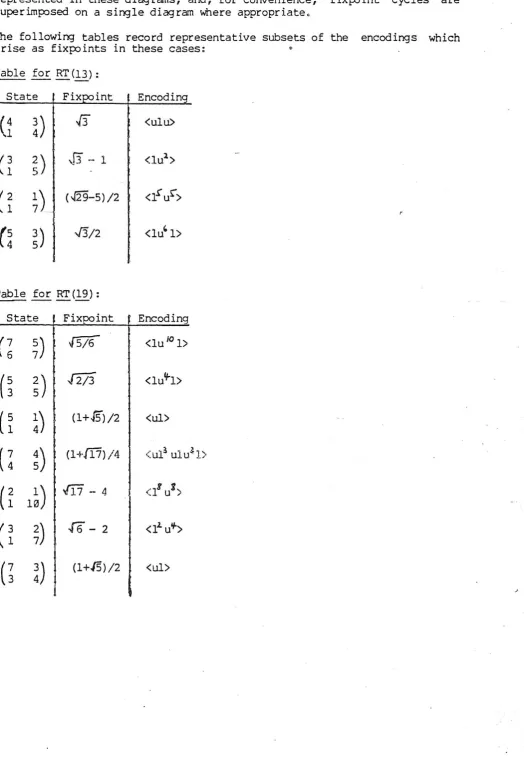
states-(See Cor. 4.f.4.). Representations of RT(2) (see tRl p.279), RT(4) and
RT(6) are given in Append ix 2" Similar diagrams representing RT(3), RT(5)
and RT(7) appear in [R] .
A simple inspection of RT(2) justifies a prescription for transformirg
p in Ac, where E(p) = x, to q in A-, where E(q) = 2x. Expticitly:
Let T = {]t,uJ and g = {t,ut}. The string p in Aa can be uniquely
parsed into the fo nn
- t,.lu.h,.ul .ta.lu.ha.ul ...t1.lu.hk.u1 ..
where t; € T 'and h: € H -for i-) 1. The string q is then derivc'tl by
transforming the segments of the parsed string p, replacing
each ti ( 1",-u) by t; (l-,uz)
and each hi(r,u1) by hi (le,u)
for i >, I, and replacin3 cach 'ul.' by'lu' anil each 'lu' by'u1'.
'fh is is an analcgue in Ad of a prescription for computing the continued
fraction expansion of 2x from that of x given by llurvri tz in 1891. (See [R] anrl IK] p.335).
The rest o! this scction, closely
RT{nl sirni Fir--ant in relation to
connectivity of RI(n) Cetermines wfr ich
closely relatecl that onc can arise
computation of another. A simple bound
can be rcarl r.ri thout input being given
based on [R], concerns properties of
the behaviour of Algorithm 4.2. The
homographic transfo rrna t ions are so
as an intermqliate comPutation in the
on the nunber of input symbols v"hich
l3
Thcorem 5.1:
Let N1 € Cel, and suppose that S,,Sa, ...,Sg are as in Cor. 4.1.3.
Ifv€A-,then:
(i) Ehere is at most one transition of the fo rm (M,v,*,*) in Rf (n) .
(ii) t.here is.a transition of the form (M,v,*,*) irr RT(n) iff I
v = cap-r (S, Sr ...St).s rntrere I.( k.( t, s = I or u, and cap(v) S RB.
(iii) (m,v,w,N) is such a transition iff
v is as in (ii) , w is of the fo rm s.z ard M.cap(v) = cap(v/).N.
Proof: Referrirg to the lhe operational account of atgori ttrms :.t and 4.2
given in 54, it is easy to shov/ that:
lil ic a .t-nca.rrrarv-a nF Dran ? ? li\
(ii) foIlov,s frorn Cor. 4"I.3
(iii) fo 1lor^s from the fact that in any complete iteration of
Algoritirm 4.2 the first outprt and the last input coincid-..
Cor. 5.1.I: there is a natural t-l correspondence between the set of
transTt-ions of Rf (n) and
(a) the set of matrices M in Pr. such that for some X in iL,Ui:
(b) the seL or pairs
,#;'lli
til:.*-*.nn8: and c c cBtrr arxreither LrRL = C or u-hu = c. Proof:
-(a1
ta1-lg RB and X rm € cB (=) M{-'= DtS, ...Sg canonically ard
}|'m = Tr ...tD* canonically,
wbere Dr and Da 6 Dts (cor. 2.2.5)
(=) (DIlvrw,Da] is a transition in RT(n) t
where v = cap-r(S,...SgX) and
-, r.r = cap -r (xr, . ..Ts ) (Thm.5.1 ( ii i) ) .
U end XRX = C then M = RX satisfies
Mx-r € RB and x'tu1 € cB.
R = Mf € RB anl c = x{
"1 € cB then XdRX = c.
(b)IfX=Lor
Convei-sely, if
In analysirrg the structure of the Raney transducers I symmetry plays an
^ ^^^- !.! -l t,qr L. syrnmetry-preserv irg tnaPs P '+ P are of interesti
transposit.ion of matrices, and "double transposition" napping
t4=la b\ to Mo=1d c\
t. d,l
[u
u]Followirg [R], 'rev' and 'int' are used to denote 'string reversal t and
'l-rr i ntornh:nrror in atF
Lenuna 5.2:
-llti - Transposition I is an f anti-automorph isnl o f the monoid Pr.
( Double transposition t I automorphisn J
(ii) If v € A* ancl N = cap(v) is in Pr .!hen:
M' = cap(rev(int(v) )) and Mo = cap(int(v) ).
DrooF: lil is a simolc exefcise.
:-i:::' \
(ii) fo 1- Ior^rs from (i) and the fact that. UL=uo=LandLt=Lo=U,-ca
Cor.5.I.2: If (M,v,w,N) is a transition in RT(n), then (Nl, rev ( int (w) ) , rev ( int (v) ) ,M|)
and (tlo, int(w) , inE(v) ,No)
are also transitions.
'I
6
NotaEion:
f?-frZ:F, the gcd of the elernents of i\4 $/i1I be denoted by 'gcd(M)'
('^. ( I ?.
- are the no r-eEch maErices k such M in that DB- ka vrith clivides rcd(Fl) n, = the k, togeEher subnachine with of RT(n) i''hose all transitions statesin
RT(n) involvin? such staCes, forms a connecEed component RT(n'k) oE Kf(n)
r.rh ich is strorgty connected and isomorphic with RI(n/k1,1).
proof: If S = L or U then gcri(M) = gcd(MS) = gcd (Sr4) so that lhe gcC of the
EfEEnts of the state matrix is invariant under transitions in RT(n). Hence
RT(n,k) is a connected component of RT(n) if it is connected - the map
RT(n,k) + RT(n/k1,1) napFlng
-iu* bk\ tola b\ tcl< dk/ (c d,/
respects a1t lransitions, and hence defines an isomorphisn o€
transducers-It thus suffices to show that for all n the transducer RT(n'l) is strorgly
connected.
this is simply provai in three steps:
(a) Let c € DB., be lower-triarr3ular, and let D be tire dia3onal maLrix
having the sa.me 'diagonal entries. If gcd(D) = I, Lhen there is a Fath
(i.e. a sequence of transilions) frar C to D in RT(n'I).
Proof of (a): Let D be the diagonal rnatrix <g'h>. Inputting only'l s to
cl--TnE- o[tp:tting '1' 's as appropriate, will transform the non-zero
off-diagonal elsnent c of C to any residue of the fo rm (kh+c) rnod g, but leave
the diagonal elsnents unchanged. Since (g,h) = I, there is a solution of
kh+c = 0 (mod g).
Dr and D' are d iac;onal matrices, and gcd(D, ) = gcd(D1) = 1, then
path from D, to D* in RT(n'l) .
Proof of (b): In view of Cor. 5.1.2, it suffices to exhibi.t a path from the
a iago-n;I m6trix <n,l> to the diagonal matrix (g,h>. The existence of such a
path follows frcm the identity: _ f, ,\:
1"--il\--i;"u
=
us 1t -/l=f/9
o\\o 1)
[;
niwhere 0 { c ( g, and the result of (a).
(c) if Dl € *,,, and gcd(M) = l, then there is a path Erorn M to a
diagonal matrix, and vice versa.
Proof of (c): In view of Cor. 5.1.2 and the fact that !1 = N for some matrix
fFn nttnll it suffices to exhibit a path from 14 to a diagonal matrix. Let
S,,Sr, ...,Sg be as in Cor. 4.1.3. From the identity: MSrSa ...Se
=/cF
^?
\
\ C B+g /
it follows thaE
tk\ rf
\v, r!
thr.ro i c :
MS,sr...sru
=
ulc?(s
3)
where0.( c ( h. If c = 0 or !cd(g,h) = l then the result follows from (a).
If neither of these conditions holds, then the above construction gives a
path frorn M to a matrix C such that:
g = gcd (p(M),q(M)) > gcd (p(C),q(c) 1 = gcd (g-c,h)
(in the notaEion of Cor. 4.1.1) from rvt-r ich (c) follo',rs by irxluction.
Remark: The connected comfronent RT(n,k) of RT(n) is the transducer defined
17
Cor.5.1.4: If (M,vrw,N) is a transition in RT(n)
" then both v and w have
1en9 t.h at. mosE n.
Proof: (i) Let M € Dtsrr. the longest input sequence virich Rf (n) can accept
in state M wi thout yielding an output has as many sy,rnbol s as there are
subtraction steps in conputirg gcd(p(M),q(M) ) usirg EucIid's algorithn. Let
this nunber be K. If M is the diagonal matrix (nrl) then K = n,
Each subtraction step of Euclid's algorithm applied to (p(N),g(M) )
properly reduces p(14)+q(M) . Thus K < p(!u)+q(M) . But by Cor. 2.2.7 (i) :
t8
56.F'ixpoints of R(l'1, ), .rnd the expansions of quadratic
As cor.'s 3.2.1 and 3.2.2 show, R.rney's algorithn
matrix M in P a map Aa->As.
Definition:
Let M e P.
A fixpoint of R(l'l,) is a string f in A such that R(F1,f) = f.
A fixpoint of ttf I is a rea] ntrnbe r x in R such that Mlxl = x.
Equivalently (since M € P), x is a solution of the equation:
c.E(f)a + (d-a).E(f) - b= 0
D(M) will denote the discriminant of this quadratic, viz: (a-d)' + 4bc
Lemnra 6.1: Let M e P. then:
-(T)ntM,
) has at least one fixpoint €
and (ii) f is a fixpoint of R(M, ) iff E(f) is a fixpoint of M[ ]" Proof:
-(ii)
R(M,f) = f iff E(R(M,r) ) = E(f) by prop.
iff MtE(f)l = s(f) bY Thm.3.3
(i) follows from (ii) since it is trivi.al to
one fixpoint in Ra
Notation:
F-i l-denote the subset of P consistinq of matrices with non-zero
Remark: If M € P* then there is a unique fixpoint x of M[ ] in R. Thus
HJM-I has at most trno fixpoints if x is rational , ard a unique fixpoint
o therwi se.
Proposition 6.2: LeL M e P+, and suppose that p is an arbi.trary string in
A-. Define a sequence of-el:m:nt: o: A :
^,_ YO - Yt YtrYl, ... ryK, ...
by settinT P;+r = M [P; ] for i ) 0.
Then:-there is a fixpoint f of R(M,) such that the lerxlth of the longest common
prefix of p; ard f tends to infinity with i.
Proof: It suffices to prove that E(pi) tends to E(f) as i tends to
intinity. (rf i is sufficiently large, there is no possibility that pi and
pjal couJ.d have large prefixes in common with tlvo disLinct encodings of a
rational nunber E(f), in view of Prop. 3.2 and Prop 1.1.)
The principle used in the proof is similar to the "Poe€r method" for
cornputing the largest eigenvalue of a matrix. Let M be the matrix:
I a b\ \ c d)
The eigenvalues of M are the roots of:
zt-@+a)z+(ad-bc)=0
which are not equal in modulus since a+d ard ad-bc are both positive.
Accordingly, if a sequence of vectors Jx; ,y;) is defined by:
/
*;\=
tu'1e (e) \Ivi/
lr
/
then the limiting direction of (x;,y;) is that of the eigenvector (X,Y) of
M associated lri th the eigenvalue of larger mociulus. Since, for all N in P
and real nunbers V, ,Va rwl a rxl vr1:
tt/v,\=/wr\ => lf v,l= !r
\q.' \ wr,l I v..l w'l
the limitirg vaLue of M, [E (p) ] is x/t. Floreover
' x/U. (beir.ts an
eigenvector) is a fixpoint of t\t l. But E(pi) = n((R(14, ))'p) = MrlE(p)l
by theorem 3.3, since for any matrices K and L in P and x in R€:
K tLtxl I = (KL) [xl .
i rrationals.
associates with a
3.2 (iv) , and ProP.1.1.
nr^r/c J-h,if M f i has at leaSL
'19
Algorithm 5.3 r
f4 := Moi
.1uo e e+} do Lrue -t
[ (cap(out) )-r .f4o.cap(out) = !1 ]
if U'!lU C P + <output 'ut); r',1 := U-'MU
-!, L.'ul € P -r (output ' 1r ); M := L{ML
::
od
Justification: The algorithm is essent'ially derivable as a particular "mode
6fij<-E;-cuEion" of Algorithn 3.4. The prin-iple is to execule Algorithm 3.4
with an input sequence determined "at run-time", and contrivetl to ensure
that input. and outprE sequences are the same. Tbe execution sequence is
such that input is accepted on the odd-nLmbered iterations of the do
od clause, ard output. is given on the everr-nr"nrbered iterations. On an input
- TTeration, the chosen input is'u' if UiMU €P and'f if L-l ML e P (lee
Prop.4.l). (There is here an element of non-determinacy as both U l"lu and
L i4L may (exceptionally) be in P). On the succeedirg iLeration t-he output
given coincides wittr the last irrpr.rt, so that Lho combinecj effecb of a
consecutive pair of iterations of Algorithm 3.4 in this node of execution
is precisely that of a single iteration of the do true -> ... od clause of
Algoritfun 5.3. I?re correctness of Algorithm 6.3-Tolloros fror Co;: 3"5.I.
Remark: The correctness of Algorithm 6.3 guarantees that the only norr
E6EE6inacy that can occur is concerned with the choice between the
suffices "Iu6" and "u1a" r,rhen E(f) is rational.
An alternative justiEication of l\}gorittn 6.3 analogous to the
juscification of Algorithm 3.I in 53 is possible. Algorithm 6.3 cornFltes
the eldnent(s) of A which has(ve) the recursive definition:
fx(p) = if u-'MU € P -) u. fx (u-trqu)
lILiML€P J I. f X (L.,I"lL)
fi
The solution(s) of this equat.ion is(are) the encodirg (s) of the unigue
positive real nunber e(M) satisfyirq:
e(M) = if r-il,lu € P + I + e(LirMU)
0 t-tNt € P + 1,/ (I + 1,/e (L:!ML) )
tt
The observation that:
Ii'r'lf. [x] = x (=) t'l tx,/ (1+x) I - x,/ (1+x)
(rhe analosue
.rT?"5':Ygl.=r1ltii",'i:i:lt;"i::
rhar e(M) isa
rixpoinrof M[ ].
Remark: ltre use of the "if ... [... [... fi' notation above reflects the
i5FdEterministic nature of the definition of fx(M). In this context, an
Notation:
IE;6A4, then (w> wilt denote the string w,w.... iuk... in A- where
w: = vJ for i > 1.
' 'Ihe subset of P (resp. P^) consisting of matrices M such tha! D(M) is
not a perfect square wili be denoted by O (resP. 0D). Note that Q is a
subset of Pf.
Theorem 6.4: Suppose that r'4c € Q and that f is a fixpoint of R(Mc, ) such
that E(f) is irrational . Then
(i) the subset of Pr consisting of matrices conmut.irq with Mo is the
subnono id generated by a single matrix hl = l^l(Mc) .
-and (ii) if w = cap-r(w), then w beJ.oqs to AtF \ (u*, lF) and is the shortest string such that f = (w>. In particular, f has a purely
periodic encod ing.
Proof: It will be convenient to prove (i) and (ii) in paral1e1 .
-Iec.
f be cornpuLed usirg Al,gorithn 5.3. the as-sigrunenhs M:=L-'[lL and
U:= U-'rlU Ieave det M, tr(M) and D(M) = tr(M)- - 4. (det M) invariant.
Moreover, the set S of matrices M in Ph with trace t and discriminant D is
finite, provided that D is not a perfect square. Explicitly:
if. 14=la b\ then a+d=t and 3 < bc = ad-n ( trl4 - n
(c d)
This proves that. f is ultimately periodic, but more is true.
Consider an arbitrary natrix f"l in S. In the computation of fx(M) using
Algorithm 5.3, there can be no non-determinacy since the fixpoinE of M[ ]
is irrational. Hence one and onlv one of L-'ML and U-''{U is in S. Now M € S
iff Mr € S, whence:
ti'lu-r€ s
similar}y rl,,rfr€
s
<=> u'lru € s.these resulEs shov, that one an<i only one of UMU'| and ltvtf is in S, fronr
wtrich it fol1ot's thaE the sequence of conj r-r;at.ions of the matrix Md
initiated by. Algorithrn 6.3, being ultimately periodic, must eventually lead
to M = LMoL-r or LM.U-' (r"hichever is in S) and thence to M = l'to. If w is the
sequence of outputs given prior to Ehe second occasion on tftich t =
"o,
then f = (w), and w contains at least one'l' and at least one 'u' since
E(f) is irrational. Moreover, if w = cap(w), then wf\4 ol^l = lue in view of
the loop invariant in Algorithn 6.3, so that all powers of W commute with To show that. w is the shortesE string in .A such that f = <tt>, suPpose
that w is of the form zk where z € Ar and z is a prefix of w. If z =
cap(z), and the execution of Ngorithm 6.3 as described above is suspended
after z has been output, then )4 = z"MoZ = N
'say. From the definition of w
it. is evident that f = <z> = <w> is a fixpoint of both No[ ] and Mo[ ].
t€t N" =/p C)ana Mo= /a b\ , wtrere Prgrr,s and a,b,c,d ) 0.
\r sl Lc dl
(Both N and M are in Q.) Since N I I and M [ ] have a common fixpoinl:
(p
-
s +,{-o)/zr = (a-
ci +6)/2.,
whence c = r and p-s = a-C as, '{D is irrational. But
tr(No) = p+s = tr(Mo) = ard,
sothatP=aands=d,and
det N = PS- rq = det 1"1 = ad-bc '
so that b = q. By definition of w, it follows that z = rv and k = 1.
Nor^, suppose that \f'MoV = l,1q where V = cap(v) and v is a string of
Iength t. in A*. since wtov = V!lo, F.lgorithm 3.4, init.iated with P = (v) and
M = M., can be repeatecily executed in such a vtay that v is first input
synbol by symbol in ! successive iterations, and then outpul sldnbol by
synbol in t successive iteraLions. By Cor. 3.5.I, (v) = f, the fixpoint of
M-- .rnd v isa nreFil of (w>. But thisenbailsv=w andV=W, since w
"ot
LI
NotaLion:
f?-fr-?E, rhen:
f (M) r,riIl denote the f ixpoint of R(M, ) ,
w(tr1) the elgnenl of A* \ (u*, tr1 def ined in Ttrm.6.4 (i) n
and w(r) = cap (w(M) ) , the matrix in thm.6"4 (ii) .
a^v (. i 1.
- (T)-P;\2, Equivalently, Q, is the set of is povre the set rs of of L mat.rices and u. of trace ) 2 in P,.
(ii) If N €Q, then W(N) e Qu f (ru) = f (W(N)), and W(W(N)) =w(N).
(iii) If N e Q,, -l - then W(N) =;q"
--Tll rt
M €p,,
rhen D(M) = G;(t'tDz-
4.der MD(M) is rational iff Er(M) = 2, in wtr i.ch case
are both 1, and one or other of the off-di4onal
(ii) h:{,{(N) is in Q , in view of (i). Since each
the d iagonal
elenents is
maLrix in Q
- 4"
Ttruselgnents of M
G"
has
a
urriquefixpoint. in R-:
x e R6 and Nx = x => Wx = trlNx = IIVJX => Wx = x.
Thus "r'J and N have a conmon irrationaL fixpoint, and f (N) = f(h'(N)), by
Prop.l.l (ii) "
Suppose that M= cap (v.s), v*-iere s € A and v€ A^. ff S = cap(s),
then S -'MS = cap(s.v) € P. Hence Algorithn 6.3, appl ied to Mo = cap(z) in
Q1r srrccesSively transforms M to cap(zo) ,cap(2,) , ....rcap(zd hhere zo =
zy= z and z;*, is obtained frorn z; by applyirg a c1clic pernrutation. As in
the proof of Thm. 6.4 (i) , M will be tirst restored to Mo after the
shortest string w such that <w> = <z> has been outzut. If Mo = l{(N). where
N is in 0, Ehen z = w(M.), and so w = z by theoran 6.4 (ii). (iii) is implicit in the proof of (ii)"
Given M in Q, the matrix l^l(M) can be computed by the followirg modified
form of Algorithm 6"3t i^ti ich is implicitly justified in the proof of
Thm.5.4 (i) "
Alqorithm 6.5:
M := rYci {Mc € 0i
if U-t'lU e p -+ W := U; M := U-,f,tU
lrhleP
t
w:=LrM:=L{ML::,
doM#r"1 -+ t_
{ (caP(out) ) .Mo.caP(out) = r'1 }
if U.MU E P -) W := W.U; M := U.MU
- L{ML € P + W := ti.L; 1"1 := L.-'&lL
fi
od;
<output the matrix W>
Cor. 6.4.2: Let N 6Q, , and 1et r and s be non-negative integers, not both
zero. If a sequence of, vectors is defined by:
tl'1r\=
1r;'1ts/
t =,/then ri ( ri+,, si .( sr., and r; + si ( ti*, * s.,, for i ), O.
Proof:
I6E-l't = /x y\, rnen lt/r\ = /xr+ys\.
(z El (=/ lzr+gs7
Since x,y,z and t are pcsitlve, it follovs that xr+ys ) r and ys+zt 7z s.
Mo reover :
?2
Cor.6.4.3: L€t x be a positive irrational. The followirg cond itions on x E?6 eQ.rTvEtent:
(a) x = E (f (l'1) ) for some M in Q.
(b) x = E (f (M) ) for some l'1 in Ql
(c) x has a purely F€riodic encod irg in A*.
(d) x is a quadratic irrational whose algebraic conjqate I is negative.
P roof l
IEI--> (n) in view of Cor. 6.4.2 (iLi), and (b) =) (a) is trivial .
(a) => (c) by Ttm.5.4 (i)
(c) => (d) Suppose that x = E((v)) wtrere v € AX, and v is a minimal period
for (v). If v = cap(v), then w(v) = v by cor.5.4.1 (iii).
(a) => (d) :
Let. M = /a U\. :tren D(M) exceeds a-d in modulus, as M is in Q. Thus:
\c dl
the quadratic equati.on Mlzl = z has a negative root, the conjugate of x.
(d) => (a):
Fron (a), x is a root of a quadratic equation:
Axa+Bx-C=0
where ArB and C are integers, and A and C are positive. Thus:
M=/r c
\(A
r+B/is in P for suitably chosen T ) 0, and x = E(f (M)).
Cor. 6.4.4: The positive irrational x satisfies the equivalent conditions
of Cor.6.4.3 iff for some k ) 2, ak >/ 0 and a; ) 0 for i=11rl,...,k-1 :
x(>I) = [ao;a,r ...rok ak + ao1d11 ...rak + ao,ar, .... ]
or x(<l) = [0 ;aoralr ...rap_,,ak + aoralr ... rdg-1* aorat, .... ]
Proof: Take x = E(<v>) in condition (c) of Cor. 6.4.3, where
\, = ;.1qo1$ ...L*-, u(K or 1S u',...u4*.r 1ak
Cor. 6.4.5: (Lagrange 1770 )
Ev:ry positj.ve quadratic irrational has an ultimately periodic continued
fraction expansion.
Proof: y can be expressed as m + r/s + x where mrrrs are non-negative
integers and s > r, and x is a quadratic irrational satisfying the
equivalent conditions of Cor. 6.4.3. computirg (sx + r)/s by Algorithm 4.2
must lead to an ultimately periodic output since x is purely periodic and
DBrr 1" finite "
Cor. 6.4.5: Let M € Q. Then (l'l(M) )E = I{(Mr) and (w(M) )S = rv(NE) .
Proof: If X € P,, then l,lx = Kvl iff XTllT = t'1TXz by Lemma 5.2, and thus
1ffi1 1't = w(M!) by Thm. 6.4. The proof for 6 is similar.
Cor 6.4.7: Let x = E((v>) be a posilive quadratic irrational wiEh a
negaEive algebraic conjugate I. rhen (-t,zf) has the encoci in7 (vD in A&,
v.rhere w = rev(int(v) ).
Proof:Letx=E(f(M))
Then cx2 + (d-a) x
-Hence Y = E(f (MT)).
Lemma 5.2, and Cor.
v,r|rere M =(a ?\€o,.
\c dl
whencey=(-I/i)>3
by-+_(d-a)
y-g=0.
= w(M r) = <cap-' (cap
satisfies the equa t ion:
23
Cor. 5.4. B: (Galois 1828)
Let x be a positive guadralic irrational.
The continued fraction expansion of x is purely periodic iff
x ) l and-1 <i<0.
Proof: Since either of Ehe stated conditions ensures that the equivalent
condit.ions of Cor" 6.4.3 are satisfied:
x has a purely periodic continued fraction expansion
Cor. 5.4.9'.
IE€ N e-O] and Iet x = E(f(M)). ltren
( i) r'q = i{6r <=> x = .I5E for positive integers b and c
-
<=> e'(M) = rev(l'r(ID-:(ii) M =i'lr (=) x= (+m + {ma + 4n )/2n for positive integers m arxl n
Proof:
Let !l =
( i) M
( a b\. :ten' t^ ;l
=;fr"'(=) a = d
<=>x={ffi
<=>x+f=a-d-=0
<=> W(M)
=
(W(M);ar by Cor" 6"4.1(ii)
and Cor. 6.4.? <=> w(M) = rev (w(f''l) ) by Lemma 5.2(ii) }a = t4t (=) b=c ,--:!_____---= , r
(=) x = (+m +'Jm^ + 4nll/2nwhere m = la--el and n = c
(=) xi = (_b/c) = (_1)
Remark: The results of Ehis section may be helpful in u.rderstand ing the
EEiEEure of Raney transducers lsee 55) "
t€t M be in DB,r, and suppose that M[ ] has an irrational fixpoint. the
transducer RT(n), when initiaLly in state M, responds to the input sequence w(M) by outputtirg w(M) r'rlrilst cyclirg throu3h a sequence of distinct.
states ard returning to the state M. The correspordence betvpen states of
RT(n) and 'cycles of statesr generated in this way is intriguing in that it
suJgests connections between the structure of RT(n) and encod ings of
quadratic irrationals wi th various different discriminants. This is of
particular interest ig p=p is prime, v*ren only Lhree of the p matrices in
DBn have rational fixpoints, namely:
I I 0\ , /p 0\ ana f(V,L)/2 (p-I)/z\
\
0 pl
\0 I/
\ (p-r),zz lp+I)/2 I(If M has a rational fixpoint, then (tr(M) )z - 4p is a perfect square, and
24
57. Pell's equation and the parity of patindromic encoriinqs.
Proposition 7.1: . \
-If M =la b\ € I and x =fx y\€ P,, then:
\c dl \z tJ
( i) X and fv! conmute i f f
and b(x-t) = (a-d)y ...(B)
(ii) (A) and (B) togethar imply
c(x-t) = (a-d)z ...(c)
cxa - (a-d) xz -bzL = c ... (P)
and 3 sirnilar quadratic identities involvirg the pairs of variables:
(x,y), (y,t) and (z,t)
dpirar^Fpll hv Fr^nsposition and double transposition from the relation:
Xu = l4X.
Proof: (i) v\M = l4X iff (A),(B) and (C) hold by a simple calculation. Since
M Q, bc is non-zero, and thus:
(A) and (B)
(ii) cxa - (a-d) xz - hzl = x(c(xlt)-(a-d) z) + cxE - bzL
= c(xt-yz) by (c) and (A)
=csinceXeP
Ey LenUnA ).Zr f 4 f
M and x commute iff [1 I (resp. l,to) and xT (resp. Xo) cornmute.
Hence the 3 equations derived from (P) by applyirg the permulationss
(a d) (x t), (a d) (x t) (b c\ (y z) arrl (b c) (y z)
of
.arbrcrdrxryrzrE ate all equivalent to (P) .
Cor. 7.1.1: Let M be as in Prop.7.L, and let W ='rl(M). Then:
-lT) -tfrErE are infinipely many solutions of the equations (A) and (B),
g iven by taking X = r,l' for i 2 6
(ii) there are infinitely rnany sclutionp of the equ.:tion (P) , given by:
/x
\
=
w'/
1\lzl
\s/
Proof: The resulE fo L Lo',rs from Thm.6.4 and Prop.?.1. the solutions are
a i-stinct by cor.6.4.2.
Remark: Algorithn 6.5 provides a simple method of conputing solutions for
(A) and (B) , and for (P).
In the context of Prop.7"l, the special case M = !l{C
Under this hypothesis, equation (P) reduces t-o the formr
cx--bzt=c
r,.*r ich in the particular case c=1, Fn (viiren E(f (M) )
classicaL "Pell's equation" (see [D]).
Cor.
7.I.2:
Let M and X be as in Prop.7.l, but subject.to the
additionalconaiEionl = d. Then
(i)
Ku = tlx(ii)
Xia = ivlx(iii) if
x and z are non-negative integers satisfyirg (P*).
thentiere
arennn-no.raf irra inl-o/rorq w And t <rv.h fh.if X and M Cqnmute.
Prnnf. f i\ and /iil llnrlar l-hp hrrrnFhpcic -.l - A
r rvvr. \f/ urru \rrl ,rJtlL'ruJfJ ut
Fi6!lz.
f
reduces to "x=t", and (P) reduces to (P*).the equation (B) of
c/9, b = b/q
k is a
non-M, and that
is of
interest.= .fi- r ic r-ha
(iii) Let X and Z qal-iqFv tp*). TF rr = or-d fh-r-l and F =
:- i \a ': j+ )
r''-then Ex' - bz' = E virere gcd (5,E) = 1. Thus z = k6 r'trere
ne.Jative integer, and y = (bz) /d is a non-ncgative intsJer such
cv- 'T?rrrq, r-hnnqi rr' t = x ensures that X Commutes with
-t.