Iranian journal of educational Sociology
(Interdisciplinary Journal of Education)Available online at: http://www.iase-idje.ir/
Volume 1, Number 5, December 2017
Smart Talent Management and Its Relationship with Meritocracy in
Educational Systems
Mina Karimi Shahri 1, Kiuomars Niaz Azari 2*, Maryam Taghvaee Yazdi 3 1.PhD student of department of educational management, Sari branch Islamic Azad university Sari, Iran. 2.Professor of department of educational management, Sari branch Islamic Azad university Sari, Iran. 3.Assistant professor of department of educational management, Sari branch Islamic Azad university Sari, Iran.
Article history:
Received date: 10 September 2017 Review date: 15 November 2017 Accepted date:11 March 2017
Abstract
Purpose: The present study aims to investigate the relationship between smart talent management and meritocracy in order to provide the expressive characteristics of the selection, appointment and
maintenance of managers. Methodology: The research method is
descriptive survey and the required information has been collected using a researcher-made questionnaire that its validity has been determined from the available resources and through expert opinion and its reliability has been determined by calculating the Cronbach's alpha coefficient (.882). The statistical population of the present study includes the associate professor faculty members and higher rankings and staffs having MA and higher degrees, i.e. a total of 1,200 people. Sampling method is stratified random sampling through which 291 people are selected as the
statistical sample. Findings: Findings of exploratory factor analysis show
that strategy, attraction, evaluation and discovery of talents are the main components of talent management, and organizational learning, knowledge expansion and sharing are the main components of knowledge management. Among the 13 dimensions of talent management, the development of talent with a standard coefficient (.90) and preservation of talent with a standard coefficient (.88) are the most effective ones,
respectively. Discussion: Among the 13 dimensions of knowledge
management, expansion and sharing with a standard coefficient (.95) and organizational learning with a standard coefficient (.88) are the most effective ones, respectively. Also, confirmatory factor analysis confirms the relationship between smart talent and meritocracy with a standard coefficient (1.06), and test statistics has evaluated the severity (correlation coefficient) of this relationship (.299).
Keywords:
Management, talent, talent management, meritocracy, educational systems
Please cite this article as: KarimiShahri M, Niaz Azari K, Taghvaee Yazdi M. (2017). Smart Talent Management and Its Relationship with Meritocracy in Educational Systems, Iranian journal of educational Sociology, 1(5), 181-193.
*Corresponding Author: [email protected]
1. Introduction
Combining the two concepts of globalization and internationalization of higher education and its synergy with the changes in science and technology have always faced universities with many challenges for joining the world of competition (Novada, 2013, 12). Highly qualified organizations recognize talented individuals in the organization as a primary source of competitive advantage because today, with rapid changes in the organizational environment and the need for the growth of managers' awareness of the multiple tasks of the organization, technological changes, entrepreneurial skills and the ability to operate in different cultures, different structures and markets, organizations need talents and elites to upgrade their organizational performance and overcome their rivals in such a situation. An issue that requires creative and intelligent people (Schmidt and Rozenberg, 2016).
Smart creatives are the same talents, elites or stars of the organization, and hence, talent management is one of the fastest growing scientific disciplines in which many researches take place (Collingset al., 2015: 233). Recent research from 40 global companies has shown that they all face the difficulty of not using a talent management strategy that results in a shortage of prerequisite forces for filling strategic organizational posts that have significantly limited the ability of the company to grow (Collings & Mellahi, 2009).
Knowledge management in organizations is also considered as a process in which an organization generates wealth from its knowledge or intellectual capital and, by designing appropriate patterns, prevents the loss of national capital (Alari et al., 2016). But most organizations do not pay enough attention to knowledge management, they face challenges including lack of basic knowledge management skills and tools to face the greatest obstacles including: organizational culture (lack of trust, communication and knowledge sharing) and adequate understanding and insight about knowledge management(Koromina et al., 2015).On the other hand, today, meritocracy and the use of efficient forces are one of the fundamental principles and organization's success factor in moving towards dynamism and transformation, and considered as a token of the victory of developmental movements within organizations; in a way that managers should not consider that they do not need to pay attention to its concepts and teachings under no circumstances, and when the system of meritocracy in government-service organizations is operating, the resources of organizations are used to implement programsmore appropriately. Besides, with the optimal use of human resources, employees feel valued and with meritocracy, it is possible to take steps to improve the performance improvement indicators, which improves the capabilities of the employees (Talebzadeh, 2014).
2. literature Review
Generally, it is believed that human resources are considered to be the most important organizational competitive advantage and organizational capital and the role of talents in organization and its management is emphasized (Tahmasebi et al., 2012: 5). On the other hand, predisposed individuals like to be part of an organization that accept it, an organization that excites them and creates a flexible environment for them at all times (Khalvandi and Abbaspour, 2013: 104). Smart talent management means effective or intelligent management of all human resources that include knowledge capital of an organization and the ability to produce, maintain, store, transfer and use knowledge to support the organization in achieving the goals and objectives (Competitive Advantage) (Vaiman, 2008).
Talent management and knowledge management, as complementary to each other, can help an organization increase organizational and individual performance and achieve more competitive advantage. Organizations use knowledge management tools as a powerful tool to understand how to transform thoughts into products and business services in order to gain more competitive advantage by selecting and absorbing prerequisite forces, developing and employing prerequisite resources and maintaining them. The
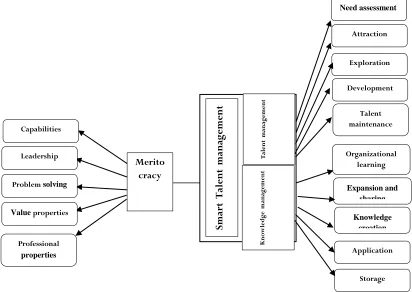
combination of talent management and knowledge management arrives at smart talent management (Figure 1).
Figure 1. smart talent management (Rezaee, 2012; quoted in Moradi and Aeeni, 2013: 11)
Competency and Competency-Based Management: In recent decades, organizations have been making extensive efforts to design and implement valid tools, practices, and techniques to diagnose and provide job satisfaction. One of the most effective concepts recently introduced into the literature on public administration and human resource management from the field of private organizations is competency-based human resource management and planning. Competency-based management is a collaborative process that places individuals in an appropriate organizational setting in accordance with their capabilities, abilities and skills, and extends professional qualifications. In this approach, each system consists of a number of subsystems, while it is itself within a larger system, and to determine the core, the level of analysis must be determined. Accordingly, competency-based management has four levels of analysis: individual, group, organization, and external environment (other organizations and society). According to the four levels of analysis, the competency system believes that the competency model in an organization can be formulated based on a top-down strategy or a bottom-up strategy. In recent decades, another method called "multilevel theory" has been raised in organization's research process. In a multilevel theory, the integrity of micro and macro levels of analysis is discussed. Based on this approach, since individuals and groups influence the organization, and the organization, in turn, affects individuals and groups, managers and employees should try to understand different levels of organization at the same time. On this basis, in order to outline a competency-based management order based on multilevel theory, not only competence issues are considered at the individual level, but also interaction of organizational dimensions with the competency system and the features of the environment, units and groups that are components of the organization should be considered (Dehghan, 2009).
Shah Amiri and Gandomkar(2015) carried out a descriptive-analytic research entitled "investigating the role of talent management on succession and meritocracy among secondary school headmasters in Shiraz “that was conducted on 190 headmasters in Shiraz city. The results suggest a significant role of talent management over the other two components. Javaherizadeh et al. (2014), also in a qualitative research based on theme analysis entitled "organizational talent management: identifying features and characteristics of key
employees, “identified a comprehensive set of general and specialized features and components of key employees through interviews with 16 experts and directors of the University of Tehran.
Bordbar et al. (2012), in a study entitled "identifying components and patterns of meritocracy", identified and optimized the competency model. After studying theoretical foundations and backgrounds, competency models were identified and ranked using Friedman test. This research was an applied research and analytical survey and the required information had been collected through existing literature, questionnaires, structured interviews and numerous meetings with experts. The results and findings of this test showed that education, organizational commitment, and positive attitude were in the highest rankings. Simister (2011) carried out a research entitled "elitism and meritocracy at the University of the United Kingdom require investment on work force". The British universities have been expanding their doors to poor and rich students since they have become comprehensive. This will allow for equal educational opportunities for all sectors. Poor sector students are forced to work at the time of study, which reduces the study time and reduces the quality of education. . The UK government has to increase the University's budget to address this problem. This investment can provide long-term economic benefits for Britain. In a research entitled "development and evaluation of partial talent management competency model", Oehly (2007) reported that the talent management process involves four stages of attracting, evaluating and exploring, developing and retaining talent and includes the dimensions of recruitment, selection, application, performance appraisal, evaluation centers, development and training, career advancement, service compensation, and discipline. Based on the main goal of this research, which is to measure the relationship between smart talent management and meritocracy, the conceptual model is presented as Figure 2 through study of past research and after obtaining the views of the experts.
Figure 2. conceptual model of the study
First question: What are the dimensions of smart talent management in branches of Islamic Azad University of KhorasanRazavi province?
Kn owle d ge m an ag em en t T alen t m an ag em en t Sma rt Tale nt mana geme nt Merito cracy Capabilities Leadership
Problem solving
Value properties
Professional properties Need assessment Attraction Exploration Development Talent maintenance Knowledge creation Storage Application Expansion and sharing Organizational learning
Second question: Is there a significant relationship between smart talent management and the meritocracy in branches of Islamic Azad University of KhorasanRazavi province?
Third question: What is the smart talent management model and its relationship with successor in branches of Islamic Azad University of KhorasanRazavi province?
3. Methodology
The present study is applied in terms of its objectives and is descriptive with survey approach and based on the structural equation of variance-oriented in terms of methodology. The statistical population of the present study includes the associate professor faculty members and higher rankings and staffs having MA and higher degrees, i.e. a total of 1,200 people. Sampling method is stratified random sampling through which 291 people are selected as the statistical sample. The data collection tool is a researcher-made questionnaire, validity of which is calculated using Varimax turnaround factor analysis and KMO index after confirmation by experts. The reliability of the questionnaire was determined by calculating the Cronbach's alpha coefficient (.882). The questionnaire of smart talent management has a question in two dimensions (knowledge management and talent management) and 10 components (strategy, talent attraction, evaluation and discovery of talent, talent development, talent maintenance, organizational learning, expansion and sharing, creation of knowledge, knowledge storage, knowledge application). The questionnaire of meritocracy has questions on five dimensions (knowledge capabilities, leadership capabilities, strategic thinking, value properties, and professional properties) and 14 components (interpersonal search, exchanges, developmental navigation, managerial tasks, managerial roles, technical skills, system thinking, visionary, opportunism, belief values, individual values, professional values, contingency skills, professional competencies) designed and arranged ona 5-point Likert scale (very low, low, moderate, much, very much), which are assigned 1 to 5 points, respectively(tables 3 and 4). Then,data normality is investigated using Kolmogorov-Smirnov test and the structural equation modeling (exploratory-confirmatory factor analysis) is carried out using the Lisrel software and the relationship between variables is analyzed using Pearson's correlation coefficient.
4. Findings
Demographic findings: The findings of the descriptive analysis of the data according to the demographic characteristics of the participants in terms of gender, age, educational level, scientific degree and scientific rank showed that 161 of respondents (55.3%)were men and had the highest frequency and 130 people (44.7%)were female respondents with the lowest frequency and a mean of 1.44 and standard deviation of .498. Also, 119 of respondents (40.9%)aged 30 to 40 years with the highest frequency and mean of 2.49 and standard deviation of .867. In addition, 50 of respondents (71.2%)had master's degree with the lowest frequency and 241 of respondents (82.8%)had a PhD degree with the highest frequency and mean of 1.83 and standard deviation of .377. Also, 123 respondents (42.3%)were in the humanities group with the highest frequency, 2 respondents (.7%)were in the arts group with the lowest frequency and mean of 2.77 and the deviations of 1.476. Finally, 160 respondents (55%)were associate professors with the highest frequency and 131 respondents (45.0%)were assistant professors with the lowest frequency and mean of 1.79 and standard deviation of 1.002.
Kolmogorov-Smirnov test (KS) was used to test the normality of distribution of the population. The result of the Kolmogorov-Smirnov test (K.S) is presented in Table (1), showing the number of data, the parameters to be considered for the distribution (such as mean and standard deviation in the normal distribution), the z-value and sig z-value. Since the calculated sig is greater than 5%, H0 is approved and not rejected. Therefore, the claim that the distributions are normal is accepted.
Table 1. K.S test results Smart talent management
Number 291
Z-Value 2.150
Sig. value(2-tailed) .331
First question: What are the dimensions of smart talent management in branches of Islamic Azad University of KhorasanRazavi province? In order to investigate the dimensions of smart talent management in units of Islamic Azad University of KhorasanRazavi and answer the first question, exploratory factor analysis has been used. Initially, for performing factor analysis, Kaiser Meyer Olkin (KMO) and Bartlett’s tests are required to ensure sampling adequacy and that the correlation matrix is not zero in the population, which are given in Table (2).
Table 2. KMO and Bartlett’s test
Accuracy .396
With approximation 1.330
Df 78
Sig. .000
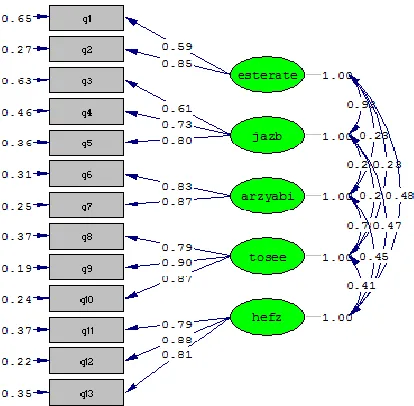
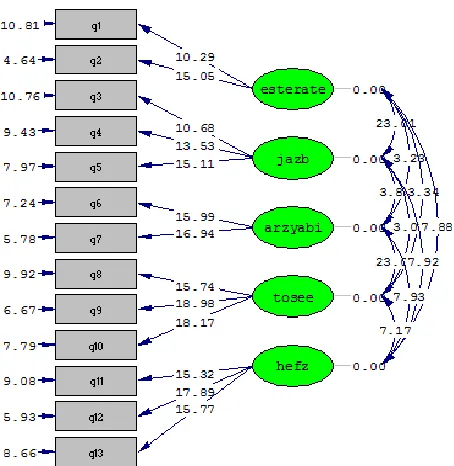
As shown in Table (2), since the significance level in the KMO test is less than .5, test is significant and factor analysis can be done. Also, the sampling adequacy (KMO) is .396 that shows the amount of variance in the data and is explained by the factors and is acceptable. Given the nature of the questions and research literature, factors were identified and named. According to the results of exploratory factor analysis, the obtained factors are strategy, talent attraction, and talent assessment and discovery system considered as talent management items; also, to provide a model as the main factors of talent management with respect to factors and components identified from construct validity of factors and components based on the findings of the qualitative section and the exploratory analysis, confirmatory factor analysis is used. Using the LISREL software, 13 items of the questionnaire were entered into the analysis divided as the main and sub factors. The results of the confirmatory factor analysis in Figure (3)show direct standard coefficients, the relationships between the components in the talent management variable, and Figure (4) shows the measurement model in the state of the coefficients of significance (T statistics).
Figure 3: direct standard coefficients of relationships between dimensions of talent management
Figure 4. T-value coefficients of the relationship between dimensions of talent management
In Figure 3, the results of the standard coefficients of talent management components indicate that among the 13 dimensions of talent management, Q9 with a standard coefficient of .90 and Q12 with a standard coefficient of .88 have the greatest impact on talent management components in Islamic Azad University units of KhorasanRazavi, respectively. Figure (4) shows the significance of talent management coefficients and dimensions. All obtained coefficients are meaningful at the error level of 5%. In addition,13 items in the talent management components explain the role of these items in talent management in Islamic Azad University units of KhorasanRazavi province.
Table 3. KMO and Bartlett’s test
Accuracy .434
With approximation 550.880
Df 78
Sig. .000
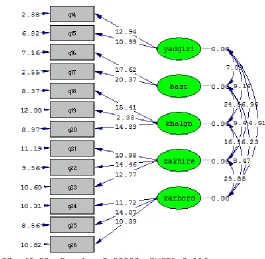
As shown in Table (3), since the significance level in the KMO test is less than .5, test is significant and factor analysis can be done. Also, the sampling adequacy (KMO) is .434, which is acceptable. Given the nature of the questions and research literature, factors were identified and named. According to the results of exploratory factor analysis, the obtained factors are organizational learning, expansion and sharing, and knowledge creation considered as knowledge management items; also, to provide a model as the main factors of knowledge management with respect to factors and components identified, confirmatory factor analysis is used. Using the LISREL software, 13 items of the questionnaire were entered into the analysis divided as the main and sub factors. The results of the confirmatory factor analysis in Figure (5)show direct standard coefficients, the relationships between the components in the knowledge management variable, and Figure (6) shows the measurement model in the state of the coefficients of significance (T statistics).
Figure 5. direct standard coefficients of relationships between dimensions of knowledge management
Figure 6. T-value coefficients of the relationship between dimensions of knowledge management
In Figure 5, the results of the standard coefficients of knowledge management components indicate that among the 13 dimensions of knowledge management, Q17 with a standard coefficient of .95 and Q14 with a standard coefficient of .88 have the greatest impact on knowledge management components in Islamic Azad University units of KhorasanRazavi, respectively. Figure (6) shows the significance of talent management coefficients and dimensions. All obtained coefficients are meaningful at the error level of 5%. In addition,13 items in the knowledge management components explain the role of these items in knowledge management in Islamic Azad University units of KhorasanRazavi province.
Second question: Is there a significant relationship between smart talent management and the meritocracy in branches of Islamic Azad University of KhorasanRazavi province?
Table 4. Pearson correlation coefficient of smart talent management and meritocracy
Variables Meritocracy
Smart talent management Indices Sig = .000 r = .299 n = 291
Findings of Table (4) show that there is a significant relationship between smart talent management and meritocracy in Islamic Azad University units of KhorasanRazavi, because the observed significance level (sig = .000) is smaller than predicted error value (.05). Therefore, with 95% confidence, it can be judged that hypothesis H0 is rejected and H1 is confirmed. The test statistic has evaluated intensity (correlation coefficient) of this relation, which is.299.
Third question: What is the smart talent management model and its relationship with successor in branches of Islamic Azad University of KhorasanRazavi province?
Initially, for performing factor analysis, Kaiser Meyer Olkin (KMO) and Bartlett tests are required to ensure sampling adequacy and that the correlation matrix is not zero in the population, which are given in Table (5).
Table 5. KMO and Bartlett’s test
Accuracy .580
With approximation 1.599
Df 3486
Sig. .000
As shown in Table (5), since the significance level in the KMO test is less than .5, test is significant and factor analysis can be done. Also, the sampling adequacy (KMO) is .580 that shows the amount of variance in the data and is explained by the factors and is acceptable. To provide a good model for smart talent management and its relationship with meritocracy in Islamic Azad University units of KhorasanRazavi, confirmatory factor analysis is performed using the LISREL software. The results of the confirmatory factor analysis in Figure (7) shows t-values of the measurement relationships between smart talent management and meritocracy in Islamic Azad University units of KhorasanRazavi province.
Figure 7. T-value coefficients of the relationship between smart talent management and meritocracy in Islamic Azad University units of KhorasanRazavi province
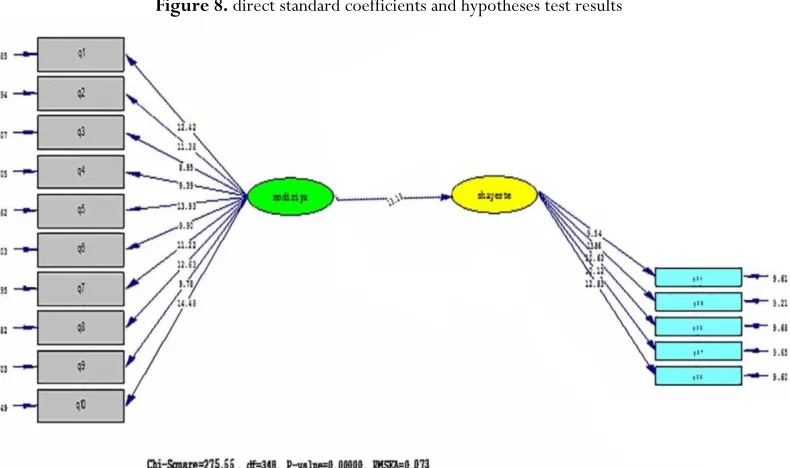
In the next part, the amount of the path of smart talent management and its role in establishing successor and meritocracy in Islamic Azad University units of KhorasanRazavi are related to the obvious (tangible) and latent (intangible) variables, as well as the standard coefficients and the t-value of the measured equation. In Fig. 8, the results of the standard coefficients indicate that from the three main components of the research, the application component with the standard coefficient of (.87) and the component of talent maintenance with the standard coefficient of (.86) have the most effect on Islamic Azad University units of KhorasanRazavi. Also, in Figure 10, all obtained coefficients are significant at an error level of 5%, as significant test of each of them is not in the range of (1.96, -1.96). Therefore, it can be said that 24 components in the research model explain the role of these items in the Islamic Azad University units of KhorasanRazavi.
Figure 8. direct standard coefficients and hypotheses test results
Figure 9. t-value coefficients and hypotheses test results under t-value coefficients
Table 6. variablesand direct coefficients of the communication path of each of them in the final model Variable Communication path coefficient Standard Sig. (t-value) Result Ranking
Meritocracy management Smart talent 1.06 13.18 Confirmed 2
As can be seen in table (6), direct relationship between meritocracy (1.06) and smart talent management is confirmed
5. Discussion
One of the basic ideas in organizational science is that the organization must be able to use its existing capabilities and at the same time acquire new capabilities, in addition to performing its past tasks accurately. The rapid technological changes, the compression of the life cycle of products and services, as well as the peak of competition have forced organizations to focus on long-term and short-term efficiency as well as competitive advantage. Increasing demand for higher education, on the one hand, and relative budget cuts forits financing, as well as the move towards the commercialization of higher education in the world scale have required the development of higher education quality, which has become a major challenge in universities around the world and has made changes in the strategies, goals, and methods of the educational system. At the present time, knowledge, as a source of competitive advantage, is of strategic importance in knowledge-based service businesses, and what those organizations do better than markets is the creation and transfer of knowledge within the organization. Creating a balance between education, research and the creation of innovative opportunities and the dynamic demands of end customers is one of the challenges facing many of the world's major universities today. In order to achieve this capability, there is a need to an educational system that, with its knowledge and skills, provides the core of creativity governance and is the axis of economic development of society. In response to the first research question and regarding the study of the dimensions of smart talent management in the units of Islamic Azad University of KhorasanRazavi using exploratory factor analysis and taking into account factor loadings and reviewing the related items, strategy, talent attraction, and talent evaluation and discovery system are talent management factors and knowledge management indicators include organizational learning, extension and sharing, and knowledge creation, respectively. The standard coefficients of talent management and knowledge management components showed that among the 13 dimensions of talent management, talent development with a standard coefficient of (.90) and maintaining talent with the standard coefficient of (.88), had the greatest effect and among the 13 dimensions of knowledge management, extension and sharing with a standard coefficient of (.95) and organizational learning with the standard coefficient of (.88) were the most effective. Comparison of the findings with the results of other researchers show that the present research is consistent with the findings of Moradi and Aeeni (2013), Rezaee (2012), Vaiman and Vans (2008) in terms of the concepts and indicators of smart talent management, and the complementary role of knowledge management and talent management. In response to the second question and the relationship between smart talent management and meritocracy in Islamic Azad University units of KhorasanRazavi province, findings suggested that there is a significant relationship between smart talent management and meritocracy in Islamic Azad University units of KhorasanRazavi province. Comparison of research findings shows that this study is in line with the findings of Shah Amiri and Gandomkar (2015), Karzar Jedivand (2014), Javaherizade et al. (2014), Bordbar et al. (2012), Simmster (2011), Little (2010), and Oehly (2007) in terms of the relationship between talent management and meritocracy. In response to the third research question, presentation of smart talent management model and its relationship with meritocracy in Islamic Azad University units of KhorasanRazavi province, the results show that from the three main components of the research, the components of application and the component of retaining talent have the greatest effect on Islamic Azad University units of KhorasanRazavi province, respectively. Finally, the 24 components in the research model explain the role of these items in Islamic Azad University units of KhorasanRazavi province.
According to research findings and identification of smart talent management dimensions including strategy, talent attraction, and talent evaluation and discovery system, managers of Islamic Azad University units of KhorasanRazavi province are suggested to consider a proper context for practical and executive planning on implementation of smart talent management in the field of human resource management of the organization.
References
Bordbar Gh, Karimi O, Zare N, Konjkav Monfared A R. (2012). Identification of Components and Patterns of meritocracy for Optimization of Employee Substitution Model.Bi-quarterly Journal of Human Resource Management Researches, Imam Hossein University, Year 4, No. 1, pp. 87-114.
Javaherizadeh E, Moghimi M, Gholipour A, Tahmasebi R. (2014). Organizational talent management: identifying features and characteristics of key employees. Journal of Management of Organizational Culture, Volume 12, Number 2, pp. 149-171. Khalvandi F. andAbbaspour, A. (2013). Design of Talent Management Process Optimization Model. Public Management Research,
Sixth Year, No. Nineteenth, pp.103-128.
DehghanNajm, M. (2009). Knowledge Management and Its Role in Organizational Innovation. Monthly Journal of Industrial Engineering, No. 10, First Year, pp. 47-52.
Rezaee, A. (2012). Smart Talent Management. The First National Conference on Modern Management Sciences, Islamic Azad University, Golestan Province, Gorgan, Iran.
Shah Amiri, T. and Gandomkar, D. (2015). Investigating the role of talent management on succession and meritocracy. The First International Conference on Educational Management in Iran, Tehran.
Talebzadeh, F. (2015). Managing succession. Tehran, Jungle publications.
Tahmasebi, R., Gholipour, A., and Javaherizadeh, E. (2012). Talent Management: Identifying and Ranking the Factors Affecting the Attraction and Preservation of Talents. Public Management Research, Vol. 5, No. 17, pp. 5-26.
GhiasiNodoshan, S. (2016).Succession of Managers: Approaches, Patterns, Theories. Tehran, Allameh Tabataba’i University, First Printing.
Gorgani, R., Baghersalimi, S., RezaeBarri, H. (2013).An Introduction to Meritocracy in Organization. Tehran: Azarakhsh publications.
KarzarJedivand, R. (2014). Identifying the Effective Factors on Managers’ Succession. International Accounting and Management Conference, Tehran, University of Tehran Conferences Center, p. 1.
Moradi, V. andAeeni, M.A. (2013).Smart talent management: a new approach to empowering employees. Second National Conference on Accounting, Financial Management and Investment,Golestan Province, Gorgan, March 1, 2013, p. 13. Yazdani, M., Tanaomi, M.M., and Bahramikia, Gh. (2012). Development of leadership competencies required for succession.
Quarterly Journal of Human Resource Management, Vol. 4, No. 13, autumn.
Alaarj،Saad،ZainalAbidin-Mohamed, UmmiSalwaBinti Ahmad Bustamam(2016).Mediating Role of Trust on the Effects of Knowledge Management Capabilities Organizational Performance Procedia - Social and Behavioral Sciences, Volume 235, 24 November 2016, Pages 729-73
Collings, D.G., &Mellahi, K. (2009). Strategic talent management: A review and research agenda. Human Resource Management Review, 19, 304 – 313.
Collings, D. G., Scullion, H., &Vaiman, V. (2015) Talent management: Progress and prospects. Human Resource Management Review;25(3): 233-258.
Krumina, Ieva،GatisKrumins, SarmiteRozentale،Vidzeme Region of Latvia: Knowledge Management in Micro Enterprise sProcedia - Social and Behavioral Sciences, Volume 213, 1 December 2015, Pages 781-786 .
Little B. (2010). Best practice talent management. Training Journal, 53(3): 45-49.
NEDEVA, M., THOMAS, D., Caswill, C. and Nielsen, K. (2013). Study of Research Funding Trends and Practices of Research Funding Organizations, Report to the Swiss Science and Technology Council, 29 November.
Oehley, Anne-Marguerite. (2007). The development and evaluation of a partial talent management competency model, Thesis (MA (Industrial Psychology), University of Stellenbosch.
Simister،john (2011(. Elitism and Meritocracy in UK Universities: the UK Needs Investment in its Labour Force First published: 20 January 2011،Full publication.
Vaiman, Vlad and Vance, Charles (2008)." Smart Talent Management: Building Knowledge Assets for Competitive Advantage", Edward Elgar Publishing, 1st addition, pp.15-35.