Journal Homepage: vrf.iranjournals.ir
Effect of olive leaf powder on the performance and ileal bacterial count
of broilers
Zahra Amini1, Siamak Parsaei2*, Mohammad Houshmand2, Reza Naghiha2
1 Graduated from Department of Animal Science, Faculty of Agriculture, Yasouj University, Yasouj, Iran; 2 Department of Animal Science, Faculty of
Agriculture, Yasuj University, Yasuj, Iran.
Article Info Abstract
Article history:
Received: 26 December 2017 Accepted: 24 October 2018
Available online: 15 September 2019
This experiment was conducted to investigate the effects of olive leaf (OL) on the performance, abdominal fat pad and some ileal bacterial population of Cobb broiler chickens. A total number of 400 day-old chicks were randomly distributed into floor pens and reared under the same condition until 14 days of age. On day 14, each pen was randomly assigned to one of the five experimental treatments with four replicates of 20 male and female chicks. The dietary treatments were consisted of a control group which fed basal diet without OL entire period of the study and groups 2 to 5 that fed diets supplemented with 0.25, 0.50, 0.75 and 1.00% OL powder, respectively. On days 21 and 42 of the experiment, ileal digesta samples were collected under the sterile condition to evaluate ileal bacterial population. The results indicated that birds fed diets containing various levels of OL, had higher body weight gain (except for 1.00% OL) and lower feed conversion ratio compared to that of the control group. Dietary inclusion of OL resulted in a higher count of Lactobacillus sp. compared to the control group on 42 days of age, while Escherichia coli count significantly was not influenced. The abdominal fat pad was lower in birds fed OL supplemented diets. In conclusion, findings of the current experiment showed that the OL had positive effects on feed conversion ratio, abdominal fat pad deposition and ileal bacterial count of broiler chickens.
© 2019 Urmia University. All rights reserved. Key words:
Abdominal fat Additive Broiler
Growth promoter Olive leaf
Introduction
Prohibition of antibiotic growth promoters in animal and poultry nutrition has stimulated the application of bioactive secondary metabolites as alternative growth enhancers in poultry nutrition. There are many non-therapeutic alternatives such as enzymes, inorganic acids, probiotics, prebiotics, herbs, immune stimulants, and other management practices.1
Olive leaf(OL) from Olea europaea has been known for its medicinal properties since ancient times. Leaves and fruits are usable parts of olive tree. The OL contains various compounds such as secoiridoid polyphenols (oleuropein and its derivatives), hydroxytyrosol, poly-phenols (verbascoside, apigenin-7-glucoside, and luteolin-7-glucoside), triterpenes including oleanolic acid, and flavonoids (rutin and diosmin).2 Therapeutic properties of
OL extracts could be attributed to oleuropein.2 The high
concentration of oleuropein is found in fruit and leaves, although, it could also be available in oil. Different properties have been reported for OL, including hypoglycemic, hypotensive, anti-arrhythmic, anti-atherosclerotic and vasodilatory effects.2
Gut microflora plays a vital role in poultry health and performance. Antioxidant and antibiotic activities of herb extracts are associated with secondary metabolites such as phenolic compounds.1 Antibiotic activity of phenolic
components present in OL against viruses, bacteria, yeasts, molds, fungi, retroviruses, and other parasites have been reported.3 Supplementation with plant extracts rich in
polyphenolic compounds has different effects on gut microorganisms.4 There is only limited data on the
influence of OL on broiler chickens, therefore, this experiment was conducted to determine the effects of OL as a growth promoter on the performance, abdominal fat pad, and gut flora in the broiler chickens.
*Correspondence: Siamak Parsaei. PhD
Department of Animal Science, Faculty of Agriculture, Yasuj University, Yasuj, Iran E-mail: [email protected]
Forum
Materials and Methods
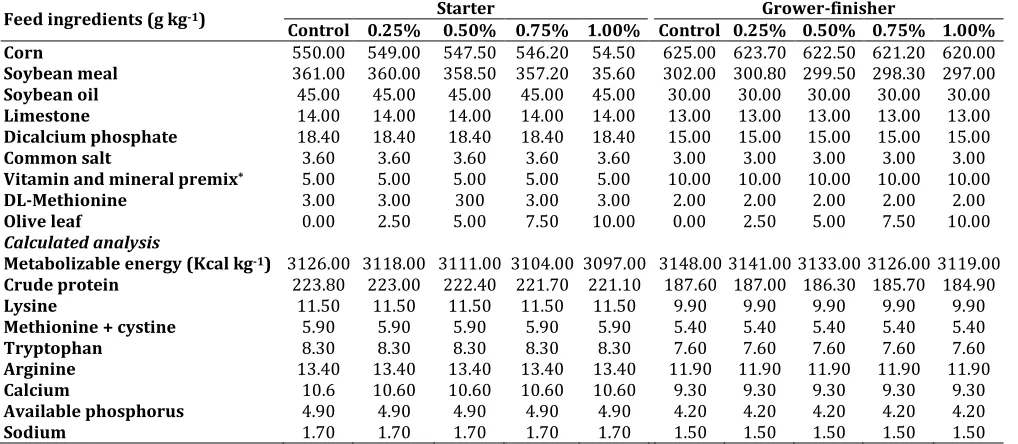
Olive leaves were collected in October from a garden around Kazeroon, Fars Province, Iran. They were dried in shadow, ground finely and included in diets from 14 to 42 days of age. Feed consumption of each pen was determined weekly. All procedures used in the current experiment were approved by the Institution of Animal Care Committee of the University of Yasouj (5419-11.10.2012). Four hundred day-old male and female broiler chicks (Cobb 500) obtained from a local commercial hatchery. Birds were weighed in the group, randomly distributed into 20 pens and fed a basal diet until 14 days of age. On day 14, pens were randomly assigned to one of the five experimental treatments. There were no significant differences in body weights of different groups on day 14. Each treatment had four replicates of 20 chicks each. Experimental treatments included one diet without OL as the control and diets 2 to 5, which were supplemented with 0.25, 0.50, 0.75 and 1.00% OL, respectively. The mash starter and finisher diets were offered form 1-21 and 22-42 days of age, respectively. The composition of the experimental diets is shown in Table 1. Birds had free access to feed and water throughout the experiment. Birds in each pen were weighed weekly as a group. Dead birds were recorded daily and feed conversion ratio (FCR) adjusted for mortality. The mortality rate was normal (around 4.00% for all treatments) and was not influenced statistically by experimental treatments. On days 21 and 42, two birds from each replicate (eight birds per
treatment) were randomly selected and slaughtered by decapitation and digestive system removed immediately and the weight of the abdominal fat pad was measured.
For microbial counts, ileal digesta samples were collected under a sterile condition and put in sterile plastic tubes and immediately transferred to the refrigerator (4 ˚C). For counting Lactobacillus sp. and Escherichia coli
populations, digesta samples were diluted and poured on the Man Rogosa Sharpe (MRS; Quelab, London, UK) and eosin methylene blue agar (EMB; Quelab), incubated at 37 ˚C for 24 hr in the anaerobic and aerobic conditions, respectively, and the number of bacteria was determined using an electronic colony counter (Sana SL-902; Hoor Teb, Tehran, Iran). The results were expressed as log10
colony-forming units(CFU) per gram of ileal content. All data were analyzed using the ANOVA procedure of SAS (version 9.1; SAS Institute, Cary, USA). Means were compared by Duncan’s multiple range test at 5.00% probability. The statistical model was as follows:
Yij=µ + Ti + εij
where, Yij is the observed size of the test, μ is the population mean, Ti is the treatment effect, and εij is the error of the experiment.
Results
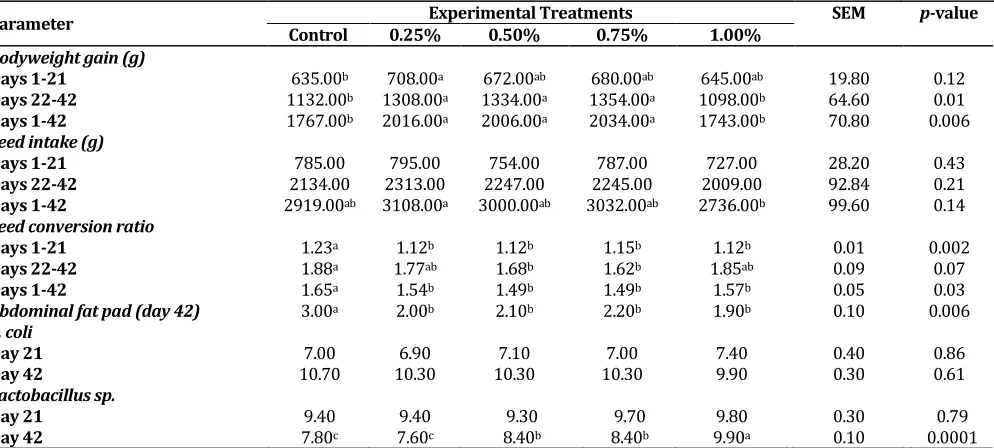
The effect of experimental treatments on broiler performance is shown in Table 2. In the starter period, birds fed the diet containing 0.25% OL had a higher body weight gain (BWG) than the control group (p < 0.05). Table 1. Composition of the experimental diets (g kg-1 diet).
Feed ingredients (g kg-1) Starter Grower-finisher
Control 0.25% 0.50% 0.75% 1.00% Control 0.25% 0.50% 0.75% 1.00% Corn 550.00 549.00 547.50 546.20 54.50 625.00 623.70 622.50 621.20 620.00
Soybean meal 361.00 360.00 358.50 357.20 35.60 302.00 300.80 299.50 298.30 297.00
Soybean oil 45.00 45.00 45.00 45.00 45.00 30.00 30.00 30.00 30.00 30.00
Limestone 14.00 14.00 14.00 14.00 14.00 13.00 13.00 13.00 13.00 13.00
Dicalcium phosphate 18.40 18.40 18.40 18.40 18.40 15.00 15.00 15.00 15.00 15.00
Common salt 3.60 3.60 3.60 3.60 3.60 3.00 3.00 3.00 3.00 3.00
Vitamin and mineral premix* 5.00 5.00 5.00 5.00 5.00 10.00 10.00 10.00 10.00 10.00
DL-Methionine 3.00 3.00 300 3.00 3.00 2.00 2.00 2.00 2.00 2.00
Olive leaf 0.00 2.50 5.00 7.50 10.00 0.00 2.50 5.00 7.50 10.00
Calculated analysis
Metabolizable energy (Kcal kg-1) 3126.00 3118.00 3111.00 3104.00 3097.00 3148.00 3141.00 3133.00 3126.00 3119.00
Crude protein 223.80 223.00 222.40 221.70 221.10 187.60 187.00 186.30 185.70 184.90
Lysine 11.50 11.50 11.50 11.50 11.50 9.90 9.90 9.90 9.90 9.90
Methionine + cystine 5.90 5.90 5.90 5.90 5.90 5.40 5.40 5.40 5.40 5.40
Tryptophan 8.30 8.30 8.30 8.30 8.30 7.60 7.60 7.60 7.60 7.60
Arginine 13.40 13.40 13.40 13.40 13.40 11.90 11.90 11.90 11.90 11.90
Calcium 10.6 10.60 10.60 10.60 10.60 9.30 9.30 9.30 9.30 9.30
Available phosphorus 4.90 4.90 4.90 4.90 4.90 4.20 4.20 4.20 4.20 4.20
Sodium 1.70 1.70 1.70 1.70 1.70 1.50 1.50 1.50 1.50 1.50
Dietary inclusion of 0.25, 0.50 and 0.75% OL resulted in significant increases in BWG during finisher period (days 22-42) and whole experimental period (days 1-42). There were no significant differences in BWG between the control and 1.00% OL groups throughout the study period. Dietary treatments did not have a significant effect on feed intake (FI) during 1 to 21 and 22 to 42 days of age. However, birds fed diet supplemented with 1.00% OL had lesser feed intake compared to those fed 0.25% OL. From 1 to 21 days of age, supplementation with all levels of OL significantly improved FCR compared to the control group. Also, FCR was better for 0.50 and 0.75% groups compared to the control group during the finisher period. Similar to the starter phase, birds fed diets containing different levels of OL, had better FCR than the control group. In our study, the addition of OL powder to the diets significantly improved BWG (except for 1.00% OL) and FCR compared to the control group.
The effects of experimental treatments on ileal bacterial population are shown in Table 2. Dietary treatments did not have a significant effect on E. coli count at 21 and 42 days of age. Supplementation with OL did not have a significant effect on the Lactobacilli population at 21 day of age. However, on day 42, birds fed diets added with 0.50, 0.75 or 1.00% OL, had a higher number of
Lactobacilli than the control group.
Discussion
There are inconsistent results in the literature on the growth-promoting effects of olive products in broiler chickens. Replacement of 15.00 and 30.00 g kg-1 wheat
bran with OL in starter and finisher diets did not have a significant effect on performance and carcass characteristics of broilers, however, replacement at the level of 50.00 g kg-1, reduced live body weight and carcass weight of
broiler chickens.5 Dietary inclusion of OL powder at the
levels of 0.00, 5.00, 10.00 and 15.00 g kg-1 of diet did not
affect growth parameters.6 In contrast to those reports,
beneficial effects of OL extract on the broilers performance have been shown in some studies. Findings of a recent study have shown that dietary inclusion of 15.00 mL of OL extract had beneficial effects on the performance of broilers reared under a hot humid tropical climate.7 In
another study, broilers fed diets supplemented with 100 and 200 mg kg-1 OL extract had higher body weight gain
and better feed conversion ratio than the control group.8
It has been reported that antioxidant properties of active compounds in OL by reducing protein oxidation can improve nitrogen retention and, therefore, bird growth.9
As mentioned earlier, OL contains isoflavonoids which can decrease lipid peroxidation, thereby, improving anti-oxidant status and growth performance in male broilers.5
The OL is rich in oleuropein (60.00 – 90.00 mg g-1 dry
OL),3 a compound which can increase the activity of the
pancreas and small intestine digestive enzymes, growth of potentially beneficial gut bacteria as well as nutrients digestion and absorption.8 One of such beneficial effects
was observed in the current experiment. Dietary supplementation with different levels of OL (except for 0.25%) resulted in significant increases in the population of beneficial bacteria. Therefore, this effect could be considered as one of the possible reasons for the improved performance of birds in the supplemental groups.
Table 2. Effects of experimental treatments on performance, abdominal fat pad (% of live weight), Escherichia coli and Lactobacillus sp. counts (Log CFU g-1).
Parameter Control 0.25% Experimental Treatments 0.50% 0.75% 1.00% SEM p-value
Bodyweight gain (g)
Days 1-21 635.00b 708.00a 672.00ab 680.00ab 645.00ab 19.80 0.12
Days 22-42 1132.00b 1308.00a 1334.00a 1354.00a 1098.00b 64.60 0.01
Days 1-42 1767.00b 2016.00a 2006.00a 2034.00a 1743.00b 70.80 0.006
Feed intake (g)
Days 1-21 785.00 795.00 754.00 787.00 727.00 28.20 0.43
Days 22-42 2134.00 2313.00 2247.00 2245.00 2009.00 92.84 0.21
Days 1-42 2919.00ab 3108.00a 3000.00ab 3032.00ab 2736.00b 99.60 0.14
Feed conversion ratio
Days 1-21 1.23a 1.12b 1.12b 1.15b 1.12b 0.01 0.002
Days 22-42 1.88a 1.77ab 1.68b 1.62b 1.85ab 0.09 0.07
Days 1-42 1.65a 1.54b 1.49b 1.49b 1.57b 0.05 0.03
Abdominal fat pad (day 42) 3.00a 2.00b 2.10b 2.20b 1.90b 0.10 0.006
E. coli
Day 21 7.00 6.90 7.10 7.00 7.40 0.40 0.86
Day 42 10.70 10.30 10.30 10.30 9.90 0.30 0.61
Lactobacillus sp.
Day 21 9.40 9.40 9.30 9.70 9.80 0.30 0.79
Day 42 7.80c 7.60c 8.40b 8.40b 9.90a 0.10 0.0001
Antibacterial activity of oleuropein against wide broad of bacteria (by cell wall degeneration) has been reported.10
Antibacterial activity of OL could be related to the inactivation of necessary enzymes for bacterial replication or by a direct attack on the cell membrane.11 Due to the
high levels of phenols, OL extract probably has prebiotic activity.12 Since it can act as a prebiotic, it stimulates the
growth of probiotic bacteria.10
Plant extracts have been reported to reduce ileal pH value and increase the number of lactic acid bacteria in the ileum and caecal contents of broiler chickens.13
Stimulation of beneficial bacteria such as Lactobacilli
and Bifido-bacteria could be contributed to a balanced
gut microflora and may provide an optimal condition for adequate protection against pathogenic microorganisms and intact immune system.14 It was suggested that
terpenoids and phenylpropanoids can penetrate into the membrane of the bacteria and the inner part of the cell because of their lipophilicity property.14 It has also been
proposed that structural properties such as the presence of the functional groups15 and aromaticity1 are
responsible for the antibacterial activity. Active components in plant extract penetrate into the cell wall of pathogenic bacteria and then alter H+ and K+ ions
transferring and interference with enzymatic reactions related to ATP production, and as a result, cell death will happen.16
Addition of OL, regardless of its level, significantly decreased abdominal fat pad compared to the control group. These findings were in agreement with the results reported in a previous work.5 They reported
that volatile plant oil decreased the abdominal fat content. Plant antioxidant components can increase lipase and bile acids secretions and due to these changes, the abdominal fat deposition will decrease.5
Dietary flavonoids inhibit phosphodiesterase activity, thereby decrease tissues fat production.17
Furthermore, it has been shown that flavonoids reduce the availability of lipid substrates and consequently reduce VLDL production in the liver.18
Hypolipidemic effects of olive derivates have been reported. Oleuropein in OL has inhibitory activity on the activity and/or expression of some enzymes such as hydroxymethylglutaryl-CoA synthase and hydroxyl-methylglutaryl-CoA reductase which play an important role in lipid synthesis in the liver.8 Taking together, it is
not surprising that the abdominal fat pad was reduced in OL-supplemental groups.
In the current experiment, dietary OL addition of resulted in the less abdominal fat pad, beneficial effect on the population of ileal bacteria and better performance. These findings probably indicated that nutrients utilization might be improved by supplementation with OL. Thus, it seems that OL could be included in broilers diets as a new growth promoter.
Acknowledgements
The authors gratefully acknowledge the Yasouj University for providing the research funds.
Conflict of interest
The authors declare that there is no conflicts of interest.
References
1. Anitha L, Sunita Raju K. A review on antimicrobial activity of vegetables, herbs and spices against cariogenic bacteria. Res J Biol 2016; 4: 12-20.
2. Somova LI, Shode FO, Ramnanan P, et al. Antihypertensive, antiatherosclerotic and antioxidant activity of triterpenoids isolated from Olea europaea, subspecies Africana leaves. J. Ethnopharmacol 2003; 84: 299-305.
3. Medina E, de Castro A, Romero C, et al. Comparison of the concentrations of phenolic compounds in olive oils and other plant oils, correlation with antimicrobial activity. J Agric Food Chem 2006; 54(14): 4954-4961. 4. Niewold TA. The nonantibiotic, anti-inflammatory
effect of antimicrobial growth promoters, the real mode of action? A hypothesis. Poult Sci 2007; 86(4): 605-609.
5. Shafey TM, Almufarij SI, Albatshan HA. Effect of feeding olive leaves on the performance, intestinal and carcass characteristics of broiler chickens. Int J Agric Biol 2013; 15(3): 585-589.
6. Varmaghani S, Rahimi S, Karimi-Torshizi MA, et al. Effect of olive leaves on ascites incidence, hemato-logical parameters and growth performance in broilers reared under standard and cold temperature conditions. Anim Feed Sci Technol 2013; 185 (1-2): 60-69.
7. Oke OE, Emeshili UK, Iyasere OS, et al. Physiological responses and performance of broiler chickens offered olive leaf extract under a hot humid tropical climate. J Appl Poultry Res 2017; 26(3): 376-382.
8. Sarica, S, Urkmez, D. The Use of grape seed, olive leaf and pomegranate peel extract as alternative natural antimicrobial feed additive in broilers diets. Europ Poult Sci 2016; 80: 1-13.
9. El–Hakim A, Cherian S, Ali MN. Use of organic acid, herbs and their combination to improve the utilization of commercial low protein broiler diets. Int J Poult Sci 2009; 8(1): 14-20.
10.De Leonardis A, Acetini A, Alfano G, et al. Isolation of a hydroxytyrosol-rich extract from olive leaves (Olea
Europaea L.) and evaluation of its antioxidant
11.Tassou SC, Nychas GJ. Inhibition of Staphylococcus
aureus by olive phenolics in broth and a model food
system. J Food Prot 1991; 57(2): 120-124.
12.Molan AL, Flanagan J, Wei W, et al. Selenium-containing green tea has higher antioxidant and prebiotic activities than regular green tea. Food Chem 2009; 114: 820-835. 13.Vidanarachchi JK, Mikkelsen LL, Sims IM, et al. Selected
plant extracts modulate the gut microflora in broilers. In proceedings: Australian poultry science symposium. Sydney, Australia 2006; 145-148.
14.Helander IM, Alakomi HL, Latva-Kala K, et al. Characterization of the action of selected essential oil components on gram-negative bacteria. J Agric Food Chem 1998; 46(9): 3590-3595.
15.Farag RS, Daw ZY, Hewed FM, et al. Antimicrobial activity of some Egyptian spice essential oils. J Food Protec 1989; 52(9): 665-667.
16.Bolukbasi S, Erhan MK. Effect of dietary thyme
(Thymus vulgaris) on laying hens performance and
Escherichia coli (E. coli) concentration in feces. Int J Nat
Engin Sci 2007; 1(2): 55-58.
17.Chatterjee S, Variyar SP, Sharma R. Bioactive lipid constituents of fenugreek. Food Chem 2010; 119(1): 349-353.