University of New Orleans University of New Orleans
ScholarWorks@UNO
ScholarWorks@UNO
University of New Orleans Theses and
Dissertations Dissertations and Theses
Summer 8-2-2012
Synthesis and Characterization of Sugar Derivatives as Functional
Synthesis and Characterization of Sugar Derivatives as Functional
Gelators
Gelators
Michael J. St Martin
University of New Orleans, [email protected]
Follow this and additional works at: https://scholarworks.uno.edu/td
Part of the Organic Chemistry Commons
Recommended Citation Recommended Citation
St Martin, Michael J., "Synthesis and Characterization of Sugar Derivatives as Functional Gelators" (2012). University of New Orleans Theses and Dissertations. 1524.
https://scholarworks.uno.edu/td/1524
This Dissertation is protected by copyright and/or related rights. It has been brought to you by ScholarWorks@UNO with permission from the rights-holder(s). You are free to use this Dissertation in any way that is permitted by the copyright and related rights legislation that applies to your use. For other uses you need to obtain permission from the rights-holder(s) directly, unless additional rights are indicated by a Creative Commons license in the record and/ or on the work itself.
i
Synthesis and Exploration of Sugar Derivatives as Functional
Gelators
A Dissertation
Submitted to the Graduate Faculty of the University of New Orleans
in partial fulfillment of the requirements for the degree of
Doctor of Philosophy In
Chemistry
By
Michael St. Martin
B.S. University of New Orleans, 2004 M.S. Univeristy of New Orleans, 2010
August 2012
ii
iii
Dedicated to:
iv
Acknowledgements
I would like to express the deepest sense of gratitude to my advisor, Dr. Guijun Wang, for her
constant support and guidance in matters both relevant to the laboratory and as well in life
scenarios external to the work environment. Of the several years I have spent working with
her, I have learned much. I would as well like to thank my committee members: Dr. Mark L
Trudell, Dr. John B. Wiley, and Dr. Steven Rick. My gratitude as well extends to a multitude of
current and past group members, including but certainly not limited to: Dr. Jean-Rene Ella
Menye, Dr. Sherwin Cheuk, Dr. Xiaoping Nie, Dr. Kristopher Williams, Dr. Navneet Goyal, Dr.
Hao Yang, and Hari Reddy. My gratitude as well extends to Steven Fournet for a very important
crystal structure rendering which was used to analyze my research. I am as well very thankful
for all of the funding provided from the National Science Foundation, and as well the University
v
Table of Contents
List of Schemes ...vii
List of Figures ...viii
List of Tables ...x
Abstract...xi
Chapter I: Introduction...1
1 Gelators ...1
1.1 Gel Structure ...5
1.2 Gelator Design Rational ...6
1.3 Gel Characterization ...7
1.4 UV/vis and Fluorescence analysis ...8
1.5 Probing the Mode of Gelator Assembly ...18
1.6 Stimuli Responsive Gelators ...27
1.7 Hydrogels as Drug Delivery Vehicles ...31
1.8 Monosaccharide Based Gelators ...33
References ...35
Chapter 2: A Glucose Based 4,6-O-Protected Diphenyl Ketal System ...42
Abstract ...42
Introduction ...43
vi
Conclusions ...59
Experimental ...60
References ...77
Chapter 3: A 2,5-Dimethoxy-4,6-O-Protected Benzylidene Acetal System ...81
Abstract ...81
Introduction ...82
Results and Discussion ...84
Conclusion ...96
Experimental ...96
References ...110
Chapter 4: Studies of Stimuli Responsiveness and Trigger Release Applications for Advanced Gelator Systems ...116
Abstract ...116
Introduction ...117
Results and Discussion ...122
Conclusions ...134
Experimental ...134
References ...139
vii
List of Schemes
Scheme 1.1 ...23
Scheme 1.2 ...32
Scheme 2.1 ...44
Scheme 2.2 ...47
Scheme 2.3 ...49
Scheme 2.4 ...50
Scheme 2.5 ...55
Scheme 2.6 ...56
Scheme 2.7 ...57
Scheme 3.1 ...85
Scheme 3.2 ...86
Scheme 3.3 ...90
Scheme 3.4 ...90
Scheme 3.5 ...93
Scheme 4.1 ...123
Scheme 4.2 ...128
Scheme 4.3 ...130
viii
List of Figures
Figure 1.1 ...1
Figure 1.2 ...3
Figure 1.3 ...4
Figure 1.4 ...4
Figure 1.5 ...6
Figure 1.6 ...8
Figure 1.7 ...10
Figure 1.8 ...10
Figure 1.9 ...11
Figure 1.10 ...12
Figure 1.11 ...14
Figure 1.12 ...15
Figure 1.13 ...16
Figure 1.14 ...17
Figure 1.15 ...18
Figure 1.16 ...20
Figure 1.17 ...22
Figure 1.18 ...24
Figure 1.19 ...25
Figure 1.20 ...26
Figure 1.21 ...28
ix
Figure 1.23 ...30
Figure 1.24 ...31
Figure 1.25 ...34
Figure 2.1 ...44
Figure 2.2 ...45
Figure 2.3 ...46
Figure 2.4 ...47
Figure 2.5 ...48
Figure 2.6 ...54
Figure 3.1 ...83
Figure 3.2 ...83
Figure 3.3 ...84
Figure 3.4 ...95
Figure 4.1 ...117
Figure 4.2 ...118
Figure 4.3 ...119
Figure 4.4 ...120
Figure 4.5 ...121
Figure 4.6 ...122
Figure 4.7 ...124
Figure 4.8 ...124
Figure 4.9 ...129
x
List of Tables
Table 1.1 ...11
Table 1.2 ...19
Table 1.3 ...21
Table 1.4 ...25
Table 1.5 ...26
Table 1.6 ...28
Table 2.1 ...50
Table 2.2 ...51
Table 2.3 ...53
Table 2.4 ...57
Table 2.5 ...59
Table 3.1 ...87
Table 3.2 ...88
Table 3.3 ...89
Table 3.4 ...91
Table 3.5 ...92
Table 3.6 ...94
Table 4.1 ...129
Table 4.2 ...131
xi
Abstract
Systems formed by the supramolecular assemblages of organic molecules known as
organogelators and hydrogelators are currently, and only recently, a subject of great attention
and promise. In this context, low molecular weight gelators (LMWGs) are of particular interest
because they provide a bottom-up approach to the formation of supramolecular architectures
through self-assembly. Gelator molecules do so via the initial formation of a one-dimensional
array of individual molecules bound non-covalently through forces such as: hydrogen bonds,
electrostatic forces, Van der Waals interactions, and other weak forces such as π-π interactions.
These interactions then lead to secondary structure formation through a similar assembly
mechanism. Understanding the gelation process through characterization techniques is critical
to the development of a design rationale for gelator molecules. Past and current research
performed by the Wang group indicates that analogues of various 4,6-benzylidene acetals form
stable gels in organic, aqueous, and organic/aqueous solvents at varying concentrations. The
basis of varying the 4,6-protecting groups on glucose and glucosamine derivatives is to discern
the relative structure activity relationships of these systems, and as well to fabricate functional
systems which respond to external stimulus. Stimuli responsive or trigger release gel systems
formed by sugar based low molecular weight gelators (LMWGs) have applications as smart
biocompatible materials, and such responsiveness in various media was explored and
developed to determine the feasibility of such applications using monosaccharide derivatives.
1
Chapter I. Introduction
1.
Gelators
Gelators are organic molecules which form soft materials known as “gels,” when incorporated
into a solvent system. The molecular architecture of gels is constituted primarily of the gelling
agent and a fluid which can be of an organic or aqueous nature. This 3-dimensional viscoelastic
material is essentially a scaffold or matrix of gel molecules networked and entangled in such a
way that solvent molecules become trapped in pockets or chambers within the matrix
formation. The two main types of gels are known as polymer gels which may as well be referred
to as chemical gels, or low molecular weight gelators which may as well be referred to as
physical gels. One of these two primary types of gels known as polymer or chemical gels will
not be extensively described in this thesis, although they are of great importance in the field of
gel materials. Polymer gels are made up, as the moniker suggests, of a polymer network which
forms a scaffold or gel ‘mesh,’ which entraps solvent molecules within pockets formed by the
polymeric material (Figure 1.1). To date, there are already extensive uses of polymer gels in a
2
variety of applications. Bhosale et al used polymer hydrogels for particle dispersion1, and as
scaffolds to grow size-controlled particles. The electroacoustics of these systems were then
analyzed to profile particle dynamic electrophoretic mobility within the gel mesh, which was
found to be directly related to the cross-link density of the polymer matrix. Tejraj Aminabhavi
et al employed a blend of microspheres of gelatin and hydroxyethyl cellulose to investigate the
controlled release of theophylline (THP), an antiasthmatic drug, using a water-in-oil emulsion
technique2. Other important applications of polymer gels include but are not limited to: gel
electrophoresis, as thickening agents, for topical drug delivery therapy, scaffolds for controlled
drug release, tissue engineering, wound dressings, anti-adhesion materials, candles, diapers,
fire retardants, hot & cold therapy packs, waste stabilization and environmental remediation,
etc. Polymeric gels are indeed important in the applications to which they pertain, but are
largely restricted to uses typically unique to non-thermoreversable superstructures.
Supramolecular or physical gels, in particular the assemblages of small molecules which form
gels via non-covalent intermolecular interactions, are soft novel materials which have several
current and potential utilities. Such molecules are known as “Low Molecular Weight Gelators,”
or LMWGs. Materials such as LMWGs are capable of being thermoreversably formed due to
the types of intermolecular bonds associated with the matrix formation, and their applications
extend to some of the aforementioned polymer gel applications in addition to having some
exclusive uses4,5. Such non-covalent interactions include: hydrogen bonding, π-π stacking, and
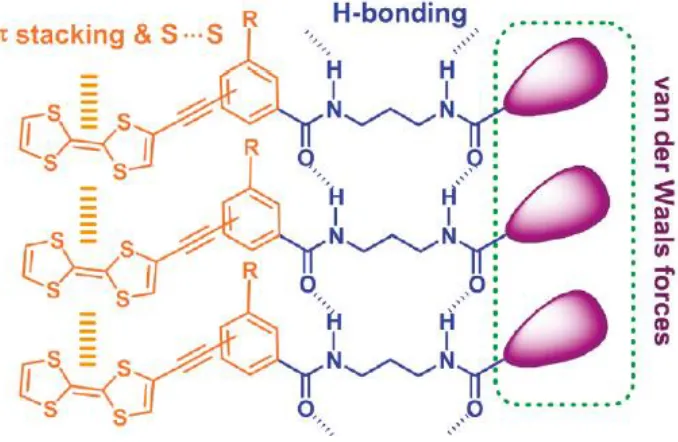
Van Der Waals interactions. An example of a tetrathiofulvalene (TTF) species’ stacking array
3
Figure 1.2 An intermolecular bonding array of TTF gelators depicting the various non-covalent interactions associated with LMWGs. Reprinted with permission from: Wang, X.; Xing, L.; Cao, W.; Li, X.;
Chen, B.; Tung, C.; Wu, L.; Langmuir. Copyright 2011 American ChemicalSociety
The well established and yet still rapidly expanding field of LMWGs currently delivers a variety
of useful materials, which will perhaps one day be considered indispensable as critical materials
for everyday utilities from industrial, pharmaceutical, and common consumer applications. The
characteristic property of thermoreversability exhibited by LMWGs, entitles them to some
niche applications, which include but are not limited to the advanced materials applications
such as: pharmaceuticals, food, drug-delivery, biomimetics, enzyme-immobilization matrices,
liquid crystalline materials, as templates for preparing other novel compounds, mechanical
actuators, and in catalysis6. For example, trimethoxysilane bis urea 1 (Figure 1.3), which was
synthesized in a one-pot reaction, was tested in a variety of organic/aqueous solvents, where
4 O Si
H
N HN HN HN Si
O O
O
O
O
O O
1
Figure 1.3 Trimethoxysilane bis urea 1
Figure 1.4 An illustration of the thermoreversability of TTF LMWGs. The gel to sol transition can take place several times over before this functional property is exhausted. Reprinted with permission from:
Wang, X.; Xing, L.; Cao, W.; Li, X.; Chen, B.; Tung, C.; Wu, L.; Langmuir. Copyright 2011 American Chemical Society
The determination of what exactly constitutes a gel is essentially a crude measurement of the
human eye. The aforementioned “crude measurement” can be performed simply by observing
a gelatinous material as being suspended for a short duration, such as in the upside down vial
to the right in Figure 4.1. A gel is characterized by its flow property, which is solid-like under
rheological considerations, yet has a composition which is predominantly liquid, with
proportions which are commonly 99% liquid and about 1% gelator molecule. A more technical
proposition was introduced by Flory, who defined a gel as: 1)”… a continuous structure with
5
is solidlike in its rheological behavior.”4 This measurement can as well be made by subjecting a
gelatinous material to the “dropping ball method,” which determines the gel integrity under
temperature variances. This experiment is carried out by introducing a metal ball to the gel at a
particular temperature, usually initially room temperature, and then heating the gel material
until the metal ball begins to descend into the gel medium, thus breaching the integrity of the
gel. Other rheological studies are carried out in a rheometer, which studies the flow properties
of solid-like materials while under an applied force.
1.1 Gel Structure
The gel matrix, an entangled network of fibrous, sheet-like, or rod-like strands, which are
secondary structures or cables formed from an anisotropic one-dimensional growth of the
non-covalently bound gel molecules, trap solvent molecules within the pores or pockets that result
from such entanglements. Images generated by a scanning electron microscopes (SEM image)
or transmission electron microscopes (TEM image) are generally used to study the morphology
of such materials. Scanning electron microscopes magnify surface structures in the micrometer
range and provide a topographical image for secondary structure analysis.
6
1.2 Gelator Design Rationale
The discovery of gelator molecules has predominantly been a circumstance of fortune. That is
to say, that the design of novel gelator molecules is limited. Such limitations are set by the
confines of the understanding of the gelation phenomenon. Once a gelator molecule has been
discovered, however, the rational design of analogues with minor tweaks and modifications,
and a comprehensive understanding of the properties which support gelation are quickly
grasped. It would appear as though an amphiphillic molecular balance must be struck in order
for a compound to develop gelator properties. This hydrophobic/hydrophilic duality is
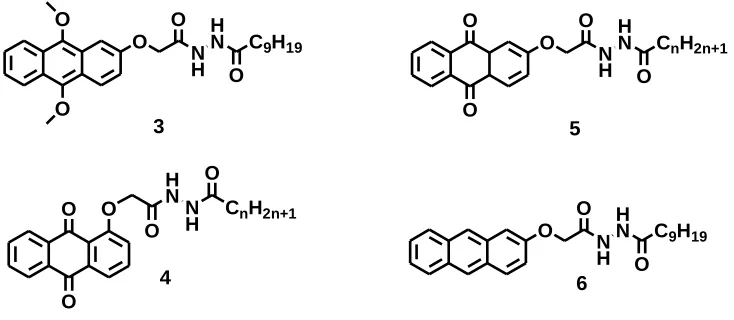
illustrated in the 2-substituted anthriquinone structures 3-6 (Figure 1.5) synthesized by
Chuan-Feng Chen et al for gel studies15:
O O N H H N O C9H19
O O O H N N H O
CnH2n+1 O O O O O N H H N O
CnH2n+1 O O O O N H H N O C9H19
3
4
5
6
Figure 1.5 2-substituted anthriquinone structures 3-6
This balance is inherently related to a composition of factors which include molecule-molecule
interactions as well as solvent-molecule interactions. Molecule-molecule interactions are such
7
which are necessary for one-dimensional fibrillar assembly. The solvent-molecule interactions
assist in a similar fashion, directing the molecular orientations critical for gel formation via
hydrophobic and/or hydrophillic forces as well as surface tension forces. The shear multitude
of factors which must coalesce for gelation to be possible makes it relatively difficult for ab
initio gelator design. Through the advancement of gelator research of the past few decades,
although, the discovery of several classes of gelator compounds provides a platform of
rationale for molecular design. Some known classes include: Amino acids (peptides),
surfactants, amides, ureas, carbohydrates, fatty acids, porphyrin derivatives, nucleobases,
tripodal compounds, quinolines, etc.
1.3
Gel Characterization
The characterization and study of these gels via the use of instrumental analysis is quite critical
to understanding the gel superstructures. The advancement of gel instrumental analytical
techniques, such as in instrumentation methods like NMR, scanning electron microscopy, X-ray
crystallography, and fluorescence study techniques have greatly progressed the understanding
of gelators and their physical properties as well as the assembly process associated with their
creation5. The study of the gel suprastructure as distinguished from the gelator in solution has
proven very revealing to the gelation process, or the gel-sol transition process, using the
8
1.4
UV and Fluorescence Analysis
Yu Fang et al analyzed the gel-sol transition of structures 7-11 (Figure 1.6) through fluorescence
spectroscopy, by attaching the flourophore naphthalene to an open-chain glucose moiety with
a hydrazine or extended diamine spacers28.
S O
O
NH(CH2)nHN CH2OH O
OH OH OH OH
Figure 1.6 Glucose based fluorescent gelators 7-11 (n = 0-5)
The fluorescence study revealed an enhanced emission from the gel structure versus the
emission of the gelator in solution. This distinction allowed for the group to interrogate the
processes involved in gel-sol transition. Such a transition and its reverse glean very illustratively
the physical processes involved on the molecular level, which can thoroughly be studied by
examining the emission changes from the fluorophore moiety. The gelator molecule involved in
the transition process may have incorporated into it a fluorophore which is essential to
inducing the gelation process or the fluorophore may simply be appended to an existing gel
molecule, meaning it is not critical to gelation and perhaps effects gelation only slightly. If,
when subjected to UV and other fluorescence related frequencies, a gelator does not fluoresce
significantly or even at all in solution, yet does so when aggregated in the gel matrix form, a
process dubbed Aggregation Induced Enhanced Emission (AIEE) occurs. Xiyou Li et al observed
9
of perylenetetracarboxyilic diimides (PDIs)26. The perylene functionality, the fluorophore,
exhibits photoconductive properties which not only assist in structural analysis of gel
morphologies, but as well may lend applicability in areas such as photoconductive
nanostructure technology. As a functionalized gelator, the perylene rings provide the weak
bonding contribution necessary for intermolecular aggregation in the form of π - π
stacking. This, in conjunction with appended hydrophillic polyoxyethylene or long chain
hydrophobic tails, gave the PDIs the typical amphiphilicity necessary for gelation, as seen in
compounds 12, 13, and 14 in Figure 1.7:
N N O O O O O O HN O O O O O O O O O O O O O NH O O O O O O O
O O O
O O O 12 N N O O HN NH O O O O O O O O O O O O O O O O O O O O O O O O
O O O
O
O O
10
N N
O
O
HN NH
O
O O O
O
O O
O O O O O
O O O
O O O
O
O
14
Figure 1.7 Molecular structures of compounds12-14.
The computed optimized molecular structures 12-14 (A-C) are shown below in Figure 1.827:
Figure 1.8 Reprinted with permission from Wu, H.; Xue, L.; Shi, Y.; Chen, Y.; Li, X.; Langmuir, 2011 Copyright 2011 American Chemical Society
The absorption/emission data was obtained from 12 and 14 in various organic solvents, the
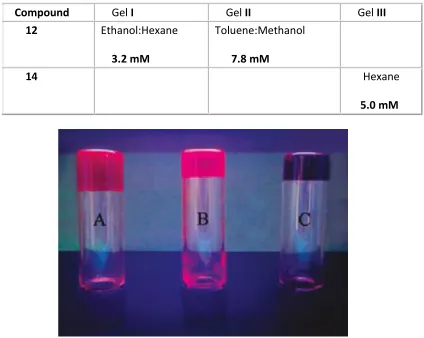
11 Table 1.1 Gels of compounds 12 and 1326.
Compound Gel I Gel II Gel III
12 Ethanol:Hexane
3.2 mM
Toluene:Methanol
7.8 mM
14 Hexane
5.0 mM
Figure 1.9 Irradiated with 365nm UV, the fluorescence of gels I, II, and III (with concentrations of 3.2, 7.8, and 5.0 mM respectively) is displayed. Reprinted with permission from Wu, H.; Xue, L.; Shi, Y.; Chen,
Y.; Li, X.; Langmuir, 2011 Copyright 2011 American Chemical Society
From image A in Figure 1.8, one can note that the polyoxyethylene tails are coplanar with the
PDI ring. This is because, in compound 12, the phenyl linker between the tail groups and the
PDI ring allows for this conformation to be possible which, in-turn, likely allows for the proper
orientational stacking necessary for one dimensional growth—a typical critical criterion for
gelation to occur. The absence of this linker in compound 13 likely attributes to its inability to
12
incorporated within it an aliphatic side-chain, which allows for hydrophobic interactions to
cooperate with the π- π interactions and form gels. Even the most minute interchromophore
distance variations are detectable by the very much sensitive techniques of UV-vis and
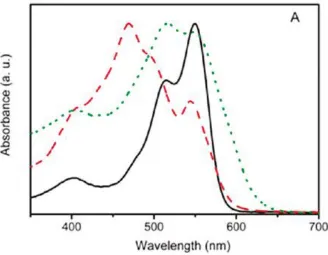
fluorescence instrumentation. For instance, it was inferred by Xiyou Li et al that a significant
blue shift of 35nm in the absorption spectra obtained26 (Figure 1.10), comparing the PDI
monomer and a concentrated PDI gel, that a relatively small interplanar distance separated face
to face stacked PDI molecules. This led to the conclusion that such intermolecular distances of
π- π stacked units in the H-aggregates form strong interactions in the ground state and
therefore absorb at these higher energies. Fluorescence studies revealed that face-to-face
stacking occurs in the aggregates formed in gel I. In consideration of the fact that, in the
fluorescence spectrum of compound 11 in Figure 1.11, a red shift to 624 nm was observed from
gel I relative to the monomer in CHCl3, it was inferred by Xiyou Li’s group that an excimer like
state must be adopted, and there must be interchromophore interactions even in the excited
state. A defining feature of Li’s PDIs is that the blue shifts are significantly greater than those
observed in previously reported literature. They reasoned that this could be due to minimal
slippage along the transverse and longitudinal axes, which if larger could perhaps cause a red
shift. Their reasoning extended, and they noted that it has been observed that in-plane torsion
between adjacent PDI molecules causes significant blue shift. Their reasoning therefore
culminated in the belief that this particular PDI system exhibited minimal slippages along the
transverse and longitudinal axes and this must be occurring along with strong in-plane torsion
13
Figure 1.10 UV-vis absorption spectra of compound 12 in CHCl3 (Solid), as a dilute gel (Dashed), and as a
concentrated gel (Dotted). Reprinted with permission from Wu, H.; Xue, L.; Shi, Y.; Chen, Y.; Li, X.; Langmuir, 2011 Copyright 2011 American Chemical Society
A discrepancy in the microstructures of gels I and II is present, although as seen in Figure 1.10,
similar shifts are observed due to face to face stacking assembly adopted by both gels. This
difference, as mentioned, is in the microstructures and Li et al describe the change from
opaque gel I to the transparent gel II as being attributed to differences in solubility. Gel I, which
is in hexane/ethanol 1:1 v/v, forms large aggregates which induce opacity. The greater
14
Figure 1.11 Fluorescence emmission spectra of compound 12 in CHCl3 (Solid), as a dilute gel (Dashed),
and as a concentrated gel (Dotted). Reprinted with permission from Wu, H.; Xue, L.; Shi, Y.; Chen, Y.; Li, X.; Langmuir, 2011 Copyright 2011 American Chemical Society
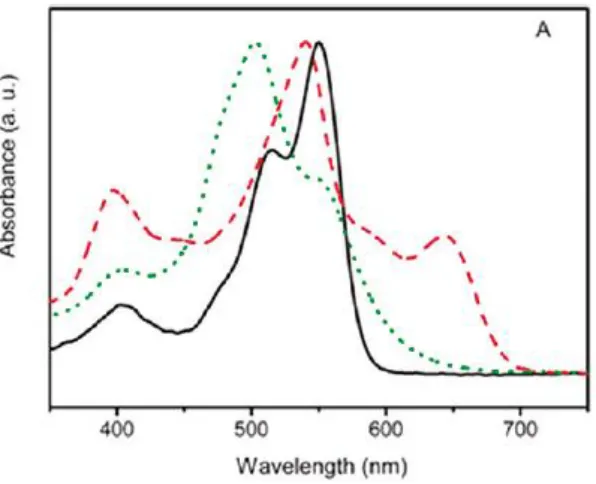
As seen in Figure 1.12, face to face stacking is observed for compound 14 in gel form as
well. This inference is based on the observed blue shift of 47 nm relative to the monomer in
CHCl3. Further experimentation to assess compound 14’s capacity to maintain a similar shift
was performed, and it did indeed maintain such a shift down to 10 -7 mol/L in a hexane
solution. This suggests that face-to-face stacking occurs at least down to this concentration
level. Compound 14 in gel form seems to form J-aggregates. The maximum at 540 nm and the
new one forming at 644 are characteristic peaks for PDIs in a coplanar configuration and that
15
Figure 1.12 UV-vis spectra of compound 14 in CHCl3 (Solid), Hexane (Dotted), and a dilute gel in hexane
as a gelling solvent to form gel III (Dashed). Reprinted with permission from Wu, H.; Xue, L.; Shi, Y.; Chen, Y.; Li, X.; Langmuir, 2011 Copyright 2011 American Chemical Society
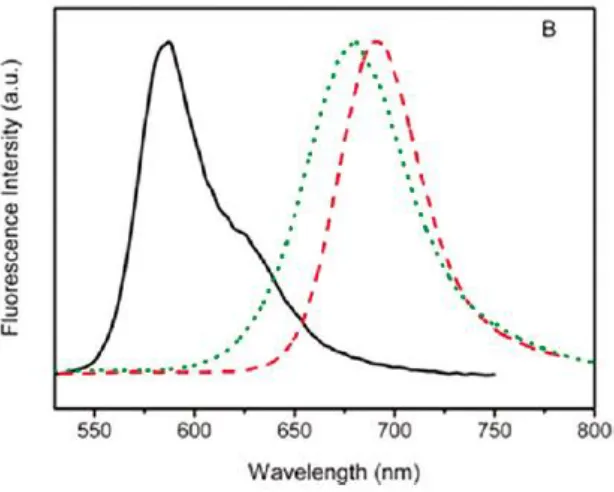
The absorption spectra, as mentioned above, are significantly different from each other. To the
group’s surprise, the emission spectra were not so different for compound 14 in the hexane
solution versus as a gel in gel III, as seen in Figure 1.13. This was attributed to a different mode
of assembly for each. In the hexane solution, an H-type aggregate formation is occurring
because excimer-like emissions are observed. This solution, as observed by the naked eye, is
red in color. The fluorescence of gel III shows an emissions signature characteristic to that of a
16
Figure 1.13 Fluorescence spectra of compound 14 in CHCl3 (Solid), Hexane (Dotted), and a dilute gel in
hexane as a gelling solvent to form gel III (Dashed). Reprinted with permission from Wu, H.; Xue, L.; Shi, Y.; Chen, Y.; Li, X.; Langmuir, 2011 Copyright 2011 American Chemical Society
Li et al developed a “speculated” microstructure for each of the gels I, II, and III. These
structures were determined in-large part due to the fluorescence emission and UV-vis
obtained. Additional characterizations were performed, including X-ray diffraction (XRD) and
atomic force microscopy (AFM) measurements. For compound 12 gel 1, the intermolecular
orientations are face to face stacked. It was speculated that the primary contributing source
for intermolecular non-covalent bonding was the π – π interactions from the PDI moiety. The
hydrophobic side-chains did not pack with high order due to bending and tangling, and small
in-plane torsion was also attributed to gel I.
17
Figure 1.14 Speculated microstructures of gels formed by compounds 12 and 14. Reprinted with permission from Wu, H.; Xue, L.; Shi, Y.; Chen, Y.; Li, X.; Langmuir, 2011 Copyright 2011 American
Chemical Society
1.5 Probing the Mode of Gelator Assembly
The mode of assembly/disassembly which is involved in the aggregative formation or
18
potential disruption, respectively, in the brain of Alzheimer afflicted persons. β-Amyloid plaque
formation and brain deposition, which in-turn leads to brain lesions, is a major hallmark of
Alzheimer’s disease, and perhaps the primary culprit for the onset of this degenerative disease.
Santiago V. Luis et al set out to probe a gel systems self-assembly pathways and load capacity
under the effects of naproxen (NPX)27, a non-steroidal anti-inflammatory drug (NSAID), in an
effort to simulate how such a drug may affect β-Amyloid aggregate formation. Research has
suggested that such an NSAID may interact with the amyloid plaques or at least the precursors
thereof and inhibit their formation. The analysis of such aggregative action was performed by
Luis and his group using peptidomimetic cyclophane compound 16, with naproxen embedded
within its gel matrix:
H3CO
COOH
HN NH
NH HN O
O
15 (NPX) 16
Figure 1.15 Chemical structures of Naproxen (NPX) and cyclophane compound 16
With an NSAID such as naproxen embedded within the gel matrix, from a biomedical context
regarding, for instance β-amyloid fibril disruption, time resolved fluorescence spectroscopy
could be used effectively to elucidate the interactions the chromophore has with the gel
assembly, as described by Luis et al. The integrity of the gels formed by 16, which had varying
19
temperatures (Tg). The observed melting trends indicated that the higher the NPX load was,
the weaker the gel assembly (Lower Tg) . In table 1.2, R represents the degree of linear
correlation.
Table 1.2 The gradient melting temperature of gelator compound 16 loaded with NPX27
16 (mg/mL)
NPX (M)
Tg (0C)
R
4 0.0 50.9 + 0.7 0.9988
4 4.0 x 10⁻⁴ 49.1 + 0.4 0.9991
4 2.5 x 10⁻³ 47.7 + 0.7 0.9983
At this juncture it was clear that an effect, specifically a weakening one, had occurred from the
addition of NPX, yet when absorption and steady-state fluorescence spectroscopy were
performed, no notable spectroscopic changes had taken place from the NPX monomer in
solution and in the gels. This compelled the group to explore other fluorescence techniques
which would help in the interrogation of system integrity differences. Therefore, time
correlated single photon counting (TCSPC), a time resolved fluorescence technique which
correlates minute distinctions of fluorescent species in different environments. Absorption,
excitation, and emission results were fit into the model below, which was calculated by using
the following multiexponential equation (eq. 1.1) of individual decays (i):
20
The following (Figure 1.16) illustrates the normalized spectra of NPX in toluene and in the gel
state.
Figure 1.16 Normalized spectra of NPX in toluene and in the gel state. Permission license No. 2864890165106
The i components, which represent the various fluorescence lifetimes, are summated in the
variable τi which represents the individual fluorescence lifetime, and αi which is a
representation of its contribution to the total signal. The degree to which the fluorescence
decay times fit the multiexponential results properly is designated χ2. In accordance with
previous data concerning NPX in various organic solvents, the monoexponential fit for its
fluorescence decay time in toluene was χ2 = 1.07 where τ = 7.38ns {26}. The monoexponential
21
however, was applied to the decay function, a more precise fit was observed. The observed
lifetimes of the two contributors τ1 and τ2 were 7.89ns and 1.46ns, respectively. The variable τ1
contributed to 97.3% of the signal, whereas τ2 contributed to 2.7%. It was hypothesized by Luis
et al that the larger component of the fluorescence lifetime can be attributed to the decay of
NPX that is not interacting with the gel matrix, and that the smaller lifetime may correspond to
NPX which is in the vicinity of gel fibers, and thus interacting with the architectural assemblage
composed of 16. To support this theory, gradient increase of the gelator molecule
concentration was applied, which revealed that the smaller lifetime component gradually
increased with increasing concentration. The logic was such that if the gelator molecule
concentration increased, the interactions between NPX and 16 would increase proportionately
due to its greater prevalence, thusly increasing the lifetime of τ2. This in fact was observed, as
tabulated in the following table:
Table 1.3 Gels of gelator 16 at various concentrations irradiated with 350 nm UV with recorded fluorescence lifetimes27
16 (mg/mL) τ1 (ns) α1 (%) τ2 (ns) α2 (%) χ2
0 7.38 100 - - 1.07
4.0 7.89 97.3 1.46 2.7 1.11
7.3 8.27 95.1 1.34 4.9 1.24
10.3 8.30 93.0 1.16 7.0 1.17
The UV-vis absorption and fluorescence analyses performed by Luis et al did not show any
significant distinctions in spectral results when steady state and conventional spectroscopic
techniques were applied, yet when time resolved fluorescence spectroscopy was applied,
22
Fluorescent probing, as past research has shown, can assist in elucidating the mechanism of
action which is involved in gel formation, but there are sometimes external or internal stimuli
that assist in architectural assembly. The mode of aggregation involved in these cases is
sometimes not fully understood, yet our comprehension of how it occurs is rapidly growing. It
has been known for some time now that impregnating a potential gel system with metal salts
may either buttress or rigidify a gel, but may also lead to gel formation, where such formation
would have otherwise not occurred. Additionally, thermal treatment or ultrasound irradiation
may assist in gelation by providing the necessary energy to overcome certain barriers
associated with the intermolecular orientations needed for one dimensional growth.
Masamichi Yamanaka and Hiromitsu Fujii explored these effects21 with a gel system which uses
tris-urea LMWG 17 in Figure 1.17.
O
O O
NH HN
N H
O NH
C8H17 N
H O C8H17
O HNC8H17
17
Figure 1.17 Tris-urea LMWG 17.
Compound 17 has the property of C3 symmetry, which is derived from functionalizing
phloroglucinol. Initially, 4-flouronitrobenzene was reacted with phloroglucinol via nucleophilic
23
reduced using hydrogen with palladium on carbon, and then this compound was reacted excess
octylisocyanate, which afforded the white solid product of 17, as illustrated in Figure 1.17. It
should be noted that this is a highly versatile synthetic route, and alterations can easily be
made to explore the use of other substituents on phloroglucinol and on the substituted
aromatic ring.
HO OH
OH
4-fluornitrobenzene, K2CO3 DMF, 67% O O O NH2 NH2
H2N
O
O O
NO2 NO2
O2N
H2, 10% Pd on Carbon
EtOAc, 95% 16 17 18 O O O NH HN N H O NH C8H17 N
H O C8H17
O HN C8H17
15
Octylisocyanate 1,2-dichlorethane, 86%
Scheme 1.1 Synthesis of tris-urea 15.
Four chloroalkane solvents were tested for the gel properties of 15 in each under various
conditions. These solvents were: dichloromethane, chloroform, 1,1,2-trichloroethane, and
24
via heating and cooling to either room temperature of flash cooling using an ice bath,
ultrasound irradiation using a sonicator, and/or metal salt doping were then applied using each
of these solvents. Comparisons were made and system properties inferred from the gel
responses to the internal and external stimuli applied. Compound 17 only formed a full gel in
1,1,2-trichloroethane with thermal treatment, and a partial gel in 1,1,2,2-tetrachloroethane. To
test how a metal salt, namely CuBr2, would affect gelation, a stoichiometric equivalent was
added to each the 1,1,2-trichloroethane and the 1,1,2,2-tetrachloroethane, as seen in Figure
1.19. Not only did this addition transform the partial gel of tetrachloroethane into a full gelator
with an MGC of 5mM, but it as well decreased the MGC of the trichloroethane gel from 10mM
to 5mM when thermally treated (Table 1.4).
Figure 1.18 Gel experimental results depicted in which mixtures of of the four previously mentioned chloroalkanes, (a) CH2Cl2, (b) CHCl3, (c) 1,1,2-trichloroethane, and (d) 1,1,2,2-tetrachloroethane and
25
Figure 1.19 Photographs acquired by Fujii et al of CuBr2 doped gels of 17 along with the standard
chloroalkanes (a) CH2Cl2, (b) CHCl3, (c) 1,1,2-trichloroethane, and (d) 1,1,2,2-tetrachloroethane.
Reprinted with permission from Yamanaka, M.; Fujii, H.; J. Org. Chem., 2009, 74, 5390–5394. Copyright 2009 American Chemical Society
Table 1.4 Resultant properties of gels formed with 15 under thermal treatment conditions.21
additive CH2Cl2 CHCl3
1,1,2-trichloroethane
1,1,2,2-tetrachloroethane
none I I G (10) PG
CuBr2 I I G (5) G (5)
Key: Gel results with Tris-urea gelator 17 having concentrations of up to 25 mM, where: G = gel; PG = partial gel; I = insoluble suspension. The critical gelation concentrations are denoted as (mM)
Morphological transformations were as well observed in the SEM images of
1,1,2-trichloroethane gels (Figure 1.20), which exhibited a fibrous entanglement in the absence of
CuBr2, and spherical particles in the presence of the metal salt. This suggests that the modes of
assembly for each system are different. An SEM image was as well acquired for the partial gel
of 17 formed in 1,1,2,2-tetrachloroethane in the presence and absence of CuBr2. Notably
26
Figure 1.20 Xerogel images of (a) 1,1,2-trichloroethane gel with 17; (b) 1,1,2,2-tetrachloroethane partial gel of 17; (a) 1,1,2-trichloroethane gel with 17 and CuBr2; and (d) 1,1,2,2-tetrachloroethane gel of 17 and
CuBr2. Reprinted with permission from Yamanaka, M.; Fujii, H.; J. Org. Chem., 2009, 74, 5390–5394.
Copyright 2009 American Chemical Society
Under the influence of ultrasound irradiation gelation may be induced where it would
otherwise have not occurred, as was the case with thermal treatment of compound 17. The
Table 1.5 Resultant properties of gels formed with 17 under ultrasound irradiation treatment conditions21
additive CH2Cl2 CHCl3
1,1,2-trichloroethane
1,1,2,2-tetrachloroethane
none I G (15) I G (5)
CuBr2 I G (5) I G (5)
BiCl3 G (15) PG I G (20)
Y(NO3)3 PG G (10) I I
27
following table summarizes the results where sonication only and sonication plus metal salt
incorporation were done.
1
.6
Tuning Gel Morphology and Rheological Properties With Internal and
External Stimuli
This study performed by Yamanaka and Fujii demonstrates how the tweaking of external and
internal stimuli can affect gelation, particularly through thermal heating and cooling, ultrasound
sonication, and metal salt/ligand doping. Cheng Wang et al have experimented with tuning
techniques which trigger reversible gel-sol transitions under the influence of photo induced
isomerization and redox chemistry using organogelators based on tetrathiofulvalene and
azobenzene groups. Photoreactive groups such as azobenzene and stilbene have been
incorporated into LMWGs with the intent for such groups to trigger gel-sol transitions11,12. It is
specifically the tetrathiofulvalene moiety which is electroactive and responds to redox
conditions whether they are chemical or electrochemical. The multistimuli responsive gelator
18 has incorporated within it such functionalities by rationale design to exploit the
28
Figure 1.21 Tetrathiofulvalene (TTF) compound 18. Reprinted with permission from: Wang, X.; Xing, L.; Cao, W.; Li, X.; Chen, B.; Tung, C.; Wu, L.; Langmuir. Copyright 2011 American ChemicalSociety
The oxidation state of the TTF moiety can reversibly change to TTF.+ radical cations or TTF2+
dications when redox conditions are applied. A conformational change is triggered by
irradiating compound 18 with the proper wavelength of electromagnetic energy, which causes
cis-trans isomerization. Simply incorporating the stimuli responsive functionalities into the gel
molecule, however, will not necessarily provide the crucial balance that must be achieved in
Table 1.6. Gelation results for compound 18.11
solvent gelation examination
CH2Cl2/ CH3OH (3/1, v/v) G (4.0 mg/mL)
CHCl3/ CH3OH (3/1, v/v) G (4.0 mg/mL)
CH2Cl2/ n-hexane (1/1, v/v) G (4.0 mg/mL)
CHCl3/ n-hexane (1/1, v/v) G (4.0 mg/mL)
THF G (4.0 mg/mL)
toluene G (4.0 mg/mL)
CH2Cl2/ CHCl3 S
1,2-dichloroethane, CCl4 P
n-hexane, cyclohexane, methanol, ethanol, DMF, DMSO, Acetone, CH3CN, ethyl acetate
I
29
order to construct a functional gelator molecule. This balance can be manipulated by attaching
functional groups which will either decrease or increase the overall LogP value of the molecule,
or in other words, the overall polarity. This was accomplished by tacking cholesterol to each
end of the gel molecule. The gelation results are summarized in table 1.6. When analyzed in
the gel form, compound 18 has a broad absorption band in the vicinity of 360nm, and it was
observed that this broad band had diminished over time as another band had intensified in the
range of 450nm. The band at 360nm can be assigned to the trans form of the azobenzene
portion of 18, and the emerging one at 450nm is assigned to the cis form. Wang et al reported
that HPLC results indicated that the composition of the solution at t0 was 81.6% trans and
18.4% cis. As seen in the below florescence spectrum, a photostationary state
Figure 1.22 Left: The absorption spectra of TTF gelator 18 irradiated at 365nm for varying durations. Right: The absorption spectra for gelator 18 when irradiated with UV light, initially for 50 s, and then subsequently at varying times. The concentrations of each were 1.0 × 10⁻⁵ M in CH2Cl2/CH3OH (3:1). The
30
spectrum was acquired for 50s under UV irradiation conditions, and the resultant composition
at this time was 96.8% cis and 3.2% trans. It was reported that continued irradiation of the
sample with visible light energy reverted the samples composition to a predominating trans
isomer presence. Interestingly, the cholesterol moiety not only made a hydrophobic
contribution to the gel molecule, thusly helping to balance the overall polarity, but it also likely
imparted chiral growth of the thin fiber formations. This is suggested by analysis of the CD
spectra obtained by the group, which showed positive CD signals at 368 and 384nm. These
signals gradually disappeared as the gel approached its solution phase through the application
of heat.
Figure 1.23 The CD spectra gelator 18 with a concentration of 8.0 mg/mL in CH2Cl2 (3/1, v/v) in: 1)
Solution; and 2) the resultant gel and subsequent UV spectra thereof at 20, 40, and 60 s respectively.
31
1.7 Hydrogelators as drug-delivery devices
Hydrogelator disassembly or the reverse under the influence of chemical stimuli such as
enzymes for the purpose of drug delivery has been explored by George John et al61. Within the
developing technology of hydrogelator drug delivery, LMWGs provide some distinct advantages
to the currently more prevalent mode which uses polymer hydrogels. These include: possible
lower toxicity, increased biodegradability, and also the property of thermoreversability which is
a more prominent LMWG feature. A variety of delivery platforms have been experimented
with. One process simply entraps a hydrophobic drug within the gel matrix as seen in
mechanism of action A in Figure 1.24 below. Another more rare condition is when the gel
molecule is itself is the active therapeutic agent, in which case its capacity to gelate water is
coincidence and not by design. And perhaps the most rational process, at least from the design
standpoint, is to simply attach a therapeutic agent covalently to a known gelator using an
enzyme-sensitive spacer.
32
One of the most alluring aspects of this form of enzymatically triggered drug delivery is that
specific locations in the body can be triggered for such release. George John et al prepared a
prodrug amphiphilic gel assembly which used the antipyretic acetaminophen. Studies were as
well conducted to demonstrate this gelator’s ability to host yet another therapeutic agent,
namely curcumin, which is a known chemopreventative drug and is as well used as an
anti-inflammatory agent. The synthesis of these hydrogelator amphiphiles is shown below starting
from acetaminophen in Scheme 1.2:
N
H OH
H3C
O i ii iii N H H3C
O O O CH3 10 N H H3C
O
O O
N H CH3 O O n O N H H3C
O OH O O O n iv N H H3C
O OCH3 O O 4 v N H H3C
O OH O O 4 19 20 21 22 23 24
Scheme 1.2 Conditions for amphiphiles and bolaamphiphiles 19-24 from precursor acetaminophen: (i) dodecanoic acid, dicyclohexylcarbodimide (DCC), dimethylaminopyridine (DMAP), anhydrous tetrahydrofuran (THF), rt, 24 h. (ii) a,ω-dicarboxylic acid (0.5 equiv.), DCC, DMAP, dry THF rt, 48 h. (iii) a, ω -dicarboxylic acid (1.2 equiv.), DCC, DMAP, dry THF, rt, 24 h. (iv) 6-bromomethylhexanoate, K2CO3, dry
33
The above design is based not only on the synthesis of amphiphiles, but also bolaamphiphiles
which have hydrophilic polar groups attached at each end of a hydrophobic chain linker. By
design, upon degradation, the gel does not produce toxic fragments or byproducts which could
be considered harmful. This and several other factors must be evaluated as potential health
hazards. As the acetaminophen is released, only a long-chain fatty acid accompanies the
disintegration, an extremely important consideration for any such system.
1.8 Monosaccharide Based Gelators
Carbohydrate based gelators, namely monosaccharide based gel molecules, are of great
importance to efforts in understanding gel systems102-104. Predictable hydrogen bond based
networks, which can be formed by the many free –OH groups in monosaccharides are potential
frameworks which could lead to gelation of various solvents. Accessibility to these hydrogen
bond donors, abundance of them, and hydrophobic balance are three factors which are more
easily controlled when dealing with monosaccharide systems, making them ideal candidates for
designing gelators. For instance, Luboradzki et al performed analytical experiments on a
tunable gelator system comprised of two different monosaccharides 25 and 26-28 (Figure 1.25),
exploiting the three free –OH groups as hydrogen bond donors/acceptors for gel matrix
34
O HO HO
OH O O
O HO HO
OH O O
R R
25 26 R = CH
3
27 R = CH2CH3
28 R = (CH2)2CH3
Scheme 1.25 Glucofuranose monosaccharide gelators 25-28. Varying amounts of 26, 27, or 28 added to 25 to ‘tune’ the gel assembly
The R groups projecting off of the dioxolane groups in compounds 26-28 help to modulate the
hydrophobic chain length, thus helping establish the proper amphiphilicity necessary for
gelation. In the case of a two component system such as this, adding a second molecule to the
system may be critical for molecular assembly in an anisotropic fashion. In the case of
Luboradzki et al, this addition only modified the gel structure, albeit in a fashion which in some
cases enhanced the gel structure
Conclusion
The design of novel gelator molecules is limited currently, although, the discovery of the
previously mentioned classes of gelator compounds does provides a platform of rationale for
molecular design. Understanding the assembly process through the use of instrumentation and
molecular probes gains the necessary insight to work toward such a goal. With every new
gelator molecule synthesized, a step toward gelator design is taken. Various LMWG molecules
were explored to illustrate the capacity of these systems to be used in applications such as drug
35
References
1. Bhosale, P. S.; Chun, J.; Berg, J. C.; Langmuir, ASAP.
2. Kajjari, P. B.; Manjeshwar, L. S.; Aminabhavi, T. M.; Ind. Eng. Chem. Res,ASAP.
3. Piepenbrock, M.; Clarke, N.; Foster, Steed, J. W.; Chem. Commun., 2011, 47, 2095–2097.
4. Flory, P. J.; Faraday Discuss. Chem. Soc., 1974, 57, 7-18.
5. Steed, J.W.; Chem. Commun., 2011, 47, 1379–1383.
6. Lu, C.; Su, S.; J. Chin. Chem. Soc., 2009, 56 121-126.
7. Kowalczuk, J.; Jarosz, S.; Tritt-Goc, J.; Tetrahedron, 2009, 65, 9801–9806.
8. Sato, H.; Yajima, T.; Yamagishi, A.; Chem. Commun., 2011, 47, 3736–3738.
9. Kellogg, R. M.; De Schryver, F.; Feringa, B. L.; Chem. Eur. J., 1997, 3, 1238-1243.
10.Suzuki, M.; Hanabusa, K.; Chem. Soc. Rev., 2009, 38, 967–975.
11.Johnson, E. K.; Adams, D. J.;Cameron, P. J.; J. Mater. Chem., 2011, 21, 2024–2027.
12.Jamart-Gregoire, B.; Allix, F.; Curcio, P.; Nghi Pham, Q.; Pickaert, G.; Langmuir,2010, 26,
16818–16827.
13.Shirakawa, M.; Fujita, N.; Shinkai, S.; J. AM. CHEM. SOC., 2005, 127, 4164-4165.
14.Coumou, P.; C.J.; Brizard, A. M.; van Esch, J. H.; de Schepper, I. M.; Bouwman, W. G.; Journal of
Physics: Conference Series, 2010,251, 012093(pg 1-5).
15.Liu, J.; Ma, J.; Chen, C.; Tetrahedron, 2011, 67, 85-91.
16.Diaz Diaz, D.; Morin, E.; Schonj, E. M.; Budin, G.; Wagner, A.; Remy, J.; J. Mater.
Chem., 2011, 21, 641–644.
36
18.Wang, X.; Xing, L.; Cao, W.; Li, X.; Chen, B.; Tung, C.; Wu, L.; Langmuir, ASAP.
19.Kowalczuk, J.; Jarosz, S.; Tritt-Goc, J.; Tetrahedron, 2009, 65, 9801–9806.
20.Yamanaka, M.; Fujii, H.; J. Org. Chem., 2009, 74, 5390–5394.
21.Ghosh, A.; Dey, J.; Langmuir,2009, 25, 8466–8472.
22.Wu, J.; Tian, Q.; Hu, H.; Xia, Q.; Zou, Y.; Li, F.; Yi, T.; Huang, C.; Chem. Commun., 2009, 4100–
4102.
23.Rodriguez-Llansola, F.; Escuder, B.; Miravet, J. F.; J. AM. CHEM. SOC., 2009, 131, 11478–11484.
24.Wu, H.; Xue, L.; Shi, Y.; Chen, Y.; Li, X.; Langmuir, ASAP.
25.Burguete, M. I.; Izquierdo, M.A.; Galindo, F.; Luis, S. V.; Chemical Physics Letters,2008, 460503–
506.
26.Yan, N.; He, G.; Zhang, H.; Ding, L.; Fang, Y.; Langmuir,2010, 26, 5909–5917.
27.Bhattarai, N.; Gunn, J.; Zhang, M. Adv. Drug Deliv. Rev. 2010, 62, 83–99.
28. Kulkarni, R. V; Sreedhar, V.; Mutalik, S.; Mallikarjun Setty, C.; Biswanath, S. A. Int. J. Biol.
Macromol. 2010, 47, 520–527.
29.Isiklan, N J. Appl. Polym. Sci. 2006, 99, 1310–1319.
30.Saravanan, M.; Panduranga Rao, K. Carbohydr. Polym. 2010, 80, 808–816.
31. Angadi, S. C.; Manjeshwar, L. S.; Aminabhavi, T. M. Int. J. Biol. Macromol. 2010, 47, 171–179.
32.Rokhade, A. P.; Agnihotri, S. A.; Patil, S. A.; Nadagouda, N. M.; Kulkarni, P. V.; Aminabhavi, T. M.
Carbohydr. Polym. 2006, 65, 243–252.
33. Ramesh Babu, V.; Rajinee Kanth, V.; Jadhav,M.M.; Aminavhavi, T. M. Novel Methyl J. Appl.
Polym. Sci. 2010, 115, 3542–3549.
37
35.Gowda, D. V.; Darshan, J.; Shivakumar, H. J.; Siddaramaiah.; Bhise, S. B.; Aloorkar, N. H. Indian J.
Pharmaceut. Sci. 2008, 70, 224–227.
36. Robert, C. C. R.; Bun, P. A.; Peppas, N. A. J. Appl. Polym. Sci. 1985, 30, 301–306.
37.Xiao, C.; Lu, Y.; Gao, S.; Zhang, L. J. Appl. Polym. Sci. 2001, 79, 1596–1602.
38.Zhang, Z.; Ni, J.; Chen, L.; Yu, L.; Xu, J.; Ding, J.; Biomaterials, 2011,32, 4725-4736.
39.Navath, R.; Menjoge, A.; Dai, H.; Romero, R.; Kannan, S.; Kannan, R. M.; Mol.
Pharmaceutics, ASAP.
40.Nagarajan, S.; Ravinder, P.; Subramanian, V.; Das, T. M.; New J. Chem., 2010, 34, 123–131.
41.Kumar, K. K.; Elango, M.; Subramanian, V.; Das, T. M.; New J. Chem., 2009, 33, 1570–1577.
42.Sa´ ez, J. A.; Escuder, B.; Miravet, J. F.; Tetrahedron, 2010, 66, 2614–2618.
43.Lee, K. Y.; Mooney, D. J. Chem. Rev. 2001, 101, 1869–1880.
44.Brandon, V. S.; Shahana, Z. F.; Omar, Z. F.; Ali, K.; Nicholas, A. P. Adv. Mater. 2009, 21,
3307-3329.
45.Yu, L.; Ding, J. Chem. Soc. Rev. 2008, 37, 1473–1481.
46.Gupta, P.; Vermani, K.; Garg, S. Drug Discovery Today2002, 7, 569–579.
47.Peppas, N. A.; Bures, P.; Leobandung, W.; Ichikawa, H. Eur. J. Pharm. Biopharm. 2000, 7, 27–46.
48.Estroff, L. A.; Hamilton, A. D. Chem. Rev.2004, 104, 1201–1217.
49.Sangeetha, N. M.; Maitra, U. Chem. Soc. Rev. 2005, 34, 821–836.
50.Hirst, A. R.; Escuder, B.; Miravet, J. F.; Smith, D. K. Angew. Chem., Int. Ed. 2008, 47, 8002–8018.
51.Banerjee, S.; Das, R. K.; Maitra, U. J. Mater. Chem.2009, 19, 6649–6687.
38
53. Bommel, K. J.; Pol, C. V. D.; Muizebelt, I.; Friggeri, A.; Heeres, A.; Meetsma, A.; Feringa, B. L.;
Esch, J. V. Angew. Chem., Int. Ed. 2004, 43, 1663–1667.
54.Sreenivasachary, N.; Lehn, J. M. Proc. Natl. Acad. Sci. U.S.A. 2005, 102, 5938–5943.
55. Yoshimura, I.; Miyahara, Y.; Kasagi, N.; Yamane, H.; Ojida, A.; Hamachi, I. J. Am. Chem. Soc.
2004, 126, 12204–12205.
56.Estroff, L. A.; Hamilton, A. D. Angew. Chem., Int. Ed. 2000, 39, 3447–3450.
57. Zhao, F.; Ma, M. L.; Xu, B. Chem. Soc. Rev. 2009, 38, 883–891.
58.Vemula, P. K.; Cruikshank, G. A.; Karp, J. M.; John, G. Biomaterials2009, 30, 383–393.
59.Murdan, S.; Andrysek, T.; Son, D. Int. J. Pharm. 2005, 300, 113–124.
60.Friggeri, A.; Feringa, B. L.; Esch, J. V. J. Controlled Release2004, 97, 241–248.
61.Xing, B.; Yu, C. W.; Chow, K. H.; Ho, P. L.; Fu, D.; Xu, B. J. Am. Chem. Soc. 2002, 124, 14846–
14847.
62.Yang, Z.; Gu, H.; Zhang, Y.; Wang, L.; Xu, B. Chem. Commun. 2004, 208–209.
63.Gao, Y.; Kuang, Y.; Guo, Z. F.; Guo, Z.; Krauss, I. J.; Xu, B. J. Am. Chem. Soc. 2009, 131, 13576–
13577.
64.Bhuniya, S.; Seo, Y. J.; Kim, B. H. Tetrahedron Lett. 2006, 47, 7153–7156.
65.Bommel, K. J. C. v.; Stuart, M. C. A.; Feringa, B. L.; Esch, J. Org. Biomol. Chem. 2005, 3, 2917–
2920.
66.Rosseboom, M.; Commandeur, J. N. M.; Vermeulen, N. P. E. Pharmacol. Rev.2004, 56, 53–102.
67.Trouet, A.; Passioukov, A.; Derpoorten, A. M. v.; Abarca-Quin’ones, J.; Baurain, R.; Lobl, T. J.;
Oliya, C.; Shochat, D.; Dubois, V. Cancer Res. 2001, 61, 2843–2846.
39
69. Sinha, V. R.; Kumria, R. Eur. J. Pharm. Sci. 2003, 18, 3–18.
70. Chourasia, M. K.; Jain, S. K. J. Pharm. Pharmaceut. Sci.2003, 6, 22–66.
71.Keren, H.; Mikhail, P.; Marina, S.; Richard, A. L.; Carlos, F. B.; Doron, S. Angew. Chem., Int. Ed.
2005, 44, 716–720.
72.Marina, S.; Doron, S. Chem. Eur. J.2007, 13, 4523–4528.
73.Groot, F. M. H. D; Albrecht, C.; Koekkoek, R.; Beusker, P. H.; Scheeren, H. W. Angew. Chem., Int.
Ed. 2003, 42, 4490–4494.
74.Sagi, A.; Weinstain, R.; Karton, N.; Shabat, D. J. Am. Chem. Soc. 2008, 130, 5434–5435.
75.Toki, B. E.; Cerveny, C. G.; Wahl, A. F.; Senter, P. D. J. Org. Chem. 2002, 67, 1866–1872.
76.Erez, R.; Shabat, D. Org. Biomol. Chem. 2008, 6, 2669–2672.
77.Smith, A. M.; Williams, R. J.; Tang, C.; Coppo, P.; Collins, R. F.; Turner, M. L.; Saiani, A.; Ulijn, R.
V. Adv. Mater. 2008, 20, 37–41.
78.Thornton, P. D.; Mart, R. J.; Webb, S. J.; Ulijn, R. V. Soft. Mater2008, 4, 821–827.
79.Huang, X.; Brazel, C. S. J. Controlled Release2001, 73, 121–136.
80.Vemula, P. K.; Cruikshank, G. A.; Karp, J. M.; John, G.; Biomaterials, 2009, 30 , 383–393.
81.Bastiat, G.; Plourde, F.; Motulsky, A.; Furtos, A.; Dumont, Y.; Quirion, R.; Fuhrmann, G.; Leroux,
J.; Biomaterials, 2010, 31, 6031-6038.
82.Vemula,P. K.; Li, J.; John, G.; J. AM. CHEM. SOC. 2006, 128, 8932-8938.
83.Oyarzun-Ampuero, F. A.; Brea, J.; Loza, M. I.; Torres, D.; Alonso, M. J.; International Journal of
Pharmaceutics, 2009, 381, 122–129.
84.Feng, G.; Xiong, Y.; Wang, H.; Yang, Y.; European Journal of Pharmaceutics and
40
85.Wang, C.; Chen, Q,; Sun, F.; Zhang, D.; Zhang, G.; Huang, Y.; Zhao, R.; Zhu, D.; J. AM. CHEM.
SOC. 2010, 132, 3092–3096.
86.Friggeri, A.; Feringa, B. L.; van Esch, J.; Journal of Controlled Release, 2004, 97, 241–248.
87.Le Renard, P; Jordan, O; Faes, A; Petri-Fink, A; Hofmann, H; Rüfenacht, D; Bosman, F,
Buchegger, F; Doelker, E.; Biomaterials, 2010,31, 691–705.
88.Chenite, A.; Chaput, C.; Wang, D.; Combes, C.; Buschmann, M. D.; Hoemann, C. D.; Biomaterials,
2000, 21, 2155–2161.
89.Yu, L.; Ding, J. D.; Chem Soc Rev, 2008, 37, 1473–1481.
90.M. Chastellain, A. Petri, A. Gupta, K.V. Rao, H. Hofmann, H.; Adv Eng Mater, 2004, 6, 235–241.
91.Chenite, A.; Buschmann, M.; Wang, D.; Chaput, C.; Kandani N.; Carbohydr Polym, 2001, 46, 39–
47.
92.Jarry, C.; Chaput, C.; Chenite, A.; Renaud, M. A.; Buschmann, M.; Leroux, J. C.; J Biomed Mater
Res, 2001, 58 , 127–135.
93.Kuo, C. K.; Ma P. X.; Biomaterials, 2001, 22 , 511–521.
94.Buchegger, F.; Adamer, F.; Schaffland, A. O.; Kosinski, M.; Grannavel, C.; Dupertuis, Y. M.; Int J
Cancer, 2004, 110 , 145–149.
95.Stropnik, C.;Musil, V.;Brumen, M.; Polymer, 2000, 41, 9227–9237.
96.Kaiser, V.; Stropnik, C.; Musil, V.; Brumen, M; Eur Polym J, 2007, 43, 2515–2524.
97.Chung, T. S.; Jiang, L. Y.; Li, Y; Kulprathipanja, S; Prog Polym Sci, 2007, 32, 483–507.
98.Bohner, M; Baroud, G; Biomaterials, 2005, 26, (13), 1553–1563.
41
100. Maitra, U.V.; Kumar, P.; Chandra, N.; D’Souza, L.J.; Prasanna, M.D.; Raju, A.R.
Chem. Commun. 1999, 595–596.
101. Beck, J.B.; Rowan, S.J. J. Am. Chem. Soc. 2003, 125, 13922-13923.
102. Luboradzki, R.; Pakulski, Z. Supramol Chem, 2009, 379-383.
103. Grigoriew, H.; Luboradzki, R.; Cunis, S. Langmuir2004, 20, 7374–7377.
104. Luboradzki, R.; Gronwald, O.; Ikeda, M.; Shinkai, S.; Reinhoudt, D.N.
Tetrahedron2000, 56, 9595–9599.
105. Gronwald, O.; Sakurai, K.; Luboradzki, R.; Kimura, T.; Shinkai, S. Carbohydr. Res.
2001, 331, 307–318.
42
Chapter II. A Glucose Based 4,6-O-Protected Diphenyl Ketal System
Abstract
Within the field of supramolecular chemistry, low molecular weight gelators are an important
new class of compounds which are of special interest because of their wide scope of significant
applications as advanced materials. Past and current research performed by the Wang group
indicates that analogues of various 4,6-acetals of either 1-deoxy or 1-methoxy glucopyranosides
form stable gels in organic, aqueous, and organic/aqueous solvents at various concentrations.
To understand the structural requirements of such analogous sugar-headgroups, a series of
4,6-diphenyl acetal derivatives of glucose were synthesized, and their respective gel properties
were analyzed in order to understand the structural influence of these novel molecules toward
supramolecular gelation. The synthesis and characterization of these new compounds are
presented in this chapter, as well as a detailed analysis of how such a series with an abundance
of aromatic moieties promotes π-π stacking, and thus obstructs or contributes to gel matrix
43
Introduction
Glucose based low molecular weight gelator (LMWG) systems have previously been explored by
few to reveal that such molecules are indeed efficient and promising gelators1. This class of
carbohydrate based molecules is profoundly versatile, resulting from their structures2,3. The
key non-covalent forces which are involved in the formation of the supramolecular assemblies
are: π-π interactions, Van der Waals interactions, and hydrogen donor/acceptor interactions4.
Sugar based LMWGs may easily be incorporated with π systems, long aliphatic chains, and
various other functional groups which serve to achieve a specifically desired amphiphilic
equilibrium. Additionally, exploitation of pre-existing hydroxyl groups for the potential
formation of hydrogen bonding arrays makes these systems attractive as ideal candidates for
having inherent or at least potential gel properties. Carbohydrate based low molecular weight
gelators not only exemplify a great capacity to form gels efficiently, but as well show great
promise as biocompatible molecules. One such factor which is sometimes significantly
important is the chirality which is inherent to glucose derived molecules5. The assemblies of
gelators, which have inherent chirality, often form with helical winding. This inherent
molecular chirality confers the observed helices in some of the macrostructures of the systems
there-of. Saccharide molecules are functional heterocycles with free hydroxyl sites ready for
selective functionalization as well. Sugars are a class of compounds which are versatile when it
comes to functionalization, and the established platform of having a thorough understanding of
selective functionalization provides pre-established routes to afford gel molecules. Das et al