in the population sciences published by the Max Planck Institute for Demographic Research Konrad-Zuse Str. 1, D-18057 Rostock · GERMANY www.demographic-research.org
DEMOGRAPHIC RESEARCH
VOLUME 12, ARTICLE 3, PAGES 51-76
PUBLISHED 10 MARCH 2005
www.demographic-research.org/Volumes/Vol12/3
DOI: 10.4054/DemRes.2005.12.3
Research Article
Intrinsically dynamic population models
Robert Schoen
1 Introduction 52 2 The two age group Intrinsically Dynamic Model 53
2.1 Analyzing Leslie Matrices 53
2.2 The Constant Subordinate Eigenstructure approach 55
3 The three age group IDM 59
4 The n age group IDM 63
5 IDM dynamics 64
5.1 The IDM birth trajectory 64
5.2 Observed populations as IDM populations 65 5.3 Transitions between stable population regimes 67 5.4 Momentum following a gradual or irregular decline
to zero growth
69
6 Summary and conclusions 71
References 72
Intrinsically dynamic population models
Robert Schoen1
Abstract
Intrinsically dynamic models (IDMs) depict populations whose cumulative growth rate over a number of intervals is equal to the product of the long term growth rates (that is the dominant roots or dominant eigenvalues) associated with each of those intervals. Here the focus is on the birth trajectory produced by a sequence of population projection (Leslie) matrices. The elements of a Leslie matrix are represented as straightforward functions of the roots of the matrix, and new relationships are presented linking the roots of a matrix to its Net Reproduction Rate and stable mean age of childbearing. Incorporating mortality changes in the rates of reproduction yields IDMs when the subordinate roots are held constant over time. In IDMs, the birth trajectory generated by any specified sequence of Leslie matrices can be found analytically.
In the Leslie model with 15 year age groups, the constant subordinate root assump-tion leads to reasonable changes in the age pattern of fertility, and equaassump-tions (27) and (30) provide the population size and structure that result from changing levels of net reproduc-tion. IDMs generalize the fixed rate stable model. They can characterize any observed population, and can provide new insights into dynamic demographic behavior, including the momentum associated with gradual or irregular paths to zero growth.
1Department of Sociology, Pennsylvania State University, 211 Oswald Tower, University Park PA 16802
1. Introduction
For nearly a century, Lotka’s stable population has been the central model of mathematical demography. In a stable population, time invariant age-specific rates of birth and death produce an exponentially increasing sequence of births and an unchanging age structure (cf. Lotka 1939; Keyfitz 1968). In the 1940s, the discrete form of Lotka’s continuous model was investigated, and the power of matrix theory brought to bear (Leslie 1945; Pollard 1973). Since the 1970s, the model has been extended to the multistate case, where more than one living state and the movements between them are recognized (Land and Rogers 1982; Rogers 1975; Schoen 1988). Yet the stable approach demands fixed vital rates. In a rapidly changing world characterized by numerous short term fluctuations and uncertain long term trends, a fixed rate assumption is unrealistic and often untenable.
To move beyond stable population constraints, demographers have sought to develop dynamic models, i.e. models with changing vital rates. In a pioneering work, Coale (1972) investigated patterns of dynamic rates and found approximate relationships be-tween changing rates and the birth sequences they produced; closed form expressions eluded him. Lee (1974) considered dynamics in populations subject to external con-straints. Preston and Coale (1982), building on Bennett and Horiuchi (1981), found closed form relationships that characterized any population, though they did not explicitly incor-porate dynamics. Kim (1987) analyzed discrete dynamic models and found a general algebraic solution connecting changing rates and their birth sequences. However, in most instances, her solution was too complex to render in closed form. Cyclically stable pop-ulations, which arise when a fixed sequence of rates repeat indefinitely, have also been examined (Tuljapurkar 1990; Caswell 2001). An explicit solution can be found for a se-quence of two rate schedules in a population with two reproductive age groups (Schoen and Kim 1994a), but most cyclical populations are far too complex for direct algebraic solution.
Recent work on “hyperstable” models has related given birth trajectories to a consis-tent underlying set of vital rates (Schoen and Kim 1994b; Kim and Schoen 1996) or to a sequence of fertility levels (Schoen and Kim 1997). Schoen and Jonsson (2003) pre-sented a modified form of Quadratic Hyperstable (QH) model that related monotonically increasing (or decreasing) fertility rates to an exponentiated quadratic birth sequence. The QH model provides closed form relationships that generalize the stable model, but the QH model is limited to one specific type of monotonic change in fertility.
2. The two age group Intrinsically Dynamic Model
2.1 Analyzing Leslie Matrices
To lay the foundation for the approach presented here, we begin with a brief review of the structure of population projection matrices (PPMs). A more complete treatment can be found in Caswell (2001) and the references cited there.
Consider a 2 age group population projection (Leslie) matrix that projects the begin-ning of the interval population to the end of the interval, i.e.
A=
a b
1 0
. (1)
The first row elements, a and b, indicate the contribution of the first and second age groups, respectively, at the beginning of the interval to the number of persons in the first age group at the beginning of the next interval. The first element of the second row, 1, indicates that all persons in the first age group at the beginning of the interval survive to be in the second age group at the beginning of the next interval. Our focus here is on the birth trajectory, rather than on the age structure, and the form ofAgenerates successive numbers of births. In effect, we assume that mortality is incorporated in the “fertility” rates in the first row of A, and by combining mortality with fertility we simplify the structure of the Leslie matrices.
Now let the initial population be described by the vector
x0=
x10
x20
(2)
wherexjtdenotes the number of persons in thejth age group at timet. We then have the projection relationship
x1=Ax0 (3)
where the elements ofx1are the “births” (i.e. numbers in the first age group) at times 1 and 0.
Any matrix can be expressed in terms of its eigenvalues and eigenvectors (Caswell 2001). Doing so provides a mathematical decomposition of the matrix, but one with substantive interpretations in demographic usage. Accordingly, we can write
A=UΛV . (4)
rates of the two ”components” implicit in matrixA. Eigenvalueλ1, the dominant root, describes the rate of growth of the dominant (stable) component, and must be greater thanλ2, the growth rate of the subordinate component (cf. Keyfitz 1968). In terms of Lotka’s intrinsic rate of natural increase,r, we have the relationshipλ1 = emr, where mis the number of years in the projection interval. (In the 2 age group case,m = 25.) The eigenvalues are defined by the characteristic equation|A−λI| = 0, whereIis the identity matrix (here of order 2) and the vertical lines denote the determinant. With the characteristic equation ofAgiven by
−λ(a−λ)−b= 0 (5)
we have the eigenvalues
λ= 12a±(a2+ 4b)1 2
(6)
where the dominant eigenvalue is provided by the positive root in equation (6).
MatrixUis the matrix of right eigenvectors, and by convention is written in the form
U =
1 1
u1 u2
. (7)
In Leslie matrices, the right eigenvectors describe the age composition of the compo-nents. Specifically,u1is the number of persons in the second age group relative to a unit number in the first age group in the stable population that arises from the persistence of PPMA. All of the elements of the first (dominant component) right eigenvector must be real and non-negative, and it is the only right eigenvector with those properties. In the
2×2Leslie matrix,u2, which reflects the age structure of the subordinate component, is real but always negative. Given the form ofAin equation (1), we can write (Caswell 2001)
u1=λ−11;u2=λ−21; (8)
whereλ2<0.
MatrixV = U−1 is the matrix of left eigenvectors. Substantively, they reflect the present value of future births in each component ofA, where those births are discounted over time by the eigenvalue of that component. The first row of V relates to the first (dominant, or stable population) component. Elements in the first column give repro-ductive values for the first age group and those in the second column for the second age group. Given equation (1), we have
V =
1 −λ2
−λ2
λ1 λ2
λ1
(λ1−λ2)
The mean age of childbearing implied by matrixA, µA, is given by
a λ1
+2b λ2 1
. In
terms of roots,µA= (λ1λ−λ2)
1 , the reciprocal of the scalar expression in curly brackets on the right of equation (9).
Convergence to stability occurs asAis raised to higher powers (i.e. as the initial pop-ulation is projected further into the future). The matrixAp, the product ofAmultiplied by itselfptimes, can be seen as equal toUΛpV. Becauseλ2< λ1, λp2becomes insignif-icant in comparison withλp1as p becomes large. After a sufficiently long period, sayP intervals, λP2 can be considered zero,APand becomes a “rank one” matrix, i.e. becomes equal toλP1 times the product of the first column ofU and the first row ofV (Caswell 2001; for a thorough discussion of the process of convergence, see Keyfitz 1968.)
2.2 The Constant Subordinate Eigenstructure approach
To specify an analytically useful dynamic model, we need to find an algebraic expression for the product of a sequence of Leslie matrices when those matrices are changing over time. That is a difficult problem because matrix multiplication is generally not commuta-tive. As a result, the desired product generally cannot be written in closed form, but only as a product integral which must be evaluated numerically (cf. Gantmacher 1959).
To obtain a special case where the product of PPMs is analytically tractable, we seek an appropriate simplifying assumption. An appealing possibility is to have the growth rate over a number of intervals equal the product of the growth rates of each of those intervals. That greatly simplifies the specification of the birth sequence in terms of the fertility rates of each interval, the crucial relationship we seek to determine. Tuljapurkar (1990: 83-85) noted that when Leslie matrices shared a common set of reproductive values, overall growth equaled the product of the λ1’s of the individual matrices. Schoen (2003) ex-amined multistate models with uniform natural increase across model states, and found population projection matrices that had both that multiplicative property in the growth rates and constant relative reproductive values. In Leslie matrices with no mortality, like those of equation (1), equation (8) shows that an eigenvalue constant over time has an eigenvector that is constant over time. Accordingly, let us consider Leslie matrices where only the dominant eigenvalue varies over time, while the subordinate eigenvalue(s) re-main constant. A sequence of such Leslie matrices should have the desired multiplicative property in the growth rates.
can thus be written as
At=
λ1t+λ2 −λ1tλ2
1 0
(10)
where the time (t) subscript has been added to dominant rootλ1. Using equation (6), it can readily be verified thatat = λ1t+λ2,bt =−λ1tλ2andλ1tandλ2are the eigen-values ofAt. Subordinate roots are not commonly encountered in demographic work, though the ratio λ2
λ1 is related to the rate of convergence to stability (Kim and Schoen 1993). However, equation (10) shows that the elements of our base Leslie matrix can be expressed as simple, symmetric functions of the dominant and subordinate roots. While that relationship is not new, its implications for demographic analysis have not been ap-preciated.
Now consider the productM0,2 = A2A1. In terms of its own eigenstructure, the product matrixM0,2can be written in the form of equation (4) as
M0,2=UM2ΛM2VM2 (11)
and we find that
UM2=
1 1
λ11+λ2
λ11(λ12+λ2)
1
λ2
(12)
ΛM2=
λ12λ11 0
0 λ2 2
(13)
and
VM2=
1 −λ
2
−λ2(λ11+λ2)
λ11(λ12+λ2) λ2
λ11(λ12+λ2)
λ12λ11−λ22)
. (14)
Paralleling equation (9), we denote the scalar factor on the right side of equation (14) as
1/µM2.
Because of the constant subordinate eigenvector restriction, that product has three important properties (Gantmacher 1959). First, the desired multiplicative property holds: the eigenvalues ofM0,2are equal to the products of the eigenvalues ofA1andA2. Thus the sequence of PPMsA2A1can be termed “intrinsically dynamic” in the sense that their product matrix (M) grows at a rate that is equal to the product of their individual growth rates.
Third, the relative sizes of the first row elements of the left eigenvector matrices of all three PPMs are equal. However, the scalar factor associated with VM2 (that can be interpreted as reflecting the reciprocal of the mean age at childbearing) does vary over time.
The dominant right eigenvector ofM is not constant, allowing the age composition of the dynamic model to change over time. To determine how it changes in the long term, consider the situation at time P, when only the dominant component of the dynamic population remains. The form of equations (11)-(14) indicates that the rank one product matrix,M0,P, can be written in terms of its dominant root, its dominant right (column) eigenvector, and its dominant left (row) eigenvector as
M0,P = P
j=1
λ1j
1
µMP 1
λ1PµM,P−1
(1−λ2). (15)
Equation (15) incorporates the scalar mean age at childbearing into the column vector, leaving the row vector constant. Let element (i, j) be the element in theith row andjth column of a matrix. At timeP, the (1,1) element ofM is the product of thePdominant eigenvalues times the factor1/µMP. The (2,1) element of M at timePis the (1,1) element of M at timeP−1, i.e. the product of the first(P−1)λ1’s times1/µM,P−1. Accordingly, the ratio of the second age group to the first at timeP (that is the (2,1) element ofUMP) is given by
µMP
(λ1PµM,P−1).
Equation (15) gives the size and structure of the long term “intrinsically dynamic model” (IDM) in terms of known PPM roots and the still to be determined mean age functionµMt. To findµMt, note that the form of the column vector in equation (15) and the known constant subordinate eigenvector allow us to write
UMt=
1 1
µMt
λ1tµM,t−1
1
λ2
. (16)
Because, at all times,V =U−1, equation (16) can be used to findVMt, and show that the scalar factor ofVMtis
1
µMt =
λ1t
λ1t−λ2
µMt
µM,t−1
. (17)
Rewriting equation (17), we have the recursive relationship
1
µMt =
λ1t+µM,tλ2−1
at every timet. Combining equation (18) for timest, t−1, t−2, and so on to eliminate µM values at times beforetgives the solution
1
µMt = 1 +
λ2
λ1t+
λ2 2
λ1tλ1,t−1 +
λ3 2
λ1tλ1,t−1λ1,t−2+
λ4 2
λ1tλ1,t−1λ1,t−2λ1,t−3 +. . . .
(19) The infinite series in equation (19) must converge because its terms alternate in sign (asλ2 <0) and the absolute value of the ratioλ2/λ1tis always less than 1 (sinceλ1tis the dominant root). Straightforward algebra confirms that equations (15) and (19) satisfy the long term IDM projection equation
xt=Atxt−1 (20)
whenxtandxt−1are equated to the product of theλ1’s times the column vector given in equation (15), andAtis given by equation (10). In the stable case, whereλ1is constant, the series in equation (19) sums toλ1/(λ1−λ2), the scalar factor µ1
A in equation (9).
[see Appendix note 1]
Heuristically, as time passes, equation (19) shows how a one time increase inλ1is steadily diminished by being relegated to successively smaller, higher order terms un-til its effect disappears. It follows that µ1
Mt increases, or the product matrix mean age
at childbearing decreases, wheneverλ1trises. Fundamentally, equation (19) reconciles population growth byλ1tbetween timest−1andtwith the population’s legacy of past growth at different rates, growth which leaves its imprint in the population’s age compo-sition. The birth cohort size adjustments that follow from equation (19) make the long term “intrinsic dynamics” of the model possible.
The solution for the 2 age group IDM in equations (15) and (19) was verified by com-parison with calculations on hypothetical data using the mathematical package Maple. Table 1 compares the product matrix with values calculated from equations (15) and (19). In the calculations,λ1t= 1 +.04tandλ2=−0.4. Those values implyat=.6 +.04t andbt=.4 +.016t. The Net Reproduction Rate (NRR) at timet,Rt, is the sum ofat andbtor1 +.2t. After 12 projection intervals (300 years), the product matrix is close to rank one asλ122 =.0000168. By projection, mean ageµM,12 = 1.26871(in units of 25 years). Table 1 shows five different theoretically calculated values, where the series in equation (19) is followed to consecutively higher powers ofλ2. Convergence occurs fairly quickly, with 6 terms of the series (150 years) providing accuracy to about.002and 9 terms to about.0001.
Table 1: Comparison of Two Age Group Intrinsically Dynamic Model Values From Equations (15) and (19) With Those From a Population Projection
Product matrix Product matrix element from summing element from the series up toλ2terms of the power
population
projection 5 6 7 8 9
Age group (j)
1 11.73411 11.72737 11.73626 11.73339 11.73435 11.73402 2 7.88256 7.87718 7.88435 7.88196 7.88279 7.88249
Note: Population projection matrix (At) specified byλ1t= 1 +.04tandλ2=−0.4.Values shown refer to the
(j,1) element of the time 12 product matrix.
3. The three age group IDM
Let our 3 age group, time varying Leslie matrix,At, be given by
At=
a1t b0 0t ct
0 1 0
(21)
where again we assume that mortality is included in the first row elements and our pro-jection follows the birth trajectory. The eigenvectors of PPM At are the roots of the characteristic equation (cf. Pollard 1973)
λ3−a
tλ2−btλ−ct= 0 (22)
and can readily be determined analytically using a mathematical program like Maple or Mathematica. [see Appendix note 2] Tuljapurkar (1993: 265) showed that the net ma-ternity values of any Leslie matrix can be written in terms of its eigenvalues. Using that relationship,Atcan be written
At=
λ1t+λ12+λ3 −(λ1tλ2+λ01tλ3+λ2λ3) λ1tλ02λ3
0 1 0
(23)
where we again assume that onlyλ1varies with time.
Aτis
Uτ =
1 1 1
λ−1τ1 λ−21 λ−31 λ−1τ2 λ−22 λ−32
. (24)
The inverse ofUτ yields the left eigenvector matrix
Vτ =
1 −(λ2+λ3) λ2λ3
−λ2
2(λ1τ−λ3)
λ2
1τ(λ2−λ3)
λ2
2(λ21τ−λ23)
λ2
1τ(λ2−λ3)
−λ2
2λ1τλ3(λ1τ−λ3)
λ2
1τ(λ2−λ3)
λ2
3(λ1τ−λ2)
λ2
1τ(λ2−λ3)
−λ2
3(λ21τ−λ22)
λ2
1τ(λ2−λ3)
λ2
3λ1τλ2(λ1τ−λ2)
λ2
1τ(λ2−λ3)
1 µAτ (25)
where the mean age of childbearing implied byAτ,µAτ, is given by
µAτ= (λ1τ−λ2λ)(2λ1τ−λ3)
1τ .
(26)
Using the structure of the eigenvectors ofAτ and the reasoning underlying equation (15), we can write the long term product matrix as
M0,t=
t
j=1
λ1j
1 µMt 1 (λ1tµM,t−1)
1 (λ1tλ1,t−1µM,t−2)
(1 −(λ2+λ3) λ2λ3). (27)
The (1,1) element ofM0,tis the product of the individual PPM growth rates, divided byµMt; the (2,1) element is the product of the PPMs up to timet−1, divided byµM,t−1; and the (3,1) element is the product of the PPMs up to timet−2, divided byµM,t−2. The latter two elements are simply the (1,1) elements ofM at times t−1andt−2, respectively. The row vector of relative reproductive values remains fixed over time and equal to its stable population counterpart.
To findµMt, we note that with constant subordinate eigenvectors the fullUMtmatrix can be written
UMt=
1 1 1
µMt
(λ1tµM,t−1) λ
−1 2 λ−31
µMt
(λ1tλ1,t−1µM,t−2) λ
−2 2 λ−32
Using the relationshipVMt=UMt−1and equating the scalar factor associated with the first row ofVMtto1/µMtyields the recursive relationship
1
µMt = 1 +
(λ2+λ3)
λ1tµM,t−1 −
(λ2λ3)
λ1tλ1,t−1µM,t−2 . (29)
Using the relationship in equation (29) to eliminateµM at times before t leads toµ1
Mt
as the sum of the series
1
µMt = 1 +
(λ2+λ3)
λ1t +
(λ3
2−λ33)
(λ2−λ3)
(λ1tλ1,t−1)+
+
(λ4
2−λ43)
(λ2−λ3)
(λ1tλ1,t−1λ1,t−2)+
(λ5
2−λ53)
(λ2−λ3)
(λ1tλ1,t−1λ1,t−2λ1,t−3)+. . . (30)
Equations (27) and (30) provide the basic relationships underlying the 3 age group IDM. The infinite series in equation (30) converges because it is an alternating series and λ1t>−(λ2+λ3), sinceλ1t+λ2+λ3=at>0. Equations (23), (27), and (30) satisfy basic projection equation (20), confirming the solution. Those equations apply regardless of whether the two subordinate roots are real and unequal, real and equal, or complex conjugates.
Table 2 compares the projected product matrix with values calculated from equations (27) and (30). In the calculations,λ1t= 1 +.02t,λ2=−.2, andλ3 =−.5. The NRR at any time can be found by summing the first row elements of theAtmatrix in equation (21). Algebraically, that yields
Rt= 1−(1−λ1t)(1−λ2)(1−λ3). (31)
With the present values,Rt= 1 +.036t, indicating how the NRR increases linearly with time (andλ1t). After 20 projection intervals (300 years, as 3 age groups imply 15 year intervals), the product matrix is very close to rank one;λ202 is less than.000001. In the projection, mean age µM,20 = 1.54841(in units of 15 years). Table 2 shows four theoretically calculated values, where the series in equation (30) is summed over the first 7 through 10 terms. Convergence is a bit slower (in terms of number of intervals) than in the two age group case. Differences between projected and calculated values are about .01−.02after 7 terms of the series, and about.001after 10 terms (150 years).
Table 2: Comparison of Three Age Group Intrinsically Dynamic Model Values From Equations (27) and (30) With Those From a Population Projection
Product matrix Product matrix element from equations element from (27) and (30), summing the series to term number population projection 7 8 9 10 Age group (j)
1 26.67127 26.65159 26.67917 26.66805 26.67261 2 18.94539 18.92959 18.95184 18.94272 18.94652 3 13.65055 13.63766 13.65589 13.64830 13.65152
Note: Population projection matrix (At) specified byλ1t= 1 +.02t,λ2=−.2andλ3=−.5. Values shown
refer to the (j,1) element of the time 20 product matrix.
roots, and Pattern 3 a double root. Those four patterns span the most commonly found three age group discrete fertility schedules (Schoen and Kim 1996).
Table 3: Fertility Patterns and Their Variation With the Dominant Root in 3 Age Group Intrinsically Dynamic Models
Pattern 1 Pattern 2 Pattern 3 Pattern 4
Root (λ1) a b c a b c a b c a b c
.8 .2 .38 .08 .1 .46 .08 0 .48 .128 0 .44 .16 .9 .3 .44 .09 .2 .53 .09 .1 .56 .144 .1 .52 .18 1.0 .4 .5 .1 .3 .6 .1 .2 .64 .16 .2 .6 .2 1.1 .5 .56 .11 .4 .67 .11 .3 .72 .176 .3 .68 .22 1.2 .6 .62 .12 .5 .74 .12 .4 .80 .192 .4 .76 .24 1.3 .7 .68 .13 .6 .81 .13 .5 .88 .208 .5 .84 .26 1.4 .8 .74 .14 .7 .88 .14 .6 .96 .224 .6 .92 .28 1.5 .9 .80 .15 .8 .95 .15 .7 1.04 .24 .7 1.00 .30 Subordinate roots −.3±.1i −.2,−.5 −.4(double root) −.4±.2i
and down, values ofλ1below.8would lead to unacceptable (negative) fertility values. The constant subordinate eigenstructure assumption was chosen for its mathematical, not its demographic, properties. By restricting the age pattern of fertility, it permits any pattern of change in fertility levels over time and allows the resultant birth trajectory to be found (and, with a mortality assumption, gives the age composition of the population at any time). The ability to vary the level of fertility represents a substantial extension of the stable population model, and at the price of an assumption that is no more unrealistic than fixed rates. The IDM first row PPM elements are all linear functions ofλ1, and hence of each other, and need not reproduce (or approximate) the characteristic age pattern of fertility. Yet they generally produce reasonable values over a broad range of λvalues when there are three reproductive ages. While investigators using IDMs need to verify that acceptable age patterns of fertility exist, Table 3 suggests that it is usually possible to do so.
4. The n age group IDM
To extend the intrinsically dynamic model to the case ofnage groups, let our standard form Leslie matrixAthave first row elementsajt,j= 1, . . . , n. As before, the subdiag-onal elements are equal to 1. The characteristic equation ofAtis then
λn
t −a1tλn−t 1−a2tλn−t 2−. . .−ant= 0. (32)
From the relationship between roots and coefficients in polynomial equations, then coefficients can be written in terms of thenroots of equation (32). Specifically,a1tis the sum of the roots taken one at a time;a2tis minus the sum of the roots taken 2 at a time; andajtis(−1)j+1 times the sum of the roots takenjat a time. As a result, in the IDM all of theajtare linear functions ofλ1t.
In Leslie matrixAt, several basic demographic measures are expressible as relatively simple functions of allnroots. Summing the first row elements of the matrix and rear-ranging terms gives the NRR as
Rt= 1−
n
j=1
(1−λjt). (33)
In intrinsically dynamic models, the NRR is always a linear function of λ1 (and vice versa).
The mean age of childbearing implied byAtcan be defined by the relationship
µAt= aλ1t
1t+ 2a2t
λ2
1t +. . .+
nant
λn
1t .
Rewriting that relationship in terms of roots yields
µAt=λ11−nt
n
j=2
(λ1t−λj). (35)
The approach used in the 2 and 3 age group models can generate the product matrix andµMtin thenage group case. Once again, thejth root of the product matrix is the product of thejth roots of the individual PPMs. Apart from the µMt factor and with one as the first element, thejth element in the first row of the left eigenvector matrix is
(−1)j−1times the sum of the subordinate roots takenj−1at a time. The first column of
the right eigenvector matrix has first term1/µMt, andjth term
1
[µM,t−j+1(λ1j)] ,
where the product goes fromt−j+2tot. A recursive equation for mean ageµMtcan be found by extending equation (28) to specify the first column ofUMt, usingVMt =UMt−1, and then equating the scalar factor ofVMtto1/µMt. Asnbecomes large, the expressions get quite complicated.
Beyond complexity, there is a serious problem with thenage group IDM as a vehicle for analyzing human populations. The pattern of fertility change required by the constant subordinate eigenstructure assumption becomes increasingly inappropriate whenn ≥4. Consider the conventional Leslie matrix with 10 five-year age groups. Since human popu-lations have essentially zero fertility below age 10, the (1,1) element of that Leslie matrix must be zero. However, any change in the dominant root would cause the (1,1) element to change by an equal amount, producing a PPM with unrealistic or unacceptable values. Consequently, the focus here is on the 3 age group model. Table 3 shows that the age patterns of fertility are quite reasonable in that model, and 15 year age groups coincide closely with the typical beginning of reproduction, the mean age of childbearing, and the end of reproduction. Moreover, it is not difficult to condense a 10 age group Leslie matrix to 3 groups (Keyfitz 1968, p37-40).
5. IDM Dynamics
5.1 The IDM birth trajectory
Consider the case whereλ1t=eht, for some known constanth. Since
t
j=1
hj=ht(t+ 1)2 ,
we have
λMt= exp(ht(t2+ 1)). (36)
Using different assumptions, Schoen and Kim (1997) and Schoen and Jonsson (2003) also found exponentiated quadratic growth associated with exponentially increasing net reproduction. Other polynomial functions forλ1talso lead to exponentiated growth in births at an order one degree higher than the largest power of t in λ1t. For example, Maple calculations indicate that ifλ1t= exp(ht2), thenλMt = exp(ht(t+1)(26 t+1)), and ifλ1t= exp(ht3), thenλMt= exp(ht2(t4+1)2).
The ability to analyze cyclical fluctuations in fertility is particularly useful, and si-nusoidal patterns inλ1tcan be summed analytically. In particular, Maple computations show that
t
j=1
sinωj=12sinω−sinω(t+ 1) + (cotω2){sinωcosω−cosω(t+ 1)} . (37)
Schoen and Kim (1997) found a similar expression for cyclical net reproduction by assuming a constant generation length, though their approach did not provide any underly-ing age-specific birth rates. Under polynomial growth inλ1t, the relative size adjustments produced by the1/µMtfactor may be small, as they were in the case of the linearly in-creasingλ1tof Table 2. With cyclical changes, however, those adjustments may play a much larger role.
5.2 Observed populations as IDM populations
Any observed population distribution can be viewed as an IDM population distribution. That representation is not unique, however, as different intrinsically dynamic models fol-low from alternative assumptions regarding the (constant) subordinate roots and the nature of the past birth trajectory.
restore the birth sequence, we can write
x0=
x120
x30
(38)
wherexj0 represents the number of persons in thejth age group at initial time 0. To simplify the calculations, assume that the population was stable with dominant growth rateλAand subordinate rootsλ2 andλ3before time (−1). Then, from the definition of λAand equation (26)
λA = xx20
30
µA = (λA−λ2λ)(2λA−λ3)
A .
(39)
To specify the IDM, we need to find the time 0 cumulative growth rate (λM0) and the time 0 product matrix mean age at childbearing (µM0). Using equation (27), with the scale readjusted so that the population age 0-14 is 1, we can equate the second element of the scaled column vector with the second element in the population in equation (38) and write
x20= (µµM0
AλM0) . (40)
Using equations (30) and (39), we can replace the infinite series in equation (30) with the stableµAand show that
1
µM0 = 1−
λA
λM0(1−µ1A).
(41)
Combining equations (40) and (41) yields the solutions
λM0 = 1 +x20xλA(µA−1) 20µA
µM0 = 1 +x20λA(µA−1). (42)
With equation (42), the IDM representation can be written as
x0=
1
[λA+µA(λM0−λA)]−1 [λ2
A+λAµA(λM0−λA)]−1
The form of equation (43) makes it clear that the age composition becomes that of the λAstable population whenλA=λM0.
To illustrate the procedure numerically, letx0’=[1 .6 .4], where the prime (’) indicates the vector transpose. Assuming stability before time (−1) and setting λ2 = −.2 and λ3 = −.5, we findλA = 1.5,µA = 1.51111, λM0 = 1.61029, and µM0 = 1.46, with age and time in units of 15 years. The faster pace of growth from time (−1) to 0 (λ0 = 1/.6 = 1.66667), compared toλA = 1.5between times (−2) and (−1), leads to an increase in cumulative growth from1.5to1.61029and a fall in the (implicit) product matrix mean age at childbearing from1.51111to1.46.
5.3 Transitions between stable population regimes
Intrinsically dynamic models can be used to examine transitions from one set of fixed rates to another. If a stable population growing atλAwere suddenly to shift to a regime with long term growth atλB, the subordinate roots remaining constant, its dynamics would be that of an IDM.
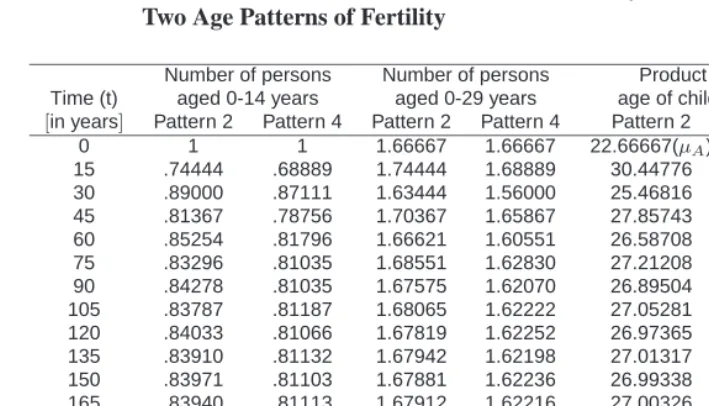
Consider a 3 reproductive age group model, and let the number of persons under age 15 at time 0 be scaled to 1. With the change in regimes fromλAtoλBoccurring at time 0, equations (27) and (30) describe the subsequent behavior of the population. Table 4 and Figure 1 show the birth trajectory (i.e. the number of persons under age 15) when λA = 1.5andλB = 1under two different patterns of fertility, specifically Patterns 2 and 4 of Table 3. After the fall in fertility to replacement level, the number of births falls sharply, then recovers some, and eventually approaches its ultimate stationary level. When all of theλ1values in equation (30) are the same, equation (26 ) applies. With the initial number of births scaled to 1, equation (27) indicates that the ultimate birth level is
µA
µB. Table 4 and Figure 2 show howµMtmoves fromµAtoµB along a path similar to
that of the birth trajectory. Consistent with Preston (1986) and Kim and Schoen (1997), the number of persons under age 30 remains quite level during the transition.
The concept of population momentum, introduced in Keyfitz (1971), refers to the increase in population size that accompanies the transition to zero growth. Given a drop to replacement level fertility at a specified initial time, momentum,Ω, is the ratio of the total size of the ultimate stationary population to the total size of the initial population. Mathematically, it can be written (cf. Schoen and Jonsson 2003)
Ω =be0Q (44)
Figure 1: The Birth Trajectory Following a Transition, at Time 0, From a Stable (λA= 1.5) to a Stationary (λB= 1) Regime, Under Two Fertility Patterns
-20 30 80 130 180 230 280
Time (t) 0.6
0.7 0.8 0.9 1.0
Population Age 0-14
∞
Figure 2: The Cumulative Mean Age of Childbearing (µMt) Following a Transition, at Time 0, From a Stable (λA= 1.5) to a Stationary (λB = 1) Regime, Under Two Fertility Patterns
-20 30 80 130 180 230 280
Time (t) 21
23 25 27 29 31 33 35 37
µ
M t
Table 4: The Birth Trajectory and Related Measures Following a Transition, at Time 0, From a Stable (λA=1.5) to a Stationary (λB=1) Regime, Under Two Age Patterns of Fertility
Number of persons Number of persons Product matrix mean Time (t) aged 0-14 years aged 0-29 years age of childbearing (µMt)
[in years] Pattern 2 Pattern 4 Pattern 2 Pattern 4 Pattern 2 Pattern 4 0 1 1 1.66667 1.66667 22.66667(µA) 24.33333 (µA) 15 .74444 .68889 1.74444 1.68889 30.44776 35.32258 30 .89000 .87111 1.63444 1.56000 25.46816 27.93367 45 .81367 .78756 1.70367 1.65867 27.85743 30.89729 60 .85254 .81796 1.66621 1.60551 26.58708 29.74897 75 .83296 .81035 1.68551 1.62830 27.21208 30.02830 90 .84278 .81035 1.67575 1.62070 26.89504 30.02804 105 .83787 .81187 1.68065 1.62222 27.05281 29.97196 120 .84033 .81066 1.67819 1.62252 26.97365 30.01686 135 .83910 .81132 1.67942 1.62198 27.01317 29.99213 150 .83971 .81103 1.67881 1.62236 26.99338 30.00292 165 .83940 .81113 1.67912 1.62216 27.00326 29.99922 180 .83956 .81111 1.67896 1.62224 26.99829 30.00001 195 .83948 .81111 1.67904 1.62222 27.00073 30.00011 210 .83952 .81111 1.67901 1.62222 26.99945 29.99986 225 .83951 .81111 1.67903 1.62222 27.00000 30.00001 240 .83952 .81111 1.67903 1.62222 26.99959 29.99990
∞ .83951 .81111 1.67901 1.62222 27.00000(µB) 30.00000(µB)
Note: Equation (30) is summed through the16thterm. Under Fertility Pattern 2,λ
2=−.2andλ3=−.5. Under Fertility Pattern 4,λ2=−.4 +.2iandλ3=−.4−.2i.
initial birth cohort. As indicated above, in the IDM
Q=µµA
B . (45)
When fertility falls, the mean age at childbearing in an IDM rises. The ratio of initial to ultimate mean ages of childbearing mirrors the ratio of initial to ultimate birth cohort sizes.
5.4 Momentum following a gradual or irregular decline to zero growth
That relationship, made applicable to any initial population by equation (42), means that the IDM context can be used to examine the population growth associated with any arbitrary route to stationarity. The subject has received considerable attention recently for several reasons. Substantively, Bongaarts and Bulatao (1999) found that momen-tum effects are likely to account for most of the future growth in the world’s popula-tion. Analytically, Schoen and Kim (1998), Li and Tuljapurkar (1999; 2000), Goldstein (2002), Goldstein and Stecklov (2002), and Schoen and Jonsson (2003) have extended techniques for finding momentum under a variety of paths to zero growth. That work has demonstrated the dramatic increases in ultimate population size that result from delays in achieving zero growth. All of those approaches, however, are either approximate, impose substantial constraints on the length or pattern of decline, or both.
Equation (27) can yield exact solutions for essentially any path to zero growth in terms of initial mean ageµM0, ultimate stationary mean ageµB, and the product of the nonstationary PPM growth rates between initial time 0 and the time,B, when the rates attain their final stationary level. Mathematically, withQ∗ denoting the relative size of the ultimate birth cohort,
Q∗=
B
j=1
λ1j
µM0
µB . (46)
In the intrinsically dynamic population, ultimate birth cohort size is determined by the product of individual PPM intrinsic growth rates, modified only by the initial and ultimate product matrix mean ages at childbearing. Momentum follows immediately from equation (44).
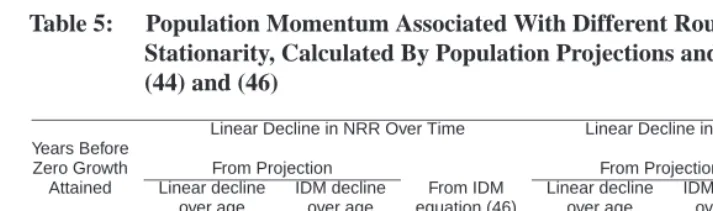
Table 5 compares population momentum values from equations (44) and (46) with those from population projections under a range of assumptions about the length and pattern of fertility decline. The initial population is the IDM withλ1 = 1.5,λ2 =−.2, andλ3 = −.5, which has an NRR of1.90. Under contemporary conditions, the value ofbe0 for that population is approximately 2, and that value is used in the calculations. Two different patterns of decline over time are considered, one linear with respect to the NRR, and the other linear with respect toλ1. One projection is done assuming a linear (proportional) decline over age, and the other assuming that the pattern of decline keeps the subordinate eigenvalues constant.
Table 5: Population Momentum Associated With Different Routes to
Stationarity, Calculated By Population Projections and By Equations (44) and (46)
Linear Decline in NRR Over Time Linear Decline in PPMλ1Over Time Years Before
Zero Growth From Projection From Projection
Attained Linear decline IDM decline From IDM Linear decline IDM decline From IDM over age over age equation (46) over age over age equation (46) 0 1.714 1.679 1.679 1.714 1.679 1.679 15 2.143 2.099 2.099 2.128 2.099 2.099 30 2.678 2.612 2.612 2.645 2.612 2.612 45 3.344 3.247 3.247 3.285 3.247 3.247
Note: Initial population stable atλ1= 1.5with NRR= 1.90. IDM subordinate roots areλ2=−.2andλ3=−.5.
In all models, the product of the initial birth rate and the ultimate life expectancy is set at 2.
case of linear NRR declines. Because that NRR/growth relationship does not hold when fertility changes proportionally over all ages, the linear decline in λ1 projections yield slightly different results from the linear decline in NRR projections. The rather modest effect associated with different age patterns of fertility decline can be seen as enhancing the value of equations (44) and (46), as it suggests that the age pattern required by the constant subordinate root assumption has only a small effect on momentum. In addition to validating the analytical results presented, Table 5 shows how delays in attaining zero growth greatly increase momentum. In the case considered, the population would grow from1to1.7if stationary rates were achieved immediately, but would grow to over3.2if the decline took place over 45 years.
6. Summary and conclusions
Intrinsically dynamic models, based on an assumption of constant subordinate roots, have been developed to provide a new approach to analyzing populations with changing rates. Because of the constraints on the age pattern of fertility associated with that assumption, attention is focused on the discrete (Leslie) model with 15 year age intervals. Equations (27) and (30) provide a complete solution for the population produced by any time pattern of change in the level of fertility (or in period-by-period growth levels).
References
Bennett, N.G. and S. Horiuchi. (1981). Estimating the completeness of death registration in a closed population. Population Index, 47, 207-21.
Birkhoff, G. and S. MacLane. (1959). A survey of modern algebra (rev. ed). New York: Macmillan.
Bongaarts, J. and R.A. Bulatao. (1999). Completing the demographic transition.
Popula-tion and Development Review, 25, 515-29.
Caswell, H. (2001). Matrix population models (2d ed). Sunderland MA: Sinauer.
Coale, A.J. (1972). The growth and structure of human populations. Princeton: Princeton University Press.
Gantmacher, F.R. (1959). Matrix theory. New York: Chelsea.
Goldstein, J.R. (2002). Population momentum for gradual demographic transitions: An alternative approach. Demography, 39, 65-73.
Goldstein, J.R. and G. Stecklov. (2002). Long-range population projections made simple.
Population and Development Review, 28, 121-41.
Keyfitz, N. (1968). Introduction to the mathematics of population. Reading MA: Addison-Wesley.
Keyfitz, N. (1971). On the momentum of population growth. Demography, 8, 71-80.
Kim, Y.J. (1987). Dynamics of populations with changing rates: Generalization of stable population theory. Theoretical Population Biology, 31, 306-22.
Kim, Y.J. and R. Schoen. (1993). On the intrinsic force of convergence to stability.
Mathematical Population Studies, 4, 89-102.
Kim, Y.J. and R. Schoen. (1996). Populations with quadratic exponential growth.
Math-ematical Population Studies, 6, 19-33.
Kim, Y.J. and R. Schoen. (1997). Population momentum expresses population aging.
Demography, 34, 421-27.
Lee, R. (1974). The formal dynamics of controlled populations and the echo, the boom, and the bust. Demography, 11, 563-85.
Leslie, P.H. (1945). On the use of matrices in certain population mathematics. Biometrika,
33, 183-212.
Li, N. and S. Tuljapurkar. (1999). Population momentum for gradual demographic tran-sitions. Population Studies, 53, 255-62.
Li, N. and S. Tuljapurkar. (2000). The solution of time-dependent population models.
Mathematical Population Studies, 7, 311-29.
Lotka, A.J. (1939). Theorie analytique des associations biologiques. Paris: Hermann.
Pollard, J.H. (1973). Mathematical models for the growth of human populations. Cam-bridge: Cambridge University Press.
Preston, S.H. (1986). The relation between actual and intrinsic growth rates. Population
Studies, 40, 495-501.
Preston, S.H. and A.J. Coale. (1982). Age structure, growth, attrition, and accession: A new synthesis. Population Index, 48, 217-59.
Rogers, A. (1975). Introduction to multiregional mathematical demography. New York: Wiley.
Schoen, R. (1988). Modeling multigroup populations. New York: Plenum.
Schoen, R. (2003). Dynamic populations with uniform natural increase across states.
Mathematical Population Studies, 10, 195-210.
Schoen, R. and S.H. Jonsson. (2003). Modeling momentum in gradual demographic transitions. Demography, 40, 621-35.
Schoen, R. and Y.J. Kim. (1994a). Cyclically stable populations. Mathematical
Popula-tion Studies, 4, 283-95.
Schoen, R. and Y.J. Kim. (1994b). Hyperstability. Paper presented at the Annual Meeting
of the Population Association of America, Miami, May 5-7.
Schoen, R. and Y.J. Kim. (1996). Stabilization, birth waves, and the surge in the elderly.
Schoen, R. and Y.J. Kim. (1997). Exploring cyclic net reproduction. Mathematical
Population Studies, 6, 277-90.
Schoen, R. and Y.J. Kim. (1998). Momentum under a gradual approach to zero growth.
Population Studies, 52, 295-99.
Tuljapurkar, S. (1990). Population dynamics in variable environments (Vol. 85). New York: Springer.
Tuljapurkar, S.D. (1993). Entropy and convergence in dynamics and demography.
Jour-nal of Mathematical Biology, 31, 253-71.
Appendix
1. In some cases, the series in equation (19) can be summed algebraically. For example, if
λ1,t−τ = {λ1 +0{1 +bsinbsinω[tω−[tτ−−τ1]]}}
Maple summation finds that(µ1
Mt)is of the form
1
µMt
= 1 +C1t+C2tsinωt+C3tcosωt
where C1t = λ2
(λ0−λ2)(1 +bsinωt)
C2t = (λ2 bλ2(λ2−λ0cosω)
2−2λ0λ2cosω+λ20)(1 +bsinωt)
and C3t = −bλ0λ2(sinω)
(λ2
2−2λ0λ2cosω+λ20)(1 +bsinωt).
2. The cubic characteristic equation of the 3 age group Leslie matrix given in equation (22) has the roots
λ1 = [2a+Z+
(12b+4a2)
Z ] 6
λ2 = [4a−Z−
(12b+4a2)
Z ]
12 + (
√
3i
12 )[Z−
(12b+ 4a2)
Z ]
λ3 = [4a−Z−
(12b+4a2)
Z ]
12 −(
√
3i
12 )[Z−
(12b+ 4a2)
Z ] where