www.theoryofgroups.ir
ISSN (print): 2251-7650, ISSN (on-line): 2251-7669 Vol. 8 No. 3 (2019), pp. 43-64.
c
⃝2019 University of Isfahan
www.ui.ac.ir
TRANSITIVE t-DESIGNS AND STRONGLY REGULAR GRAPHS
CONSTRUCTED FROM LINEAR GROUPS L(2, q), q≤23
DEAN CRNKOVI ´C AND ANDREA ˇSVOB∗
Communicated by Attila Maroti
Abstract. In this paper we construct transitive t-designs from the linear groups L(2, q), q ≤ 23. Thereby we classifyt-designs,t≥2, admitting a transitive action of the linear groupsL(2, q), q≤23,
up to 35 points and obtained numerous transitive designs, for 36≤v≤55. In many cases we proved
the existence oft-designs with certain parameter sets. Among others we constructed t-designs with
parameters 2-(55,10,4), 3-(24,11,495), 3-(24,12,5m), m ∈ {11,12,22,33,44,66,132}. Furthermore,
we constructed strongly regular graphs admitting a transitive action of the linear groupsL(2, q), q≤23.
1. Introduction
We assume that the reader is familiar with the basic facts of group theory, design theory and theory of strongly regular graphs. We refer the reader to [2,19], [7,17] and [2,3,19] for related background materials in design theory, group theory and theory of strongly regular graphs, respectively.
An incidence structure is an ordered triple D = (P,B,I) where P and B are non-empty disjoint sets and I ⊆ P × B. The elements of the set P are called points, the elements of the setB are called blocks and I is called an incidence relation. An incidence structure that does not contain repeated blocks (blocks incident with the same set of points) is called simple. If |P|=|B|, then the incidence structure is called symmetric. The incidence matrix of an incidence structure is a v×b matrix [mij]
MSC(2010): Primary: 05E18; Secondary: 05B05, 20D06, 05E30.
Keywords: t-design, strongly regular graph, linear group, transitive group. Received: 08 July 2017, Accepted: 09 August 2017.
∗Corresponding autho.
http://dx.doi.org/10.22108/ijgt.2017.21613
where v and b are the numbers of points and blocks respectively, such that mij = 1 if the point Pi and the block xj are incident, and mij = 0 otherwise. An isomorphism from one incidence structure to another is a bijective mapping of points to points and blocks to blocks which preserves incidence. An isomorphism from an incidence structure D onto itself is called an automorphism of D. The set of all automorphisms forms a group called the full automorphism group ofDand is denoted byAut(D).
At-(v, k, λ) design is a finite incidence structureD= (P,B,I) satisfying the following requirements:
(1) |P|=v,
(2) every element of B is incident with exactlyk elements ofP, (3) every telements of P are incident with exactlyλelements of B.
If D is a t-design, then it is also ans-design, for 1≤s≤t−1. A 2-(v, k, λ) design is called a block design. We say that a t-(v, k, λ) design D is a quasi-symmetric design with intersection numbers x
and y (x < y) if any two blocks of D intersect in eitherx ory points.
A graph is regular if all the vertices have the same degree; a regular graph is strongly regular of type (v, k, λ, µ) if it hasv vertices, degreek, and if any two adjacent vertices are together adjacent to
λvertices, while any two non-adjacent vertices are together adjacent toµvertices. A strongly regular graph of type (v, k, λ, µ) is usually denoted by SRG(v, k, λ, µ).
In this paper we consider t-designs and strongly regular graphs constructed from the linear groups
L(2, q), q≤23.
The group L(2, q) acts 3-transitively on subsets of size 3 of the projective line if q ≡ 3(mod 4). Thereby, unions of orbits of a subgroup ofL(2, q) produce simple 3-designs under the action ofL(2, q). However, if q≡1(mod 4), the action is not 3-transitive so we do not have to obtain 3-designs. In [6], Cameron, Maimani, Omidi and Tayfeh-Rezaie determined all 3-designs admitting an automorphism group isomorphic to L(2, q) with block size not congruent to 0 and 1 modulo p, where q = pn is a prime power congruent to 3 modulo 4. Further information on the research regarding linear groups
L(2, q), where q≡1(mod 4), can be found in [1], but the whole enumeration of t-designs admitting a transitive action of the groups L(2, q), q≤23, have not been described so far.
Generators of the linear groupsL(2, q), q≤23 are available via the Internet:
http://brauer.maths.qmul.ac.uk/Atlas/. All the t-designs are obtained by using programmes written for Magma [5].
The paper is organized as follows: in Section 2 we briefly describe the method of construction of transitive designs and graphs used in this paper, and in Section3 we describe t-designs and strongly regular graphs constructed under the action of the linear groups L(2, q), q≤23.
2. Designs and graphs constructed from groups
We say that an incidence structureIis transitive if an automorphism group ofIacts transitively on points and blocks. An incidence structure I is called primitive if an automorphism group acts primi-tively on points and blocks. Further, we say that graph Γ is transitive (primitive) if an automorphism group acts transitively (primitively) on the set of vertices of the graph Γ.
The construction of primitive symmetric 1-designs and regular graphs for which the stabilizer of a point and the stabilizer of a block are conjugate is presented in [11], [12] and [13]. The generalization,
i.e. the method for constructing not necessarily symmetric but still primitive 1-designs, is presented in [8] and [9]. In [10], a construction of not necessarily primitive, but still transitive block designs is presented.
Theorem 2.1 ([10]). Let G be a finite permutation group acting transitively on the sets Ω1 and Ω2 of size m and n, respectively. Let α ∈Ω1 and ∆2 =∪si=1δiGα, where Gα={g ∈G | αg =α} is the
stabilizer of α and δ1, . . . , δs∈Ω2 are representatives of distinct Gα-orbits on Ω2. If ∆2̸= Ω2 and
B={∆2g:g∈G},
then D(G, α, δ1, . . . , δs) = (Ω2,B) is a 1-(n,|∆2|,|G|Gα|
∆2|
∑s
i=1|αGδi|) design with m|G·|Gα|
∆2| blocks. The group H ∼=G/∩x∈Ω
2Gx acts as an automorphism group on (Ω2,B), transitively on points and blocks of the design.
If ∆2= Ω2 then the set B consists of one block, and D(G, α, δ1, . . . , δs) is a design with parameters 1-(n, n,1).
If the groupG acts t-transitively on the set Ω2, then the obtained design (Ω2,B) is at-design (see
[10]). However, if Gdoes not actt-transitively on the set Ω2, the obtained design (Ω2,B) may still be
a t-design.
In this paper we describe construction of t-designs, for t ≥ 2, from linear groups L(2, q), q ≤ 23, obtained by using Theorem 2.1.
Corollary 2.2. If Ω1 = Ω2 and ∆2 is a union of self-paired and mutually paired orbits of Gα, then
the design D(G, α, δ1, . . . , δs) is a symmetric self-dual design and the incidence matrix of that design
If Gα =G∆2, we can interpret the design (Ω2,B) from Theorem2.1 in the following way:
• the point set is Ω2, • the block set is Ω1 =αG,
• the blockαg′ is incident with the set of points{δig:g∈Gαg′, i= 1, . . . , s}= ∆2g′.
If Gα ̸=G∆2, then the above described design with the block set Ω1 has repeated blocks, and the corresponding simple design is the design (Ω2,B) from Theorem 2.1, which has m|G·|Gα|
∆2| blocks.
Note that the construction from Theorem 2.1 gives us 1-designs and regular graphs. Since every
t-design, for t≥1, is also a 1-design, Theorem2.1gives us all designs which admit a transitive action of the groupGon points and blocks. Using this method of construction we obtained all 1-designs and regular graphs admitting a transitive action of the linear groups L(2, q), q≤23 but we recorded only those 1-designs that are also t-designs,t≥2, and those regular graphs that are strongly regular.
3. Results
In this section we list allt-designs and strongly regular graphs that we constructed using the method described in Section2. Each subsection contains the information about the linear group that we used, subgroups of the group and it’s properties and the data about obtained t-designs. The last section contains information about constructed strongly regular graphs. For each constructed structure (t -design and strongly regular graph) we give the structure of the full automorphism group, the number of non-isomorphict-designs and remarks about constructedt-design and SRG. In tables to follow, for designs indicated by∗ we proved the existence in terms of parameters.
3.1. Transitive t-designs from L(2,5). It is well known (see [7]) that the groupL(2,5)∼=L(2,4)∼=
A5. The linear groupL(2,5) is the simple group of order 60 and up to conjugation it has 9 subgroups. In Table 1 we give the list of all the subgroups, up to conjugation. We classify t-designs, t ≥ 2, admitting transitive action of the group L(2,5). The constructed designs are presented in Table2.
Table 1. Subgroups of the groupL(2,5)
Structure Order Index Primitive Structure Order Index Primitive
I 1 60 No S3 6 10 Yes
Z2 2 30 No D10 10 6 Yes
Z3 3 20 No A4 12 5 Yes
E4 4 15 No A5 60 1 No
Table 2. t-designs constructed from the groupL(2,5)
Parameters of designs # of blocks # non-isomorphic Full automorphism group
2-(6,3,2) 10 1 A5
2-(10,3,2) 30 1 A5
2-(10,4,2) 15 1 S6
2-(10,4,8) 60 1 S5
2-(15,7,3) 15 1 A8
2-(15,7,12) 60 1 GL(2,4) :Z2
2 GL(2,4)
Remark 3.1. Transitive t-designs described in Table 2 were all previously known. For further
infor-mation on quasi-symmetric 2-(10,4,2) we refer the reader to [18] and for other designs we refer the reader to [16].
3.2. Transitive t-designs from L(2,7). The linear group L(2,7) is the simple group of order 168 and up to conjugation it has 15 subgroups. It is well known (see [7]) thatL(2,7)∼=L(3,2). We classify
t-designs, t≥2,v <56 admitting transitive action of the groupL(2,7). In Table3we give the list of all the subgroups, up to conjugation, and in Table 4 we present the constructed designs.
Table 3. Subgroups of the groupL(2,7)
Structure Order Index Primitive Structure Order Index Primitive
I 1 168 No D8 8 21 No
Z2 2 84 No A4 12 14 No
Z3 3 56 No A4 12 14 No
E4 4 42 No Z7 :Z3 21 8 Yes
E4 4 42 No S4 24 7 Yes
Z4 4 42 No S4 24 7 Yes
S3 6 28 No L(2,7) 168 1 No
Table 4. t-designs constructed from the group L(2,7),v <56
Parameters of designs # of blocks # non-isomorphic Full automorphism group
2-(7,3,1) 7 1 L(2,7)
2-(7,3,4) 28 1 L(2,7)
3-(8,3,1) 56 1 S8
3-(8,4,1) 14 1 E8 :L(2,7)
3-(8,4,3) 42 1 L(2,7) :Z2
2-(21,5,4) 84 2 L(2,7)
2-(28,9,16)∗ 168 85 L(2,7)
5 L(2,7)
2-(28,10,20)∗ 168 1 E8 :L(2,7)
8 L(2,7) :Z2
213 L(2,7)
Remark 3.2. Designs with parameters 2-(28,9,16) and 2-(28,10,20) are not mentioned in the [16]
since r >41. Up to our best knowledge they have not been known before, so we proved the existence of the 2-(28,9,16)and 2-(28,10,20). All others transitivet-designs described in Table 4 were previously known (see [14,16] ). For further information on unique quasi-symmetric 3-(8,4,1) design we refer the reader to [18].
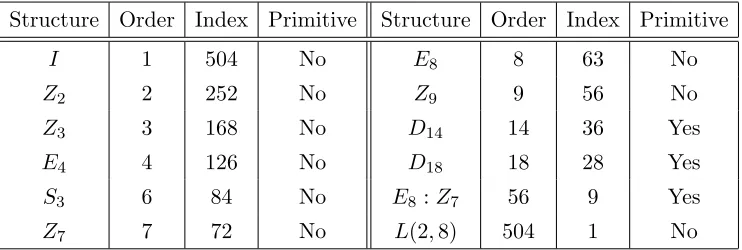
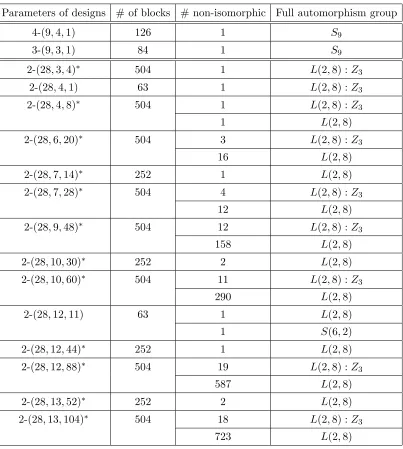
3.3. Transitivet-designs fromL(2,8). The linear groupL(2,8) is the simple group of order 504 and up to conjugation it has 12 subgroups, given in Table5. We classifyt-designs,t≥2,v≤28 admitting transitive action of the group L(2,8) and the obtained designs are listed in Table 6. Additionally, we classify t-designs, t≥2,v = 36, b≤252 admitting transitive action of the group L(2,8) and the obtained designs are listed in Table 7.
Table 5. Subgroups of the groupL(2,8)
Structure Order Index Primitive Structure Order Index Primitive
I 1 504 No E8 8 63 No
Z2 2 252 No Z9 9 56 No
Z3 3 168 No D14 14 36 Yes
E4 4 126 No D18 18 28 Yes
S3 6 84 No E8:Z7 56 9 Yes
Table 6. t-designs constructed from the group L(2,8),v≤28
Parameters of designs # of blocks # non-isomorphic Full automorphism group
4-(9,4,1) 126 1 S9
3-(9,3,1) 84 1 S9
2-(28,3,4)∗ 504 1 L(2,8) :Z3
2-(28,4,1) 63 1 L(2,8) :Z3
2-(28,4,8)∗ 504 1 L(2,8) :Z3
1 L(2,8)
2-(28,6,20)∗ 504 3 L(2,8) :Z3
16 L(2,8)
2-(28,7,14)∗ 252 1 L(2,8)
2-(28,7,28)∗ 504 4 L(2,8) :Z3
12 L(2,8)
2-(28,9,48)∗ 504 12 L(2,8) :Z3
158 L(2,8)
2-(28,10,30)∗ 252 2 L(2,8)
2-(28,10,60)∗ 504 11 L(2,8) :Z3
290 L(2,8)
2-(28,12,11) 63 1 L(2,8)
1 S(6,2)
2-(28,12,44)∗ 252 1 L(2,8)
2-(28,12,88)∗ 504 19 L(2,8) :Z3
587 L(2,8)
2-(28,13,52)∗ 252 2 L(2,8)
2-(28,13,104)∗ 504 18 L(2,8) :Z3
Table 7. t-designs constructed from the group L(2,8),v= 36, b≤252
Parameters of designs # of blocks # non-isomorphic Full automorphism group
2-(36,5,4) 252 1 L(2,8)
2-(36,6,2) 84 1 L(2,8) :Z3
2-(36,6,6)∗ 252 3 L(2,8) :Z3
2-(36,10,9) 126 1 L(2,8) :Z3
2-(36,10,18)∗ 252 4 L(2,8) :Z3
1 L(2,8)
2-(36,11,22)∗ 252 4 L(2,8) :Z3
2-(36,15,28)∗ 168 1 L(2,8) :Z3
1 L(2,8)
2-(36,16,12) 63 1 L(2,8) :Z3
1 S(6,2)
2-(36,16,48)∗ 252 2 L(2,8) :Z3
Remark 3.3. For t = 3,4 designs described in Table 6 were known before. For quasi-symmetric
2-(28,4,1), 2-(28,12,11) and 2-(36,16,12) designs we refer the reader to [10, 16, 18]. Majority of
2-designs listed in Table 6 and Table7 haver >41.
3.4. Transitivet-designs fromL(2,9). It is well known (see [7]) thatL(2,9)∼=S(4,2)′ ∼=A6 ∼=M10′ . The linear group L(2,9) is the simple group of order 360 and up to conjugation it has 22 subgroups, listed in Table8. We classify t-designs, t≥2,v≤30 admitting transitive action of the group L(2,8) and the obtained designs are listed in Table 9. Additionally, we classify t-designs, t ≥ 2, v = 36,
b≤180 andv= 40, b≤180 admitting transitive action of the groupL(2,9) and the obtained designs are listed in Table10.
Table 8. Subgroups of the groupL(2,9)
Structure Order Index Primitive Structure Order Index Primitive
I 1 360 No E9 9 40 No
Z2 2 180 No D10 10 36 No
Z3 3 120 No A4 12 30 No
Z3 3 120 No A4 12 30 No
E4 4 90 No E9 :Z2 18 20 No
E4 4 90 No S4 24 15 Yes
Z4 4 90 No S4 24 15 Yes
Z5 5 72 No E9 :Z4 36 10 Yes
S3 6 60 No A5 60 6 Yes
S3 6 60 No A5 60 6 Yes
Table 9. t-designs constructed from the group L(2,9),v≤30
Parameters of designs # of blocks # non-isomorphic Full automorphism group
3-(6,3,1) 20 1 S6
3-(10,4,6) 180 1 A6 :E4
3-(10,5,3) 36 1 A6.Z2
2-(10,3,4) 60 1 S6
2-(10,4,2) 15 1 S6
2-(10,5,20)∗ 90 1 S6
2-(15,7,3) 15 1 A8
2-(15,7,24)∗ 120 1 A8
2-(15,7,36)∗ 180 1 S6
2-(15,7,72)∗ 360 1 A6
2 S6
Table 10. t-designs constructed from the groupL(2,9), v= 36,40, b≤180
Parameters of designs # of blocks # non-isomorphic Full automorphism group
2-(36,8,4) 90 1 S6
2-(36,15,12) 72 1 A6
1 S6
2-(36,15,30)∗ 180 3 A6
2-(40,13,4) 40 1 L(4,3) :Z2
Remark 3.4. Fort= 3 designs described in Table9 were known before.
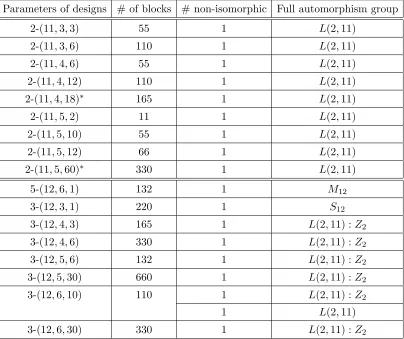
3.5. Transitive t-designs fromL(2,11). The linear group L(2,11) is the simple group of order 660 and up to conjugation it has 16 subgroups, which are listed in Table 11. In Table 12 we give the information on the obtained designs.
Table 11. Subgroups of the group L(2,11)
Structure Order Index Primitive Structure Order Index Primitive
I 1 660 No D10 10 66 No
Z2 2 330 No Z11 11 60 No
Z3 3 220 No A4 12 55 No
E4 4 165 No D12 12 55 Yes
Z5 5 132 No Z11:Z5 55 12 Yes
S3 6 110 No A5 60 11 Yes
S3 6 110 No A5 60 11 Yes
Z6 6 110 No L(2,11) 660 1 No
Table 12. t-designs constructed from the groupL(2,11), v <55
Parameters of designs # of blocks # non-isomorphic Full automorphism group
2-(11,3,3) 55 1 L(2,11)
2-(11,3,6) 110 1 L(2,11)
2-(11,4,6) 55 1 L(2,11)
2-(11,4,12) 110 1 L(2,11)
2-(11,4,18)∗ 165 1 L(2,11)
2-(11,5,2) 11 1 L(2,11)
2-(11,5,10) 55 1 L(2,11)
2-(11,5,12) 66 1 L(2,11)
2-(11,5,60)∗ 330 1 L(2,11)
5-(12,6,1) 132 1 M12
3-(12,3,1) 220 1 S12
3-(12,4,3) 165 1 L(2,11) :Z2
3-(12,4,6) 330 1 L(2,11) :Z2
3-(12,5,6) 132 1 L(2,11) :Z2
3-(12,5,30) 660 1 L(2,11) :Z2
3-(12,6,10) 110 1 L(2,11) :Z2
1 L(2,11)
Table 13. t-designs constructed from the group L(2,11), v= 55, b≤330
Parameters of designs # of blocks # non-isomorphic Full automorphism group
2-(55,9,8)∗ 330 2 L(2,11)
2-(55,10,4)∗ 132 2 L(2,11)
2-(55,10,10)∗ 330 6 L(2,11)
2-(55,18,34)∗ 330 1 L(2,11) :Z2
29 L(2,11)
2-(55,19,38)∗ 330 7 L(2,11)
2-(55,27,78)∗ 330 1 L(2,11) :Z2
48 L(2,11)
Remark 3.5. For t > 2 we refer the reader to [14]. The design 5-(12,6,1) is famous Witt design, W12, on which the Mathieu group M12 acts 5-transitively. For further information on W12 we refer the reader to [20,21].
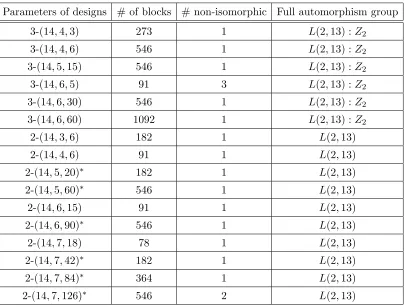
3.6. Transitivet-designs fromL(2,13). The linear groupL(2,13) is the simple group of order 1092 and up to conjugation it has 16 subgroups. We classify t-designs, t≥2, v < 78 admitting transitive action of the group L(2,13). These subgroups are listed in Table 14, and in Table 15 we give the information on the obtained designs.
Table 14. Subgroups of the group L(2,13)
Structure Order Index Primitive Structure Order Index Primitive
I 1 1092 No D12 12 91 Yes
Z2 2 546 No A4 12 91 Yes
Z3 3 364 No Z13 13 84 No
E4 4 273 No D14 14 78 Yes
S3 6 182 No D26 26 42 No
S3 6 182 No Z13:Z3 39 28 No
Z6 6 182 No Z13:Z6 78 14 Yes
Table 15. t-designs constructed from the groupL(2,13), v <78
Parameters of designs # of blocks # non-isomorphic Full automorphism group
3-(14,4,3) 273 1 L(2,13) :Z2
3-(14,4,6) 546 1 L(2,13) :Z2
3-(14,5,15) 546 1 L(2,13) :Z2
3-(14,6,5) 91 3 L(2,13) :Z2
3-(14,6,30) 546 1 L(2,13) :Z2
3-(14,6,60) 1092 1 L(2,13) :Z2
2-(14,3,6) 182 1 L(2,13)
2-(14,4,6) 91 1 L(2,13)
2-(14,5,20)∗ 182 1 L(2,13)
2-(14,5,60)∗ 546 1 L(2,13)
2-(14,6,15) 91 1 L(2,13)
2-(14,6,90)∗ 546 1 L(2,13)
2-(14,7,18) 78 1 L(2,13)
2-(14,7,42)∗ 182 1 L(2,13)
2-(14,7,84)∗ 364 1 L(2,13)
2-(14,7,126)∗ 546 2 L(2,13)
Remark 3.6. Fort= 3 we refer the reader to [14].
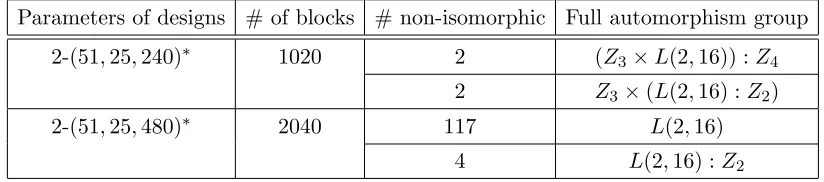
3.7. Transitivet-designs fromL(2,16). The linear groupL(2,16) is the simple group of order 4080 and up to conjugation it has 21 subgroups, listed in Table 16. We classify t-designs, t ≥ 2, v < 51 admitting transitive action of the group L(2,16). The constructed designs are described in Table 17. Additionally, we classifyt-designs, t≥2, v= 51,b≤2040 admitting transitive action of the group
Table 16. Subgroups of the group L(2,16)
Structure Order Index Primitive Structure Order Index Primitive
I 1 4080 No Z15 15 272 No
Z2 2 2040 No E16 16 255 No
Z3 3 1360 No Z17 17 240 No
E4 4 1020 No D30 30 136 Yes
E4 4 1020 No D34 34 120 Yes
E4 4 1020 No E16:Z3 48 85 No
Z5 5 816 No A5 60 68 Yes
S3 6 680 No E16:Z5 80 51 No
E8 8 510 No E16:Z15 240 17 Yes
D10 10 408 No L(2,16) 4080 1 No
A4 12 340 No
Table 17. t-designs constructed from the groupL(2,16), v <51
Parameters of designs # of blocks # non-isomorphic Full automorphism group
4-(17,7,6) 408 1 L(2,16) :Z4
4-(17,7,60) 4080 1 L(2,16) :Z4
4-(17,8,15) 510 1 L(2,16) :Z4
4-(17,8,120) 4080 1 L(2,16) :Z4
3-(17,3,1) 680 1 S17
3-(17,4,2) 340 1 L(2,16) :Z4
3-(17,4,6) 1020 1 L(2,16) :Z2
3-(17,5,1) 68 1 L(2,16) :Z4
3-(17,5,15) 1020 1 L(2,16) :Z2
3-(17,5,60) 4080 1 L(2,16) :Z4
3-(17,6,20) 680 1 L(2,16) :Z2
3-(17,6,24) 816 1 L(2,16) :Z4
3-(17,6,60) 2040 1 L(2,16) :Z4
1 L(2,16)
3-(17,7,70) 1360 1 L(2,16) :Z2
3-(17,7,105) 2040 2 L(2,16)
3-(17,8,56) 680 2 L(2,16) :Z2
3-(17,8,168) 2040 1 L(2,16) :Z4
1 L(2,16)
Table 18. t-designs constructed from the group L(2,16), v= 51, b≤2040
Parameters of designs # of blocks # non-isomorphic Full automorphism group
2-(51,25,240)∗ 1020 2 (Z3×L(2,16)) :Z4
2 Z3×(L(2,16) :Z2)
2-(51,25,480)∗ 2040 117 L(2,16)
4 L(2,16) :Z2
Remark 3.7. For designs witht= 3,4 we refer the reader to[14].
3.8. Transitivet-designs fromL(2,17). The linear groupL(2,17) is the simple group of order 2448 and up to conjugation it has 22 subgroups. The subgroups are listed in Table19, and the constructed designs are given in Table 20. We classify t-designs, t≥2, v <36 admitting transitive action of the group L(2,17) and the obtained designs are listed in Table 20. Additionally, we classify t-designs,
t≥2,v= 36,b≤1224 admitting transitive action of the group L(2,17) and the obtained designs are listed in Table 21.
Table 19. Subgroups of the group L(2,17)
Structure Order Index Primitive Structure Order Index Primitive
I 1 2448 No A4 12 204 No
Z2 2 1224 No A4 12 204 No
Z3 3 816 No D16 16 153 Yes
E4 4 612 No Z17 17 144 No
E4 4 612 No D18 18 136 Yes
Z4 4 612 No S4 24 102 Yes
S3 6 408 No S4 24 102 Yes
D8 8 306 No D34 34 72 No
D8 8 306 No Z17:Z4 68 36 No
Z8 8 306 No Z17:Z8 136 18 Yes
Table 20. t-designs constructed from the groupL(2,17), v <36
Parameters of designs # of blocks # non-isomorphic Full automorphism group
5-(18,8,16) 2448 1 L(2,17) :Z2
3-(18,4,6) 1224 2 L(2,17) :Z2
3-(18,5,15) 1224 1 L(2,17)
3-(18,6,10) 408 1 L(2,17) :Z2
3-(18,6,20) 816 1 L(2,17) :Z2
3-(18,6,30) 1224 1 L(2,17) :Z2
3-(18,6,60) 2448 2 L(2,17) :Z2
3-(18,8,42) 612 1 L(2,17) :Z2
2 L(2,17)
3-(18,8,84) 1224 2 L(2,17) :Z2
2 L(2,17)
3-(18,8,168) 2448 1 L(2,17) :Z2
3-(18,9,252) 2448 1 L(2,17) :Z2
2-(18,3,8)∗ 408 1 L(2,17)
2-(18,4,12)∗ 306 2 L(2,17)
2-(18,5,40)∗ 612 1 L(2,17)
2-(18,5,80)∗ 1224 2 L(2,17)
2-(18,6,10) 102 1 L(2,17)
2-(18,6,60)∗ 612 1 L(2,17)
2-(18,6,120)∗ 1224 2 L(2,17)
2-(18,6,240)∗ 2448 1 L(2,17)
2-(18,7,168)∗ 1224 11 L(2,17)
2-(18,7,336)∗ 2448 3 L(2,17)
2-(18,8,28)∗ 153 1 L(2,17)
2-(18,8,224)∗ 1224 2 L(2,17)
2-(18,8,448)∗ 2448 4 L(2,17)
2-(18,9,32)∗ 136 2 L(2,17)
2-(18,9,72)∗ 306 1 L(2,17)
2-(18,9,96)∗ 408 2 L(2,17)
2-(18,9,144)∗ 612 1 L(2,17)
2-(18,9,192)∗ 816 1 L(2,17)
2-(18,9,288)∗ 1224 9 L(2,17)
Table 21. t-designs constructed from the group L(2,17), v= 36, b≤1224
Parameters of designs # of blocks # non-isomorphic Full automorphism group
2-(36,15,68)∗ 408 3 L(2,17)
2-(36,15,136)∗ 816 7 L(2,17)
2-(36,15,204)∗ 1224 57 L(2,17)
Remark 3.8. For information on known 3-designs with 18 points the reader may consult[14].
3.9. Transitive t-designs from L(2,19). The linear group L(2,19) is the simple group of order 3420 and up to conjugation it has 19 subgroups. We classify t-designs, t ≥ 2, v < 57 admitting transitive action of the group L(2,19). These subgroups are listed in Table 22, and the information on constructed designs are given in Table 23.
Table 22. Subgroups of the group L(2,19)
Structure Order Index Primitive Structure Order Index Primitive
I 1 3420 No A4 12 285 No
Z2 2 1710 No D18 18 190 Yes
Z3 3 1140 No Z19 19 180 No
E4 4 855 No D20 20 171 Yes
Z5 5 684 No Z19:Z3 57 60 No
S3 6 570 No A5 60 57 Yes
Z9 9 380 No A5 60 57 Yes
D10 10 342 No Z19:Z9 171 20 Yes
D10 10 342 No L(2,19) 3420 1 No
Table 23. t-designs constructed from the groupL(2,19), v <57
Parameters of designs # of blocks # non-isomorphic Full automorphism group
3-(20,3,1) 1140 1 S20
3-(20,4,1) 285 1 L(2,19)
3-(20,4,3) 855 1 L(2,19) :Z2
3-(20,4,6) 1710 2 L(2,19) :Z2
3-(20,5,6) 684 1 L(2,19) :Z2
3-(20,5,10) 1140 1 L(2,19) :Z2
3-(20,5,30) 3420 2 L(2,19) :Z2
1 L(2,19)
3-(20,6,10) 570 1 L(2,19) :Z2
1 L(2,19)
3-(20,6,20) 1140 1 L(2,19) :Z2
3-(20,6,30) 1710 3 L(2,19) :Z2
3 L(2,19)
3-(20,6,60) 3420 2 L(2,19) :Z2
2 L(2,19)
3-(20,7,35) 1140 1 L(2,19) :Z2
2 L(2,19)
3-(20,7,105) 3420 9 L(2,19) :Z2
6 L(2,19)
3-(20,8,14) 285 1 L(2,19) :Z2
3-(20,8,28) 570 1 L(2,19) :Z2
1 L(2,19)
3-(20,8,42) 855 1 L(2,19) :Z2
1 L(2,19)
3-(20,8,84) 1710 3 L(2,19) :Z2
6 L(2,19)
3-(20,8,168) 3420 7 L(2,19) :Z2
11 L(2,19)
3-(20,9,28) 380 1 L(2,19) :Z2
3-(20,9,84) 1140 1 L(2,19) :Z2
1 L(2,19)
3-(20,9,252) 3420 12 L(2,19) :Z2
21 L(2,19)
3-(20,10,36) 342 1 L(2,19) :Z2
1 L(2,19)
3-(20,10,40) 380 1 L(2,19)
3-(20,10,120) 1140 3 L(2,19)
3-(20,10,180) 1710 5 L(2,19) :Z2
10 L(2,19)
3-(20,10,360) 3420 8 L(2,19) :Z2
Remark 3.9. For information on known 3-designs with 20 points the reader may consult[14].
3.10. Transitive t-designs from L(2,23). The linear group L(2,23) is the simple group of order 6072 and up to conjugation it has 23 subgroups, which are listed in Table 24. We classify t-designs,
t ≥ 2, v < 253 admitting transitive action of the group L(2,23). The information on constructed designs are given in Tables25 and 26.
Table 24. Subgroups of the group L(2,23)
Structure Order Index Primitive Structure Order Index Primitive
I 1 6072 No A4 12 506 No
Z2 2 3036 No D12 12 506 No
Z3 3 2024 No D12 12 506 No
E4 4 1518 No A4 12 506 No
E4 4 1518 No D22 22 276 Yes
Z4 4 1518 No Z23 23 264 No
Z6 6 1518 No S4 24 253 Yes
S3 6 1012 No S4 24 253 Yes
S3 6 1012 No D24 24 253 Yes
D8 8 759 No Z23:Z11 253 24 Yes
Z11 11 552 No L(2,23) 6072 1 No
Z12 12 506 No
Table 25. 5-designs constructed from the groupL(2,23), v <253
Parameters of designs # of blocks # non-isomorphic Full automorphism group
5-(24,7,3) 6072 1 L(2,23)
5-(24,8,1) 759 1 M24
5-(24,9,6) 2024 1 L(2,23)
Table 26. 3-designs constructed from the groupL(2,23), v <253
Parameters of designs # of blocks # non-isomorphic Full automorphism group
3-(24,3,1) 2024 1 S24
3-(24,4,3) 1518 1 L(2,23) :Z2
1 L(2,23)
3-(24,4,6) 3036 2 L(2,23) :Z2
3-(24,5,30) 6072 5 L(2,23) :Z2
1 L(2,23)
3-(24,6,10) 1012 1 L(2,23) :Z2
2 L(2,23)
3-(24,6,20) 2024 1 L(2,23) :Z2
3-(24,6,30) 3036 4 L(2,23) :Z2
5 L(2,23)
3-(24,6,60) 6072 4 L(2,23) :Z2
5 L(2,23)
3-(24,7,105) 6072 15 L(2,23) :Z2
20 L(2,23)
3-(24,8,21) 759 1 L(2,23) :Z2
3-(24,8,42) 1518 1 L(2,23) :Z2
1 L(2,23)
3-(24,8,84) 3036 6 L(2,23) :Z2
14 L(2,23)
3-(24,8,168) 6072 15 L(2,23) :Z2
44 L(2,23)
3-(24,9,84) 2024 3 L(2,23) :Z2
1 L(2,23)
3-(24,9,252) 6072 27 L(2,23) :Z2
93 L(2,23)
3-(24,10,180) 3036 10 L(2,23) :Z2
28 L(2,23)
3-(24,10,360) 6072 24 L(2,23) :Z2
132 L(2,23)
3-(24,11,45) 552 1 L(2,23) :Z2
3-(24,11,495) 6072 41 L(2,23) :Z2
185 L(2,23)
3-(24,12,55) 506 1 L(2,23) :Z2
2 L(2,23)
3-(24,12,60) 552 2 L(2,23)
3-(24,12,110) 1012 2 L(2,23)
3-(24,12,165) 1518 1 L(2,23) :Z2
4 L(2,23)
3-(24,12,220) 2024 2 L(2,23) :Z2
1 L(2,23)
3-(24,12,330) 3036 8 L(2,23) :Z2
27 L(2,23)
3-(24,12,660) 6072 30 L(2,23) :Z2
Remark 3.10. In[6]Cameron determined parameters for possible 3-designs obtained from the group L(2, q), q ≡ 3(mod 4), but there the 3-designs have not been enumerated. In [14, 15], the designs with parameters 3-(24,11,495) and 3-(24,12,5m), m ∈ {11,12,22,33,44,66,132} from Table 26 are mentioned as unknown. The design 5-(24,8,1) is famous Witt design, W24, on which the Mathieu group M24 acts 5-transitively. For further information on W24 we refer the reader to [20,21].
3.11. SRGs from L(2, q), q≤23. Using the method described in Theorem2.1and Corollary 2.2, we obtained regular graphs on which the linear groupsL(2, q), q≤23 act transitively. Using the computer search we obtained strongly regular graphs. Finally, we determined the full automorphism groups of the constructed SRGs. In Table 27 we give the details about obtained graphs i.e. the linear group which acts transitively on the obtained graph, the parameters and the full automorphism group of the graph.
Table 27. SRGs fromL(2, q), q≤23
Graph Γ Parameters Aut(Γ)
Γ1= Γ(L(2,5)) (10,3,0,1) S5
Γ2= Γ(L(2,5)) (15,6,1,3) S6
Γ3= Γ(L(2,7)) (21,10,3,6) S7
Γ4= Γ(L(2,7)) (28,12,6,4) S8
Γ5= Γ(L(2,8)) (36,14,7,4) S9
Γ6= Γ(L(2,8)) (63,30,13,15) L(2,8) :Z3
Γ7= Γ(L(2,8)) (63,30,13,15) O(7,2)
Γ8= Γ(L(2,9)) (15,6,1,3) S6
Γ9= Γ(L(2,9)) (36,10,4,2) (S6×S6) :Z2
Γ10= Γ(L(2,9)) (40,12,2,4) O(5,3) :Z2
Γ11= Γ(L(2,9)) (45,16,8,4) S10
Γ12= Γ(L(2,11)) (55,18,9,4) S11
Γ13= Γ(L(2,11)) (66,20,10,4) S12
Γ14= Γ(L(2,13)) (91,24,12,4) S14
Γ15= Γ(L(2,16)) (120,51,18,24) O(5,4) :Z2
Γ16= Γ(L(2,16)) (136,30,15,4) S17
Γ17= Γ(L(2,16)) (136,60,24,28) O(5,4) :Z2
Γ18= Γ(L(2,17)) (136,63,30,28) L(2,17)
Γ19= Γ(L(2,17)) (153,32,16,4) S18
Γ20= Γ(L(2,19)) (190,36,18,4) S20
The SRGs Γ1,Γ2,Γ3,Γ4,Γ5,Γ8,Γ11,Γ12,Γ13,Γ14,Γ16,Γ19,Γ20,are triangular graphs. The graph Γ9
is the unique graph with this parameters. The graph Γ10 and Γ7 are O(5,3) and O(7,2) graphs,
PG(6,2), respectively, and defining the adjacency by orthogonality. The graphs Γ15 and Γ18 are
polar graphs N O−(5,4) and N O−(8,2) respectively, while Γ17 is the complement of the polar graph N O+(5,4). For further information we refer the reader to [3,4].
Acknowledgments
This work has been fully supported by Croatian Science Foundation under the project 1637.
References
[1] N. Balachandran and D. Ray-Chaudhuri, Simple 3-designs andP SL(2, q) withq≡1mod 4,Des. Codes Cryptogr.,
44(2007) 263–274.
[2] T. Beth, D. Jungnickel and H. Lenz,Design Theory, 2nd Edition, Cambridge University Press, Cambridge, 1999.
[3] A. E. Brouwer, Strongly Regular Graphs, in: C. J. Colbourn, J. H. Dinitz (Eds.), Handbook of Combinatorial
Designs, 2nd ed., Chapman & Hall/CRC, Boca Raton, 2007 852–868.
[4] A. E. Brouwer, Parameters of Strongly Regular Graphs, 2017. Available at http://www.win.tue.nl/∼aeb/graphs/srg/srgtab.html.
[5] W. Bosma and J. Cannon,Handbook of Magma Functions, Department of Mathematics, University of Sydney, 1994.
http://magma.maths.usyd.edu.au/magma.
[6] P. J. Cameron, H. R. Maimani, G. R. Omidi and B. Tayfeh-Rezaie, 3-designs fromP SL(2, q),Discrete Math.,306
(2006) 3063–3073.
[7] J. H. Conway, R. T. Curtis, S. P. Norton, R. A. Parker, R. A. Wilson and J. G. Thackray,Atlas of Finite Groups,
Clarendon Press, Oxford, 1985.
[8] D. Crnkovi´c and V. Mikuli´c, On some combinatorial structures constructed from the groups L(3,5), U(5,2) and
S(6,2),Int. J. Comb.,2011(2011) 12 pages.
[9] D. Crnkovi´c and V. Mikuli´c, Unitals, projective planes and other combinatorial structures constructed from the
unitary groupsU(3, q), q= 3,4,5,7,Ars Combin.,110(2013) 3–13.
[10] D. Crnkovi´c, V. Mikuli´c Crnkovi´c and A. ˇSvob, On some transitive combinatorial structures constructed from the
unitary groupU(3,3),J. Statist. Plann. Inference,144(2014) 19–40.
[11] J. D. Key and J. Moori, Codes, Designs and Graphs from the Janko GroupsJ1andJ2,J. Combin. Math. Combin.
Comput.,40(2002) 143–159.
[12] J. D. Key and J. Moori, Correction to: Codes, designs and graphs from the Janko groupsJ1 andJ2, [J. Combin.
Math. Combin. Comput. 40 (2002), 143–159],J. Combin. Math. Combin. Comput.,64(2008) 153.
[13] J. D. Key, J. Moori and B. G. Rodrigues, On some designs and codes from primitive representations of some finite
simple groups,J. Combin. Math. Combin. Comput.,45(2003) 3–19.
[14] G. B. Khosrovshahi, t-Designs with t≥ 3, in: C. J. Colbourn, J. H. Dinitz (Eds.), Handbook of Combinatorial
Designs, 2nd ed., Chapman & Hall/CRC, Boca Raton, 2007 79–102.
[15] D. L. Kreher, t-designs, in: C. J. Colbourn and J. H. Dinitz (Eds.), Handbook of Combinatorial Designs, 1st ed., Chapman & Hall/CRC, Boca Raton, 1996 65–84.
[16] R. Mathon and A. Rosa, 2-(v, k, λ) Designs of Small Order, in: C. J. Colbourn, J. H. Dinitz (Eds.), Handbook of
Combinatorial Designs, 2nd ed., Chapman & Hall/CRC, Boca Raton, 2007 25–58.
[18] M. S. Shrikhande,Quasi-Symmetric Designs, in: C. J. Colbourn, J. H. Dinitz (Eds.), Handbook of Combinatorial
Designs, 2nd ed., Chapman & Hall/CRC, Boca Raton, 2007 578–582.
[19] V. D. Tonchev,Combinatorial Configurations: Designs, Codes, Graphs, John Willey & Sons, New York, 1988.
[20] E. Witt, Die 5-Fach transitiven Gruppen von Mathieu,Abh. Math. Sem. Univ. Hamburg,12(1938) 256–264. [21] E. Witt, ¨Uber Steinersche Systeme,Abh. Math. Sem. Univ. Hamburg,12(1938) 265-275.
Dean Crnkovi´c
Department of Mathematics, University of Rijeka, Radmile Matejˇci´c 2, Rijeka, Croatia
Email: [email protected]
Andrea ˇSvob
Department of Mathematics, University of Rijeka, Radmile Matejˇci´c 2, Rijeka, Croatia