A Monthly Double-Blind Peer Reviewed (Refereed/Juried) Open Access International e-Journal - Included in the International Serial Directories Indexed & Listed at:
Ulrich's Periodicals Directory ©, ProQuest, U.S.A., EBSCO Publishing, U.S.A., Cabell’s Directories of Publishing Opportunities, U.S.A., Open J-Gage, India [link of the same is duly available at Inflibnet of University Grants Commission (U.G.C.)],
VOLUME NO.3(2013),ISSUE NO.03(MARCH) ISSN2231-5756
INTERNATIONAL JOURNAL OF RESEARCH IN COMMERCE, IT & MANAGEMENT
CONTENTS
CONTENTS
CONTENTS
CONTENTS
Sr.No.
TITLE & NAME OF THE AUTHOR (S)
Page No.
1. EXTENT OF ABSOLUTE POVERTY IN RURAL SECTOR OF HIMACHAL PRADESH: A MEASURE OF UNEMPLOYMENT
RAMNA
1 2. THE ENTREPRENEURSHIP CORE COMPETENCES FOR DISTRIBUTION SERVICE INDUSTRY
SU-CHANG CHEN, HSI-CHI HSIAO, JEN-CHIA CHANG, CHUN-MEI CHOU, CHIN-PIN CHEN & CHIEN-HUA SHEN
5 3. THE RELATIONSHIP BETWEEN MACROECONOMIC VARIABLES AND CEMENT INDUSTRY RETURNS: EMPIRICAL EVIDENCE FROM PAKISTANI CEMENT
INDUSTRY
MUHAMMAD IMRAN & QAISAR ABBAS
10
4. OUTLOOK OF MANAGEMENT STUDENTS TOWARDS EFFICIENCY OF ONLINE LEARNING-A CASE STUDY OF SHIVAMOGGA CITY, KARNATAKA STATE
SANDHYA.C, R. HIREMANI NAIK & ANURADHA.T.S
17 5. TRAFFIC RELATED MORTALITY AND ECONOMIC DEVELOPMENT
MURAT DARÇIN
21 6. SUBSCRIBER’S PERCEPTION TOWARDS CUSTOMER CARE SERVICE IN MOBILE TELECOMMUNICATION WITH SPECIAL REFERENCE TO TUTICORIN
CITY
S. ANTHONY RAHUL GOLDEN. & DR. V. GOPALAKRISHNAN
27
7. A STUDY OF WAVELET BASED IMAGE COMPRESSION ALGORITHMS
CHETAN DUDHAGARA & DR. KISHOR ATKOTIYA
31 8. A STUDY OF CONSUMER’S IMPULSE BUYING BEHAVIOUR WITH REFERENCE TO EFFECT OF PROMOTIONAL TOOL IN THE OUTLETS OF
CHHATTISGARH
DR. MANOJ VERGHESE & POOJA G. LUNIYA
37
9. STUDY OF CONSUMER BEHAVIOR IN CELL PHONE INDUSTRY
DR. ARUNA DEOSKAR
41 10. ANOTHER APPROACH OF SOLVING UNBALANCED TRANSPORTATION PROBLEM USING VOGEL’S APPROXIMATION METHOD
DILIP KUMAR GHOSH & YASHESH ZAVERI
45 11. PROBLEM OF NON-PERFORMING ASSETS OF STATE BANK OF INDIA: A CASE STUDY OF NAGPUR DISTRICT
DR. N. K. SHUKLA & M. MYTRAYE
49 12. INVESTMENT STRATEGY OF LIC OF INDIA AND ITS IMPACT ON PROFITABILITY
T. NARAYANA GOWD, DR. C. BHANU KIRAN & DR. CH. RAMAPRASADA RAO
59 13. PREDICTION OF DHAKA TEMPERATURE BASED ON SOFT COMPUTING APPROACHES
SHIPRA BANIK, MOHAMMAD ANWER & A.F.M. KHODADAD KHAN
65 14. SET THEORETIC APPROACH TO FUNDS FLOW STATEMENTS – A STUDY WITH REFERENCE TO STATE BANK OF INDIA
DR. PRANAM DHAR
71 15. STRATEGIES FOR THE SUCCESS OF BRAND EXTENDED PRODUCT : AN ANALYTICAL STUDY OF DEHRADUN DISTRICT WITH SPECIAL REFERENCE TO
FMCG
DR. AMIT JOSHI, DR.SAURABH JOSHI, DR. PRIYA GROVER & PARVIN JADHAV
80
16. VALUE ADDED TAX AND ECONOMIC GROWTH: THE NIGERIA EXPERIENCE (1994 -2010)
DR. OWOLABI A. USMAN & ADEGBITE TAJUDEEN ADEJARE
85 17. CORPORATE SOCIAL RESPONSIBILITY INITIATIVES BY POWER GRID CORPORATION OF INDIA LIMITED: A STUDY
DR. S. RAGHUNATHA REDDY & MM SURAJ UD DOWLA
90 18. METADATA MANAGEMENT IN DATA WAREHOUSING AND BUSINESS INTELLIGENCE
VIJAY GUPTA & DR. JAYANT SINGH
93 19. QUALITY OF WORK LIFE - A CRITICAL STUDY ON INDIAN HOSPITALS
B.UMA RANI & M. SARALA
97 20. BUSINESS ETHICS: WAY FOR SUSTAINABLE DEVELOPMENT OF ORGANISATION
DR. SATYAM PINCHA & AVINASH PAREEK
105 21. USE OF ICT TOOLS IN HIGHER EDUCATION
SANDEEP YADAV & KIRAN YADAV
108 22. CONSTRUCTING CONFIDENCE INTERVALS FOR DIFFERENT TEST PROCEDURES FROM RIGHT FAILURE CENSORED NORMAL DATA
V. SRINIVAS
111 23. RECOGNISING CUSTOMER COMPLAINT BEHAVIOUR IN RESTAURANT
MUHAMMAD RIZWAN, MUHAMMAD AHMAD ATHAR, MUBASHRA WAHEED, ZAINAB WAHEED, RAIMA IMTIAZ & AYESHA MUNIR
116 24. SOCIO-CULTURAL EFFECTS OF ALCOHOL CONSUMPTION BEHAVIOUR OF YOUNG COMMERCIAL DRIVERS IN SOUTH WEST NIGERIA
DR. ADEJUMO, GBADEBO OLUBUNMI
123 25. MEAN-SHIFT FILTERING AND SEGMENTATION IN ULTRA SOUND THYROID IMAGES
S. BINNY
126 26. E-TAILING, ONLINE RETAILING ITS FACTORS AND RELATIONS WITH CUSTOMER PERSPECTIVE
WASIMAKRAM BINNAL
131 27. THE KNOWLEDGE MANAGEMENT AND THE PARAMETERS OF THE TECHNOLOGICAL INNOVATION PROCESS: APPLICATION IN THE TUNISIAN CASE
MLLE MAALEJ RIM & HABIB AFFES
134 28. THE RELATIONSHIP BETWEEN CORPORATE SOCIAL RESPONSIBILITY AND CORPORATE FINANCIAL PERFORMANCE: META-ANALYSIS
ASMA RAFIQUE CHUGHTAI & AAMIR AZEEM
139 29. AN EMPIRICAL STUDY ON STRESS SYMPTOMS OF ARTS, ENGINEERING AND MANAGEMENT STUDENTS IN TIRUCHIRAPALLI DISTRICT, TAMIL NADU
S. NAGARANI
144 30. PURCHASE INTENTION TOWARDS COUNTERFEIT PRODUCT
MUHAMMAD RIZWAN, SYEDA RABIA BUKHARI, TEHREEM ILYAS, HAFIZA QURAT UL AIN & HINA GULZAR
152
INTERNATIONAL JOURNAL OF RESEARCH IN COMMERCE, IT & MANAGEMENT
CHIEF PATRON
CHIEF PATRON
CHIEF PATRON
CHIEF PATRON
PROF. K. K. AGGARWAL
Chancellor, Lingaya’s University, Delhi
Founder Vice-Chancellor, Guru Gobind Singh Indraprastha University, Delhi
Ex. Pro Vice-Chancellor, Guru Jambheshwar University, Hisar
FOUNDER
FOUNDER
FOUNDER
FOUNDER PATRON
PATRON
PATRON
PATRON
LATE SH. RAM BHAJAN AGGARWAL
Former State Minister for Home & Tourism, Government of Haryana
Former Vice-President, Dadri Education Society, Charkhi Dadri
Former President, Chinar Syntex Ltd. (Textile Mills), Bhiwani
CO
CO
CO
CO----ORDINATOR
ORDINATOR
ORDINATOR
ORDINATOR
AMITA
Faculty, Government M. S., Mohali
ADVISORS
ADVISORS
ADVISORS
ADVISORS
DR. PRIYA RANJAN TRIVEDI
Chancellor, The Global Open University, Nagaland
PROF. M. S. SENAM RAJU
Director A. C. D., School of Management Studies, I.G.N.O.U., New Delhi
PROF. M. N. SHARMA
Chairman, M.B.A., Haryana College of Technology & Management, Kaithal
PROF. S. L. MAHANDRU
Principal (Retd.), Maharaja Agrasen College, Jagadhri
EDITOR
EDITOR
EDITOR
EDITOR
PROF. R. K. SHARMA
Professor, Bharti Vidyapeeth University Institute of Management & Research, New Delhi
CO
CO
CO
CO----EDITOR
EDITOR
EDITOR
EDITOR
DR. BHAVET
Faculty, Shree Ram Institute of Business & Management, Urjani
EDITORIAL ADVISORY BOARD
EDITORIAL ADVISORY BOARD
EDITORIAL ADVISORY BOARD
EDITORIAL ADVISORY BOARD
DR. RAJESH MODI
Faculty, Yanbu Industrial College, Kingdom of Saudi Arabia
PROF. SANJIV MITTAL
University School of Management Studies, Guru Gobind Singh I. P. University, Delhi
PROF. ANIL K. SAINI
Chairperson (CRC), Guru Gobind Singh I. P. University, Delhi
DR. SAMBHAVNA
VOLUME NO.3(2013),ISSUE NO.03(MARCH) ISSN2231-5756
INTERNATIONAL JOURNAL OF RESEARCH IN COMMERCE, IT & MANAGEMENT
DR. MOHENDER KUMAR GUPTA
Associate Professor, P. J. L. N. Government College, Faridabad
DR. SHIVAKUMAR DEENE
Asst. Professor, Dept. of Commerce, School of Business Studies, Central University of Karnataka, Gulbarga
ASSOCIATE EDITORS
ASSOCIATE EDITORS
ASSOCIATE EDITORS
ASSOCIATE EDITORS
PROF. NAWAB ALI KHAN
Department of Commerce, Aligarh Muslim University, Aligarh, U.P.
PROF. ABHAY BANSAL
Head, Department of Information Technology, Amity School of Engineering & Technology, Amity
University, Noida
PROF. A. SURYANARAYANA
Department of Business Management, Osmania University, Hyderabad
DR. SAMBHAV GARG
Faculty, Shree Ram Institute of Business & Management, Urjani
PROF. V. SELVAM
SSL, VIT University, Vellore
DR. PARDEEP AHLAWAT
Associate Professor, Institute of Management Studies & Research, Maharshi Dayanand University, Rohtak
DR. S. TABASSUM SULTANA
Associate Professor, Department of Business Management, Matrusri Institute of P.G. Studies, Hyderabad
SURJEET SINGH
Asst. Professor, Department of Computer Science, G. M. N. (P.G.) College, Ambala Cantt.
TECHNICAL ADVISOR
TECHNICAL ADVISOR
TECHNICAL ADVISOR
TECHNICAL ADVISOR
AMITA
Faculty, Government M. S., Mohali
FINANCIAL ADVISORS
FINANCIAL ADVISORS
FINANCIAL ADVISORS
FINANCIAL ADVISORS
DICKIN GOYAL
Advocate & Tax Adviser, Panchkula
NEENA
Investment Consultant, Chambaghat, Solan, Himachal Pradesh
LEGAL ADVISORS
LEGAL ADVISORS
LEGAL ADVISORS
LEGAL ADVISORS
JITENDER S. CHAHAL
Advocate, Punjab & Haryana High Court, Chandigarh U.T.
CHANDER BHUSHAN SHARMA
Advocate & Consultant, District Courts, Yamunanagar at Jagadhri
SUPERINTENDENT
SUPERINTENDENT
SUPERINTENDENT
SUPERINTENDENT
SURENDER KUMAR POONIA
INTERNATIONAL JOURNAL OF RESEARCH IN COMMERCE, IT & MANAGEMENT
CALL FOR MANUSCRIPTS
CALL FOR MANUSCRIPTS
CALL FOR MANUSCRIPTS
CALL FOR MANUSCRIPTS
Weinvite unpublished novel, original, empirical and high quality research work pertaining to recent developments & practices in the area of Computer, Business, Finance, Marketing, Human Resource Management, General Management, Banking, Insurance, Corporate Governance and emerging paradigms in allied subjects like Accounting Education; Accounting Information Systems; Accounting Theory & Practice; Auditing; Behavioral Accounting; Behavioral Economics; Corporate Finance; Cost Accounting; Econometrics; Economic Development; Economic History; Financial Institutions & Markets; Financial Services; Fiscal Policy; Government & Non Profit Accounting; Industrial Organization; International Economics & Trade; International Finance; Macro Economics; Micro Economics; Monetary Policy; Portfolio & Security Analysis; Public Policy Economics; Real Estate; Regional Economics; Tax Accounting; Advertising & Promotion Management; Business Education; Management Information Systems (MIS); Business Law, Public Responsibility & Ethics; Communication; Direct Marketing; E-Commerce; Global Business; Health Care Administration; Labor Relations & Human Resource Management; Marketing Research; Marketing Theory & Applications; Non-Profit Organizations; Office Administration/Management; Operations Research/Statistics; Organizational Behavior & Theory; Organizational Development; Production/Operations; Public Administration; Purchasing/Materials Management; Retailing; Sales/Selling; Services; Small Business Entrepreneurship; Strategic Management Policy; Technology/Innovation; Tourism, Hospitality & Leisure; Transportation/Physical Distribution; Algorithms; Artificial Intelligence; Compilers & Translation; Computer Aided Design (CAD); Computer Aided Manufacturing; Computer Graphics; Computer Organization & Architecture; Database Structures & Systems; Digital Logic; Discrete Structures; Internet; Management Information Systems; Modeling & Simulation; Multimedia; Neural Systems/Neural Networks; Numerical Analysis/Scientific Computing; Object Oriented Programming; Operating Systems; Programming Languages; Robotics; Symbolic & Formal Logic and Web Design. The above mentioned tracks are only indicative, and not exhaustive.
Anybody can submit the soft copy of his/her manuscript anytime in M.S. Word format after preparing the same as per our submission guidelines duly available on our website under the heading guidelines for submission, at the email address: [email protected].
GUIDELINES FOR SUBM
GUIDELINES FOR SUBM
GUIDELINES FOR SUBM
GUIDELINES FOR SUBMISSION OF MANUSCRIPT
ISSION OF MANUSCRIPT
ISSION OF MANUSCRIPT
ISSION OF MANUSCRIPT
1. COVERING LETTER FOR SUBMISSION:
DATED: _____________ THE EDITOR
IJRCM
Subject: SUBMISSION OF MANUSCRIPT IN THE AREA OF .
(e.g. Finance/Marketing/HRM/General Management/Economics/Psychology/Law/Computer/IT/Engineering/Mathematics/other, please specify)
DEAR SIR/MADAM
Please find my submission of manuscript entitled ‘___________________________________________’ for possible publication in your journals.
I hereby affirm that the contents of this manuscript are original. Furthermore, it has neither been published elsewhere in any language fully or partly, nor is it under review for publication elsewhere.
I affirm that all the author (s) have seen and agreed to the submitted version of the manuscript and their inclusion of name (s) as co-author (s).
Also, if my/our manuscript is accepted, I/We agree to comply with the formalities as given on the website of the journal & you are free to publish our contribution in any of your journals.
NAME OF CORRESPONDING AUTHOR:
Designation:
Affiliation with full address, contact numbers & Pin Code: Residential address with Pin Code:
Mobile Number (s): Landline Number (s): E-mail Address: Alternate E-mail Address:
NOTES:
a) The whole manuscript is required to be in ONE MS WORD FILE only (pdf. version is liable to be rejected without any consideration), which will start from the covering letter, inside the manuscript.
b) The sender is required to mention the following in the SUBJECT COLUMN of the mail:
New Manuscript for Review in the area of (Finance/Marketing/HRM/General Management/Economics/Psychology/Law/Computer/IT/
Engineering/Mathematics/other, please specify)
c) There is no need to give any text in the body of mail, except the cases where the author wishes to give any specific message w.r.t. to the manuscript. d) The total size of the file containing the manuscript is required to be below 500 KB.
e) Abstract alone will not be considered for review, and the author is required to submit the complete manuscript in the first instance.
f) The journal gives acknowledgement w.r.t. the receipt of every email and in case of non-receipt of acknowledgment from the journal, w.r.t. the submission of manuscript, within two days of submission, the corresponding author is required to demand for the same by sending separate mail to the journal.
2. MANUSCRIPT TITLE: The title of the paper should be in a 12 point Calibri Font. It should be bold typed, centered and fully capitalised.
3. AUTHOR NAME (S) & AFFILIATIONS: The author (s) full name, designation, affiliation (s), address, mobile/landline numbers, and email/alternate email address should be in italic & 11-point Calibri Font. It must be centered underneath the title.
4. ABSTRACT: Abstract should be in fully italicized text, not exceeding 250 words. The abstract must be informative and explain the background, aims, methods,
VOLUME NO.3(2013),ISSUE NO.03(MARCH) ISSN2231-5756
INTERNATIONAL JOURNAL OF RESEARCH IN COMMERCE, IT & MANAGEMENT
5. KEYWORDS: Abstract must be followed by a list of keywords, subject to the maximum of five. These should be arranged in alphabetic order separated by commas and full stops at the end.
6. MANUSCRIPT: Manuscript must be in BRITISH ENGLISH prepared on a standard A4 size PORTRAIT SETTING PAPER. It must be prepared on a single space and
single column with 1” margin set for top, bottom, left and right. It should be typed in 8 point Calibri Font with page numbers at the bottom and centre of every page. It should be free from grammatical, spelling and punctuation errors and must be thoroughly edited.
7. HEADINGS: All the headings should be in a 10 point Calibri Font. These must be bold-faced, aligned left and fully capitalised. Leave a blank line before each
heading.
8. SUB-HEADINGS: All the sub-headings should be in a 8 point Calibri Font. These must be bold-faced, aligned left and fully capitalised.
9. MAIN TEXT: The main text should follow the following sequence:
INTRODUCTION
REVIEW OF LITERATURE
NEED/IMPORTANCE OF THE STUDY
STATEMENT OF THE PROBLEM
OBJECTIVES
HYPOTHESES
RESEARCH METHODOLOGY
RESULTS & DISCUSSION
FINDINGS
RECOMMENDATIONS/SUGGESTIONS
CONCLUSIONS
SCOPE FOR FURTHER RESEARCH
ACKNOWLEDGMENTS
REFERENCES
APPENDIX/ANNEXURE
It should be in a 8 point Calibri Font, single spaced and justified. The manuscript should preferably not exceed 5000 WORDS.
10. FIGURES & TABLES: These should be simple, crystal clear, centered, separately numbered & self explained, and titles must be above the table/figure. Sources of data should be mentioned below the table/figure. It should be ensured that the tables/figures are referred to from the main text.
11. EQUATIONS: These should be consecutively numbered in parentheses, horizontally centered with equation number placed at the right.
12. REFERENCES: The list of all references should be alphabetically arranged. The author (s) should mention only the actually utilised references in the preparation
of manuscript and they are supposed to follow Harvard Style of Referencing. The author (s) are supposed to follow the references as per the following:
•
All works cited in the text (including sources for tables and figures) should be listed alphabetically.•
Use (ed.) for one editor, and (ed.s) for multiple editors.•
When listing two or more works by one author, use --- (20xx), such as after Kohl (1997), use --- (2001), etc, in chronologically ascending order.•
Indicate (opening and closing) page numbers for articles in journals and for chapters in books.•
The title of books and journals should be in italics. Double quotation marks are used for titles of journal articles, book chapters, dissertations, reports, working papers, unpublished material, etc.•
For titles in a language other than English, provide an English translation in parentheses.•
The location of endnotes within the text should be indicated by superscript numbers.PLEASE USE THE FOLLOWING FOR STYLE AND PUNCTUATION IN REFERENCES: BOOKS
•
Bowersox, Donald J., Closs, David J., (1996), "Logistical Management." Tata McGraw, Hill, New Delhi.•
Hunker, H.L. and A.J. Wright (1963), "Factors of Industrial Location in Ohio" Ohio State University, Nigeria. CONTRIBUTIONS TO BOOKS•
Sharma T., Kwatra, G. (2008) Effectiveness of Social Advertising: A Study of Selected Campaigns, Corporate Social Responsibility, Edited by David Crowther & Nicholas Capaldi, Ashgate Research Companion to Corporate Social Responsibility, Chapter 15, pp 287-303.JOURNAL AND OTHER ARTICLES
•
Schemenner, R.W., Huber, J.C. and Cook, R.L. (1987), "Geographic Differences and the Location of New Manufacturing Facilities," Journal of Urban Economics, Vol. 21, No. 1, pp. 83-104.CONFERENCE PAPERS
•
Garg, Sambhav (2011): "Business Ethics" Paper presented at the Annual International Conference for the All India Management Association, New Delhi, India, 19–22 June.UNPUBLISHED DISSERTATIONS AND THESES
•
Kumar S. (2011): "Customer Value: A Comparative Study of Rural and Urban Customers," Thesis, Kurukshetra University, Kurukshetra. ONLINE RESOURCES•
Always indicate the date that the source was accessed, as online resources are frequently updated or removed. WEBSITESINTERNATIONAL JOURNAL OF RESEARCH IN COMMERCE, IT & MANAGEMENT
ANOTHER APPROACH OF SOLVING UNBALANCED TRANSPORTATION PROBLEM USING VOGEL’S
APPROXIMATION METHOD
DILIP KUMAR GHOSH
PROFESSOR & HEAD
DEPARTMENT OF STATISTICS
SAURASHTRA UNIVERSITY
RAJKOT
YASHESH ZAVERI
ASST. PROFESSOR
CHETANA’S R K INSTITUTE OF MANAGEMENT & RESEARCH
MUMBAI
ABSTRACT
Solution of any Transportation Problem (TP) necessitates Initial Basic Feasible Solution (IBFS) to get optimal schedule of shipment of goods. The better the initial solution is, less computational efforts and less time is required to generate optimal solution. One of the most powerful methods to determine IBFS is Vogel’s Approximation Method (VAM) among many other methods available in the vast literature of TP. Very few literature are available on handling unbalanced TP using VAM. Initial solution of unbalanced TP is very much based on how VAM process ‘ZERO’ in the dummy cells. For this purpose we have presented another approach of getting IBFS of unbalanced TP using VAM and to test efficiency of proposed heuristic with the existing methods for the same VAM and VAM-Total Opportunity Cost (TOC).
JEL CODE
C630 Computational Techniques
KEYWORDS
Initial Basic Feasible Solution, Real Allocations, Total Opportunity Cost, Unbalanced Transportation Problem, Vogel’s Approximation Method.
1.0
INTRODUCTION
he Transportation Problem (TP) deals with a situation in which a single product is to be transported from several sources (S) (called origin, supply / capacity centers) to several sinks (called destination, demand / requirement centers). In general, let there be m sources S1, S2, … Sm having ai (i=1,2,…,m)
units of supply or capacity, respectively, to be distributed among n destinations (D) D1, D2,…, Dn with bj (j=1,2,…n) units of requirement, respectively. Let
cij be the cost of shipping one unit of the commodity from sources i to destination j for each route. If xij represents number of units shipped per route from
source i to destination j, then the problem is to determine the transportation schedule so as to minimize the total transportation cost satisfying supply and demand condition. That is, the problem is to determine how quantity of goods to be shipped from each origin to several destinations so as to minimize the total transportation cost.
Mathematically, Transportation Problem is stated as follows: m n
Minimize (total cost) Z = Σ Σ cij*xij
i j
Subject to the constraints n
Σ xij= ai, ▼i = 1,2,…,m (supply constraint)
j m
Σ xij= bj, ▼ j = 1,2,…,n (demand constraint)
i
xij≥ 0 for all i and j
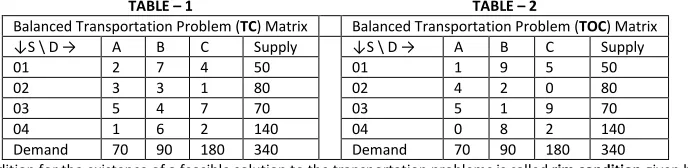
Original Unit Transportation Cost Matrix is known as TC matrix. Kirca and Satir [6] first transformed the TC Matrix to Total Opportunity Cost Matrix (TOCM), where for each row / column in the original TC Matrix, Row Opportunity Cost Matrix (ROCM) / Column Opportunity Cost Matrix (COCM) is generated by subtracting the smallest cost in the row /column from other cost elements in the same row / column. Transportation Cost Matrix obtained by adding corresponding elements of ROCM and COCM is known as TOCM; i.e. TOCM = ROCM + COCM. Kirca and Satir [6] effectively use the Greedy algorithm (LCM) with some tie-breaking rules on the TOC matrix to generate an IBFS to the TP. Mathirajan and Meenakshi [7] used VAM on the TOC matrix instead of TC matrix which showed significant improvement in IBFS. Now we shall develop TOC Matrix of a balanced TP using an example. Table – 1 and Table – 2 shows the TC and TOC matrix respectively as shown below:
VOLUME NO.3(2013),ISSUE NO.03(MARCH) ISSN2231-5756
INTERNATIONAL JOURNAL OF RESEARCH IN COMMERCE, IT & MANAGEMENT
TABLE – 1 TABLE – 2
Balanced Transportation Problem (TC) Matrix Balanced Transportation Problem (TOC) Matrix ↓S \ D → A B C Supply ↓S \ D → A B C Supply 01 2 7 4 50 01 1 9 5 50 02 3 3 1 80 02 4 2 0 80 03 5 4 7 70 03 5 1 9 70 04 1 6 2 140 04 0 8 2 140 Demand 70 90 180 340 Demand 70 90 180 340
Necessary and sufficient condition for the existence of a feasible solution to the transportation problems is called rim condition given by Total Supply = Total Demand i.e. Σ ai = Σ bj
Most of the TP are Unbalanced in nature. If total demand is not the same as total supply, the problem is called Unbalanced Transportation Problem.
(i) When the total capacity of the origins exceeds the total requirement of destinations (Supply Imbalance TP), a dummy destination (column) is introduced in the transportation matrix which absorbs the excess capacity. The cost of shipping from each origin to this dummy destination is assumed to be zero. The insertion of a dummy destination establishes equality between the total origin capacities and total destination requirements. The problem is then amenable for solution by the transportation algorithm. For some of the unbalanced TP, the dummy values are taken as positive numbers. Few TPs use unit inventory holding costs in the cells of dummy column.
(ii) When total capacity of origins is less than the total requirement of destinations (Demand Imbalance TP), a dummy origin (row) is introduced in the transportation matrix to meet out the excess demand. The cost of shipping from the dummy origin to each destination is assumed to be zero. The introduction of a dummy origin establishes the equality between the total capacity of origins and the total requirement of destinations. The problem is then amenable for solution by the transportation algorithm. For some of the unbalanced TP, the dummy values are taken as positive numbers. Few TPs use unit shortage cost in the cells of dummy row.
An attempt to get better initial solutions for the problem is made so that computational effort at the second step becomes easier and less number of iterations is required to determine the optimum solution. A number of heuristic are available to get an initial basic feasible solution. Although some heuristics can find an initial feasible solution very quickly, often the solution they find is not very good in terms of minimizing total transportation cost. On the other hand, some heuristics may not find an initial solution so quickly, but the solution they find is often very good in terms of minimizing total cost. Well known heuristics methods are North West Corner Rule, Least Cost Cell Method, Vogel’s Approximation Method (VAM) [1, 2]. Shimshak [3] et al’s version of VAM, Goyal’s [4] version of VAM, Ramakrishnan’s [5] version of VAM show improvement in determination of initial feasible solution for large scale Transportation Problems. Kirca and Satir [6] developed a heuristic to obtain efficient initial basic feasible solution, called Total Opportunity Cost (TOC). Mathirajan and Meenakshi [7] extended TOC using the VAM procedure. They coupled VAM with the total opportunity cost TOC and achieved very efficient initial solutions. An Improved version of VAM (IVAM) was suggested by Serdar Korukoglu and Serkan Balli [8]. Goyal [4] and Ramakrishnan [5] proposed to use maximum shipping cost as the cost in the dummy cells. Hence they discourage making allocations in the cells of dummy row / dummy column until last step.
Usually the zero cells in dummy row / dummy column are treated the same way as real cost cells and then the problem is solved as balanced problem. Various heuristics are available for finding IBFS of Transportation Problem. One of the most efficient methods to determine IBFS is VAM. Allocations in the TP matrix always depend on all previous allocations. While applying Original VAM to find IBFS of any Unbalanced TP, first allocation is made to dummy cell in the problem matrix. Hence, actually we begin the solution with allocation in a dummy (fictitious) cell first, which is least preferred for making allocation. However the cost in the dummy cells is zero, it does not add to the initial cost of transportation, it affects the remaining allocations in the matrix and quality of initial solution of unbalanced TP. However, insertion of dummy row below the real origins / dummy column after the real destinations suggests that we desire allocations to be done in corresponding dummy cells at last.
2.0
ANOTHER METHOD FOR SOLVING UNBALANCED TRANSPORTATION PROBLEM
In this article we propose that zero / non-zero cost dummy cells should not be treated as real cost cells until last allocation. It should also be taken care that at any stage dummy cells should not be considered for computing penalties or shipment of goods while using VAM for getting IBFS of unbalanced TP. All initial allocations are done in ‘REAL’ cells and allocations to dummy cells are done at the end. We shall call this method ‘VAM-R’. Goal of this methodology is the same suggested by Goyal [4]. Objective of this paper is to compare IBFS obtained using proposed algorithm with solution using original VAM applied to unbalanced TP and solution using original VAM applied to TOC matrix of unbalanced Transportation (VAM-TOC).
2.1 PROPOSED ALGORITHM – [VAM-R] Following is the algorithm for another method of solving unbalanced transportation problem.
Step 1: Balance the given transportation problem if either (total supply > total demand) or (total supply < total demand).
Step 2: Determine the penalty cost for each row and each column by subtracting the lowest cell cost in the row or column from the next lowest cell cost in the same row or same column.
Here ignore computing penalty for dummy row / dummy column. Also ignore zero / non-zero dummy cell values while computing penalties.
Step 3: Select the rows or columns with the highest penalty costs. If tie occurs in highest penalties among rows or columns, then select least cost cell in those rows or columns. Further if there is tie in least cost cells, select the cell with maximum possible allocation at lowest cost. (i.e. allocating as much as possible to the feasible cell at the lowest transportation cost.) If tie occurs in allocating maximum possible amount then select cell in the row (column) with maximum supply (demand).
Step 4: Strike off the row or column for which supply or demand is exhausted.
Step 5: Repeat steps 2-4 on the reduced matrix until all requirements have been met in such a way that allocation(s) in the dummy cells will be done at the end. Step 6: Compute total transportation cost for the feasible allocations using the original transportation cost matrix.
To compare our method with Goyal’s method [4], we have taken an example illustrated by Goyal [4] and then solved using both methods. The results are shown in Table – 3, Table – 4 and Table – 5 respectively. These tables show TC matrix illustrated by Goyal, IBFS using Goyal’s method and IBFS using VAM-R.
TABLE – 3
↓From \ To → 1 2 3 Available A 06 10 14 50 B 12 19 21 50 C 15 14 17 50 Required 30 40 55 125 / 150
IBFS using Goyal’s Method is shown below.
TABLE – 4
INTERNATIONAL JOURNAL OF RESEARCH IN COMMERCE, IT & MANAGEMENT
IBFS using proposed algorithm [VAM-R] is shown below.TABLE – 5
↓From \ To → 1 2 3 Dummy Available A 06 10 [40] 14 [10] 0 50 B 12 [30] 19 21 0 [20] 50 C 15 14 17 [45] 0 [5] 50 Required 30 40 55 25 150 2.2 COMPARISON BETWEEN VAM, GOYAL’S METHOD AND VAM-R
IBFS using VAM-R algorithm is better than solution using conventional VAM for unbalanced TP. It is interesting to note that both method, Goyal’s method and VAM-R, give the same initial solution which comes out to be 1665. However optimum solution is 1615. If we solve the same problem using VAM it requires 2
improvements while Goyal’s method and our method require only one improvement for the same optimum solution. Goyal [4] suggested that the costs of transportation in dummy cells are assumed equal to the highest unit transportation cost before applying VAM. With this modification to applying VAM for unbalanced TP, the allocation of units in dummy cells is given least priority. VAM-R algorithm differs from Goyal’s modification to applying VAM in two ways. One, it considers transportation costs in the dummy cells equal to zero as compared to highest unit transportation cost suggested by Goyal [4]. Second, values in the dummy cells are avoided while computing penalties for each row and each column at every stage and hence they are avoided for making allocation until last real allocation is done.
Next, we shall take another example to illustrate our method when dummy cell values are zero.
Example-1: - Here we wish to minimize the cost of advertisement (Rs.) in different age-group (13-18, 19-25, 26-35, above 35) using different media (M1, M2, M3). Vohra N. D. [9]
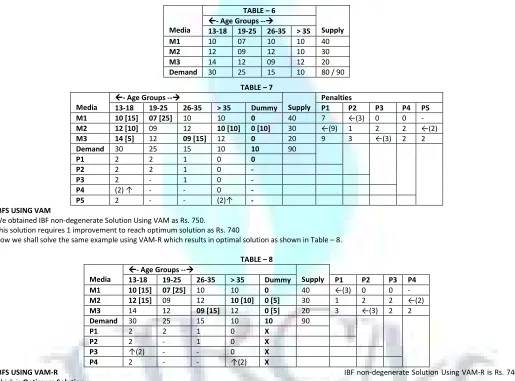
Table – 6 and Table – 7 respectively shows the original TC matrix and IBFS using VAM.
Media
TABLE – 6
Supply - Age Groups
--13-18 19-25 26-35 > 35 M1 10 07 10 10 40
M2 12 09 12 10 30
M3 14 12 09 12 20
Demand 30 25 15 10 80 / 90
TABLE – 7
Media
- Age Groups
--Supply
Penalties
13-18 19-25 26-35 > 35 Dummy P1 P2 P3 P4 P5 M1 10 [15] 07 [25] 10 10 0 40 7 ←(3) 0 0 -
M2 12 [10] 09 12 10 [10] 0 [10] 30 ←(9) 1 2 2 ←(2)
M3 14 [5] 12 09 [15] 12 0 20 9 3 ←(3) 2 2
Demand 30 25 15 10 10 90
P1 2 2 1 0 0
P2 2 2 1 0 -
P3 2 - 1 0 -
P4 (2) ↑ - - 0 - P5 2 - - (2)↑ - IBFS USING VAM
We obtained IBF non-degenerate Solution Using VAM as Rs. 750. This solution requires 1 improvement to reach optimum solution as Rs. 740
Now we shall solve the same example using VAM-R which results in optimal solution as shown in Table – 8.
TABLE – 8
Media
- Age Groups
--Supply
13-18 19-25 26-35 > 35 Dummy P1 P2 P3 P4 M1 10 [15] 07 [25] 10 10 0 40 ←(3) 0 0 -
M2 12 [15] 09 12 10 [10] 0 [5] 30 1 2 2 ←(2)
M3 14 12 09 [15] 12 0 [5] 20 3 ←(3) 2 2
Demand 30 25 15 10 10 90
P1 2 2 1 0 X
P2 2 - 1 0 X
P3 ↑(2) - - 0 X P4 2 - - ↑(2) X
IBFS USING VAM-R IBF non-degenerate Solution Using VAM-R is Rs. 740 which is Optimum Solution.
Hence proposed algorithm, VAM-R, works efficiently on unbalanced TP as it reduces the computational task, i.e. number of iteration(s) required for improvement of IBFS to get optimum solution and time required to reach optimum solution. Also the number of penalties has reduced.
Remark:-
1. Here P1, P2 … P4, P5 denote respective row penalties and column penalties. 2. ‘X’ denotes that ‘no’ penalty is computed for dummy column.
3. Values in [ ] show actual non-zero allocation in corresponding cells.
4. ←(3) under P1 denotes highest penalty to be considered for allocaYon in the lowest cost cell in row M1 and so on.
Example-2: - Next, we take an example where dummy values are non-zero.
TABLE – 9
↓ Supplier \ Outlet → O1 O2 O3 Supply S1 5 1 [10] 7 10 S2 6 [60] 4 [10] 6 [10] 80 S3 3 [15] 2 5 15
Demand 75 20 50 145 / 105
VOLUME NO.3(2013),ISSUE NO.03(MARCH) ISSN2231-5756
INTERNATIONAL JOURNAL OF RESEARCH IN COMMERCE, IT & MANAGEMENT
TABLE – 10
↓ Supplier \ Outlet → O1 O2 O3 Supply S1 5 1 [10] 7 10 S2 6 [60] 4 [10] 6 [10] 80 S3 3 [15] 2 5 15 Dummy 5 3 2 [40] 40 Demand 75 20 50 145
Table – 10 shows IBFS using VAM-R algorithm. IBFS using VAM-R is Rs. 595 which is the same as Optimum Solution. Here, non-zero cell values in the dummy column represent unit penalties for unsatisfied demand at respective retail outlet. Thus, VAM-R works efficiently in case of non-zero dummy cell-values.
3.1 COMPUTATIONAL EXPERIMENT AND MEASURES OF PERFORMANCE
Quality of any heuristic is major concern because closer the IBFS to optimum solution, less number of iterations is required to determine optimum feasible solution. For testing efficiency and evaluating performance of the proposed algorithm, VAM-R, with available heuristics, VAM and VAM-TOC, computational experiment were carried out on a set of 12 unbalanced TP of both type – Supply Imbalance and Demand Imbalance; with zero and non-zero values in dummy cells. Performance measures used to determine efficiency of proposed heuristic are as follows:
1) Percentage of Optimum Solutions by each heuristics and
2) Average Number of Iterations required to obtain optimal solution using the initial solution by any heuristic.
3.2 ANALYSIS AND COMPARISON
Comparison of Percentage of Optimum Solutions and Average Number of Iterations required determining optimal solution using the initial solution by any heuristic.
Table – 11 shows IBFS using three heuristics; VAM, VAM-TOC and VAM-R along with Number of Iterations required to obtain optimal solution using the initial solution by any heuristic.
TABLE – 11 IBFS using
VAM
No. of Iteration to reach optimum solution
IBFS using VAM-TOC
No. of Iteration to reach optimum solution
IBFS using VAM-R
No. of Iteration to reach optimum solution
Optimum Solution using MODI method
820 2 740 1 760 1 720
1510 1 1540 1 1510 1 1465
740 2 710 0 710 0 710
97 3 113 1 92 0 92
168 1 140 1 128 0 128
917 1 909 1 917 1 893
98 1 98 1 90 0 90
2752 1 2424 0 2424 0 2424
700 0 700 0 700 0 700
14544 0 14544 0 14544 0 14544
180 0 196 1 180 0 180
1590 0 1590 0 1610 1 1590
Total = 12 Total = 7 Total = 4
-SUMMARY RESULTS
TABLE – 12 Heuristics
Surveyed
(% of Best Solution , Standard Error)
Average Number of Iterations required to reach Optimum Solution for IBFS that are non-optimal
VAM – R (66.67%, 13.61%) 1.0 VAM (33.33%, 13.61%) 1.5 VAM – TOC (41.67%, 14.23%) 1.0
4
CONCLUSION
Vogel’s Approximation Method is applied to original Transportation Cost matrix in two different ways. One is conventional VAM approach and other is alternative approach of using VAM for Unbalanced TP, i.e. VAM-R. Also VAM is applied to Total Opportunity Cost (TOC) matrix, as suggested by Mathirajan and Meenakshi [7], (VAM-TOC). Original VAM is weaker to produce good quality IBFS of unbalanced TP. VAM-R approach of making allocations to all ‘REAL’ cells first and allocations in the dummy cells be made at last benefit much in the terms of defined performance measures. Large proportion of problems produces optimum solution very quickly and requires less computational effort and less time to reach optimal solution. VAM-R is more competent to handle dummy cells in unbalanced TP and hence produce better quality IBF solutions of unbalanced TP.
Summary Results Table – 12 clearly shows that, for unbalanced Transportation Problem, applying VAM-R is more efficient than original VAM and VAM-TOC heuristics in terms of percentage of best solutions and average number of iterations required to reach optimal solution.
5
REFERENCES
1. S. D. Sharma, “Operations Research”, Kedarnath Ramnath & Sons,2007
2. J. K. Sharma, “Operations Research Theory and Applications”, MacMillan Publishers India Ltd, 2009
3. D. G. Shimshak, J. A. Kaslik and T. D. Barclay, A modification of Vogel's approximation method through the use of heuristics, ”Infor” 19, 259-263, 1981. 4. S. K. Goyal, Improving VAM for unbalanced transportation problems, “Journal of Operational Research Society” 35(12), 1113-1114, 1984
5. G. S. Ramakrishnan, An improvement to Goyal's modified VAM for the unbalanced transportation problem, “Journal of Operational Research Society “39(6), 609-610, 1988
6. O. Kirca and A. Satir, A heuristic for obtaining an initial solution for the transportation problem, “Journal of Operational Research Society” 41(9), 865- 871, 1990
7. M. Mathirajan and B. Meenakshi, Experimental Analysis of Some Variants of Vogel's Approximation Method, “Asia-Pacific Journal of Operational Research” 21(4), 447-462, 2004.
8. Serdar Korukoglu , An Improved Vogel’s Approximation Method for the Transportation Problem, “Mathematical and Computational Applications”, Vol. 16, No. 2, pp. 370-381, 2011
INTERNATIONAL JOURNAL OF RESEARCH IN COMMERCE, IT & MANAGEMENT
REQUEST FOR FEEDBACK
Dear Readers
At the very outset, International Journal of Research in Commerce, IT and Management (IJRCM)
acknowledges & appreciates your efforts in showing interest in our present issue under your kind perusal.
I would like to request you to supply your critical comments and suggestions about the material published
in this issue as well as on the journal as a whole, on our E-mail i.e.
for further
improvements in the interest of research.
If you have any queries please feel free to contact us on our E-mail
.
I am sure that your feedback and deliberations would make future issues better – a result of our joint
effort.
Looking forward an appropriate consideration.
With sincere regards
Thanking you profoundly
Academically yours
Sd/-
VOLUME NO.3(2013),ISSUE NO.03(MARCH) ISSN2231-5756