*Corresponding author:Siska Angreni ISSN: 0976-3031
Research Article
DEVELOPMENT OF PRACTICAL INSTRUCTIONS FOR MEDIA INTEGRATED
INSTRUMENTS COMPONENTS SCIENCE NATURAL SCIENCE ELEMENTARY
SCHOOL APPROACH SKIN PROCESS APPROACH
Siska Angreni* and Hidayati Azkiya
Department of Primary School Teacher Education, Faculty of teacher training
and education, Bung Hatta State, Indonesia
DOI: http://dx.doi.org/10.24327/ijrsr.2018.0907.2416
ARTICLE INFO ABSTRACT
The aim of this research is to develop guidance of media-assisted Practitioner of Integrated Instrument of Natural Science of Elementary School based on process skill approach. The research design used is development research. Subjects in this study were the students of grade V elementary school 09 Surau Gadang. Instrument used in the form of a product validation set of practicum instructions and questionnaire of teacher and student responses to develop practice manual. The data were analyzed descriptively quantitatively and supported by qualitative data in the form of suggestions from material experts, display experts, teachers and students. Development of media-aided practice manuals the integrated Instrument component of natural sciences, elementary school is based on a process skill approach developed in the appropriate category after being assessed by qualified experts, viewers, teachers and students on average
INTRODUCTION
As science learning in general, science learning in primary schools should always be oriented to practicum activities. Regarding practicum activities, observation and experimentation are activities that must be done. Sundari (2017) science learning in school cannot be separated from practicum activities. Learning of practicum method can make students believe more in truth or conclusions based on their own experiments than the teacher said or read from the book. In line with Wahyuni (2015) opinion that to master science is not enough only to be obtained by learning from a book or just listen to an explanation from the other side, but needed a learning activity involving the existence of the activity process to produce certain new product. Practicum activities can also develop students' attitudes to conduct natural exploration studies. Practical activities make learning more meaningful because students are involved in the learning process and gain hands-on experience. According to Rofiah's (2014) teaching a science lesson in elementary school not only through Minds-on science, but also learning activities with hands-on science using science practice tools along with instructions for its use.
However, in reality, there is still a lot of science learning process in elementary school, which only use conventional method, that is a lecture. Lessons are generally dominated by teachers. Teachers are the only source of knowledge so that students tend to passively listen to what the teacher says, consequently the students do not develop their ability to explore all natural phenomena in the field of science.
Apart from the several reasons outlined above, laboratory activities with the use of teaching aids play a very important role, especially in the teaching of science. Kusumawati (2016) media has a very important contribution in the learning process. The results of the study also show that the learning process by using teaching media can improve the quality of learning. This is in accordance with the results of research asiah (2013) and maryandi (2013) that the utilization of integrated instrument component science media has a positive effect on learning outcomes of learners. While the results of angreni (2017) research that the availability of integrated instrument component science media in the elementary schooln nanggalo sub district allows the learning process using the media but the utilization has not been used optimally.
Recent Scientific
Research
International Journal of Recent Scientific Research
Vol. 9, Issue, 7(G), pp. 28209-28213, July, 2018
Copyright © Siska Angreni and Hidayati Azkiya , 2018, this is an open-access article distributed under the terms of the Creative Commons Attribution License, which permits unrestricted use, distribution and reproduction in any medium, provided the original work is properly cited.
DOI: 10.24327/IJRSR CODEN: IJRSFP (USA)
Article History: Received 10th April, 2018 Received in revised form 2nd
May, 2018
Accepted 26th June, 2018
Published online 28th July, 2018
Key Words:
The fact that occurred in the field was not in accordance with ideal learning activities expected. Based on the results of interviews, direct observation and questionnaire distribution of needs analysis with teachers at elementary school negeri 09 surau gadang, it is known that the ownership of the integrated instrument component media in elementary school has been sufficient to conduct practicum-oriented learning activities. However, in science learning activities, teachers have not optimized the use of existing integrated instrument component science media, it is caused by several factors, among others: teachers do not have specific practice manuals in using integrated instrument component media. The guidance is still modular in general as it is a integrated instrument component media introduction package book, so the teacher should develop experimental frameworks and worksheets independently. In line with the results of the interviews, based on the results of questionnaires the analysis of the needs of teachers who were given to twelve teachers elementary schooln 09 surau gadang obtained percentage of 91.5% of the respondents stated that they do not understand the practice guides in the use of science media given by the government. While 11.8% have self-made worksheets each time they want to experiment.
In the effort to utilize the media of integrated instrument component (integrated instrument component) of science in elementary school, it is necessary practicum guidance for teachers to implement the learning process meaningful. Development of practicum guidance using the right approach will be able to motivate and engage learners actively in the learning process. Innovative learning is expected to improve students' skills (isjoni, 2008). Ambarsari (2013) with applied science process skills students easily understand complicated and abstract concepts when accompanied by concrete examples. Kusumawati (2016) process skill needs to be trained because science is concerned with systematically finding out about nature, then the process skill emphasizes the provision of immediate experience to develop the competence to explore and understand the natural surroundings scientifically. Angreni (2017) approaches the process of integrating planting the concept of (aspect cognitive) as well as train and developing the abilities of psychomotor aspects and affective. Djojosoediro (2013) states that the science process skills as an effort to seek knowledge and scientific truth.
The application of a process skill approach in practicum activities can involve physically, mentally and directly involved learners. In addition, teachers can create worksheets that will be given to learners. Angreni (2017) states that the process skill approach emphasizes the learning, activity and creativity of students, including the physical, mental and social involvement of students in acquiring knowledge, skills, values and attitudes and applying in everyday life to achieve a goal. This opinion is in line with the research that will be conducted on the development of teacher training manuals in using integrated instrument component science media in elementary schools based on process approach, so that teachers better understand using integrated instrument component science media in learning and the media is no longer a lavish display. Furthermore, the learning process will be more interesting and meaningful the purpose of this study was to produce guided
practice manuals integrated instrument component science media based approach to process skills.
METHODS
This research is designed with Research and Development (R & D) research design. Research and Development is a research method used to produce a specific product and test the practicality of the product (Sugiyono, 2012). In this study, the implementation of this research is limited only to the stage of the production of instruction manuals of SCIENCE assisted by integrating instrument component science media based on skill process that has been feasible and valid.
In the process of developing this product, applied expert test and product trial. Expert tests are conducted to determine the level of feasibility of products that have been developed which consists of expert test material and appearance. While product testing is done to get information about the legibility of the products produced. Product testing conducted in elementary school 09 Surau Gadang.
The research design used adapted from Sugiyono (2012) namely; (1) Potentials and problems, at this stage, questionnaires, interviews and observations are conducted to determine the availability of integrated instrument component science media and problems of using science integrated instrument component media; (2) collection of data and information, at this stage library study, reading directly from journals, articles and books; (3) product design, further develop product design instruction manual assisted media integrated instrument component science based approach to process skills; (4) validation of products, after the initial product is completed, the next step is to test the validity to the material and display expert team; (5) Final Product Repair, the product is repaired in accordance with the improvement suggestion of the testing team; (6) trial usage on research subject to know product legibility; and (7) Product revisions, this stage is done by evaluating test results and reviewing any deficiencies.
Methods of data collection are done by three kinds, namely, interview techniques, observation techniques and questionnaire techniques. Observation and interview techniques are used to obtain information on the availability of integrated instrument component science media, learning resources and practical guidance available as well as facilities and infrastructure of science learning support and the implementation of practicum which is usually done in elementary school 09 Surau Gadang. Questionnaires were used in the form of questions given to respondents to obtain data on legibility of practice manuals, teacher responses and student responses to practical instructions.
questionnaire response instrument has 2 choices of answers, namely "Yes and No". Each choice answer defines the practicality of the product according to the expert.
Data analysis technique
Data obtained from material experts and display experts were analyzed by following the criteria of assessment adapted from BSNP (2007) as follows
1. It is appropriate to use without revision, if the average score is greater than 2.75
2. It is appropriate to use without revision, if the average scoring score is less than or equal to 2.75
3. Not feasible, if the average scoring score is 1
Further practical data obtained from teachers using Guttman scale, then analyzed by descriptive percentage. The percentage results are then categorized by Ridlo criteria (2005) as follows: Score <50%: Very unfulfilled criteria, 50% <score <59%: Not meeting criteria, 60% <score <69%: Less meet the criteria, 70% <score <84%: Meets the criteria, 85% <score <100%: Really meet the criteria
RESULTS
Product Development Design
Product development design in research is as follows; (1) the front cover shall contain the title of the laboratory manual, author and labor instruction manual; (2) introduction, (3) table of contents (4) the contents of the practicum manual (5) the discipline of practice, (6) the standard of competence, (7) the title of the experiment, (8) the purpose of the experiment (9) (11) experimental or work steps, (12) experimental data table (13) analytical activities containing questions for processing experimental results data (14) of the experimental data, presentation activities, (15) concluding experimental results that have been done.
Expert test of Material and Display
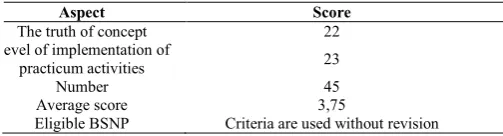
Experts test the material aims to find out the truth of the concept and level of implementation of practical activities and integrity with the skills of the process that existed in the guided laboratory instruction medium integrated instrument component science skills-based process. Table 1 shows the results of material tests conducted with aspects of the assessment on the components of conceptual truth and the implementation of practicum activities.
Table 1 Expert Validation Result of instruction manual with media-based Integrated Instrument Component Science process skill
Aspect Score
The truth of concept 22
Level of implementation of
practicum activities 23
Number 45
Average score 3,75
Eligible BSNP Criteria are used without revision
The test results of the material expert indicate that the material presented in the lab manual has been eligible without revision. Advice from validators that need to be improved is the work or action steps need to be well sued and show photographs of the workings so that students are more motivated and understand the work steps. Furthermore, Table 2 shows the results of the
display test with aspects of the assessment of the design components of the cover and the design of the contents.
Table 2 Expert Viewer Validation Results for Media-assisted Practice Guides Integrated Instrument Component of science based on process
skills.
No Aspects Score
1 Clarity of sentence and readability 16
2 Physical appearance and completeness of
the practice manual 20
3 Integrity of process skills 22
4 Evaluation of learning 9
Total 67
Average score 3,2
Criteria BSNP Criteria are used
without revision
Based on the results of the display test indicates that the developed practice manual has a look with very reasonable criteria. In this test the validator advises the development product such as using a contrasting text color with the background, adjusting the image on the contents of the practice manual with the activities performed, adding a list of references at each end of the experiment and adding a glossary.
Table 3 Results of teacher's responses to the development of assisted practice manuals integrated instrument component science skills-based
process.
No Aspects in question Answer Results
(%)
Yes No
1 Appearance lab manual overall interesting 2 - 100%
2 The objectives of the lab are formulated clearly
in practice manuals 2 - 100%
3 Measuring on practicum activities can help
students in the measurement phase. 2 - 100%
4
The 'observation' component in the practice manual can help the student at the stage of
recording and interpreting the data
1 1 50%
5 The material presented is a concept in science
learning 2 - 100%
6 Guidance on the use of practicum instructions is
clearly communicated 1 1 50%
7 The work steps in the practice manual are
appropriate to the student's level of ability 1 1 50%
8
The use of drawings and examples in practical manuals is very relevant and can help students
understand
2 - 100%
9 The use of existing tools in the lab manual can
help students in the use phase of the tool 2 - 100%
10 Component instructions manual complete 2 - 100%
11 Working procedures are in accordance with the skills of the process 2 - 100%
12 The practice manual can add students' insight
into the concept of science learning 2 - 100% 13 Components, delivering observed results can
already help students at the communicating stage 2 - 100% 14 The practice manual corresponds to the time
allocation in the school 1 1 50%
15 Media integrated instrument component science
simple plane used already available in the school. 2 - 100%
Number of respondents 2
Average percentage 86,66%
Criteria Very meet the criteria
Based on table 3 it can be seen that the teacher answered “yes” on every aspect asked. From the result of questionnaire teacher's response is known there are 4 aspects got the value of 1 because answered “no”. The teacher's response earned an average percentage of 86.66%, which means the developed practice manual is included in "highly qualified".
Product Trial
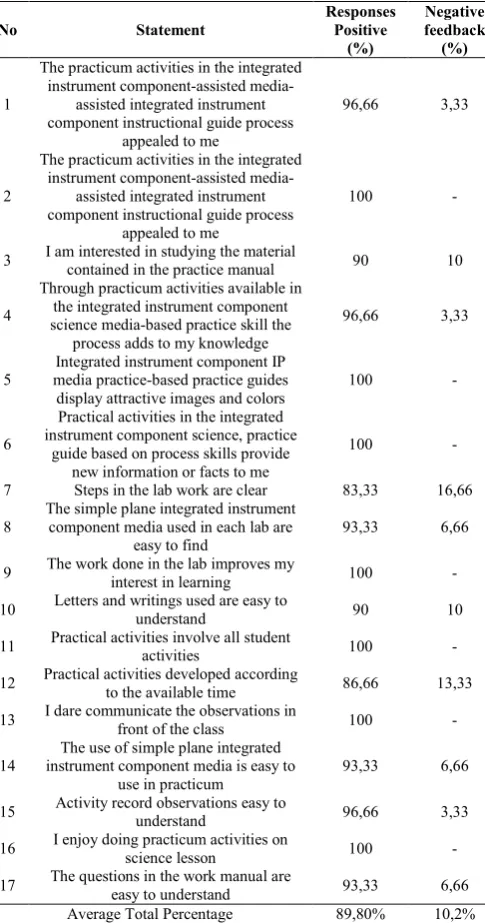
integrating instrument component science media based on process skill, students were given a questionnaire and asked to fill in according to one answer choice for each item statement. The result of the analysis of the statement statement questionnaire is shown in table 4.
Table 4 Results in Questionnaire Analysis Students' response to the indicator guide lab manual
No Statement
Responses Positive
(%)
Negative feedback (%)
1
The practicum activities in the integrated instrument component-assisted
media-assisted integrated instrument component instructional guide process
appealed to me
96,66 3,33
2
The practicum activities in the integrated instrument component-assisted
media-assisted integrated instrument component instructional guide process
appealed to me
100 -
3 I am interested in studying the material
contained in the practice manual 90 10
4
Through practicum activities available in the integrated instrument component science media-based practice skill the
process adds to my knowledge
96,66 3,33
5
Integrated instrument component IP media practice-based practice guides display attractive images and colors
100 -
6
Practical activities in the integrated instrument component science, practice
guide based on process skills provide new information or facts to me
100 -
7 Steps in the lab work are clear 83,33 16,66
8
The simple plane integrated instrument component media used in each lab are
easy to find
93,33 6,66
9 The work done in the lab improves my
interest in learning 100 -
10 Letters and writings used are easy to
understand 90 10
11 Practical activities involve all student
activities 100 -
12 Practical activities developed according
to the available time 86,66 13,33
13 I dare communicate the observations in
front of the class 100 -
14
The use of simple plane integrated instrument component media is easy to
use in practicum
93,33 6,66
15 Activity record observations easy to
understand 96,66 3,33
16 I enjoy doing practicum activities on
science lesson 100 -
17 The questions in the work manual are
easy to understand 93,33 6,66
Average Total Percentage 89,80% 10,2%
Student responses were measured using a student response questionnaire consisting of 17 questions related to the integrated instrument component science media-assisted practice manual. The result of the student's response to the practice manual showed that almost all students were 93,33% of students gave positive response to the practice manual. This is demonstrated by the student activity during the experimental activity, the observed process skills performed well. In line with the results of research Qary (2016) that students are very enthusiastic to follow the learning activities using media integrated instrument component science. In accordance with the Azzahro research (2014) by developing learning, discovery tools get 95.9% of students give a positive response.
Based on the results of the development, it was found that guided laboratory instruction integrated instrument component science elementary school media that has been developed in accordance with the Sugiyono development model, but in the slightest modification. A series of activities starts from identifying potentials and problems. This stage the researchers made initial observations in elementary school 09 Surau Gadang. Based on the observation result, it is known that the facilities and infrastructure of science learning are complete enough. Media integrated instrument component science in the school has fulfilled the implementation of learning using integrated instrument component science media (Angreni, 2017).
As for the problems found, the teachers do not have specific practice manuals in using integrated instrument component media, thus causing a lack of preparation from both teachers and students. Based on the validation results of the material experts, the display and test of the product that the developed practice manual is very valid which means to be used in the elementary school science practicum activities. The developed practice manuals are appropriate for use to facilitate practicum activities. This is in accordance with the opinion of Rustaman (2003) that the practice manual is one of the means necessary to facilitate teaching and learning activities so that the learning objectives can be achieved. The importance of developing practice manuals is used to activate students and help develop students' process skills through existing activities in developed practice manuals (Prayitno, 2017). This is also in line with Sawitri's (2008) opinion that the purpose of the preparation of the practice manual should include several things such as to enable students not only to gain knowledge in the form of theory, but to manage their own acquisition of knowledge and learning skills as well as to assist students in developing process skills through activities in practice manuals. The developed practice manual contains the components that should be present in a lab manual. Arifin (1995) that the components in the lab manual should contain the labels, practical, theoretical, instrument and materials and evaluation objectives. The developed practice manual has been able to integrate observed process skills. The practice manual also contains the practical rules for students to conduct experimental activities in accordance with the rules that have been written. In accordance with Prayitno's (2017) state that occupational safety in the lab is a major component of student safety in conducting activities.
CONCLUSION
Based on the results of the development that has been done that the guidance manual developed has met the criterion is very valid from the expert, practical of teachers and students, which means feasible to be used in the activity of simple class V grade aircraft material practicum.
References
Angreni Siska. 2017. Ketersediaan dan Pemanfaatan Media Komponen Instrumen Terpadu (KIT) IPA di SD Negeri Kecamatan Nanggalo Kota Padang. Jurnal Pendidikan Dasar Nusantara (JPDN) 2 (2) 231-242.
Education V. Volume 1A hal: 325-331 April 10-11th 2017 Universitas Ekasakti.
Ambarsari Wiwin, Santoso Slamet, Maridi. Penerapan Pembelajaran Inkuiri Terbimbing Terhadap Keterampilan Proses Sains Dasar pada Pelajaran Biologi Siswa Kelas VIII SMP Negeri 7 Surakarta. Jurnal Pendidikan Biologi, Volume 5, No 1 Hal:81-95 Tahun 2013.
Arifin, M. 1995. Pengembangan Program Pengajaran Bidang Studi Kimia. Surabaya Airlangga Universitas Press. Asiah Nor. 2013. Pengaruh Pemanfaatan Media KIT IPA
Terhadap Hasil Belajar Siswa Kelas IV SDN 31 Pontianak. Jurnal Pendidikan dan Pembalajaran 3 (4) April 2014
Astono Juli, Suyoso, Slamet MT. 2012. Pengembangkan KIT Praktikum Sains Ramah Lingkungan dari Bahan Daur Ulang dan Implementasinya dalam Kegiatan PPL-KKN Melalui Strategi Pemberdayaan Masyarakat Pemulung di Sekitar Sekolah Mitra. Prosiding Seminar Nasional Penelitian, Pendidikan dan Penerapan MIPA, Fakultas MIPA, Universitas Negeri Yogyakarta, 2 Juni 2012. Azzahro, Izzah Fatimah.2014. Pengembangan Perangkat
Pembelajaran Berbasis discovery Learning pada Sub Materi Respirasi dan Fotosintesis Kelas VII SMP. Jurnal Penelitian Pendidikan IPA. 2 (3)
Djojosoediro. 2013. Pengembangan dan pembelajaran IPA SD. Modul Kuliah.
Hake, R.R. 2002. Assesment of Physics Teaching Methods. Proceedings of the UNESCO Asian Physics Education Workshop on Active Learning in Physics. Sri Lanka: University of Peradeniya. Tersedia di http://www.physics.indiana.edu/~hake/ [diakses pada tanggal 12 Januari 2017]
Kusumawati Naniek. 2016. Pengembangan Perangkat Pembelajaran Berintegrasi Media KIT IPA untuk Melatih Keterampilan Proses Sains Siswa Kelas V Sekolah Dasar. Jurnal Al-Bidayah 8 (2) 169-184.
Maryandi Riko. 2013. Penggunaan KIT IPA pada Materi Energi Panas Terhadap Hasil Belajar Siswa Kelas IV SD. Jurnal Pendidikan dan Pembalajaran 2 (8) Agustus 2013. Prayitno Trio Ageng. 2017. Pengembangan Petunjuk
Praktikum Mikrobiologi Program Studi Pendidikan Biologi. Jurnal Biota 3 (1)31-37.
Qary Ismi Faridlatul, Widodo Wahono, Indah Novita Kartika. 2016 .Pengembangan Lembar Kegiatan Siswa dan KIT IPA Pada Materi Energi dalam Sistem Kehidupan untuk Melatih Keterampilan Berpikir Kritis Siswa SMP. Jurnal Pendidikan Sains, 4 (3)1-6.
Ridlo, S dan E. Rudyatmi. 2005. Evaluasi Pembelajaran. Semarang: Universitas Negeri Semarang
Rofiah Nurul Hidayati. 2014. Pengembangan Lembar Kerja Peserta Didik (LKPD) Berbasis KIT Untuk Meningkat Keterampilan Proses Proses Dasar IPA di MI/SD. Jurnal Al-Bidayah 6 (2)253-271.
Rustaman N. 2003. Media Pengajaran. Bandung: Sinar Baru. Sawitri S. 2008. Model Pengembangan Buku Petunjuk Praktek
Mata Kuliah Draping. Jurnal Penelitian pendidikan. 24 (1) 23-24
Sugiyono. 2012. Metode Penelitian Kuantitatif, Kualitatif, dan R&D. Bandung: Alfabeta.
Sundari, Rosidin Undang,Wahyudi Ismu. 2017. Pengembangan Panduan Praktikum IPA SMP Berbasis Model Collaborative Teamwork Learning. Jurnal Pembelajaran Fisika. 5 (3) 47-58.
Wahyuni Sri. 2015. Pengembangan Petunjuk Praktikum IPA untuk Meningkatkan Kemampuan Berpikir Kritis Siswa SMP. Jurnal Pengajaran MIPA, 20 (2) 196-203.
How to cite this article:
Siska Angreni and Hidayati Azkiya. 2018, Development of Practical Instructions for Media Integrated Instruments Components Science Natural Science Elementary School Approach Skin Process Approach. Int J Recent Sci Res. 9(7), pp.28209-28213. DOI: http://dx.doi.org/10.24327/ijrsr.2018.0907.2416