Please cite this article as: M. Jalilkhani, A. R. Manafpour, A Simplified Modal Pushover Analysis-based Method for Incremental Dynamic Analysis of Regular RC Moment-resisting Frames, International Journal of Engineering (IJE), IJE TRANSACTIONS B: Applications Vol. 31, No. 2, (February 2018) 196-203
International Journal of Engineering
J o u r n a l H o m e p a g e : w w w . i j e . i r
A Simplified Modal Pushover Analysis-based Method for Incremental Dynamic
Analysis of Regular RC Moment-resisting Frames
M. Jalilkhani*, A. R. Manafpour
Department of Civil Engineering, Urmia University, Urmia, Iran
P A P E R I N F O
Paper history: Received 06 October 2017
Received in revised form 13 November 2017 Accepted 30 December 2017
Keywords:
Sidesway Collapse Capacity Pushover Analysis
Incremental Dynamic Analysis Method RC Moment-resisting Frame
A B S T R A C T
Incremental Dynamic Analysis (IDA) procedure is now considered as a robust tool for estimating the seismic sidesway collapse capacity of structures. However, the procedure is time-consuming and requires numerous nonlinear response-history analyses. This paper proposes a simplified Modal Pushover Analysis (MPA) procedure for IDA of RC moment-resisting frames. The proposed method uses the dynamic response of an equivalent single-degree-of-freedom system, characterized by a bilinear relationship between the lateral force and roof-displacement. This relationship is determined by the ‘first-mode’ pushover analysis of the structure. Four regular RC moment-resisting frames designed based on the current US building codes are selected and subjected to the proposed method. The analysis results obtained from the original MPA-based IDA method, Static Push-Over to Incremental Dynamic Analysis (SPO2IDA) and the method proposed by Shafei et al are also presented for comparison. The performance of the proposed method is then evaluated through comparisons with the results obtained from IDAs. The results show that the proposed method can efficiently estimate the dynamic capacity of the example buildings for different seismic intensities. Nonetheless like to MPA-based IDA and SPO2IDA methods less accurate results are obtained by the proposed procedure for 16% and 84% IDA fractiles in most case studies.
doi: 10.5829/ije.2018.31.02b.02
1. INTRODUCTION1
Since the structural collapse is one of the primary sources of life and monetary losses during and after an earthquake, the accurate estimate of collapse potential of structures under extreme ground motions has always been one of the main objectives of earthquake engineering. The Incremental Dynamic Analysis (IDA) procedure [1] is now identified as a robust tool which can estimate the sidesway collapse capacity of structures by performing several nonlinear response history analyses under various ground motion records, each scaled to multiple levels of intensity. However, because the procedure requires numerous and computationally demanding nonlinear response history analyses, it is often restricted to research and has gained less popularity among engineers in practical
*Corresponding Author’s Email: [email protected] (F. Behnamfar)
applications. To overcome the computational difficulties in IDA, several nonlinear static (pushover) analysis-based methods have recently been developed by researchers.
collapse capacity and fragility curve of steel frames not only for the first-mode-dominated structures, but also for structures having significant higher mode effects. Also, it was shown that the higher modes have insignificant contribution in the sidesway collapse capacity of structures. A simplified version of MPA-based IDA procedure was then developed [5], in which the peak modal displacement demands of the equivalent SDOF systems were computed using an empirical equation for inelastic displacement ratio (CR) instead of using nonlinear response history analysis. It was shown that the proposed method can provide satisfactory IDA curves of steel frames, even for tall buildings with complex dynamic responses. Nevertheless, the accuracy and effectiveness of the method for other types of seismic resisting systems has not been demonstrated yet. In another study, a simplified pushover analysis-based procedure was developed [6] to estimate the median value and the dispersion of sidesway collapse capacity of moment-resisting frame and shear wall structural systems. The results showed that the proposed method can estimate the median collapse capacity of moment-resisting frames with more accuracy compared to those given by SPO2IDA and the method proposed by FEMA P440a document [7]. However, due to the lack of experimental data for the collapse response of shear wall structures, the accuracy of the method was not demonstrated for these buildings. In another research, the “collapse capacity spectrum” method was proposed [8] to estimate the seismic collapse capacity of P-delta sensitive moment-resisting frames. Two static pushover analyses with and without P-delta effects were employed by the method to obtain the global hardening and post-yielding stiffness ratios. Then, the method uses some closed-form equations for estimating the collapse capacity. In another research, a web-based methodology for the prediction of summarized IDA curves for the first-mode-dominant structures was developed [9] which requires seven parameters, where five of them describe the idealized pushover curve. More recently, a simplified pushover-based procedure has been proposed [10], which can provide a rapid tool for estimating the collapse margin ratio of moment-resisting frames. The proposed method is based on replacing a MDOF structural model with a fictitious inelastic SDOF system, characterized by an elastic-perfectly-plastic relationship between the lateral force and roof displacement, obtained from a standard pushover analysis. Nevertheless, the strain-hardening and degradation effects were totally ignored by the method for the SDOFs, which may have a significant contribution on the collapse response of real MDOF buildings. Some other simplified nonlinear analysis methods have also been developed by researchers for the collapse response assessment of structures. Some of these methods can be found in References [11, 12].
The objective of this study is to propose a simplified MPA-based IDA method for the rapid seismic collapse response assessment of RC moment-resisting frames. The method is based on the IDA of an equivalent SDOF system which mimics a force-deformation relationship, obtained from the ‘first-mode’ pushover analysis of the real MDOF building. To compare the accuracy and effectiveness of the proposed method with other similar nonlinear analysis methods, the analysis results obtained from three simplified pushover analysis-based methods are also presented in this study. The selected simplified methods are the original MPA-based IDA [3], SPO2IDA [2] and the method proposed by Shafei et al. [6]. The first two represent methods that use the concept of equivalent SDOF system with probably less computational efforts as compared with similar methods. On the other hand, the method proposed by Shafei et al. uses some closed-form equations, representing the simplest method available for the rapid estimation of seismic collapse capacity of structures. The capability of the studied simplified methods to estimate the median and the important IDA fractiles of seismic collapse capacity of the frames is investigated through comparisons with the exact results obtained from a comprehensive set of IDAs. Four regular RC moment-resisting frames that incorporate deterioration of components are considered. Also, only a set of far-field ground motion records are used for this assessment and the near-field earthquakes with impulsive effects are not included.
2. PROPOSED SIMPLIFIED ANALYSIS METHOD
To overcome the limitations and shortcomings in the original based IDA, a simplified version of MPA-based IDA method is proposed in this paper which can suitably be applied to structures even with incomplete pushover curves. Moreover, because the method benefits from a simple bilinear idealized pushover curve, it is found easy to be used in practical applications. A step-by-step summary of the proposed simplified MPA-based IDA procedure considering only the first mode effect is as follows:
1. Calculate the first-mode (fundamental) natural period, T1, and the corresponding mode shape vector, φ1, for the building.
2. Develop the base shear–roof displacement (Vb1-ur1) pushover curve by nonlinear static analysis of the building using the lateral force distribution s*1=mφ1 where m is the mass matrix.
3. Idealize the pushover curve as a bilinear backbone curve. The idealization must be performed similar to the one that suggested in FEMA P695 [15] with the exception of applying equal absorbed energy for the original and idealized curves up to the point at which 20% strength loss occurs.
4. Convert the idealized pushover curve to obtain the force–displacement (F /L -Ds1 1 1) relation for the first-‘mode’ inelastic SDOF system by utilizing
*
s1 1 b1 1
F /L =V /M and D =u /Γ φ1 r1 1 r1 in which
* 1
M is the first-mode effective mass; φr1 is the value of φ1 at the roof level, and Γ =φ1 1Tm1/φ1Tmφ1.
5. Estimate the seismic collapse response of the equivalent SDOF system constructed in the previous step by IDA for a set of ground motion records. 6. Develop the summarized IDA curves of the original
MDOF structure by using the results obtained from the previous step and the transformation factors presented in step 4.
3. STRUCTURAL MODELS AND EARTHQUAKES
Four RC, buildings with 3-, 6-, 9- and 12-stories are designed and used for the evaluation of the proposed simplified method. The buildings are located in Los Angeles area with high seismic hazard, and designed in accordance with the ACI 318-11 and ASCE 7-10 requirements. All buildings have similar plan dimensions of 15m×15m with three bays in each primary direction. Height of the first story is 3.5m and other stories have a height of 3m. The dead and live loads are equal to 5.2 and 2 KN/m2 on the floor area. The seismic mass is assumed to be equal at all floors and consist of the dead load plus 20% of the live load. It is assumed that the lateral load is resisted by four intermediate RC moment-resisting frames in each
primary direction. In each case, a typical interior frame is considered for the seismic collapse response assessment.
Two-dimensional analytical models are constructed using the OpenSees software for each frame. The beam-column members are modeled by one-component lumped plasticity elements composed of an elastic segment with two concentrated plastic hinges at both ends. The plastic hinges are modeled by nonlinear zero-length rotational springs with stiffness degradation and strength deterioration characteristics as proposed by Ibarra et al. [16]. In this study, the properties of the plastic hinges are calculated from a series of empirical relationships developed by Haselton and Deierlein [17]. Centerline dimensions are used in the element modeling, and the columns are assumed to be fixed at the base. The effective initial stiffness of beam-column elements are defined using the secant stiffness through 40% of the yield moment. This initial stiffness value can be more suitable for modeling the full range of seismic performance of structures from small deformations up to global collapse [18]. 5% Rayleigh damping is used for the first and third modes of vibration. P-delta effect is also considered in this study. The first fundamental period of the 3-, 6-, 9-, and 12-story frames are 0.52, 0.77, 1.07 and 1.43 s, respectively.
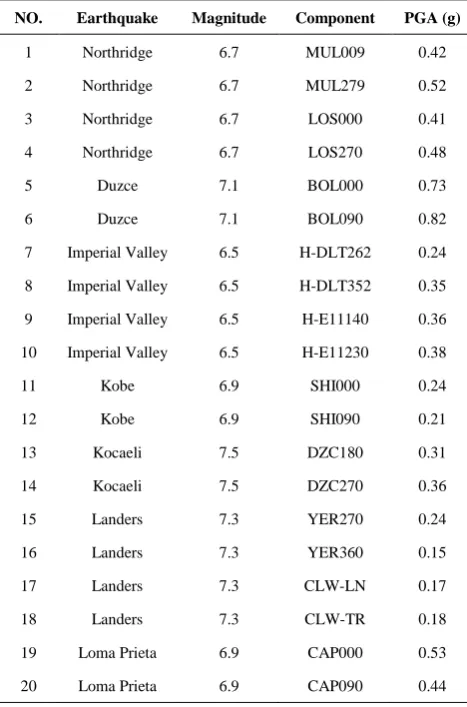
Twenty far-field ground motion records from FEMA-P695 [15] document are selected and used for IDAs. The selected records possess high magnitudes and recorded on stiff soil. The most important criteria used for the selection of these records are, as follows: (1) closest distance to the rupture between 10 and 100 km; (2) average shear-wave velocity in upper 30 m of soil, Vs30 > 180 m/s; (3) high-pass filter frequency below 0.28 Hz (corresponding to the longest period of 3.57 sec). This can suitably ensure that the selected high-pass filtered records are unaffected by the filtration process, and thus appropriate to be used for IDA of the example buildings whose fundamental periods are lower than 3.57 sec. More details of the selected ground motions are provided in Table 1.
4. EVALUATION OF COLLAPSE CAPACITY
In this section, the seismic collapse response of the example models based on IDA and simplified analysis methods are presented.
TABLE 1. Earthquake ground motions used in this study
NO. Earthquake Magnitude Component PGA (g)
1 Northridge 6.7 MUL009 0.42
2 Northridge 6.7 MUL279 0.52
3 Northridge 6.7 LOS000 0.41
4 Northridge 6.7 LOS270 0.48
5 Duzce 7.1 BOL000 0.73
6 Duzce 7.1 BOL090 0.82
7 Imperial Valley 6.5 H-DLT262 0.24
8 Imperial Valley 6.5 H-DLT352 0.35
9 Imperial Valley 6.5 H-E11140 0.36
10 Imperial Valley 6.5 H-E11230 0.38
11 Kobe 6.9 SHI000 0.24
12 Kobe 6.9 SHI090 0.21
13 Kocaeli 7.5 DZC180 0.31
14 Kocaeli 7.5 DZC270 0.36
15 Landers 7.3 YER270 0.24
16 Landers 7.3 YER360 0.15
17 Landers 7.3 CLW-LN 0.17
18 Landers 7.3 CLW-TR 0.18
19 Loma Prieta 6.9 CAP000 0.53
20 Loma Prieta 6.9 CAP090 0.44
The results of these analyses for one ground motion lead to one IDA curve. In this study, the spectral acceleration corresponding to the first mode elastic vibration period of the structure, Sa(T1), and the maximum interstory drift ratio (MIDR) are chosen as the intensity measure (IM) and engineering demand parameter (EDP) for the development of IDA curves, respectively. Nonetheless, IDA curves based on maximum roof displacement (MRD) are also developed and used for the evaluation of the original and simplified MPA-based IDA methods which are both based on equivalent SDOF concepts. In IDAs, the sidesway collapse capacity is defined as the spectral acceleration value at which the structure becomes dynamically unstable due to unbound increase of MIDR or MRD. This occurs when the IDA curve becomes flat.
The IDA curves for the example models subjected to the set of twenty ground motion records are shown in Figure 1. The median seismic collapse capacities obtained from IDAs are also shown in the same figure. The response of IDAs will be used as the benchmark solution for the evaluation of simplified analysis procedures in the next paragraphs.
Figure 1. IDA of the example frames subjected to the set of twenty ground motions (MIDR chosen as the EDP)
4. 2. SPO2IDA Method Herein, the seismic collapse response of the example buildings are evaluated by the approximate SPO2IDA method and compared with the exact IDA results. In all cases, the ‘first-mode’ lateral load pattern is used for the development of capacity curves. Figure 2 shows the
0 1 2 3 4
0 0.02 0.04 0.06 0.08 0.1
Sa (T
1
) (g)
Maximum interstory drift ratio 3story frame
Single IDA curves Summarized IDA curves =2.50g
16% IDA 84% IDA
50% IDA
0 0.5 1 1.5 2
0 0.02 0.04 0.06 0.08 0.1
Sa
(
T
1
)
(g)
Maximum interstory drift ratio 6story frame
=1.07g
16% IDA 84% IDA
50% IDA
0 0.5 1 1.5
0 0.02 0.04 0.06 0.08 0.1
Sa
(
T
1
)
(g)
Maximum interstory drift ratio 9story frame
=0.79g
84% IDA
16% IDA 50% IDA
0 0.5 1 1.5
0 0.02 0.04 0.06 0.08 0.1
Sa
(
T
1
)
(g)
Maximum interstory drift ratio 12story frame
=0.51g
16% IDA 84% IDA
16%, 50%, and 84% fractile IDA curves estimated by SPO2IDA approximate procedure along with those given by the exact IDA method for the example buildings. The median seismic collapse capacities obtained from SPO2IDA method are also shown in the same figure.
As can be seen from Figure 2, the approximate curves generally agree with those given by the exact IDA approach; however, the level of agreement varies from one structure to another and at different ranges of MIDR. More specifically some differences can be seen immediately after the linear elastic region, but they are reduced at high values of deformation.
Figure 2. 16%, 50% and 84% fractile IDA curves for the example structures from SPO2IDA and IDA methods
There is also a good correlation between the results near the collapse region. This is especially true for the summarized 50% fractile IDA curves. Comparison of estimated collapse capacities with the exact values shows that SPO2IDA method can predict the median collapse capacity of the example structures fairly well. The exact values obtained as median collapse capacity for the 3-, 6-, 9- and 12-story frames are equal to 2.50g, 1.07g, 0.79g and 0.51g, respectively (see Figure 2); i.e., the estimation errors are generally less than 11% for these buildings. Nevertheless, less accurate estimates from SPO2IDA method for the 16% and 84% fractile IDA curves are obtained.
4. 3.MPA-based IDA Method In this section, the seismic collapse response of the reference structures are re-evaluated by the approximate MPA-based IDA method and compared with the exact IDA results. Figure 3 shows the IDA results for the ‘first-mode’ SDOF system of the structures subjected to the selected ground motion records. The summarized IDA curves and the median collapse capacity predicted by the MPA-based IDA for each building are also shown in the same figure.
As can be seen from Figure 3, the MPA-based IDA can estimate the collapse response of the buildings fairly well. The median collapse capacities predicted by the MPA-based IDA are 2.51g, 1.03g, 0.81g and 0.51g for the 3-, 6-, 9-, and 12-story buildings, respectively; i.e., the estimation errors are less than 4% for these structures. As a result, the MPA-based IDA method can generally predict the median collapse capacity with smaller error compared to SPO2IDA. However like to SPO2IDA, less accurate collapse responses are obtained by the method for the 16% and 84% fractile IDA curves; such that the accuracy of the method decreases as the number of stories is increased. For example, in the 12-story frame, the collapse capacities for the 16% and 84% fractiles are underestimated by 17% and 10% compared to the exact IDA results, respectively; whereas the estimation errors for the 3-story frame are only about 3% and 4%, respectively.
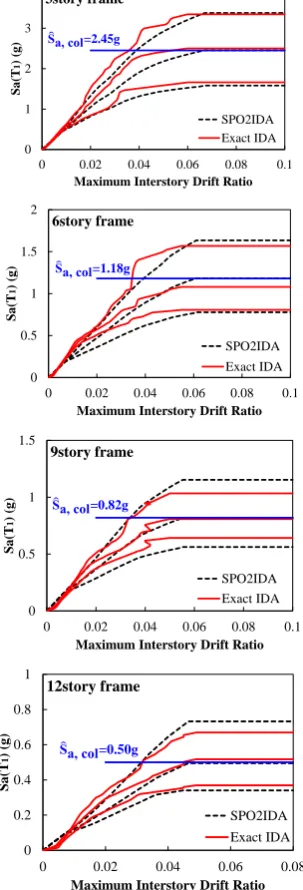
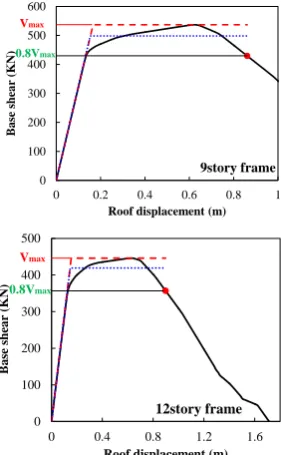
4. 4. Proposed MPA-based IDA Method The analysis results obtained from the proposed MPA-based IDA method is presented. A comparison is then made between the results obtained from the proposed method with those given by the exact IDA approach. As mentioned earlier, the proposed simplified MPA- based IDA method uses a bilinear representation of the pushover curve which is similar to the one that has been used by FEMA P695 [15] document with the exception of applying equal absorbed energy for the original and idealized curves up to the point at which 20% strength loss occurs. Figure 4 shows the ‘first-mode’ pushover curve and its bilinear representation for each building. 0
1 2 3 4
0 0.02 0.04 0.06 0.08 0.1
Sa
(T
1
)
(g
)
Maximum Interstory Drift Ratio
3story frame
SPO2IDA Exact IDA
=2.45g
0 0.5 1 1.5 2
0 0.02 0.04 0.06 0.08 0.1
Sa
(T
1
)
(g
)
Maximum Interstory Drift Ratio 6story frame
SPO2IDA Exact IDA
=1.18g
0 0.5 1 1.5
0 0.02 0.04 0.06 0.08 0.1
Sa
(T
1
)
(g
)
Maximum Interstory Drift Ratio 9story frame
SPO2IDA Exact IDA =0.82g
0 0.2 0.4 0.6 0.8 1
0 0.02 0.04 0.06 0.08
Sa
(T
1
)
(g
)
Maximum Interstory Drift Ratio 12story frame
Figure 3. IDA curves for the SDOF systems with the proposed bilinear backbone curve and the corresponding MPA-based IDA results for the example buildings
The idealized pushover curves based on FEMA P695 document are also shown for comparison.
Figure 3 shows the summarized IDA curves estimated by the proposed method and those given by the exact IDA method for the example buildings.
The median seismic collapse capacities obtained from the proposed method are also shown in the same figure.
Figure 4. Bilinear idealized pushover curves based on the proposed and FEMA P695 idealization methods
As can be seen from Figure 3, the approximate curves generally agree with those given by the IDA and the original MPA-based IDA methods; however, the level of agreement varies from one structure to another and at different ranges of roof displacement. Some slight differences can be observed between the MPA-based IDA and proposed methods in the linear elastic region, but they are gradually increased at high values of roof 0 1 2 3 4 5 6
0 0.1 0.2 0.3 0.4 0.5
Sa ( T 1 ) (g)
Top displacement (m)
3story frame
Single IDA curve 0 1 2 3
0 0.1 0.2 0.3 0.4 0.5
Sa (T 1 ) (g )
Top displacement (m)
6story frame 0 0.5 1 1.5 2
0 0.1 0.2 0.3 0.4 0.5
Sa ( T 1 ) (g)
Top displacement (m)
9story frame 0 0.2 0.4 0.6 0.8 1
0 0.2 0.4 0.6
Sa ( T 1 ) (g)
Top displacement (m)
12story frame 0 1 2 3 4
0 0.2 0.4 0.6 0.8
Sa ( T 1 ) [g]
Roof displacement (m) Proposed MPA-based IDA Exact IDA =2.66g 84% IDA 50% IDA 16% IDA 0 0.4 0.8 1.2 1.6 2
0 0.2 0.4 0.6 0.8
Sa ( T 1 ) [g]
Roof displacement (m)
=0.99g 84% IDA 50% IDA 16% IDA 0 0.2 0.4 0.6 0.8 1 1.2 1.4
0 0.5 1
Sa ( T 1 ) [g]
Roof displacement (m)
=0.83g 16% IDA 50% IDA 84% IDA 0 0.2 0.4 0.6 0.8 1
0 0.2 0.4 0.6 0.8 1
Sa ( T 1 ) [g]
Roof displacement (m)
=0.54g 16% IDA 50% IDA 84% IDA 0 100 200 300 400
0 0.2 0.4 0.6
Ba
se shea
r (
K
N)
Roof displacement (m) 3story frame Pushover curve
Bilinear curve - FEMA P695
Bilinear curve - Proposed
Vmax 0.8Vmax 0 150 300 450 600
0 0.2 0.4 0.6 0.8 1
Ba
se shea
r (
K
N)
Roof displacement (m) 6story frame Vmax 0.8Vmax 0 100 200 300 400 500 600
0 0.2 0.4 0.6 0.8 1
Ba
se shea
r (
K
N)
Roof displacement (m)
9story frame Vmax 0.8Vmax 0 100 200 300 400 500
0 0.4 0.8 1.2 1.6
Ba
se shea
r (
K
N)
Roof displacement (m)
12story frame
Vmax
displacement. Comparison of estimated collapse capacities with the exact values shows that the MPA-based IDA and the proposed simplified methods provide almost similar results for the collapse capacities in the most case studies. This is especially true for the summarized 50% fractile IDA curves. The estimation errors from the original MPA-based IDA and the proposed methods for the median collapse capacity are almost less than 4% and 8%, respectively. Like to the original MPA-based IDA, the proposed method also fails to accurately estimate the 16% and 84% fractile IDA curves for the reference buildings.
4. 5. Method Proposed by Shafei et al. The sidesway collapse capacity of the reference structures are determined by the Shafei et al. method and compared with the exact IDA results. As explained earlier, the procedure estimates the median value and dispersion of seismic collapse capacity of moment resisting frames by using some closed-form equations and hence needs much less computational effort. The main advantage of the method is that it directly uses MODF models. These models can predict more realistic results for different global or local collapse modes as they can to some extent take into account the effect of cyclic deterioration in strength and stiffness of structural components through the nonlinear analysis. The results illustrate that the Shafei et al. method can estimate the median sidesway collapse capacity of the buildings with good accuracy. The errors from the Shafei et al. [6] method are less than 2%, 8% and 0.5% (corresponding to 1.05g, 0.72g and 0.51g median collapse capacities) for the 6-, 9- and 12-story buildings, respectively. However, poor estimate is obtained by the method for the 3-story building (i.e., 44% error). This deficiency may be attributed to the fact that the zi factors are not well defined by the procedure for structures with the number of stories less than four.
5. CONCLUSION
The issue of seismic sidesway collapse assessment for RC frame structures is studied in this paper considering simplified methods based on nonlinear static analysis. A new simplified MPA-based IDA method is proposed which can acceptably estimate the seismic capacity of RC buildings by IDA of an equivalent SDOF system whose backbone curve mimics a bilinear idealized pushover curve of the original MDOF structure. A good correlation is observed between the results obtained from the proposed method with those given by the original MPA-based IDA and IDA methods. The results obtained from three other simplified analysis methods for different seismic intensities are also presented in this paper. The performance of the studied methods is
evaluated by comparing the calculated median collapse capacities with those given by the exact IDA method. Based on the results of various pushover and IDAs carried out for RC structures with different heights, the main findings of the study are summarized as follows: The results obviously show that there is a good
correlation between the results obtained by the proposed simplified method and those given by the exact IDA method; however, the level of agreement varies from one structure to another and at different ranges of roof displacement. Comparison of estimated collapse capacities with the exact values shows that the MPA-based IDA and the proposed simplified methods provide almost similar results for the collapse capacities in the most case studies. This is especially true for the summarized 50% fractile IDA curves. Nevertheless, like the original MPA-based IDA method, the proposed method fails to accurately estimate the 16% and 84% fractile IDA curves for the reference buildings.
SPO2IDA predicts sufficiently accurate results for the median seismic collapse capacity of the regular RC frames. The estimation errors are less than 11% for the example buildings. The method is also capable of predicting the structural capacities for the CP and GI limit states with good accuracy. However, for the LS limit state, less accurate capacities are obtained by the procedure.
MPA-based IDA method can provide fairly accurate estimates of structural capacities for CP and GI limit states in most case studies. A reasonable approximation of summarized 50% fractile IDA curves is achieved by the method for the reference buildings. Nonetheless, the accuracy of the method deteriorates in approximating the 16% and 84% fractile IDA curves. Compared to SPO2IDA, the summarized IDA curves approximated by MPA-based IDA are much closer to those given by the exact IDA method, in most cases.
The method proposed by Shafei et al. produces sufficiently acceptable results for the median collapse capacity of the analyzed buildings except in the case of 3-story frame, where poor estimates are obtained. This shortcoming is attributed to the fact that the zi factors are not well defined by the procedure for structures with the number of stories less than four. Among the simplified methods studied in this paper, this method is identified as the simplest procedure which can reliably estimate the median sidesway collapse capacity of mid- to high-rise frame buildings with the minimum computational efforts.
6. REFERENCES
1. Vamvatsikos, D. and Cornell, C.A., "Incremental dynamic analysis", Earthquake Engineering & Structural Dynamics, Vol. 31, No. 3, (2002), 491-514.
2. Vamvatsikos, D. and Cornell, C.A., "Direct estimation of seismic demand and capacity of multidegree-of-freedom systems through incremental dynamic analysis of single degree of freedom approximation", Journal of Structural Engineering, Vol. 131, No. 4, (2005), 589-599.
3. Han, S.W. and Chopra, A.K., "Approximate incremental dynamic analysis using the modal pushover analysis procedure",
Earthquake Engineering & Structural Dynamics, Vol. 35, No. 15, (2006), 1853-1873.
4. Han, S.W., Moon, K.H. and Chopra, A.K., "Application of mpa to estimate probability of collapse of structures", Earthquake Engineering & Structural Dynamics, Vol. 39, No. 11, (2010), 1259-1278.
5. Moon, K.-H., Han, S.W., Lee, T.S. and Seok, S.W., "Approximate mpa-based method for performing incremental dynamic analysis", Nonlinear Dynamics, Vol. 67, No. 4, (2012), 2865-2888.
6. Shafei, B., Zareian, F. and Lignos, D.G., "A simplified method for collapse capacity assessment of moment-resisting frame and shear wall structural systems", Engineering Structures, Vol. 33, No. 4, (2011), 1107-1116.
7. Agency, F.E.M., Improvement of nonlinear static seismic
analysis procedures. 2005, Applied Technology Council
(ATC-55 Project) Redwood City, California.
8. Adam, C. and Jäger, C., "Simplified collapse capacity assessment of earthquake excited regular frame structures vulnerable to p-delta", Engineering Structures, Vol. 44, No., (2012), 159-173.
9. Peruš, I., Klinc, R., Dolenc, M. and Dolšek, M., "A web‐based methodology for the prediction of approximate ida curves",
Earthquake Engineering & Structural Dynamics, Vol. 42, No. 1, (2013), 43-60.
10. Hamidia, M., Filiatrault, A. and Aref, A., "Simplified seismic sidesway collapse analysis of frame buildings", Earthquake Engineering & Structural Dynamics, Vol. 43, No. 3, (2014), 429-448.
11. Yazdani, A., Razmyan, S. and Hossainabadi, H.B., "Approximate incremental dynamic analysis using reduction of ground motion records", International Journal of Engineering-Transactions B: Applications, Vol. 28, No. 2, (2014), 190-197. 12. Tavakoli, H. and Kiakojouri, F., "Numerical study of
progressive collapse in framed structures: A new approach for dynamic column removal", International Journal of Engineering, Transaction A: Basics, Vol. 26, No. 7, (2013), 685–692..
13. Chopra, A.K. and Goel, R.K., "A modal pushover analysis procedure for estimating seismic demands for buildings",
Earthquake Engineering & Structural Dynamics, Vol. 31, No. 3, (2002), 561-582.
14. Ibarra, L.F., Medina, R.A. and Krawinkler, H., "Hysteretic models that incorporate strength and stiffness deterioration",
Earthquake Engineering & Structural Dynamics, Vol. 34, No. 12, (2005), 1489-1511.
15. Agency, F.E.M., Quantification of building seismic performance
factors. 2009, FEMA P695, Washington, DC.
16. Ibarra, L.F. and Krawinkler, H., "Global collapse of frame structures under seismic excitations, Pacific Earthquake Engineering Research Center Berkeley, CA, (2005).
17. Haselton, C.B., Liel, A.B., Dean, B.S., Chou, J.H. and Deierlein, G.G., Seismic collapse safety and behavior of modern reinforced concrete moment frame buildings, in Structural engineering research frontiers. (2007), 1-14.
18. Goulet, C.A., Haselton, C.B., Mitrani‐Reiser, J., Beck, J.L., Deierlein, G.G., Porter, K.A. and Stewart, J.P., "Evaluation of the seismic performance of a code‐conforming reinforced‐ concrete frame building—from seismic hazard to collapse safety and economic losses", Earthquake Engineering & Structural Dynamics, Vol. 36, No. 13, (2007), 1973-1997.
A Simplified Modal Pushover Analysis-based Method for Incremental Dynamic
Analysis of Regular RC Moment-resisting Frames
M. Jalilkhani, A. R. Manafpour
Department of Civil Engineering, Urmia University, Urmia, Iran
P A P E R I N F O
Paper history: Received 06 October 2017
Received in revised form 13 November 2017 Accepted 30 December 2017
Keywords:
Sidesway Collapse Capacity Pushover Analysis
Incremental Dynamic Analysis Method RC Moment-resisting Frame
ديكچ ه
( هدنیازف یکیمانید لیلحت رضاح لاح رد
IDA
) هزرل شزیرورف تیفرظ نیمخت تهج دنمتردق یرازبا هزاس یبناج یا
یم رامش هب اه نیا اب .دیآ
،لاح نیا نامز شور رب یم یطخریغ ینامز هچخیرات لیلحت یدایز دادعت دنمزاین و هدوب هداس شور کی هلاقم نیا .دشاب
شوپ لیلحت زا هدش روا
( لادوم
MPA
باق هدنیازف یکیمانید لیلحت روظنم هب ار ) نتب یشمخ یاه
یم داهنشیپ همرآ متسیس کی یکیمانید خساپ زا یداهنشیپ شور .دنک
زا هک لداعم دازآ هجرد کت یم تیعبت ماب ییاجباج و یبناج یورین نیب دوجوم یطخود هطبار کی
یم هدافتسا ،دنک قیرط زا هطبار نیا .دیامن
شوپ لیلحت یم تسد هب هزاس لوا دوم ریظن روا نتب یشمخ باق راهچ .دیآ
نیئآ ساسا رب هدش یحارط مظنم همرآ همان
رضاح لاح ینامتخاس یاه
پ شور طسوت و هدش باختنا اکیرمآ یم رارق لیلحت دروم یداهنشی
هیلوا شور زا هدمآ تسد هب یلیلحت جیاتن .دنریگ
MPA-based IDA
،
شوپ لیلحت ( هدنیازف یکیمانید لیلحت لباقم رد روا
SPO2IDA
یداهنشیپ شور و )
Shafei
یم هئارا هسیاقم روظنم هب زین شناراکمه و .دنوش
سپس ، لیلحت زا لصاح جیاتن اب هدمآ تسد هب جیاتن هسیاقم زا یداهنشیپ شور درکلمع
IDA
یبایزرا دروم یم وش د یم ناشن جیاتن . هک دهد
یم یداهنشیپ شور هزاس یکیمانید تیفرظ یرثؤم روط هب دناوت
تدش ءازا هب ار لاثم یاه هزرل یاه
دوجو نیا اب .دنزب نیمخت فلتخم یا ،
دننامه
شور یاه
MPA-based IDA
و
SPO2IDA
کهد ءازا هب یاه 16 % و 84 نیئاپ تقد اب جیاتن بلغا یارب یداهنشیپ شور طسوت یرت
.دندمآ تسد هب یتاعلاطم یاهدروم