*Corresponding author: Vidya S M ISSN: 0976-3031
Research Article
OPTIMIZATION OF AMPLIFICATION CONDITIONS FOR DNA BARCODING MARKERS IN
MEDICINALLY IMPORTANT GENUS MUCUNA
Rashmi K V
1., Sathyanarayana N
2and Vidya S M
3*
1
Department of Biotechnology, Sir M Visvesvaraya Institute of Technology, Hunasamaranahalli,
Bangalore 562157, Karnataka, India
2
Department of Botany, Sikkim University, Gangtok 737102, Sikkim, India
3
Department of Biotechnology, NMAM Institute of Technology, Nitte 574110,
Udupi dist., Karnataka, India
ARTICLE INFO ABSTRACT
Genus Mucuna belongs to the family Fabaceae is one of the potential underutilized legumes which include 150 species of annual and perennial species of pantropical distribution. Members of this genus possess several promising nutritional and agronomic attributes it has received wide-ranging attention from pharmaceutical industries, nutritional chemists and agronomists alike in recent years. The evolution and relationship among different Mucuna taxa (both at species and sub-species level) of India have remained unknown except M. pruriens. Because of this, it is necessary to conduct research at the species level as well as to assess phenetic relationships among different taxa in India to place the genus in right taxonomic and phylogenetic perspective. The Consortium for the Barcode of Life (CBOL) – Plant working group revealed the utility of nuclear Internal Transcribed Spacer (nrITS) region of the nuclear ribosomal cistron (18S-5.8S-26S) and chloroplast regions like trnH-psbA, matK and rbcL towards developing the plant DNA barcodes. Though these regions are considered as universal barcode regions, it observed from literature that to get successful amplification of these regions many PCR parameters needs to be optimized. Here we report different amplification parameters optimized for the amplification of nrITS2, trnH-psbA, matK and rbcL regions in Mucuna species of India collected from different geographical locations. The amplified regions from the optimized protocols were sequenced and obtained sequences after editing were queried in NCBI BLAST to confirm that they distinctly match the respective barcode regions of the Mucuna species. The results of these analysis revealed that obtained sequences were authentic and could be used for phylogenetic studies and DNA barcoding of Mucuna species of India.
INTRODUCTION
Mucuna Adans a promising underutilized legume (Rai et al.,
2007) belongs to the family Fabaceae, which includes around 150 species of both annual and perennial varieties, distributed pantropically (Buckles, 1995). Members of this genus are capturing commercial and scientific importance as there are many reports on their medicinal, nutritional and agronomical properties (Bhat and Kharim, 2009; Siddhuraju et al., 2000; Bressani, 2002). M. pruriens, an annual of this genus exhibits lot promise towards sustainable agricultural practices as it produces very high green biomass, high nitrogen fixing ability and an average seed yield of 2.4t/ha/yr, which are very rich in protein content (Buckles, 1995; Carsky and Ndikawa, 1998). Genus Mucuna is also known for its significant levels (1-5%) of L-DOPA (L-3, 4-dihydroxyphenylalanine), a non-protein
amino acid which is the precursor for the synthesis of neurotransmitter Dopamine and it is used in the treatment of Parkinson’s disease (Katzenschlager et al., 2004; Lieu et al.,
2010). Besides this, different parts of this plant are supplemented as active ingredient of many ayurvedic formulations administered against several medical ailments (Amin et al., 1996; Longhi et al., 2011; Obogwu et al., 2014).
Taxonomic revision on genus Mucuna in Indian subcontinent has reported the existence of ten species - of which M.
atropurpurea (Roxb.) DC.ex Wight and Arn is endemic to
peninsular India; M. imbricata DC.ex Bak., M. Bracteata
DC.ex Kurz, M. macrocarpa Wall., M. sempervirens Hemsl.
and M. nigricans (Lour) Steud. are largely distributed in the
eastern Himalayas and M. pruriens, M. monosperma DC. ex Wight and M. gigantea (Wild.) DC. are widely dispersed
Recent Scientific
Research
International Journal of Recent Scientific Research
Vol. 7, Issue, 11, pp. 14237-14242, November, 2016
Copyright © Rashmi K V., Sathyanarayana N and Vidya S M., 2016, this is an open-access article distributed under the terms of the Creative Commons Attribution License, which permits unrestricted use, distribution and reproduction in any medium, provided the original work is properly cited.
Article History:
Received 16th August, 2016 Received in revised form 25th September, 2016
Accepted 23rd October, 2016
Published online 28th November, 2016
Key Words:
In Medicinally Important Genus Mucuna
(Wilmot-Dear, 1987). The recently reported M.sanjappe was identified from the Western Ghats of India (Aitawade et al.,
2012). Except M. pruriens all other species are woody perennials.
Members of this genus are climbers, with long slender branches. Leaves are trifoliar with lanceolate lamina and the petioles are hairy. Inflorescence contains bunch of flowers ranging from 15 to sixty large flowers with dark purple or creamy white corolla. Pods exhibit characteristic thick layer of pod-hairs on them which causes itching and irritation when they come in contact with human skin, due to the presence of purities (Wilmot-Dear, 1987). Pod shape and number of seeds is again different across the species (Jaheer and Sathyanarayana, 2010).
Though there are lot of reports and revisions on the taxonomical classification of species and subspecies of this genus, a collective review of these reports ends with considerable taxonomic ambiguities (Dassanayake and Fosberg, 1980; Sasidharan, 2004; Ellis, 1990; Saldanha, 1996). A number of taxa namely, Mucuna aterrima, M. cochinchinensis, M. hassjoo, M. nivea and M. utilis which were formerly considered separate species are now included as varieties of M. pruriens, (Wilmot-Dear, 1987). In India, two main varieties of M. pruriensviz., var. utilis and var. pruriens
are widely reported (Wilmot-Dear, 1987; Sur, 2002; Sasidharan, 2004) , along with a third group viz., var. hirsuta. The latter was earlier classified as an independent species (Ellis, 1990; Saldanha, 1996); but subsequent revisions; especially the one by Wilmot Dear (1987) categorically suggested its inclusion, along with few others, under the botanical varieties of M. pruriens. Distribution of this genus across the wide geographical and climatic conditions of India has reflected tremendous genetic diversity among Mucuna. In order to understand the evolution and relationship among different Mucuna taxa (both at species and sub-species level), it is necessary to conduct research towards this way.
Studies by Kress & Erickson and The Consortium for the Barcode of Life (CBOL) – Plant working group revealed the utility of nuclear and chloroplast genes towards developing the plant DNA barcodes (Kress and Erickson, 2007; C.P.Group,2009). Observations made by these studies specifically suggest that nuclear Internal Transcribed Spacer (nrITS) region of the nuclear ribosomal cistron (18S-5.8S-26S) and chloroplast regions like trnH-psbA, matK and rbcL are the most commonly sequenced loci for molecular systemic investigations and species. In genus Mucuna there are very few reports on molecular phyologentic studies using the above said markers. Study made by Stefanovic et al on a large group of Phaseoloid legumes using eight chloroplast regions including
matK and rbcL reported genus Mucuna is sister to genus
Desmodieae (Stefanovic et al., 2009). However, such reports for species in the Indian subcontinent are lacking. The present research group made the first attempt on establishing the phylogenetic inference in Mucuna species of India using nrITS and trnH-psbA sequences for only seven species (Jaheer et al.,
2015), BUT it is found in the later stages of the research, to amplify these regions across large number of species and subspecies few modifications are needed for the earlier reported protocols.
Though the barcode regions nrITS, trnH-psbA, matK and rbcL
are considered as the universal markers, the review made by Vijayan and Tsou clearly lists out the different sets of suitable primers to amplify these candidate regions (Vijayan and Tsou, 2010). The protocols followed to amplify these regions vary from report to report in parameters like primer concentrations, annealing temperatures and utility of PCR additives etc. (Tallei & Kolondam, 2015; Lagoudakis et al., 2011; Phong et al., 2014). For example to amplify nrITS2 region the reported annealing temperatures ranges between 36C to 60C (Jaheer et al., 2015; Selvaraj et al., 2012; Ihrmark et al., 2012), to retrieve
matK sequences always it needs extra efforts with multiple primer combinations (Parmentier et al., 2013; Fazekas et al., 2008). Thus it is very important to screen the relevant primer combination and optimize the amplification conditions for the DNA barcoding markers for the taxa under study before taking a large scale phylogenetic analysis and DNA barcoding. In this view, the present study reports the suitable primer combinations and optimized the PCR amplification conditions for regions of nrITS2 and chloroplast trnH-psbA, matK and
rbcL in Mucuna species of India.
MATERIALS AND METHODS
Plant Material and DNA Isolation: Four different species of
Mucuna namely M.atropurpurea, M. monosperma, M.bracteata, M.nigricans and two botanical varieties of M.
pruriens var. utilis and M. pruriens var. pruriens were collected
from the natural growing areas of India. DNA was isolated from the tender leaflets of the 5-7 day old plantlets using
modified Doyle and Doyle method (Doyle & Doyle, 1990). 0.5 to 1 g of fresh leaf sample was ground in liquid nitrogen and homogenized in 10ml of extraction buffer containing 2%
cetyltrimethylammoniumbromide (CTAB), 1% Polyvinylpyrolidone (PVP), 0.5% Charcoal, 1.4 M NaCl, 0.1M Tris-HCl, 20mM EDTA and 0.2% β mercaptoethanol. This suspension was incubated at 600C for 1 hour and extraction was done with two times chloroform: isoamylalcohol (24:1) and one time phenol: chloroform: isoamylalcohol (1:1) treatments. Finally the DNA was precipitated using 0.67 volumes of isopropanol. The concentrated DNA pellet was washed with 70% ethanol to remove the traces of phenol or chloroform. This pellet was air dried and dissolved in 1X Tris-EDTA buffer (pH 8). Isolated DNA was assessed for its quality and quantity using ethidium bromide staining on 0.8% agarose gel.
Internal Transcribed Spacer (nrITS) amplification
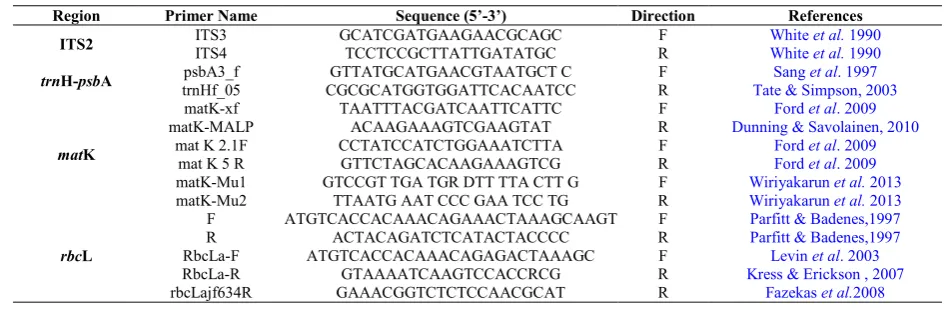
For amplification of ITS region ITS3 and ITS4 (Table 1) primers were used. Sequences of the primers used are given in Table 1. Amplification reaction was carried out in 0.025cm3 reaction mixture containing 0.2mM dNTP’s, 10mM Tris-HCl, 1.5mM MgCl2, 50mM KCl, 0.1% Triton X-100, 1.0 U Taq
trnH-psbA amplification
Amplification of trnH-psbA region was carried out in 0.025cm3 reaction mixture containing 0.3mM dNTP’s, 10mM Tris-HCl, 3mM MgCl2, 50mM KCl, 0.1% Triton X-100, 1.0 U Taq DNA polymerase, two different individual concentrations of primers i.e., 0.1µM and 0.2µM forward and reverse primers (Eurofins Genomics India Pvt. Ltd. Bangalore) and 50ng of genomic DNA. Primers were used in the study are psbAF and trnHR (Table 1). Amplification program included the following steps: 1 min at 94 0C, followed by 40 cycles of 30 s at 94 0C, 40 s annealing at 53 0C and 40 s extension at 72 0C and a final extension cycle of 5 min at 72 0C.
matK amplification
For amplifying the matK region in Mucuna species the three different combinations (Table 1) of matK primers (mat K 2.1F/5 R, matK-Mu1F/Mu2 R & matK-xf/MALP) were tested. Amplification reaction was carried out in a total of 0.025cm3 reaction mixture containing 10mM Tris-HCl,50mM KCl, 0.1% Triton X-100, 1.5mM MgCl2, 0.2mM dNTP’s, 1.0 U Taq DNA polymerase, with different concentrations (1 µM, 0.5 µM and 0.3µM) of forward and reverse primers (Eurofins Genomics India Pvt. Ltd. Bangalore) and 50ng of genomic DNA. The thermal cycling program was tested with two different annealing temperatures and the programs is as follows; 94°C for 1 min; 35 cycles of 94°C for 30 s, 49°C /55°C for 30 s, 72°C for 50 s; final extension 72°C for 5 min.
rbcL amplification
rbcL region amplification in Mucuna species was tried with three different rbcL primer combinations (Table 1). Amplification reaction was carried out in a total of 0.025cm3 reaction mixture containing 10mM Tris-HCl,50mM KCl, 0.1% Triton X-100, 2.5mM MgCl2, 0.4mM dNTP’s, 1.0 U Taq DNA polymerase, 0.3µM of forward and reverse primers (Eurofins Genomics India Pvt. Ltd. Bangalore) and 50ng of genomic DNA. The same reaction was also tested with 5% DMSO The thermal cycling program was as follows; 94°C for 1 min; 35 cycles of 94°C for 30 s, 49°C /55°C for 30 s, 72°C for 50 s; final extension 72°C for 5 min.
Amplification of all the above marker regions was performed in Peltier thermal cycler (MJ Research, USA). In all the reactions a negative control was kept, which contained all PCR reactants except the template DNA, which was replaced with nuclease free water.
Amplification products were resolved on 1.5% agarose gel (1X TAE) followed by ethidium bromide staining.
Sequencing of the amplicons, sequence alignment and analysis of the data
The nrITS2, trnH-psbA, matK and rbcL amplification products were sequenced in both forward and reverse directions at Eurofins Genomics India Pvt. Ltd. using ABI 3730XL (Applied BioSystems) sequencer following the manufacturer’s protocols. The sequence data obtained was manually assessed and trimmed based on the quality parameters like background noise, peak intensity in respective chromatograms using Chromas lite version 2.01 (Technelysium, 2015). Successful sequencing was considered only when bidirectional sequences obtained in different sequencing runs could be assembled into a reliable contig a BLAST (http://blast.ncbi.nlm.nih.gov/) run was done to confirm their identity. Obtained sequences were submitted to NCBI Genbank. Genbank accession numbers are given in table 2.
RESULTS
ITS2 region of Mucuna species showed a single non-spurious amplification product of size ~300-400bp at the concentration of 0.1µM of ITS3 and ITS4 primers with an annealing temperature of 560C (Figure 1). 0.05µM & 0.2µM concentrations yielded less intense bands and primer dimers respectively. Amplification at 580C annealing temperature yielded poor amplification products, where as with 540C the product intensity was almost comparable with 560C with minor reduction in the intensity. The average G+C content among different sequences of ITS2 region varied from 54 to 63 % indicating well conserved regions.
The chloroplast trnH-psbAspacer region gave an intense sharp amplification product of size ranging between 350 to 450bp with 0.1µM concentration of psbAFand trnHR primers (Figure 1). The G+C content varied from 27 to 31 % indicating less conserved regions compared to ITS.
To amplify matK region of Mucuna species three different combinations were tried, out of which only matK-xf/MALP primer combination showed the amplification at a concentration of 0.3µM of forward and reverse primers. This amplification was seen at an annealing temperature of 49°C and the product size was between 900 to 1100bp (Figure 1).
Table 1 List of Primers and their sequences used in the present study
Region Primer Name Sequence (5’-3’) Direction References
ITS2 ITS3 ITS4 GCATCGATGAAGAACGCAGC TCCTCCGCTTATTGATATGC R F White White et al.et al. 1990 1990
trnH-psbA psbA3_f GTTATGCATGAACGTAATGCT C F Sang et al. 1997
trnHf_05 CGCGCATGGTGGATTCACAATCC R Tate & Simpson, 2003
matK
matK-xf TAATTTACGATCAATTCATTC F Ford et al. 2009
matK-MALP ACAAGAAAGTCGAAGTAT R Dunning & Savolainen, 2010
mat K 2.1F CCTATCCATCTGGAAATCTTA F Ford et al. 2009
mat K 5 R GTTCTAGCACAAGAAAGTCG R Ford et al. 2009
matK-Mu1 GTCCGT TGA TGR DTT TTA CTT G F Wiriyakarun et al. 2013
matK-Mu2 TTAATG AAT CCC GAA TCC TG R Wiriyakarun et al. 2013
rbcL
F ATGTCACCACAAACAGAAACTAAAGCAAGT F Parfitt & Badenes,1997
R ACTACAGATCTCATACTACCCC R Parfitt & Badenes,1997
RbcLa-F ATGTCACCACAAACAGAGACTAAAGC F Levin et al. 2003
RbcLa-R GTAAAATCAAGTCCACCRCG R Kress & Erickson , 2007
In Medicinally Important Genus Mucuna
The average The G+C content was comparable with trnH-psbA spacer and it varied from 27 to 31 % indicating less conserved regions.
The last chloroplast region under study was rbcL and the amplification was obtained with both F/R and RbcLa-F/jf634R combinations with 5% DMSO in the reaction mixture. DMSO was found critical for the amplification of
rbcL region, as it was observed in the absence of it this region never amplified. The optimum annealing temperature for the above primer combinations was 550C and the product size was ranging between 550-650bp (Figure 1). The G+C content varied from 40 to 43% indicating better conserved regions than
matK and trnH-psbA.
Amplification profile of DNA barcode regions in Mucuna species
DISCUSSION
The concept of DNA barcoding highlights the utility of conserved regions to identify species more accurately using the standardized DNA sequences (Hebert et al., 2003). Although the regions ITS, trnH-psbA, matK and rbcL are considered as the universal markers, literature reveals different optimum conditions for amplifying these regions. Nuclear Internal Transcribed Spacer region (nrITS2) amplification conditions in the present study are in consensus with the earlier reports (Fazekas et al., 2008; Madesis et al., 2012). However, it is observed attempts to amplify nrITS2 at 360C and 480C were also successful (Jaheer et al., 2015; Baldwin, 1998). This suggests probably the combination of primers ITS 3 and ITS4 used to amplify nrITS2 region of nrITS which is located between 5.8Sr DNA and 26Sr DNA has a wide annealing temperature range (White et al. 1990). Being shorter than full length ITS region, ITS2 also exhibited efficient marker attributes in DNA barcoding and phylogenetic analysis (Han et al., 2013). CBOL recommended the inclusion of chloroplast
trnH-psbAspacer region along with the matK and rbcL regions to develop plant DNA barcodes because of its molecular resolving power at species level and ease in amplification (Shaw et al., 2007). Several studies reported the combined analysis of non-coding regions of ITS + trnH-psbA resulted a better discrimination between the closely related species (Bolson et al., 2015; Pang et al., 2012).
Table 2 Genbank accession numbers of the four barcode regions from Mucuna species
nrITS2 matK rbcl trnH_psbA
M.atropurpurea KX499608 KX606940 KX606913 KX606865
M.bracteata KX499611 KX606943 KX606937 KX606870
M.monosperma KX499613 KX606942 KX606930 KX606872
M.nigricans JQ340034 KX721059 KX721060 KX606907
M. pruriens
var. utilis KX499624 KX606951 KX606921 KX606890
M. pruriens
var. pruriens KX499617 KX606952 KX606928 KX606877
Figure 1 Amplification profile of nrITS2 , trnH-psbA, matK and rbcL regions in Mucuna species; M: 1KB Ladder; Lanes 1- 5: Mucuna species
Though matK is one among the two locus universal barcode suggested by CBOL plant working group (C.P.Group, 2009), its amplification across the species using universal primers is not successful (Vijayan and Tsou, 2010). Because of this, to amplify matK region of the species under study, always relevant primers selection and optimization of other PCR parameters arises. In the present study out of the three different combinations of matK primers screened only matK-xf/MALP was able to amplify matK region in Mucuna. Where as to amplify another chloroplast barcode region rbcl such universality related issues were not found but it is observed for successful amplification of rbcl region PCR additive DMSO plays a very critical role. CBOL plant working group has recommended the two locus combination of rbcL + matK as the plant barcode based on the recoverability, sequence quality and levels of species discrimination (C.P.Group, 2009).
CONCLUSION
This study reports the amplification efficiency of the DNA barcode markers like ITS and trnH-psbA, matK and rbcL in medicinally and nutritionally important genus Mucuna. The results of the present study lead foundation to expand the sample size towards inferring the phylogeny of the genus to get a better understanding on the relationship among the members of the genus Mucuna.
Acknowledgements
The authors acknowledge the support of Sri Krishnadevaraya Educational Trust (Sri KET), Bangalore and N.M.A.M. Institute of Technology, Nitte, Karkala, Udupi Dist.
References
1. Aitawade, M.M., Yadav, S.R. 2012. Mucuna sanjappae, a new species from the north-Western Ghats, India, Kew Bull., 67(3), 539-43.
2. Amin, K. M. Y., Khan, M. N., Zillur-Rehman, S., & Khan, N. A. 1996. Sexual function improving effect of
Mucuna pruriens in sexually normal male
rats, Fitoterapia, 67(1), 53-58.
3. Baldwin, B.G. 1992. Phylogenetic utility of the internal transcribed spacers of nuclear ribosomal DNA in plants: an example from the Compositae, Molecular phylogenetics and evolution, 1(1), 3-16.
4. Bhat, R., Karim, A.A. 2009. Exploring the Nutritional Potential of Wild and Underutilized Legumes, Compr. Rev. Food Sci. Food Safety, 8(4), 305–331.
5. Bolson, M., de Camargo Smidt, E., Brotto, M.L., Silva-Pereira, V. 2015. ITS and trnH-psbA as Efficient DNA Barcodes to Identify Threatened Commercial Woody Angiosperms from Southern Brazilian Atlantic Rainforests, PloS one, 10(12), e0143049.
6. Bressani, R. 2002. Factors influencing nutritive value in food grain legumes: Mucuna compared to other grain legumes. In Food and feed from Mucuna: Current user and the way forward, Proceedings of an International Workshop, 164-188.
7. Buckles, D. 1995. Velvetbean: A new plant with a history, Eco. Bot., 49, 13-25.
8. Carsky, R. J., Ndikawa, R. 1998. Identification of cover crops for the semi-arid savanna zone of West Africa, In: Buckles, D., Eteka, A., Osiname, M., Galiba, M.,
Galiano, G. (Eds.). Cover Crops in West Africa - Contributing to Sustainable Agriculture, IDRC, IITA, Sasakawa Global 2000, Otawa, Canada, Ibadan, Nigeria, Cotonou, Benin. 179-187.
9. CBOL Plant Working Group. 2009. A DNA barcode for land plants, Proceedings of the Nat. Acad. Sci. 106(31), 12794–12797.
10. Dassanayake, M.D., Fosberg, F.R. 1980. A Revised Handbook to the Flora of Ceylon-Complete Set. Taylor & Francis US.
11. Doyle, J.J., & Doyle, L. J. 1990. Isolation of DNA from plant tissue, Focus, 12, 13-15.
12. Dunning, L.T., Savolainen, V. 2010. Broad-scale amplification of matK for DNA barcoding plants, a technical note, Botanical Journal of the Linnean Society, 164, 1–9.
13. Ellis, J. L. 1990. Flora of Nallamalais, 2, 221-490. 14. Fazekas, A. J., Burgess, K. S., Kesanakurti, P. R.,
Graham, S. W., Newmaster, S. G., Husband, B. C., Percy, D. M., Hajibabaei, M., Barrett, S. C. H. 2008. Multiple multilocus DNA barcodes from the plastid genome discriminate plant species equally well, PLoS One, 3(7).
15. Fazekas, A.J., Burgess, K.S., Kesanakurti, P.R,, et al. 2008. Multiple multilocus DNA barcodes from the plastid genome discriminate plant species equally well, PLOS One, 7, e2802.
16. Ford, C.S., Ayres, K.L., Haider, N., Toomey, N., van-Alpen-Stohl J, et al. 2009. Selection of candidate DNA barcoding regions for use on land plants, Botanical Journal of the Linnean Society, 159, 1–11.
17. Han, J., Zhu, Y., Chen, X., Liao, B., Yao, H., Song, J., Chen, S., Meng, F. 2013. The short ITS2 sequence serves as an efficient taxonomic sequence tag in comparison with the full-length ITS, BioMed research international,
18. Hebert, P.D., Ratnasingham, S., de Waard, J.R. 2003. Barcoding animal life: cytochrome c oxidase subunit 1 divergences among closely related species, Proceedings of the Royal Society of London B: Biological Sciences, 270 (1), S96-9.
19. Ihrmark, K., Bödeker, I. T. M., Cruz-Martinez, K., Friberg, H., Kubartova, A., Schenck, J., Strid, Y., Stenlid, J., Brandström-Durling, M., Clemmensen, K. E., Lindahl, B. D. 2012. New primers to amplify the fungal ITS2 region - evaluation by 454-sequencing of artificial and natural communities, FEMS Microbiol. Ecol., 82(3), 666–677.
20. Jaheer M, Chopra R, Kunder KR, Bhat D, Rashmi KV, Sathyanarayana N. 2015. Cytogenetic and ITS-psbA-trnH Sequence Analysis for Phylogenetic Inference in
Mucuna sp. of India, Tropical Plant Biology, 8(3-4), 108-16.
21. Jaheer, M., Sathyanarayana, N. 2010. Karyomorphological studies in Mucuna of India, Chromosome Bot., 5, 37–41.
In Medicinally Important Genus Mucuna
23. Kress, W. J., & Erickson, D. L. 2007. A two-locus global DNA barcode for land plants: the coding rbcL
gene complements the non-coding trnH-psbA spacer region, PLoS one, 2(6), e508.
24. Levin, R.A., Wagner, W.L., Hoch, P.C., et al. 2003. Family-level relationships of Onagraceae based on chloroplast rbcL and ndhF data, American Journal of Botany, vol 90:107-115 (modified from Soltis P et al. (1992) Proceedings of National Academy of Sciences USA, 89: 449-451).
25. Lieu, C. A., Kunselman, A. R., Manyam, B. V., Venkiteswaran, K., & Subramanian, T. 2010. A water extract of Mucuna pruriens provides long-term amelioration of parkinsonism with reduced risk for dyskinesias, Parkinsonism & related disorders, 16(7), 458-465.
26. Longhi, J. G., Perez, E., Lima, J. J. D., & Cândido, L. M. B. 2011. In vitro evaluation of Mucuna pruriens (L.) DC. antioxidant activity, Brazilian journal of pharmaceutical sciences, 47(3), 535-544.
27. Madesis, P., Ganopoulos, I., Ralli, P., Tsaftaris, A. 2012. Barcoding the major Mediterranean leguminous crops by combining universal chloroplast and nuclear DNA sequence targets, Genet. Mol. Res., 11(3), 2548–2558. 28. Obogwu, M. B., Akindele, A. J., & Adeyemi, O. O.
2014. Hepatoprotective and in vivo antioxidant activities of the hydroethanolic leaf extract of Mucuna pruriens
(Fabaceae) in antitubercular drugs and alcohol models, Chinese journal of natural medicines, 12(4), 273-283.
29. Pang, X., Liu, C., Shi, L., Liu, R., Liang, D., Li, H., Cherny, S.S., Chen, S. 2012. Utility of the trnH–psbA intergenic spacer region and its combinations as plant DNA barcodes: A meta-analysis, PLoS One, 7(11), e48833.
30. Parfitt, D. E., & Badenes, M. L. 1997. Phylogeny of the genus Pistacia as determined from analysis of the chloroplast genome, Proceedings of the National Academy of Sciences of the United States of America, 94(15), 7987–7992.
31. Parmentier, I., Duminil, J., Kuzmina, M., Philippe, M., Thomas, D. W., Kenfack, D., Chuyong, G. B., Cruaud, C., Hardy, O. J. 2013. How Effective Are DNA Barcodes in the Identification of African Rainforest Trees?, PLoS One, 8(4).
32. Phong, D. T., Van Tang, D., Hien, V. T. T., Ton, N. D., Van Hai, N. 2014. Nucleotide diversity of a nuclear and four chloroplast DNA regions in rare tropical wood species of Dalbergia in Vietnam: a DNA barcode identifying utility, Asian Journal of Applied Sciences (ISSN: 2321–0893), 2(02).
33. Rai, M., Pandey, S., Ram, D., Rai, N., Pandey, A. K., Yadav, D.S. 2007. Plant Genetic Resources of Legumes and Underutilized Vegetable Crops in India, Acta Hortic, 752, 225-230.
34. Saldanha, J. C. 1996. Flora of Karnataka, ISBN 81-204-1040-8.
35. Sang, T., Crawford, D.J., Stuessy, T.F. 1997. Chloroplast DNA phylogeny, reticulate evolution and
biogeography of Paeonia (Paeoniaceae), American Journal of Botany, 84, 1120–1136.
36. Sasidharan, N. 2004. Biodiversity documentation for Kerala. Part 6. Flowering plants. KFRI handbook 17. 37. Saslis-Lagoudakis, C. H., Klitgaard, B. B., Forest, F.,
Francis, L., Savolainen, V., Williamson, E. M., Hawkins, J. A. 2011. The use of phylogeny to interpret cross-cultural patterns in plant use and guide medicinal plant discovery: an example from Pterocarpus (Leguminosae), PLoS One, 6(7), e22275.
38. Selvaraj, D., Shanmughanandhan, D., Sarma, R.K., Joseph, J.C., Srinivasan, R.V., Ramalingam, S. 2012. DNA Barcode ITS effectively distinguishes the Medicinal Plant Boerhavia diffusa from Its Adulterants, Genomics, Proteomics Bioinforma., 10(6), 364–367. 39. Shaw, J., Lickey, E.B., Schilling, E.E., Small, R.L.
2007. Comparison of whole chloroplast genome sequences to choose noncoding regions for phylogenetic studies in angiosperms: the tortoise and the hare III,
American journal of botany, 94(3), 275-88.
40. Siddhuraju,P., Becker,K., and Makkar,H.P.2000. Studies on the nutritional composition and antinutritional factors of three different germplasm seed materials of an under-utilized tropical legume, Mucuna pruriens var. utilis. J. of Agr. Food Chem.,48, 6048-6060.
41. Stefanovic, S., Pfeil, B. E., Palmer, J. D., & Doyle, J. J. 2009. Relationships among phaseoloid legumes based on sequences from eight chloroplast regions, Systematic Botany, 34(1), 115-128.
42. Sur, P.R. 2002. Taxonomy and ethnobotany of the genus
Mucuna Adans, J. Econ. Taxon. Bot., 26 (2), 494-8. 43. Tallei, T. E., Kolondam, B. J. 2015. DNA barcoding of
Sangihe Nutmeg (Myristica fragrans) using matK gene, HAYATI Journal of Biosciences, 22(1), 41-47. 44. Tate, J.A., Simpson, B.B. 2003. Paraphyly of Tarasa
(Malvaceae) and diverse origins of the polyploid species, Systematic Botany, 28, 723–737.
45. Technelysium, P. 2015. Chromas lite 2.01.
46. Vijayan, K., & Tsou, C. H. 2010. DNA barcoding in plants: taxonomy in a new perspective, Current Science (Bangalore), 99(11), 1530-1541.
47. White, T.J., Bruns, T., Lee, S. and Taylor, J.1990. Amplification and direct sequencing of fungal ribosomal RNA genes for phylogenetics. Chapter 38. Pages 315-322. In: PCR Protocols: a Guide to Methods and Applications (M. Innis, D. Gelfand, J. Sninsky and T. White, eds.), Academic Press, Orlando, Florida.
48. Wilmot Dear, C. M. 1987. A revision of Mucuna
(Leguminosae-Phaseolae) in the Indian Subcontinent and Burma, Kew Bull., 42(1), 23-46.
49. Wiriyakarun, S., Yodpetch, W., Komatsu, K., Zhu, S., Ruangrungsi, N., & Sukrong, S. 2013. Discrimination of the Thai rejuvenating herbs Pueraria candollei (White Kwao Khruea), Butea superba (Red Kwao Khruea), and Mucuna collettii (Black Kwao Khruea) using PCR-RFLP, Journal of natural medicines, 67(3), 562-570.