A b s t r a c t. Interest in rapeseed cultivation for fuel pro-duction purposes is related with possibility of its oil utilization in biofuel production. Need for such production is a result of very fast development of road transport, which, through emission of signifi-cant amounts of CO2, sulphur compounds and numerous heavy metals, contributes to environment pollution.
The process of rapeseed natural drying, as well as drying in a dryer, is one of the stages of post-harvest processing which has a significant effect on this plant, especially when its chemical com-position is taken into consideration.
The goal of this research was determination of differences in quality characteristics of rapeseed which had undergone natural drying and seeds delivered to Oil Comp. Kruszwica and dried there in raw material dryer, as well as assessment of their usability for biofuel production.
K e y w o r d s: rapeseed, quality, drying, biofuel
INTRODUCTION
Rapeseed is one of industrial plants whose economic significance is increasing in Poland and worldwide. Interest in rapeseed cultivation for fuel production is related with the possibility of rapeseed oil utilization in biofuel production. The need of doing so is a result of very fast development of road transport, which, through emission of significant amounts of CO2, sulphur compounds and numerous heavy metals,
contributes to natural environment pollution (Kegl, 2008; Leckbandet al., 2002; Ramadhaset al., 2005; Rosiak, 2006; Shahet al., 2004).
The main factor affecting rapeseed usability as fodder, for food production and purposes not related with food production [biofuel (RME), technical purposes, chemical, cosmetic and pharmaceutical industry] (Podkówka, 2004) might be research targeted at improving varieties, seed
yield, content of oil, proteins and active substances like tocopherols, as well as changes in composition and propor-tions of fatty acids and reduction of anti-nutritional com-pounds in seeds (Bartkowiak-Broda, 2006; Bomb et al., 2007; Wa³kowski, 2006).
Currently registered and cultivated Polish varieties of rapeseed have the same characteristics of oil as varieties processed into RME in various countries of the European Union (Bartkowiak-Broda, 2002; Bartkowiak-Broda and Wa³kowski, 2003). Among others, varieties Kaszub, Lubusz, Kana and others guarantee high yield whose quality meets EU standards for biodiesel made of rapeseed oil (Pszczo³a, 2006). Seeds to be processed for food and energetic pur-poses should be doubly improved varieties ‘00’ and must meet the same quality requirements:
– minimal content of oil – 40%,
– oleic acid content share in sum of fatty acids – not less than 56%,
– moisture content 6-8%,
– iodine number not greater than 120, – acid number not grater than 3, – erucic acid content not more than 1%,
– alkenyl glucosinolate content not higher than 25mmol g-1 dry of fat-free weight,
– content of useless impurities not more than 1%, – content of useful impurities not more than 4%,
– presence of alive mites – unacceptable, and less than 20 dead ones in 1 kg of seeds (Krzymañski, 2002).
The process of rapeseed drying, both natural and in a dryer, is one of the stages of post-harvest processing which has a significant effect on this plant. The method used to con-duct this process, and especially mistakes made during
Influence on drying condition on quality properties of rapeseed
M. Kachel-Jakubowska* and M. Szpryngiel
Department of Machinery Agricultural Exploitation and Management in Agricultural Engineering, University of Life Sciences, Akademicka 13, 20-033 Lublin, Poland
Received February 2, 2008; accepted June 4, 2008
© 2008 Institute of Agrophysics, Polish Academy of Sciences
*Corresponding author’s e-mail:
A A
Agggrrroooppphhyhyysssiiicccsss
handling of this sensitive raw material, containing signifi-cant amounts of nutrients [proteins, fat (fatty acidsegoleic acid) as well as hydrocarbons] and susceptible to tempera-ture changes, will affect both its quality and incurred costs of obtaining it (Krasuckiet al. 2002; Nellist and Bruce, 1992; Tys and Rybacki, 2001; Yiuet al., 1983). The whole process of seeds drying may significantly affect their mechanical strength, and transport of dried seeds can cause even up to 50% of all damage occurring during the whole harvesting process and post-harvest processing (Stêpniewski and Szot, 1995). Fornalet al. (1989; 1994) noticed that during drying, as a result of simultaneous influence of heat and water, dena-turation changes of protein structure occur. That results from shrinking of cell and formation of empty spaces which, prior to the dehydration of seed, were filled with fat. Fat drops, at high temperature, lose their phosphoprotein enve-lopes and consolidate into bigger clusters.
The goal of this research was determination of rapeseed quality properties and differences occurring as a result of utilization of two methods of raw material drying, natural and in delivered seed dryer of Oil Comp. Kruszwica, as well as of usability of obtained raw material for biofuel production.
MATERIAL AND METHODS
The research was conducted on 2.5 kg seed samples delivered to the Institute of Agrophysics PAS in Lublin (180 samples in total), taken from big batches of raw material delivered to Oil Comp. Kruszwica S.A. from 36 various drying plants. Samples were taken, with conformity with PN-EN ISO 542/1997 valid standard, from batches of raw material from the following regions of Poland: Kuyavian-Pomeranian and Lubusz Voivodeships (KP) – 70 samples, Greater Poland Voivodeship (WP) – 40 samples, Warmian-Masurian Voivodeship (WM) – 50 samples and West Pomeranian Voivodeship (ZP) – 20 samples. The above mentioned regions are characterized with a significant con-centration of rapeseed plantations. The material for research was very diverse when varieties of rapeseed are considered.
Each batch of seeds was represented by two samples, one dried in a dryer at set temperature and the other dried in natural conditions. Information concerning the region of origin, supplier data and type of dryer, as well as drying temperature in the case of dried seeds, was put on labels the samples were labelled with.
The following parameters were analysed: fat content using Soxhlet apparatus, in relation to dry matter, fatty acids composition by means of gas chromatography (Rotenberg and Anderson (1980) procedure), amount of macro- and microdamage of seeds by means of the method elaborated at the Institute of Agrophysics PAS in Lublin, and moisture content of rapeseed using near infrared spectrophotometer (NIR) OXFORD QN 1000.
The results were statistically analysed. From the post hoc tests available in Statistica, Tukey test (HSD) was chosen. Apart from classical variance analysis, in order to present particular factors as sources of variability of dependent variables (seed quality parameters), analysis of variation components by means of Statistica program ‘planned comparisons’ module was performed.
RESULTS
Moisture content in seeds was treated in a special way as, without any doubt, it is a parameter associated with their quality and it is a variable dependent on year and region where rapeseed was cultivated as well as on the drying process itself (both in a dryer or natural).
Moisture content in raw material leaving the dryer is presented in Fig. 1. It shows that moisture content of most seeds (57%) dried in a dryer ranged from 6 to 9%, which value is considered to be optimal. There were also many overdried seeds – 28%. The smallest group, 15%, were seeds con- taining more than 9% of water.
In the case of naturally dried seeds the share of parti-cular groups was different. Small amount of dry seeds (7%) and a lot of seeds with moisture content above 9% (36%) were noted.
In order to conduct damage analysis, all samples were divided into three groups depending on percentage share of damaged seeds.
Damage levels in particular groups were set as follows, levels: 1) no more than 1%, 2) 1-4, 3) 4-6, 4) 6-9, 5) more than 9% of damaged seeds. Levels first and second meet the requirements set by norms of oil and fat industry, while level 3 and higher exceed them.
7%
57% 36%
< 6% m ois ture [6-9)% m ois ture ? 9% m ois ture
a)
a <6% moisture
6-9% moisture
³9% moisture
28%
57% 15%
Fig. 1.Moisture content in seeds dried: a – naturally, b – in a dryer,
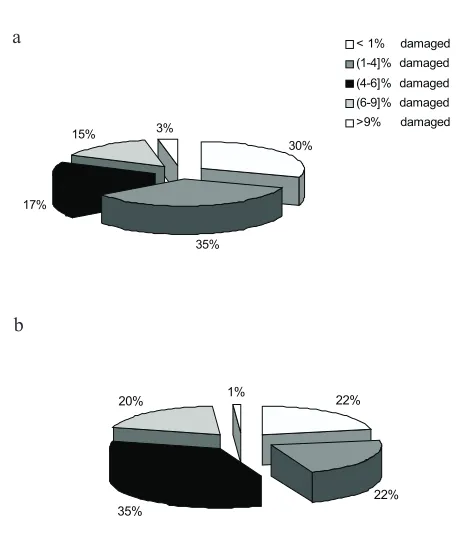
In Fig. 2, the percentage share of samples characterized with various levels of damage in the whole investigated material, dried both naturally and in a dryer, is presented.
A majority of naturally dried seeds (65%) were charac-terized with level of damage meeting the requirements, and 30% of these seeds were practically undamaged (Fig. 2a). Only 35 % of seeds were classified in levels 3 and 4 (4-9% of damaged seeds).
After the process of drying, the amount of damaged seeds increased significantly (Fig. 2b). Most of the samples (35%) were on level 3. An increase of the amount of seeds classified in level 4 was noted, while the amount of samples with less than 4% of damaged seeds decreased to 44%.
Conducted statistical tests (Fig. 3) showed that observed differences of damage level after natural drying and in the dryer are statistically significant.
Raw material used in Oil Comp. Kruszwica S.A. were seeds in which oil content ranged from 35.5 to 46% d.w.
In order to analyse the effect of the drying process on oil content, all samples were divided into groups with regard to oil content: <39, 39-40, 40-41, 41-42 and³42% d.w. The choice of these ranges was based on preliminary analysis of sample size in the particular ranges. The results are presented in the form of a diagram (Fig. 4).
When diagrams 4a and 4b are compared, it is easy to notice that differences between fat content in seeds dried naturally and in a dryer are clear. Decrease, after drying, of the number of samples in the group containing³42% and si-multaneous increase of samples in the group containing more than 39% of fat indicates that, as a result of drying, distribution of fat content moved towards lower values.
Figure 5 confirmed observations based on Figure 4 that during drying in a dryer decrease of fat content in seeds took place. Mean fat content after natural drying was 40.61%, while seeds dried in a dryer contained 40.36% of fat on average. However, conducted tests showed that these changes, when the whole studied raw material is considered, are statistically insignificant.
The research, the goal of which was determination of fatty acids profile in rapeseed, was conducted on raw mate-rial harvested from 2001 to 2003 and delivered by 11 sup-pliers from 3 regions: Kuyavian-Pomeranian, Warmian-Masurian and Greater Poland Voivodeships.
30%
35% 17%
15% 3%
< 1% damaged
(1-4]% damaged (4-6]% damaged (6-9]% damaged
>9% damaged
a)
a
22%
22% 35%
20% 1%
b)
Fig. 2.Percentage distribution of damage level of rapeseed
delive-red to Oil Comp. and dried: a – naturally, and b – in a dryer. b
10%
26%
36% 13%
15%
< 39% [d.w.]
[39-40)% [d.w.]
[40-41)% [d.w.]
[41-42)% [d.w.]
? 42% [d.w.] a)
a
17%
32% 28%
19%
4%
Fig. 4.Percentage content of fat (d.w.) in rapeseeds delivered to
Oil Comp. after drying: a – natural, b – in a dryer. b
D S
DS (D - after natural drying S - after drying in dryer) 2,0
2,5 3,0
Damage
Fig. 3.Effect of drying on seed damage level: D – after natural
drying, S – after drying in a dryer.
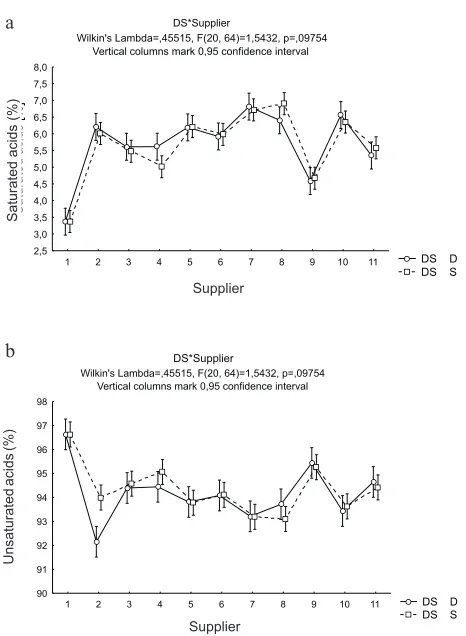
During this three year study, the content of saturated acids in seeds undergoing natural drying ranged from 3.15 to 7.02% of total acids, while after drying in a dryer it ranged form 2.74 to 6.99% of total acids. The amount of unsaturated acids, in the sum of all acids, in seeds dried naturally and in a dryer, ranged from 90.73 to 96.84 and from 92.35 to 97.26%, respectively. In order to check if the observed
differences in fatty acid content in naturally dried seeds are statistically significant, multivariate significance tests were performed using the factorial design of: Year, Supplier, Year´Supplier.
The tests showed that among the grouping factors (Year, Supplier, Year´Supplier), Supplier was the only factor significantly differentiating mean values of particular acids content (Fig. 6).
CONCLUSIONS
1. Investigated in this paper basic quality parameters of naturally dried rapeseed meet the requirements set by norms of oil and fat industry. This proves that both the rapeseed varieties as well as the cultivation and harvest methods were chosen correctly. The disadvantage of naturally dried raw material was relatively high content of moisture, which in 36% of samples exceeded the allowable norm of 9%. Therefore, it can be said that natural drying may be used in special situations, when moisture content of raw material is not very high and its amount, because of significant space necessary for storage, not very big.
2. Detailed analysis of data allowed choosing factors causing changes of investigated seed quality parameters during drying, determine trends of changes and state hypo-thesis explaining the occurring phenomena. Seed damage was the most important parameter of seed quality, capable of affecting some other parameters. The research showed that during drying decrease of oil content in seeds takes place. The greatest, statistically significant, difference was noted in material characterized with the highest moisture content. Therefore, a hypothesis that fat loss was caused by leaks through damaged places in seeds, was formed.
3. In the case of biofuels, existing Polish and European norms specify requirements concerning final products of fat and oil processing: fatty acid methyl ester, but they do not specify any requirements concerning fat and oil used in their production, thus raw materials for production of oils themselves. The best argument to back up this statement is the fact that old oils used in gastronomy etc. can also be utilized. In literature concerning biofuels, a statement that presence of long chain fatty acids in unsaturated esters improves fuel lubrication properties, can only be found. Research on the content of particular fatty acids in rapeseed delivered to Oil Comp. from 2001 to 2003 showed that, regardless of the producer and year that rape was harvested, the amounts of unsaturated acids were high and after drying ranged from 92.35 to 97.26% of all acids sum. Among them, oleic (C18:1), linolic (C18:2) and linolenic (C18:3) acids dominated, with average content of 65.4, 18.56 and 9.47%, respectively. Therefore, it can be said that oil produced of investigated rapeseed is a good raw material for biofuel production.
D S
DS (D - after natural drying, S - after drying in dryer) 40,1
40,2 40,3 40,4 40,5 40,6 40,7 40,8 40,9
Fat
[
%
]
Fig. 5.Effect of drying on fat content.
DS*Supplier
Wilkin's Lambda=,45515, F(20, 64)=1,5432, p=,09754 Vertical columns mark 0,95 confidence interval
DS D DS S 1 2 3 4 5 6 7 8 9 10 11
Supplier 2,5
3,0 3,5 4,0 4,5 5,0 5,5 6,0 6,5 7,0 7,5 8,0
Saturated
a
cids
[%]
DS*Supplier
Wilkin's Lambda=,45515, F(20, 64)=1,5432, p=,09754 Vertical columns mark 0,95 confidence interval
DS D DS S 1 2 3 4 5 6 7 8 9 10 11
Supplier
90 91 92 93 94 95 96 97 98
Unsaturated
a
cids
[%]
Fig. 6.Variation of fatty acids content: a – saturated, b –
unsatu-rated in samples dried naturally and in a dryer, and its dependence on suppliers.
a
b
Supplier
Unsaturated
acids
(%)
Supplier
Saturated
acids
(%)
Fat
REFERENCES
Bartkowiak-Broda I., 2002. Characteristics of rape varieties (in
Polish). Wieœ Jutra, 8(49), 34.
Bartkowiak-Broda I., 2006.Guidelines for breeding rape. Rape –
biofuels (in Polish). A Guide for Producers. Business Press, Warsaw, Poland.
Bomb C., McCormick K., Deurwaarder E., and Kaberger T., 2007. Biofuels for transport in Europe: lessons from Germany and the UK. Energy Policy, 35, 2256-67.
Fornal J., Jaroch R., Kaczyñska B., and Ornowski A., 1989.
The influence of hydrotermal treatment of rapeseed on their selected physical properties and ability to crush during grinding. Fat Sci. Technol., 94, 5, 196.
Fornal J., Sadowska J., Jaroch R., Kaczyñska B., and Winnicki
T., 1994.Effect of drying of rapeseeds on their mechanical
properties and technological usability. Int. Agrophysics, 8, 215-224.
Kegl B., 2008. Biodiesel usage at low temperature. Fuel, 87,
1306-1317.
Krasucki W., Tys J., Szafran K., Rybacki R., and Orlicki £.,
2002.Effect of different drying temperatures of rape seeds
on their chemical composition (in Polish). Roœliny Oleiste, 23, 427-438.
Krzymañski J., 2002. The qualities of the olive for rape and fodder
(in Polish). Wieœ Jutra, 2(43), 43.
Leckband G., Frauen M., and Friedt W., 2002.Napus 2000.
Rapeseed (Brasica napus) breeding for improved human nutrition. Food Res. Int., 35, 273-278.
Nellist M. and Bruce D.M., 1992.Drying and storage of oilseed
rape in U.K. Part 1: Physical and engineering aspects. Oilseeds Res. Rev., 36, 5-84.
Podkówka W., 2004. The Direction Use of Rape.
Biofuel-Glycerine-Feed with Rape. WU Press, Bydgoszcz, Poland.
Pszczo³a J., 2006. Good seed-good yield, good rapeseeds the
shooter. Rape – biofuels (in Polish). A Guide for Producers. Business Press, Warsaw, Poland.
Ramadhas A.S., Muraleedharan C., and Jayaraj S., 2005.
Performance and emission evoluation of a diesel engine fueled with methyl esters of rubber seed oil. Renew. Energy., 30, 1789-800.
Rosiak E., 2006. The development of the biofuel market
opportunity for Polish agriculture. Rape – biofuels. A Guide for Producers. Business Press, Warsaw, Poland.
Rotenberg S. and Anderson J.O., 1980.The effect of dietary
citrus pectin of fat acid balance and on the fatty acid content of the lever and small intension in rats. Acta Agric. Scand., 30, 8-12.
Shah S., Dharma S., and Gupta M.N., 2004.Biodiesel
prepa-ration by lipasecatalyzed transesterification of Jatropha oil. Energy Fuels, 18, 154-9.
Stêpniewski A. and Szot B., 1995. Factors determining the
resistance of rapeseed to damage. Zeszyty Probl. Post. Nauk Roln., 427, 51-63.
Tys J. and Rybacki R., 2001.Rape-quality seeds, the processes of
harvesting, drying, storage (in Polish). Acta Agrophysica, 44, 5-107.
Wa³kowski T., 2006.Growing rape renewable source of energy.
Rape – biofuels (in Polish). A Guide for Producers. Business Press, Warsaw, Poland.
Yiu S.H., Altosaar I., and Fulcher R.G., 1983.The effect of