Journal of Studies in Learning and Teaching English
Volume. 5, Issue. 2, Ser. 10, (2016), 169-181
The Influence of Asynchronous
Computer-Mediated Versus Conventional
Corrective Feedback on Iranian EFL Learners’
Writing Accuracy
Sara Ghazi
Department of English Language Shiraz Branch, Islamic Azad University
Shiraz, Iran
Mostafa Zamanian
∗Department of English Language Shiraz Branch, Islamic Azad University
Shiraz, Iran
Abstract. The purpose of this study was to investigate the effects of asynchronous computer-mediated versus conventional corrective feed-back on Iranian learners’ writing accuracy. To this end, 38 pre- interme-diate female students aged 21 to 28 participated in the study. They were asked to write two compositions. Only errors regarding English articles were treated using highlights and comments features of word proces-sor for the first group of participants receiving e-mail, and red pen for the second group of participants receiving hard copies. Direct corrective feedback was provided for both electronic and print students. Results re-vealed that although providing corrective feedback was effective in both contexts, the learners who received feedback via e-mail showed more absorption of the grammatical feedback than the conventional feedback group.
Keywords:Corrective feedback, asynchronous computer-mediated feed-back, conventional feedback
Received: September 2016; Accepted: November 2016 ∗Corresponding author
169
Journal of Studies in Learning and Teaching English
Volume. 5, Issue. 2, Ser. 10, (2016), 169-181
The Influence of Asynchronous
Computer-Mediated Versus Conventional
Corrective Feedback on Iranian EFL Learners’
Writing Accuracy
Sara Ghazi
Department of English Language Shiraz Branch, Islamic Azad University
Shiraz, Iran
Mostafa Zamanian
∗ Department of English Language Shiraz Branch, Islamic Azad UniversityShiraz, Iran
Abstract. The purpose of this study was to investigate the effects of asynchronous computer-mediated versus conventional corrective feed-back on Iranian learners’ writing accuracy. To this end, 38 pre- interme-diate female students aged 21 to 28 participated in the study. They were asked to write two compositions. Only errors regarding English articles were treated using highlights and comments features of word proces-sor for the first group of participants receiving e-mail, and red pen for the second group of participants receiving hard copies. Direct corrective feedback was provided for both electronic and print students. Results re-vealed that although providing corrective feedback was effective in both contexts, the learners who received feedback via e-mail showed more absorption of the grammatical feedback than the conventional feedback group.
Keywords:Corrective feedback, asynchronous computer-mediated feed-back, conventional feedback
Received: September 2016; Accepted: November 2016 ∗Corresponding author
170
S. Ghazi and M. Zamanian1. Introduction
The role of written corrective feedback (WCF) in the process of
acquir-ing a second language (L2), has been an issue of notable controversy
among theorists and researchers (eg. Bitchener & Knoch, 2009, 2010;
Krashen, 1984;). While corrective feedback (CF) has been widely used
as a pedagogical means, practical and theoretical objections have been
raised to its effectiveness (e.g. Truscott, 1999; 2009).
Teachers of second or foreign languages and researchers have long
been maintained that written corrective feedback can help students learn
the targeted linguistic forms and give them the ability to increase the
correct use of target structures. Hence, they continuously attempt to find
an effective way to provide written WCF to give students opportunity
to improve their writing accuracy.
In the process of learning target language, learners possibly make
syntactic errors and mistakes. When learners make mistakes, teachers
usually try to give students appropriate feedback as to guide them
to-wards the target language. By providing appropriate corrective feedback,
teachers can effectively cope with the failure learners indicate between
what they receive as input and what they produce as output (Campillo,
2003). Providing students with corrective feedback facilitates the
pro-cess of experiencing the effect of what they have produced as a guide to
their future output (Brown, 1998). Lightbown and Spada (1990) defined
corrective feedback as any indication teachers made to help learners
un-derstand that their use of the target language is in error and needs to
be corrected.
learn-The Influence of Asynchronous Computer-Mediated ...
171
ing processes. Besides information processing, computers were used as a
means for communication (Gundez, 2005). Hiltz and Turoff (1978) first
coined the term CMC when experimenting on computer conferencing
as a tool of communication on the Internet. They defined CMC as a
medium for generating, understanding, transmitting, decoding, and
en-coding information. Barnes (2002) also viewed CMC as a broad range of
technologies that have been integrated into human interaction and
shar-ing of information with the use of interconnected networks includshar-ing
e-mail, discussion groups, and real-time chat.
Conventionally CMC is divided into two modes: synchronous (SCMC)
and asynchronous (ACMC) (Pfaffman, 2008). Warschauer (2001)
pro-vided a definition for different modes of CMC as: (1) “Synchronous
computer-mediated communication, by which communication happens
in real time via chat or online network; (2) Asynchronous
computer-mediated communication, by which communication takes place in a
de-layed manner for instance by e-mail; and (3) The reading and writing of
documents online” (p. 207). Asynchronous CMC (ACMC) provides
op-portunities for both interlocutors to review, revise, or even drop the
com-munication before sending information (Heisler & Crabill, 2006). This
feature of ACMC involves learners in the process of critical thinking,
and problem solving (Lee, 2004), since learners focus on more purposeful
communication. Lee (2004) also pointed that ACMC provided
opportu-nities for learners to take notice of erroneous structures, and therefore,
output modification such as self-repairing could happen. Moreover, as
adopted in language learning and teaching, CMC is considered to have
more positive impacts on learners, since students feel less bored in a
more interesting environment compared to class restricted one. Results
obtained from research in recent years indicated that learners hone their
writing accuracy in specific targeted areas when teachers provided
writ-ten corrective feedback (e.g. Ellis et al, 2008; Bitchener, 2008).
172
S. Ghazi and M. Zamanianfound out that the learner improved his language ability because he
stud-ied new vocabularies and grammatical structures when receiving e-mails,
and uses them to improve the content of his letters. In the same vein,
Nagata (1993, 1997) reported positive findings in her study of 14 second
year Japanese students’ acquisition of Japanese particles. Students were
divided into two groups: one receiving online metalinguistic feedback
by means of online particle exercises, and the other receiving
transla-tion feedback on the same online particle errors. The result of the study
showed that the group which received metalinguistic electronic feedback
outperformed those of translation group. Similarly, Sauro (2009) also in
a study reported that asynchronous and synchronous CMC were
per-fect environments for both teachers and learners, since they facilitate
the occurrence of noticing, and increases the learners’ awareness of their
errors. Another study by Razzaghifard and Razzaghifard (2011)
exam-ined corrective feedback in a computer-mediated communicative setting,
and indicated that students who received computer-mediated corrective
perform better than the students receiving no feedback.
As has been noted, although many studies have been conducted on
the effectiveness of different types of WCF, there is still a matter of
con-troversy over what types of WCF is more beneficial to students’ writing
accuracy. As Bitchener, Young, and Cameron (2005) stated, further
re-search is needed to examine the influence of different types of corrective
feedback with less advanced learners, therefore; the present study aims
at investigating the effects of asynchronous CMC in comparison to the
conventional pen-and-paper approach on students’ writing accuracy to
find out which of these two types of feedback is more helpful in
reten-tiveness of targeted item.
2. Method
The Influence of Asynchronous Computer-Mediated ...
173
the writing accuracy of the learners.
2.1. Design
The focus of this study was on correcting students’ written work. The
researcher targeted past tense verbs as a grammatical category and made
correction on errors related to this element.
2.2. Participants
Participants of the present study were 38 EFL learners. They were
ran-domly chosen among a number of students, and according to Oxford
Placement Test (2007), they were identified as pre-intermediate
learn-ers. All were female and Persian native speaklearn-ers.
2.3. Procedure
Participants of the study were randomly assigned to one of the two types
of error treatment method. Asynchronous computer-mediated corrective
feedback was applied using e-mail, and errors were corrected directly
using word processor comments and highlighting features. Conventional
corrective feedback, on the other hand was applied using red pen, and
error correction was provided directly. The study was done during two
sessions, each lasted about 40 minutes. During each session students
were given topics and were asked to write a composition about the given
topic. Participants were supposed to write a minimum of 150 word
com-position in 40 minutes. While researcher was correcting the
composi-tions, only errors related to the targeted structure were treated until
the last session. A week after each session, compositions with correction
on targeted structure were delivered to students.
After grading essays, two raters selected papers and corrected them
separately. Table 1 shows the inter-rater correlation.
Table 1:
Inter-rater correlation
The Influence of Asynchronous Computer-Mediated ...
173
the writing accuracy of the learners.
2.1. Design
The focus of this study was on correcting students’ written work. The
researcher targeted past tense verbs as a grammatical category and made
correction on errors related to this element.
2.2. Participants
Participants of the present study were 38 EFL learners. They were
ran-domly chosen among a number of students, and according to Oxford
Placement Test (2007), they were identified as pre-intermediate
learn-ers. All were female and Persian native speaklearn-ers.
2.3. Procedure
Participants of the study were randomly assigned to one of the two types
of error treatment method. Asynchronous computer-mediated corrective
feedback was applied using e-mail, and errors were corrected directly
using word processor comments and highlighting features. Conventional
corrective feedback, on the other hand was applied using red pen, and
error correction was provided directly. The study was done during two
sessions, each lasted about 40 minutes. During each session students
were given topics and were asked to write a composition about the given
topic. Participants were supposed to write a minimum of 150 word
com-position in 40 minutes. While researcher was correcting the
composi-tions, only errors related to the targeted structure were treated until
the last session. A week after each session, compositions with correction
on targeted structure were delivered to students.
After grading essays, two raters selected papers and corrected them
separately. Table 1 shows the inter-rater correlation.
Table 1:
Inter-rater correlation
��� �������� �� ������������ ����������������� ���
���
��� ������� �������� �� ��� ���������
���� ������
��� ����� �� ���� ����� ��� �� ���������� ��������� ������� ����� ���
���������� �������� ���� ����� ����� �� � ����������� �������� ��� ����
���������� �� ������ ������� �� ���� ��������
���� ������������
������������ �� ��� ������� ����� ���� �� ��� ��������� ���� ���� ����
����� ������ ����� � ������ �� ��������� ��� ��������� �� ������
��������� ���� ������ ���� ���� ��������� �� ���������������� ������
���� ��� ���� ������ ��� ������� ������ ���������
���� ���������
������������ �� ��� ����� ���� �������� �������� �� ��� �� ��� ��� �����
�� ����� ��������� ������� ������������ ����������������� ����������
�������� ��� ������� ����� ������� ��� ������ ���� ��������� ��������
����� ���� ��������� �������� ��� ������������ ��������� ������������
���������� ��������� �� ��� ����� ���� ��� ������� ����� ��� ���� ���
����� ���������� ��� �������� ��������� ��� ����� ��� ���� ������ ���
��������� ���� ������ ����� �� �������� ������ ���� ������� ��������
���� ����� ������ ��� ���� ����� �� ����� � ����������� ����� ��� �����
������ ������������ ���� �������� �� ����� � ������� �� ��� ���� ����
�������� �� �� �������� ����� ���������� ��� ���������� ��� ��������
������ ���� ������ ������� �� ��� �������� ��������� ���� ������� �����
��� ���� �������� � ���� ����� ���� �������� ������������ ���� ����������
�� �������� ��������� ���� ��������� �� ���������
����� ������� ������� ��� ������ �������� ������ ��� ��������� ����
����������� ����� � ����� ��� ����������� ������������
����� ��
����������� �����������
۵ ������������������������������������������������������������������������������������������������� ����������������������������������������������������������������������������������������� ������� ����� ���������� ��������� ������ ����� ���������� ��������� ���� ������������� ����������� ������������� ����������� ���������� ��� ���� ������ ����� ���� �������� ������ ���� ����� ���� ������ �������������������������������������������������������������������������������������������� ��� ��������� ������� ����� �������� ��������� ����� ������ ������� ���� ����� ������ ��� ������ �� ������������ ������ ���� ������ ������� ������������� ����� ��������� ��� ������ �� �������� ��� ���� ����� ������������ ��� ��� ��������� ������ ����������� ���� ����������� ���� �������������� ����� ������������������������������������������������������������������������������������������������ ���������������������������������������������������������������������������������������� �� �������������������������������������������������������������������������������������� ������������������������������������� �������������������������������� � � ���������������� ������������������������������������ � � ������������������������������� � ������������ � � ������������ �����������������������Spearman’s rho
� � ������������������������������� �������������� � � �������������� � �
�������������������������, the correlations between the raters’ scores are .965 and .904. Thus,
������������������������������������������������������������������������������������������� ������������������������������������������������������������������������������� ����������������������������������������������������������������������������������������� ���� �������� ������� �������� ��� ���� ��������� ���������� ����� ��������� ������ ����������� ���� ���������� ���� ������ ������ ��� ��������� ������������� ��� ���� ������ ���� ������ ��� ����� ������ ����������������������������������������������������������������������������������������������� ����������������������������������������������� � ��������������� ۵ ������������������������������������������������������������������������������������������������� ����������������������������������������������������������������������������������������� ������� ����� ���������� ��������� ������ ����� ���������� ��������� ���� ������������� ����������� ������������� ����������� ���������� ��� ���� ������ ����� ���� �������� ������ ���� ����� ���� ������ �������������������������������������������������������������������������������������������� ��� ��������� ������� ����� �������� ��������� ����� ������ ������� ���� ����� ������ ��� ������ �� ������������ ������ ���� ������ ������� ������������� ����� ��������� ��� ������ �� �������� ��� ���� ����� ������������ ��� ��� ��������� ������ ����������� ���� ����������� ���� �������������� ����� ������������������������������������������������������������������������������������������������ ���������������������������������������������������������������������������������������� �� �������������������������������������������������������������������������������������� ������������������������������������� �������������������������������� � � ���������������� ������������������������������������ � � ������������������������������� � ������������ � � ������������ �
����������������������Spearman’s rho
� � ������������������������������� �������������� � � �������������� � �
�������������������������, the correlations between the raters’ scores are .965 and .904. Thus,
������������������������������������������������������������������������������������������� ������������������������������������������������������������������������������� ����������������������������������������������������������������������������������������� ���� �������� ������� �������� ��� ���� ��������� ���������� ����� ��������� ������ ����������� ���� ���������� ���� ������ ������ ��� ��������� ������������� ��� ���� ������ ���� ������ ��� ����� ������ ����������������������������������������������������������������������������������������������� ����������������������������������������������� � ��������������� ۵ ������������������������������������������������������������������������������������������������� ����������������������������������������������������������������������������������������� ������� ����� ���������� ��������� ������ ����� ���������� ��������� ���� ������������� ����������� ������������� ����������� ���������� ��� ���� ������ ����� ���� �������� ������ ���� ����� ���� ������ �������������������������������������������������������������������������������������������� ��� ��������� ������� ����� �������� ��������� ����� ������ ������� ���� ����� ������ ��� ������ �� ������������ ������ ���� ������ ������� ������������� ����� ��������� ��� ������ �� �������� ��� ���� ����� ������������ ��� ��� ��������� ������ ����������� ���� ����������� ���� �������������� ����� ������������������������������������������������������������������������������������������������ ���������������������������������������������������������������������������������������� �� �������������������������������������������������������������������������������������� ������������������������������������� �������������������������������� � � ���������������� ������������������������������������ � � ������������������������������� � ������������ � � ������������ �
����������������������Spearman’s rho
� � ������������������������������� �������������� � � �������������� � �
�������������������������, the correlations between the raters’ scores are .965 and .904. Thus,
174
S. Ghazi and M. ZamanianAccording to table 1, the correlations between the raters’ scores are .965
and .904. Thus, based on the Spearman-Brown prophecy formula
(Hen-ning 1987, p.82), inter-rater coefficient is .98. It can be concluded that
these two sets of scores are highly reliable. One group of the students was
chosen randomly to send and receive their compositions via e-mail.
Er-rors related to the targeted structure were provided using highlights and
comments. The other group of students participated in the study was
asked to hand their compositions in hard copies, and to receive them in
hard copies as well. Errors related to the targeted structure were treated
using red pen.
2.4. Treatment
One group of the students was chosen randomly to send and receive
their compositions via e-mail. Errors related to the targeted structure
were provided using highlights and comments. The other students
par-ticipated in the study was asked to hand their compositions in hard
copies, and to receive them in hard copies as well. Errors related to the
targeted structure were treated using red pen.
3. Data Analysis
To find out if providing online corrective feedback affects learners’
writ-ing performance, the researcher ran the paired samples
t
-test to compare
the pre and post-test scores of the online corrective feedback group.
Ta-bles 2 and 3 show the results.
Table 2:
Descriptive statistics of the pretest and post-test scores of
the online corrective feedback group
���
�� ����� ��� �� ����������������� �� ����� �� ��� ������������ ������� ��� ������� ������ ��� ����
��� ����� ����� ����� �� ��� �������������� �������� ������� �����
���� ����� ������ ����������� ��������� �� ���� �� ��� �� ��������� ����
����� ��� ���� �� ������ ��� ������ ��������� ��� ��� ����� �� ��� ����
����� ��� ������ �������� �� ���� ��� ������� ����� ������������ ���
������� ������ ������� �� ��� �������� ��������� ���� �������� ����� �����
������ ��� ��������� ��� ����� ����� �� �������� ������������ �� ���
����� ��� ����� �� ���� ����� ������������ �� ���� ������� ��� �� ���
����� ���� �� ���� ������ �� ����� ������ ������� �� ��� �������� ���������
���� ������� ����� ��� ����
���� ���������
��� ����� �� ��� �������� ��� ������ �������� �� ���� ��� �������
����� ������������ ��� ������� ������ ������� �� ��� �������� ���������
���� �������� ����� ���������� ��� ��������� ��� ����� �������� ����
��������� �� ��� ����� ��� ����� �� ���� ����� ������������ �� ����
������� ��� �� ������� ���� �� ���� ������ �� ����� ������ ������� �� ���
�������� ��������� ���� ������� ����� ��� ����
�� ���� ��������
�� ��� ��� �� ��������� ������ ���������� �������� ������ ��������� �����
��� ������������ ��� ���������� ��� ��� ������ ������� ������ �� �������
��� ��� ��� ��������� ������ �� ��� ������ ���������� �������� ������ ���
���� � ��� � ���� ��� ��������
����� ��
����������� ���������� �� ��� ������� ��� ��������� ������ ��
��� ������ ���������� �������� �����
۶
������������������������������������������������������������������������������������������������������ ������� �������� ��� ���� ��������� ���������� ����� ��������� ������ ����������� ���� ���������� ���� ������ ������������������������������������������������������������������������������������������������������� �������������������������������������������������������������������������������������������������� �
�����������������
������������������������������������������������������������������������������������������������ ���� ����������� ���� ���� ������� ��������������� ��� �������� ���� ���� ���� ���������� ������� ��� ���� �������������������������������������������������������������������
�
�
�
����������������������������������������������������������������������������������������������������� ������
� ����� �� �����
��������� �
�
�������������������������������� �
�������
� ������� ��� �������� �������
���������
� ������� ��� �������� �������
�
� �
�
�
�
�
�
�
The Influence of Asynchronous Computer-Mediated ...
175
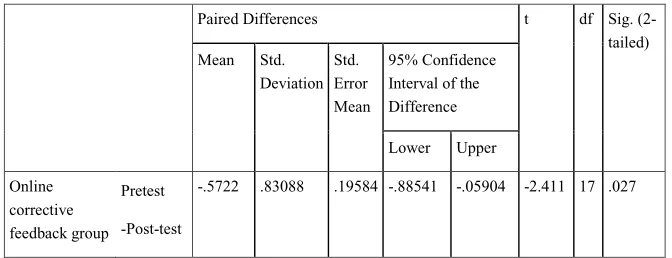
Table 3:
Paired samples test to compare the pretest and post-test
scores of the online corrective feedback group
The results of the paired
t
-test in table 3 indicate that there is a
sig-nificant difference between the pretest and post-test scores of the online
corrective feedback group (
sig.
=
.
02
, p < .
05)
.
As table 2 shows, the
participants of the online corrective feedback group gained higher mean
score in the post-test (mean = 7.46) than the pretest (mean = 6.88). It
can be inferred that online corrective feedback has a positive effect on
learners’ writing performance.
To determine if providing conventional corrective feedback affects
learners’ writing performance, the paired samples
t
-test was run. Tables
4 and 5 show the pertaining results.
Table 4:
Descriptive statistics of the pretest and post-test scores of
the conventional corrective feedback group
��� �������� �� ������������ ����������������� ���
���
����� ��
������ ������� ���� �� ������� ��� ������� ��� ���������
������ �� ��� ������ ���������� �������� �����
��� ������� �� ��� ������ ������ �� ����� � �������� ���� ����� �� � ����
������� ��������� ������� ��� ������� ��� ��������� ������ �� ��� ������
���������� �������� ����� �����
�
���� � � �����
�� ����� � ������ ���
������������ �� ��� ������ ���������� �������� ����� ������ ������ ����
����� �� ��� ��������� ����� � ����� ���� ��� ������� ����� � ������ ��
��� �� �������� ���� ������ ���������� �������� ��� � �������� ����� ��
��������� ������� ������������
�� ��������� �� ��������� ������������ ���������� �������� ������
��������� ������� ������������ ��� ������ ������� ������ ��� ���� ������
� ��� � ���� ��� ���������� ��������
����� ��
����������� ���������� �� ��� ������� ��� ��������� ������ ��
��� ������������ ���������� �������� �����
٧ � � � � � � � � �������������������������������������������������������������������������������������� �������������������������� � � ������������������� �� ��� �������� ������� � ���� � ����� ��������� � ����� ������ ���� � ��������������� ���������������� ���������� � ����� � ������ ������� ����������� �������������� � ������� � ���������� � ������ � ������� ��������������� �������� ��������������� � ��������� �������� ��� ���� �������������� ��� ������ �� ��������� ����� ������ ��� �� ������������ ����������� �������� ���� �������� ���� ���������� ������� ��� ���� ������� ����������� ��������� ������ ������ ������ �������� ��� ������ �� ������� ���� ������������� ��� ���� ������� ����������� ��������� ������ ������� ������� ����� ������ ��� ���� ���������� ������ �� ������ ����� ���� �������� ������ �� ������� ��� ���� ��� inferred that online corrective feedback has a positive effect on learners’ �������� ��������������������� ���������� ���providing conventional corrective feedback affects learners’ writing �������������������������������������������������������������������������������������������� � ٨ �������������������������������������������������������������������������������������������������� ��������������� � � � ����� �� ����� ��������� � ����������� ���� � ������������������������ �������������� � ������� � ������� ��� �������� ������� ��������� � ������� ��� �������� ������� � � ��������������������������������������������������������������������������������������������� �������������������������� � � � ������������������� �� ��� ����� ��� ������� � ���� � ����� ��������� � ����� ������ ���� � ��������������� ���������������� ���������� � ����� � ������ ������������� ����������� �������������� � �������� � ��������� � ������ � ������� ������� ��������������� ���������� ����� � ������������������������������������������������������������������������������������������������� ������� ��� ���� ������������� ����������� ��������� ������ ��� ������������ ������ �� �������������� ���������� ��� ������ ��� ���� ������������� ��� ������������� ����������� ��������� ������ ������� ������� ������ ��� ���� ���������� ������ ���� ����� ���� �������� ������ ������������������ ��� ���� ��� concluded that providing conventional corrective feedback positively affects learners’ writing ������������� � ��� �������� �� ������������ ����������������� ���
���
����� ��
������ ������� ���� �� ������� ��� ������� ��� ���������
������ �� ��� ������ ���������� �������� �����
��� ������� �� ��� ������ ������ �� ����� � �������� ���� ����� �� � ����
������� ��������� ������� ��� ������� ��� ��������� ������ �� ��� ������
���������� �������� ����� �
����
�
�
��
� � � �
���
�
�� ����� � ������ ���
������������ �� ��� ������ ���������� �������� ����� ������ ������ ����
����� �� ��� ��������� ����� � ����� ���� ��� ������� ����� � ������ ��
��� �� �������� ���� ������ ���������� �������� ��� � �������� ����� ��
��������� ������� ������������
�� ��������� �� ��������� ������������ ���������� �������� ������
��������� ������� ������������ ��� ������ ������� ������ ��� ���� ������
� ��� � ���� ��� ���������� ��������
����� ��
����������� ���������� �� ��� ������� ��� ��������� ������ ��
��� ������������ ���������� �������� �����
��� �������� �� ������������ ����������������� ������
����� ��
������ ������� ���� �� ������� ��� ������� ��� ���������
������ �� ��� ������ ���������� �������� �����
��� ������� �� ��� ������ ������ �� ����� � �������� ���� ����� �� � ����
������� ��������� ������� ��� ������� ��� ��������� ������ �� ��� ������
���������� �������� ����� �����
�
���� � � �����
�� ����� � ������ ���
������������ �� ��� ������ ���������� �������� ����� ������ ������ ����
����� �� ��� ��������� ����� � ����� ���� ��� ������� ����� � ������ ��
��� �� �������� ���� ������ ���������� �������� ��� � �������� ����� ��
��������� ������� ������������
�� ��������� �� ��������� ������������ ���������� �������� ������
��������� ������� ������������ ��� ������ ������� ������ ��� ���� ������
� ��� � ���� ��� ���������� ��������
����� ��
����������� ���������� �� ��� ������� ��� ��������� ������ ��
��� ������������ ���������� �������� �����
٧ � � � � � � � � �������������������������������������������������������������������������������������� �������������������������� � � ������������������� �� ��� �������� ������� � ���� � ����� ��������� � ����� ������ ���� � ��������������� ���������������� ���������� � ����� � ������ ������� ����������� �������������� � ������� � ���������� � ������ � ������� ��������������� �������� ��������������� � ��������� �������� ��� ���� �������������� ��� ������ �� ��������� ����� ������ ��� �� ������������ ����������� �������� ���� �������� ���� ���������� ������� ��� ���� ������� ����������� ��������� ������ ������ ������ �������� ��� ������ �� ������� ���� ������������� ��� ���� ������� ����������� ��������� ������ ������� ������� ����� ������ ��� ���� ���������� ������ �� ������ ����� ���� �������� ������ �� ������� ��� ���� ��� inferred that online corrective feedback has a positive effect on learners’ �������� ��������������������� ���������� ���providing conventional corrective feedback affects learners’ writing �������������������������������������������������������������������������������������������� � ٨ �������������������������������������������������������������������������������������������������� ��������������� � � � ����� �� ����� ��������� � ����������� ���� � ������������������������ �������������� � ������� � ������� ��� �������� ������� ��������� � ������� ��� �������� ������� � � ��������������������������������������������������������������������������������������������� �������������������������� � � � ������������������� �� ��� ����� ��� ������� � ���� � ����� ��������� � ����� ������ ���� � ��������������� ���������������� ���������� � ����� � ������ ������������� ����������� �������������� � �������� � ��������� � ������ � ������� ������� ��������������� ���������� ����� � ������������������������������������������������������������������������������������������������� ������� ��� ���� ������������� ����������� ��������� ������ ��� ������������ ������ �� �������������� ���������� ��� ������ ��� ���� ������������� ��� ������������� ����������� ��������� ������ ������� ������� ������ ��� ���� ���������� ������ ���� ����� ���� �������� ������ ������������������ ��� ���� ��� concluded that providing conventional corrective feedback positively affects learners’ writing ������������� � ��� �������� �� ������������ ����������������� ���
���
����� ��
������ ������� ���� �� ������� ��� ������� ��� ���������
������ �� ��� ������ ���������� �������� �����
��� ������� �� ��� ������ ������ �� ����� � �������� ���� ����� �� � ����
������� ��������� ������� ��� ������� ��� ��������� ������ �� ��� ������
���������� �������� ����� �����
�
���� � � �����
�� ����� � ������ ���
������������ �� ��� ������ ���������� �������� ����� ������ ������ ����
����� �� ��� ��������� ����� � ����� ���� ��� ������� ����� � ������ ��
��� �� �������� ���� ������ ���������� �������� ��� � �������� ����� ��
��������� ������� ������������
�� ��������� �� ��������� ������������ ���������� �������� ������
��������� ������� ������������ ��� ������ ������� ������ ��� ���� ������
� ��� � ���� ��� ���������� ��������
����� ��
����������� ���������� �� ��� ������� ��� ��������� ������ ��
��� ������������ ���������� �������� �����
The Influence of Asynchronous Computer-Mediated ...
175
Table 3:
Paired samples test to compare the pretest and post-test
scores of the online corrective feedback group
The results of the paired
t-test in table 3 indicate that there is a
sig-nificant difference between the pretest and post-test scores of the online
corrective feedback group (sig.
=
.02, p < .05).
As table 2 shows, the
participants of the online corrective feedback group gained higher mean
score in the post-test (mean = 7.46) than the pretest (mean = 6.88). It
can be inferred that online corrective feedback has a positive effect on
learners’ writing performance.
To determine if providing conventional corrective feedback affects
learners’ writing performance, the paired samples
t-test was run. Tables
4 and 5 show the pertaining results.
Table 4:
Descriptive statistics of the pretest and post-test scores of
the conventional corrective feedback group
The Influence of Asynchronous Computer-Mediated ...
175
Table 3:
Paired samples test to compare the pretest and post-test
scores of the online corrective feedback group
The results of the paired
t
-test in table 3 indicate that there is a
sig-nificant difference between the pretest and post-test scores of the online
corrective feedback group (
sig.
=
.
02
, p < .
05)
.
As table 2 shows, the
participants of the online corrective feedback group gained higher mean
score in the post-test (mean = 7.46) than the pretest (mean = 6.88). It
can be inferred that online corrective feedback has a positive effect on
learners’ writing performance.
To determine if providing conventional corrective feedback affects
learners’ writing performance, the paired samples
t
-test was run. Tables
4 and 5 show the pertaining results.
176
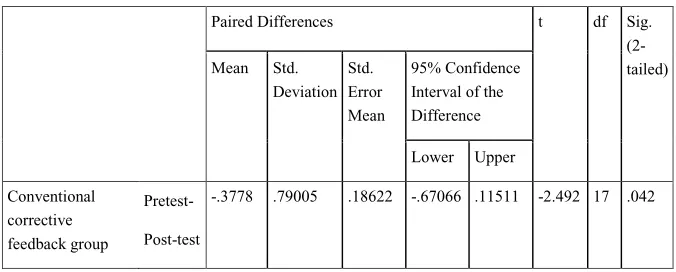
S. Ghazi and M. ZamanianTable 5:
Paired samples test to compare the pre-test and post-test
scores of the conventional corrective feedback group
Based on the results presented in Table 5, the difference between the
pretest and post-test scores of the conventional corrective feedback group
is significant (sig.
=
.042, p < .05).
According to Table 4, the
partici-pants of conventional corrective feedback group gained higher score in
the post-test (mean =7) than the pretest (mean =6.62). Therefore, it can
be concluded that providing conventional corrective feedback positively
affects learners’ writing performance.
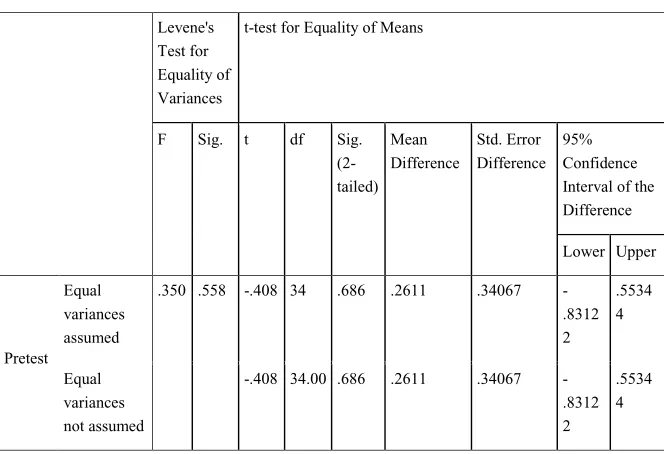
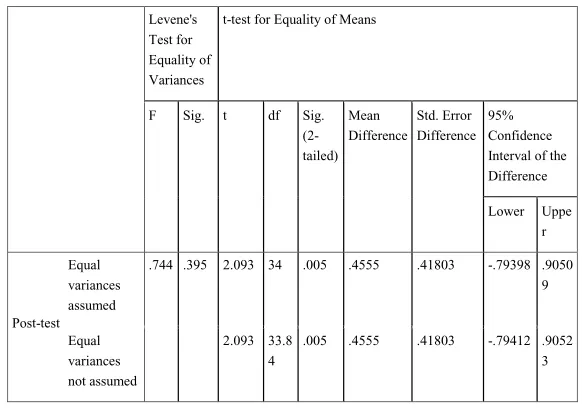
The researcher then ran the
t-test analysis to compare the
partici-pants’ writing performance receiving online corrective feedback and the
participants’ writing performance receiving conventional feedback.
Ta-bles 6 and 7 show the results of the t-test for the pretest scores.
Table 6:
Descriptive statistic of the pretest scores of online and
conventional corrective feedback groups
���
�� ����� ��� �� ������������� ��
������ ������� ���� �� ������� ��� �������� ��� ���������
������ �� ��� ������������ ���������� �������� �����
����� �� ��� ������� ��������� �� ����� �� ��� ��������� ������� ���
������� ��� ��������� ������ �� ��� ������������ ���������� �������� �����
�� ���������� �����
�
����� � � �����
��������� �� ����� �� ��� ��������
����� �� ������������ ���������� �������� ����� ������ ������ ����� ��
��� ��������� ����� ��� ���� ��� ������� ����� ������� ���������� �� ���
�� ��������� ���� ��������� ������������ ���������� �������� ����������
������ ��������� ������� ������������
��� ���������� ���� ��� ��� ������ �������� �� ������� ��� ��������
������ ������� ����������� ��������� ������ ���������� �������� ��� ���
������������� ������� ����������� ��������� ������������ ��������� ���
���� � ��� � ���� ��� ������� �� ��� ������ ��� ��� ������� �������
����� ��
����������� ��������� �� ��� ������� ������ �� ������ ���
������������ ���������� �������� ������
٨ �������������������������������������������������������������������������������������������������� ��������������� � � � ����� �� ����� ��������� � ����������� ���� � ������������������������ �������������� � ������� � ������� ��� �������� ������� ��������� � ������� ��� �������� ������� � � ��������������������������������������������������������������������������������������������� �������������������������� � � � ������������������� �� ��� ����� ��� ������� � ���� � ����� ��������� � ����� ������ ���� � ��������������� ���������������� ���������� � ����� � ������ ������������� ����������� �������������� � �������� � ��������� � ������ � ������� ������� ��������������� ���������� ����� � ������������������������������������������������������������������������������������������������� ������� ��� ���� ������������� ����������� ��������� ������ ��� ������������ ������ �� �������������� ���������� ��� ������ ��� ���� ������������� ��� ������������� ����������� ��������� ������ ������� ������� ������ ��� ���� ���������� ������ ���� ����� ���� �������� ������ ������������������ ��� ���� ��� concluded that providing conventional corrective feedback positively affects learners’ writing ��������������
٩
��������� ����������� ����� ���� ���� ������� ��������� ��� �������� the participants’ writing performance receiving online corrective feedback and the participants’ writing performance ����������������������������������������������������������������������������������������������� �������� � ������������������������������������������������������������������������������������������ ��������������� � � � ������� �� ����� ����� ��������� � ����������� ���� � �������� � �������������������������� � ��� ������� �������� ������� �������������������������������� � ��� ������� �������� ������� � �
���
�� ����� ��� �� ������������� ��
������ ������� ���� �� ������� ��� �������� ��� ���������
������ �� ��� ������������ ���������� �������� �����
����� �� ��� �������