A Monthly Double-Blind Peer Reviewed Refereed Open Access International e-Journal - Included in the International Serial Directories
Indexed & Listed at:
Ulrich's Periodicals Directory ©, ProQuest, U.S.A., EBSCO Publishing, U.S.A., Cabell’s Directories of Publishing Opportunities, U.S.A. as well as in Open J-Gage, India [link of the same is duly available at Inflibnet of University Grants Commission (U.G.C.)]
VOLUME NO.2(2012),ISSUE NO.6(JUNE) ISSN 2231-5756
CONTENTS
CONTENTS
CONTENTS
CONTENTS
Sr.No.
TITLE & NAME OF THE AUTHOR (S)
Page No.
1. THE IMPACT OF PLANNING AND CONTROL ON SERVICE SMES SUCCESS
GAD VITNER & SIBYLLE HEILBRUNN
1
2. CHALLENGES FOR SMALL AND MEDIUM ENTERPRISES IN INFORMATION TECHNOLOGY IN THE CITY OF BANGALORE, INDIA
SULAKSHA NAYAK & DR. HARISHA G. JOSHI
9
3. ROLE OF MANAGEMENT INFORMATION SYSTEMS IN MANAGERIAL DECISION MAKING OF ORGANIZATIONS IN THE GLOBAL BUSINESS WORLD
MD. ZAHIR UDDIN ARIF, MOHAMMAD MIZENUR RAHAMAN & MD. NASIR UDDIN
14
4. EFFECTS OF CALL CENTER CRM PRACTICES ON EMPLOYEE JOB SATISFACTION
DR. ALIYU OLAYEMI ABDULLATEEF
19
5. DETERMINANTS OF CAPITAL STRUCTURE: EVIDENCE FROM TANZANIA’S LISTED NON FINANCIAL COMPANIES
BUNDALA, NTOGWA NG'HABI & DR. CLIFFORD G. MACHOGU
24
6. RELATIONSHIP BETWEEN INTRINSIC REWARDS AND JOB SATISFACTION: A COMPARATIVE STUDY OF PUBLIC AND PRIVATE ORGANIZATION
TAUSIF M.
33
7. NUCLEAR ENERGY IN INDIA: A COMPULSION FOR THE FUTURE
DR. KAMLESH KUMAR DUBEY & SUBODH PANDE
42
8. CONTEXTUAL FACTORS FOR EFFECTIVE IMPLEMENTATION OF PERFORMANCE APPRAISAL IN THE INDIAN IT SECTOR: AN EMPIRICAL STUDY
SUJOYA RAY MOULIK & DR. SITANATH MAZUMDAR
47
9. A STUDY OF CITIZEN CENTRIC SERVICE DELIVERY THROUGH e-GOVERNANCE: CASE STUDY OF e-MITRA IN JAIPUR DISTRICT
RAKESH SINGHAL & DR. JAGDISH PRASAD
53
10. TWO UNIT COLD STANDBY PRIORITY SYSTEM WITH FAULT DETECTION AND PROVISION OF REST
VIKAS SHARMA, J P SINGH JOOREL, RAKESH CHIB & ANKUSH BHARTI
61
11. MACRO ECONOMIC FACTORS INFLUENCING THE COMMODITY MARKET WITH SPECIAL REFERENCE TO GOLD AND SILVER
DR. G. PANDURANGAN, R. MAGENDIRAN, L. S. SRIDHAR & R. RAJKOKILA
68
12. CRYTICAL ANALYSIS OF EXPONENTIAL SMOOTHING METHODS FOR FORECASTING
UDAI BHAN TRIVEDI
71
13. COMPARATIVE STUDY ON RETAIL LIABILITIES, PRODUCTS & SERVICES OF DISTRICT CENTRAL CO-OPERATIVE BANK & AXIS BANK
ABHINAV JOG & ZOHRA ZABEEN SABUNWALA
75
14. SECURE KEY EXCHANGE WITH RANDOM CHALLENGE RESPONSES IN CLOUD
BINU V. P & DR. SREEKUMAR A
81
15. COMPUTATIONAL TRACKING AND MONITORING FOR EFFICIENCY ENHANCEMENT OF SOLAR BASED REFRIGERATION
V. SATHYA MOORTHY, P.A. BALAJI, K. VENKAT & G.GOPU
84
16. FINANCIAL ANALYSIS OF OIL AND PETROLEUM INDUSTRY
DR. ASHA SHARMA
90
17. ANOVA BETWEEN THE STATEMENT REGARDING THE MOBILE BANKING FACILITY AND TYPE OF MOBILE PHONE OWNED: A STUDY WITH REFERENCE TO TENKASI AT VIRUDHUNAGAR DSITRICT
DR. S. VALLI DEVASENA
98
18. VIDEO REGISTRATION BY INTEGRATION OF IMAGE MOTIONS
V.FRANCIS DENSIL RAJ & S.SANJEEVE KUMAR
103
19. ANALYZING THE TRADITIONAL INDUCTION FORMAT AND RE – DESIGING INDUCTION PROCESS AT TATA CHEMICALS LTD, MITHAPUR
PARUL BHATI
112
20. THE JOURNEY OF E-FILING OF INCOME TAX RETURNS IN INDIA
MEENU GUPTA
118
21. ROLE OF FINANCIAL TECHNOLOGY IN ERADICATION OF FINANCIAL EXCLUSION
DR. SARIKA SRIVASTAVA & ANUPAMA AMBUJAKSHAN
122
22. ATTRITION: THE BIGGEST PROBLEM IN INDIAN IT INDUSTRIES
VIDYA SUNIL KADAM
126
23. INFORMATION TECHNOLOGY IN KNOWLEDGE MANAGEMENT
M. SREEDEVI
132
24. A STUDY OF EMPLOYEE ENGAGEMENT & EMPLOYEE CONNECTS’ TO GAIN SUSTAINABLE COMPETITIVE ADVANTAGE IN GLOBALIZED ERA
NEERU RAGHAV
136
25. BIG-BOX RETAIL STORE IN INDIA – A CASE STUDY APPROACH WITH WALMART
M. P. SUGANYA & DR. R. SHANTHI
142
26. IMPACT OF INFORMATION TECHNOLOGY ON ORGANISATIONAL CULTURE OF STATE BANK OF INDIA AND ITS ASSOCIATED BANKS IN SRIGANGANAGAR AND HANUMANGARH DISTRICTS OF RAJASTHAN
MOHITA
146
27. USER PERCEPTION TOWARDS WEB, TELEVISION AND RADIO AS ADVERTISING MEDIA: COMPARATIVE STUDY
SINDU KOPPA & SHAKEEL AHAMED
149
28. STUDY OF GROWTH, INSTABILITY AND SUPPLY RESPONSE OF COMMERCIAL CROPS IN PUNJAB: AN ECONOMETRIC ANALYSIS
SUMAN PARMAR
156
29. DEVELOPMENT AND EMPIRICAL VALIDATION OF A LINEAR STYLE PROGRAM ON ‘STRUCTURE OF THE CELL’ FOR IX GRADE STUDENTS
RAMANJEET KAUR
160
30. PERFORMANCE APPRAISAL OF INDIAN BANKING SECTOR: A COMPARATIVE STUDY OF SELECTED PUBLIC AND FOREIGN BANKS
SAHILA CHAUDHRY
163
INTERNATIONAL JOURNAL OF RESEARCH IN COMMERCE, IT & MANAGEMENT
CHIEF PATRON
CHIEF PATRON
CHIEF PATRON
CHIEF PATRON
PROF. K. K. AGGARWAL
Chancellor, Lingaya’s University, Delhi
Founder Vice-Chancellor, Guru Gobind Singh Indraprastha University, Delhi
Ex. Pro Vice-Chancellor, Guru Jambheshwar University, Hisar
PATRON
PATRON
PATRON
PATRON
SH. RAM BHAJAN AGGARWAL
Ex. State Minister for Home & Tourism, Government of Haryana
Vice-President, Dadri Education Society, Charkhi Dadri
President, Chinar Syntex Ltd. (Textile Mills), Bhiwani
CO
CO
CO
CO----ORDINATOR
ORDINATOR
ORDINATOR
ORDINATOR
AMITA
Faculty, Government M. S., Mohali
ADVISORS
ADVISORS
ADVISORS
ADVISORS
DR. PRIYA RANJAN TRIVEDI
Chancellor, The Global Open University, Nagaland
PROF. M. S. SENAM RAJU
Director A. C. D., School of Management Studies, I.G.N.O.U., New Delhi
PROF. M. N. SHARMA
Chairman, M.B.A., Haryana College of Technology & Management, Kaithal
PROF. S. L. MAHANDRU
Principal (Retd.), Maharaja Agrasen College, Jagadhri
EDITOR
EDITOR
EDITOR
EDITOR
PROF. R. K. SHARMA
Professor, Bharti Vidyapeeth University Institute of Management & Research, New Delhi
CO
CO
CO
CO----EDITOR
EDITOR
EDITOR
EDITOR
DR. BHAVET
Faculty, M. M. Institute of Management, Maharishi Markandeshwar University, Mullana, Ambala, Haryana
EDITORIAL ADVISORY BOARD
EDITORIAL ADVISORY BOARD
EDITORIAL ADVISORY BOARD
EDITORIAL ADVISORY BOARD
DR. RAJESH MODI
Faculty, Yanbu Industrial College, Kingdom of Saudi Arabia
PROF. SANJIV MITTAL
University School of Management Studies, Guru Gobind Singh I. P. University, Delhi
PROF. ANIL K. SAINI
Chairperson (CRC), Guru Gobind Singh I. P. University, Delhi
DR. SAMBHAVNA
Faculty, I.I.T.M., Delhi
DR. MOHENDER KUMAR GUPTA
VOLUME NO.2(2012),ISSUE NO.6(JUNE) ISSN 2231-5756
DR. SHIVAKUMAR DEENE
Asst. Professor, Dept. of Commerce, School of Business Studies, Central University of Karnataka, Gulbarga
MOHITA
Faculty, Yamuna Institute of Engineering & Technology, Village Gadholi, P. O. Gadhola, Yamunanagar
ASSOCIATE EDITORS
ASSOCIATE EDITORS
ASSOCIATE EDITORS
ASSOCIATE EDITORS
PROF. NAWAB ALI KHAN
Department of Commerce, Aligarh Muslim University, Aligarh, U.P.
PROF. ABHAY BANSAL
Head, Department of Information Technology, Amity School of Engineering & Technology, Amity University, Noida
PROF. A. SURYANARAYANA
Department of Business Management, Osmania University, Hyderabad
DR. ASHOK KUMAR
Head, Department of Electronics, D. A. V. College (Lahore), Ambala City
DR. SAMBHAV GARG
Faculty, M. M. Institute of Management, Maharishi Markandeshwar University, Mullana, Ambala, Haryana
PROF. V. SELVAM
SSL, VIT University, Vellore
DR. PARDEEP AHLAWAT
Reader, Institute of Management Studies & Research, Maharshi Dayanand University, Rohtak
S. TABASSUM SULTANA
Associate Professor, Department of Business Management, Matrusri Institute of P.G. Studies, Hyderabad
SURJEET SINGH
Asst. Professor, Department of Computer Science, G. M. N. (P.G.) College, Ambala Cantt.
TECHNICAL
TECHNICAL
TECHNICAL
TECHNICAL ADVISOR
ADVISOR
ADVISOR
ADVISOR
AMITA
Faculty, Government H. S., Mohali
MOHITA
Faculty, Yamuna Institute of Engineering & Technology, Village Gadholi, P. O. Gadhola, Yamunanagar
FINANCIAL ADVISORS
FINANCIAL ADVISORS
FINANCIAL ADVISORS
FINANCIAL ADVISORS
DICKIN GOYAL
Advocate & Tax Adviser, Panchkula
NEENA
Investment Consultant, Chambaghat, Solan, Himachal Pradesh
LEGAL ADVISORS
LEGAL ADVISORS
LEGAL ADVISORS
LEGAL ADVISORS
JITENDER S. CHAHAL
Advocate, Punjab & Haryana High Court, Chandigarh U.T.
CHANDER BHUSHAN SHARMA
Advocate & Consultant, District Courts, Yamunanagar at Jagadhri
SUPERINTENDENT
SUPERINTENDENT
SUPERINTENDENT
SUPERINTENDENT
SURENDER KUMAR POONIA
INTERNATIONAL JOURNAL OF RESEARCH IN COMMERCE, IT & MANAGEMENT
CALL FOR MANUSCRIPTS
CALL FOR MANUSCRIPTS
CALL FOR MANUSCRIPTS
CALL FOR MANUSCRIPTS
Weinvite unpublished novel, original, empirical and high quality research work pertaining to recent developments & practices in the area of Computer, Business, Finance, Marketing, Human Resource Management, General Management, Banking, Insurance, Corporate Governance and emerging paradigms in allied subjects like Accounting Education; Accounting Information Systems; Accounting Theory & Practice; Auditing; Behavioral Accounting; Behavioral Economics; Corporate Finance; Cost Accounting; Econometrics; Economic Development; Economic History; Financial Institutions & Markets; Financial Services; Fiscal Policy; Government & Non Profit Accounting; Industrial Organization; International Economics & Trade; International Finance; Macro Economics; Micro Economics; Monetary Policy; Portfolio & Security Analysis; Public Policy Economics; Real Estate; Regional Economics; Tax Accounting; Advertising & Promotion Management; Business Education; Management Information Systems (MIS); Business Law, Public Responsibility & Ethics; Communication; Direct Marketing; E-Commerce; Global Business; Health Care Administration; Labor Relations & Human Resource Management; Marketing Research; Marketing Theory & Applications; Non-Profit Organizations; Office Administration/Management; Operations Research/Statistics; Organizational Behavior & Theory; Organizational Development; Production/Operations; Public Administration; Purchasing/Materials Management; Retailing; Sales/Selling; Services; Small Business Entrepreneurship; Strategic Management Policy; Technology/Innovation; Tourism, Hospitality & Leisure; Transportation/Physical Distribution; Algorithms; Artificial Intelligence; Compilers & Translation; Computer Aided Design (CAD); Computer Aided Manufacturing; Computer Graphics; Computer Organization & Architecture; Database Structures & Systems; Digital Logic; Discrete Structures; Internet; Management Information Systems; Modeling & Simulation; Multimedia; Neural Systems/Neural Networks; Numerical Analysis/Scientific Computing; Object Oriented Programming; Operating Systems; Programming Languages; Robotics; Symbolic & Formal Logic and Web Design. The above mentioned tracks are only indicative, and not exhaustive.
Anybody can submit the soft copy of his/her manuscript anytime in M.S. Word format after preparing the same as per our submission guidelines duly available on our website under the heading guidelines for submission, at the email addresses: [email protected]or
GUIDELINES FOR SUBMISSION OF MANUSCRIPT
GUIDELINES FOR SUBMISSION OF MANUSCRIPT
GUIDELINES FOR SUBMISSION OF MANUSCRIPT
GUIDELINES FOR SUBMISSION OF MANUSCRIPT
1. COVERING LETTER FOR SUBMISSION:
DATED: _____________ THE EDITOR
IJRCM
Subject: SUBMISSION OF MANUSCRIPT IN THE AREA OF .
(e.g. Finance/Marketing/HRM/General Management/Economics/Psychology/Law/Computer/IT/Engineering/Mathematics/other, please specify)
DEAR SIR/MADAM
Please find my submission of manuscript entitled ‘___________________________________________’ for possible publication in your journals.
I hereby affirm that the contents of this manuscript are original. Furthermore, it has neither been published elsewhere in any language fully or partly, nor is it under review for publication elsewhere.
I affirm that all the author (s) have seen and agreed to the submitted version of the manuscript and their inclusion of name (s) as co-author (s).
Also, if my/our manuscript is accepted, I/We agree to comply with the formalities as given on the website of the journal & you are free to publish our contribution in any of your journals.
NAME OF CORRESPONDING AUTHOR:
Designation:
Affiliation with full address, contact numbers & Pin Code: Residential address with Pin Code:
Mobile Number (s): Landline Number (s): E-mail Address: Alternate E-mail Address:
NOTES:
a) The whole manuscript is required to be in ONE MS WORD FILE only (pdf. version is liable to be rejected without any consideration), which will start from the covering letter, inside the manuscript.
b) The sender is required to mention the following in the SUBJECT COLUMN of the mail:
New Manuscript for Review in the area of (Finance/Marketing/HRM/General Management/Economics/Psychology/Law/Computer/IT/
Engineering/Mathematics/other, please specify)
c) There is no need to give any text in the body of mail, except the cases where the author wishes to give any specific message w.r.t. to the manuscript. d) The total size of the file containing the manuscript is required to be below 500 KB.
e) Abstract alone will not be considered for review, and the author is required to submit the complete manuscript in the first instance.
f) The journal gives acknowledgement w.r.t. the receipt of every email and in case of non-receipt of acknowledgment from the journal, w.r.t. the submission of manuscript, within two days of submission, the corresponding author is required to demand for the same by sending separate mail to the journal.
2. MANUSCRIPT TITLE: The title of the paper should be in a 12 point Calibri Font. It should be bold typed, centered and fully capitalised.
3. AUTHOR NAME (S) & AFFILIATIONS: The author (s) full name, designation, affiliation (s), address, mobile/landline numbers, and email/alternate email address should be in italic & 11-point Calibri Font. It must be centered underneath the title.
4. ABSTRACT: Abstract should be in fully italicized text, not exceeding 250 words. The abstract must be informative and explain the background, aims, methods,
VOLUME NO.2(2012),ISSUE NO.6(JUNE) ISSN 2231-5756
5. KEYWORDS: Abstract must be followed by a list of keywords, subject to the maximum of five. These should be arranged in alphabetic order separated by commas and full stops at the end.
6. MANUSCRIPT: Manuscript must be in BRITISH ENGLISH prepared on a standard A4 size PORTRAIT SETTING PAPER. It must be prepared on a single space and
single column with 1” margin set for top, bottom, left and right. It should be typed in 8 point Calibri Font with page numbers at the bottom and centre of every page. It should be free from grammatical, spelling and punctuation errors and must be thoroughly edited.
7. HEADINGS: All the headings should be in a 10 point Calibri Font. These must be bold-faced, aligned left and fully capitalised. Leave a blank line before each
heading.
8. SUB-HEADINGS: All the sub-headings should be in a 8 point Calibri Font. These must be bold-faced, aligned left and fully capitalised.
9. MAIN TEXT: The main text should follow the following sequence:
INTRODUCTION
REVIEW OF LITERATURE
NEED/IMPORTANCE OF THE STUDY
STATEMENT OF THE PROBLEM
OBJECTIVES
HYPOTHESES
RESEARCH METHODOLOGY
RESULTS & DISCUSSION
FINDINGS
RECOMMENDATIONS/SUGGESTIONS
CONCLUSIONS
SCOPE FOR FURTHER RESEARCH
ACKNOWLEDGMENTS
REFERENCES
APPENDIX/ANNEXURE
It should be in a 8 point Calibri Font, single spaced and justified. The manuscript should preferably not exceed 5000 WORDS.
10. FIGURES &TABLES: These should be simple, crystal clear, centered, separately numbered & self explained, and titles must be above the table/figure. Sources of data should be mentioned below the table/figure. It should be ensured that the tables/figures are referred to from the main text.
11. EQUATIONS: These should be consecutively numbered in parentheses, horizontally centered with equation number placed at the right.
12. REFERENCES: The list of all references should be alphabetically arranged. The author (s) should mention only the actually utilised references in the preparation
of manuscript and they are supposed to follow Harvard Style of Referencing. The author (s) are supposed to follow the references as per the following:
•
All works cited in the text (including sources for tables and figures) should be listed alphabetically.•
Use (ed.) for one editor, and (ed.s) for multiple editors.•
When listing two or more works by one author, use --- (20xx), such as after Kohl (1997), use --- (2001), etc, in chronologically ascending order.•
Indicate (opening and closing) page numbers for articles in journals and for chapters in books.•
The title of books and journals should be in italics. Double quotation marks are used for titles of journal articles, book chapters, dissertations, reports, working papers, unpublished material, etc.•
For titles in a language other than English, provide an English translation in parentheses.•
The location of endnotes within the text should be indicated by superscript numbers.PLEASE USE THE FOLLOWING FOR STYLE AND PUNCTUATION IN REFERENCES: BOOKS
•
Bowersox, Donald J., Closs, David J., (1996), "Logistical Management." Tata McGraw, Hill, New Delhi.•
Hunker, H.L. and A.J. Wright (1963), "Factors of Industrial Location in Ohio" Ohio State University, Nigeria.CONTRIBUTIONS TO BOOKS
•
Sharma T., Kwatra, G. (2008) Effectiveness of Social Advertising: A Study of Selected Campaigns, Corporate Social Responsibility, Edited by David Crowther & Nicholas Capaldi, Ashgate Research Companion to Corporate Social Responsibility, Chapter 15, pp 287-303.JOURNAL AND OTHER ARTICLES
•
Schemenner, R.W., Huber, J.C. and Cook, R.L. (1987), "Geographic Differences and the Location of New Manufacturing Facilities," Journal of Urban Economics, Vol. 21, No. 1, pp. 83-104.CONFERENCE PAPERS
•
Garg, Sambhav (2011): "Business Ethics" Paper presented at the Annual International Conference for the All India Management Association, New Delhi, India, 19–22 June.UNPUBLISHED DISSERTATIONS AND THESES
•
Kumar S. (2011): "Customer Value: A Comparative Study of Rural and Urban Customers," Thesis, Kurukshetra University, Kurukshetra.ONLINE RESOURCES
•
Always indicate the date that the source was accessed, as online resources are frequently updated or removed.WEBSITE
INTERNATIONAL JOURNAL OF RESEARCH IN COMMERCE, IT & MANAGEMENT
CONTEXTUAL FACTORS FOR EFFECTIVE IMPLEMENTATION OF PERFORMANCE APPRAISAL IN THE INDIAN
IT SECTOR: AN EMPIRICAL STUDY
SUJOYA RAY MOULIK
RESEARCH SCHOLAR
DEPARTMENT OF BUSINESS MANAGEMENT
UNIVERSITY OF CALCUTTA
CALCUTTA
DR. SITANATH MAZUMDAR
PROFESSOR
DEPARTMENT OF BUSINESS MANAGEMENT
UNIVERSITY OF CALCUTTA
CALCUTTA
ABSTRACT
Designing and implementing performance appraisals for professionals engaged in knowledge intensive professions such as Information Technology (IT) is in itself a daunting task given the skilful yet abstract nature of knowledge work. It may be argued that the contextual factors of the performance appraisal function not only contribute to the performance orientation of the IT knowledge workers, but also pave the way for synergistic and cohesive working relationships. The significance of the contextual variables which impact performance appraisal (PA) thus cannot be ignored and if so would render any attempt to improve the practice deficient. This paper is an attempt to identify the contextual factors that have a significant impact on the performance appraisal function in the IT sector. Using the method of exploratory factor analysis, data collected from 118 IT professionals working in different Indian cities on varied contextual variables has been grouped into six factors relevant to the IT profession and knowledge workers employed in the same. Both distal and proximal contextual variables have been identified and the rationale of the resulting factors for has been examined keeping in tune with previous research in related areas.
KEYWORDS
Performance Appraisal, Indian IT sector, Contextual Variables.
INTRODUCTION
he Performance appraisal (PA) function in any organisation plays a role much beyond simply evaluating an individual/team/organisations performance in terms of set standards or goals. As an umbrella function consisting goal setting, appraising, developing, counselling and rewarding, the Performance Management System (PMS) reflects the underlying man management philosophy and is thereby a manifestation of the performance culture of an organisation. Performance appraisal systems (PAS), the evaluative component of the PMS, is one of the most integral human resource practices due its critical association with other HR functions like compensation, training and employee engagement. Much research in the area of appraisals has focused on areas pertaining to implementation, evaluation of the different models / instruments of appraisal or process issues per se. However, it must be appreciated that despite efficient design of constituent elements/processes of a practice there are factors that could impede the effective execution of the same. The context within which the practice is executed plays a significant role in the effective implementation of any human resource (HR) system.
SIGNIFICANCE OF ‘CONTEXT’ IN PERFORMANCE APPRAISALS
Mowday and Sutton (1993) characterise context as “stimuli and phenomena that surround and thus exist in the environment external to the individual, most often at a different level of analysis”. In the study of organisational behaviour and practices, it has been observed that strong situational factors with obvious norms and rigid roles tend to constrain the expression of individual differences. Weak situations permit more latitude or opportunity for the expression of such differences. In a more complex manner, context can be conceived of as a set of situational opportunities for, and countervailing constraints against, organisational behaviour (Mowday & Sutton, 1993). Johns (2007) in his study on context impacting organisational behaviour has categorised context into two levels: omnibus context and discrete context. The term omnibus refers to an entity that comprises many features or particulars. Thus, it refers to context broadly considered. Discrete context, however, refers to the particular contextual variables or levers that shape behaviour or attitudes. Discrete context can be viewed as nested within omnibus context such that the effects of omnibus context are mediated by discrete contextual variables or their interactions. Discrete contextual variables might apply to any level of analysis, from individuals to industries. Johns (2006) has interpreted context as situational opportunities and constraints that affect the occurrence and meaning of organisational behaviour as well as functional relationships between variables. Context can serve as a main effect or interact with personal variables such as disposition to affect organisational behaviour.
The context within which PA is practiced plays a major role in influencing the success/failure of the system. Context is very important in organisational studies on HR practices as it helps frame phenomena in ways that influence our perceptions and interpretations of them, which in turn, affect decisions and actions (e.g., Johns, 2006). Supervisor–subordinate dyadic interactions and evaluations take place within a work relationship, and this relationship reflects social, emotional, political, and cognitive processes that help explain the decision outcomes. Levy and Williams (2004) have discussed at length the distal and proximal variables which constitute the contextual canvas of performance appraisals. They referred to distal variables as macro-level factors that influence the performance evaluation system and include social norms, regulatory mandates, culture and climate effects, strategy, and network relationships. Environmental factors generally shape performance evaluations as antecedents to formal appraisal systems and informal appraisal norms. Theoretically, environmental factors should influence affective reactions only when they modify performance evaluation systems or influence perceptions of change. Structural proximal variables are performance evaluation features that influence the nature and content of the performance evaluation such as performance standards, the frequency of evaluation, legitimacy of the evaluation, and evaluation system features. Process proximal variables influence the conduct of a performance evaluation (Levy & Williams, 2004). Examples of process proximal variables include the rater–ratee relationship, performance expectancies, task characteristics, and rater and ratee affect. Few researchers have explored relevant aspects and features of the context within which performance appraisals takes place (e.g., Levy & Williams2004). The efforts in this direction have not looked at the different components within the contextual domain. Organisational decisions, actions, and behaviour (e.g., performance evaluation) can be completely understood only in situ, or as played out against the contextual backdrop of the day-to-day interactions occurring in work contexts that frame such behaviour. (Ferris et al 2008)
In the past, Indian human resource practices have been studied extensively in comparison to global practices. Researchers such as Sparrow and Budhwar (1997) have highlighted employee performance appraisal as a relatively underemphasized factor in Indian managerial practices. Indian HRM practices that do not give priority to performance appraisal fail to enhance the strategic competitiveness of Indian firms. Another observation is this regard has been that the productivity of work cultures in Indian organisations is jeopardized by employee performance appraisal practices that appear to be biased, ad hoc and unintegrated into a
VOLUME NO.2(2012),ISSUE NO.6(JUNE) ISSN 2231-5756
globally competitive HRM system (Mendonca and Kanungo, 1990; Virmani and Guptan, 1991). The lack of Indian performance appraisal practices formally integrated into a quality performance-based HRM system allows Indian managers to over-control and under-control employees (Lindsay and Patrick, 1997).Misuse of performance appraisal authority adversely impacts Indian employees who have already been described as low on ‘efficiency emphasis’ that is, low on initiative for process improvement, low on risk-taking propensity to increase productivity and low on self-monitoring inclinations (Sparrow and Budhwar, 1997). When Indian managerial appraisals do not distinguish between employee contributions and the limiting social, technical and environmental constraints on performance – over which the individual has no control – employees regard performance appraisal judgments as unfair and withhold productive efforts (Mendonca and Kanungo, 1990; Virmani and Guptan, 1991; Sparrow and Budhwar, 1997). It is also alleged when Indian managers rely exclusively on subjective biases in performance appraisal and do not objectively evaluate and develop employees in order to reward and improve performance, or remove constraints to performance, the integrated improvement of the HR quality system is threatened (Kanungo and Misra, 1985).Indian managers have also been criticized for not involving employees in the performance management process (Virmani and Guptan, 1991; Mendonca and Kanungo, 1990). The presence of mutual influence between Indian managers and their employees with regard to performance management leads to realistic and appropriate standards of performance, agreement about evaluation and development processes, and enhanced acceptance and commitment to performance improvements. The prevailing absence of this mutual influence in India, especially managerial receptiveness to employee feedback, has provoked scepticism and resistance to the implementation of formal performance management systems.
STUDYING CONTEXT IN RELATION TO THE IT PROFESSION IN INDIA
The IT industry in India is a growing industry employing a large number of the total workforce in various positions across India and the globe. Certain factors that add to IT being a desirable profession and techie firms being employee destinations of choice are the exposure to foreign assignment, non linearity of entry level prerequisites( in terms of credentials) and plenty of opportunity to move ahead to greener pastures. However, research suggests that given the obviously technology centric nature of jobs and assignments, intellectual capital of the employees becomes a highly personal asset that lies with the individual themselves - an asset that they carry with them from assignment to assignment thus, organisation to organisation. Research suggests that occupational commitment often overshadows organisational commitment (Guzman et al, 2008). Productivity of knowledge workers has been found to be difficult to define in measurable/tangible terms but there can be no debate to the fact that individuals working in the IT sector need an environment conducive to learning and development while on the job. (Drucker)
Research pertaining to contextual studies is largely restricted to the traditional sectors of the economy like manufacturing and, in some cases, services, but has ignored dynamic and knowledge-intensive contexts like software, where the role of organisational culture is argued to be critical in enhancing productivity and quality. Most importantly, it has been argued that knowledge work does not lend itself for analysis to normal forms of standards (Mathew, 2007). (Ehin, 2008) Orlikowski and Baroudi (1989) argue that workers involved in IT-related activities within organisations form an occupational community, albeit one that is loosely defined and lacking in distinct boundaries. Studies of IT workers have suggested that they share many beliefs and behavioural patterns that transcend the particular organisational culture in which those workers are embedded (Duliba and Baroudi, 1991). Guzman et al. (2004, 2008) state that IT professionals form a distinctive occupational culture that crosses the boundaries of the organisations where these people work. Newell et al. (2002) argue that often, management in knowledge intensive firms does not have the level of expertise and skills that the people they employ possess. Furthermore, unlike the manufacturing sector, these organisations are people centric and employ predominantly knowledge workers (KW). Knowledge workers also called “gold-collared workers” (Kelly, 1990) are engaged in work the nature of which is difficult to objectively define in terms of contribution. It has also been discussed by researchers as to how knowledge workers desire autonomy and ownership of their task and how managing KW is largely about 'un-managing’. In keeping with the above features of IT work, HR managers have to continuously evolve career paths, motivate their employees and create a culture of oneness, which will also act as retention tools.
Paul and Anantharaman (2003) in their study on the impact of HR practices on a firm’s performance observed from data collected from employees of 34 different software companies (multinationals and domestic) that Performance appraisal, training, job design, compensation and incentives directly influences the competence, organisational commitment and customer orientation of employees. Employee participation in the appraisal process, equity, fairness and justice can add to organisational commitment.
Mathew (2007) has also observed that since software organisations in India often take up large service projects for multinational companies, the clarity of operational goals and objectives enhances the coordination of projects and minimises waste of effort and resources. The implication of work being designed and allotted around projects is that teams are formed and disbanded continuously based on project requirements. This sometimes results in what is called “bench time” (the time employees are not billed to customer projects in the software business). Clearly set goals and objectives and their proper communication helps a better coordination of projects and ensures lower “bench” time and higher utilisation of resources. Mathew’s study suggests that the people-oriented aspects of culture like concern for employees and trust enhance the affective disposition of the employees. Empowerment or professional freedom is a significant aspect of organisational culture, and this often enables employees to approach and deal with customers, colleagues and reporting officers freely and informally without the restrictions of hierarchy, and this helps in the timely execution and closure of projects.
Mahadevan and Sundarajan (2008) also state that the effectiveness of performance management in the Indian IT sector depends on many factors including content, linkages and the extent to which employee’s perceive the practice to be useful. However, detailed studies into the factors involved are limited. In the following study of contextual factors of performance appraisals ,we refer to the general studies of Levy and Williams (2004) and Ferris et al. (2008) ‘Context’ is interpreted as a rather broad term, which encompasses the research examining the cognitive perspective on supervisor rating processes, the social and relationship context, social influence and politics, the role of affect and emotion in rating processes, and other features of the dyadic context, such as fit, perceived similarity, and distance. In essence, the ‘performance evaluation context’ reflects the multifaceted background against which formal and informal appraisals of job performance take place. Distal variables comprise macro-level factors that influence the performance evaluation system. These are classified as environmental factors in accountability theory (Frink et al., 2008), and include social norms, regulatory mandates, culture and climate effects, strategy, and network relationships. Environmental factors generally shape performance evaluations as antecedents to formal appraisal systems and informal appraisal norms. Theoretically, environmental factors should influence affective reactions only when they modify performance evaluation systems or influence perceptions of change. These factors are expected to be mediated through structural and process proximal variables. Structural proximal variables are performance evaluation features that influence the nature and content of the performance appraisals. Examples include performance standards, the frequency of evaluation, legitimacy of the evaluation, and evaluation system features. Process proximal variables that are considered to influence the implementation of a performance evaluation would include the rater–ratee relationship, performance expectancies, task characteristics, and rater and ratee affect.
Of these factors identified in prior research mentioned above, the following study is an attempt to identify those contextual factors that impact the implementation of appraisals in the knowledge based and people centric IT occupation.
OBJECTIVES OF THE STUDY
The following study is an attempt to identify the contextual variables, which contribute to effective implementation of performance appraisals in the Indian IT sector and further explore the relevance of these variables in the context of knowledge workers employed in the same.
RESEARCH METHODOLOGY
SAMPLE
INTERNATIONAL JOURNAL OF RESEARCH IN COMMERCE, IT & MANAGEMENT
factors affecting PAS from both appraisee and appraiser perspectives. Employees working in Nasscom listed organisations were chosen for this survey. The questionnaire was distributed to most respondents in an on-line format so as to reach out to employees based in different cities in India. (Kolkata, Mumbai, Bangalore and Pune).
RESEARCH INSTRUMENT
The study depends mainly on the primary data collected through a structured questionnaire consisting 19 Likert Scale items (5 point scale) covering different variables that form the backdrop of the performance appraisal function such awareness, pre appraisal involvement, supervisor competence, goal/task features and other aspects identified as variables in contextual studies.
The scale consisted of 19 statements. It was measured on a Likert 5 point scale ranging from strongly agree, agree, neutral, disagree and strongly disagree. In the pilot testing phase on basis of 40 respondents’ data the scale was tested for its Cronbach’s Alpha Co-efficient Reliability Score. The alpha score was found to be 0.891, on the basis of which the survey was continued with the same scale.
TECHNIQUE
The data obtained in the research has been evaluated by exploratory factor analysis in SPSS in order to transform the data structures including many variables constituting the backdrop of appraisal systems for e.g., performance orientation in the organisation, pre appraisal training, perceptions of relevance of appraisal etc into contextual variables that impact an individual’s satisfaction with the PA system.
FINDINGS & ANALYSIS
For the analysis, confirmation that the data are correlated is revealed by the Kaiser-Mayer-Olkin Measure of Sampling Adequacy (above 0.609) and Bartlett’s test of sphericity ( p=0.000). The items with highest loadings were used in assigning the labelling of the factor. The data were analyzed using factor analysis (Principal Components with Varimax Rotation). Factor Analysis reduced the 19 independent variables into six factor groups.
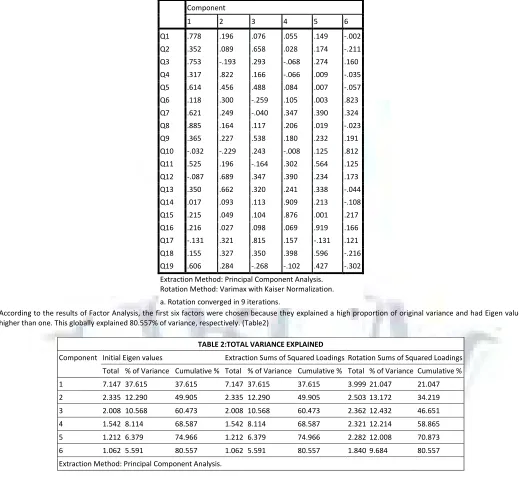
The factor solution employed principal components extraction with varimax rotation. Factors were derived using the Eigen value criterion. The rotated component matrix is reported in Table 1.
TABLE 1:ROTATED COMPONENT MATRIX Component
1 2 3 4 5 6
Q1 .778 .196 .076 .055 .149 -.002
Q2 .352 .089 .658 .028 .174 -.211
Q3 .753 -.193 .293 -.068 .274 .160
Q4 .317 .822 .166 -.066 .009 -.035
Q5 .614 .456 .488 .084 .007 -.057
Q6 .118 .300 -.259 .105 .003 .823
Q7 .621 .249 -.040 .347 .390 .324
Q8 .885 .164 .117 .206 .019 -.023
Q9 .365 .227 .538 .180 .232 .191
Q10 -.032 -.229 .243 -.008 .125 .812
Q11 .525 .196 -.164 .302 .564 .125
Q12 -.087 .689 .347 .390 .234 .173
Q13 .350 .662 .320 .241 .338 -.044
Q14 .017 .093 .113 .909 .213 -.108
Q15 .215 .049 .104 .876 .001 .217
Q16 .216 .027 .098 .069 .919 .166
Q17 -.131 .321 .815 .157 -.131 .121
Q18 .155 .327 .350 .398 .596 -.216
Q19 .606 .284 -.268 -.102 .427 -.302
Extraction Method: Principal Component Analysis. Rotation Method: Varimax with Kaiser Normalization. a. Rotation converged in 9 iterations.
According to the results of Factor Analysis, the first six factors were chosen because they explained a high proportion of original variance and had Eigen value higher than one. This globally explained 80.557% of variance, respectively. (Table2)
TABLE 2:TOTAL VARIANCE EXPLAINED
Component Initial Eigen values Extraction Sums of Squared Loadings Rotation Sums of Squared Loadings Total % of Variance Cumulative % Total % of Variance Cumulative % Total % of Variance Cumulative %
1 7.147 37.615 37.615 7.147 37.615 37.615 3.999 21.047 21.047
2 2.335 12.290 49.905 2.335 12.290 49.905 2.503 13.172 34.219
3 2.008 10.568 60.473 2.008 10.568 60.473 2.362 12.432 46.651
4 1.542 8.114 68.587 1.542 8.114 68.587 2.321 12.214 58.865
5 1.212 6.379 74.966 1.212 6.379 74.966 2.282 12.008 70.873
6 1.062 5.591 80.557 1.062 5.591 80.557 1.840 9.684 80.557
VOLUME NO.2(2012),ISSUE NO.6(JUNE) ISSN 2231-5756
INTERPRETATION OF FACTORS AND RELEVANCE TO THE IT INDUSTRY
FACTOR 1: EMPLOYEE AWARENESS OF AND INVOLVEMENT IN OVERALL PAS
The item with the highest factor loading for this factor group corresponds to the organisations’ initiative in making the employee aware of the importance and functionality of PAS .Another component of this factor is how far the organisation invites participation and suggestions for improvement in the overall effectiveness of the system. Other items include minimal use of external consultants and more internally initiated action research oriented interventions for improvement of appraisal efficiency over time.
Mitchell & Daniels (2003) state that individual differences in knowledge, skills, and dispositions combine with features of the IT work environment, such as norms for hard work, positive expectations, and elements of task design to enhance motivation (e.g., challenge and autonomy). Robson(2005) in his work on how performance measurement systems contribute to building high performance cultures states that in such cultures employees feel that in addition to their everyday operational activities, part of their job was to continually assist in improving the performance of the organisation. This would result in the belief that they could somehow affect or control critical aspects of overall performance. Measurement system has to be constructed specifically to encourage everyone in the organisation to be in the psychological state of “in-control” of the performance of the relevant systems within the organisation. For this purpose, performance measurement systems have to be designed, from the outset, with the psychological consequences in mind. This is best achieved by understanding organisations in terms of different types of systems that interact with each other. In order to encourage the perceptions that are required for a culture of high performance, measurements systems have to provide the relevant, local, team level, and graphical information. This information has to be in a form that can assist in the process of enabling people to perceive an important part of their job as being “in control” of the performance of the systems in which they are involved.(Robson ,2005)
FACTOR 2: PERCEPTION OF PERFORMANCE CONSEQUENCES/PERFORMANCE EXPECTANCIES
This factor represents the extent to which employees believe that there is a link between their appraisal results and the reward/recognition attached to the same. On the flip side, this also represents to what extent that employees feel that poor performance is suitably dealt with. Thus the company’s policy in terms of performance-reward linkage – both positive and negative discipline in the context of appraisals is a factor that impacts implementation.
Ownership of work (one’s perceived degree of control over his outcomes within his work environment) and individual accountability for tasks would imply that there is tangible proof of the implementation of consequences for both good and below par performance. Knowledge intensive organisations such as IT are examples of high performance work cultures which share information, involve employees in decision making, and emphasize employee feedback about quality and business processes (Becker & Huselid, 1998; Huselid, 1995; Lawler, Mohrman, & Benson, 2001).In such work cultures it is necessary that supervisors recognize the link between performance and motivation.(Mahadevan and Sundararajan,2008)
FACTOR 3: ORGANISATIONAL SUPPORT SYSTEMS
The components under this label comprise the provision of resources in terms of both physical support infrastructures (technology and resource sharing, work procedures, physical work environment etc.), information and knowledge sharing as well as effective work relationships in terms of quality of supervision (supervisors knowledge of individuals job and constructive inputs as and when required) and team capabilities (when working in project team based structures). IT workers experience numerous sources of stress that are universal across occupations and work environments. Research shows that, similar to other professions, stress in IT results from intensive work demands, complex relationships with others, career concerns, systems maintenance, role ambiguity, and tedious administrative tasks (Lim & Teo, 1999), as well as fear of obsolescence, team and client interactions, role overload, work culture issues, technical constraints, and competing work and family demands (Rajeswari & Anantharaman, 2003)
FACTOR 4: FOCUS AND SIGNIFICANCE OF INDIVIDUAL JOB/ ROLE
Items on the Likert Scale which correspond to this factor are based on the role his job plays in the organisation. The extent to which not only the strategic direction of the organisation is communicated but also the strategic relevance of the individual’s role in the organisation is clarified is important for efficiency of the PAS. The significance of what the employee does combine with the ‘importance’ of the work given to him the overall .The individual is responsible and accountable for his role.
An aspect of performance management in high performance professions such as IT is that the system should reinforce the employee’s perception that he plays a larger role than just a cog in the system. This factor seems to reinforce the fact that knowledge workers have a strong need for autonomy and control over one’s work processes within the workplace, a fact that reflects Drucker’s (1999) description of the very nature of knowledge work stating that KWs must identify the task themselves and have autonomy. Ehin’s(2008) believes in ‘unmanaging’ knowledge workers where he advocated that employees should be given the opportunity to participate and contribute in organisational setups which do not adhere strictly to hierarchical control mechanisms but provide autonomy, challenging tasks and organisational information sharing.
FACTOR 5: APPRAISER COMPETENCE
It might be mentioned here that the highest factor loading corresponded to the item specifying that supervisors should be appraised also on how they contribute to , reward and recognise subordinate and team performance. Another component of this factor is the practice of PA being done for all levels of the organisation. This reflects on the appraisal of those who are in supervisory positions (playing the role of a rater) as well as having other responsibilities (to be rated upon).
This factor reflects the need for developing rater/supervisor competence and the extent to which the organisation identifies gaps in appraiser competence and addresses the issue of pre appraisal training initiatives (appraiser training) Generally it is understood that during the performance planning stage, supervisors and subordinates jointly set and clarify goals, performance expectations, and evaluation methods and criteria. The supervisors must ensure that the subordinates have the authority, knowledge, skills, and organisational resources to successfully complete work targets. Certain areas of pre appraisal preparedness would include knowledge of organisation’s rating forms and procedures so as to clarify performance expectations, evaluation criteria, and methods; delegation/empowerment to create accountability by clarifying duties, work assignments, goals and expectations, and providing sufficient authority to achieve assigned responsibilities( for those in supervisory roles) (Fink and Longnecker, 1998,Kumar 2005) The supervisor’s competence would include ability for effective decision making and sound judgment – to effectively evaluate the subordinate’s actual performance on various rating criteria. In an industry such as the IT Industry where quantifying contributions is essentially a difficult task, the competence of the rater would definitely be a defining factor in effective implementation.
FACTOR 6: REFLECTION OF STATED RULES, NORMS AND BELIEFS
The performance appraisal function should be a tangible demonstration of behaviour which is supported by the stated norms, values and beliefs (organisation culture) of the organisation i.e. should reinforce the organisation culture. The factor loading that defines this factor corresponds to what extent the organisation has been able to convey that the PA system is an important part of and in turn contributes is important in sustaining the organisations culture.
INTERNATIONAL JOURNAL OF RESEARCH IN COMMERCE, IT & MANAGEMENT
study shows that organisational culture has an impact on the conception, planning, implementation and effectiveness of quality initiatives. The abstract and sophisticated nature of the work in software organisations renders the traditional levers of productivity and quality inadequate and makes a strong case for the relevance of organisational culture, which is recognised as an important analytical organisational framework, for analysing productivity and quality.
CONCLUSION
This paper attempts to identify contextual variables within the organisation that impact the effectiveness of the performance appraisal process being practiced. Contextual factors identified in this research comprise employee awareness of and involvement in goal setting, which in fact possessed the highest factor loading. This reinforces the belief that knowledge workers would require a certain degree of control over their own goals and targets .Implications for empowerment and autonomy are reflected strongly as a pre requisite for effective performance appraisal practices in IT organisations. Another factor which stands out is a strong perception of reward linkages which in turn reinforce performance expectancies. Explicitly stated consequences of performance therefore remain an integral variable which affects employees’ perceptions of the appraisal process. Organisation support in terms of physical workplace design, ergonomic considerations as well as knowledge sharing and learning resources also have been identified as an important contextual factor. An interesting fourth factor reveals the relevance of the knowledge workers role in the canvas of the organisations strategy. It is therefore important to identify how organisation strategies are cascaded and translated into individual roles in the organisation. The competence of the rater /supervisor reflects the perception of the supervisors rating skills in terms of understanding and evaluating performance in keeping with perceptions of fairness and equity. Pre appraisal training in rating behaviour and bias control thus can contribute to better appraisals. Affectively, the rater-ratee relationship is also a variable for scrutiny under this factor especially given that the scope for supervision in the context of knowledge work is task allotment, delegation, providing autonomy, learning resources and guiding when required. . Finally, the perceived congruence of the PA system with the organisations culture as apparent in the stated norms, values and performance culture constitutes the sixth factor. Two reasons could be attributed to this being the factor with the lowest Eigen value. Firstly, we can attribute this to an interesting observation which reinforces Levy and Williams(2004) and later Ferris et al’s (2008) theories is that the first five factors can be categorized as the proximal factors and the sixth factor is the broader distal factor which in turn is largely moderated and explained through the proximal factors. Secondly, it could be in keeping to the fact that occupational culture; therefore ‘work’ related aspects have been found to often override organisational culture considerations.
Of the proximal factors, the first factor is related to the design of the system in general (participation and design) and can be broadly termed as a structural proximal variable and the next four factors fall in the category of process proximal variables. This study reinforces the fact that nature of knowledge work and how human resource management practices relating to knowledge intensive firms need to be based on the unique features and nature of knowledge work and knowledge workers.
SCOPE FOR FURTHER RESEARCH
This paper is based on primary data collected from a relatively small sample of IT professionals working in India. Also, this survey has been conducted on a sample of professionals who have been in the industry between 8-10 years. Therefore, such research can be extended to other industries so as to enable HR practitioners an insight into what beyond the appraisal instrument per se; monitoring and feedback process impacts employees’ perceptions on the effectiveness of performance appraisals.
REFERENCES
1. Amba-Rao, Sita C., Petrick, Joseph A., Gupta, Jatinder N.D. And Von Der Embse, Thomas J. (2000) Comparative Performance Appraisal Practices and Management Values Among Foreign and Domestic Firms in India, International Journal of Human Resource Management 11:1 February, Pp 60-89 2. Becker, B. E., & Huselid, M. A. (1998). High Performance Work Systems and Firm Performance: A Synthesis of Research and Managerial Implications. In G.
R. Ferris (Ed.), Research In Personnel and Human Resource Management, Vol. 16, Pp. 53–101.
A. Borman, D. R. Ilgen, & R. J. Klimoski (Eds.), Handbook of Psychology: Volume 12: Industrial and Organisational Psychology (Pp. 225–254).Hoboken, NJ: Wiley.
3. Budhwar, P. And Sparrow, P. (1997) ‘Evaluating Levels Of Strategic Integration and Devolvement of Human Resource Management in India’. International Journal of Human Resource Management, 8, Pp.476-94
4. Duliba, K.A. And Baroudi, J. (1991), “Is Personnel: Do They Form an Occupational Community?” In Ferratt, T.W. (Ed.), Proceedings Of The 1991 Acm Sigcpr Conference, Athens, GA,8-9, Pp. 111-8.
5. Ehin Charles (2008), Un-Managing Knowledge Workers, Journal of Intellectual Capital, Vol. 9 No. 3, Pp. 337-350
6. Ferris Gerald R.A, Munson Timothy P. Basik Kevin, Buckley, Ronald (2008) the Performance Evaluation Context: Social, Emotional, Cognitive, Political, And Relationship Components, Human Resource Management Review 18 146–163
7. Fink, L.S. & Longenecker, C.O. (1998). Training As a Performance Appraisal Improvement Strategy, Career Development International 3 (6):243-251. 8. Frink, D. D., Treadway, D. C., & Ferris, G. R. (2005). Social Influence in the Performance Evaluation Process. In S. Cartwright (Ed.), Second Edition Blackwell
Encyclopedic Dictionary of Human Resource Management, Vol. 5. (Pp. 346−349)Oxford, UK: Blackwell Publishers.
9. Grinstein, A. And Goldman, A. (2006), “Characterising the Technology Firm: An Exploratory Study”, Research Policy, Vol. 35 No. 1, Pp. 121-43.
10. Guzman, I.R., Stam, K.R. And Stanton, J.M. (2008), “The Occupational Culture Of Is/It Personnel within Organisations”, the Data Base For Advances in Information Systems, Vol. 39 No. 1, Pp. 33-50.
11. Huselid, M. A. (1995). The Impact of Human Resource Management Practices on Turnover, Productivity, and Corporate Financial Performance, Academy of Management Journal, 38, 635–672.
12. Johns,Gary (2006) The Essential Impact Of Context On Organisational Behaviour, Academy Of Management Review 2006, Vol. 31, No. 2, 386–408. 13. Kelly, R. (1990), the Gold Collar Worker – Harnessing the Brainpower of the New Workforce, Addison-Wesley, Reading, Ma.
14. Kumar, Dsp Dev (2005) the Importance of Rater Training Journal of the Kuala Lumpur Royal Malaysia Police College, No. 4, 1-17
15. Lawler, E. E., Iii, Mohrman, S. A., & Benson, G. (2001). Organizing For High Performance. San Francisco, Ca: Jossey-Bass.
16. Levy, P. E., & Williams, J. R. (2004). The Social Context of Performance Appraisal: A Review and Framework for the Future, Journal of Management, 30, 881−905.
17. Lim, V. K. G., & Teo, T. S. H. (1999). Occupational Stress and It Personnel in Singapore: Factorial Dimensions and Differential Effects, International Journal of Information Management, 19, 277–291.
18. Mahadevan A. ,Sundararajan S.(2008) Effectiveness Of Performance Management System In IT Industries - An Empirical Approach, Srusti Management Review, July-December 2008 Pp 27-32
19. Major, Debra A., Davis Donald D. , Germano L I S A M., Fletcher ,Thomas D ., Sanchez-Hucles Janis & Mann Joan (2007) Managing Human Resources In Information Technology: Best Practices Of High Performing Supervisors, Human Resource Management, Fall 2007, Vol. 46, No. 3, Pp. 411–427
20. Mathew, Jossy (2007) the Relationship of Organisational Culture With Productivity and Quality A Study of Indian Software Organisations, Employee Relations, Vol. 29 No. 6, Pp. 677-695
21. Misra, Sasi; Kanungo, Rabindra N.; Lutz Von Rosenstiel, and Stuhler, Elmar A.The Motivational Formulation of Job and Work Involvement: A Cross-National Study, Human Relations, June 1985 38: 501-518
VOLUME NO.2(2012),ISSUE NO.6(JUNE) ISSN 2231-5756
23. Mowday, R. T., & Sutton, R. I. 1993. Organisational behaviour: Linking individuals and groups to organisational contexts.Annual Review of Psychology, 44: 195–229.
24. Newell, S., Scarbrough, H. And Swan, J. (2001) From Global Knowledge Management to Internal Electronic Fences: Contradictory Outcomes of Intranet Development, British Journal of Management, Vol.12 No. 2, and Pp 97-112.
25. Orlikowski, W.J. And Baroudi, J.J. (1989), “The Information Systems Profession: Myth or Reality”, Office: Technology & People, Vol. 4 No. 1, Pp. 13-30. 26. Paul, A.K. And Anantharaman, R.N. (2004), “Influence of HRM Practices on Organisational Commitment: A Study among Software Professionals in India”,
Human Resource Development Quarterly, Vol. 15 No. 1, Pp. 77-88.
27. Rajeswari, K. S., Anantharaman, R. N. (2003). Development of an Instrument to Measure Stress among Software Professionals: Factor Analytic Study. Proceedings of the 2003 Acm Sigmis Conference on Computer Personnel Research, Philadelphia, Pa, Pp. 34–43.
28. Robson, Ian (2005) Implementing A Performance Measurement System Capable Of Creating A Culture Of High Performance Perception Dynamics,
International Journal of Productivity and Performance Management, Vol. 54 No. 2, Pp. 137-145
INTERNATIONAL JOURNAL OF RESEARCH IN COMMERCE, IT & MANAGEMENT
REQUEST FOR FEEDBACK
Dear Readers
At the very outset, Internation]al Journal of Research in Commerce, IT and Management (IJRCM)
acknowledges & appreciates your efforts in showing interest in our present issue under your kind perusal.
I would like to request you to supply your critical comments and suggestions about the material published
in this issue as well as on the journal as a whole, on our E-mails i.e.
or
for further improvements in the interest of research.
If you have any queries please feel free to contact us on our E-mail [email protected].
I am sure that your feedback and deliberations would make future issues better – a result of our joint
effort.
Looking forward an appropriate consideration.
With sincere regards
Thanking you profoundly
Academically yours
Sd/-