Please cite this article as: E. Mirzaei, Y. Minatour, H. Bonakdari, A. A. Javadi, Application of Interval-Valued Fuzzy Analytic Hierarchy Process Approach in Selection Cargo Terminals, a Case Study, International Journal of Engineering (IJE), TRANSACTIONS C: Aspects Vol. 28, No. 3, (March 2015) 387-395
International Journal of Engineering
J o u r n a l H o m e p a g e : w w w . i j e . i rApplication of Interval-valued Fuzzy Analytic Hierarchy Process Approach in
Selection Cargo Terminals, a Case Study
E. Mirzaeia, Y. Minatourb, H. Bonakdaric,*, A. A. Javadid
a Department of Civil Engineering, Qayenat Branch, Islamic Azad University, Ghaen, Iran bDepartment of Civil Engineering, Razi University, Kermanshah, Iran
cAdvanced Research Institute of Water and Wastewater, Razi University, Kermanshah, Iran. dCollege of Engineering, Mathematics and Physical Sciences, University of Exeter, Exeter, UK.
P A P E R I N F O
Paper history:
Received 05February2014
Received in revised form 08September2014 Accepted 13November2014
Keywords:
Cargo Terminal Fuzzy AHP Ghaen (Qayenat) City Interval-valued Fuzzy Sets Group Decision Making.
A B S T R A C T
Cargo terminals are the gateways for entrance of commodities into the transportation network. Therefore, locating them in optimal locations could have a major impact on the cost effectiveness and efficiency of transport, traffic safety and reduction in environmental pollutions. Due to the presence of a large number of parameters involved and the existing uncertainties, decision making in this field is a complex task. If the decision makers cannot reach an agreement on the method of defining linguistic variables based on the fuzzy sets, favorable results and more accurate modeling can be achieved by using the interval-valued fuzzy sets (IVFSs) which provide an additional degree of freedom to represent the uncertainty and fuzziness in the real world. This study presents a group fuzzy analytic hierarchy process (AHP) based on IVFSs (IVF-AHP), and its application to find the optimal location for the Ghaen (Qayenat) cargo terminal in Ghaen City, Iran. The results show that the proposed method is a reliable method in selecting the optimal location for cargo terminals.
doi: 10.5829/idosi.ije.2015.28.03c.07
1. INTRODUCTION1
Existent suitable cargo terminal as the main gateway into the economic efficiency of the transportation network has an important role in economic efficiency of transportation, traffic safety and reducing environmental pollution. Selecting a suitable location for these terminals is important due to the high initial investment and operation costs of the future. There are several factors that should be considered simultaneously in locating the appropriate terminals. There are many stakeholders involved in this issue (government, private and public entities), some of which may not apply these criteria in their decision making, which may lead to wrong decisions. On the other hand, in the traditional approach to decision-making (without using engineering techniques) some criteria may not be considered or their
1*Corresponding Author’s Email:[email protected] (H.
Bonakdari)
the IVTFNs, which is named IVF-AHP. With the information uncertainty and inaccuracy considered, a new model for project evaluation and selection is proposed which it is combined with the fuzzy analytic hierarchy process (AHP). The proposed method is applied to select the optimal location for the Ghaen (Qayenat) cargo terminal in Ghaen City, Iran, as a case study. Section 2 presents literature review of the subject andSection 3 illustrates the IVFSs. Section 4 describes the IVF-AHP method for solving MCDM problems. In Sections 5 and 6, the application of IVF-AHP to a real case study is investigated. The conclusions are stated in Section 7. The proposed method provides a way to handle fuzzy multi-criteria group decision-making problems and to evaluate the qualities and weight of the attributes in complex situations.
2. LITERATURE REVIEW
The AHP, first introduced by [5], is a MCDM method for solving MCDM problems by setting their priorities. This method uses precise numbers in the rating of alternatives. The AHP uses objective mathematics to process the subjective and personal preferences of an individual or a group in decision-making [12]. The AHP works on a premise that decision making of complex problems can be handled by structuring it into a simple and comprehensible hierarchical structure. Solution of the AHP hierarchical structure is obtained by synthesizing local and global preference weights to obtain the overall priority [5]. The classical MCDM methods such as AHP cannot handle problems with imprecise information effectively. One of the tools which has been used for transmission of uncertainties in decision-making problems during recent decades is the type-1 fuzzy sets (FSs) introduced by [13]. To date, many researchers have extended the AHP based on fuzzy sets (fuzzy AHP methods). The most important and earliest fuzzy AHP methods are summarized below. Van Laarhoven and Pedrycz [14] proposed the first study that applied the fuzzy logic principle to AHP. Buckley [15] initiated trapezoidal fuzzy numbers to express the decision maker’s evaluation on alternatives with respect to each criterion while Van Laarhoven and Pedrcyz [14] have used triangular fuzzy numbers. Chang [16] introduced a new approach for handling fuzzy AHP with the use of triangular fuzzy numbers for pair-wise comparison scale of fuzzy AHP, and the use of the extent analysis method for the synthetic extent values of the pair-wise comparisons. Cheng [17] proposed a new algorithm for evaluating naval tactical missile systems by the fuzzy analytical hierarchy process based on grade value of membership function. Deng [18] presented a fuzzy approach for tackling qualitative multi-criteria analysis problems in a simple and straightforward manner. Others research works are
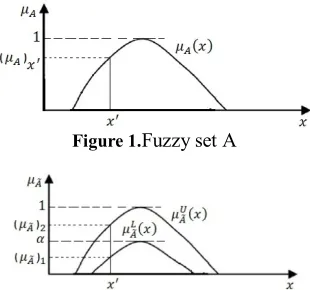
extensions of the available methods [19-22]. Fuzzy AHP methods have been used for a variety of specific applications in decision making problems by many researches, including hospital site selection [23], selection of optimum underground mining method [24], supplier selection in a washing machine company [25] and ranking suitable sites for irrigation with reclaimed water [26]. However, the application of the fuzzy AHP methods in locating the site for cargo terminal has not been reported in the literature. Lately, type-2 fuzzy sets (interval-valued fuzzy sets; IVFSs), introduced by [27, 28] have been utilized in transmission of uncertainties and fuzzy conceptions into MCDM methods. This is due to the fact that the IVFSs provide an additional degree of freedom to represent the uncertainty and fuzziness of the real world. The difference between FSs and IVFSs is that the membership function of the IVFSs is a fuzzy system within the interval of [0, 1], while that of the FSs is a numerical value in the interval of [0, 1]. Figure 1 illustrates the membership value at x¢of the FS A. Thereby, the membership value of x¢ is (mA)x¢.
Figure 2 illustrates the membership value at x¢of the IVFS A. Thereby, the membership value of x¢is the interval of [(mA~)1,(mA~)2].
3. INTERVAL-VALUED FUZZY SETS
The type-2 fuzzy sets concept, also known as IVFSs, was proposed by [27, 28]. IVFSs are useful in situations where it is not possible for a membership function of the type, μ:X→[0,1], to assign an exact value from the interval [0,1] to each element, xÎX, without losing some information [27, 28]. In these situations the membership degree is defined as a continuum of values ranging over the interval of [0,1] rather than an exact value selected from the interval [0,1]. The mathematical description of the type-2 fuzzy concept is as follows [28]:
Figure 1.Fuzzy set A
) , ( x ))}, x ( , x {( A )] x ( ), x ( [ ) x ( , X x ] 1 , 0 [ X : , X x )]}, x ( ), x ( [ , x { A A U A L A A U A L A U A L A U A L A ¥ + -¥ Î m = m m = m m £ m Î " ® m m Î m m = (1)
where mLA(x) is the lower limit of the degree of membership and mAU(x) its upper limit. Given two interval-valued fuzzy numbers,Nx=[Nx-;Nx+]and
] M ; M [
Mx = x- x+ , according to [28], we have:
Definition 1 If .Î(+,-,´,¸), then
], N . N ; M . N [ ) y . x ( M .
N = x- y- x+ y+ for a positive non-fuzzy number (v), v.M(x.y)=[v.My-;v.My+].
Definition 2 Let N~and M~ be two IVTFNs (Figure 4).
N~and M~ can then be represented as [29]:
)] N , N ( ; N ); N , N [(
N~= 1¢ 1 2 3 3¢ (2)
)] M , M ( ; M ); M , M [(
M~= 1¢ 1 2 3 3¢ (3)
Definition 2.1. The addition, subtraction, multiplication
and division operations between N~ and M~ are defined as follows: )] M N , M N ( ; M N ); M N , M N [( M~
N~+ = 1¢+ 1¢ 1+ 1 2+ 2 3+ 3 3¢+ ¢3
(4) )] M N , M N ( ; M N ); M N , M N [( M~
N~- = 1¢- 1¢ 1- 1 2- 2 3- 3 3¢ - ¢3
(5) )] M N , M N ( ; M N ); M N , M N [( M~ N ~ 3 3 3 3 2 2 1 1 1
1´ ¢ ´ ´ ´ ¢´ ¢
¢ = ´ (6) )] M / N , M / N ( ; M / N ); M / N , M / N [( M~ / N ~ 1 3 1 3 2 2 3 1 3
1 ¢ ¢ ¢
¢
= (7)
Definition 2. 2. Let:
6 ) N N N 2 N N ( ) N~ (
h = 1¢+ 1+ 2+ 3+ 3¢ (8)
6 ) M M M 2 M M ( ) M~ (
h = 1¢+ 1+ 2+ 3+ 3¢ (9)
We say: M~
N~> if h(N~)>h(M~) (10)
Figure 3. Two Interval-valued triangular fuzzy numbers N~and M~
4. THE PROPOSED METHOD
The proposed method in this study is a group IVF-AHP method to solve MCDM problems. While determining precisely the degree of membership case by case is most difficult, it can be expressed as an interval of real numbers instead. Taking this into consideration, in this paper the importance of the weight of attributes and the rating of the decision alternatives with respect to attributes are pooled as linguistic variables, a concept very useful in dealing with situations that are too complex or ill-defined. Linguistic variables are then considered as IVTFNs by using some mathematical equations. Here, a questionnaire is used to pool the opinions of the experts. In order to receive their realistic opinions, an iterative technique of questioning with a consistency analysis is implemented. Decision making by using this method involves several essential steps as follows:
Step 1: Forming a committee for decision making, this
committee involves experts and decision makers.
Step 2: The effective criteria in the decision-making
problems are determined by using a comprehensive literature review and the opinions of experts. The potential alternatives are then proposed based on the determined criteria by experts.
Step 3: The hierarchy diagram is a graphic
representation of the decision problem in which the objective is in the highest level, criteria in intermediate, and alternatives in the lowest level.
Step 4: The experts' opinions regarding the importance
or rating of decision element are pooled by using a questionnaire.
Step 5: According to the questionnaires, a comparison
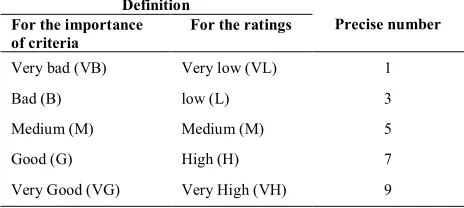
matrix is established based on each expert opinion for each decision element using the scale of Table 1. Let El1, El2,.…Eln denote a set of decision elements. Their comparison matrix is defined as follows:
ú ú ú ú ú û ù ê ê ê ê ê ë é b b b b b b = b = ´ 1 / 1 / 1 1 / 1 1 El El El ) ( N El El El n 2 n 1 n 2 12 n 1 12 n 2 1 n n ij n 2 1 L M O M M L L M L (11)
(,ij 1,2,...,n.,i j) ,
1
ij= = =
b (12)
(
,ij 1,2,...,n.,i j)
,
j i
ij=ll = ¹
b (13)
TABLE 1. Linguistic variables for the importance weight of attribute and the ratings
Precise number Definition
For the ratings For the importance
of criteria
1 Very low (VL)
Very bad (VB)
3 low (L) Bad (B) 5 Medium (M) Medium (M) 7 High (H) Good (G) 9 Very High (VH)
Very Good (VG)
TABLE 2. Consistency index, RI. of random matrices [5]
10 9 8 7 6 5 4 3 2 1 n 1.49 1.45 1.41 1.32 1.24 1.12 0.9 0.58 0 0 RI
Step 6: Following the above outlines, an interval valued
fuzzy matrix, A~can be calculated, based on all of the opinions of experts, as:
ú ú ú ú ú û ù ê ê ê ê ê ë é = = -´ 1 x~ x~ x~ 1 x~ x~ x~ 1 ) x~ ( A~ 1 n 2 1 n 1 n 2 1 12 n 1 12 n n ij L M O M M L L (14)
The TIVFNs x~ andij x~ij-1 are used to represent the opinions of experts about each decision element. These TIVFNs are obtained as:
(
,ij 1,2,...,n.,i j)
), b , b ( ; m ); a , a (
x~ij= ij¢ ij ij ij¢ ij = ¹ (15)
(
,ij 1,2,...,n.,i j)
), a 1 , a 1 ( ; m 1 ); b 1 , b 1 ( x~ ij ij ij ij ij 1
ij = ¢ ¢ = ¹
-(16) K ..., , 1 k ), x ( Min a ijk k
ij= =
¢ (17) K ..., , 1 k , 2 ) ( Min ) ( ) ( Min a K 1 k ijk k k 1 ijk ijk k ij = b -b + b
=
Õ
= (18)Õ
= = b = K 1 k k 1 ijkij ( ) ,k 1,...,K
m (19) K ..., , 1 k , 2 ) ( ) ( Max ) ( Max b K 1 k k 1 ijk ijk k ijk k ij = b -b -b
=
Õ
= (20)K ..., , 1 k ), ( Max b ijk k
ij= b =
¢ (21)
where, a¢ij£aij£mij£bij£b¢ij; bijkindicates the relative importance (or the relative rating) of element i (λi), over the relative importance (or the relative rating)
of element j (λj) based on opinion of expert k (calculated by Equations (11), (12) and (13)), and K is the number of experts involved in the decision making.
Step 7: Convert the fuzzy comparison matrices
(Equation(14)) into crisp comparison as follows:
ú ú ú ú ú û ù ê ê ê ê ê ë é = = -´ 1 x x x 1 x x x 1 ) x ( A 1 n 2 1 n 1 n 2 1 12 n 1 12 n n ij L M O M M L L (22) where: 6 b b m 2 a a
xij= ij¢+ ij+ ij+ ¢ij+ ij (23)
6 a 1 a 1 m 1 2 b 1 b 1
xij1 12 12 12 12 12¢
+ + + ¢ + = - (24)
Step 8: Analyze the consistency of each comparison
matrix (Equation(22)) by calculating the consistency index (CI) and the consistency ratio (CR) (Calabrese et al. 2013): n 1 n CI max -l = (25) % 100 )) n ( RI CI (
CR= - ´ (26)
where λmax is the largest value of the comparison matrix, n the dimension of the matrix and RI(n) a random index depending on n as shown in Table 2.
The consistency of the matrix is acceptable only if CR is less than 10%. If a matrix results are inconsistent, it is then necessary to obtain new comparison judgments and new fuzzy comparison matrix. The matrix review must be continued until the consistency is satisfied.
Step 9: After the consistency is satisfied, the relative
interval-valued fuzzy weights of decisions elements )
W~
( i are calculated based on interval valued fuzzy matrix (see Equation(12)) as follows:
[
x~ x~]
(z ,z );z ;(z ,z ) Z ~ i 3 i 3 i 2 i 1 i 1 n 1 in iji= ÄLÄ = ¢ ¢ (27)
) w , w ( ; w ); w , w ( ) Z ~ Z ~ ( Z~
W~i= iÄ iÅLÅ n-1= 1¢i 1i 2i 3i ¢3i (28)
Step 10: The relative weights (local weights) of the
6
w w w 2 w w
Wi= ¢1i+ 1i+ 2i+ 3i+ ¢3i (29)
Step 11: The relative weights of the decision elements
(calculated in previous step) are aggregated according to Saaty’s AHP, [8] to obtain the total weight and an overall rating for the alternatives. Each alternative with the higher weight has the higher priority.
5. CASE STUDY
One of the aims of this study is selecting an optimal site for a cargo terminal in Ghaen (Qayenat), located 110 km north of Birjand (the capital of South Khorasan province) in Iran. In order to decide on the optimal location for the cargo terminal, as the first step, the most effective attributes (criteria and sub-criteria) in the cargo terminal site selection were determined by conducting a comprehensive review of the literature and experts’ opinions. Table 3 lists the selected attributes and a brief explanation about them is presented here.
Local area (C1): Includes: Non-adjacent to the city
limits and urban development (S1). Non-adjacent to the public centers (such as recreation centers, cultural heritage and tourism) (S2). Adjacent to main road (S3). Adjacent to convection networks, water distribution and gas station (S4).
Land Topography (C2): Topography is very important
due to heavy traffic and avoiding the risk of flooding and landslides, and it should be smooth, especially for cars traffic.
Cost (C3): Includes cost of land, energy and water
supply and all costs associated with construction.
The predominant direction of wind (C4): This is
important in transmission of noise and health in the city.
Environmental impact (C5): The environmental
impact should be considered, especially in relation to cutting of trees.
Expansion possibility in the future (C6): Cargo
terminal should be in a place to allow future development in terms of land costs, environmental damage, etc.
Distance from the cargo center (C7): It is preferred
that the distance from the main centers of cargo production is low. Considering the effective criteria chosen, by using the experts’ opinions and the collected data, four potential cargo terminal sites (site ‘A’, ‘B’,
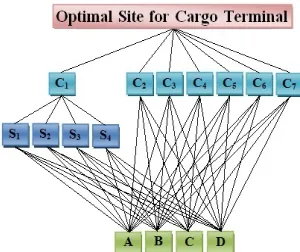
‘C’ and ‘D’) in the surrounding areas of Ghaen city were proposed. To determine the importance of the weight of the attributes and to rate the alternatives using the proposed method, a questionnaire was designed. Then,the four experts (E1, E2, E3 and E4) involved in this project were asked to express the importance of the weight of each attribute and the rating of alternatives with respect to each attribute using linguistic variables inserted in the questionnaires (Table 1). Then, a consistency check was carried out. Where they were not satisfactory, the opinions were sent back to the experts. This process was repeated until the consistency check became acceptable. Table 4 shows the opinions of the experts on the importance weight of the attributes and the rating of the alternatives with respect to each attribute in the final repetition.The proposed method was then applied to select the optimal location. First, the hierarchical structure of the cargo terminal site selection problem was built. Figure 4 shows this structure with four levels: one objective (cargo terminal site selection), seven criteria (C1-C7), four sub-criteria (S1-S4) and four alternatives (A, B, C and D).
Figure 4. The hierarchical structure of the cargo terminal location of Gaen City problem
TABLE 3. The most important attributes for locating the cargo terminal Definition
Sub-criteria Definition
Criteria
Non-adjacent to the city limits and urban development S1
Local area C1
Non-adjacent to the public centers (such as recreation centers, cultural heritage and tourism)
S2
Adjacent to main road S3
Adjacent to convection networks, water distribution and gas station S4
Land Topography C2
Cost C3
The predominant direction of wind C4
Environmental destruction C5
Expansion possibility in the future C6
TABLE 4. Experts' opinions about the importance weight of attributes and the rating of alternatives Rating Importance weight D C B A E4 E3 E2 E1 Sub-Criterion E4 E3 E2 E1
Criterion E1 E2 E3 E4 E1 E2 E3 E4 E1 E2 E3 E4 E1 E2 E3 E4
G M M G G M M G G M M G G M M G VH H VH H S1 H VH H H C1 M M G G VG G G VG G M G G G B B G M M M M S2 G VG VG VG M M G M G G M G G G M G H H H M S3 VG VG G G M M M M M M G M G VG G G M L L M S4 B M G G VG G G VG G M G G G B M G M M L M C2 B B M G G VG M G G M G VG G G M G H VH VH VH C3 B M G G VG G G VG G G G G G G M G L L M M C4 VG VG G G M B B B M M B B VG VG VG VG L L L L C5 B M G G M G M B G M VG G M M M M M M L H C6 VG VG G G M B B B M M B B VG VG VG VG H L M M C7
TABLE 6. Interval valued fuzzy positive reciprocal matrix of alternatives with respect to C2 D C B A (0.600,0.800);1.000;(1.667,2.333) (0.429,0.542);0.656;(0.717,0.778) (0.600,0.705);0.809;(0.905,1.000) (1.000,1.000);1.000;(1.000,1.000) A (1.000,1.118);1.236;(1.785,2.333) (0.714,0.763);0.811;(0.905,1.000) (1.000,1.000);1.000;(1.000,1.000) (1.000,1.118);1.236;(1.451,1.667) B (1.000,1.262);1.524;(2.262,3.000) (1.000,1.000);1.000;(1.000,1.000) (1.000,1.117);1.233;(1.317,1.400) (1.286,1.405);1.524;(1.929,2.333) C (1.000,1.000);1.000;(1.000,1.000) (0.333,0.495);0.656;(0.828,1.000) (0.429,0.619);0.809;(0.905,1.000) (0.429,0.714);1.000;(1.333,1.667) D
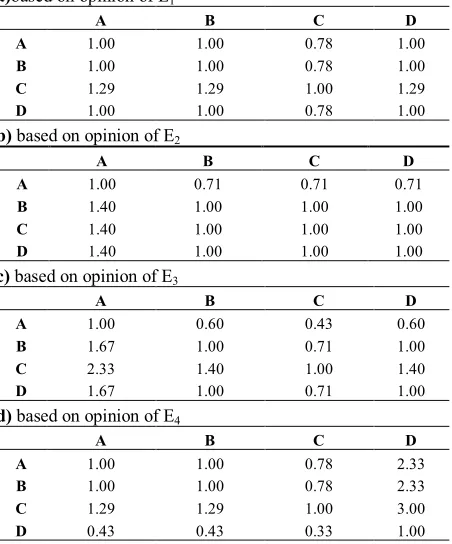
TABLE 5. Comparison of the alternatives with respect to C2 a)based on opinion of E1
D C B A 1.00 0.78 1.00 1.00 A 1.00 0.78 1.00 1.00 B 1.29 1.00 1.29 1.29 C 1.00 0.78 1.00 1.00 D
b) based on opinion of E2
D C B A 0.71 0.71 0.71 1.00 A 1.00 1.00 1.00 1.40 B 1.00 1.00 1.00 1.40 C 1.00 1.00 1.00 1.40 D
c) based on opinion of E3
D C B A 0.60 0.43 0.60 1.00 A 1.00 0.71 1.00 1.67 B 1.40 1.00 1.40 2.33 C 1.00 0.71 1.00 1.67 D
d) based on opinion of E4
D C B A 2.33 0.78 1.00 1.00 A 2.33 0.78 1.00 1.00 B 3.00 1.00 1.29 1.29 C 1.00 0.33 0.43 0.43 D
For example, the calculations for the alternatives with respect to C2 are as follows:
The opinions of experts to determine the rating of the alternatives with respect to C2in the final repetition are collected according to row 4 and columns 11 to 26 in Table 4.By using the scale of Table 1 and Equations (11), (12) and (13), the comparison matrices of the alternatives with respect to C2, based on each expert’s opinion, are established according to Table 5.
The interval-valued fuzzy matrix of alternatives with respect to C2is calculated as presented in Table 6 (see Equations(14) to (21)). The crisp comparison matrix of alternatives with respect to C2 is calculated by Equations(22), (23) and (24) and the results are presented in Table 7. The CR for this matrix is calculated using Equation(26) and the result is presented at the bottom of Table 6. As can be observed, the value of the CRis less than 0.1.Thus, this matrixis consistent, and the judgments about the alternatives with respect to C2 are acceptable.
TABLE 7.Crisp comparison matrix of alternatives with respect to C2
TABLE 8. Calculations of The relative fuzzy weights of alternatives with respect to C2
Alternative (i) i
Z ~ i
W~
A (0.627,0.744);0.854;
(1.020,1.161) (0.115,0.155);0.210;
(0.283,0.373)
B (0.919,0.988);1.055;
(1.237,1.404) (0.168,0.206);0.260;
(0.344,0.452)
C (1.065,1.186);1.301;
(1.548,1.769) (0.195,0.247);0.320;
(0.430,0.569)
D (0.497,0.684);0.854;
(1.000,1.136) (0.091,0.142);0.210;
(0.278,0.366)
TABLE 9. The total weight of the alternatives
Criterion Sub-criterion
Alternatives
A B C D
C1 (0.223)
S1 (0.349)
0.250 0.250 0.250 0.250
S2 (0.222)
0.195 0.275 0.328 0.247
S3 (0.281)
0.240 0.240 0.220 0.326
S4 (0.176)
0.292 0.221 0.192 0.311
C2 (0.122)
0.224 0.281 0.347 0.216
C3 (0.257)
0.277 0.293 0.310 0.182
C4 (0.108)
0.252 0.279 0.313 0.204
C5 (0.083)
0.374 0.166 0.145 0.334
C6 (0.137)
0.254 0.345 0.247 0.259
C7 (0.147)
0.374 0.166 0.145 0.334
Total Weight 0.302
0.282 0.280 0.272
Similar calculations are made to obtain the crisp comparison matrices of criteria (using opinions inserted in columns 1 to 10 of Table 4), the crisp comparison matrices of sub-criteria (using opinions inserted in columns 1 to 10 of Table 4), the crisp comparison matrices of the alternatives with respect to the other criteria and sub-criteria (using opinions inserted in columns 11 to 26 of Table 4) and their CR values.The relative fuzzy weights of alternatives with respect to C2 are calculated using Equations(27) and (28).The results are presented in Table 8.
Using Equation (29), the relative weights of alternative iwith respect to C2(WiC*2), which are
non-fuzzy numbers, are obtained as follows:
224 . 0 6
373 . 0 283 . 0 ) 210 . 0 2 ( 155 . 0 115 . 0 W
2
AC =
+ + ´ + + =
281 . 0 6
452 . 0 344 . 0 ) 260 . 0 2 ( 206 . 0 168 . 0 W
2
BC =
+ + ´ + + =
347 . 0 6
569 . 0 430 . 0 ) 320 . 0 2 ( 247 . 0 195 . 0 W
2
CC =
+ + ´ + + =
216 . 0 6
366 . 0 278 . 0 ) 210 . 0 2 ( 142 . 0 091 . 0 W
2
DC =
+ + ´ + + =
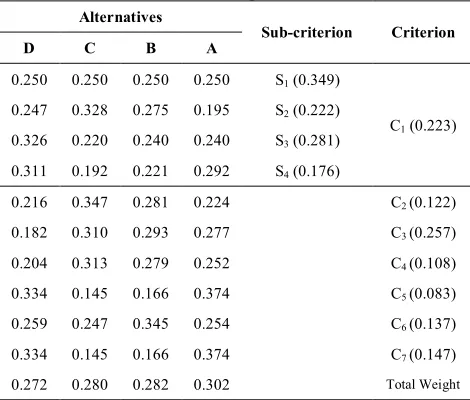
As can be observed, the relative weight of alternative C with respect to C2(WiC*2)is higher than the other alternatives. Therefore, alternative C is the optimal alternative based on criterion C2. Similar calculations are made based on the opinions of the experts in the final repetition (inserted in Table4)to obtain the relative weight of the attributes and the rating alternatives with respect to the attributes. Table 9 shows the relative weights of criteria (see column 2), the relative weight of sib-criteria (see column 2) and the relative weight of alternatives with respect to each attribute (see columns 3, 4, 5 and 6). The total weight of each alternative resulted from the combination of the relative weights of the decision elements according to AHP is shown in the last row of this table. As can be seen, also in the last row, the four proposed sites were ranked “A”, “B”, “C”
and “B”, respectively. Therefore, alternative “A” is the optimal site for the cargo terminal of the Ghaen City, Iran. For example, the total weight of the alternative
“A” is calculated according to AHP as follows:
0.302 = 0.374) (0.147 0.254) (0.137 0.374) (0.083
0.252)
×
(0.108 + 0.277)
×
(0.257 + 0.224)
×
(0.122
+ 0.292) 0.176
×
(0.223 + 0.240) 0.281
×
(0.223 +
0.195) 0.222
×
(0.223 + 0.250) 0.349
×
(0.223 = WAt
´ + ´ + ´ +
´ ´
´ ´
=
Similarly: WBt =0.282,WCt =0.280,WDt =0.272
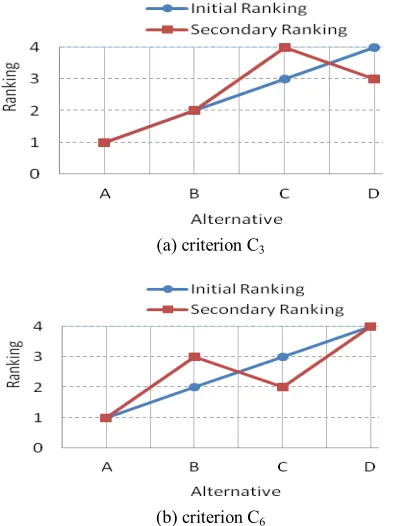
6. SENSITIVITY ANALYSIS
(a) criterion C3
(b) criterion C6
Figure 5. Sensitivity analysis on the importance of criteria C3 and C6
7. CONCLUSION
Selecting a suitable terminal site location is among those decisions that significantly affect city limits and urban development. In addition, the terminal construction is a hugely costly project and it must be constructed in a location that has more potential to offset the associated costs. Hence, extensive studies from various aspects must be carried out to select the best site. Given the dependence of this matter to different quantitative and qualitative parameters, decision making regarding the site selection is a complex task. In this paper, a method is proposed, based on interval-valued fuzzy sets (IVF-AHP method) that can provide a way to handle fuzzy multi-criteria group decision-making problems and evaluate the qualities and weights of the attributes in complex situations. Considering the underlying fuzziness, the IVF-AHP method provides favorable results in a more flexible and intelligent manner than traditional fuzzy sets. Therefore, this method is a suitable decision-making tool for solving MCDM problems. The method was applied to select the optimal site for a cargo terminal for Ghaen City, Iran, as a case study. After applying the proposed method, alternative “A” was identified as the optimal site. Although in this study the proposed method is illustrated by application to a cargo terminal site selection problem, it should be noted that the method is generic and can be applied also to rating problems in other areas.
8. REFERENCES
1. Aryanejad, M. and Ghavampour, S., "Two stage multiple attribute decision making problem in iranian gas distribution systems", International Journal Of Engineering Transactions A, Vol. 17, No., (2004), 135-144.
2. Zegordi, S., Nik, E. and Nazari, A., "Power plant project risk assessment using a fuzzy-anp and fuzzy-topsis method",
International Journal of Engineering-Transactions B: Applications, Vol. 25, No. 2, (2012), 107.
3. Benayoun, R., Roy, B. and Sussman, N., "Manual de reference du programme electre", Note de synthese et Formation, Vol. 25, No., (1966).
4. Roy, B., "Classement et choix en présence de points de vue multiples", RAIRO-Operations Research-Recherche Opérationnelle, Vol. 2, No. V1, (1968), 57-75.
5. Satty, T.L., The analytic hierarchy process., New York: McGraw-Hill New York.(1980)
6. Yoon, K.P. and Hwang, C.-L., "Multiple attribute decision making: An introduction, Sage Publications, Vol. 104, (1995). 7. Mousavi, S., Makoui, A., Raissi, S. and Mojtahedi, S., "A
multi-criteria decision-making approach with interval numbers for evaluating project risk responses", International Journal of Engineering-Transactions B: Applications, Vol. 25, No. 2, (2012), 121.
8. Saaty, T.L., "Decision making with dependence and feedback: The analytic network process, RWS publications Pittsburgh, Vol. 4922, (1996).
9. Opricovic, S., "Multicriteria optimization of civil engineering systems", Faculty of Civil Engineering, Belgrade, Vol. 2, No. 1, (1998), 5-21.
10. Opricovic, S. and Tzeng, G.H., "Multicriteria planning of post‐earthquake sustainable reconstruction", Computer‐Aided Civil and Infrastructure Engineering, Vol. 17, No. 3, (2002), 211-220.
11. Vahdani, B., Salimi, M. and Mousavi, S., "A new compromise decision-making model based on topsis and vikor for solving multi-objective large-scale programming problems with a block angular structure under uncertainty", International Journal of Engineering, Vol. 27, No. 11, (2014).
12. Saaty, T.L. and Vargas, L.G., "Models, methods, concepts & applications of the analytic hierarchy process, Springer Science & Business Media, Vol. 175, (2012).
13. Zadeh, L.A., "Fuzzy sets", Information and Control, Vol. 8, No. 3, (1965), 338-353.
14. Van Laarhoven, P. and Pedrycz, W., "A fuzzy extension of saaty's priority theory", Fuzzy sets and Systems, Vol. 11, No. 1, (1983), 199-227.
15. Buckley, J.J., "Fuzzy hierarchical analysis", Fuzzy Sets And Systems, Vol. 17, No. 3, (1985), 233-247.
16. Chang, D.-Y., "Applications of the extent analysis method on fuzzy ahp", European Journal Of Operational Research, Vol. 95, No. 3, (1996), 649-655.
17. Cheng, C.-H., "Evaluating naval tactical missile systems by fuzzy ahp based on the grade value of membership function",
European Journal of Operational Research, Vol. 96, No. 2, (1997), 343-350.
18. Deng, H., "Multicriteria analysis with fuzzy pairwise comparison", International Journal of Approximate Reasoning, Vol. 21, No. 3, (1999), 215-231.
20. Wang, Y.-M. and Chin, K.-S., "An eigenvector method for generating normalized interval and fuzzy weights", Applied mathematics and computation, Vol. 181, No. 2, (2006), 1257-1275.
21. Lee, S.-H., "Using fuzzy ahp to develop intellectual capital evaluation model for assessing their performance contribution in a university", Expert Systems with Applications, Vol. 37, No. 7, (2010), 4941-4947.
22. Calabrese, A., Costa, R. and Menichini, T., "Using fuzzy ahp to manage intellectual capital assets: An application to the ict service industry", Expert Systems with Applications, Vol. 40, No. 9, (2013), 3747-3755.
23. Vahidnia, M.H., Alesheikh, A.A. and Alimohammadi, A., "Hospital site selection using fuzzy ahp and its derivatives",
Journal of Environmental Management, Vol. 90, No. 10, (2009), 3048-3056.
24. Naghadehi, M.Z., Mikaeil, R. and Ataei, M., "The application of fuzzy analytic hierarchy process (fahp) approach to selection of
optimum underground mining method for jajarm bauxite mine, iran", Expert Systems with Applications, Vol. 36, No. 4, (2009), 8218-8226.
25. Kilincci, O. and Onal, S.A., "Fuzzy ahp approach for supplier selection in a washing machine company", Expert systems with Applications, Vol. 38, No. 8, (2011), 9656-9664.
26. Anane, M., Bouziri, L., Limam, A. and Jellali, S., "Ranking suitable sites for irrigation with reclaimed water in the nabeul-hammamet region (tunisia) using gis and ahp-multicriteria decision analysis", Resources, Conservation and Recycling, Vol. 65, (2012), 36-46.
27. Turksen, I.B., "Interval valued fuzzy sets based on normal forms", Fuzzy Sets And Systems, Vol. 20, No. 2, (1986), 191-210.
28. Gorzałczany, M.B., "A method of inference in approximate reasoning based on interval-valued fuzzy sets", Fuzzy Sets And Systems, Vol. 21, No. 1, (1987), 1-17.
Application of Interval-valued Fuzzy Analytic Hierarchy Process Approach in
Selection Cargo Terminals, a Case Study
E. Mirzaeia, Y. Minatourb, H. Bonakdaric, A. A. Javadid
a Department of Civil Engineering, Qayenat Branch, Islamic Azad University, Ghaen, Iran bDepartment of Civil Engineering, Razi University, Kermanshah, Iran
cAdvanced Research Institute of Water and Wastewater, Razi University, Kermanshah, Iran. dCollege of Engineering, Mathematics and Physical Sciences, University of Exeter, Exeter, UK.
P A P E R I N F O
Paper history:
Received 05 February 2014
Received in revised form 08 September 2014 Accepted 13November 2014
Keywords:
Cargo Terminal Fuzzy AHP Ghaen (Qayenat) City Interval-valued Fuzzy Sets Group Decision Making.
ﺪﯿﮑﭼ ه
ﺎﭘﯾ ﻪﻧﺎ ﺎﻫ هزاورد ي دورو ﺎﻫﻻﺎﮐ ﻪﺑ ﻪﮑﺒﺷ ي ﻞﻤﺣ و ﻞﻘﻧ ﺪﻨﺘﺴﻫ . اﺮﺑﺎﻨﺑ ﯾ ،ﻦ ﻣ ﺖﯿﻌﻗﻮ ﺎﻬﻧآ رد ﻞﺤﻣ ﺐﺳﺎﻨﻣ ، ﻣ ﯽ ﺪﻧاﻮﺗ ﺛﺄﺗ ﯿﺮ هﺪﻤﻋ ا ي ﺮﺑ
ﺮﺛا ﺸﺨﺑ ﯽ ﺰﻫ ﯾ ﻪﻨ و هﺮﻬﺑ رو ي زا ﻪﮑﺒﺷ ﻞﻤﺣ و ،ﻞﻘﻧ اﯾ ﻨﻤ ﯽ ﻓاﺮﺗ ﯿ ﮏ و ﺶﻫﺎﮐ ﮔدﻮﻟآ ﯽ ﺎﻫ ي زﯾ ﺖﺴ ﺤﻣ ﯿﻄ ﯽ ﻪﺘﺷاد ﺷﺎﺑ ﻨﺪ . ﺎﺑ ﻪﺟﻮﺗ ﻪﺑ
ﺮﯿﺛﺎﺗ ﻞﻣاﻮﻋ ،دﺪﻌﺘﻣ و مﺪﻋ ﻌﻄﻗ ﯿ ﺖ ﺎﻫ ي ،دﻮﺟﻮﻣ ﻤﺼﺗ ﯿﻢ ﮔﯿ ﺮ ي رد اﯾ ﻦ ﻣز ﯿ ﻪﻨ ﯾ ﮏ رﺎﮐ ﭘﯿ ﭽ ﯿ هﺪ ﺖﺳا . ﺮﮔا ﻤﺼﺗ ﯿﻢ ﮔﯿ نﺎﮔﺪﻧﺮ ﻧﻤ ﯽ ﺪﻧاﻮﺗ
ﻪﺑ ﻖﻓاﻮﺗ رد درﻮﻣ شور ﺮﻌﺗ ﯾ ﻒ ﻐﺘﻣ ﯿ ﺎﻫﺮ ي ﺮﺛﻮﻣ ﺮﺑ سﺎﺳا ﻪﻋﻮﻤﺠﻣ ﺎﻫ ي زﺎﻓ ي ﺳﺮﺑ ﻨ ،ﺪ ﺎﺘﻧ ﯾ ﺞ بﻮﻠﻄﻣ و لﺪﻣ زﺎﺳ ي ﻗد ﯿ ﻖ ﺮﺗ ،ﻣ ﯽ
-ﻧاﻮﺗ ﺪ ﺎﺑ هدﺎﻔﺘﺳا زا ﻪﻋﻮﻤﺠﻣ ي زﺎﻓ ي ﺎﺑ شزرا هزﺎﺑ
(IVFSs)
، ﻪﮐ ﻪﺟردﮏﯾ دازآ ي ﻓﺎﺿا ﯽ زا مﺪﻋ ﻤﻃا ﯿ نﺎﻨ و زﺎﻓ ي رد نﺎﻬﺟ
ﻌﻗاو ﯽ ﯽﻣﻪﺋارا هﺪﻨﻫد ، ﻪﺑ ﺪﯾآﺖﺳد . اﯾ ﻦ ﻪﻌﻟﺎﻄﻣ ﯾ ﮏ آﺮﻓ ﯾ ﺪﻨ هوﺮﮔ ﻠﺤﺗ ﯿﻠ ﯽ زﺎﻓ ي ﻪﻠﺴﻠﺳ ﺒﺗاﺮﻣ ﯽ )
AHP
( سﺎﺳاﺮﺑ
IVFSs
(IVF-AHP)
ﺖﺳا و دﺮﺑرﺎﮐ نآ ار اﺮﺑ ي ﭘﯿ اﺪ ندﺮﮐ ﻞﺤﻣ ﻬﺑ ﯿ ﻪﻨ ي ﻪﻧﺎﯾﺎﭘ ي ﻞﻤﺣ و ﻞﻘﻧ ﺮﻬﺷرد ﻦﺋﺎﻗ ، اﯾ ناﺮ ﺪﻨﮐﯽﻣﻪﺋاراار .
ﺎﺘﻧ ﯾ ﺞ نﺎﺸﻧ ﻣ ﯽ ﺪﻫد ﻪﮐ شور ﭘﯿ دﺎﻬﻨﺸ ي ﯾ ﮏ شور ﻞﺑﺎﻗ دﺎﻤﺘﻋا رد بﺎﺨﺘﻧا ﻞﺤﻣ ﺐﺳﺎﻨﻣ اﺮﺑ ي ﻞﻤﺣ و ﻞﻘﻧ ﺎﭘﯾ ﻪﻧﺎ ﯽﻣ ﺪﺷﺎﺑ .