I
I
I
N
N
N
T
T
T
E
E
E
R
R
R
N
N
N
A
A
A
T
T
T
I
I
I
O
O
O
N
N
N
A
A
A
L
L
L
J
J
J
O
O
O
U
U
U
R
R
R
N
N
N
A
A
A
L
L
L
O
O
O
F
F
F
R
R
R
E
E
E
S
S
S
E
E
E
A
A
A
R
R
R
C
C
C
H
H
H
I
I
I
N
N
N
C
C
C
O
O
O
M
M
M
M
M
M
E
E
E
R
R
R
C
C
C
E
E
E
,
,
,
I
I
I
T
T
T
A
A
A
N
N
N
D
D
D
M
M
M
A
A
A
N
N
N
A
A
A
G
G
G
E
E
E
M
M
M
E
E
E
N
N
N
T
T
T
A Monthly Double-Blind Peer Reviewed Refereed Open Access International e-Journal - Included in the International Serial Directories
Indexed & Listed at: Ulrich's Periodicals Directory ©, ProQuest, U.S.A., Index Copernicus Publishers Panel, Poland, Open J-Gage, India
C
C
C
CONTENTS
ONTENTS
ONTENTS
ONTENTS
Sr.
No.
TITLE & NAME OF THE AUTHOR (S)
Page No.
1
.
CONFLICT MANAGEMENT AND LEADERSHIP STYLE AS PREDICTORS OF ORGANISATIONAL LEARNINGARUNA B. BHAT, DR. SANTOSH RANGNEKAR & DR. MUKESH BARUA
1
2
.
A STUDY ON TRAINING FACTORS AND ITS IMPACT ON TRAINING EFFECTIVENESS IN KEDAH STATE DEVELOPMENT CORPORATION, KEDAH, MALAYSIADR. VIMALA SANJEEVKUMAR & HU YANAN
8
3
.
EDUCATIONAL HYPERMEDIA - IMPACTS ON TEACHING AND LEARNING PROCESSESDR. SALAH ALKHAFAJI. & B.SRIRAM.
16
4
.
TECHNOLOGICAL ‘CATCHING UP’ IN BANGLADESH-EPZS: A PERFORMANCE APPRAISALDR. TAIMUR SHARIF & DR. JAMAL UDDIN AHMED
21
5
.
APPRAISING ICT RELEVANCE IN POLITICAL ADVERTISINGDR. CHINENYE NWABUEZE, RITA OKEKE & FESTINUS OKOYE
32
6
.
EFFECTIVE MAINTENANCE MANAGEMENT IN PETROCHEMICAL INDUSTRIESN. K. K. PRASANNA & TUSHAR N. DESAI
36
7
.
IMPACT OF BUSINESS TYPES ON THE PROBLEMS FACED BY SHG WOMEN ENTREPRENEURSDR. M. R. VANITHAMANI & DR. S. SANDHYA MENON
41
8
.
MORALE AND MOTIVATION OF PUBLIC SECTOR BANK EMPLOYEES (A CASE STUDY OF KURNOOL CITY IN A.P.)DR. G. RAMA KRISHNA, P. BASAIAH, DR. A. HARI HARA NATH REDDY & K. VENU GOPAL RAO
45
9
.
HIDDEN MOTIVATORS OF TELECOM EMPLOYEESDR. PRATIMA VERMA
50
10
.
MICROFINANCE IN INDIAR. RAJENDRAKUMAR & DR. S. ASOKKUMAR
55
11
.
IDENTIFICATION OF IT GOVERNANCE PRACTICES & HUMAN RESOURCES IMPACTING BUSINESS - IT ALIGNMENT IN THE INDIAN IT CONTEXTLAKSHMI VISHNU MURTHY TUNUGUNTLA & DR. MU.SUBRAHMANIAN
57
12
.
CONSUMER’S PERCEPTION AND PURCHASE INTENTIONS TOWARDS GREEN PRODUCTSDASARI.PANDURANGARAO, SHAIK.CHAND BASHA & K.V.R.SATYAKUMAR
63
13
.
ROUGH SET THEORY IN ANALYSING THE CONSUMER AWARENESS ABOUT FACE WASH PRODUCTS IN CHENNAI CITYC.R.SENTHILNATHAN
67
14
.
A STUDY ON BRAND PREFERENCE OF MOBILE PHONE CUSTOMERS WITH REFERENCE TO ERODE CITYDR. P. KARTHIKEYAN
72
15
.
RELATIONSHIP BETWEEN WORKING CAPITAL AND PROFITABILITY: AN EMPIRICAL ANALYSISM. SUMAN KUMAR, S. MD. AZASH & N. VENKATA RAMANA
77
16
.
FEMALE WORKFORCE - A MISSING PILLAR OF HUMAN RESOURCE DEVELOPMENT IN THE GLOBALIZATION ERAFIONA JEELANI, ZEENAZ ELIZABETH & DR. PARVEZ A. MIR
81
17
.
AN ANALYSIS ON IMPACT OF MOBILE PHONES ON INDIAN CONSUMER - A COMPARATIVE STUDYSHEETAL SINGLA & DR. SANJIV BANSAL
86
18
.
‘SOFT SKILLS’- AN ESSENTIALITY IN TODAY’S BUSINESS ENGLISHJAYATEE CHAKRABORTY
96
19
.
ROLE OF RFID TECHNOLOGY IN HOSPITALSDR. L. KALYAN VISWANATH REDDY & RAMAIAH ITUMALLA
100
20
.
A COMPARATIVE STUDY OF CORPORATE GOVERNANCE DISCLOSURE PRACTICE OF ELECON AND GMMJAIMIN H. TRIVEDI & DIVYANG V. BHRAMBHATT
106
21
.
A STUDY ON WORKING CAPITAL MANAGEMENT IN TAMILNADU SUGAR CORPORATION LIMITED (TASCO)DR. P. KANAGARAJU
109
22
.
PERFORMANCE EVALUATION AND BARRIERS OF CRM PRACTICES IN HIGHER EDUCATIONDR. NARINDER TANWAR
113
23
.
SERVICE QUALITY GAP IN PRIVATE HOSPITALSVANISHREE
119
24
.
MEASURING IMPACT OF TRAINING ON DEVELOPMENT: A STATISTICAL APPROACHS. AMOLAK SINGH
122
25
.
IMPACT OF STRESS ON WORK-LIFE-BALANCE OF WOMEN EMPLOYEES WITH REFERENCE TO BPO AND EDUCATION SECTORS IN BANGALOREK. THRIVENI KUMARI
129
CHIEF PATRON
CHIEF PATRON
CHIEF PATRON
CHIEF PATRON
PROF. K. K. AGGARWAL
Chancellor, Lingaya’s University, Delhi
Founder Vice-Chancellor, Guru Gobind Singh Indraprastha University, Delhi
Ex. Pro Vice-Chancellor, Guru Jambheshwar University, Hisar
PATRON
PATRON
PATRON
PATRON
SH. RAM BHAJAN AGGARWAL
Ex. State Minister for Home & Tourism, Government of Haryana
Vice-President, Dadri Education Society, Charkhi Dadri
President, Chinar Syntex Ltd. (Textile Mills), Bhiwani
CO
CO
CO
CO----ORDINATOR
ORDINATOR
ORDINATOR
ORDINATOR
AMITA
Faculty, Government M. S., Mohali
ADVISORS
ADVISORS
ADVISORS
ADVISORS
DR. PRIYA RANJAN TRIVEDI
Chancellor, The Global Open University, Nagaland
PROF. M. S. SENAM RAJU
Director A. C. D., School of Management Studies, I.G.N.O.U., New Delhi
PROF. M. N. SHARMA
Chairman, M.B.A., Haryana College of Technology & Management, Kaithal
PROF. S. L. MAHANDRU
Principal (Retd.), Maharaja Agrasen College, Jagadhri
EDITOR
EDITOR
EDITOR
EDITOR
PROF. R. K. SHARMA
Professor, Bharti Vidyapeeth University Institute of Management & Research, New Delhi
CO
CO
CO
CO----EDITOR
EDITOR
EDITOR
EDITOR
DR. BHAVET
Faculty, M. M. Institute of Management, Maharishi Markandeshwar University, Mullana, Ambala, Haryana
EDITORIAL ADVISORY BOARD
EDITORIAL ADVISORY BOARD
EDITORIAL ADVISORY BOARD
EDITORIAL ADVISORY BOARD
DR. RAJESH MODI
Faculty, Yanbu Industrial College, Kingdom of Saudi Arabia
PROF. SANJIV MITTAL
University School of Management Studies, Guru Gobind Singh I. P. University, Delhi
PROF. ANIL K. SAINI
Chairperson (CRC), Guru Gobind Singh I. P. University, Delhi
DR. SAMBHAVNA
Faculty, I.I.T.M., Delhi
DR. MOHENDER KUMAR GUPTA
DR. SHIVAKUMAR DEENE
Asst. Professor, Government F. G. College Chitguppa, Bidar, Karnataka
MOHITA
Faculty, Yamuna Institute of Engineering & Technology, Village Gadholi, P. O. Gadhola, Yamunanagar
ASSOCIATE EDITORS
ASSOCIATE EDITORS
ASSOCIATE EDITORS
ASSOCIATE EDITORS
PROF. NAWAB ALI KHAN
Department of Commerce, Aligarh Muslim University, Aligarh, U.P.
PROF. ABHAY BANSAL
Head, Department of Information Technology, Amity School of Engineering & Technology, Amity University, Noida
PROF. A. SURYANARAYANA
Department of Business Management, Osmania University, Hyderabad
DR. ASHOK KUMAR
Head, Department of Electronics, D. A. V. College (Lahore), Ambala City
DR. SAMBHAV GARG
Faculty, M. M. Institute of Management, Maharishi Markandeshwar University, Mullana, Ambala, Haryana
DR. V. SELVAM
Divisional Leader – Commerce SSL, VIT University, Vellore
DR. PARDEEP AHLAWAT
Reader, Institute of Management Studies & Research, Maharshi Dayanand University, Rohtak
S. TABASSUM SULTANA
Asst. Professor, Department of Business Management, Matrusri Institute of P.G. Studies, Hyderabad
SURJEET SINGH
Asst. Professor, Department of Computer Science, G. M. N. (P.G.) College, Ambala Cantt.
TECHNICAL ADVISOR
TECHNICAL ADVISOR
TECHNICAL ADVISOR
TECHNICAL ADVISOR
AMITA
Faculty, Government H. S., Mohali
MOHITA
Faculty, Yamuna Institute of Engineering & Technology, Village Gadholi, P. O. Gadhola, Yamunanagar
FINANCIAL ADVISORS
FINANCIAL ADVISORS
FINANCIAL ADVISORS
FINANCIAL ADVISORS
DICKIN GOYAL
Advocate & Tax Adviser, Panchkula
NEENA
Investment Consultant, Chambaghat, Solan, Himachal Pradesh
LEGAL ADVISORS
LEGAL ADVISORS
LEGAL ADVISORS
LEGAL ADVISORS
JITENDER S. CHAHAL
Advocate, Punjab & Haryana High Court, Chandigarh U.T.
CHANDER BHUSHAN SHARMA
Advocate & Consultant, District Courts, Yamunanagar at Jagadhri
SUPERINTENDENT
SUPERINTENDENT
SUPERINTENDENT
SUPERINTENDENT
CALL FOR MANUSCRIPTS
CALL FOR MANUSCRIPTS
CALL FOR MANUSCRIPTS
CALL FOR MANUSCRIPTS
Weinvite unpublished novel, original, empirical and high quality research work pertaining to recent developments & practices in the area of Computer, Business, Finance, Marketing, Human Resource Management, General Management, Banking, Insurance, Corporate Governance and emerging paradigms in allied subjects like Accounting Education; Accounting Information Systems; Accounting Theory & Practice; Auditing; Behavioral Accounting; Behavioral Economics; Corporate Finance; Cost Accounting; Econometrics; Economic Development; Economic History; Financial Institutions & Markets; Financial Services; Fiscal Policy; Government & Non Profit Accounting; Industrial Organization; International Economics & Trade; International Finance; Macro Economics; Micro Economics; Monetary Policy; Portfolio & Security Analysis; Public Policy Economics; Real Estate; Regional Economics; Tax Accounting; Advertising & Promotion Management; Business Education; Business Information Systems (MIS); Business Law, Public Responsibility & Ethics; Communication; Direct Marketing; E-Commerce; Global Business; Health Care Administration; Labor Relations & Human Resource Management; Marketing Research; Marketing Theory & Applications; Non-Profit Organizations; Office Administration/Management; Operations Research/Statistics; Organizational Behavior & Theory; Organizational Development; Production/Operations; Public Administration; Purchasing/Materials Management; Retailing; Sales/Selling; Services; Small Business Entrepreneurship; Strategic Management Policy; Technology/Innovation; Tourism, Hospitality & Leisure; Transportation/Physical Distribution; Algorithms; Artificial Intelligence; Compilers & Translation; Computer Aided Design (CAD); Computer Aided Manufacturing; Computer Graphics; Computer Organization & Architecture; Database Structures & Systems; Digital Logic; Discrete Structures; Internet; Management Information Systems; Modeling & Simulation; Multimedia; Neural Systems/Neural Networks; Numerical Analysis/Scientific Computing; Object Oriented Programming; Operating Systems; Programming Languages; Robotics; Symbolic & Formal Logic and Web Design. The above mentioned tracks are only indicative, and not exhaustive.
Anybody can submit the soft copy of his/her manuscript anytime in M.S. Word format after preparing the same as per our submission guidelines duly available on our website under the heading guidelines for submission, at the email addresses: [email protected]or
GUIDELINES FOR SUBMISSION OF MANUSCRIPT
GUIDELINES FOR SUBMISSION OF MANUSCRIPT
GUIDELINES FOR SUBMISSION OF MANUSCRIPT
GUIDELINES FOR SUBMISSION OF MANUSCRIPT
1. COVERING LETTER FOR SUBMISSION:
DATED: _____________
THE EDITOR
IJRCM
Subject: SUBMISSION OF MANUSCRIPT IN THE AREA OF .
(e.g. Computer/IT/Engineering/Finance/Marketing/HRM/General Management/other, please specify).
DEAR SIR/MADAM
Please find my submission of manuscript titled ‘___________________________________________’ for possible publication in your journals.
I hereby affirm that the contents of this manuscript are original. Furthermore, it has neither been published elsewhere in any language fully or partly, nor is it under review for publication anywhere.
I affirm that all author (s) have seen and agreed to the submitted version of the manuscript and their inclusion of name (s) as co-author (s).
Also, if my/our manuscript is accepted, I/We agree to comply with the formalities as given on the website of journal & you are free to publish our contribution in any of your journals.
NAME OF CORRESPONDING AUTHOR:
Designation:
Affiliation with full address, contact numbers & Pin Code:
Residential address with Pin Code:
Mobile Number (s):
Landline Number (s):
E-mail Address:
Alternate E-mail Address:
2. MANUSCRIPT TITLE: The title of the paper should be in a 12 point Calibri Font. It should be bold typed, centered and fully capitalised.
3. AUTHOR NAME (S) & AFFILIATIONS: The author (s) full name, designation, affiliation (s), address, mobile/landline numbers, and email/alternate email address should be in italic & 11-point Calibri Font. It must be centered underneath the title.
5. KEYWORDS: Abstract must be followed by list of keywords, subject to the maximum of five. These should be arranged in alphabetic order separated by commas and full stops at the end.
6. MANUSCRIPT: Manuscript must be in BRITISH ENGLISH prepared on a standard A4 size PORTRAIT SETTING PAPER. It must be prepared on a single space and single column with 1” margin set for top, bottom, left and right. It should be typed in 8 point Calibri Font with page numbers at the bottom and centre of the every page. It should be free from grammatical, spelling and punctuation errors and must be thoroughly edited.
7. HEADINGS: All the headings should be in a 10 point Calibri Font. These must be bold-faced, aligned left and fully capitalised. Leave a blank line before each heading.
8. SUB-HEADINGS: All the sub-headings should be in a 8 point Calibri Font. These must be bold-faced, aligned left and fully capitalised.
9. MAIN TEXT: The main text should follow the following sequence:
INTRODUCTION
REVIEW OF LITERATURE
NEED/IMPORTANCE OF THE STUDY
STATEMENT OF THE PROBLEM
OBJECTIVES
HYPOTHESES
RESEARCH METHODOLOGY
RESULTS & DISCUSSION
FINDINGS
RECOMMENDATIONS/SUGGESTIONS
CONCLUSIONS
SCOPE FOR FURTHER RESEARCH
ACKNOWLEDGMENTS
REFERENCES
APPENDIX/ANNEXURE
It should be in a 8 point Calibri Font, single spaced and justified. The manuscript should preferably not exceed 5000 words.
10. FIGURES &TABLES: These should be simple, centered, separately numbered & self explained, and titles must be above the table/figure. Sources of data should be mentioned below the table/figure. It should be ensured that the tables/figures are referred to from the main text.
11. EQUATIONS: These should be consecutively numbered in parentheses, horizontally centered with equation number placed at the right.
12. REFERENCES: The list of all references should be alphabetically arranged. The author (s) should mention only the actually utilised references in the preparation of manuscript and they are supposed to follow Harvard Style of Referencing. The author (s) are supposed to follow the references as per following:
•
All works cited in the text (including sources for tables and figures) should be listed alphabetically.•
Use (ed.) for one editor, and (ed.s) for multiple editors.•
When listing two or more works by one author, use --- (20xx), such as after Kohl (1997), use --- (2001), etc, in chronologically ascending order.•
Indicate (opening and closing) page numbers for articles in journals and for chapters in books.•
The title of books and journals should be in italics. Double quotation marks are used for titles of journal articles, book chapters, dissertations, reports, working papers, unpublished material, etc.•
For titles in a language other than English, provide an English translation in parentheses.•
The location of endnotes within the text should be indicated by superscript numbers.PLEASE USE THE FOLLOWING FOR STYLE AND PUNCTUATION IN REFERENCES: BOOKS
•
Bowersox, Donald J., Closs, David J., (1996), "Logistical Management." Tata McGraw, Hill, New Delhi.•
Hunker, H.L. and A.J. Wright (1963), "Factors of Industrial Location in Ohio," Ohio State University.CONTRIBUTIONS TO BOOKS
•
Sharma T., Kwatra, G. (2008) Effectiveness of Social Advertising: A Study of Selected Campaigns, Corporate Social Responsibility, Edited by David Crowther & Nicholas Capaldi, Ashgate Research Companion to Corporate Social Responsibility, Chapter 15, pp 287-303.JOURNAL AND OTHER ARTICLES
•
Schemenner, R.W., Huber, J.C. and Cook, R.L. (1987), "Geographic Differences and the Location of New Manufacturing Facilities," Journal of Urban Economics, Vol. 21, No. 1, pp. 83-104.CONFERENCE PAPERS
•
Garg Sambhav (2011): "Business Ethics" Paper presented at the Annual International Conference for the All India Management Association, New Delhi, India, 19–22 June.UNPUBLISHED DISSERTATIONS AND THESES
•
Kumar S. (2011): "Customer Value: A Comparative Study of Rural and Urban Customers," Thesis, Kurukshetra University, Kurukshetra.ONLINE RESOURCES
•
Always indicate the date that the source was accessed, as online resources are frequently updated or removed.WEBSITE
EDUCATIONAL HYPERMEDIA - IMPACTS ON TEACHING AND LEARNING PROCESSES
DR. SALAH ALKHAFAJI.
ASST. DEAN
ADMINISTRATIVE AFFAIRS
SUR UNIVERSITY COLLEGE
SUR
SULTANATE OF OMAN
B.SRIRAM.
LECTURER & QUALITY ASSURANCE OFFICER
SUR UNIVERSITY COLLEGE
SUR
SULTANATE OF OMAN
ABSTRACT
Educational processes are immersed with educational hypermedia technology for past decades. As students understanding ability, cognitive skills, educators’ experiences and subject knowledge have greater influence in educational processes, there are needs to implement new techniques in its processes to achieve the required goals. Constructive methodologies need to be developed and incorporated in teaching processes. One such method identified is using hypermedia in daily classroom activities. In developed countries, this educational technology is used wide-spread. In developing and underdeveloped countries, usage of educational hypermedia is blooming. The available hypermedia technology should be used effectively in conceptual and contextual ways. This paper discusses the impacts of this hypermedia technology in teaching and learning processes. Also, the problems in using hypermedia in classroom on both learners and educators perspectives have been identified. This paper suggests some changes required in teaching pedagogies to utilize the hypermedia technology in classroom environment to make all the students to get benefit out of this innovation.
KEYWORDS
Hypermedia technology, Educational hypermedia, Teaching and learning processes, Impacts on educational methodologies, Constructive Methodologies.
INTRODUCTION
YPERMEDIA AND EDUCATIONAL TECHNOLOGY
A multimedia system in which related items of information are connected and presented together is defined as hypermedia. Hypermedia is used as a logical extension of the term hypertext in which graphics, audio, video, plain text and hyperlinks intertwine to create a generally non-linear medium of information. This visual, interactive and non-linear medium for communication is based on a human-computer interaction paradigm in which the user can browse through a database using point and click interaction techniques. Hypermedia provides user-centered control of multimedia databases through application of powerful hardware and highly interactive software (Marchionini, 2003).
Due to technological growth, educational technology has tremendous development in various dimensions. The learning and teaching processes have significant changes due to these innovations. The technology has changed the educational processes to higher degrees. In particular, hypermedia technology has simplified the teaching and learning processes in the classroom. Educators have opportunities to provide good quality education by using hypermedia technology. Hypermedia has been accepted as a best educational technology by most of the educators. It has not been accepted by some educators as they do not match their expectations.
Simple introduction and implementation of educational technology in the educational environment do not help for sustainable growth in student’s achievements. Proper factors that support student’s achievements have to be identified while using the available technology. As learning is an active process of recreating and developing knowledge, educational technologies should emphasis more on constructivism in learning (wikibooks). Various constructive teaching and learning methodologies need to be developed to support student’s achievements while using such technology. The role of the educators has been revolutionized and they have to provoke the learners for active learning while using hypermedia in the classrooms.
Student’s active participation is one of the important factors in learning processes. Learning is an interactive process which requires both educators and learners actions and reactions. Learning does not refer only memorizing the subject topics but also includes how they can be transferred into real life applications. The major goal of educational processes is to get required knowledge and understanding skills, cognitive skills and transferable skills by the students. Otherwise, the students will not benefit in life long learning. While using hypermedia in the classroom, all these points have to taken into account to provide quality education. Apart from these, the users should have enough background and knowledge about the hypermedia technology. The effective usage of hypermedia perfectly depends on the student’s level and the educators teaching pedagogies. Though numerous researches have been made in this field, still the discrepancies between hypermedia potentials and educators / learners requirements could not be fully eliminated.
This paper identifies the potential uses of hypermedia as educational technology and highlights the positive and negative impacts of hypermedia technology on educational methodologies. Problems in using hypermedia on both educators and learners perspectives are identified as well. Beside, some change which may be considered in teaching and learning processes using hypermedia in the classroom are suggested.
STATEMENT OF PROBLEM
Though hypermedia technology has been used widespread all over the world, they do not meet educators and learners requirements as expected. Hypermedia has made the learning processes easy for some users and in the contrary, too difficult for the others based on their backgrounds. It has modernized the teaching and learning styles in many aspects. They have significant impacts on educators and learners. They have both positive and negative impacts on teaching and learning processes. These impacts are not properly addressed to convene the educators and learners to use hypermedia in their educational processes. The methods to reduce the negative impacts of hypermedia on cognitive skills are also not properly explained. Thus, this paper identifies the major positive and negative impacts of educational hypermedia with respect to educator’s and learner’s perspectives.
RESEARCH QUESTIONS
1. What are the significant impacts of hypermedia on teaching and learning processes?
2. Does the available hypermedia effectively used in conceptual and contextual learning processes?
3. How the educators and students are influenced by educational hypermedia?
4. Are constructive methodologies incorporated in the available hypermedia to ensure all educators and learners get benefit? 5. What are the changes required in teaching and learning processes to use available hypermedia in the classroom?
LIMITATIONS
As hypermedia development are based on the needs and requirements of the local users, the identified impacts may vary. The suggested changes required in teaching and learning processes also depends on the classroom environment. These impacts may be studied further extensively using various other means as impacts on teaching processes and impacts on learning processes.
LITERATURE REVIEW
Hypertext attempts to get around the limitations of text by structuring it into a mesh rather than a line. As well as static material text and static diagrams and photographs – hypertext systems may also include more dynamic material such as animation, video and audio clips, and even full computer applications. Such systems are often known as multimedia or hypermedia. More interactive hypermedia may contain embedded games or applications. Some hypermedia may contain more intelligent components or agents actively working to shape the experience for the user. Some educational hypertexts adapt their content depending on a model of the learner (Dix et al, 2008).
Adaptive educational hypermedia is one of the first and most popular kinds of adaptive hypermedia. It applies adaptive hypermedia to the domain of education. The most popular adaptive hypermedia systems are web-based systems. An interesting aspect of adaptive hypermedia is that it makes distinction between adaptation (system-driven personalization and modifications) and adaptability (user-driven personalization and modifications). However, the truth of adaptive hypermedia systems is somewhere in the middle, combining and balancing adaptation and adaptability (wiki, 2011).
Teacher’s knowledge and training is a critical component in the successful integration of technology in today’s classroom. The concern regarding teacher participation for the effective utilization of educational technology was reinforced by Cuban (1996). The preparedness of teachers to utilize technology was additionally addressed by Ivers (2002) (Miller, 2006)
There are various learning-styles, experts and theorists have classified learners as visual, auditory, or tactile (touching) and kinesthetic (moving). Learners that prefer the kinesthetic learning style like to learn best when they are involved or active and find it difficult to sit still for long periods, they may often use movement as a memory aid. Those who prefer a tactile way of learning may use writing and drawing as memory aids and learn well in hands-on activities like projects and demonstrations (Teaching English Website 2006). Visual and in particular auditory learners tend to do well in the classroom. Tactile/kinesthetic learners typically do not. Research increasingly suggests that the majority of students classified as "at risk" of academic failure fit the description of concrete/common sense learner style, and favour the tactile/kinesthetic mode. Kinesthetic activities make abstract concepts concrete. This is extremely important for students/learners who have difficulty dealing with abstractions. Whether the learner's preferred modality is auditory, visual, or tactile/kinesthetic, it is known that none of us always remembers what is seen or heard, and all of us remember best what we have had an opportunity to do.
Innovations in the field of information technology (IT) continue to increase at an ever spiraling rate; advances in operating systems, software, communication devices and methodologies are renovating the inventory of IT products on a near daily basis. Businesses are embracing many of these technologies and are anticipating that university graduates will have the skills to quickly adapt to their business environment and choices of technologies. The IT educator plays a significant role in preparing students in IT fields of study to enter the IT-permeated business environment. That role is, in part, influenced by the educator’s attitudes and choices regarding adoption of innovations. Educators in every discipline help to prepare their graduates for the world beyond the classroom. Every discipline has those educators who are considered “techies” or innovators - those who are first to adopt new technologies. It is expected that a higher percentage of IT educators would be early adopters of IT innovations(Gillard et al. 2008).
Modern technologies such as Computer and Telecommunications technologies have been the most remarkable and transformative of the technologies emerging over the past 30 years. The emergence and convergence of these technologies has been termed Information and Communication Technology (ICT), a term sometimes synonymously used with Information Technology (IT). IT is defined as the combination of computer technology with telecommunications technology. The term includes computer hardware and software, data, image, and voice networks (Whitten et al., 2004, p.12) (Randalph, 2008).
RESEARCH METHODOLOGY
DATA COLLECTIONSecondary data were analyzed for this research purpose. The data collected by distributing the questionnaires, prepared by the same authors for other researches related to educational hypermedia development methodologies and knowledge enhancement tools, were analyzed to identify the impacts of educational hypermedia on teaching and learning perspectives.
The data collected were segregated, summarized and analyzed. The closed ended questions were categorized based on the research questions. The answers of the open ended questions were considered for theoretical definitions and explanations.
Interviews were conducted with some of the respondents to get clear ideas about the usage and impacts of educational hypermedia in their day – to – day teaching and learning processes. Professors, lecturers and teachers opinions were considered for conducting study about the educator’s perspectives of hypermedia. Students’ opinions were used to judge learner’s perspectives. General users in private and public sectors were included in studies to know the view of professional development impacts of hypermedia. Developers, who had enough knowledge about educational hypermedia development processes or developed some hypermedia, were considered to identify the developer’s perspectives.
DATA ANALYSIS AND INTERPRETATIONS
Analysis on Number of Respondents
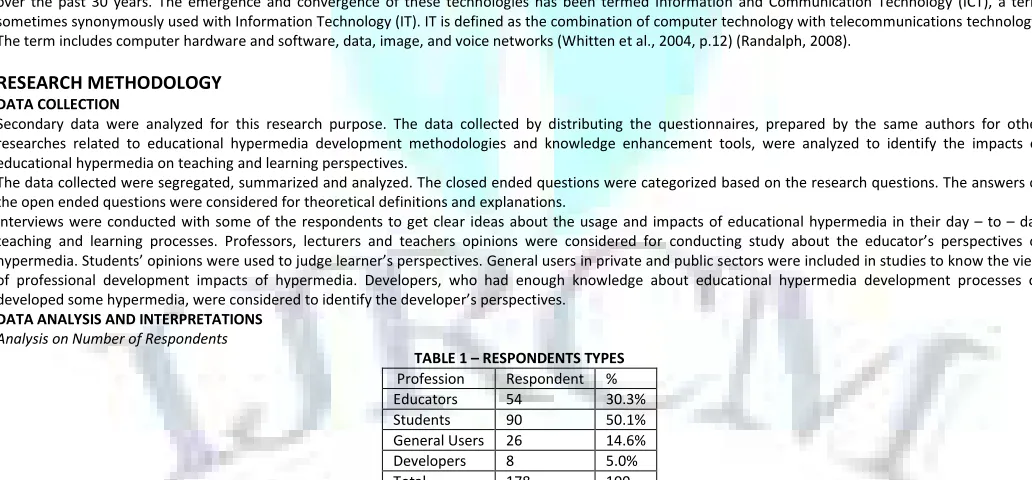
TABLE 1 – RESPONDENTS TYPES
Profession Respondent %
Educators 54 30.3%
Students 90 50.1%
General Users 26 14.6%
Developers 8 5.0%
Total 178 100
FIG. 1 RESPONDENTS PROFESSION ANALYSIS
Total Respondents
30%
51% 15%
4%
Educators Students General Users Developers
Knowledge about Hypermedia Analysis
The respondents were asked about their knowledge about hypermedia to know their background. Though the knowledge about hypermedia cannot be exactly measured and rated, the basic idea about these optional questions was to have an overall opinion about the knowledge of the respondents about the education hypermedia. This helped the researchers to relate their responses in close – end questions with their experience and knowledge. This has been shown in Table 2.
TABLE 2 – RESPONDENTS KNOWLEDGE ABOUT MULTIMEDIA
Response Educators Students General User Developers Total Total %
Excellent 49 39 4 5 97 54.5%
Very Good 5 34 8 2 49 27.5%
Good 0 15 13 1 29 16.3%
Average 0 2 1 0 3 1.7%
No Idea 0 0 0 0 0 0%
Total 54 90 26 8 178 100%
In the respondents, 90.7% of the educators had excellent knowledge about hypermedia usages in the classroom. 87% educators were using different hypermedia. 85.2% of the educators had excellent knowledge about up – to – date hypermedia tools. 74.1% of the educators said that they know the pros and cons of hypermedia in teaching and learning processes.
43.3% of the students had excellent knowledge about hypermedia usages in the classroom. 38.9% students said that they know about different hypermedia. 33.3% of the students had excellent knowledge about up – to – date hypermedia tools. 52.2% of the students said that they know the pros and cons of hypermedia in teaching and learning processes. The students studying foundation level said that their knowledge about hypermedia usages in teaching and learning processes is average and also they were not aware of pros and cons of the hypermedia technology in education.
15.4% of the general user had excellent knowledge about hypermedia usages in the classroom. 46.2% general users knew about using different hypermedia. 38.5% of the general had excellent knowledge about up – to – date hypermedia tools. 34.6% of the general users were aware of pros and cons of hypermedia in teaching and learning processes.
62.5% of the developers said that they have excellent knowledge about the hypermedia technology. 75% of the developers knew about the usage of different hypermedia. 87.5% of the developers said that they were aware of up – to – date hypermedia tools. 75% of the developers knew about the pros and cons of hypermedia in educational methodologies. These have been graphically represented in Fig 2.
FIG. 2: RESPONDENTS TYPES – KNOWLEDGE ABOUT MULTIMEDIA
Respondents Hypermedia Knowledge
49
39
4 5
5
34
8
2 0
15
13
1 0
2
1
0 0
0
0
0
0 10 20 30 40 50 60 70 80 90 100
Educators Students General User Developers
Respondents Types
N
o
o
f
R
e
s
p
o
n
d
e
n
ts
QUESTIONNAIRE ANALYSIS
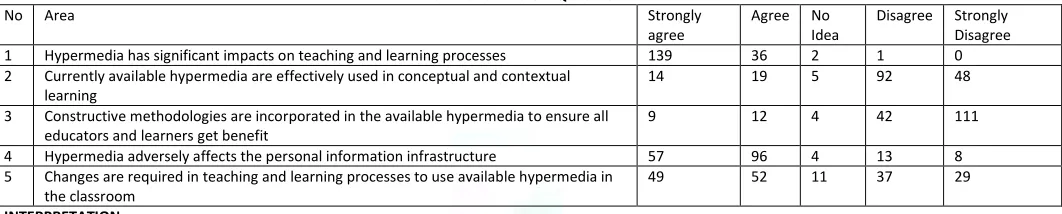
Table 3 shows the analyses on questionnaire.
TABLE 3: RESPONSES ON QUESTIONNAIRE
No Area Strongly
agree
Agree No Idea
Disagree Strongly Disagree
1 Hypermedia has significant impacts on teaching and learning processes 139 36 2 1 0
2 Currently available hypermedia are effectively used in conceptual and contextual learning
14 19 5 92 48
3 Constructive methodologies are incorporated in the available hypermedia to ensure all educators and learners get benefit
9 12 4 42 111
4 Hypermedia adversely affects the personal information infrastructure 57 96 4 13 8
5 Changes are required in teaching and learning processes to use available hypermedia in the classroom
49 52 11 37 29
INTERPRETATION
More than 98% of the respondents, either strongly agreed or agreed that hypermedia has significant impacts on teaching and learning processes. 78.7% of respondents, either strongly disagreed or disagreed that the currently available hypermedia is effectively used in conceptual and contextual learning. For this question, 32.7% of the educators either agreed or strongly agreed that the currently available hypermedia is used effectively. 80.4% of the respondents strongly disagreed or disagreed that constructive methodologies are incorporated in the available hypermedia to ensure all educators and learners get benefit. In this, 74.1% educators and 77.8% of the students either strongly disagreed or disagreed. 55.6% of the educators, 53.9% of the general users, 87.5% of the developers and 55.6% of the students suggested that changes are required in teaching and learning processes based on the available hypermedia to use available hypermedia potentially in the classroom.
HYPERMEDIA TECHNOLOGY AND DEVELOPMENT STRATEGIES
Now – a – day’s hypermedia system plays a vital role in educational systems. As the whole world is experiencing new technological developments, traditional ways of teaching will not be so effective and constructive. Hypermedia and hypertext should be used as effective tools for both teaching and learning. In hypermedia environment students need to participate actively. As the understanding capacity of student’s is divergent and the requirements of the courses vary, hypermedia should provide facilities by considering all these issues. Also, it should motivate the students towards learning. When hypermedia is designed, proper designing approach should be followed in order to satisfy all needs.
Hypertext and hypermedia usage in education needs an active participation of students (Pehl et al). Motivation towards learning is one of the most important issues in using hypermedia in education. Teaching and learning processes will be successful only if the students participate actively. The hypermedia system should have proper stimuli to make the students to participate actively. Apart from this, the student’s cognitive skills should not get affected (Marchionini, 2003). Also, the student’s various skills such as analytical and transferable skills should be optimized.
As we have different educational systems, the hypermedia should match to the corresponding environment. Another major consideration should be on student’s learning and understanding perspectives. As every student has different understanding capability, the hypermedia may provide additional tools to assist the students to understand the concepts easily. The educators should feel convenient to use hypermedia in their teaching processes. It should contain audio and video aids in order to be consistent in teaching. Required authoring tools should also be included in interactive modes.
Like any other software methodology, the life-cycle of an educational hypermedia application should not stop after the implementation and hand-over. It should be maintained and continually improved. As suggested by Thomas (1994), problems reported should be acted on at the earliest opportunity and feedback should be actively sought from learners and teachers.
The complex learning processes propose the needs for situated learning, social negotiation and multiple perspectives on the different aspects of the subject matter. Different learning strategies must be adopted to assist the learner in the construction of knowledge. Educational technology has grown enormously and the usage of hypertexts and hypermedia in education has become fundamental component of teaching and learning processes.
The developed counties receive the full potentials of that hypermedia and use the educational hypermedia in their daily activities. They develop hypermedia based on their requirements and benefit at the maximum. The developed countries use educational hypermedia in advanced contextual and conceptual ways. The students and educators utilize the potentials of hypermedia optimally and get benefit out of it. The teaching and learning processes have been simplified to match to the environmental needs. The latest hypermedia technologies and development strategies are used in all aspects. Hypermedia technology has become an essential in teaching and learning processes in developed countries.
The developing and underdeveloped countries try to extract some features of this educational hypermedia to go with their educational requirements and environments. Current development strategies could not match to their necessities in contextual meanings. The educational hypermedia have greater impacts on both teaching and learning processes of educational processes either in positive or in negative aspects. The potentials of the educational hypermedia utilizations perfectly depend on the systems that have been adapted.
As, most of the hypermedia technologies uses English language as development tool, the developing countries and underdeveloped countries with lack of necessary English language proficiency of the students hinder in using the full potentials of educational hypermedia in classroom environment. As English is the medium of instruction in most of the higher education providers, the students with average English background feel that the educational hypermedia do not match to their requirements. Understanding the subjects and course contents have become little difficult in these situations.
Proper development strategies have to be adopted in developing educational hypermedia to cohere with the local requirements and potentials of hypermedia. Clear methodologies should be realized in order to achieve the required outcomes in using hypermedia in classroom environment. The learner’s requirements should be addressed in these development strategies to minimize the negative impacts in learning processes. Also, the educator’s perceptions have to be considered as essential developmental strategies to maximize the teaching efficiency.
Thus educational hypermedia has major impacts on educational methodologies in various aspects. The impacts of educational hypermedia shall be differentiated in two ways: Positive Impacts and Negative Impacts. Also, they shall be distinguished separately for teaching processes and learning processes. But, in overall, the impacts have greater influences in cognitive psychology.
IMPACTS OF HYPERMEDIA ON EDUCATIONAL PROCESSES
IMPACTS ON TEACHING PROCESSESPositive Impacts on Teaching Processes
Negative Impacts on Teaching Processes
Though the educational hypermedia has positive impacts on teaching processes, still they have some negative impacts too. The educators need to prepare themselves to utilize hypermedia effectively in the classroom. They have made to spend considerable time for this preparation. Text book usage has become nearly zero in the classroom, which in turn, affects the cognitive skills of the educators. The traditional teaching methodologies have been totally eradicated. But, in heterogeneous educational environment, still in some places traditional teaching is more effective than the hypermedia. New teaching processes have been introduced irrespective of the educational atmosphere, in which, the educators may not have enough knowledge and training. The educators need to train themselves to know the usage of the technology.
As most of the educators are fully engaged with administrative works, it is difficult for them to make necessary changes, addition or deletion in the available hypermedia data. Apart from this, the data transferring has become a tedious job for the educators. Thus, the educators can not fully utilize the hypermedia in their teaching processes. The resources available in some hypermedia are not enough for the particular course. Thus the educators could not provide enough guidance for cross references and resources. Some hypermedia lacks in required links like links to learning outcomes, links to various format of the course materials and links to descriptive test manager. These make the educators to lack in proper classroom assessments, which are major part of teaching processes.
IMPACTS ON LEARNING PROCESSES
Positive Impacts on Learning Processes
Students could get good benefit out of the available hypermedia at any time. As hypermedia provides necessary information regarding any subject immediately, students shall learn the subject easily with the help of experts advises and methods. Virtual classrooms assist the learning processes in various ways. Students could contact any experts as and when they get the doubt. Educational advises are available freely at any time. Students could use the given references to learn in depth of the subject. Students could get full subject knowledge, if they could utilize the potentials of the hypermedia. Simultaneous preparation, relating the various courses and continuous learning are the some the important impacts on learning processes.
Negative Impacts on Learning Processes
The most important negative impact of hypermedia is using textbooks in the classrooms. Students lack in learning through reading books. As, hypermedia provides various assistances, students get cognitive laziness. In some cases, if the students have poor language knowledge, they get frustrated in learning and show very poor interest. The students with poor background of English language could not benefit fully out of hypermedia features. As, hypermedia affects the personal information infrastructure in all levels, students are deficient in reading, writing and logical thinking.
CONCLUSION & RECOMMENDATIONS
Hypermedia as a technology supports teaching and learning processes in many ways. But, the educational environment, socio – cultural heritages and ethical issues need to be considered while using hypermedia in the classroom. The technology should provide required resources and other related materials to support teaching and learning processes. They should be interactive. The language barriers should be removed by introducing translations to other languages. The educators must know to utilize the hypermedia in the classroom based on the student’s level. Educators should be well aware of various features of the available hypermedia, in order to get full benefit. More contextual and conceptual methodologies must be used while creating hypermedia. The developers should think in various directions to assist the learning processes in all stages.
Hypermedia should provide shared teaching and learning environment to help the educators and learners. Students should be self – motivated and their responsibilities should be increased. The required knowledge enhancement tools should be added to the currently available hypermedia. The educator’s responsibilities should be increased by developing new teaching processes. The educators should use various teaching processes to reduce the negative impacts on cognitive skills. Textbooks should be used in the classrooms to avoid cognitive laziness.
FURTHER SCOPES
As educational processes are changing rapidly, more constructive methods shall be used to develop the research in various aspects. We have identified some common impacts on teaching and learning processes based on the research methodologies used. The impacts may be further studied globally in various educational environments.
ACKNOWLEDGEMENT
We would like to thank the staff members, educators and students of Sur University College, Sur, Sultanate of Oman for their cooperation to conduct this research. Also, we would like to thank Sur University College for its financial, moral and ethical support for the research.
REFERENCES
Dix, Alan., Finlay, Janet., Abowd, J.D., Beale, Russell – “Human – Computer Interaction” – 3e – Pearson Education – (2008)
Alkhafaji, Salah., Sriram, B., – “Educational Hypermedia Development Methodologies” – Presented in First Joint Scientific Symposium Committee, CAS, Sultanate of Oman on 13th April 2010 in Sohar University, Sultanate of Oman – Conference Proceedings PP: 8 – 22
Alkhafaji, Salah., Sriram, B.,– “Information Seeking – A Knowledge Enhancement Tool” –International Journal of Information Science and Computer Mathematics
– Volume 2, Issue 1, Aug 2010 – ISSN: 1829 4969 – PP: 9 – 24. Visit: http://pphmj.com/abstract/5357.htm
Eben Afari-Kumah1, Hannah Ayaba Tanye – “Tertiary Students’ View on Information and Communications Technology Usage in Ghana” – Journal of Information Technology Impacts – Vol 9, No 2, PP: 81 – 90 – (2009)
Marchionini., Gary., – Information Seeking in Electronic Environments – 2003 – Cambridge University Press
Randalph, Justus J., – Multidisciplinary Methods in Educational Technology Research and Development – HAMK University of Applied Sciences – 2008 ISSN: 1795 424X
Pehl, Margit., Prenner, Peter., Purgothfer, Peter., – Hypermedia in education: Monitoring the development of Hypermedia Documents
Miller, Russell K – “The Impact of Educational Technology on Learner Interactions: A Multiple case Study of Elementary Classrooms” – Paper Submitted for Doctorate Completion to College of Education – Wichita State University – 2006
Gillard, Sharlett., Baile, Denice., Nolan, Ernest., – “Ten Reasons for IT Educators to be Early Adopters of IT Innovations” – Journal of Information Technology Education – Vol 7 (2008)
Russell, Stuart., Norvig, Peter., – Artificial Intelligence: A Modern Approach – 2e – (2009) – Prentice Hall Thomas, R. Durable, low-cost, educational software. Computers and Education, 22(1/2), 1994,P: 65-72.
Educational Technology Innovation and Impact/Why use Technology in Education/ Tactile-Kinesthetic Learners – Visited and Retrieved on 15.11.2010 from http://en.wikibooks.org/wiki/Educational_Technology_Innovation_and_Impact/Why_use_Technology_in_Education/Tactile-Kinesthetic_Learners
Technology impacts on education – BBC News – Visited and Retrieved on 15.11.2010 from www.news.bbc.uk/2/hi/technology/8508040.stm
Visited and retrieved on 16.11.2010 from http://en.wikibooks.org/wiki/Educational_Technology_Innovation_and_Impact/Why_use_ Technology_in_Education.htm
REQUEST FOR FEEDBACK
Dear Readers
At the very outset, International Journal of Research in Commerce, IT and Management (IJRCM)
acknowledges & appreciates your efforts in showing interest in our present issue under your kind perusal.
I would like to request you to supply your critical comments and suggestions about the material published
in this issue as well as on the journal as a whole, on our E-mails i.e.
or
for further improvements in the interest of research.
If you have any queries please feel free to contact us on our E-mail
.
I am sure that your feedback and deliberations would make future issues better – a result of our joint
effort.
Looking forward an appropriate consideration.
With sincere regards
Thanking you profoundly
Academically yours
Sd/-