A Monthly Double-Blind Peer Reviewed (Refereed/Juried) Open Access International e-Journal - Included in the International Serial Directories
Indexed & Listed at:
VOLUME NO.3(2013),ISSUE NO.09(SEPTEMBER) ISSN2231-5756
INTERNATIONAL JOURNAL OF RESEARCH IN COMMERCE, IT & MANAGEMENT
CONTENTS
CONTENTS
CONTENTS
CONTENTS
Sr.No.
TITLE & NAME OF THE AUTHOR (S)
Page No.
1. ADEQUACY OF KNOWLEDGE AND ATTITUDE TOWARDS INFORMATION TECHNOLOGY OF STUDENT LIBRARY USERS AT SELECTED COLLEGES AND UNIVERSITIES IN CALABARZON, PHILIPPINES
DR. MA. LINDIE D. MASALINTO, DR. MA. CONSUELO M. OBILLO, RUFO S CALIXTRO JR., JOSEFA G. CARRILLO & MA. XENIA Z. BITERA
1
2. MOBILITY IN HETEROGENEOUS WIRELESS NETWORK USING HMAC C. SUGANTHI & DR. C. MANOHARAN
4
3. A STUDY ON CONSUMERS PERCEPTION TOWARDS THE PURCHASE DECISION OF TWO WHEELER MOTORCYCLES IN NELLORE DISTRICT, ANDHRA PRADESH
D.V.RAMANA & DR. PARA SUBBAIAH
9
4. OPTIMIZING THE DE-DUPLICATION FOLIAGE IMAGE ACCESS IN STORAGE SYSTEMS CHITTALA RAMA SATYA & B.VIJAYA KUMAR
15
5. A STUDY ON THE IMPACT OF E TAILERS ON UNORGANISED AND ORGANISED RETAILERS WITH REFERENCE TO ELECTRONIC GOODS KALAVATHY K.S & DR. BINA PANDEY
18
6. A MODERN CLASSIFICATION OF PRICING STRATEGIES OF RETAILERS SREELATA, N. V. NARASIMHAM & DR. M. K. GUPTA
24
7. LEADERSHIP CONCEPT: AN OPINION SURVEY IN A PRIVATE SECTOR AND GOVERNMENT SECTOR DR. E. LOKANADHA REDDY & DR. G HARANATH
30
8. MARKETING MIX: A REVIEW ON THE ‘P’S OF MARKETING M.VASUDEVAN, DR. V. M. SENTHILKUMAR & K.SASIKUMAR
37
9. SECURING A BIOMETRIC TRAIT: A CASE STUDY ON FINGER PRINTS MADHU CHAUHAN & DR. R. P. SAXENA
40
10. INFORMATION AND COMMUNICATION TECHNOLOGY AND THE PERFORMANCE OF SMALL AND MEDIUM ENTERPRISES IN NASARAWA STATE, NIGERIA
UMARU DANLADI MOHAMMED & CHINELO GRACE OBELEAGU-NZELIBE
43
11. RELIABILITY TEST PLANS BASED ON LOG-LOGISTIC DISTRIBUTION R.R.L.KANTAM, B.SRIRAM & A. SUHASINI
49
12. MIGRATION AND SUSTAINABLE DEVELOPMENT DR. H.R.UMA, MADHU G.R. & MAHAMMAD HABEEB
58
13. THE ANTECEDENTS OF BRAND LOYALTY: AN EMPIRICAL STUDY ON AIRTEL CELLULAR SERVICES DR. P. SUJATHA
61
14. STATUS OF BI SOLUTIONS AT SELECTED BRANCHES OF BANKS IN RAJASTHAN DR. AZIMUDDIN KHAN
66
15. A STUDY ON USAGE OF GEOSPATIAL TECHNOLOGIES IN POWER UTILITY VARUN PRAKASH
71
16. AN IMPROVED INVISIBLE WATERMARKING TECHNIQUE FOR IMAGE AUTHENTICATION DASU VAMAN RAVI PRASAD
76
17. ORGANIZATIONAL STRUCTURE, RESPONSIBILITY, MOTIVATION LEVEL AND JOB SATISFACTION OF SELF-FINANCING ENGINEERING COLLEGES BY USING MATHEMATICAL MODELING
RAVI DATT, DR. SUNIL DUTT, DR. SITA RAM & SANTOSH KUMARI
82
18. DESIGN AND IMPLEMENTATION OF A REAL-TIME VEHICLE TRACKING SYSTEM
MAITANMI OLUSOLA STEPHEN, OGUNLERE SAMSON OJO, DR. ADEKUNLE YINKA, GREGORY ONWODI & MALASOWE BRIDGET
86
19. PERFORMANCE EVALUATION OF MANET ROUTING PROTOCOLS WITH SCALABILITY FOR E-MAIL THROUGHPUT TRAFFIC USING OPNET MODELER MANDEEP SINGH & BALWINDER SINGH
93
20. DETAILED INVESTIGATION OF RESIDENTIAL SATISFACTION IN APARTMENT’S MANAGEMENT SERVICE P. BALATHANDAYUTHAM & DR. R. SRITHARAN
98
21. A STUDY ON THE PSYCHOLOGICAL IMPACT OF REDUNDANCY ON SURVIVORS S.SOWJANYA
100
22. A STUDY ON SECURITY THREAT AWARENESS AMONG STUDENTS USING SOCIAL NETWORKING SITES, BY APPLYING DATA MINING TECHNIQUES A.PAPPU RAJAN
103
23. ELECTRONIC REMITTANCE SYSTEM IN INDIA: CHANGING PARADIGMS OF PAYMENT MECHANISMS IN INDIA SAMIR
107
24. E-SATISFACTION AND E-LOYALTY OF CONSUMERS SHOPPING ONLINE R. SATHISH KUMAR
111
25. STUDENTS PERCEPTION TOWARDS e-BANKING: SPECIAL REFERENCE TO KOLLAM DISTRICT IN KERALA NIJAZ NIZAR
114
26. TECHNOLOGICAL DRIFT TOWARDS SMART DEVICES: AN OVERVIEW MUKESH H.V & HALASWAMY D. NAIK
118
27. MOTIVATION AS AN EFFECTIVE TOOL FOR ORGANIZATIONAL DEVELOPMENT IN NIGERIA DR. ABDULSALAM JIBRIL & YUSUF SAJO
121
28. AN UNDERSTANDING OF DUNNING’S OWNERSHIP-LOCATION-INTERNALISATION (OLI) ECLECTIC THEORY OF MULTINATIONAL COMPANIES JABES GABBIS ODHIAMBO KOTIENO
124
29. AUTHORING TOOL: KEY FOR E-LEARNING SYSTEM DEVELOPMENT JAVED WASIM
128
30. ANTECEDENTS AND CONSEQUENCES OF WORK-EXHAUSTION (IT SECTOR) UMAIR NAJAM & FAISAL ABBAS
131
CHIEF PATRON
CHIEF PATRON
CHIEF PATRON
CHIEF PATRON
PROF. K. K. AGGARWAL
Chairman, Malaviya National Institute of Technology, Jaipur
(An institute of National Importance & fully funded by Ministry of Human Resource Development, Government of India)
Chancellor, K. R. Mangalam University, Gurgaon
Chancellor, Lingaya’s University, Faridabad
Founder Vice-Chancellor (1998-2008), Guru Gobind Singh Indraprastha University, Delhi
Ex. Pro Vice-Chancellor, Guru Jambheshwar University, Hisar
FOUNDER
FOUNDER
FOUNDER
FOUNDER PATRON
PATRON
PATRON
PATRON
LATE SH. RAM BHAJAN AGGARWAL
Former State Minister for Home & Tourism, Government of Haryana
Former Vice-President, Dadri Education Society, Charkhi Dadri
Former President, Chinar Syntex Ltd. (Textile Mills), Bhiwani
CO
CO
CO
CO----ORDINATOR
ORDINATOR
ORDINATOR
ORDINATOR
AMITA
Faculty, Government M. S., Mohali
ADVISORS
ADVISORS
ADVISORS
ADVISORS
DR. PRIYA RANJAN TRIVEDI
Chancellor, The Global Open University, Nagaland
PROF. M. S. SENAM RAJU
Director A. C. D., School of Management Studies, I.G.N.O.U., New Delhi
PROF. M. N. SHARMA
Chairman, M.B.A., Haryana College of Technology & Management, Kaithal
PROF. S. L. MAHANDRU
Principal (Retd.), Maharaja Agrasen College, Jagadhri
EDITOR
EDITOR
EDITOR
EDITOR
PROF. R. K. SHARMA
Professor, Bharti Vidyapeeth University Institute of Management & Research, New Delhi
CO
CO
CO
CO----EDITOR
EDITOR
EDITOR
EDITOR
DR. BHAVET
Faculty, Shree Ram Institute of Business & Management, Urjani
EDITORIAL ADVISORY BOARD
EDITORIAL ADVISORY BOARD
EDITORIAL ADVISORY BOARD
EDITORIAL ADVISORY BOARD
DR. RAJESH MODI
Faculty, Yanbu Industrial College, Kingdom of Saudi Arabia
PROF. SANJIV MITTAL
University School of Management Studies, Guru Gobind Singh I. P. University, Delhi
PROF. ANIL K. SAINI
VOLUME NO.3(2013),ISSUE NO.09(SEPTEMBER) ISSN2231-5756
INTERNATIONAL JOURNAL OF RESEARCH IN COMMERCE, IT & MANAGEMENT
DR. SAMBHAVNA
Faculty, I.I.T.M., Delhi
DR. MOHENDER KUMAR GUPTA
Associate Professor, P. J. L. N. Government College, Faridabad
DR. SHIVAKUMAR DEENE
Asst. Professor, Dept. of Commerce, School of Business Studies, Central University of Karnataka, Gulbarga
ASSOCIATE EDITORS
ASSOCIATE EDITORS
ASSOCIATE EDITORS
ASSOCIATE EDITORS
PROF. NAWAB ALI KHAN
Department of Commerce, Aligarh Muslim University, Aligarh, U.P.
PROF. ABHAY BANSAL
Head, Department of Information Technology, Amity School of Engineering & Technology, Amity
University, Noida
PROF. A. SURYANARAYANA
Department of Business Management, Osmania University, Hyderabad
DR. SAMBHAV GARG
Faculty, Shree Ram Institute of Business & Management, Urjani
PROF. V. SELVAM
SSL, VIT University, Vellore
DR. PARDEEP AHLAWAT
Associate Professor, Institute of Management Studies & Research, Maharshi Dayanand University, Rohtak
DR. S. TABASSUM SULTANA
Associate Professor, Department of Business Management, Matrusri Institute of P.G. Studies, Hyderabad
SURJEET SINGH
Asst. Professor, Department of Computer Science, G. M. N. (P.G.) College, Ambala Cantt.
TECHNICAL ADVISOR
TECHNICAL ADVISOR
TECHNICAL ADVISOR
TECHNICAL ADVISOR
AMITA
Faculty, Government M. S., Mohali
FINANCIAL ADVISORS
FINANCIAL ADVISORS
FINANCIAL ADVISORS
FINANCIAL ADVISORS
DICKIN GOYAL
Advocate & Tax Adviser, Panchkula
NEENA
Investment Consultant, Chambaghat, Solan, Himachal Pradesh
LEGAL ADVISORS
LEGAL ADVISORS
LEGAL ADVISORS
LEGAL ADVISORS
JITENDER S. CHAHAL
Advocate, Punjab & Haryana High Court, Chandigarh U.T.
CHANDER BHUSHAN SHARMA
Advocate & Consultant, District Courts, Yamunanagar at Jagadhri
SUPERINTENDENT
SUPERINTENDENT
SUPERINTENDENT
SUPERINTENDENT
CALL FOR
CALL FOR
CALL FOR
CALL FOR MANUSCRIPTS
MANUSCRIPTS
MANUSCRIPTS
MANUSCRIPTS
We invite unpublished novel, original, empirical and high quality research work pertaining to recent developments & practices in the areas of Computer Science & Applications; Commerce; Business; Finance; Marketing; Human Resource Management; General Management; Banking; Economics; Tourism Administration & Management; Education; Law; Library & Information Science; Defence & Strategic Studies; Electronic Science; Corporate Governance; Industrial Relations; and emerging paradigms in allied subjects like Accounting; Accounting Information Systems; Accounting Theory & Practice; Auditing; Behavioral Accounting; Behavioral Economics; Corporate Finance; Cost Accounting; Econometrics; Economic Development; Economic History; Financial Institutions & Markets; Financial Services; Fiscal Policy; Government & Non Profit Accounting; Industrial Organization; International Economics & Trade; International Finance; Macro Economics; Micro Economics; Rural Economics; Co-operation; Demography: Development Planning; Development Studies; Applied Economics; Development Economics; Business Economics; Monetary Policy; Public Policy Economics; Real Estate; Regional Economics; Political Science; Continuing Education; Labour Welfare; Philosophy; Psychology; Sociology; Tax Accounting; Advertising & Promotion Management; Management Information Systems (MIS); Business Law; Public Responsibility & Ethics; Communication; Direct Marketing; E-Commerce; Global Business; Health Care Administration; Labour Relations & Human Resource Management; Marketing Research; Marketing Theory & Applications; Non-Profit Organizations; Office Administration/Management; Operations Research/Statistics; Organizational Behavior & Theory; Organizational Development; Production/Operations; International Relations; Human Rights & Duties; Public Administration; Population Studies; Purchasing/Materials Management; Retailing; Sales/Selling; Services; Small Business Entrepreneurship; Strategic Management Policy; Technology/Innovation; Tourism & Hospitality; Transportation Distribution; Algorithms; Artificial Intelligence; Compilers & Translation; Computer Aided Design (CAD); Computer Aided Manufacturing; Computer Graphics; Computer Organization & Architecture; Database Structures & Systems; Discrete Structures; Internet; Management Information Systems; Modeling & Simulation; Neural Systems/Neural Networks; Numerical Analysis/Scientific Computing; Object Oriented Programming; Operating Systems; Programming Languages; Robotics; Symbolic & Formal Logic; Web Design and emerging paradigms in allied subjects.
Anybody can submit the soft copy of unpublished novel; original; empirical and high quality research work/manuscriptanytime in M.S. Word format
after preparing the same as per our GUIDELINES FOR SUBMISSION; at our email address i.e. [email protected] or online by clicking the link online submission as given on our website (FOR ONLINE SUBMISSION, CLICK HERE).
GUIDELINES FOR SUBMISSION OF MANUSCRIPT
GUIDELINES FOR SUBMISSION OF MANUSCRIPT
GUIDELINES FOR SUBMISSION OF MANUSCRIPT
GUIDELINES FOR SUBMISSION OF MANUSCRIPT
1. COVERING LETTER FOR SUBMISSION:
DATED: _____________
THE EDITOR
IJRCM
Subject: SUBMISSION OF MANUSCRIPT IN THE AREA OF.
(e.g. Finance/Marketing/HRM/General Management/Economics/Psychology/Law/Computer/IT/Engineering/Mathematics/other, please specify)
DEAR SIR/MADAM
Please find my submission of manuscript entitled ‘___________________________________________’ for possible publication in your journals.
I hereby affirm that the contents of this manuscript are original. Furthermore, it has neither been published elsewhere in any language fully or partly, nor is it under review for publication elsewhere.
I affirm that all the author (s) have seen and agreed to the submitted version of the manuscript and their inclusion of name (s) as co-author (s).
Also, if my/our manuscript is accepted, I/We agree to comply with the formalities as given on the website of the journal & you are free to publish our contribution in any of your journals.
NAME OF CORRESPONDING AUTHOR: Designation:
Affiliation with full address, contact numbers & Pin Code: Residential address with Pin Code:
Mobile Number (s): Landline Number (s): E-mail Address: Alternate E-mail Address:
NOTES:
a) The whole manuscript is required to be in ONE MS WORD FILE only (pdf. version is liable to be rejected without any consideration), which will start from the covering letter, inside the manuscript.
b) The sender is required to mentionthe following in the SUBJECT COLUMN of the mail:
New Manuscript for Review in the area of (Finance/Marketing/HRM/General Management/Economics/Psychology/Law/Computer/IT/ Engineering/Mathematics/other, please specify)
c) There is no need to give any text in the body of mail, except the cases where the author wishes to give any specific message w.r.t. to the manuscript. d) The total size of the file containing the manuscript is required to be below 500 KB.
e) Abstract alone will not be considered for review, and the author is required to submit the complete manuscript in the first instance.
f) The journal gives acknowledgement w.r.t. the receipt of every email and in case of non-receipt of acknowledgment from the journal, w.r.t. the submission of manuscript, within two days of submission, the corresponding author is required to demand for the same by sending separate mail to the journal.
2. MANUSCRIPT TITLE: The title of the paper should be in a 12 point Calibri Font. It should be bold typed, centered and fully capitalised.
3. AUTHOR NAME (S) & AFFILIATIONS: The author (s) full name, designation, affiliation (s), address, mobile/landline numbers, and email/alternate email address should be in italic & 11-point Calibri Font. It must be centered underneath the title.
VOLUME NO.3(2013),ISSUE NO.09(SEPTEMBER) ISSN2231-5756
INTERNATIONAL JOURNAL OF RESEARCH IN COMMERCE, IT & MANAGEMENT
5. KEYWORDS: Abstract must be followed by a list of keywords, subject to the maximum of five. These should be arranged in alphabetic order separated bycommas and full stops at the end.
6. MANUSCRIPT: Manuscript must be in BRITISH ENGLISH prepared on a standard A4 size PORTRAIT SETTING PAPER. It must be prepared on a single space and single column with 1” margin set for top, bottom, left and right. It should be typed in 8 point Calibri Font with page numbers at the bottom and centre of every page. It should be free from grammatical, spelling and punctuation errors and must be thoroughly edited.
7. HEADINGS: All the headings should be in a 10 point Calibri Font. These must be bold-faced, aligned left and fully capitalised. Leave a blank line before each heading.
8. SUB-HEADINGS: All the sub-headings should be in a 8 point Calibri Font. These must be bold-faced, aligned left and fully capitalised.
9. MAIN TEXT: The main text should follow the following sequence:
INTRODUCTION
REVIEW OF LITERATURE
NEED/IMPORTANCE OF THE STUDY
STATEMENT OF THE PROBLEM
OBJECTIVES
HYPOTHESES
RESEARCH METHODOLOGY
RESULTS & DISCUSSION
FINDINGS
RECOMMENDATIONS/SUGGESTIONS
CONCLUSIONS
SCOPE FOR FURTHER RESEARCH
ACKNOWLEDGMENTS
REFERENCES
APPENDIX/ANNEXURE
It should be in a 8 point Calibri Font, single spaced and justified. The manuscript should preferably not exceed 5000 WORDS.
10. FIGURES &TABLES: These should be simple, crystal clear, centered, separately numbered & self explained, and titles must be above the table/figure. Sources of data should be mentioned below the table/figure. It should be ensured that the tables/figures are referred to from the main text.
11. EQUATIONS:These should be consecutively numbered in parentheses, horizontally centered with equation number placed at the right.
12. REFERENCES: The list of all references should be alphabetically arranged. The author (s) should mention only the actually utilised references in the preparation of manuscript and they are supposed to follow Harvard Style of Referencing. The author (s) are supposed to follow the references as per the following:
•
All works cited in the text (including sources for tables and figures) should be listed alphabetically.•
Use (ed.) for one editor, and (ed.s) for multiple editors.•
When listing two or more works by one author, use --- (20xx), such as after Kohl (1997), use --- (2001), etc, in chronologically ascending order.•
Indicate (opening and closing) page numbers for articles in journals and for chapters in books.•
The title of books and journals should be in italics. Double quotation marks are used for titles of journal articles, book chapters, dissertations, reports, working papers, unpublished material, etc.•
For titles in a language other than English, provide an English translation in parentheses.•
The location of endnotes within the text should be indicated by superscript numbers.PLEASE USE THE FOLLOWING FOR STYLE AND PUNCTUATION IN REFERENCES: BOOKS
•
Bowersox, Donald J., Closs, David J., (1996), "Logistical Management." Tata McGraw, Hill, New Delhi.•
Hunker, H.L. and A.J. Wright (1963), "Factors of Industrial Location in Ohio" Ohio State University, Nigeria.CONTRIBUTIONS TO BOOKS
•
Sharma T., Kwatra, G. (2008) Effectiveness of Social Advertising: A Study of Selected Campaigns, Corporate Social Responsibility, Edited by David Crowther & Nicholas Capaldi, Ashgate Research Companion to Corporate Social Responsibility, Chapter 15, pp 287-303.JOURNAL AND OTHER ARTICLES
•
Schemenner, R.W., Huber, J.C. and Cook, R.L. (1987), "Geographic Differences and the Location of New Manufacturing Facilities," Journal of Urban Economics, Vol. 21, No. 1, pp. 83-104.CONFERENCE PAPERS
•
Garg, Sambhav (2011): "Business Ethics" Paper presented at the Annual International Conference for the All India Management Association, New Delhi, India, 19–22 June.UNPUBLISHED DISSERTATIONS AND THESES
•
Kumar S. (2011): "Customer Value: A Comparative Study of Rural and Urban Customers," Thesis, Kurukshetra University, Kurukshetra.ONLINE RESOURCES
•
Always indicate the date that the source was accessed, as online resources are frequently updated or removed.WEBSITES
DESIGN AND IMPLEMENTATION OF A REAL-TIME VEHICLE TRACKING SYSTEM
MAITANMI OLUSOLA STEPHEN
ASST. LECTURER
DEPARTMENT OF COMPUTER SCIENCE
BABCOCK UNIVERSITY
OGUN STATE
OGUNLERE SAMSON OJO
LECTURER
DEPARTMENT OF COMPUTER SCIENCE
BABCOCK UNIVERSITY
OGUN STATE
DR. ADEKUNLE YINKA
ASSOCIATE PROFESSOR
DEPARTMENT OF COMPUTER SCIENCE
BABCOCK UNIVERSITY
OGUN STATE
GREGORY ONWODI
LECTURER
SCHOOL OF SCIENCE & TECHNOLOGY
NATIONAL OPEN UNIVERSITY OF NIGERIA
NIGERIA
MALASOWE BRIDGET
SR. LECTURER
DEPARTMENT OF COMPUTER SCIENCE
COLLEGE OF EDUCATION
NIGERIA
ABSTRACT
Security in general is a major concern in our society today and over time, the security of vehicles has become a priority. Various inventions and technologies have been brought about to put minds at rest, but the complete eradication of theft of cars is much of a tedious task. A solution to knowing the location of vehicles either when they are stolen or for any other reasons. To know this location, it involves the installation of a vehicle tracker in a hidden position in the vehicle so that it is not easily seen while providing essential clues as to the location of the vehicle and also a remote tracking server that receives the location information of the car in longitude and latitude and converts it to a physical address and sends it to the authorized user.
KEYWORDS
Tracker, vehicle, longitude, latitude.
INTRODUCTION
ecurity in general is a major concern in our society today. Every day, people purchase vehicles for different purposes, but for which ever reason, a lot of money is spent in the transaction which demands that adequate provision should be provided for its security and safety (Bajaja et al. 2012). Auto theft is a serious crime which is getting rampant day after day. It is then necessary for car users everywhere to have a way to track down their cars in case it is ever stolen. Real Time Vehicle Tracking System is one of the measures of securing vehicles. The word tracking means to find or follow something, therefore, Real time vehicle tracking is a method used to track and monitor any remote vehicle equipped with a hardware unit that receives and transfers signals through global positioning system (GPS) satellite. It makes use of GPS to provide actual geographic real time position of each vehicle.
A vehicle tracker is therefore a major and essential device that should be in every vehicle because it gives the owner the ability to know the exact location of such cars at any point in time anywhere in the world with geography information systems (GIS) (Ambade et al. 2011).
It is very useful for both individuals and companies. It can help a company in the sense that the company workers cannot take the company car(s) to unassigned locations. It can also help an individual who is probably on a business trip to know whether his car is still where he left it or not.
Today, the vehicle tracking system is playing a major role in most sectors as vehicles have become a major means of transportation.
PROBLEM STATEMENT
An increase in car theft in the society which in most cases searching for such cars may not have positive effect is becoming a major concern. Systems like the security lock and alarm system has been implemented in cars to prevent theft, but if a burglar can break open the lock, it therefore becomes easy for the burglar to steal the car. This brought the need for the introduction of this real time tracking system.
VOLUME NO.3(2013),ISSUE NO.09(SEPTEMBER) ISSN2231-5756
INTERNATIONAL JOURNAL OF RESEARCH IN COMMERCE, IT & MANAGEMENT
OBJECTIVES OF THE STUDY
The main objectives of this system are:
Developing Automatic Vehicle Location system using GPS for positioning information and global systems of telecommunication (GSM) for information transmission.
LITERATURE REVIEW
Over time, the security of vehicles has become a priority. Various inventions and technologies have been brought about to put minds at rest, but the complete eradication of theft of cars is much of a tedious task. Technologies like the car alarm system have been put in place but it is limited to an audible distance and it doesn’t give the location of the car if it is successfully stolen. A solution to knowing the location of vehicles when they are stolen is the Real Time Vehicle Tracking System that involves the installation of a vehicle tracker in a hidden position in the vehicle so that it is not easily located while providing essential clues as to the location of the vehicle.
GPS
The Global Positioning System (GPS) is the only fully-functional satellite navigation system. More than two dozen GPS satellites orbit the Earth, transmitting radio signals which allow GPS receivers to determine their location, speed and direction. GPS has become indispensable for navigation around the world and an important tool for map-making and synchronization of telecommunications networks. (Khindker, 2009)
It provides location and time information in all weather conditions, anywhere on or near the Earth where there is an unobstructed line of sight to four or more GPS satellites.
Global Positioning System satellites transmit signals to equipment on the ground. GPS receivers passively receive satellite signals; they do not transmit. GPS receivers require an unobstructed view of the sky, so they are used only in outdoors and they often do not perform well within forested areas or near tall buildings. GPS operations depend on a very accurate time reference, which is provided by atomic clocks at the U.S. Naval Observatory. Each GPS satellite has atomic clocks on board (Introduction to GSM, 2013).
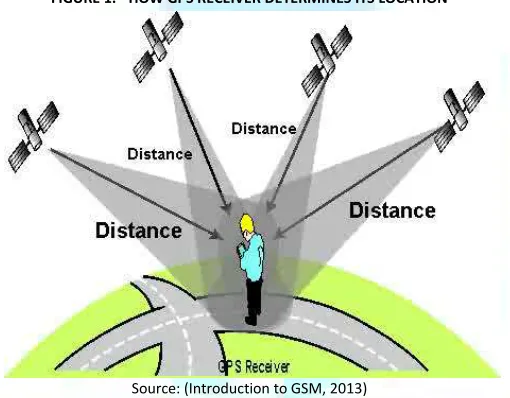
Each GPS satellite transmits data that indicates its location and the current time. All GPS satellites synchronize operations so that these repeating signals are transmitted at the same instant. The signals, moving at the speed of light arrive at a GPS receiver at slightly different times because some satellites are farther away than others. The distance to the GPS satellites can be determined by estimating the amount of time it takes for their signals to reach the receiver.
HOW GPS DETERMINES POSITION
A GPS receiver knows the location of the satellites because that information is included in satellite transmissions. By estimating how far away a satellite is, the receiver also knows that it is located somewhere on the surface of an imaginary sphere centred at the satellite. It then determines the sizes of several spheres, one for each satellite. The receiver is located where these spheres intersect; this can be seen as depicted in fig. 1.
FIGURE 1. - HOW GPS RECEIVER DETERMINES ITS LOCATION
Source: (Introduction to GSM, 2013)
HOW ACCURATE IS THE GPS?
The accuracy of a position determined with GPS depends on the type of receiver. Most hand-held GPS units have about 10-20 meter accuracy. Other types of receivers use a method called Differential GPS (DGPS) to obtain much higher accuracy. DGPS requires an additional receiver fixed at a known location nearby. Observations made by the stationary receiver are used to correct positions recorded by the roaming units, producing an accuracy greater than 1 meter (Khondker, 2009).
TYPES OF VEHICLE TRACKING SYSTEM
Research according to Parade et al. (2011) indicates that Vehicle tracking system can be typically classified into passive tracking and active systems. Each of these utilizes the GPS technology and the satellite to get the vehicle’s location but the mode by which the user gets the location information is what differs. For the purpose of this article, the active system will be used.
PASSIVE SYSTEMS
Passive tracking systems store information such as GPS location, vehicle speed, and can trigger events such as start/stop or ignition on/off. It is usually used by people who need to track mileage or monitor location stops. When a vehicle returns to a predetermined location, the tracking device’s information is wirelessly sent to a host computer or it is removed from its location and plugged into a computer to view the information.
ACTIVE SYSTEMS
Active tracking systems generally collect the same information, but are more sophisticated than passive systems because they are enabled to work with cellular or satellite networks. Using these wireless networks, they are able to transmit data to a computer or data centre for further evaluation. They can also allow you to locate a vehicle live on a map and to do this you might be required to install a software onto your computer or create an account with a tracking company, when this is done you will be able to monitor a vehicle’s direction and speed in real time.
The advantage of using this type of system is that it allows you to redirect vehicles and warn drivers about their speed as they progress along their journey. Additionally, these systems are commonly web-based so tracking data can be accessed from any capable device with an internet connection.
GSM/GPRS MODEM
A GSM modem is a wireless modem that works with a GSM wireless network. A wireless modem behaves like a dial-up modem. The main difference between them is that a dial-up modem sends and receives data through a fixed telephone line while a wireless modem sends and receives data through radio waves (How passive and active works, 2013).
FIGURE 2: A GSM/GPRS MODEM
Source: (How active and passive works, 2013)
DESIGN AND IMPLEMENTATION OF VEHICLE TRACKING SYSTEM
This article was aimed at developing an Automatic Vehicle Location system using GPS for positioning information and GSM/GPRS for information transmission with the following features:
• Acquisition of vehicle’s location information (latitude longitude) after specified time interval.
• Transmission of vehicle’s location and other information (including ignition status, door open/close status) to the monitoring station/Tracking server after specified interval of time.
• A Web based software to display all transmitted information to end user along with displaying location of vehicle on a map.
The objective of the paper was to build an additional feature to the present security system that will warn the owner of the vehicle by sending SMS when there has been an intrusion into the vehicle.
The system was designed to have two major units
• In-Vehicle unit
• Tracking Server/Monitoring Station.
The In-Vehicle unit is the major part of the system and it is installed into the vehicle. It is responsible for capturing the current location of vehicle, proximity sensors for parking assistance, vibration Sensors and ultrasonic Sensors for measuring the distance. It is also responsible for transmitting this information to the Tracking Server located anywhere in the world.
COST EFFECTIVE GPS – GPRS BASED OBJECT TRACKING SYSTEM
This article proposes and implements a low cost object tracking system using GPS and GPRS. The objective of this research is to reduce the cost of the tracking system using the latest technologies and also making it available to the common people.
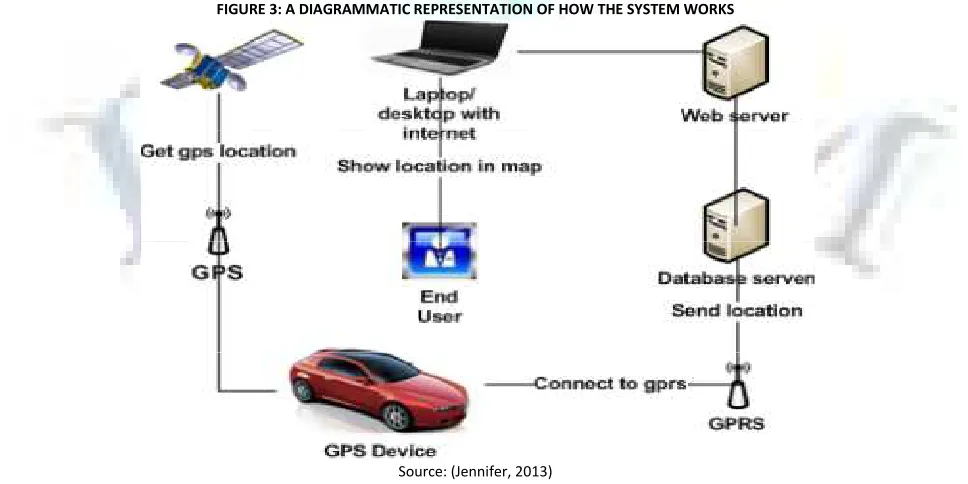
The system allows a user to view the present and the past positions recorded of a target object on Google Map through the internet. The system reads the current position of the object using GPS, the data is sent via GPRS service from the GSM network towards a web server using the POST method of the HTTP protocol. The object’s position data is then stored in the database for live and past tracking (Ambade et al. 2011).
The system has two parts:
• The tracking device and
• The database server.
The device is attached with the moving object and it gets the position from GPS satellite in real-time.
DATA TRANSMISSION METHOD
The tracking device communicates with the server and the data is sent via GPRS service from the GSM network. The reason for this choice is because using GPRS is cheaper than using SMS.
It then sends the position information with the International Mobile Equipment Identity (IMEI) number as its own identity to the server. The data is checked for validity and the valid data is saved into the database. When a user wants to track the device, he logs into the service provider’s website and gets the live position of the device on Google Map. A custom report is also generated which includes a detailed description of the vehicles status. Users can also see the previous positions of the device as seen in the fig. 3.
FIGURE 3: A DIAGRAMMATIC REPRESENTATION OF HOW THE SYSTEM WORKS
VOLUME NO.3(2013),ISSUE NO.09(SEPTEMBER) ISSN2231-5756
INTERNATIONAL JOURNAL OF RESEARCH IN COMMERCE, IT & MANAGEMENT
REAL TIME VEHICLE LOCKING AND TRACKING SYSTEM USING GSM AND GPS TECHNOLOGY-AN ANTI-THEFT SYSTEMThis project deals with the design & development of a theft control system for an automobile, which is being used to prevent/control the theft of a vehicle. The developed system makes use of an embedded system based on Global System for Mobile communication (GSM) technology. The designed & developed system is installed in the vehicle. An interfacing mobile is also connected to the microcontroller, which is in turn, connected to the brain box of the vehicle (Parade et al. 2011).
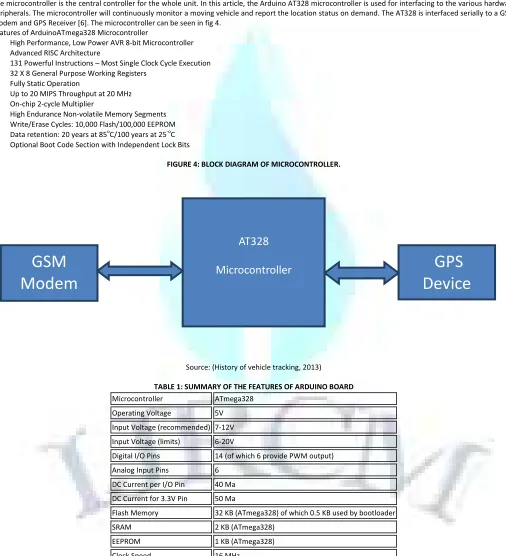
An AVR Microcontroller is interfaced to a GSM module, GPS Receiver and also to the vehicle locking system. The Microcontroller will keep listening for new SMS arrival. If a SMS arrives, it will check for authentication and after authentication is verified, it will read the GPS location and will send it to the user’s cell phone in the form of SMS, also same information will be sent to a host pc. The PC will have a Visual Basic (VB) based application running on it. This will extract the SMS information from GSM modem or cell phone, and it will plot the latitudes and longitudes on the Google maps. For plotting on the Google maps pc must have an Internet connection. The vehicle can also be locked/ unlocked by sending a message to the system.
MICROCONTROLLER
The microcontroller is the central controller for the whole unit. In this article, the Arduino AT328 microcontroller is used for interfacing to the various hardware peripherals. The microcontroller will continuously monitor a moving vehicle and report the location status on demand. The AT328 is interfaced serially to a GSM Modem and GPS Receiver [6]. The microcontroller can be seen in fig 4.
Features of ArduinoATmega328 Microcontroller
• High Performance, Low Power AVR 8-bit Microcontroller
• Advanced RISC Architecture
• 131 Powerful Instructions – Most Single Clock Cycle Execution
• 32 X 8 General Purpose Working Registers
• Fully Static Operation
• Up to 20 MIPS Throughput at 20 MHz
• On-chip 2-cycle Multiplier
• High Endurance Non-volatile Memory Segments
• Write/Erase Cycles: 10,000 Flash/100,000 EEPROM
• Data retention: 20 years at 85oC/100 years at 25-oC
• Optional Boot Code Section with Independent Lock Bits
FIGURE 4: BLOCK DIAGRAM OF MICROCONTROLLER.
Source: (History of vehicle tracking, 2013)
TABLE 1: SUMMARY OF THE FEATURES OF ARDUINO BOARD
Microcontroller ATmega328
Operating Voltage 5V
Input Voltage (recommended) 7-12V
Input Voltage (limits) 6-20V
Digital I/O Pins 14 (of which 6 provide PWM output)
Analog Input Pins 6
DC Current per I/O Pin 40 Ma
DC Current for 3.3V Pin 50 Ma
Flash Memory 32 KB (ATmega328) of which 0.5 KB used by bootloader
SRAM 2 KB (ATmega328)
EEPROM 1 KB (ATmega328)
Clock Speed 16 MHz
OPERATIONAL PROCEDURES
The Arduino Uno has a number of facilities for communicating with a computer, another Arduino, or other microcontrollers. The ATmega328 provides UART TTL (5V) serial communication, which is available on digital pins 0 (RX) and 1 (TX). An ATmega16U2 on the board channels this serial communication over universal serial bus (USB) and appears as a virtual com port to software on the computer. The '16U2 firmware uses the standard USB COM drivers, and no external driver is needed. However, on Windows, an inf file is required. The Arduino software includes a serial monitor which allows simple textual data to be sent to and from
GSM
Modem
AT328
Microcontroller
GPS
the Arduino board. The RX and TX LEDs on the board will flash when data is being transmitted via the USB-to-serial chip and USB connection to the computer (but not for serial communication on pins 0 and 1).
The Software Serial library allows for serial communication on any of the Uno's digital pins.
The ATmega328 also supports I2C (TWI) and SPI communication. The Arduino software includes a Wire library to simplify use of the I2C bus.
16MHZ CRYSTAL RESONATOR
The crystal resonator is connected to Pins 9 and 10 of the Microcontroller. It is responsible for clocking the microcontroller at 16Mhz. The resonator is seen in fig. 5.
FIG 5– 16MHZ CRYSTAL RESONATOR INTERFACED TO A MICROCONTROLLER BOARD
Source: (History of vehicle tracking, 2013)
POWER SUPPLY
The power source of the tracker will be a 9v battery or 12v from the vehicle battery which will be eventually regulated to 5v which is the voltage rate of the circuit.
TRACKING SERVER TOOLS AT COMMANDS
AT commands are instructions used to control a GSM modem. In this project, AT commands are used to control the GSM modem connected to PC serving as the tracking server and also the GSM/GPRS module in the tracker. Attention (AT) and every command line starts with AT or at that is why modem commands are called AT commands. The starting AT is the prefix that informs the modem about the start of a command /line. It is not part of the AT command name. For example, D is the actual AT command name in ATD, and +CMGS is the actual AT command name in AT+CMGS.
REVERSE GEOCODING
Geocoding refers to translating a human-readable address into a location on a map. The process of doing the converse, translating a location on the map into a human-readable address, is known as reverse geocoding.
For example, the following query contains the latitude/longitude value for a location in Abuja:
http://maps.googleapis.com/maps/api/geocode/json?latlng= 09.045020, 007.405295&sensor=true
Results of the possible addresses:
• Nnamdi Azikiwe Expy, Abuja, Nigeria
• Citec Estate, Abuja, Nigeria
• Abuja Capital Territory, Nigeria
• Nigeria
The resulting addresses are not just postal addresses, but any way to geographically name a location. For example, when geocoding a point in a city, the geocoded point may be denoted as a street address, as the city, as its state or as a country. The reverse geocoder returns any of these types as valid results. The reverse geocoder matches political entities (countries, provinces, cities and neighbourhoods), street addresses, and postal codes.
VOLUME NO.3(2013),ISSUE NO.09(SEPTEMBER) ISSN2231-5756
INTERNATIONAL JOURNAL OF RESEARCH IN COMMERCE, IT & MANAGEMENT
FLOW CHART OF THE REAL-TIME VEHICLE TRACKING SYSTEMSource: Research article, 2013
OPERATIONAL METHODS
An SMS command is sent to the tracker; the microcontroller receives this message from the serial line via the Tx pin of the Cellular Module. Meanwhile, at all times, the GPS module is continuously picking up locations (longitude and latitude) from the satellites. The microcontroller parses the stream of NMEA data returning from the GPS module and extract out the Longitude and Latitude and send an SMS to the sender’s phone number as seen in fig. 6.
Yes
Coordinate (longitude, latitude) is sent back to sender
End
MICROCONTROLER Is command is valid?
Microcontroller extracts the sender ID from the message and prompts the GSM module
to reply with the coordinates (present location) SMS command for request
is sent to Car Tracker
SMS received by GSM cellular Module in the
Tracker device
Message is received and Analyzed by the Microcontroller for a valid
command Start
FIGURE 6: BRINGING IT ALL TOGETHER: HOW IT WORKS
Source: (Introduction to GSM/GPRS Wireless modem, 2013)
SUMMARY AND CONCLUSION
The main objective of the article is to know the precise location of the vehicle at a particular time with the help of the main parts of the tracking device, which includes the in-vehicle unit, and a PC based application. This objective was achieved by the successful review and analysis of different related works and by meticulously scrutinizing different method of design of a car tracking device together with its properties.
The paper is written in such a way that it allows us to understand the different components used in making a car tracking device and also the principles behind them such as longitude, latitude, GPS, GSM communication amongst others.
In conclusion, we can gather that it is very necessary to give our car adequate protection because it is quite valuable and for this to be guaranteed, we encourage owners/users to invest on real time car tracking system.
RECOMMENDATION
This research has not reach it peak point, better technology could still be applied by writing codes that is capable of either switching off the ignition or activate an alarm system.
REFERENCES
1. Ambade S. D. and Shaikh , S. A. (2011) ”Design and implementation of vehicle tracking system using GPS”, Journal of Information Engineering and Applications, Vol.1, No.3.
2. Bajaj, D. and Gupta, N.,(2012) ”GPS Based Automatic Vehicle Tracking using RFID”, International Journal of Engineering and Innovative Technology (IJEIT), Vol.1, Issue.1,
3. Explaining how active and passive tracking devices work, retrieved 2013 http://www.trackcompare.co.uk/explaining- how-active-and- passive-tracking-devices-work
4. GPRS General Packet Radio Service Tutorial, http://www.radioelectronics.com/info/cellulartelecomms/gprs/gprs_tutorial.php 5. History of vehicle tracking, retrieved 2013 http://www.historyofvehicletracking.co.uk/
6. Introduction to GSM / GPRS Wireless Modems, Retrieved 2013 http://www.developershome.com/sms/GSMModemIntro.asp BTS BUS tracking using GPS & GSM system, pp. 15- 17, http://www.scribd.com/doc/92672305/Bus-Tracking-Using-Gps-Gsm-System
7. Jennifer Hord retrieved 2013 How SMS works http://computer.howstuffworks.com/e-mail-messaging/sms.htm
8. Khondker , S. H. (2009) “Cost effective GPS- GPRS based object tracking system”, Proceedings of the International Multi Conference of Engineers and Computer Scientists (IMECS) 2009, Vol. I, Hong Kong.
9. Pravada P.W. and Dahad, S.O. (2011) “Real Time Vehicle Locking and Tracking System using GSM and GPS Technology- An Anti-theft System”, International Journal of Technology and Engineering System (IJTES), Vol.2.No.3, Jan –March
10. SMS vs GPRS, http://www.ehow.com/m/info_12195105_sms_vs_gprs.html
11. Types of tracking devices, http://www.ehow.com/m/facts_5006571_types-tracking -devices.html
VOLUME NO.3(2013),ISSUE NO.09(SEPTEMBER) ISSN2231-5756
INTERNATIONAL JOURNAL OF RESEARCH IN COMMERCE, IT & MANAGEMENT
REQUEST FOR FEEDBACK
Dear Readers
At the very outset, International Journal of Research in Commerce, IT and Management (IJRCM)
acknowledges & appreciates your efforts in showing interest in our present issue under your kind perusal.
I would like to request you to supply your critical comments and suggestions about the material published
in this issue as well as on the journal as a whole, on our E-mail i.e.
for further
improvements in the interest of research.
If you have any queries please feel free to contact us on our E-mail
.
I am sure that your feedback and deliberations would make future issues better – a result of our joint
effort.
Looking forward an appropriate consideration.
With sincere regards
Thanking you profoundly
Academically yours
Sd/-