*Corresponding author:Adarsh Kumar ISSN: 0976-3031
Research Article
INTERVAL TYPE 2 CONTROLLER BASED POWER QUALITY IMPROVEMENT OF PV
GENERATION SYSTEM BY USING FACTS DEVICE
Adarsh Kumar
1and Qureshi M.F
21
Department of Electrical Engg., Scholar, Dr. C.V. Raman University, Bilaspur, India
2Department of Electrical Engg., Additional Director, DTE Raipur, India
DOI: http://dx.doi.org/10.24327/ijrsr.2018.0910.2789
ARTICLE INFO ABSTRACT
Integrating the Solar PV and Wind Energy Systems with the conventional grid has proved to be a great boon to the power industry. In this paper, we shall study about the Solar PV integration, a comparison between the efficiency of Solar PV systems and Wind Energy Systems, the impacts of Solar PV integration with the conventional grid and about the methods to mitigate the problems arising from the increased Solar PV integration (penetration) in the conventional grid. Two or more different system use for making energy called hybrid system. In this paper hybrid system is a combination of wind energy and solar PV array with showing hybrid system is more important than individual one. The proposed DC-DC boost converters are used for both sources i.e. wind and PV having less number of switches. Using PI controller, varying DC output are converted into constant. Hybrid system not only improves the power but also cost of the system. This paper proposed that the power quality improvement of hybrid system using D-STATCOM use in the system. To remove the harmonics in the current and give constant power supply. This proposed hybrid system simulates on MATLAB software.
In this paper, Solar PV systems and Wind Energy Systems (hybrid system) serves as the main source for improving Power Quality features. The control strategy for the hybrid system generator is designed from Type-2 Fuzzy Logic Controller (FLC). Most of the applications are worked with high uncertainties. Type-2 FLC have the capability to capture the uncertainties about membership functions of fuzzy sets. For the different voltage instability, hybrid system generator is controlled to cancel out of them. The performance measurement of the hybrid system generator with Type-2 FLC for PQ improvement is validated in MATLAB/Simulink, which show the value of Total Harmonic Distortion (THD) is 0.9103%, power factor is unity and injected values for sag/swell gets better results compared to a traditional technique
INTRODUCTION
Both solar PV and wind energy systems (hybrid system) undergo variation during the entire day which leads to the inability of infallible forecasting. The major issue with wind integration is anticipating and managing large, fast down-ramps. The major up-ramps and down ramps are very easy to forecast in the solar PV systems. The advantages of high solar penetrations incorporate low cost thermal storage, load balancing and easy forecasting. Solar energy is concentrated over maximum hours of the day, which makes the system balanced with high solar penetration challenges.
High solar penetrations lead to operational and reliability challenges on the power system. Operational challenges result from system balancing issues as the solar output is
concentrated to limited hours of the day. The reliability challenges include power oscillations, imbalanced voltage supply, protection issues, increased losses, transformer and cable rating issues and reverse power flow. Research has been done in the past few years to mitigate the issues arising from high solar PV penetration in the conventional grid. The impact of high solar penetration that results in potentially problematic low system damping operating conditions. The role of FACTS devices in improving the power quality issues arising from solar penetrations has been discussed in this paper.
In number of application multiple renewable energy system are required to connect load or grid. For good power management multiport DC-DC converters are proposed to hybrid application. To generate variable DC into fixed DC the DC-DC converter is use. PV panel can extract the solar irradiance and
International Journal of
Recent Scientific
Research
International Journal of Recent Scientific Research
Vol. 9, Issue, 9(A), pp. 29082-29089, October, 2018
Copyright © Adarsh Kumar and Qureshi M.F, 2018, this is an open-access article distributed under the terms of the Creative Commons Attribution License, which permits unrestricted use, distribution and reproduction in any medium, provided the original work is properly cited.
DOI: 10.24327/IJRSR CODEN: IJRSFP (USA)
Article History:
Received 15th July, 2018
Received in revised form 7th
August, 2018
Accepted 13th September, 2018
Published online 28th October, 2018
Key Words:
produced large amount of power. Wind energy is the form of kinetic energy and this energy is convert into whatever customer demands. Windmill is use in many rural area for water pumping. In this paper, Wind-PV hybrid renewable energy connected to load for proper power management with uses only one controllable switch. Generation power from wind is AC that converted first into DC then applied DC-DC Boost converter. Similarly from PV is DC that directly applied to new converter. This Multiport DC-DC boost converter are control by PI/PID Controller. This PV-Wind Hybrid system provides electricity power to private house, firm house, apartment, street light, etc. electrical power depending on the need of where the site is use. Aim of my project to connect the wind-PV to dc link capacitor and fulfil all the needs from customer. The settling time be reduced than the individual one with increasing output. The SPWM inverter is connect to convert the DC sources into AC for nonlinear AC load. The FACTS devices are connected parallel between inverter and load. To improve power quality reduces harmonics in supply and produces the same power at all time. The paper Modeling and simulation of the system in MATLAB Simulink.
Developing applications of RES like solar and wind (PV-Wind Hybrid system) have additionally the difficulty of voltage disturbances and harmonics due to the alternating nature of sources and converters connected with them. The incorporation of PV-Wind Hybrid system is growing due to numerous benefits such as easy installation, safer process with lesser operating costs, etc. Several researchers have examined the effects of various kinds of techniques to PQ performance of distribution systems. For grid connected PV-Wind Hybrid system, many PQ problems may occur. By asking a comprehensive solution to tolerate the power quality within adequate limits, predominantly specified the nature of quickly varying power systems.
Some of the studies with the outdated control strategies are not appropriate for reactive power applications. As an end result, current gets disturbed and PV-Wind Hybrid system inverter injects that current with high total harmonic distortion (THD) into the grid. To conquer the above mentioned problems, Type-2 FLC strategy for PV-Wind Hybrid generators is utilized to enhance the power quality improvements. Because, it has set of fuzzy rules that can contain several models (equations). It is much better because there is no out of control and it depends on mathematical equations. Moreover, it has more number of parameters (types and membership functions modules) to form their control surface. FLC output completely depends on change of output and there is not sudden change. With the help of this controlling technique, the efficiency of the entire system increases. Furthermore, Type-2 FLC controllers easy to implement and understand because of their rule-base values. By using Type-2 Fuzzy sets to represent the FLC inputs and outputs will result in the reduction of the FLC rule base when compared to using Type-1 Fuzzy sets. This is because the uncertainty represented in the FOU in Type-2 Fuzzy sets allows us to cover the same range as Type-1 Fuzzy sets with a smaller number of labels. Finally, results showed that the extra degrees of freedom produced by the FOU enables a Type-2 FLC to provide controlled outputs.
DSTATCOM (distributed static compensator) for harmonics reduction and improve voltage stability
Because variable power produced from WIND-PV hybrid system, the output of inverter is variable. Harmonics are present in the system and inverting voltage is variable. Then implement Distribution side means load side is DSTATCOM (distributed static compensator) to reduced harmonics compensation and gives the voltage stability all time. Shunt connected reactive power compensation device that is D-STATCOM to capable generating and absorbing reactive power. The AC power is obtain from inverter and produced to non-linear load with having fluctuation. To reduce that fluctuation, D-STATCOM is very important to improvement of power quality of supply.
Fig 1 Hybrid system model with FACTS device
System component modelling
Wind System
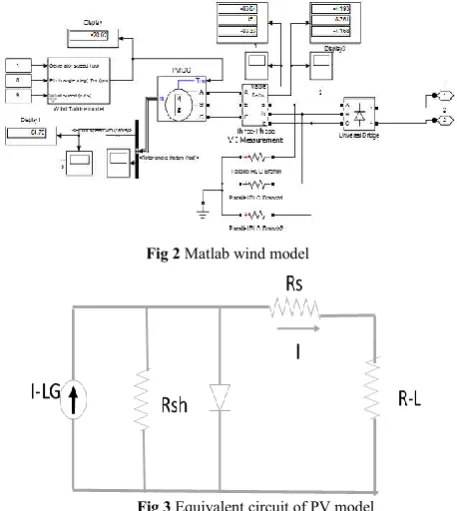
One of the quickly growing electricity in the world is wind generation. Wind is the form of kinetic energy that converted to first mechanical with the help of turbine for generation of electricity from wind, system having PMSG, inverter, Rectifier. In the system wind turbine capture the energy from wind, and generator convert that mechanical energy into electrical. With the help of power electronics apparatus converts the power from low to high quality and it control the rotor generator speed. Fig. 2 shows Matlab wind model.
Fig 2 Matlab wind model
Fig 3 Equivalent circuit of PV model
The solar panel is convert solar energy into electrical energy with DC-DC converter to step up the voltage of the solar energy. In general Current source are connect with parallel to the diode can be represented as a photovoltaic cell. The equivalent circuit also combination of series resistance and shunt resistance represented by Rsh whose value is large and Rs is small. Photovoltaic cell is the semiconductor device that absorb the energy and convert energy of light into electricity by the effect of solar radiation and temperature. Fig. 3 shows equivalent circuit of PV model.
DC-DC Boost Converter
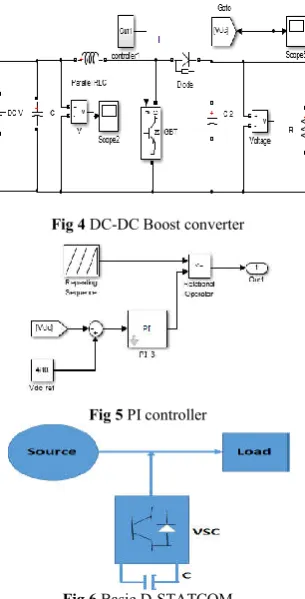
DC-DC converter are operate as a Boost, Buck and Buck-Boost in different way with different voltage output. There is one MOSFET/IGBT used for ON-OFF control. ON-OFF control is depend on the switching circuit. Fig. 4 DC-DC Boost converter not only increases the output but also give constant output than input. Because wind and PV gives a variable output and boost converter gives the constant output than input. Fig.4 shows DC-DC Boost converter.
Fig 4 DC-DC Boost converter
Fig 5 PI controller
Fig 6 Basic D-STATCOM
PI Controller
In PI controller the output value is compared with reference value and error calculate. These error goes to PI controller and give the constant output. These constant value compared with repeating sequence to generate gate pulse.
D-Statcom
The D-STATCOM is a controlled reactive, capable to generating and absorbing reactive power sources. D-STATCOM includes the VSC i.e. voltage sources converter and DC link capacitor connected in parallel or shunt. The aim of the D-STATCOM is to control the voltage at a PCC i.e. power point coupling where the lode is connected to the system.
Hybrid system simulation model
Fig 7 Overall Simulink model of Wind-PV hybrid system with D-Statcom
Input data use for hybrid solar, wind power generation system are given in table 1, 2, 3
Table 1 Parameters of PV cell
Table 2 Parameter of Wind model
Table 3 Parameter use in simulation
Output Power of wind take more time to constant than the hybrid Wind-PV. The settling time for wind is 1.2 sec and for hybrid wind PV is to take 0.4-0.6 sec, so hybrid generation of power is more important than the indivisiual one. Power become increase with the help of PV i.e. solar plant. Because when in winter the sun become low and wind high in summer vice-versa. In part A. wind power shown and then in part B. hybrid generation of power without DSTATCOM nd at last in part c. hybrid generation of power with D-STATCOM.
Fig 8 Load voltage and current THD of hybrid system without D-STATCOM
In the fig. 8, it shows that the graph of hybrid system wind-PV. Because of PV hybrid power increases than individual wind system. Harmonics present in the system because hybrid system without D-STATCOM i.e. without facts device
Hybrid Wind-PV system with D-Statcom
In the fig.9 Shows below, this hybrid system wind-PV with D-STATCOM. To reduce harmonics present in the system some facts device is used. For variable generation of power, D-STATCOM is useful device to reduce harmonics and maintain power in both side
Fig 9 Load voltage and current THD of hybrid system with D-STATCOM
Power oscillation mitigation measures
Emerging Mitigation methods: The emerging mitigation
methods comprise of the reactive power control of the PV inverters, Distributed energy storage systems (DESS), Dynamic voltage restorer (DVR), and FACTS devices. The main focus of this paper shall be on the mitigation of power oscillations using the FACTS devices.
Dstatcom: Dstatcom is a solid-state device based on voltage
source convertor topology and is connected in parallel to the point of common coupling of a distribution system. It is basically used for the voltage regulation and is supported by the energy stored in the dc capacitor. When a Dstatcom is connected with a particular load, it injects a compensating current in the system so as to meet the total demand of the connected utility. The PV installation capacity can be prominently increased by increasing the size of the Dstatcom. As the Dstatcom improves the voltage regulation of the system, to the power oscillations can also be compensated by varying the amount of current injected in the system.
Fig 10 Solar PV module integrated with conventional grid
Fig 11 Solar PV module with Series
FACTS controller
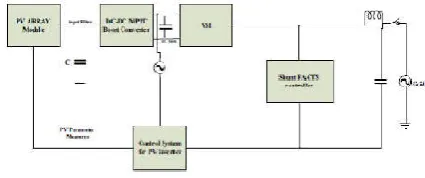
In Fig.10, we see a schematic block diagram of a PV array module connected with the grid. The DC-DC boost converter incorporated with the MPPT algorithm is used to enhance the PV voltage injected into the system. For better system performance, a VSI and PV inverter are also used. Penetration levels are checked up to which the PV array integrated with grid works without any distortions or damping’s. As soon as the power oscillation damping occurs, FACTS devices can be used as mitigation measures as illustrated in Fig.11 and Fig.12. The series FACTS controller controls the active and reactive power flow in the system and also control the power oscillations by balancing the voltage levels injected in the system.
Fig 12 Solar PV module with Shunt FACTS controller
The shunt FACTS controllers are connected at the end of the line and are used to regulate reactive power flow in the system. They are also used for power factor correction when used in capacitive mode of operation.
Problem identification
is determined to develop a grid-connected system with a PV-Wind Hybrid system generator. The design of the Type-2 FLC system is presented first. Then, the overall proposed control scheme is described. Finally, the Type-2 FLC structure is illustrated as per power quality requirement.
PV-Wind Hybrid system generator with Type-2 FLC control strategy
Proposed Type-2 FLC design
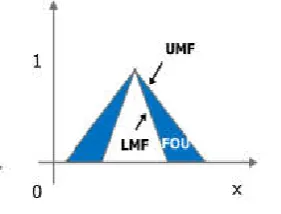
Type-2 FLC is an expansion of the method of familiar standard fuzzy sets. The Type-2 fuzzy set is denoted by a membership function (MF) of fuzzy (i.e.) for every element present with membership category is also called a fuzzy set. These sets are 3-dimensional and comprise a foot point of uncertainty (FOU), which is mentioned as new (or) third dimension of fuzzy sets in Type-2 technique.
Fig 13 Architecture of Type-2 FLC
From the Fig. 13, in Fuzzifier section the inputs are converted into the fuzzy set because numbers are not able to activate the defined rules which is explained in terms of fuzzy sets only. Next these fuzzy sets are calibrated into an output set of fuzzy with the help of inference section. At first, this one is established by measuring every rule using the theory of fuzzy set after that using the mathematical method to determine the output of every rule. Inference make only one rule at a time. From this, output of inference section will be fired rule output with one or more sets. Apparently, the output sets of fired rules have to be transformed into number in the output section. In type reducer section, fuzzy set of type-2 is reduced into fuzzy set of interval value of type-1. Output processing happens after completing the type reducer reduction, yet called as defuzzification. Since, a fuzzy set of type reducer has been always a number of finite intervals, the value of defuzzifier is just the difference between the end points of two intervals.
Fig 14 Membership function of Type-2 FLC
Fig 15 The block diagram of system under study for PQ enhancement by PV cell.
In Fig. 14, the design process of Type-2 FLC, it has 2-input, 1-ouput and each variable for input/output has 7 linguistic variables. Even though, by using the Type-2 FLC which terminates the FOU, upper membership function (UMF) and lower membership function (LMF) to provide firing strengths. The area between the UMF and LMF is defined as FOU. It produces a further degree of freedom that create it feasible to solve uncertainty. Although in real world environments, the fuzzy sets of Type-2 FLC have the ability to produce a relevant framework to solve the uncertainty. In the proposed work, four inputs are given to Type-2 FLC to attain the control signal for inverter of the PV-Wind Hybrid system. In Type-2 FLC, the fuzzy set in X is ~ and the membership grade is ( , )
Can also be expressed as
where
Where denote union over all admissible and .For discrete universe of discourse is replaced by can be re-expressed as
If and are both discrete then
Uncertainty in the primary membership of a type-2 fuzzy set, consists of bounded region that we call the FOU. It is the union of all primary membership, that is,
The voltage quality can be evaluated by means of its voltage sag and swell deviation from load reference value. If the output voltage deviation is less, the output voltage quality is extraordinary. Otherwise, Type-2 FLC is designed to rectify the voltage quality problems regardless of the supply voltage distortion. Meanwhile, it is observed that, for the Type-2 FLC strategy, certain system constraints are specified to deliver an adaptive control signal for the inverter.
Fig 16 Overall control strategy with Type-2 FLC design
The overall control strategy with Type-2 FLC design is shown in Fig.16. This structure is extended with four input values and one output value. The four inputs are ( (load power), (source voltage), (injected current) and (PV injection power)) and output is (injective power reference). From that, once the inputs and output of the Type-2 FLC is trained, it will be used to produce to control signal PWM generator to the inverter of PV-Wind Hybrid system. The mathematical demonstration of the above mentioned points is written as follows.
Fig 17 Structure of Type-2 FLC extended with four input values and one output value.
Let the source voltage and load voltage are expressed as:
Where, and are the vector representation of source and load voltages correspondingly at time
and are magnitudes of source and load voltage respectively at time and are the phase angle of source and load voltages at time t. Now, the magnitude of load voltage must be equal at all periods to preserve the load away from destruction regardless of distortion in source voltage. In spite of maintaining the reference voltage, suitable control signals given to PWM generator. If there is some trouble in voltage source, at first it is declared by Type-2 FLC, because it is one of the inputs for controlling.
SIMULATION RESULTS AND DISCUSSIONS
In this section, the performance of the Type-2 FLC controller for enhancing the power quality is investigated. Type-2 FLC handles both balanced and unbalanced situations without any difficulties and injects the appropriate voltage component to correct rapidly any variance in the supply voltage to keep the load voltage balanced and constant at the nominal value. As
compared with conventional controllers, Type-2 FLC has low steady state errors and low settling time. In this paper, four inputs and single output fuzzy inference system are considered. The input for the
fuzzy system is represented as error of PI controller. In order to
confirm the above mentioned work, a modest single phase system is established and verified for different voltage sag/swell disorders. To authenticate the performance of Type-2 FLC, it is analysed with two cases and compared with traditional controller techniques. From the paper, power quality features are improved with the help of PI controller. The results from those papers are compared with the proposed technique in the below mentioned comparison table 1.
Case 1: System performances during voltage sag
In this case, voltage sag of 60% is applied in supply voltage to check the conventional and proposed systems performances. The illustration of system performance for the above case is presented in Fig. 18.
(a)
(b)
(c)
(d)
(e)
(f)
(a)
(b)
(c)
(d)
(e)
(f)
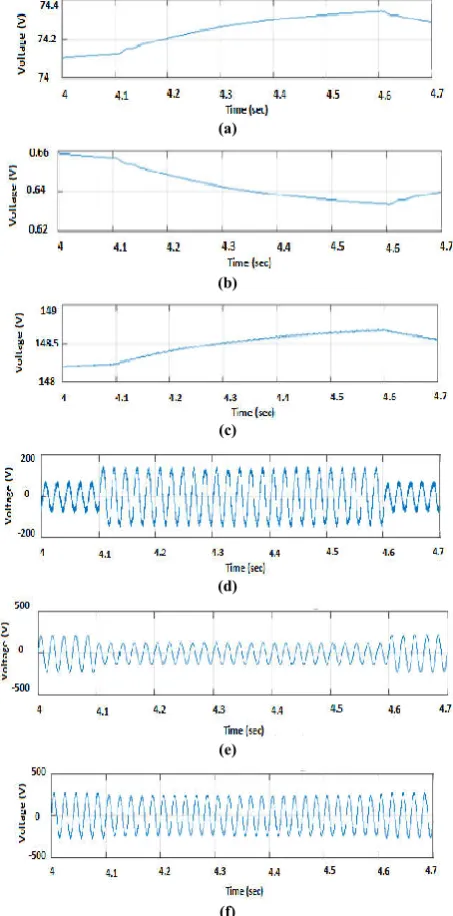
Fig 19 The performance of Type-2 FLC systems in 125% swell: (a) PV-Wind Hybrid system voltage output (b) PV-Wind Hybrid system current output (c) Dc link Voltage (d) Transformer voltage (e) Source voltage (f) Load voltage
From above Fig. 19, it is notable that, 125% of swell is applied to supply voltage during 4.1S to 4.6S. Here, during swell time, opposite to as a case in sag time; PV-Wind Hybrid system output voltage, current and DC voltages work in opposite way can be visible in Fig.19. Injected voltage from the transformer is reduced to cancel out the swell supply voltage. The difference in its phase with supply voltage results in good load voltage. It is visible for both conventional and proposed systems. Supply voltage with swell is also shown. Finally, in conventional PI controlled system, load voltage had tried to reach the reference of supply voltage and little bit lower than the supply voltage where as in Type-2 FLC system and it had reached the reference. It is due to the superior control capability of Type-2 FLC. The in-depth view of sag and swell operations in conventional and proposed systems presented in Fig.20. It is shown as follows.
(a)
(b)
Fig 20 The performance of Type-2 FLC system during sag and swell:(a) Load voltage during sag (b) Load voltage during swell
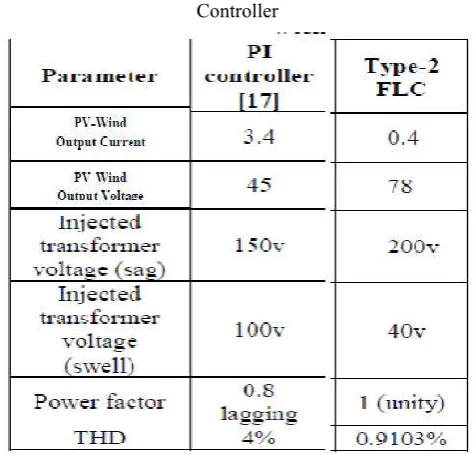
Table 1 Comparison table for Type-2 FLC with existing PI Controller
From the above discussions, it shows that, proposed Type-2 FLC is much better control strategy than a traditional controller for enhancing power quality during voltage sag/swell. Table 1 shows the performance measurements of Type-2 FLC with traditional techniques. The above table displays Type-2 FLC achieves better results when compared with other conventional techniques.
CONCLUSION
structures of PV-Wind Hybrid system output voltage, current, transformer injected voltage, DC voltage and supply/load voltages are also exposed for the period of sag and swell operations. The results of simulation presented and discussed in this paper are total harmonic distortion (THD) of voltage at the PCC, supply current, and load voltage. It is observed that the load voltage THD reduced to the level of 0.9103%. The THD and the amount of unbalance in load voltage decreased by the application of Type-2 FLC. It performed better than the traditional methods in mitigating harmonics and voltage sag/swell. This work can be extended for different types of load and THD can be minimized. Recent optimization techniques may be used to find optimal solutions; their performances may be compared. FACTS technology has till date proven to be the best for mitigating power oscillations from the system. The idea is to mitigate the power oscillations arising from PV integration in the grid using the various FACTS devices and to draw a conclusion that which FACTS device is the best suited for mitigating the power oscillations.
To improvement power quality of the hybrid system it needs the study of all controllers and facts devices. In this work, a fast and cost effective D-STATCOM is proposed for reducing the problems of harmonics and maintain AC voltage at both side in distribution system. The result of the simulation are shown with and without D-STATCOM. Hysteresis loss current control used to find the error signals which is the difference between the reference current and the load current to trigger the switches of an inverter using PWM (pulse width modulation). The D-STATCOM use in the distribution system without any difficulties and injected voltage component to correct the supply voltage by keeping the load voltage constant. In this study, the D-STATCOM is reduced the ability of harmonics in the system, total harmonics reduction has been proved by implementation of simulation. According to IEEE standards THD should be less than the 10%. With using D-STATCOM in distribution side the THD are reduced up to 5.73%.
References
1. S. Seme, N. Lukač, B. Štumberger, and M. Hadžiselimović, “Power quality experimental analysis of grid-connected photovoltaic systems in urban distribution networks”, Energy, Vol.139, pp.1261-1266, 2017.
2. W.U. Tareen, S. Mekhilef, M. Seyedmahmoudian, and B. Horan, “Active power filter (APF) for mitigation of power quality issues in grid integration of wind and photovoltaic energy conversion system”, Renewable and Sustainable Energy Reviews, Vol.70, pp.635-655, 2017. 3. W.J. Praiselin and J.B. Edward, “Voltage Profile
Improvement of Solar PV Grid–Connected Inverter with Micro Grid Operation using PI Controller”, Energy Procedia, Vol.117, pp.104-111, 2017.
4. G.S. Elbasuony, S.H.A. Aleem, A.M. Ibrahim, and A.M. Sharaf, “A unified index for power quality evaluation in distributed generation systems”, Energy, Vol.149, pp.607-622, 2018.
5. Y. Wang, B. Ren, and Q.C. Zhong, “Bounded-voltage Power Flow Control for Grid-tied PV Systems”, IFAC-PapersOnLine, Vol.50, No.1, pp.7699-7704, 2018. 6. M. Hasheminamin, V.G. Agelidis, A. Ahmadi, P. Siano,
and R. Teodorescu, “Single-point reactive power control method on voltage rise mitigation in residential networks with high PV penetration”, Renewable Energy, Vol.119, pp.504-512, 2018.
7. N. Chettibi and A. Mellit, “Intelligent control strategy for a grid connected PV/SOFC/BESS energy generation system”, Energy, Vol.147, pp.239-262, 2108.
8. Mr. SharadS.Pawar, Mr. A.P.Deshpande, and Mrs. Meera Murli, “Modelling and Simulation of DSTATCOM for Power Quality Improvement in Distribution System using MATLAB Simulink tool”, ICESA,2015.
9. Megh Sharma, Lalit Kumar Deegwal and Nitesh Kumar Gupta, “FACTS devices in Renewable Energy Plants to solve Power System issues”, SSRG-IJEEE,volume 3, ISSN:2348- 8379, 2016.
10. Khadkikar, R.K.V.a.V., “Utilization of Solar Farm Inverter as STATCOM”, in US Provisional Patent application.
11. Singh B, Jayaprakash P, Kumar S, Kothari DP, “Implementation of neural network controlled three-leg VSC and a transformer as three-phase four wire DSTATCOM”, IEEE Trans IndAppl 2011.
12. S.Angalaeswari, M.G.Thejeswar, R.Santhana Poongodi, W.Valeed Basha, P. Sasikumar,”Power Quality Improvement of Standalone Hybrid\Solar-Wind Power Generation System using FACTS Devices,” vol. 3, no. 3, pp. 7987-7992, Mar. 2014.
How to cite this article:
Adarsh Kumar and Qureshi M.F., 2018, Interval Type 2 Controller Based Power Quality Improvement of Pv Generation System by Using Facts Device. Int J Recent Sci Res. 9(10), pp.29082-29089. DOI: http://dx.doi.org/10.24327/ijrsr.2018.0910.2789