Tools or Traits: The Path to Successful Continuous
Improvement Implementation in a Logistics
Environment
Lee Alexander Wood
ii Declaration
I declare that no part of this work has been submitted in support of an application for another degree qualification of this or any other university, or other institute of learning.
Supervisors: Dr. Gillian Green
Reader in Business Technologies Bolton Business School
University of Bolton Bolton
BL3 5AB
Prof. Bob Wood
Bolton Business School University of Bolton Bolton
BL3 5AB
Dr. Robert Campbell
School for Creative Technologies University of Bolton
Bolton BL3 5AB
iii Abstract
This thesis examines the opportunities to improve the implementation of a Continuous Improvement (CI) culture supporting the success of logistics organisations of the future. It is based on the proposition that the manner in which individuals and organisations behave will form greater influence on the success of CI implementation programs than the use of recognised CI tools and techniques taught in the classroom. By definition CI covers wide-ranging themes and its applications are not tied specifically to projects; the literature review will explore how CI can be utilised to improve organisational
performance evaluating synergies between CI and associated domains. Enablers and blockers to successful CI implementation programs will be examined leading to an understanding of the amalgam between soft and hard skills and their interactions.
Reflective practice is the chosen approach to the PhD, underpinned with over twenty years’ experience of the researcher working with CI as part of their roles and
responsibilities. The literature review provided a theoretical base, including the development of content for the semi-structured interviews deriving qualitative data in support of the thesis aims and objectives. This process supported additional
unexpected outputs, discussed within the conclusions and recommendations sections. The over-riding domain of the thesis is CI Implementation; however this was broken down into Organisational Learning, Organisational Frames of Reference, Learning Organisations, Culture, Emotional Intelligence and Appreciative Inquiry with supplemental areas of Knowledge Management, Innovation and Trust. The task-orientated elements of CI tools and techniques are described, providing the reader with an overview of their use and potential value to organisations.
Conclusions are drawn regarding the importance of successful CI implementation in logistics organisations. Recommendations are proposed as to how to improve CI implementation by reducing the potential for blockers to stall or ultimately prevent the process from operating as a self-sustaining business as usual activity. This is achieved through a blend of task, organisational and individual cultures working in unison. The main contribution of the thesis is the provision of a CI Implementation Model,
iv Road Map
The thesis opens with an introduction to the central domain, Continuous Improvement (CI) implementation in Chapter 1, including a short appraisal of the positioning of an embedded CI culture in support of successful organisations of the future. The rationale for completion of a PhD by practice is discussed, identifying a number of supporting domains researched to support the aims and objectives of the thesis. The professional career of the researcher is discussed, including their journey to professional recognition as a Chartered Engineer (CEng) whilst developing their CI journey over twenty years, through reflection and practice, coupled with elements of academic learning. A brief overview of CI tools and techniques is provided for the reader in support of their understanding of how they might be applied in successful organisations. The main contribution of the thesis, the CI Implementation Model is briefly discussed within this chapter with the model undergoing development through subsequent chapters culminating in the complete model detailed in Chapter 7.
In the literature review, Chapter 2, multiple domains in support of successful CI implementation programs were researched, providing a theoretical grounding for the thesis, supporting the development of content for the semi-structured interview process. From this qualitative data generated was analysed, providing input to the recommendations in support of the thesis aims and objectives. A model for successful CI implementation and a Systematic Review of Literature Table were provided detailing the path to the research questions raised for the semi-structured interview process.
Chapter 3 provided an understanding as to the research methodology utilised, the decision making process for the sample size and analysis method utilised to interpret the qualitative data derived from the semi-structured interviews. The aims and objectives of the thesis were presented, specifically aligned to Deutsche Post (DP) DHL, with the potential for derived recommendations to be implemented by external organisations where synergy was evident.
v Chapter 8 provides detailed feedback of the semi-structured interviews through a narrative approach. The compare / contrast responses are structured in a manner to present the reader with informative dialogue from an informed respondent group, intended to offer detailed information that is both interesting and readable. Answering the ‘Why CI?’ question formed a key measure of the semi-structured interview process,
leading to a number of supplementary outputs forming part of the thesis outcomes.
The conclusions, recommendations and contributions of the thesis are developed within Chapter 9. The chapter is broken down into a number of sub-sections in order to assist the reader in navigating the content therein. The introductory section includes a tabular representation to summarise the detailed information supporting the thesis objectives, whilst assisting effective navigation back to the key sections of the thesis should the reader wish to hone in on the supporting evidence. Limitations of the research and future research opportunities are discussed; these form part of feedback to be shared directly with DP DHL, specifically focusing on the links between
Organisational Learning (OL), CI, innovation and Knowledge Management (KM).
vi Key Terms
Acronym Description
AI Appreciative Inquiry
BAU Business As Usual
BS British Standard
CAPA Corrective Action, Preventative Action
CEng Chartered Engineer
CI Continuous Improvement
COIN Company Intranet
CPD Continual Professional Development
DoE Design of Experiments
DMAIC Define, Measure, Analyse, Improve, Control
DMADV Define, Measure, Analyse, Design, Verify
DP DHL Deutsche Post DHL. (The author’s current employer)
EA Effective Analysis
EC Engineering Council
EI Emotional Intelligence
EOS Employee Opinion Survey
FCW First Choice Way
FM Failure Mode
FMCG Fast Moving Consumer Goods
FMEA Failure Modes and Effects Analysis
ICI Imperial Chemical Industries
IEE Institute of Electrical Engineers
IEng Incorporated Engineer
IET Institute of Engineering and Technology
IIE Institute of Incorporated Engineers
IS Information System
iShare DP DHL intranet based information sharing system
JIT Just In Time
KM Knowledge Management
KPI Key Performance Indicators
LEAN Is not an abbreviation; it is a term for a systemic approach to waste elimination
LO Learning Organisation
LSS Lean Six Sigma
MES Manufacturing Execution System
MIP Manufacturing Improvement Teams
OEE Overall Equipment Efficiency
vii
Acronym Description
OFOR Organisational Frames Of Reference
OL Organisational Learning
PDCA Plan Do Check Act.
PI Process Improvement
PRA Professional Registration Advisor
RAG Red Amber Green
RDC Regional Distribution Centre
RPN Risk Priority Number
SKU Stock Keeping Unit
SME Subject Matter Expert
TIMWOOD Acronym relating to seven identified wastes
TPM Total Productive Maintenance
TQM Total Quality Management
3PL Third Party Logistics
UK& I United Kingdom and Ireland
UK & U Underpinning Knowledge and Understanding
viii
Table of Contents Declaration ... ii
Abstract…………. ... iii
Road Map ... iv
Key Terms ... vi
Table of Contents ... viii
Acknowledgements ... xii
Table of Figures ... xiii
List of Tables ... xv
Chapter 1 1.1. INTRODUCTION ... 1
1.2. BACKGROUND TO THE RESEARCH ... 4
1.3. WHAT IS CONTINUOUS IMPROVEMENT? ... 8
1.4. RESEARCH AIMS ... 11
1.5. POSITIONING OF THE THESIS ... 13
1.6. BOUNDARIES ... 13
1.6.1. In Scope ... 13
1.6.2. Out of Scope ... 14
1.6.3. Constraints and Restrictions ... 14
1.7. THE RESEARCHER ... 14
1.8. METHODOLOGY ... 17
1.8.1. Introduction to ContinuousImprovement ... 18
1.8.2. Kaizen ... 18
1.8.3. Total Productive Maintenance (TPM) ... 19
1.8.4. Total Quality Management (TQM) ... 21
1.8.5. Just In Time ... 24
1.8.6. Five-S Approach to the Workplace ... 26
1.8.7. Six Sigma ... 28
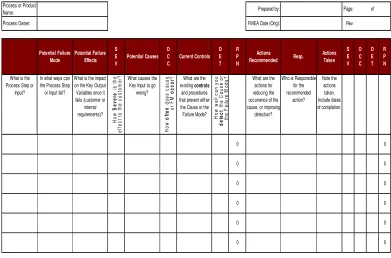
1.8.8. Failure Mode Effect Analysis ... 29
1.9. SUMMARY ... 31
Chapter 2 2.1. INTRODUCTION ... 33
2.2. LITERATURE REVIEW ... 34
2.3. ORGANISATIONAL LEARNING ... 35
2.4. ORGANISATIONAL FRAMES OF REFERENCE ... 49
2.5. LEARNING ORGANISATIONS ... 53
2.6. KNOWLEDGE MANAGEMENT ... 57
2.7. INNOVATION ... 62
ix
2.9. CULTURE ... 67
2.10. CULTURAL MODELS ... 69
2.11. EMOTIONAL INTELLIGENCE ... 82
2.12. APPRECIATIVE INQUIRY ... 90
2.13. SUMMARY ... 97
Chapter 3 3.1. INTRODUCTION ... 101
3.2. PhD BY PROFESSIONAL PRACTICE ... 102
3.3. RESEARCH PARADIGMS ... 105
3.4. RESEARCH METHOD ... 114
3.5. RESEARCH AIMS AND OBJECTIVES ... 115
3.6. RESEARCH DESIGN... 116
3.7. RESEARCH METHODOLOGY ... 120
3.8. GENERALISABILITY, RELIABILITY AND VALIDITY ... 121
3.9. THEMATIC DATA ANALYSIS ... 123
3.9.1. Phases of Completing Thematic Analysis ... 124
3.10. DATA COLLECTION ... 127
3.11. POST INTERVIEW ... 128
3.12. SUMMARY ... 129
Chapter 4 4.1. INTRODUCTION TO MY PROFESSIONAL CAREER ... 131
4.2. BACKGROUND TO THE INITIAL REFLECTIVE OPPORTUNITY ... 133
4.3. REFLECTIVE PRACTICE ONE – THEORY ... 135
4.4. REFLECTIVE PRACTICE ONE – PRACTICE ... 137
4.5. REFLECTIVE PRACTICE ONE – REFLECTION ... 138
4.6. SUMMARY ... 142
Chapter 5 5.1. BACKGROUND TO REFLECTION #2 ... 144
5.2. REFLECTIVE PRACTICE TWO – THEORY ... 146
5.3. REFLECTIVE PRACTICE TWO – PRACTICE ... 155
5.4. REFLECTIVE PRACTICE TWO – REFLECTION ... 158
5.5. SUMMARY ... 162
Chapter 6 6.1. BACKGROUND TO REFLECTION #3 ... 164
6.2. REFLECTIVE PRACTICE THREE – THEORY... 166
6.3. REFLECTIVE PRACTICE THREE – PRACTICE ... 182
6.4. REFLECTIVE PRACTICE THREE – REFLECTION ... 188
x
Chapter 7 7.1. INTRODUCTION ... 195
7.2. SUMMARY OF REFLECTIVE PRACTICES ... 196
7.3. SUMMARY ... 199
Chapter 8 8.1. INTRODUCTION ... 201
8.2. QUESTIONS AND KEY FINDINGS ... 203
8.2.1. Organisational Learning and CI - Symbiotic Relationship ... 207
8.2.2. Understanding of Knowledge Management ... 212
8.2.3. Potential Interaction between CI / PI and Innovation. ... 215
8.2.4. Incentivising Support for CI / PI and Innovation ... 219
8.2.5. Delivery of CI / PI Training ... 222
8.2.6. Trust... 223
8.2.7. Organisational support to CI Implementation ... 225
8.2.8. Appreciative Inquiry ... 226
8.2.9. What does CI mean to you? ... 229
8.3. SUMMARY ... 232
Chapter 9 9.1. INTRODUCTION ... 233
9.2. OVERVIEW OF AIMS AND OBJECTIVES ... 235
9.3. CONCLUSIONS RELATING TO AIMS AND OBJECTIVES ... 237
9.4. CONCLUSIONS DERIVED FROM THE LITERATURE REVIEW ... 239
9.5. CONCLUSIONS DERIVED FROM INTERVIEW FEEDBACK ... 241
9.5.1. Leadership Style and Support ... 241
9.5.2. Organisational Learning ... 242
9.5.3. CI Tools and Techniques ... 243
9.5.4. CI Culture ... 243
9.5.5. Corporate Overview ... 245
9.5.6. Knowledge Management ... 246
9.6. QUANTITATIVE OUTPUTS FROM INTERVIEW PROCESS ... 247
9.7. RECOMMENDATIONS ... 248
9.7.1. CI Tools and Techniques ... 248
9.7.2. Corporate Programs and Communication ... 249
9.7.3. DP DHL CI Maturity ... 250
9.7.4. Organisational Approach ... 252
9.7.5. Skill-Set of CI Practitioners ... 253
9.7.6. CI Resource ... 255
9.7.7. CI and Innovation ... 256
xi
9.7.9. Trust... 258
9.7.10. Appreciative Inquiry ... 258
9.7.11. Understanding the Depth of DP DHL CI Implementation (Culture) ... 259
9.8. CONTRIBUTIONS TO THEORY. ... 260
9.8.1. CILT McKibbin Research Foundation ... 260
9.8.2. Colleague Engagement ... 261
9.8.3. Knowledge Management ... 262
9.8.4. Appreciative Inquiry ... 263
9.8.5. CI Implementation scope ... 263
9.8.6. Organisational Learning ... 263
9.9. CONTRIBUTIONS TO PRACTICE ... 264
9.9.1. Change Management ... 264
9.9.2. CI Implementation Presentation – Internal Leadership ... 264
9.9.3. Maturity of DP DHL - CI Culture ... 265
9.9.4. Benchmarking ... 265
9.9.5. Organisational Support to CI Community ... 266
9.10. LIMITATIONS OF THE RESEARCH ... 266
9.11. FURTHER RESEARCH ... 267
9.12. SUMMARY ... 268
References ... 270
Bibliography ... 292
Appendixes Appendix 1 - Glossary of terms ... 298
Appendix 2 - Chartership ... 302
Appendix 3 - Reflective Practice #1 ... 305
Appendix 4 - Reflective Practice #2 ... 320
Appendix 5 - Reflective Practice #3 ... 327
Appendix 6 - McKibbin Research Award ... 337
Appendix 7 - CI Presentation ... 365
Appendix 8 - Semi-structured Interview Transcript ... 374
xii Acknowledgements
Especially to Jacky, who has sacrificed her desires in support of mine through my study and family and friends who have provided encouragement, motivation and, most importantly, their patience through the difficult times on my research journey.
To all respondents who gave their time to support and patience to allow me to explore my thoughts and help me keep focused on my objectives.
I would like to thank the DP DHL Supply Chain Senior Management Team for supporting me through the challenging milestones of the project.
From the University: Professor Wood, Dr. Campbell and Dr. Green, you have helped me create an on-going desire for knowledge, supporting me on a journey I can never truly finish.
xiii
Table of Figures Figure 1 - Career path, indicating academic and workbased learning ... 1
Figure 2 - Implementation Circle ... 4
Figure 3 - Diagrammatical Career Path Relating to Reflective Practice ... 15
Figure 4 - The Kaizen Umbrella ... 19
Figure 5 - Matsui Analytical Framework ... 25
Figure 6 - CI Implementation Model, Initial Framework ... 31
Figure 7 - Academic and Professional Learning Pathway ... 33
Figure 8 - Organisational Learning as a Dynamic Mode ... 41
Figure 9 - The Conceptual Model ... 42
Figure 10 - Information Processing by Organisations ... 52
Figure 11 - Kolb and Fry’s Learning Cycle ... 55
Figure 12 - Gibbs Reflective Cycle ... 56
Figure 13 - Schematic representation of knowledge creation in real world ... 58
Figure 14 - SECI model of knowledge creation ... 59
Figure 15 - Key Characteristics in Contemporary Conceptualisation of Innovation ………Processes ... 63
Figure 16 - Complexities of divergent organisational cultures ... 69
Figure 17 - Hofstede’s Culture Triangle ... 71
Figure 18 - Trompenaars Corporate Culture Model ... 73
Figure 19 - Components of Culture ... 75
Figure 20 - Garrisons Triangle Model of Culture ... 77
Figure 21 - Maslow's Values Pyramid (Norwood, 2002). ... 79
Figure 22 - Model of Emotional Intelligence ... 89
Figure 23 - CI Implementation Model ... 98
Figure 24 - Academic pathway ... 101
Figure 25 - Respondent roles and hierarchical levels ... 119
Figure 26 - Underpinning Methodology ... 129
Figure 27 - Electrical infrastructure, reflective practice project one ... 131
Figure 28 - Electrical infrastructure, project overview and reflection ... 134
Figure 29 - CI implementation initial model ... 143
Figure 30 - Lead Oxide Mill installation, reflective practice project two ... 144
Figure 31 - Oxide Mill, project overview and reflection ... 146
Figure 32 - A model of reflection in the learning process ... 149
Figure 33 - Components of Reflection ... 150
Figure 34 - The Reflection process in context ... 151
xiv
Figure 36 - CI Implementation, reflective practice project three ... 164
Figure 37 - CI Culture Implementation, project overview and reflection ... 165
Figure 38 - Professional reflective practice cycle ... 169
Figure 39 - Surface to Deep Learning ... 173
Figure 40 - The Johari Window ... 177
Figure 41 - Unhealthy and healthy communication ... 178
Figure 42 - Batari’s box ... 179
Figure 43 - Five P’s ... 180
Figure 44 - CI implementation Model, Final Elements ... 194
Figure 45 - Reflective Practice Interactions ... 195
Figure 46 - CI Implementation Model ... 199
xv
List of Tables Table 1 - OEE Definitions of OEE Variables ... 20
Table 2 - Failure Mode Effects Analysis Table ... 30
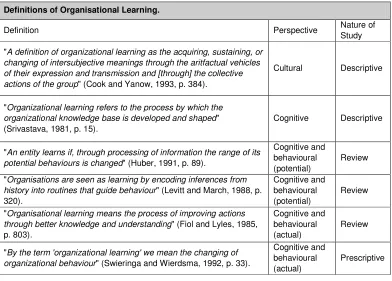
Table 3 - Definitions of Organisational Learning ... 38
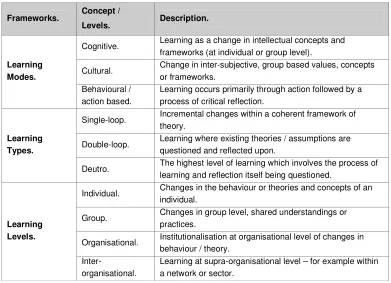
Table 4 - Learning in Organisations ... 40
Table 5 - OFOR Elements and Examples ... 49
Table 6 - The learning company framework ... 54
Table 7 - Gibbs Reflective Cycle ... 57
Table 8 - SECI Knowledge Conversion ... 60
Table 9 - Links between previous Typologies of Trust and Companion, ………....Competence and Commitment Trust ... 65
Table 10 - Dimensions of Emotional Intelligence... 88
Table 11 - Systematic Review of Literature ... 99
Table 12- Coding Procedures for Grounded Theory ... 111
Table 13 - Phases of Thematic Analysis ... 124
Table 14 - Advantages of Thematic Analysis ... 127
Table 15 - Moons framework of reflective writing. ... 167
Table 16 - Three approaches to reflection ... 168
Table 17 - Biggs and Collis (1982) SOLO taxonomy ... 173
Table 18 - Paradox of Change (PLI, 2013)... 181
Table 19 - Kotter (1996) - Leading Change / DP DHL ACT Comparison ... 182
Table 20 - Organisational support to CI Implementation. ... 226
Table 21 - Overview of Contribution to Objectives ... 234
1
CHAPTER ONE – INTRODUCTION
1.1. INTRODUCTION
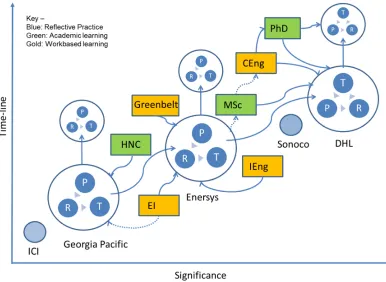
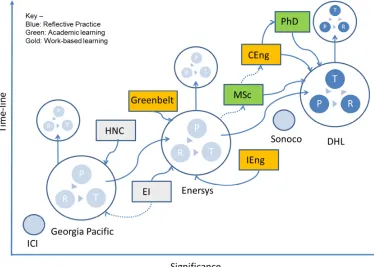
This introductory diagram (see Figure 1), illustrates the career path of the researcher indicating the key elements of reflective practice, academic and work-based learning. The timeline is spread over a 30 year period, taking into account professional actions as well as the researchers academic and work-based learning. The professional actions are inter-linked with the academic and work-based learning elements visualised below.
Figure 1 - Career path, indicating academic and work-based learning (Author's Own, 2014).
The Continuous Improvement (CI) journey of the researcher has followed a progressive path from initial use on an informal basis to the present position of formal responsibility for CI at a complex site, seen as one of the more advanced of Deutsche Post (DP) DHL’s in the pursuit of a CI culture.
2 marketplace of today. One increasingly popular approach for enabling CI
implementation is through mobilising a high level of involvement of an organisations workforce in sustained incremental problem-solving. The outcomes of this can be considerable, supporting innovation; however implementing programs of this kind are not easy (Bessant and Caffyn, 1997).
The main objective of this thesis is to explore the proposition that the manner in which individuals and organisations interact will form greater influence on the success of Continuous Improvement (CI) implementation programs than the use of recognised CI tools and techniques that can be taught in the classroom. The literature review identified the complexity of the interwoven relationships between people and organisations and this will be investigated to examine their potential to be mutually supportive or detractive of CI implementation when combined.
The primary contribution of the thesis is the development of a CI Implementation model, (see Chapter 7), detailing a pathway in support of embedding a sustainable CI culture within an organisation. This model is the culmination of empirical data, outputs from semi-structured interviews, professional practice and reflection. Further
theoretical and practice based contributions are offered within Chapter 9 of the thesis, targeting the wider CI community, DP DHL internal community, methods and practice. The theoretical contributions consist of:
• McKibbin Research Foundation Award 2014, supporting the wider CI
community.
• Colleague engagement internal to DP DHL developed through an OL culture
approach to colleagues.
• KM internal to DP DHL; treat KM as a tangible asset to drive business
performance, ensuring this is evidenced to share value.
• Appreciative Inquiry approach to colleague engagement unlocking discretionary
effort, recognised as a ‘distinct value proposition’.
• Provision of a set of internal measures designed to provide a transparent
approach to CI implementation, driving effective resource and funding decisions.
• Development of an internal OL study to develop a new work stream providing a
3 The practise based contributions consist of:
• Applying the DP DHL Accelerated Change and Transition (ACT) program to
sites of over 100 employees to drive a CI culture change.
• Presenting a CI implementation overview and strategy to Senior DP DHL
leadership.
• Development of an internal four-tier CI implementation questionnaire to drive
clarity and validity of responses leading to a clearer and more objective understanding of where DP DHL CI implementation (culture) is positioned.
• Develop trust in relationships across peer organisations to the point that best
practice sharing is possible for mutual benefit.
• Developing the expectations placed upon an organisation to implement a CI
culture.
The term CI has become a widely used phrase which has taken on a variety of meanings dependant on how an organisation views it. It can be referred to as a pre-cursor to innovation; the continual quest to improve products, processes or customer service through quality improvement programs. In contrast others view CI as a core value that lies at the heart of an organisations identity and culture (Bessant and Caffyn, 1997).
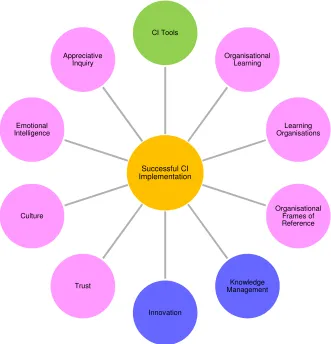
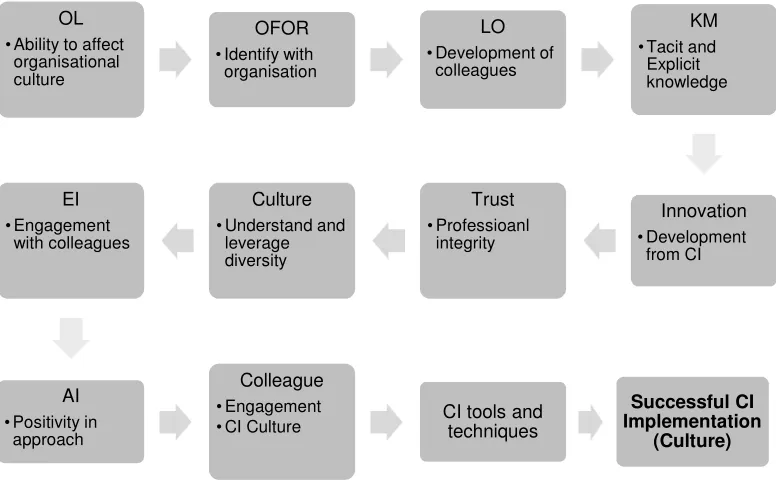
The diagram below (see Figure 2), details the areas researched within the literature review in support of CI implementation; the core component of successful CI
implementation is thus complex to achieve and relies on a number of elements to work in unison for effective implementation to take place. The areas designated are not an exclusive list; however the development of the literature review linked the headings identified as having a level of inter-relationship through the CI implementation journey.
This led to their development as key topics to research further to build up a cohesive picture and they are subsequently detailed within Chapter 2 - Literature Review. The colour coding represents predominance to: task (green), colleague and organisational behaviours (pink) and a combination of task / behavioural (blue) to identify the
difference.
The requirement for a CI approach in organisations of the logistics business
environment will be interrogated to understand if it is a ‘nice to have’ or critical business
4 career and this experience will be compared to the literature review looking for
compare / contrast perspectives and new learning opportunities as they unfold.
To facilitate the understanding of CI this chapter includes a representative overview of CI tools and techniques presently utilised within organisations; the expectation here is that the level of detail provided will allow the reader to appreciate the positioning of CI and its relevance to organisations.
Figure 2 - Implementation Circle (Author's Own, 2014).
1.2. BACKGROUND TO THE RESEARCH
I find myself in the position of researching a PhD by Practice, reviewing the
implementation of CI programs rather than the management of CI projects which is a significant shift in position for me. This is driven in part by a change in career path which has taken me from highly complex manufacturing environments into the third-party logistics (3PL) automated business of DP DHL where I have direct managerial
Successful CI Implementation
CI Tools
Organisational Learning
Learning Organisations
Organisational Frames of Reference
Knowledge Management
Innovation Trust
Culture Emotional Intelligence
5 responsibility for CI in a large-scale Regional Distribution Centre (RDC) supplying a well-known supermarket chain with products on a daily basis.
Coyle, Bardi, and Langley (2003) comment that 3PL’s involves an external organisation that performs all or part of a company's logistics operations. In relation to DP DHL their business portfolio covers all logistics and supply chain functions, however this varies from contract to contract and by business division dependent on the specific
customer’s requirements.
Lummus and Vokura discuss the definition of Supply Chain Management and offer the following summary:
“All the activities involved in delivering a product from raw material through to the customer including sourcing raw materials and parts, manufacturing and assembly, warehousing and inventory tracking, order entry and order
management, distribution across all channels, delivery to the customer, and the information systems necessary to monitor all of these activities”(Lummus and
Vokura, 1999, p. 11).
In more recent times as technology has developed automation has had the effect of driving supply chain performance, through increased efficiency and speed of warehouse operations. Historically the areas noted by Lummus and Vokura (1999) had been viewed as passive elements under tight management control rather than areas to be looked at from a CI perspective to drive innovation and competitive advantage (Hyland et al., 2003). Consequently progressive management was viewed as meeting the objectives of technical competence with performance judged against strictly defined Key Performance Indicators (KPI’s) rather than flexible strategic initiatives. Delighting customers had been viewed as cost minimisation first, all other criteria second, leading to pro-active and innovative areas such as the use of inventory management information and packaging reduction programs potentially being missed by the supplier and customer alike.
6 In an increasing global economy, CI and innovation have become pre-requisites for staying competitive. There is an absolute need to service the customer in the world-wide markets of today and in the case of DP DHL, this is driven by two distinct requirements. Firstly, as an ever more demanding end customer; you and I, require everything we desire [products] to be available all of the time at the right price. Secondly DP DHL’s offering as a 3PL provider puts added pressure on the
organisation to outperform internal sites of their primary customers and other external providers to ensure we maintain our position, find new and innovative ways of working and potentially grow our business in contract size and scope.
DP DHL’s business is driven by three specific core values under the banner of First Choice Way (FCW) namely; Employer of Choice, Provider of Choice and Investor of Choice with CI recognised as an enabler in achievement of these goals. The above forms part of the DP DHL Strategy 2015 program which has been in place for a number of years. In April 2014 the organisational strategy evolution has led to Strategy 2020 that will lead on from Strategy 2015. This focuses on core business competencies, working together and developing business opportunities in emerging markets and is identified as ‘Focus, Connect and Grow’. This promotes the drive for CI and innovative products that can support an added value approach to DP DHL’s customer proposition.
There has been an acceptance in international best practice organisations of an Organisational Learning (OL) approach to CI, including products and key processes (Boer et al., 2000). To maintain a sustainable competitive advantage in logistics functions such as RDC’s; the management teams of these operations can benefit from implementing CI, whilst ensuring that their organisations have the necessary means to support organisational learning concurrently. CI practitioners can be misguided into believing that a formally implemented process is the means to an end for CI. The challenge is to find a way for this often highly academically qualified group to reflect on their delivery of CI programs, increase engagement with the DP DHL colleague
population, thereby providing a sustainable implementation component of the CI processes they have direct affinity to.
By undertaking a PhD by professional practice the intention is to link the theory of CI, which is often misunderstood, misinterpreted and misrepresented, with the practice of how to implement a CI culture, rather than simply complete the CI activities
7 implementation in the organisation, in fact they are underutilised. It is the ability to implement and sustain CI processes where issues proliferate.
Should this thesis prove successful in providing solutions to improve the
implementation process of a CI culture, the opportunities will be shared across the UK and Ireland (UK&I), potentially the wider regions of the DP DHL and the external CI community. The challenge through this thesis will be to find a way for site managerial teams to reflect on the positive value of CI implementation and the advantages it will bring to them in their respective businesses; this will only be possible by making the implementation process as user friendly, inclusive, effective and sustainable as
possible without the need for high levels of on-going resource, a commodity not readily available.
Reflection on professional practice is necessary to address the reasoning behind the failure to implement CI effectively from a ‘user’ perspective and interrogation of
published literature seeks to find underlying patterns that may well be complex in nature to understand. The literature review covered theory, practice and praxis, testing the relevance and impact of a number of identified areas including; Organisational Learning, Organisational Frames of Reference, Learning Organisations, Culture, Emotional Intelligence and Appreciative Inquiry, however as the literature review developed, the areas of Knowledge Management, Innovation and Trust became key components of the overall scope. Whilst not able to address to the same level of detail within this thesis, they were necessary additions to formulate a structured
understanding of the overall taxonomy.
Taking account of reflective experiences, coupled with semi-structured interviews of varying hierarchical level colleagues may provide answers to the questions this thesis will raise. The interviewee responses are summarised within Chapter 8 to appraise the need for CI and assess the understanding of DP DHL business professionals in
reinforcing the influences of the aforementioned topic areas and what they can bring to an organisation through effective support of CI implementation processes.
The lead into the literature review commences with a summary overview of a number of recognised CI tools and techniques used to support the task oriented components of CI implementation; this leads to a wider review of the areas identified as having the potential to affect the behavioural and culturally orientated aspects of CI
8 1.3. WHAT IS CONTINUOUS IMPROVEMENT?
One of many definitions of Continuous Improvement is that it is:
“An on-going effort to improve products, services, or processes. These efforts can seek ʻincrementalʼ improvement over time or ʻbreakthroughʼ improvement all at once. Delivery (customer valued) processes are constantly evaluated and improved in the light of their efficiency, effectiveness and flexibility” (American
Society for Quality, 2013).
The above definition is offered to assist the reader in understanding the positioning of CI and its relative merit in driving the on-going improvements required in today’s target driven organisations. The proposition that a CI culture gives rise to an innovation driven culture is of particular significance; the development of an innovative culture is crucial to the prospects of an organisations ability to continually develop new customer offerings and future strategic direction (Singh and Singh, 2013).
When CI is implemented in isolation it delivers value; however the potential will be constrained by the size of the individual opportunity and will not support ground-breaking initiatives that would keep an organisation at the forefront in its respective markets. The need for constant development of organisational competitiveness and flexibility to meet customer demands supports the need for new methods to be introduced continually (Black, 1991).
Davis (2006) introduces CI with a number of descriptions covering basic concepts which are noted here for reference. CI activities usually occur at three levels within an organisation. The first level, also called the floor level, concerns itself with Kaizen or good changes within the control of the operator. The second level, Process
Improvement (PI), is concerned with continually improving processes. The third level, business process reengineering, is concerned with radical changes in processes.
9 CI theory has been around for a number of decades and CI tools have been defined, redefined, renamed and become ever more computerised and statistically driven. They are now at the point where data to support understanding is readily available should the end user be capable of knowing what they are looking for and how to capture it objectively. This has caused a paradigm shift of its own to occur as process
experience and knowledge embedded in individuals based on tacit knowledge have been incrementally replaced by explicit, data driven systems. These systems offered by software providers such as MiniTab™ and SigmaXL™ afford laypersons who have inherited CI as part of their role or moved into the profession, a high level of information to absorb and relate to.
What the complex algorithmic programs cannot do is ensure projects are progressing to time, have the correct resourcing and skills in place and guarantee business driven goals are achieved as pre-requisites for success. This drives the absolute need to understand why the process of CI, which, by the very nature of its definition, may not be self-sustaining when conceivably it should be following the implementation process.
CI strategies have been acknowledged as the driver behind waste reduction programs for many years now focusing either on small incremental changes or in some cases breakthrough level projects whereby the very essence [culture] at the heart of an organisation may have purposely been changed to affect a positive outcome. The majority of manufacturing industries around the world are obligated to provide their customers with innovation and rapid response to ever changing requirements and this has driven other sectors, such as the supply chain, to follow suit.
Reid (2006) comments that competition and continuously increasing expectations of customer satisfaction have proven to be endless drivers of organisational performance improvements. The CI strategist constantly seeks to identify and implement on-going enhancements in an organisations products, services and processes as a means of delighting the customer. Companies are therefore applying CI strategies to enhance their systems and operations wherever and whenever possible (Malik and YeZhuang, 2006).
10 manufacturing world CI implementation programs have been the enabler for continuing business prosperity and in numerous cases survival and this is becoming more
widespread across other business sectors as customers around the world continue to drive the culture of ‘more for less’.
Consumers also drive the need for CI and this is seen within the logistics’ environment where 50,000 to 100,000 square metre RDC’s for food and non-food merchandise are becoming widespread replacing many smaller, well run, financially sound operations. The design characteristics and use of automation; seen as a growing trend, rather than use more people, drive a higher level of operational efficiency that is hard to challenge as these operations come on-line. It is important to note however, that a strong starting position bears little resemblance to the enhanced expectations that can be placed upon an operation as it matures and the end customer expectation increases. This is duly noted by the researcher whose site has increased productivity in the region of 20% over a 10 year period with the expectation to continue to increase this rate of improvement in performance over coming years.
Objectives such as providing excellent customer service and quality are standard requirements, as is a cost effective solution with a cost neutral / reduction being the on-going expectation for the majority of customers. This begs the question as to what will deliver the next step change in the performance of organisations. To compete in this aggressively competitive environment, organisations need to adopt strategies in their operations and logistics environments that will keep them at the forefront of their respective business offerings (Black, 1991).
This drives a basic business expectation that can easily be missed; customers pay for value, they don’t pay for inefficiencies inherent in their suppliers or supply chain. This is where CI can be a differentiator and this study will summarise a number of mature CI tools and techniques to enable the reader to identify with them and how they might be applied successfully when a CI culture is embedded in an organsisation.
11 The need for sustained innovation, identified as an output from CI programs, in order to ensure business survival has been well documented (Hamel, 2000). Unless
organisations improve what they present to their customer; be that product offering, service level or innovation, there is a high risk of failure. CI is required across organisations as a whole with a two-fold approach of doing more of what they do well and, when necessary, doing what they normally do differently. This establishes a distinctive framework where ‘do better’ improvements can be achieved (Day and
Schoemaker, 2000).
Considerable attention has been focused on ways in which organisations manage the process of innovation. An important aspect of this concerns the question of extending involvement in innovative activities to all levels of an organisations workforce (Nelson and Winter, 1982; Pavitt, 2002). The underlying principle follows that many employees have a high capacity for finding and solving problems and seizing opportunities if they are given the chance. While some innovation activities require specialised knowledge which can be bought in if required; the bulk of them can be addressed to acceptable standards with a high level of workforce participation and engagement (Bessant and Caffyn, 1997; Imai, 1997; Boer et al., 1999).
The question of how to successfully implement CI programs, without stalling and resorting to previous, less efficient processes and systems is the motivation for the research. It is recognised that implementing a CI program whilst deemed as an improvement by the change agents [implementers], it is a form of change for those expected to embrace it. This is often reason enough to fight against it if transparent communications, trust and mutual benefits are not evident from the start.
1.4. RESEARCH AIMS
12 The diversity of personnel; be that cultural or ethnicity across multi-national
organisations may lead to the potential for conflict within them, driven by inappropriate context of implementation plans, cultural ignorance and the loss of implied context and meaning through translation. These areas will be researched to understand if, by the very nature of being different, there are culturally driven barriers for why well planned, coherent implementation projects succeed in one area whilst failing in another with what appears on the surface to be the same, credible implementation plan.
The literature review initially examined Organisational learning (OL) in order to
understand if an organisation that is truly engaged with OL as an ethos, can use this as a springboard to affect the positive outcome of CI implementation in their respective businesses. Hult et al. (2003) comment that OL is identified as an important parameter in the accomplishment of logistics and supply chain goals with Flint et al. (2005)
identifying OL as a contributor to logistics innovation.
There is evidence within the literature review that cultural changes and transformations are taking place world-wide; following a study (Haire et al., 1966), researchers have continued to search for similarities in culture-specific beliefs and values in various aspects of work-related attitudes and behaviours. The cross-over into OL and how this can be positively channelled in relation to project outcomes, in this case CI
implementation, form a key aspect of the literature review.
Heuer et al. (1999) suggests that if cultures of the world are converging then related international business practices will become increasingly similar. It is important to understand the issues surrounding cultural convergence and divergence, and the processes underlying cultural changes. Furthermore, the ability to characterise cultures, and how to enhance the precision of cultural models by understanding when the effects of culture are important will be analysed. This sits clearly as an area to explore in relation to the thesis research.
Cultural models will be reviewed to gain an understanding of the issues that may affect individual or organisational approaches to a situation and thus the idea of CI being implemented at a site where it was previously unknown. Behavioural patterns and competencies of managers who are responsible for CI implementation will be
13 The primary research for the thesis was derived from semi-structured interviews, taking account of my experience of working with CI to support the literature review in
formulating the areas to examine. Secondary data including publications and professional journals were researched with specific documentation on the DP DHL iShare and Company Intranet (COIN) portals complementing this. The outcome of this approach facilitated the necessary understanding in relation to CI programs and their implementation within DP DHL as a reference point.
1.5. POSITIONING OF THE THESIS
The question of how to implement CI programs successfully in organisations will be explored within this study; this to include a review of the behavioural competencies of implementation managers in order to develop a skill-set inclusive of task and people (cultural) requirements. To support this, a review of professional competence,
including Continuing Professional Development (CPD) in the subject matter area form the basis for the CI implementation practitioners soft and hard skill-set and on-going learning needs. The requirement for organisations to support CI practitioners and implementers development of skill-sets; including task and softer skills elements, will be discussed taking into account the literature review, professional experiences and outcomes of the semi-structured interviews completed.
1.6. BOUNDARIES
The thesis topic areas cover wide-raging subject matter and it was necessary to define the in and out of scope boundaries.
1.6.1. In Scope
14 1.6.2. Out of Scope
The detailed development of management approach to support local implementation of CI. An identified aim is to propose what implementation managers require in their skill-set, rather than how to achieve this precondition, as this must be dealt with locally as part of management development programs in line with cultural and ethnic distinctions.
Being able to present a one-fits-all CI implementation solution across cultural
boundaries will not work; they would form part of OL approach and not be prescriptive to a particular culture. Localised area management would be expected to develop appropriately defined plans for implementation in line with local culture, ethnicities and expectations.
CI processes such as Corrective Action / Preventative Action (CAPA); Define; Measure; Analyse; Improve and Control (DMAIC) and Lean Six Sigma (LSS) include tools and techniques; these can be trained out and utilised as standalone processes.
1.6.3. Constraints and Restrictions
DP DHL projects that are innovative in nature and provide a competitive edge at the present time may be sensitive to inclusion and are thus excluded as examples. Similarly, customer projects where intellectual property is a concern cannot be compromised and they are also excluded. Data protection information / limitation, including ethical considerations will also be taken into account.
1.7. THE RESEARCHER
On completion of a technical apprenticeship working in the chemical sector, I joined Imperial Chemical Industries (ICI) where my exposure to PI and subsequently CI took on a deeper meaning (see Figure 3 below). The diagram illustrates the five key organisations of career progression with Georgia-Pacific, EnerSys and DP DHL specifically identified against the axes as increasing in chronological time-frame and significance, forming the three reflective elements of the thesis.
15 aware at the time. This took me into further CI / PI improvement roles with an
increasing level of opportunity and responsibility. The area of professional development took on a more formal approach at ICI following reflection of where I wanted to be in the future; a Chartered Engineer (CEng). This culminated in achieving CEng status some fifteen years later through defined steps of Continuing Professional Development (CPD) as a member of the Electrical Engineers (IEE) and Incorporated Engineers (IIE) institutes to the present day as a Chartered Member of the Institute of Engineering and Technology (IET) (see Appendix 2).
Figure 3 - Diagrammatical Career Path Relating to Reflective Practice (Author's Own, 2014)
After six years of involvement with de-bottlenecking, CI / PI and plant up-rating projects at ICI, I moved into the paper industry working for Georgia-Pacific, formerly Fort
James, in a Senior Engineering role that allowed further development of my CI skill set including significant cost reduction and improvement projects where I took the lead role. My responsibilities diversified to include energy management which led to numerous carbon reduction programmes using CI tools, both small and large-scale which were a great success for the site and also for me professionally.
16 discussions from differing perspectives took place. I took the lead on a number of paper machine engineering projects that culminated in the opportunity to take on a major engineering infrastructure project, leading to the initial area of theory, practice and reflection detailed within Chapter 4.
Following four years in the paper industry I moved into the industrial stand-by power sector for EnerSys, a world-wide industrial battery business. This was primarily as a Senior Engineer, however I was promoted into progressively more senior operational roles leading to Site Operations Manager in the relatively short time period of two years. This afforded me a level of opportunity to pursue further avenues of
development and pass on the CI skills I had developed over previous years. My CI journey included the achievement of a formal qualification to Green Belt level for Lean Methodologies in 2001 attained as part of a major site project I was responsible for; forming the second area of theory, practice and reflection detailed within Chapter 5.
Whilst at EnerSys I progressed to Incorporated Engineer (IEng) registration as an integral milestone on the journey to Chartership, developing my professional engineering network and commencing my volunteer activities for professional engineering institutions as an interviewer supporting engineers applying for professional registration.
After seven years with EnerSys I moved into a more senior role as an Assistant Plant Manager for Sonoco a leading food packaging business. Whilst this did not present the same opportunities to be actively involved in projects, I retained formal responsibility for CI / PI and took a Manufacturing Execution System (MES) project from conception to full site integration as lead project manager. This project facilitated improvements to the productivity and quality standards of the products manufactured at the site and was an enabler of a cultural change program I initiated at the site.
17 In my present role I have the opportunity to develop the business aspects of my CI experience to a position where I find myself exposed to senior managers of the
business on an on-going basis. This led to the present position, following on from initial reflection, as to the feasibility of researching for a PhD to understand how best to improve implementation processes for CI within DP DHL and the external CI
community. This forming the third area of theory, practice and reflection detailed within Chapter 6.
1.8. METHODOLOGY
Through initial research, Organisational Learning (OL) was identified as a key element in the success of project implementation and development of employees to unlock their next level of potential to support future success.
In The Fifth Discipline, Senge (2006) argues that experiential learning is the best way
to develop, however most individuals never experience the outcome of their actions and do not therefore close the learning cycle. In my profession as a Senior
Engineering Manager the combination on Underpinning Knowledge and Understanding (UK&U), coupled with experiential learning, are viewed as two compulsory conditions for measuring competence and developing professional engineering standards leading to formal registration.
I have first-hand experience of this; working to Chartered status, and presently support fellow engineers in their professional registration journey as a Professional Registration Advisor (PRA). Synergies will be sought reviewing the approach to professional engineering development and how it may align itself with the skill set for development and management of CI implementation managers.
18 1.8.1. Introduction to ContinuousImprovement
The intent of this section of the chapter is to offer the reader a brief overview of the CI tools that are commonly used in industry to support the development and execution of CI projects. Each one of the topics raised have numerous published works available that the reader may wish to research further should they be of specific interest. I felt that without this section a layperson in the area of CI may struggle to appreciate the reasoning for the importance of CI and the absolute need for successful
implementation of a CI culture in a progressive organisation.
In support of the above view I became astutely aware that CI is not as widely
understood as previously thought. Whilst discussing the PhD with staff and students at the University it became evident that the term ‘Continuous Improvement’ was not
widely recognised; this outcome repeated numerous times in conversations in and outside of professional work situations. These observations indicated that there is much work to be done in the area of developing published work relating to CI implementation.
There may be an opportunity for the marketing departments of organisations to
incorporate and support the development of CI implementation programs as part of the overall business strategy offering they have. Reflection of the research undertaken may strengthen or weaken support for this and will be discussed briefly within the thesis outputs.
1.8.2. Kaizen
Kaizen is a Japanese word that has become synonymous with CI and describes the process of CI utilising standardised working methods (Chen et al. 2001). Kaizen is successful because it utilises the lean-thinking approaches of designing a flexible, controllable, efficient, and unique process (Womack and Jones, 1996). There are over 200 CI tools that can be utilised by organisations to drive their performance; however the scope of this literature review will not support that level of appraisal. The areas noted below form the basis for the majority of frequently used tools that cover many strategies, including TPM, JIT, 5S, Six Sigma, FMEA and TQM (Imai, 1986) (See Figure 4).
19 ‘ZEN’ meaning ‘for the better’ (Palmer, 2001). It is based on making small incremental
changes with the over-riding ethos on waste reduction in any and all processes an operation or business undertakes. This can cover areas from operations, logistics and financial efficiency, through to safety and environmental programs and overall
effectiveness (Cheser, 1998) making a significant reduction to production costs (Williams, 2001).
Figure 4 - The Kaizen Umbrella (Imai, 1986, p. 4).
1.8.3. Total Productive Maintenance (TPM)
TPM is a team-based preventive and productive maintenance system which involves all levels of employees, consisting of different disciplines from senior executives to warehouse and shop-floor operators. It was first introduced in Japan and has been successful in increasing productivity and Overall Equipment Effectiveness (OEE) (Hongyi et al., 2003).
20
Downtime Losses
• Breakdown losses categorised as time losses when productivity is reduced, and
quantity losses caused by defective products.
• Set-up and adjustment losses result from downtime and defective products that
occur when production of one item ends and the equipment is adjusted to meet the requirements of another item.
Speed Losses
• Idling and minor stoppage losses occur when production is interrupted by a
temporary malfunction or when a machine is idling.
• Reduced speed losses refer to the difference between equipment design speed
and actual operating speed.
Quality Losses
• Quality defects and rework are losses in quality caused by malfunctioning
production equipment.
• Start-up losses are yield losses that occur during the early stages of production,
from machine start-up to stabilization.
The definition of OEE differs between applications and authors; however Nakajima was the original author of OEE with De Groote (1995) recognised as one of several authors acknowledged in the field. It is widely used across a number of industrial sectors and is recognised as an objective means of performance management (see Table 1).
Nakajima (1988) De Groote (1995)
Availability (A)
Loading time-downtime Loading time
Planned production time-unplanned downtime Planned production time
Performance (P)
Ideal cycle time x output Operating time
Actual amount of production Planned amount of production
Quality (Q)
Input volume of quality defects Input
Actual amount of production - non-accepted amount Actual amount
OEE (A) x (P) x (Q) (A) x (P) x (Q)
21 A simple calculation is offered here indicating the extent to which a process is
thoroughly interrogated by the OEE measure. If a process were producing goods at 90% of the agreed time at 90% of the targeted throughput with a 90% quality standard this would suggest a high standard of performance without cross-examination. The reality is different however as this would lead to a calculation of:
OEE = (A) x (P) x (Q) equating to 0.9 x 0.9 x 0.9 giving an OEE of 72.9%. As a point of reference world class levels are at 85% and above (Nakajima, 1988).
TPM is predominantly used to define production and quality capability, however it has spread from manufacturing to the process industries and further, having the potential to be used in people management as well as generally for improved resource use (Juran and Gryna, 1993). The underlying driver to a successful TPM program is that if all equipment is properly maintained the number of unexpected failures will reduce; safety and quality increase thus driving an improved OEE level. TPM has been embraced in many industries such as automotive; however there is a need for this to develop further with improved implementation practices and procedures (Ahuja and Khamba, 2007).
The essence of TPM is that the operator of a machine or process completes basic, routine maintenance such as checking for leaks and that all parts of a machine or process are working correctly. Issues that they cannot resolve at the time they are seen are reported to line managers or engineers who can fix them before they become significant enough to stop an entire production line or stand-alone item producing or moving products. The expectation is to systematically reduce emergency and unscheduled maintenance as the TPM program is developed (Paropate et al. 2011).
Mora (2002) stated that in recent years, many companies have attempted to implement TPM programs, however less than 10% succeeded. This may be indicative of the inability of businesses to implement change programs successfully, rather than TPM exclusively. The question posed by this research, although specifically targeting CI implementation, should perhaps be widened following on from this work to look at whether poor implementation of any change program is the root cause of failure in many organisations.
1.8.4. Total Quality Management (TQM)
TQM has continuously developed over the last 30 years, however, there is no
22 Kumar et al. (2009) offer definitions stating that TQM is an integrated management philosophy and a set of practices that support the following; emphasis on CI; meeting customers' requirements; reducing rework; long-range thinking; increased employee involvement and team-work; process redesign; competitive benchmarking; team-based problem-solving; constant measurement of results and closer relationships with
suppliers.
TQM is a management system which has been designed as an integrated, customer-focused approach to improve the quality of an organisation’s processes, products and services (Waldman, 1994). The first and most important principle is customer focus, with the goal of satisfying customers’ expectations described as fundamental and is expressed by an organisation's attempt to design and deliver products and services that fulfill customer needs (Dean and Bowen, 1994).
It can be summarised as a customer-focused management system that involves all levels of employees in CI, with an integrated management philosophy. It is aimed at continuously improving the performance of products, processes, and services to achieve and surpass customer expectations (Ugboro and Obeng, 2000), capable of responding to a demanding and changeable environment (Deming, 2000). The ethos is supported by the use of data to drive an objective decision making strategy, setting out a formal account of where the organisation is heading and effective
communications to integrate quality into the culture of the organisation.
Bank (1992) suggests that TQM is a comprehensive and systematic approach that intends to improve the quality of products and services through on-going improvements in response to long-term feedback. From a customer perspective this is evident as it is they [customers] who ultimately define the quality of the service or product they
purchase; this is a thought provoking concept as we can often wrongly assume that we [supplier] decide the quality standard the customer will be happy to pay for when in actual fact they control this. Organisations have unique cultures and value propositions and these can vary distinctly across different regions and countries of the world. TQM recognises this, and strives to develop CI cultures where delivering excellence in all its products and services is what they do. In relation to TQM, CI represents a commitment to constant examination of technical and administrative processes in search of
improved methods (Dean and Bowen, 1994).
23 objectives of the organisation. Business performance measurement must be
transparent and communicated at regular intervals to all levels of employees to support a culture of trust.
Beer (2003) suggests that TQM is ineffective in sixty to seventy percent of organisations due to senior management not realigning their own behavior or
supporting changes to policies and procedures. Deming (2000) points out that a high percentage of quality related failures can be attributed to insufficient and ineffective systems in organisations. Generally TQM failures are evident through implementation processes rather than the theory or methods employed; TQM as a stand-alone
program, which is not integrated into organisational context and culture, is artificial and cannot work successfully (Moosa et al., 2010).
An indicator of a good system is when routine activities are performed by individuals automatically without their having to be reminded; such an organisation also has a tendency to lower numbers of quality issues. A stronger systems approach not only standardises work and reduces workplace stress; it also positively influences moral and ethical values. This suggests that business improvements do not happen simply through implementation of programs, they are dependent on numerous impacts identifying, organisational behaviour as a key element (Moosa et al., 2010).
Employee commitment and engagement can only be truly obtained when employees feel comfortable to discuss ideas with managers [empowerment] and after fear of retribution, however that may be perceived, is actively discouraged. Organisational strategies that encourage commitment / risk-taking and promote creativity and
innovation, including employees at all levels, have been increasingly recognised as key factors in long-term organisational survival (Kanter, 1983).
Potential benefits of employee empowerment identified include stronger task commitment, higher levels of initiative in carrying out role responsibilities, increased innovation and learning, higher job satisfaction and stronger organisational
24 Advocates of TQM are not in complete agreement on the factors that reflect the
adoption of a TQM orientation; however, customer satisfaction, CI, and teamwork are frequently cited as core factors for TQM (Dean and Bowen, 1994). The literature provides a high number of studies reviewing the critical factors for successful TQM implementation. Through a process of grouping similar requirements TQM can be viewed as a composite of the following seven constructs (Motwani, 2001):
1) Top [senior] management commitment; 2) Quality measurement and benchmarking; 3) Process management;
4) Product design;
5) Employee training and empowerment; 6) Supplier quality management;
7) Customer involvement and satisfaction.
1.8.5. Just In Time
Just-in-time (JIT) was initially introduced by Taiichi Ohno when he was the Executive VP of the Toyota Motor Company (Ohno and Mito, 1988). Toyota implemented JIT to enable them to meet the exacting requirements of their customers as expectations rose through the 1970’s and into the 1980’s. The basis of JIT is captured by Voss (1988) who identified that JIT provided cost-effective production and delivery of the right parts in the correct quantities to the desired location as and when they were to be consumed by production processes using minimum labour, materials and transportation
resources.
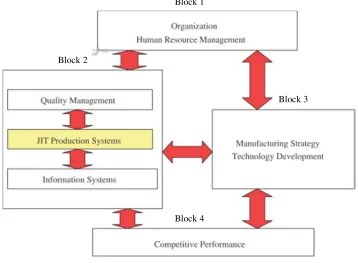
Matsui (2007) focused on the requirements for JIT production systems and the roles and consequences of JIT production for manufacturing companies including the ability of JIT production systems to support improved decisions or practices in other
operations management areas. Figure 5 indicates an analytical framework with four major building blocks to assess the real value of JIT production for Japanese manufacturing companies.
25 closely related to each other and interact with core manufacturing operations systems. These three blocks work together in determining the competitive performance of the manufacturing plant, indicated by block four (Matsui, 2007).
Figure 5 - Matsui Analytical Framework (Matsui, 2007).
This alludes to their use within the logistics environment where customers want to hold minimum stocks to support customer demand. With highly fluctuating demands across a high level of different products; known as Stock Keeping Units (SKU’s) and very short lead times, demands placed on suppliers cannot always be met. It is therefore
important to note that a JIT philosophy is not a one-size-fits-all solution.
The researcher’s workplace would be typical of this with a high number of SKU’s, some 14,500 with a 10% to 15% daily fluctuation in demand within 24 hours notice. JIT would not work under these constraints and the improvement opportunity here comes from effective management of the warehouse and transport operations, looking at CI and innovative opportunities rather than a direct JIT approach. In general, this suggests that the successful implementation of management driven practices frequently depends upon organisational characteristics, so that not all organisations can, or should, implement the same set of practices (Souza and Voss, 2008).
Block 1
Block 2
Block 3
26 1.8.6. Five-S Approach to the Workplace
Osada (1991) refers to Five-S (5S) as the five keys to a total quality environment. The term 5S has often been confused with simply having a clean and tidy workplace when in actual fact it goes much further than that. This situation is not helped by the fact that a large proportion of Western literature still acknowledges 5S as ‘housekeeping’ (Becker, 2001; Eckhardt, 2001). Fortunately, 5S is now more frequently understood to be the initial process in having a lean philosophy (James-Moore and Gibbons, 1997; Hines et al., 2004) as it encourages workers to improve their working conditions and helps them learn how to reduce waste, unplanned downtime, and in-process inventory (Gapp et al. 2008). Chapman (2005) indicates that 5S is a systematic approach to lean production; a business system for organising and managing manufacturing operations with the essence based on requiring less human effort, space, capital investment and time to make products with fewer defects.
The 5S’s are derived from five Japanese words namely; Seiri, Seiton, Seiso, Seiketsu and Shitsuke. It is a system of waste reduction management through optimisation of productivity and quality by maintaining an orderly workplace, utilising visual
management to achieve more consistent operational results. The practice of 5S aims to embed the values of organisation, neatness, cleaning, standardisation and discipline into the workplace, basically in its existing configuration (James-Moore and Gibbons, 1997). There are too many descriptions of 5S to note here from published literature; however a combination of Osada (1991); Bayo-Moriones et al. (2010) and Singh and Singh (2013) offer the reader a summary overview, with additional input from Becker (2001) and Ho (1998).
Seiri, which in English is referred to as the ‘sort’ element of 5S, is the process of
sorting out necessary and unnecessary items in the workplace and discarding those that are not required. The idea of Seiri is to keep only the required items in the workplace in a convenient location. An event known as ‘Red Tagging’ is often used through the sort process in which all items thought not to be required are tagged with a red indicator (small label) and then moved to a quarantine area for review before being disposed of if classified as not needed or waste. Although it can be difficult in
organisations that maintain equipment for possible future use this process is most effective when care is taken to identify and keep only essential items (Becker, 2001).
Seiton means ‘a place for everything and everything in its place’, with the equivalent