A Study on the Impact of Technology on Learning Expectations in Modern
Environment
Prof. Saumyabrata Nath, B.Sc(Maths-Hons), MBA(OM*), MBA(Mkt), MBA(HR) Assistant Professor
S.A.V. Acharya Institute of Management Studies, Mumbai E-mail Id : [email protected]
Abstract
"Everything new and different is automatically technology because it's usually branded as 'hard to understand,'" explained Lauren St. John, a senior at the University of Pittsburgh–Johnstown. For example, voice over the Internet. This seems like a new concept, but really we've been using this for years. Anyone with a mike on their computer would just press the 'talk' icon on instant messenger and there you have it—voice over the Internet."
Together, these three themes pose interesting questions for colleges and universities:
How will institutions define and develop technology-enabled learning when students view technology as encompassing a wide range of mobile options beyond the traditional classroom?
Do student expectations regarding technology and customization constitute a barrier to effective teaching and learning with technology?
What does it mean when students consider an institution's "advanced technology" as "so yesterday?"
Introduction
As human beings we are infinitely inventive and constantly searching for ways to improve our lives. Our accomplishments and inventions resulting from this quest have changed the course of history along the way. Information technology is not only revolutionizing the way that enterprises do business with consumers, but also the way that they do business with each other, the way they do business within the organization and more importantly the way they help their employees with these innovations. The application of computers both at home and at work help us to better organize our lives, more easily perform repetitive or logical tasks, and give us tools to support us in our creativity. Like the Renaissance and the Industrial Revolution before it, the Information Age continues to transform our lives and the ways in which we do many of our tasks. The use of computers to assist in performing tedious tasks, how-ever, is not a recent concept. For centuries, human beings have looked for ways to improve the accuracy of their computations and to better control the world around them. The cumbersome mainframe devices of the time were revolutionized in the 1970s, however, with the invention of the microprocessor. This innovative technology led to the development of the personal computer that is commonplace today both at home and at work. Since the introduction of the personal computer to the workplace, the way that we do work has been transformed. Depending on the software applications that are installed on the computers, one can not only do word processing, but desktop publishing as well. Electronic spreadsheets that automatically total columns of figures and quickly paste cells to other pages make the task of double entry bookkeeping almost fun. Whether we work on independent personal computers or are part of a network, the ability to do our work using computers has impacted us all. The application of computers to business is virtually as unlimited as the tasks we perform in the workplace.
Human Resource management is slowly being transformed by information technology. Technology today is the driver of new processes for dealing with citizens and suppliers. But it is also reshaping important functions and processes that only organizations may care about such as accounting, payroll and personnel administration. All put together, the internal and external impact of new technologies is changing the way organizations manage and make decisions. This also calls for a look at the other side of the coin. Technology has done more harm than good to human beings. One bad effect of technology on life is that with more technology placing barriers between people, face to face meetings happen less. This small change leads to a whole host of serious problems with society in general.
Business Relationships
Employee Morale
Installing monitoring software in the workplace sends the message to employees that the company does not trust them, according to research done under the aegis of Professor Howard Besser while teaching at New York University. Giving employees responsibility, trust and respect boosts their morale and productivity. Showing them that they are not trusted and must be recorded decreases morale and worker productivity. This is true regardless of the actual reasons for installing monitoring software, according to the same research.
Spam
Spam refers to unwanted and unsolicited email messages. Spam is widespread and has negative impacts on business, according to the article "Impact of Information Technology on Global Business" published by Purdue University. Wading through spam email is a waste of time, and spam filters can only do so much. Users of spam filters must then check for necessary email messages diverted incorrectly as spam.
Brick and Mortar
The popularity of ecommerce has had a negative impact on brick-and-mortar retail stores. Smaller stores are finding more and more difficult to compete with both Internet businesses and larger retail stores. For example, small community bookstores must compete with Amazon.com as well as large stores such as Barnes & Noble that sell in person and online. Sometimes the smaller stores end up going out of business.
As Mark Kennedy rightly said “All of the biggest technological inventions created by man- the airplane, the automobile, the computer- says little about his intelligence, but speaks volumes about his laziness”
Objectives of Study
1) To study the technology and its implications on human learning.
2) To study the learning cycle and its implications on overall development at Technological & learning phases.
3) To study the impact of technology on how it affects human life. 4) To study the negative impact of technology on human expectations.
Need for Study
Research is required in any field to come up with new theories or modify, accept, or nullify the existing theory. From time immemorial we have seen so many discoveries and inventions that took place through research and the world has got so many new theories which help the human being to solve his problems.
Technology in business we would concentrate on the implications of technology on human beings and his expectations
It discovers facts and relationship in order to make the use of technology more effective. It relates social sciences like human psychology and learning to technology.
Scope of Study
Research is confined to make operational in colleges of professional courses.
Statement of Problem
Recent Research has examined several factors influencing career development. These same factors also affect other aspects of human development.
Learning Domain/ discipline has more dimensions added into it for effective learning. It is imperative to understand, explore and describe what critical factors like Leadership, Culture, Attitude, Motivation; Communication skills etc will have greater impact on successful learning and Overall Development of the students.
It is now a challenge for academics to incorporate and design a curriculum to bring the much sought after change and helps the students transform their knowledge and aim at overall development.
With this scenario and context researcher has taken up this study to explore and define the impact of technology on human life.
Research Design
A qualitative approach was followed. Qualitative research is a method of inquiry employed in many different academic disciplines, traditionally in the social-sciences, but also in market research and further contexts. Qualitative research aims to gather an in-depth understanding of human behavior and the reasons that govern such behavior. The qualitative method investigates why and how of decision making, not just what, where, when.
Surveys may be used for descriptive, explanatory and exploratory research. A descriptive survey design was used. A survey is used to collect original data for describing a population too large to observe directly (Mouton 1996:232). A survey obtains information from a sample of people by means of self-report, that is, the people respond to a series of questions posed by the investigator (Pilot & Hungler 1993:148). In this study the information was collected through self-administered questionnaires distributed personally to the subjects by the researcher.
A descriptive survey was selected because it provides an accurate portrayal or account of the characteristics, for example behavior, opinions, abilities, beliefs, and knowledge of a particular individual, situation or group. This design was chosen to meet the objectives of the study.
Extension education, Radhakrishna, Leite, and Baggett (2003) found that 64% used questionnaires. They also found that a third of the studies reviewed did not report procedures for establishing validity (31%) or reliability (33%). Development of a valid and reliable questionnaire is a must to reduce measurement error. Groves (1987) defines measurement error as the "discrepancy between respondents' attributes and their survey responses" (p. 162).
Development of a valid and reliable questionnaire involves several steps taking considerable time. The steps are background, questionnaire conceptualization, and format and data analysis, establishing validity and establishing reliability.
Research Methodology
In this chapter the research methodology used in the study is described. The geographical area where the study was conducted, the study design and the population and the sample are described. The instrument used to collect the data, including methods implemented to maintain validity and reliability of the instrument are described.
A qualitative approach was followed. Qualitative research is a method of inquiry employed in many different academic disciplines, traditionally in the social-sciences, but also in market research and further contexts. Qualitative research aims to gather an in-depth understanding of human behavior and the reasons that govern such behavior. The qualitative method investigates why and how of decision making, not just what, where, when
Primary research entails the use of immediate data in determining the impact of environment on comprehensive development of students. In this study primary data was gathered from students, who were given questionnaires on various factors influencing development. Primary data is more accommodating as it shows latest information. Whereas secondary research is a means to reprocess and reuse collected information. In secondary data, information relates to a past period. Secondary data is obtained from journals, articles and web on different learning theories and on matters instantaneously interested with current research project.
Education research is a widespread study owing to its omnipresence. To get a clear understanding of the topic of study a large number of educational institutions and students have to be considered for primary data. But due to resource and time constraints, a sample size of 100 was targeted. And finally data was gathered from a convenient sample of 89 respondents. Weighted average technique was used to organize and analyze data.
Limitations
In every project work there are some kinds of constraints that affect the accuracy of work. This research shall be concentrated on only Little Flower Public School and students of 10th standard. This is specifically related to the researcher’s inability to cover the wide educational spread of the country.
There may also be some limitations in both collection and analysis of data, owing to the age of the students and their understanding of the questionnaire, which shall be attributed to data collection, reliability and authenticity of data obtained in normal circumstances.
Finally this research was constrained by the available budget and severely limited by the amount of time available. Most of the research and analysis was done in the three months, time frame.
Technology and its impact on Learning
"Everything new and different is automatically technology because it's usually branded as 'hard to understand,'" explained Lauren St. John, a senior at the University of Pittsburgh–Johnstown. "For example, [take] voice over the InterNext. This seems like a new concept, but really we've been using this for years. Anyone with a mike on their computer would just press the 'talk' icon on instant messenger and there you have it—voice over the InterNext."
Together, these three themes pose interesting questions for colleges and universities:
How will institutions define and develop technology-enabled learning when students view technology as encompassing a wide range of mobile options beyond the traditional classroom?
Do student expectations regarding technology and customization constitute a barrier to effective teaching and learning with technology?
What does it mean when students consider an institution's "advanced technology" as "so yesterday?"
To address these questions, we have to look at the learning expectations of the Next Generation.
Learning Expectations of the Next Generation
The Next Generation's learning expectations begin with the expertise and passion of the faculty member. The following student comments represent the general perspective of students
interviewed for this process:
"To me, my success in the classroom depends on the teacher. If the teacher is prepared and knowledgeable about their particular field, I know I can expect to learn from their knowledge as well as know what is expected of me." —Joseph Gerocs, Junior, San Diego State University
"I love when I come back from a class where my professor's knowledge of a particular field is astonishing." —Samuel Bass, Junior, Southwest Missouri State University. "It's great when the professor is passionate about the field. They are usually
The assertion made in this study is that there exists an individual domain which encapsulates personal factors that influence student learning, and that these factors can be described by a students’ motivation towards engaging in the learning activities and his/her capability to
understand the concepts. Students need to have motivation and the skill to be successful learners. Motivation has been found to affect students’ learning progress. It is an abstract concept and there are a number of theories about it.
In all, there are many factors that influence the development of an individual and in turn influence his learning abilities. These influences may vary or differ from individual to individual. The problem of research in learning is that each of these factors is regarded as important, with all having an immediate impact. Consequently, studying anyone of them in isolation from the others carries obvious risks. On the other hand it is difficult, if not impossible to discuss all of them at once.
Literature Review
Learners have changed as a result of their exposure to technology, says Greenfield, who analyzed more than 50 studies on learning and technology, including research on multi-tasking and the use of computers, the Internet and video games. Her research was published this month in the journal Science.
Reading for pleasure, which has declined among young people in recent decades, enhances thinking and engages the imagination in a way that visual media such as video games and television do not, Greenfield said.
How much should schools use new media, versus older techniques such as reading and classroom discussion?
"However, most visual media are real-time media that do not allow time for reflection, analysis or imagination — those do not get developed by real-time media such as television or video games. Technology is not a panacea in education, because of the skills that are being lost.
"Studies show that reading develops imagination, induction, reflection and critical thinking, as well as vocabulary," Greenfield said. "Reading for pleasure is the key to developing these skills. Students today have more visual literacy and less print literacy. Many students do not read for pleasure and have not for decades."
Another study Greenfield analyzed found that college students who watched "CNN Headline News" with just the news anchor on screen and without the "news crawl" across the bottom of the screen remembered significantly more facts from the televised broadcast than those who watched it with the distraction of the crawling text and with additional stock market and weather information on the screen.
information is made available in ways that reflect the unique experiences, backgrounds and learning styles of each student.
There is a great deal of research on the attributes of student-centered classroom. Most of the research is reported in the form of studies based on observation. Froyd and Simpson (2008) referenced the National Research Council (2000) that synthesized research on learning and recommended organizing the
learning environment around four foci: knowledge, learner, assessment and community. Although the research and theory on student-centered learning is complex and diverse, McCombs and Miller (2006) provide a description that sufficiently summarizes how student-centered learning impacts the relevant components of a school system.
Theories of learning
Theories about human learning can be grouped into four broad “perspectives”. They are 1. Behaviorism- focus on observable behavior
2. Cognitive- learning as purely a mental/ neurological process 3. Humanistic- emotions and affect play a role in learning 4. Social- humans learn best in group activities
The development of these theories over many decades is a fascinating story. There is also information about general theories of learning, memory and instructional methodology.
Experiential Theory
Kolbproposed a four-stage learning process with a model that is often referred to in describing experiential learning (McGill & Beaty 1995). The process can begin at any if the stages and is continuous, i.e there is no limit to the number of cycles you can make in learning situation. This theory asserts that without reflection we would simply continue to repeat our mistakes.
Honey and Mumford (1986 cited in McGill & Beaty 1995 p177) building on Kolb’s work, identified four learning styles:
Activist (enjoys the experience itself)
Reflector (spends a great deal of time and effort reflecting)
Theorist (good at making connections and abstracting idea from experience)
Pragmatist (enjoys the planning stage)
There are strengths and weaknesses in each of these styles. Honey and Mumford argue that learning is enhanced when we think about our learning style so that we can build on strengths and work towards minimizing weaknesses to improve the quality of learning
Data Collection
Data collection is an important aspect of any type of research study. Inaccurate data collection can impact the results of a study and ultimately lead to invalid results. Data collection methods for impact evaluation vary along a continuum. At one end of this continuum is, quantitative methods and at the other and of the continuum is qualitative methods for data collection. This study uses the quantitative method of data collection, which relies on random sampling and structured data collection that fit diverse experiences into predetermined response categories. They produce results that are easy to summarize, compare and generalize.
Questionnaire was the main data gathering strategy used for this study. The questionnaire consisted of 13 questions, describing various parameters that might influence the overall development of the students. The questionnaire used checklist and rating scales. These devices help simplify and quantify people’s behaviors and attitudes. A checklist is a list of behaviors or characteristics, or other entities that the researcher is looking for. Either the researcher or the survey participant simply checks whether each item on the list is observed, present or true or vice versa. A rating scale is more useful when a behavior needs to be evaluated on a continuum, also known as Likert Scales.
Focus Group
The focus of the study were secondary school students, especially students of standard X, as the researcher believes that secondary school forms the foundation of a student’s future endeavors and performances. The study was conducted at Little Flower Public School, Bangalore, affiliated to the Indian School Certificate Examinations, New Delhi.
Sampling Methods
biological fields of study, when attempting to assess trends in human development or to gain a better understanding of changes in human behavior.
Sample Size
According to Burns and Grove (1993:779), a population is defined as all elements (individuals, objects and events) that meet the sample criteria for inclusion in a study. The study population consisted of students studying in professional courses like MMS, BMS, Engineering & Diploma courses in Raigad District, Maharashtra. A convenient sample of 100 was selected from the different Institutions. Mouton (1996:132) defines a sample as elements selected with the intention of finding out something about the total population from which they are taken.
Tools Used
This study used the weighted average tool to organize and analyze data. It is an average in which each quantity to be averaged is assigned a weight. These weightings determine the relative importance of each quantity on the average. Weightings are the equivalent of having that many like items with the same value involved in the average. Graphical and tabular format was used to represent data, which displays the number of observations within a given interval.
Analysis and Interpretation
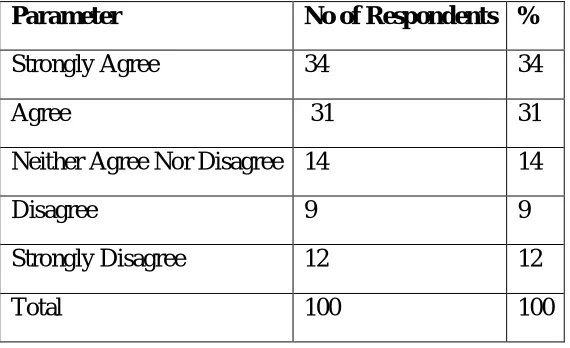
Table 1: Title: Quality of Technology has an impact on student’s performance.
Parameter No of Respondents %
Strongly Agree 34 34
Agree 31 31
Neither Agree Nor Disagree 14 14
Disagree 9 9
Strongly Disagree 12 12
Total 100 100
Observation: From the above table researcher found that 34% strongly agree that quality of technology has an impact on the overall performance of the student, and 31% agree, 14% neither agree nor disagree, 9% disagree and a mere 12S% strongly disagree with the above parameter.
Inference: From the above table we infer that quality of technology does have an impact on the overall performance of a student.
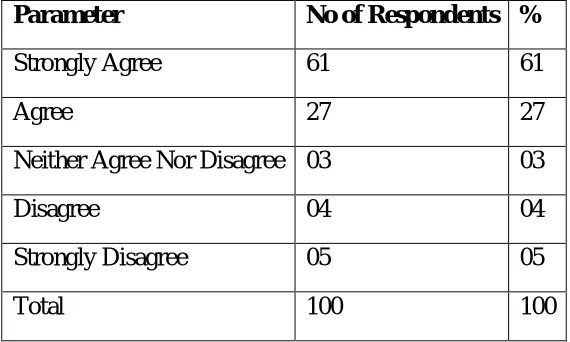
Table 2:
Parameter No of Respondents %
Strongly Agree 61 61
Agree 27 27
Neither Agree Nor Disagree 03 03
Disagree 04 04
Strongly Disagree 05 05
Total 100 100
Observation: From the above table researcher found that 61% strongly agree that technology eases the ability to understand the concepts effects learning , and 27% agree, 3% neither agree nor disagree, 4% disagree and a mere 5% strongly disagree with the above parameter.
Inference: From the above table we can understand the importance of conceptual understanding. It is clear that Technology eases the ability to understand the concepts and affects the learning of a student.
Table 3
Title: technology is necessary to express knowledge.
Parameter No of Respondents %
Strongly Agree 08 08
Agree 27 27
Neither Agree Nor Disagree 60 60
Disagree 04 04
Strongly Disagree 01 01
Total 100 100
Observation: From the above table researcher found that 8% strongly agree that technology is necessary to express knowledge, and 27% agree, and a majority of 60% neither agree nor disagree, 4% disagree and a mere 1% strongly disagree with the above parameter.
Inference: technology is an integral part of learning but students appreciate a balanced form of information transfer and do not believe that technology is a must for expression of knowledge.
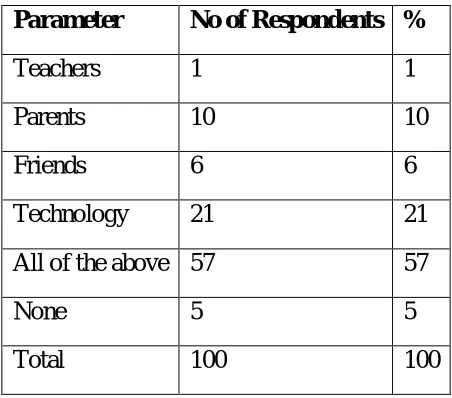
Title: Technology as a motivation for students.
Parameter No of Respondents %
Teachers 1 1
Parents 10 10
Friends 6 6
Technology 21 21
All of the above 57 57
None 5 5
Total 100 100
Observation: 1% agrees that teachers are the source of motivation, and to 10% of the students’ parents are the source of motivation, for 6% friends are the motivation, and to 21% technology is a source of motivation, 57% opine that all of the above are a source of motivation for them, and 5% take no motivation from the above mentioned people.
Inference: From the above table we understand that technology also motivates a student to some extent
Table 5
Title: Technology affects the learning of a student.
Parameter No of Respondents %
Strongly Agree 38 38
Agree 31 31
Neither Agree Nor Disagree 25 25
Disagree 5 5
Strongly Disagree 1 1
Observation: From the above table researcher found that 38% strongly agree that Technology affects the learning of a student, and 31% agree, 25% neither agree nor disagree, 5% disagree and a mere 1% strongly disagree with the above parameter.
Inference: From the above table we infer that Technology has an impact on the learning of the students and must be taken note of in the process of learning.
Table 6
Title: Technology is a strong determinant of an individual’s development.
Parameter No of Respondents %
Strongly Agree 50 50
Agree 33 33
Neither Agree Nor Disagree 10 10
Disagree 5 5
Strongly Disagree 2 2
Total 100 100
Observation: From the above table researcher found that 50% strongly agree that Technology is a strong determinant of an individual’s development, and 33% agree, 10% neither agree nor disagree, 5% disagree and a mere 2% strongly disagree with the above parameter.
Inference: From the above table we can also infer that Technology is also a major determinant of an individual’s overall development.
Table 7
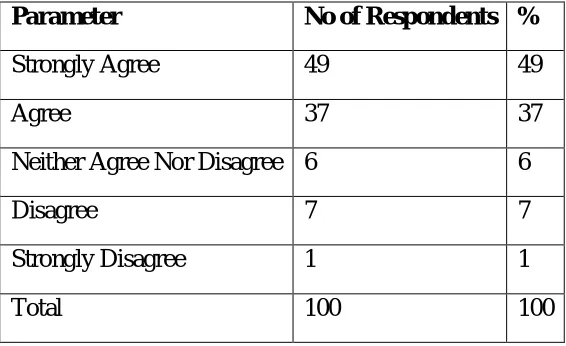
Title: Technology improves the Self learning ability of a student.
Parameter No of Respondents %
Strongly Agree 49 49
Agree 37 37
Neither Agree Nor Disagree 6 6
Disagree 7 7
Strongly Disagree 1 1
Observation: From the above table researcher found that 49% strongly agree that technology improves the self-learning ability of a student, and 37% agree, 6% neither agree nor disagree, 7% disagree and a mere 1% strongly disagree with the above parameter.
Inference: The above table proves the fact that self- learning improves with the help of
technology and makes learning effective and has an impact on the intellectual development of a student.
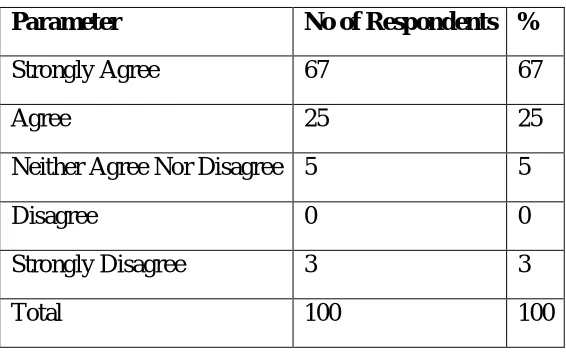
Table 8
Title: Technology helps in reinforcement of knowledge.
Parameter No of Respondents %
Strongly Agree 67 67
Agree 25 25
Neither Agree Nor Disagree 5 5
Disagree 0 0
Strongly Disagree 3 3
Total 100 100
Observation: From the above table researcher found that 67% strongly agree that Technology helps in better practice, retention and reinforcement of the acquired knowledge, and 25% agree, 5% neither agree nor disagree, 0% disagree and a mere 3% strongly disagree with the above parameter.
Inference: The table above shows that Technology helps in better understanding and reinforcement of acquired knowledge.
Table 9
Title: Technology influences a student’s future endeavors.
Parameter No of Respondents %
Strongly Agree 52 52
Agree 29 29
Neither Agree Nor Disagree 14 14
Disagree 4 4
Total 100 100
Observation: From the above table researcher found that 52% strongly agree that Technology influences the future endeavors of students, and 29% agree, 14% neither agree nor disagree, 4% disagree and a mere 1% strongly disagree with the above parameter.
Inference: Technology always plays an important role in shaping up the future endeavors of students.
Table 10
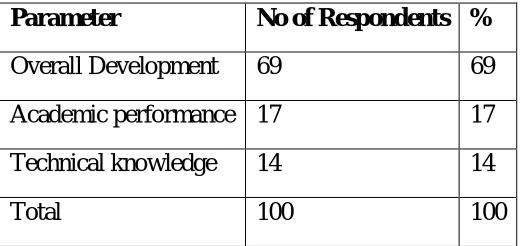
Title: Critical factor for success.
Parameter No of Respondents %
Overall Development 69 69
Academic performance 17 17 Technical knowledge 14 14
Total 100 100
Observation: From the above table researcher found that 69% strongly agree that overall development is the critical factor for success, and 17% believe that academic performance is necessary to be successful, and 14% students opine that technical knowledge is important for success.
Inference: From the above statistics we understand that it is not only the Technology that
decides the success of a student but a majority of students believe that overall development is the critical factor for success.
Table 11:
Title: Parent guidance helps overall development of students.
Parameter No of Respondents %
Strongly Agree 56 56
Agree 29 29
Neither Agree Nor Disagree 9 9
Disagree 5 5
Strongly Disagree 1 1
Observation: From the above table researcher found that 56% strongly agree that parent guidance helps overall development of students, and 29% agree, 9% neither agree nor disagree, 5% disagree and a mere 1% strongly disagree with the above parameter.
Inference: Parent guidance and help is of great importance during the formative years of the students, and helps in their overall development.
Table 12:
Title: Information Technology like smart class is an efficient service delivery system and an aide to understand the concepts.
Parameter No of Respondents %
Strongly Agree 26 26
Agree 42 42
Neither Agree Nor Disagree 14 14
Disagree 10 10
Strongly Disagree 8 8
Total 100 100
Observation: From the above table researcher found that 26% strongly agree that Information technology like smart class helps in efficient service delivery and better understanding of the concepts, and 42% agree, 14% neither agree nor disagree, 10% disagree and a mere 8% strongly disagree with the above parameter.
Inference: A picture is equal to a thousand words. And today information technology plays a major role in providing efficient service and helping students better understand the concepts.
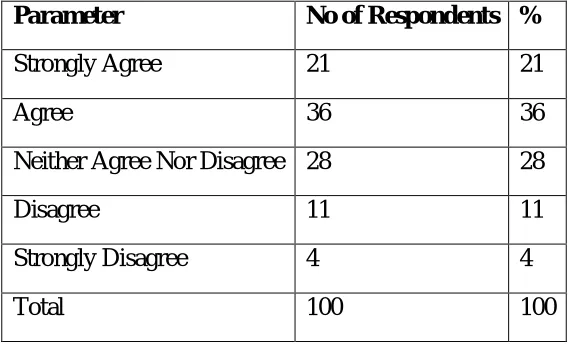
Table 13:
Title: Technology influences the all-round development of students.
Parameter No of Respondents %
Strongly Agree 21 21
Agree 36 36
Neither Agree Nor Disagree 28 28
Disagree 11 11
Strongly Disagree 4 4
Observation: From the above table researcher found that 21% strongly agree that technology helps in all-round development of students, and 36% agree, 28% neither agree nor disagree, 11% disagree and a mere 4% strongly disagree with the above parameter.
Inference: The use of technology always helps students in gathering new information and thus helps in the overall development of students.
Summary of Findings
1. Researcher infers that quality of technology does have an impact on the overall performance of a student.
2. We understand the importance of conceptual understanding. It is clear that Technology eases the ability to understand the concepts and affects the learning of a student. 3. Technology is an integral part of learning but students appreciate a balanced form of
information transfer and do not believe that technology is a must for expression of knowledge.
4. Technology also motivates a student to some extent
5. Researcher opines that technology has an impact on the learning of the students and must be taken note of in the process of learning.
6. Technology is a major determinant of an individual’s overall development.
7. Self- learning improves with the help of technology and makes learning effective and has an impact on the intellectual development of a student.
8. Researcher feels that technology helps in better understanding and reinforcement of acquired knowledge.
9. Technology always plays an important role in shaping up the future endeavors of students.
10.From the above statistics we understand that it is not only the Technology that decides the success of a student but a majority of students believe that overall development is the critical factor for success.
11.Parent guidance and help is of great importance during the formative years of the students, and helps in their overall development
12.A picture is equal to a thousand words. And today information technology plays a major role in providing efficient service and helping students better understand the concepts. 13.The use of technology always helps students in gathering new information and thus helps
Conclusion
Knowledge becomes an enhancement for living when it aids our life, not when it starts hampering it. It sounds surprising when something that has been hailed as a life saver is called a life spoiler. But the fact of the matter is that for an average learner, technological innovations have become knowledge bombardments. And the irony is that it all goes down the drain when it becomes ineffective due to lack of use, or should I say lack of proper use. Today’s learner is born into a world which throws knowledge at him from every corner. A century ago it was the parent and after that the teacher who was responsible for imparting knowledge. As Alvin Toffler points out ‘the illiterate of the 21st century will not be those who cannot read and write, but those who cannot learn, unlearn and relearn.’ Thus it becomes imperative for the education system to lay stress on basic skills that will equip them for life. Skills that will enhance their communication, problem-solving and interpersonal abilities. It is equally important for each learner to take an initiative of his or her own to better himself. In a world where innovation has become a trademark and thinking out of the box has become mandatory, establishing systems to enable lifelong learning has become an integral part for schools. Shape Up or Ship Out is the mantra for schools which refuses to acknowledge the fact that students of today are more aware of what’s happening around them, are exposed to the knowledge explosion. The latest technological advances have done much to facilitate the HR transformation. Indeed by altering the access, flow and distribution of information in an organization, technology has transformed public personnel administration by reducing the labor intensity of the record keeping function and thereby releasing resources to play a strategic role for the use of Technological innovations if the individual’s total development lags behind.
References
1. Anderson. J.R (1995). Cognitive Psychology and its Implications, Fourth Edition. New York: W. H. Freeman & Company.
2. Anderson. R. C. (1977). The notion of schemata and the educational enterprise, schooling and acquisition of knowledge. Hillsdale, NJ: Erlbaum.
3. Bandura A. (1986) Social Foundations of Thought and Action.
4. Bruner. J. (1996). The culture of education, Cambridge, MA: Harvard University press.
5. Burns, R. 1995 The adult learner at work Business and Professional Publishing,
6. Elmasri, R. & Navathe, S. B. (1989). Fundamentals of database systems. Redwood City, CA: The Benjamin/Cummings Publishing Company.
7. Evans, Nancy J., Deanna S. Forney, and Florence DiBrito. Student development in college: theory, research, and practice. San Francisco: Jossey-Bass Publishers, 1998. Print.
8. Kohler. W. (1947). Gestalt psychology: an introduction to new concepts in modern psychology (rev.ed) New York: Liver right.
9. Laird, D. 1985 Approaches to training and development Addison-Wesley,
10. Lucas, H. C. Jr. (2005).Information technology: Strategic decision making for managers. New York: John Wiley and Sons.