APPENDIX
The Commander's Handbook
on the Law
of Naval Operations
NWP 9 (Rev. A)
FMFM 1-10
385
The opinions shared in this paper are those of the author and do not necessarily reflect the views and opinions of the U.S. Naval War College, the Dept. of the Navy, or Dept. of Defense.
PREFACE
SCOPE
This publication sets out those fundamental principles of international and domestic law that govern
u.s.
naval operations at sea. Part I, Law of Peacetime Naval Operations, provides an overview and general discussion of the law of the sea, including definitions and descriptions of the jurisdiction and sovereignty exercised by nations over various parts of the world's oceans; the international legal status and navigational rights of warships and military aircraft; protection of persons and property at sea; and the safeguarding of national interests in the maritime environment. Part II, Law of Naval Warfare, sets out those principles of law of special concern to the naval commander during any period in whichu.s.
naval forces are engaged in armed conflict. Although the primary emphasis of Part II is upon the rules of international law concerned with the conduct of naval warfare, attention is also directed to relevant principles and concepts common to the whole of the law of armed conflict.PURPOSE
This publication is intended for the use of operational commanders and supporting staff elements at all levels of command. It is designed to provide officers in command and their staffs with an overview of the rules of law governing naval operations in peacetime and during armed conflict. The explanations and descriptions in this publication are intended to enable the naval commander and his staff to comprehend more fully the legal foundations upon which the orders issued to them by higher authority'are premised and to understand better the commander's responsibilities under international and domestic law to execute his mission within that law. This publication sets forth general guidance. It is not a comprehensive treatment of the law nor is it a substitute for the definitive legal guidance provided by judge advocates and others responsible for advising commanders on the law.
Officers in command of operational units are encouraged to utilize this publication as a training aid for assigned personnel.
APPLICABILITY
388 Law of Naval Operations
conflict. It is the policy of the United States to apply the law of armed conflict to all circumstances in which the armed forces of the United States are engaged in combat operations, regardless of whether such hostilities are declared or otherwise designated as "war." Relevant portions of Part II are, therefore, applicable to all hostilities involving U.S. naval forces irrespective of the character, intensity, or duration of the conflict. Part II may also be used for information and guidance in situations in which the U.S. is a nonparticipant in hostilities involving other nations.
RULES OF ENGAGEMENT (ROE)
The Joint Chiefs of Staff and the commander~ of the unified and specified commands have the authority to exercise the right of national self-defense and declare forces hostile. Incident to this authority, the commanders of the unified and specified commands may issue directives, e.g., rules of engagement, that delineate the circumstances and limitations under which the forces under their command will initiate and/or continue engagement with other forces encountered. These directives are definitive within the commander's area of responsibility. This publication provides general information,
is not directive, and does not supersede guidance issued by such commanders or higher authority.
INTERNATIONAL LAW
For purposes of this publication, international law is defined as that body of rules that nations consider binding in their relations with one another. International law derives from the practice of nations in the international arena and from international agreements. International law provides stability in international relations and an expectation that certain acts or omissions will effect predictable consequences. If one nation violates the law, it may expect that others will reciprocate. Consequently, failure to comply with international law ordinarily involves greater political and economic costs than does observance. In short, nations comply with international law because it is in their interest to do so. Like most rules of conduct, international law is in a continual state of development and change.
389
International Agreements. An international agreement is a commitment entered into by two or more nations which reflects their intention to be bound by its terms in their relations with one another. International agreements, whether bilateral treaties, executive agreements, or multilateral conventions, bind only those nations that are a party to them or that may otherwise consent to be bound by them. To the extent that multilateral conventions of broad application codify existing rules of customary law, they may be regarded as evidence of international law binding upon parties and nonparties alike.
u.s. Navy Regulations. u.s. Navy Regulations, 1973, require U.S. naval
commanders to observe international law. Article 0605, Observance of International Law, states:At all times, a commander shall observe and require his command to observe the prinicples of international law. Where necessary to fulfillment of this responsibility, a departure from other provisions of Navy Regulations is authorized.
ORDERING DATA
Report any page shortage by speedletter to NAVTACSUPPACT (copy to CNO (OP-953) ). Order a new publication or change, as appropriate, by submitting Form DD 1348 to NA VPUBFORMCEN Philadelphia in accordance with Introduction to Navy Stocklist of Publications and Forms, NA VSUP Publication 2002.
RECOMMENDED CHANGES
Recommended changes to this publication may be submitted at any time using the accompanying format for routine changes.
Submit recommendations to:
NA VY JAG (Code 10) 200 Stovall Street
Alexandria, VA 22332-2400
In addition forward two copies of all recommendations to:
Director
Navy Tactical Support Activity Washington Navy Yard
390 Law of Naval Operations
URGENT CHANGE RECOMMENDATIONS
When items for changes are considered to be urgent (as defined in NWP
o
and including matters of safety), this information shall be sent by priority message (see accompanying sample message format) to NAVY JAG, with information copies to CNO (OP-616B), Naval Safety Center (if appropriate), Navy Tactical Support Activity, and all other commands concerned, clearly explaining the proposed change. Information addresses should comment as appropriate. See NWP O.CHANGE SYMBOLS
Revised text is indicated by a black vertical line in either margin of the page, like the one printed next to this paragraph. The change symbol shows where there has been a change. The change might be material added or information restated. A change symbol in the margin by the chapter number and title indicates a new or completely revised chapter.
[Editor's note: We have omitted change symbols in this appendix. Instead, as noted in the Preface to this volume, we have underlined the changes. In many cases, the only changes which occurred betweeen the original NWP 9 and this revised edition have been the italicization of certain words for emphasis. In such cases we have underlined the italicized words.]
USE OF ITALICS
Part I
Law of Peacetime Naval Operations
Chapter 1-Legal Divisions of the Oceans and Airspace
Chapter 2-Intemational Status and Navigation of Warships and Military Aircraft
Chapter 3-Protection of Persons and Property at Sea
392 Law of Naval Operations
Chapter 1
Legal Divisions of the
Oceans and Airspace
1.1 INTRODUCTION
The oceans of the world traditionally have been classified under the broad headings of internal waters, territorial seas, and high seas. Airspace has been divided into national and international airspace. In recent years, new concepts have evolved, such as the exclusive economic zone and archipelagic waters, which have dramatically expanded the jurisdictional claims of coastal and island nations over wide expanses of the oceans previously regarded as high seas. The phenomenon of expanding maritime jurisdiction and the rush to extend the territorial sea to 12 nautical miles and beyond were the subject of international negotiation from 1973 through 1982 in the course of the Third United Nations Conference on the Law of the Sea. That Conference produced the 1982 United Nations Convention on the Law of the Sea (1982 LOS Convention). Although not signed by the United States and not yet in formal effect, the provisions of the 1982 LOS Convention relating to navigation and overflight codified existing law and practice and are considered by the United States to reflect customary international law.
1.2 RECOGNITION OF COASTAL NATION CLAIMS
In a statement on U.S. oceans policy issued 10 March 1983, the President stated:
"First, the United States is prepared to accept and act in accordance with the balance of interests relating to traditional uses of the oceans - such as navigation and overflight. In this respect, the United States will recognize the rights of other States in the waters off their coasts, as reflected in the [1982 LOS] Convention, so long as the rights and freedoms of the United States and others under international law are recognized by such coastal States.
The legal classifications ("regimes") of ocean and airspace areas directly affect naval operations by determining the degree of control that a coastal or island nation may exercise over the conduct of foreign merchant ships, warships, and aircraft operating within these areas. The methods for measuring maritime jurisdictional claims, and the extent of coastal or island nation control exercised in those areas, are set forth in the succeeding paragraphs of this chapter. The DOD Maritime Claims Reference Manual (DoD 200S.1-M) contains a listing of the ocean claims of coastal and island nations.
1.3 MARITIME BASELINES
The territorial sea and all other mantlme zones are measured from baselines. In order to calculate the seaward reach of claimed maritime zones, it is first necessary to comprehend how baselines are drawn.
1.3.1 Low-Water Line
Unless other special rules apply, the baseline from which maritime claims of a nation are measured is the low-water line along the coast as marked on that nation's official large-scale charts.
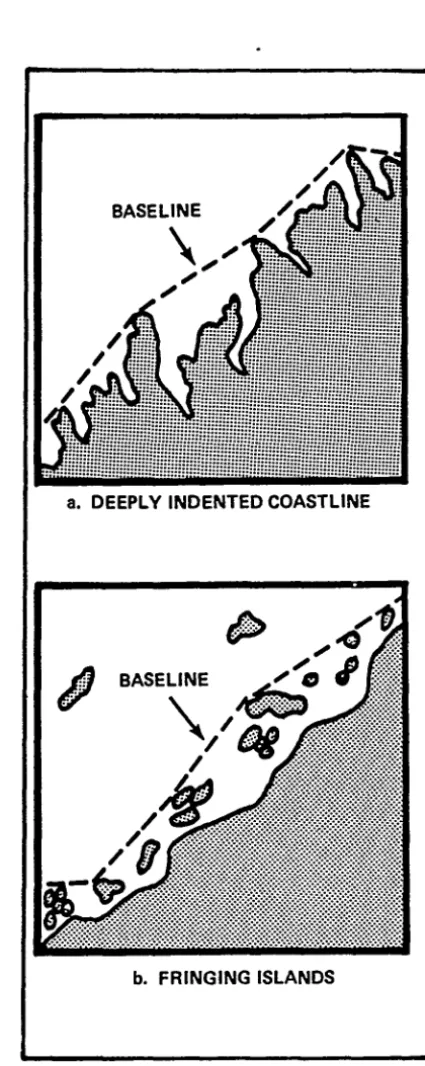
1.3.2 Straight Baselines. Where it would be impracticable to use the low-water line, as where the coastline is deeply indented or where there is a fringe of islands along the coast in its immediate vicinity, the coastal or island nation may instead employ straight baselines. The general rule is that straight baselines must not depart from the general direction of the coast, and the sea areas they enclose must be closely linked to the land domain. A coastal or island nation which uses straight baselines must either clearly indicate them on its charts or publish a list of geographical coordinates of the points joining them together. See Figure 1-1. The United States, with few exceptions, does not employ this practice and interprets restrictively its use by others.
1.3.2.1 Unstable Coastlines. Where the coastline is highly unstable due to natural conditions, e.g., deltas, straight baselines may be established connecting appropriate points on the low-water line. These straight baselines remain effective, despite subsequent regression or accretion of the coastline, until changed by the coastal or island nation.
394 Law of Naval Operations
or from a low-tide elevation unless a lighthouse or similar installation, which is permanently above sea level, has been erected thereon.
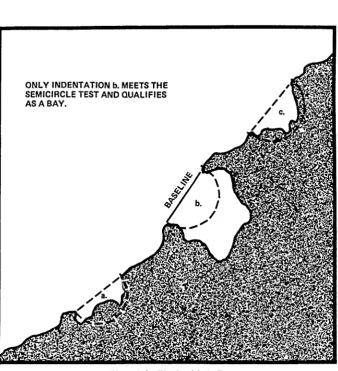
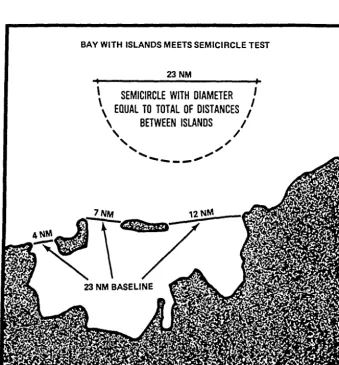
1.3.3 Bays and Gulfs. There is a complex formula for determining the baseline closing the mouth of a legal bay or gulf. For baseline purposes, a "bay" is a well-marked indentation in the coastline of such proportion to the width of its mouth as to contain landlocked waters and constitute more than a mere curvature of the coast. The water area of a "bay" must be greater than that of a semicircle whose diameter is the length of the line drawn across the mouth. See Figure 1-2. Where the indentation has more than one mouth due to the presence of islands, the diameter of the test semicircle is the sum of the lines across the various mouths. See Figure 1-3.
The baseline across the mouth of a bay may not exceed 24 nautical miles in length. Where the mouth is wider than 24 nautical miles, a baseline of 24 nautical miles may be drawn within the bay so as to enclose the maximum water area. See Figure 1-4. Where the semicircle test has been met, and a closure line of 24 nautical miles or less may be drawn, the body of water is a "bay" in the legal sense.
1.3.3.1 Historic Bays. So-called historic bays are not determined by the semicircle and 24-nautical mile closure line rules described above. To meet the international standard for establishing a claim to a historic bay, a nation must demonstrate its open, effective, long term, and continuous exercise of authority over the bay, coupled with acquiescence by foreign nations in the exercise of that authority. The United States has taken the position that an actual showing of acquiescence by foreign nations in such a claim is required, as opposed to a mere absence of opposition.
1.3.4 River Mouths. If a river flows directly into the sea, the baseline is a straight line across the mouth of the river between points on the low-water line of its banks.
1.3.5 Reefs. The low-water line of a reef may be used as the baseline for islands situated on atolls or having fringing reefs.
395
1.4 NATIONAL WATERS
For operational purposes, the world's oceans are divided into two parts. The first includes internal waters, territorial seas, and archipelagic waters. These "national waters" are subject to the territorial sovereignty of coastal and island nations, with certain navigational rights reserved to the international community. The second part includes contiguous zones, waters of the exclusive economic zone, and the high seas. These are "international waters" in which all nations enjoy the high seas freedoms of navigation and overflight. International waters are discussed further in paragraph 1.5.
1.4.1 Internal Waters. Internal waters are landward of the baseline from which the territorial sea is measured. Lakes, rivers, some bays, harbors, some canals, and lagoons are examples of internal waters. From the standpoint of international law, internal waters have the same legal character as the land itself. There is no right of innocent passage in internal waters, and, unless in distress, ships and aircraft may not enter or overfly internal waters without the permission of the coastal or island nation.
1.4.2 Territorial Seas. The territorial sea is a belt of ocean which is measured seaward from the baseline of the coastal or island nation and subject to its sovereignty. The
u.s.
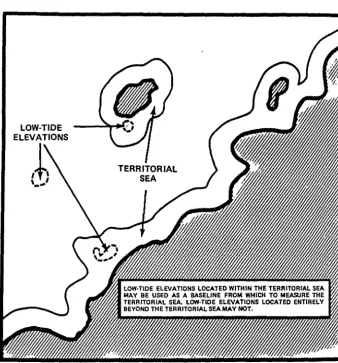
claims a 12-nautical mile territorial sea and recognizes territorial sea claims of other nations up to a maximum breadth of 12 nautical miles.1.4.2.1 Islands, Rocks, and Low-Tide Elevations. Each island has its own territorial sea and, like the mainland, has a baseline from which it is calculated. An island is defined as a naturally formed area of land, surrounded by water, which is above water at high tide. Rocks are islands which cannot sustain human habitation or economic life of their own. Provided they remain above water at high tide, they too possess a territorial sea determined in accordance with the principles discussed in the paragraphs on baselines. A low-tide elevation (above water at low tide but submerged at high tide) situated wholly or partly within the territorial sea may be used for territorial sea purposes as though it were an island. Where a low-tide elevation is located entirely
beyond the territorial sea, it has no territorial sea of its own. See Figure
1-5.
1.4.2.2 Artificial Islands and Off-Shore Installations. Artificial islands and off-shore installations have no territorial sea of their own.
396 Law of Naval Operations
partly beyond the limits of the territorial sea, are included within the territorial sea. Roadsteads included within the territorial sea must be clearly marked on charts by the coastal or island nation.
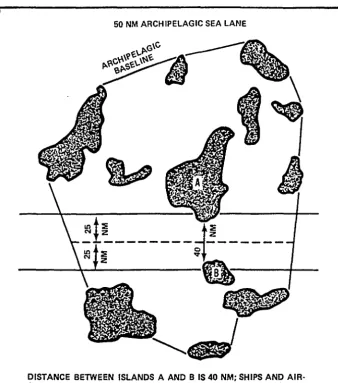
1.4.3 Archipelagic Waters. An archipelagic nation is a nation that is constituted wholly of one or more groups of islands. Such nations may draw straight archipelagic baselines joining the outermost points of their outermost islands, provided that the ratio of water to land within the baselines is between 1 to 1 and 9 to 1. The waters enclosed within the archipelagic baselines are called archipelagic waters. {The archipelagic baselines are also the baselines from which the archipelagic nation measures seaward its territorial sea, contiguous zone, and exclusive economic zone.} The u.S. recognizes the right of an archipelagic nation to establish archipelagic baselines enclosing archipelagic waters provided the baselines are drawn in conformity with the 1982 LOS Convention and that the u.S. is accorded navigation and overflight rights and freedoms under international law in the enclosed archipelagic and adjacent waters.
1.4.3.1 Archipelagic Sea Lanes. Archipelagic nations may designate archipelagic sea lanes through their archipelagic waters suitable for continuous and expeditious passage of ships and aircraft. All normal routes used for international navigation and overflight are to be included. If the archipelagic nation does not designate such sea lanes, the right of archipelagic sea lanes passage may nonetheless be exercised by all nations through routes normally used for international navigation and overflight.
1.5 INTERNATIONAL WATERS
International waters include all ocean areas not subject to the territorial sovereignty of any nation. All waters seaward of the territorial sea are international waters in which the high seas freedoms of navigation and overflight are preserved to the international community. International waters include contiguous zones, exclusive economic zones, and high seas.
island nation recognizes u.s. rights in the zone consistent with the provisions of the 1982 LOS Convention.
1.5.2 Exclusive Economic Zones. Exclusive economic zones (EEZs) are resource-related zones adjacent to the coast and extending beyond the territorial sea. As the name suggests, its central purpose is economic. The u.s. recognizes the sovereign rights of a coastal or island nation to prescribe and enforce its laws in the exclusive economic zone, extending up to 200 nautical miles from the baselines used to measure the territorial sea, for the purposes of exploration, exploitation, management, and conservation of the natural resources of the waters, seabed, and subsoil of the zone, as well as for the production of energy from the water, currents, and winds. The coastal or island nation may exercise jurisdiction in the zone over the establishment and use of artificial islands, installations, and structures having economic purposes; over marine scientific research (with reasonable limitations); and over some aspects of marine environmental protection (primarily implementation of international vessel-source pollution control standards). However, in the EEZ all nations enjoy the right to exercise the traditional high seas freedoms of navigation and overflight, of the laying of submarine cables and pipelines, and of all other traditional high seas uses by ships and aircraft which are not resource related. The United States established a 200-nautical mile exclusive economic zone by Presidential Proclamation on 10 March 1983.
1.5.3 High Seas. The high seas include all parts of the ocean seaward of the exclusive economic zone. When a coastal or island nation has not proclaimed an exclusive economic zone, the high seas begin at the seaward edge of the territorial sea.
398 Law of Naval Operations
1.6 CONTINENTAL SHELVES
The juridical continental shelf of a coastal or island nation consists of the seabed and subsoil of the submarine areas that extend beyond its territorial sea to the outer edge of the continental margin, or to a distance of200 nautical miles from the baseline used to measure the territorial sea where the continental margin does not extend to that distance. The continental shelf may not extend beyond 350 nautical miles from the baseline of the territorial sea or 100 nautical miles from the 2,500 meter isobath, whichever is greater. Although the coastal or island nation exercises sovereign rights over the continental shelf for purposes of exploring and exploiting its natural resources, the legal status of the superjacent water is not affected. Moreover, all nations have the right to lay submarine cables and pipelines on the continental shelf.
1.7 SAFETY ZONES
Coastal and island nations may establish safety zones to protect artificial islands, installations, and structures located in their internal waters, archipelagic waters, territorial seas and exclusive economic zones, and on their continental shelves. In the case of artificial islands, installations, and structures located in the exclusive economic zones or on the continental shelf beyond the territorial sea, safety zones may not extend beyond 500 meters from the outer edges of the facility in question, except as authorized by generally accepted international standards.
1.8 AIRSPACE
Under international law , airspace is classified as either national airspace (that over the land, internal waters, archipelagic waters, and territorial seas of a nation) or international airspace (that over contiguous zones, exclusive economic zones, the high seas, and territory not subject to the sovereignty of any nation). Subject to a right of overflight of international straits (see paragraph 2.5.1.1) and archipelagic sea lanes (see paragraph 2.5.1.2), each nation has complete and exclusive sovereignty over its national airspace. Except as they may have otherwise consented through treaties or other international agreements, the aircraft of all nations are free to operate in international airspace without interference by other nations.
1.9 OUTER SPACE
399
400 Law of Naval Operations
BASELINE
\
"
"""
a. DEEPLY INDENTED COASTLINE
4b
-0'
"
JfJ
BASE~E
/~tf)
I
"/ dJi
b. FRINGING ISLANDS
ONLY INDENTATION b. MEETS THE SEMICIRCLE TEST AND QUALIFIES ASABAY.
402 Law of Naval Operations
BAY WITH ISLANDS MEETS SEMICIRCLE TEST
23NM
I ,
\ SEMICIRCLE WITH DIAMETER I
\ EQUAL TO TOTAL OF DISTANCES /
\
,
BETWEEN ISLANDS //
'"
'....
/; /
...
_--""
'2NM
BASELINE WHERE BAY NARROWS TO 24 NM
404 Law of Naval Operations
LOW·TlDE ELEVATIONS LOCATED WITHIN THE TERRITORIAL SEA MAY BE USED AS A BASELINE FROM WHICH TO MEASURE THE TERRITORIAL SEA. LOW·TlDE ELEVATIONS LOCATED ENTIRELY BEYOND THE TERRITORIAL SEA MAY NOT.
Chapter 2
I nternational Status and Navigation of
Warships and Military Aircraft
2.1 STATUS OF WARSlTIPS
2.1.1 Warship DeHned. International law defines a warship as a ship belonging to the armed forces of a nation bearing the external markings distinguishing the character and nationality of such ships, under the command of an officer duly commissioned by the government of that nation and whose name appears in the appropriate service list of officers, and manned by a crew which is under regular armed forces discipline. In the
U.s.
Navy, those ships designated"uss"
are "warships" as defined by international law.u.s.
Coast Guard vessels designated "USCGC" are also "warships" under international law.2.1.2 International Status. A warship enjoys sovereign immunity from interference by the authorities of nations other than the flag nation. Police and port authorities may board a warship only with the permission of the commanding officer. A warship cannot be required to consent to an onboard search or inspection, nor may it be required to fly the flag of the host nation. Although warships are required to comply with coastal nation traffic control, sewage, health, and quarantine restrictions instituted in conformance with the 1982 LOS Convention, a failure of compliance is subject only to diplomatic complaint or to coastal nation orders to leave its' territorial waters immediately. Moreover, warships are immune from arrest and search, whether in national or international waters, are exempt from foreign taxes and regulation, and exercise exclusive control over all passengers and crew with regard to acts performed aboard.
2.1.2.1 Nuclear Powered Warships. Nuclear powered warships and conventionally powered warships enjoy identical international legal status.
406 Law of Naval Operations
accident or enemy action (unless the warship or aircraft was captured before it sank). As a matter of policy, the
u.s.
Government does not grant permission to salvage sunkenu.s.
warships or military aircraft that contain the remains of deceased service personnel or explosive material. Requests from foreign countries to have their sunken warships or military aircraft, located in U.S. waters, similarly respected by salvors, are honored.2.1.2.3 Auxiliaries. Auxiliaries are vessels, other than warships, that are owned by or under the exclusive control of the armed forces. Because they are state owned or operated and used for the time being only on government noncommercial service, auxiliaries enjoy sovereign immunity. This means that, like warships, they are immune from arrest and search, whether in national or international waters. Like warships, they are exempt from foreign taxes and regulation, and exercise exclusive control over all passengers and crew with respect to acts performed on board.
U.S. auxiliaries include all vessels which comprise the Military Sealift Command (MSC) Force. The MSC Force includes: (1) United States Naval Ships (USNS) (i.e., U.S. owned vessels or those under bareboat charter, and assigned to MSC); (2) the National Defense Reserve Fleet and the Ready Reserve Force (RRF) (when activated and assigned to MSC); (3) privately owned vessels under time charter assigned to the Afloat Prepositioned Force (APF); and (4) those vessels chartered by MSC for a period of time or for a specific voyage or voyages. The U.S. claims full rights of sovereign immunity for all USNS, APF, NRDF and RRF vessels. As a matter of policy, however, the U.S. claims only freedom.. from arrest and taxation for those MSC Force time and voyage charters not included in the APF.
2.2 STATUS OF MILITARY AIRCRAFT
2.2.1 Military Aircraft Dermed. International law defines military aircraft to include all aircraft operated by commissioned units of the armed forces of a nation bearing the military markings of that nation, commanded by a member of the armed forces, and manned by a crew subject to regular armed forces discipline.
not board the aircraft without the consent of the aircraft commander. Should the aircraft commander fail to certify compliance with host nation customs, immigration or quarantine requirements, the aircraft may be directed to leave the territory and national airspace of that nation immediately.
2.2.2.1 Military Contract Aircraft. Civilian owned and operated aircraft, the full capacity of which has been contracted by the Military Airlift Command (MAC) and used in the military service of the United States, qualify as "~tate aircraft" if they are so designated by the United States. In those circumstances they too enjoy sovereign immunity from foreign search and inspection. As a matter of policy, however, the United States normally does not designate MAC-charter as "~tate aircraft."
2.3 NAVIGATION IN AND OVERFLIGHT OF NATIONAL
WATERS
2.3.1 Internal Waters. As discussed in the preceding chapter, coastal and island nations exercise the same jurisdiction and control over their internal waters and superjacent airspace as they do over their land territory. Because most ports and harbors are located landward of the baseline of the territorial sea, entering a port ordinarily involves navigation in internal waters. Because entering internal waters is legally equivalent to entering the land territory of another nation, that nation's permission is required. To facilitate international maritime commerce, many nations grant foreign merchant vessels standing permission to enter internal waters, in the absence of notice to the contrary. Warships and auxiliaries, and all aircraft, on the other hand, require specific and advance entry permission, unless other bilateral or multilateral arrangements have been concluded.
Exceptions to the rule of non-entry into internal waters without coastal nation permission, whether specific or implied, arise when rendered necessary by force majeure or by distress, or when straight baselines are established that have the effect of enclosing, as internal waters, areas of the sea previously regarded as territorial waters or high seas. In the latter event, international law provides that the right of innocent passage (see paragraph 2.3.2.1) or that of transit passage in an international strait (see paragraph 2.3.3.1) may be exercised by all nations in those waters.
2.3.2 The Territorial Sea
408 Law of Naval Operations
proceeding to or from internal waters. Innocent passage includes stopping and anchoring, but only insofar as incidental to ordinary navigation, or as rendered necessary by force majeure or distress. Passage is innocent so long as it is not prejudicial to the peace, good order, or security of the coastal or island nation. Among the military activities considered to be pre;udicial to peace, good order, and security, and therefore inconsistent with innocent passage, are:
1. Any threat or use offorce against the sovereignty, territorial integrity, or political independence of the coastal or island nation
2. Any exercise or practice with weapons of any kind
3. The launching, landing, or taking on board of any aircraft or any military device
4. Intelligence collection activities detrimental to the security of that coastal or island nation
5. The carrying out of research or survey activities.
The coastal or island nation may take affirmative actions in its territorial sea to prevent passage that is not innocent, including, where necessary, the use of force. Foreign ships, including warships, exercising the right of innocent passage are required to comply with the laws and regulations enacted by the coastal or island nation in conformity with established principles of international law and, in particular, with such laws and regulations relating to the. safety of navigation. Innocent passage does not include a right of overflight.
2.3.2.2 Permitted Restrictions. For purposes such as resource conservation, environmental protection, and navigational safety, a coastal or island nation may establish certain restrictions upon the right of innocent passage of foreign vessels. Such restrictions upon the right of innocent passage through the territorial sea are not prohibited by international law , provided that they are reasonable and necessary; do not have the practical effect of denying or impairing the right of innocent passage; and do not discriminate in form or in fact against the ships of any nation or those carrying cargoes to, from, or on behalf of any nation. The coastal or island nation may, where
navigati~nal safety dictates, require foreign ships exercising the right of
innocent passage to utilize designated sea lanes and traffic separation schemes.
409
2.3.2.4 Warships and Innocent Passage. All warships, including submarines, enjoy the right of innocent passage on an unimpeded and unannounced basis. Submarines, however, are required to navigate on the surface and to show their flag when passing through foreign territorial seas. If a warship does not comply with coastal or island nation regulations that conform to established principles of international law and disregards a request for compliance which is made to it, the coastal or island nation may require the warship immediately to leave the territorial sea.
2.3.2.5 Assistance Entry. All ship and aircraft commanders have an obligation to assist those in danger of being lost at sea. This long recognized duty of mariners permits assistance entry into the territorial sea by ships or, under certain circumstances, aircraft without permission of the coastal or island nation to engage in
bona fide
efforts to render emergency assistance to those in danger or distress at sea. This right applies only when the location of the danger or distress is reasonably well known. It does not extend to entering the territorial sea or airspace to conduct a search.2.3.3 International Straits
2.3.3.1 International Straits Overlapped by Territorial Seas. Straits used for international navigation through the territorial sea between one part of the high seas or an exclusive economic zone and another part of the high seas or an exclusive economic zone are subject to the legal regime of transit passage. Under international law, the ships and aircraft of all nations, including warships and military aircraft, enjoy the right of unimpeded transit passage through such straits. Transit passage is defined as the exercise of the freedoms of navigation and overflight solely for the purpose of continuous and expeditious transit in the normal modes of operation utilized by ships and aircraft for such passage. This means that submarines are free to transit international straits submerged, since that is their normal mode of operation, and that surface warships may transit in a manner consistent with sound navigational practices and the security of the force, including formation steaming and the launching and recovery of aircraft. All transiting ships and aircraft must proceed without delay; must refrain from the threat or the use of force against the sovereignty, territorial integrity, or political independence of nations bordering the strait; and must otherwise refrain from any activities other than those incident to their normal modes of continuous and expeditious transit.
410 Law of Naval Operations
nations at peace with the bordering coastal or island nation but involved in armed conflict with another nation.
Coastal or island nations bordering international straits overlapped by territorial seas may designate sea lanes and prescribe traffic separation schemes to promote navigational safety. However, such sea lanes and separation schemes must be approved by the competent international organization in accordance with generally accepted international standards. Ships in transit must respect properly designated sea lanes and traffic separation schemes.
The regime of innocent passage (see paragraph 2.3.2.1), rather than transit passage, applies in straits used for international navigation that connect a part of the high seas or an exclusive economic zone with the territorial sea of a coastal or island nation. There may be no suspension of innocent passage through such straits.
2.3.3.2 International Straits Not Completely Overlapped
by
Territorial Seas. Ships and aircraft transiting through or above straits used for international navigation which are not completely overlapped by territorial seas and through which there is a high seas or exclusive economic zone corridor suitable for such navigation, enjoy the high seas freedoms of navigation and overflight while operating in and over such a corridor. Accordingly, so long as they remain beyond the territorial sea, all ships and aircraft of all nations have the unencumbered right to navigate through and over such waters subject only to due regard for the right of others to do so as well.2.3.4 Archipelagic Waters
through archipelagic waters, in the normal modes of operation, by the ships and aircraft involved. This means that submarines may transit while submerged, and that surface warships may carry out those activities normally undertaken during passage through such waters, including activities necessary to their security, such as formation steaming and the launching and recovery of aircraft. The right of archipelagic sea lanes passage cannot be impeded, or suspended by the archipelagic nation for any reason.
2.3.4.2 Innocent Passage. Outside of archipelagic sea lanes, all surface ships, including warships, enjoy the more limited right of innocent passage throughout archipelagic waters just as they do in the territorial sea. Submarines must remain on the surface and fly their national flag. Any threat or use of force directed against the sovereignty, territorial integrity, or political independence of the archipelagic nation is prohibited. Launching and recovery of aircraft are not allowed, nor may weapons exercises be conducted. The archipelagic nation may promulgate and enforce reasonable restrictions on the right of innocent passage through its archipelagic waters for customs, fiscal, immigration, fishing, pollution, and sanitary purposes. Innocent passage may be suspended temporarily by the archipelagic nation in specified areas of its archipelagic waters when essential for the protection of its security, but it must first promulgate notice of its intentions to do so and must apply the suspension in a nondiscriminatory manner. There is no right of overflight through airspace over archipelagic waters outside of archipelagic sea lanes.
2.4 NAVIGATION IN AND OVERFLIGHT OF
INTER-NATIONAL WATERS
2.4.1 The Contiguous Zone. The contiguous zone is comprised of international waters in and over which the ships and aircraft, including warships and military aircraft, of all nations enjoy the high seas freedoms of navigation and overflight as described in paragraph 2.4.3. Although the coastal or island nation may exercise in those waters the control necessary to prevent and punish infringement of its customs, fiscal, immigration, and sanitary laws that may occur within its territory (including its territorial sea), it cannot otherwise interfere with international navigation and overflight in and above the contiguous zone.
412 Law of Naval Operations
and use of artificial islands, installations, and structures having economic purposes; over marine scientific research (with reasonable limitations); and over some aspects of marine environmental protection. Accordingly, the coastal or island nation cannot unduly restrict or impede the exercise of the freedoms of navigation in and overflight of the exclusive economic zone. Since all ships and aircraft, including warships and military aircraft, enjoy the high seas freedoms of navigation and overflight and other internationally lawful uses of the sea related to those freedoms, in and over those waters, the existence of an exclusive economic zone in an area of naval operations need not, of itself, be of operational concern to the naval commander.
2.4.3 The High Seas. All ships and aircraft, including warships and military aircraft, enjoy complete freedom of movement and operation on and over the high seas. For warships, this includes task force maneuvering, flight operations, military exercises, surveillance, intelligence gathering activities, and ordnance testing and firing. All nations also enjoy the right to lay submarine cables and pipelines on the bed of the high seas as well as on the continental shelf beyond the territorial sea, with coastal or island nation approval for the course of pipelines on the continental shelf. All of these activities "must be conducted with due regard for the rights of other nations and for the safe conduct and operation of other ships and aircraft.
2.4.3.1 Closure or Warning Areas. Any nation may declare a temporary closure or warning area on the high seas to advise other nations of the conduct of activities that, although lawful, are hazardous to navigation and/or overflight. The u.S. and other nations routinely declare such areas for missile testing, gunnery exercises, space vehicle recovery operations, and other purposes entailing some danger to lawful uses of the high seas by others. Notice of the establishment of such areas must be promulgated in advance, usually in the form of a Notice to Mariners (NOTMAR) and/or a Notice to Airmen (NOTAM). Ships and aircraft of other nations are not required to remain outside a declared closure or warning area, but are obliged to refrain from interfering with activities therein. Consequently, u.S. ships and aircraft may operate in a closure area declared by a foreign nation, collect intelligence and observe the activities involved, subject to the requirement of due regard for the rights of the declaring nation to use the high seas for such lawful purposes, as may the ships and aircraft of other nations in a U.S. declared closure area.
claims that purport to prohibit warships and military aircraft from operating in so-called security zones extending beyond the territorial sea, such claims have no basis
in
international law in time of peace and are not recognized by the United States.The Charter of the United Nations and general principles of international law recognize that a nation may exercise measures of individual or collective self-defense against an imminent threat of armed attack or an actual attack directed at that nation or at the regional defense organization of which it is a member. Those measures may include the establishment of "defensive sea areas" or "maritime control areas" in which the threatened nation seeks to enforce some degree of control over foreign entry into its territory. Historically, the establishment of such areas extending beyond the territorial sea has been restricted to periods of war or of declared national emergency involving the outbreak of hostilities. International law does not determine the geographic limits of such areas or the degree of control that a coastal or island nation may lawfully exercise over them, beyond laying down the general requirement of reasonableness in relation to the needs of national security and defense.
2.4.5 Polar Regions
2.4.5.1 Arctic Region. The U.S. considers that the waters, icepack, and airspace of the Arctic region beyond the lawfully claimed territorial seas of littoral nations have international status and are open to navigation by the ships and aircraft of all nations. Although several nations, including Canada and the U.S.S.R., have, at times, attempted to claim sovereignty over the Arctic on the basis of discovery, historic use, contiguity (proximity), or the so-called "sector" theory, those claims are not recognized in international law. Accordingly, all ships and aircraft enjoy the freedoms of high seas navigation and overflight on, over, and under the waters and ice pack of the Arctic region beyond the lawfully claimed territorial sea.
2.4.5.2 Antarctic Region. A number of nations have asserted conflicting and often overlapping claims to portions of Antarctica. These claims are premised variously on discovery, contiguity, occupation and,
in
some cases, the "sector" theory. The U.S. does not recognize the validity of the claims of other nations to any portion of the Antarctic area.414 Law of Naval Operations
territorial sovereignty, the 1959 accord provides that no activity in the area undertaken while the treaty is in force will constitute a basis for asserting, supporting, or denying such claims.
The treaty also provides that Antarctica" shall be used for peaceful purposes only," and that "any measures of a military nature, such as the establishment of military bases and fortifications, the carrying out of military maneuvers, as well as the testing of any type of weapons" shall be prohibited. All stations and installations, and all ships and aircraft at points of discharging or embarking cargo or personnel in Antarctica, are subject to inspection by designated foreign observers. Therefore, classified activities are not conducted by the
u.s.
in Antarctica, and all classified material is removed fromu.s.
ships and aircraft prior to visits to the continent. In addition, the treaty prohibits nuclear explosions and disposal of nuclear wastes anywhere south of 60° South Latitude. The treaty does not, however, affect in any way the high seas freedoms of navigation and overflight in the Antarctic region. Antarctica has no territorial sea or territorial airspace.2.4.6 Nuclear Free Zones. The 1968 Nuclear Weapons Non-Proliferation Treaty, to which the United States is a party, -acknowledges the right of groups of nations to conclude regional treaties establishing nuclear free zones. Such treaties or their provisions are binding only on parties to them or to protocols incorporating those provisions. To the extent that the rights and freedoms of other nations, including the high seas freedoms of navigation and overflight, are not infringed upon, such treaties are not inconsistent with international law. The 1967 Treaty for the Prohibition of Nuclear Weapons in Latin America (Treaty of Tlatelolco) is an example of a nuclear free zone arrangement that is fully consistent with international law, as evidenced by U.S. ratification of its two protocols. This in no way affects the exercise by the U.S. of navigational rights and freedoms within waters covered by the Treaty of Tlatelolco.
2.5. AIR NAVIGATION
with the sole exception of overflight of international straits and archipelagic sea lanes. Aircraft wishing to enter national airspace must identify themselves, seek or confirm permission to land or to transit, and must obey all reasonable orders to land, turn back, or fly a prescribed course and/or altitude. Aircraft in distress are entitled to special consideration and should be allowed entry and emergency landing rights. Concerning the right of assistance entry, see paragraph 2.3.2.5.
2.5.1.1 International Straits Which Connect EEZ/High Seas to EEZI High Seas and are Overlapped
by
Territorial Seas. All aircraft, including military aircraft, enjoy the right of unimpeded transit passage through the airspace above international straits overlapped by territorial waters. Such transits must be continuous and expeditious, and the aircraft involved must refrain from the threat or the use of force against the sovereignty, territorial integrity, or political independence of the nation or nations bordering the strait. The exercise of the right of overflight by aircraft engaged in the transit passage of international straits cannot be suspended in peacetime for any reason. (See paragraph 2.5.2 for a discussion of permitted activities over international straits not completely overlapped by territorial seas.)2.5.1.2 Archipelagic Sea Lanes. All aircraft, including military aircraft, enjoy the right of unimpeded passage through the airspace above archipelagic sea lanes. The right of overflight of such sea lanes is essentially identical to that of transit passage through the airspace above international straits overlapped by territorial seas.
2.5.2 International Airspace. International airspace is the airspace over the contiguous zone, the high seas, the exclusive economic zone, and territories not subject to national sovereignty (e.g., Antarctica). All international airspace is open to the aircraft of all nations. Accordingly, aircraft, including military aircraft, are free to operate in international airspace without interference from coastal or island nation authorities. Military aircraft may engage in flight operations, including ordnance testing and firing, surveillance and intelligence gathering, and support of other naval activities. All such activities must be conducted with due regard for the rights of other nations and the safety of other aircraft and of vessels. (Note, however, that the Antarctic Treaty prohibits military maneuvers and weapons testing in Antarctic airspace.) These same principles apply with respect to the overflight of high seas or EEZ corridors through that part of international straits not overlapped by territorial seas.
416 Law of Naval Operations
all nations). That multilateral treaty, commonly referred to as the "Chicago Convention," applies to civil aircraft. It does not apply to military aircraft or to MAC-charter aircraft designated as "~tate aircraft" (see paragraph 2.2.2.1), other than to require that they operate with "due regard for the safety of navigation of civil aircraft." The Chicago Convention established the International Civil Aviation Organization (ICAO) to develop international air navigation principles and techniques and to "promote safety of flight in international air navigation. "
Various operational situations do not lend themselves to ICAO flight procedures. These include military contingencies, classified missions, politically sensitive missions, or routine aircraft carrier operations. Operations not conducted under ICAO flight procedures are conducted under the "due regard" or "operational" prerogative of military aircraft. (For additional information see DOD Dir. 4540.1 and OPNAVINST 3770.4.)
2.5.2.2 Flight Information Regions. A Flight Information Region (FIR) is a defined area of airspace within which flight information and alerting services are provided. FIRs are established by ICAO for the safety of civil aviation and encompass both national and international airspace. Ordinarily, but only as a matter of policy,
u.s.
military aircraft on routine point-to-point flights through international airspace follow ICAO flight procedures and utilize FIR services. As mentioned above, exceptions to this policy include military contingency operations, classified or politically sensitive missions, and routine aircraft carrier operations or other training activities. Whenu.s.
military aircraft do not follow ICAO flight procedures, they must navigate with "due regard" for civil aviation safety.2.5.2.3 Air Defense Identification Zones in International Airspace.
ADIZ procedures established by other nations, unless the
u.s.
has specifically agreed to do so.It should be emphasized that the foregoing contemplates a peacetime or nonhostile environment. In the case of imminent or actual hostilities, a nation may find it necessary to take measures in self-defense that will affect overflight in international airspace.
2.6 EXERCISE AND ASSERTION OF NAVIGATION AND OVERFLIGHT RIGHTS AND FREEDOMS
As announced in the President's United States Oceans Policy statement of 10 March 1983,
"The United States will exercise and assert its navigation and overflight rights and freedoms on a worldwide basis in a manner that is consistent with the balance ofinterests reflected in the [1982 LOS] convention. The United States will not, however, acquiesce in unilateral acts of other states designed to restrict the rights and freedoms of the international community in navigation and overflight and other related high seas uses."
When maritime nations appear to acquiesce in excessive maritime claims and fail to exercise their rights actively in the face of constraints on international navigation and overflight, those claims and constraints may, in time, be considered to have been accepted by the international community as reflecting the practice of nations and as binding upon all users of the seas and superjacent airspace. Consequently, it is incumbent upon maritime nations to protest through diplomatic channels all excessive claims of coastal or island nations, and to exercise their navigation and overflight rights in the face of such claims. The President's Oceans Policy Statement makes clear that the United States has accepted this responsibility as a fundamental element of its national policy.
2.7 RULES FOR NAVIGATIONAL SAFETY FOR VESSELS AND
AIRCRAFT
418 Law of Naval Operations
the operation of naval ships and craft "shall diligently observe" the 1972 COLREGS.
2.7.2 National Rules. Many nations have adopted special rules for waters subject to their territorial sovereignty (i.e., internal waters, archipelagic waters, and territorial seas). Violation of these rules by u.s. Navy vessels may subject the u.s. to lawsuit for collision or other damage, provide the basis for diplomatic protest, result in limitation on u.s. access to foreign ports, or provide the basis for other foreign action.
2.7.2.1 U.S. Inland Rules. The u.s. has adopted special Inland Rules applicable to navigation in U.S. waters landward of the demarcation line established by
u.s.
law for that purpose. (Seeu.s.
Coast Guard publication CG 169, title 33 Code of Federal Regulations part 80, and title 33 U.S. Code sections 2001 to 2073.) The 1972 COLREGS apply seaward of the demarcation line in U.S. national waters, in the u.s. contiguous zone and exclusive economic zone, and on the high seas.2.7.3 Navigational Rules for Aircraft. Rules for air navigation in international airspace applicable to civil aircraft may be found in Annex 2 (Rules of the Air) to the Chicago Convention, DOD Flight Information Publication (FLIP) General Planning, and OPNAVINST 3710.7 (series) NATOPS Manual. The same standardized technical principles and policies of ICAO that apply in international and most foreign airspace are also in effect in the continental United States. Consequently,
u.s.
pilots can fly all major international routes following the same general rules of the air, using the same navigation equipment and communication practices and procedures, and being governed by the same air traffic control services with which they are familiar in the United States.2.8 U.S.-U.S.S.R. AGREEMENT ON THE PREVENTION OF INCIDENTS ON AND OVER THE mGH SEAS
waters and international airspace, including that of the exclusive economic zone and the contiguous zone.
Principal provisions of the INC SEA agreement include:
1. Ships will observe strictly both the letter and the spirit of the International Rules of the Road.
2. Ships will remain well clear of one another to avoid risk of collision and, when engaged in surveillance activities, will exercise good seamanship so as not to embarrass or endanger ships under surveillance.
3. Ships will utilize special signals for signalling their operations and intentions.
4. Ships of one party will not simulate attacks by aiming guns, missile launchers, torpedo tubes, or other weapons at the ships of the other party, and will not launch any object in the direction of passing ships nor illuminate their navigation bridges.
5. Ships conducting exercises with submerged submarines will show the appropriate signals to warn of submarines in the area.
6. Ships, when approaching ships of the other party, particularly those engaged in replenishment or flight operations, will take appropriate measures not to hinder maneuvers of such ships and will remain well clear.
7. Aircraft will use the greatest caution and prudence in approaching aircraft and ships of the other party, in particular ships engaged in launching and landing aircraft, and will not simulate attacks by the simulated use of weapons or perform aerobatics over ships of the other party nor drop objects near them.
The INC SEA agreement was amended in a 1973 protocol to extend certain provisions of the agreement to include nonmilitary ships. Specifically, U.S. and Soviet military ships and aircraft shall not make simulated attacks by aiming guns, missile launchers, torpedo tubes, and other weapons at nonmilitary ships of the other party nor launch or drop any objects near nonmilitary ships of the other party in such a manner as to be hazardous to these ships or to constitute a hazard to navigation.
The agreement also provides for an annual review meeting between Navy representatives of the two parties to review its implementation.
2.9 MILITARY ACTIVITIES IN OUTER SPACE
420 Law of Naval Operations
limit of outer space, international law recognizes freedom of transit by man-made space objects at earth orbiting altitude and beyond.
2.9.2 The Law of Outer Space. International law, including the United Nations Charter, applies to the outer space activities of nations. Outer space is open to exploration and use by all nations. However, it is not subject to national appropriation, and must be used for peaceful purposes. The term "peaceful purposes" does not preclude military activity. While acts of aggression in violation of the United Nations Charter are precluded, space-based systems may lawfully be employed to perform essential command, control, communications, intelligence, navigation, environmental, surveillance and warning functions to assist military activities on land, in the air, and on and under the sea. Users of outer space must have due regard for the rights and interests of other space nations to do so as well.
2.9.2.1 General Principles of the Law of Outer Space. International law governing space activities addresses both the nature of the activity and the location in space where the specific rules apply. As set out in paragraph 2.9.1, outer space begins at the undefmed upper limit of the earth's airspace and extends to infinity. In general terms, outer space consists of both the earth's moon and other natural celestial bodies, and the expanse between these natural objects.
The rules 'of international law applicable to outer space include the following:
1. Access to outer space is free and open to all nations.
2. Outer space is free from claims of sovereignty and not otherwise subject to national appropriation.
3. Outer space is to be used for peaceful purposes.
4. Each user of outer space must show due regard for the rights of others.
5. No nuclear or other weapons of mass destruction may be stationed in outer space.
6. Nuclear explosions in outer space are prohibited.
7. Exploration of outer space must avoid contamination of the environment of outer space and of the earth's biosphere.
8. Astronauts must render all possible assistance to other astronauts in distress.
and vehicles located there are open to inspection on a reciprocal basis. There is no corresponding right of physical inspection of man-made objects located in the expanse between celestial bodies. Military personnel may be employed on natural celestial bodies for scientific research and for other activities undertaken for peaceful purposes.
2.9.3 International Agreements on Outer Space Activities. The key legal principles governing outer space activities are contained in four widely ratified multilateral agreements: the 1967 Outer Space Treaty; the 1968 Rescue and Return of Astronauts Agreement; the Liability Treaty of 1972; and the Space Objects Registration Treaty of 1975. A fifth, the 1979 Moon Treaty, has not been widely ratified. The United States is a party to all of these agreements except the Moon Treaty.
2.9.3.1 Related International Agreements. Several other international agreements restrict specific types of activity in outer space. The US-USSR Anti-Ballistic Missile (ABM) Treaty of 1972 prohibits the development, testing, and deployment of space-based ABM systems or components. Also prohibited is any interference with the surveillance satellites both nations use to monitor ABM Treaty compliance.
The 1963 Limited Test Ban Treaty (a multilateral treaty) includes an agreement not to test nuclear weapons or to carry out any other nuclear explosions in outer space.
The 1977 Environmental Modification Convention (also a multilateral treaty) prohibits military or other hostile use of environmental modification techniques in several environments, including outer space.
The 1982 International Telecommunication Convention and the 1979 Radio Regulations govern the use of the radio frequency spectrum by satellites and the location of satellites in the geostationary-satellite orbit.
2.9.4 Rescue and Return of Astronauts. Both the Outer Space Treaty and the Rescue and Return of Astronauts Agreement establish specific requirements for coming to the aid of astronauts. The treaties do not distinguish between civilian and military astronauts.
422 Law of Naval Operations
and the Secretary-General of the United Nations, take immediate steps to rescue the personnel if within its territory, and, if in a position to do so, extend search and rescue assistance if a high seas or other international area landing is involved. Rescued personnel are to be safely and promptly returned.
Nations also have an obligation to inform the Secretary-General of the United Nations if they discover outer space phenomena which constitute a danger to astronauts.
50 NM ARCHIPELAGIC SEA LANE
DISTANCE BETWEEN ISLANDS A AND B IS 40 NM; SHIPS AND AIR· CRAFT MUST APPROACH NO CLOSER THAN 4 NM TO EITHER ISLAND (10 PERCENT OF DISTANCE BETWEEN ISLANDS).
424 Law of Naval Operations
Chapter 3
Protection of Persons and
Property at Sea
3.1 INTRODUCTION
The protection of both
u.s.
and foreign persons and property at sea byu.s.
naval forces in peacetime involves international law, domestic U.S. law and policy, and political considerations. Vessels and aircraft on and over the sea, and the persons and cargo embarked in them, are subject to the hazards posed by the ocean itself, by storm, by mechanical failure, and by the actions of others such as pirates, terrorists, and insurgents. In addition, foreign authorities and prevailing political situations may affect a vessel or aircraft and those on board by involving them in refugee rescue efforts, political asylum requests, regulatory enforcement actions, or applications of unjustified use of force against them.Given the complexity of the legal, political, and diplomatic considerations that may arise in connection with the use of naval forces to protect civilian persons and property at sea, operational plans, operational orders, and, most importantly, the applicable peacetime rules of engagement promulgated by the operational chain of command ordinarily require the on-scene commander to report immediately such circumstances to higher authority and, whenever it is practicable under the circumstances to do so, to seek guidance prior to the use of armed force.
3.2 RESCUE, SAFE HARBOR, AND QUARANTINE
3.2.1 Assistance to Persons, Ships, and Aircraft in Distress. Both the 1958 Geneva Convention on the High Seas and the 1982 UN Convention on the Law of the Sea (1982 LOS Convention) provide that every nation shall require the master of a ship flying its flag, insofar as he can do so without serious danger to his ship, crew, or passengers, to render assistance to any person found at sea in danger of being lost and to proceed with all possible speed to the rescue of persons in distress if informed of their need of assistance, insofar as it can reasonably be expected of
him.
He is also to be required, after a collision, to render assistance to the other ship, its crew, and its passengers and, where possible, to inform the other ship of the name of his own ship, its port of registry, and the nearest port at which it will call. (See paragraph 2.3.2.5 for a discussion of "Assistance Entry.")3.2.1.1 Duty of Naval Commanders. Article 0925, U.S. Navy Regulations, 1973, requires that, insofar as he can do so without serious danger to his ship or crew, the commanding officer or senior officer present, as appropriate, shall proceed with all possible speed to the rescue of persons in distress if informed of their need for assistance (insofar as this can reasonably be expected of
him);
render assistance to any person found at sea in danger of being lost; and, after a collision, render assistance to the other ship, her crew and passengers, and, where possible, inform the other ship of his identity.3.2.1.2 Duty of Masters. In addition, the U.S. is party to the 1974 London Convention on Safety of Life at Sea, which requires the master of every merchant ship and private vessel not only to speed to the assistance of persons in distress, but to broadcast warning messages with respect to dangerous conditions or hazards encountered at sea.
3.2.2 Safe Harbor. Under international law, no port may be closed to a foreign ship seeking shelter from storm or bad weather or otherwise compelled to enter it in distress, unless another equally safe port is open to the distressed vessel to which it may proceed without additional jeopardy or hazard. The only condition is that the distress must be real and not contrived and based on a well-founded apprehension ofloss of the vessel, cargo, or crew. In general, the distressed vessel may enter a port without being subject to local regulations concerning any incapacity, penalty, prohibition, duties, or taxes in force at that port.
426 Law of Naval Operations
3.2.3 Quarantine. Article 0763, U.S. Navy Regulations, 1973, requires that the commanding officer or aircraft commander of a ship or aircraft comply with quarantine regulations and restrictions. While not required under any circumstances to permit inspection of his vessel or aircraft, commanding officers shall afford every other assistance to health officials, U.S. or foreign, and shall give all information required, insofar as permitted by the requirements of military necessity and security.
3.3 ASYLUM
International law recognizes the right of a nation to grant asylum to foreign nationals already present within or seeking admission to its territory. The U.S. defines "asylum" as:
Protection and sanctuary granted by the United States Government within its territorial jurisdiction or in international waters to a foreign national who applies for such protection because of persecution or fear of persecution on account of race, religion, nationality, membership in a particular social group, or political opinion.
3.3.1 Territories Under the Exclusive Jurisdiction of the United States and International Waters. Any person requesting asylum in international waters or in territories under the exclusive jurisdiction of the United States (including the U.S. territorial sea, the Commonwealth of Puerto Rico, territories under U.S. administration, and U.S. possessions) will be received on board any naval aircraft or vessel or any Navy or Marine Corps activity or station. Persons seeking asylum are to be afforded every reasonable care and protection permitted by the circumstances. Under no circumstances will a person seeking asylum in U.S. territory or in international waters be surrendered to foreign jurisdiction or control, unless at the personal direction of the Secretary of the Navy or higher authority. (See Article 0940, U.S. Navy Regulations, 1973, and SECNA VINST 5710.22 for specific guidance.)