C A S E R E P O R T
Open Access
Splice-site mutation causing partial
retention of intron in the
FLCN
gene in
Birt-Hogg-Dubé syndrome: a case report
Mitsuko Furuya
1*, Hironori Kobayashi
2, Masaya Baba
3, Takaaki Ito
4, Reiko Tanaka
5and Yukio Nakatani
6Abstract
Background:
Birt-Hogg-Dubé syndrome (BHD) is an autosomal dominant disorder caused by germline mutations
in the folliculin gene (
FLCN
). Nearly 150 pathogenic mutations have been identified in
FLCN
. The most frequent
pattern is a frameshift mutation within a coding exon. In addition, splice-site mutations have been reported, and
previous studies have confirmed exon skipping in several cases. However, it is poorly understood whether there are
any splice-site mutations that cause translation of intron regions in
FLCN
.
Case presentation:
A 59-year-old Japanese patient with multiple pulmonary cysts and pneumothorax was hospitalized
due to dyspnea. BHD was suspected and genetic testing was performed. The patient exhibited the splice-site mutation of
FLCN
in the 5
′
end of intron 9 (c.1062 + 1G > A). Total mRNA was extracted from pulmonary cysts, and RT-PCR assessment
and sequence analyses were done. Two distinct bands were generated; one was wild-type and the other was a
larger-sized mutant. Sequence analysis of the latter transcript revealed the insertion of 130 base pairs of intron 9 from the
beginning of the splice-site between exons 9 and 10.
Conclusion:
To our knowledge, this is the first report of distinct intron insertion using a BHD patient
’
s diseased
tissue-derived mRNA. The present case suggests that a splice-site mutation can lead to exon skipping as well as intron reading
mRNA. The splicing process may be dependent in part on whether the donor or acceptor site is affected.
Keywords:
Birt-Hogg-Dubé syndrome (BHD), Splice-site mutation, Folliculin (FLCN)
Background
Birt-Hogg-Dubé syndrome (BHD), also called
Hornstein-Knickenberg syndrome, is an inherited disorder
character-ized by skin fibrofolliculomas, multiple pulmonary cysts
and kidney cancers [
1
,
2
]. The gene responsible for
BHD, folliculin (
FLCN
), is located at 17p11.2. [
3
], and
its protein product, FLCN, cooperatively interacts with
its partners folliculin-interacting proteins 1 (FNIP1)
and FNIP2, playing important roles in organogenesis
and tissue homeostasis [
4
–
8
]. The FLCN complex binds
with AMPK and regulates mammalian target of
rapa-mycin (mTOR) [
4
–
8
]. The principal role of FLCN in
human diseases is tumor suppression. Around 20
–
30%
of affected family members are reported to develop
renal cell carcinomas (RCCs) [
2
]. Rats carrying a
mutant
Flcn
and heterozygous knockout mice
devel-oped renal tumors [
9
–
12
]. Further studies using
organ-specific
Flcn
knockout mice demonstrated
characteris-tic disorders such as polycyscharacteris-tic kidney disease, cardiac
hypertrophy and alveolar enlargement, indicating that
FLCN function is involved in a wide variety of human
disorders [
13
–
16
].
There are nearly 150 known mutation patterns of
FLCN
[
17
,
18
]. The most frequent type is a frameshift
within an exon region. Less frequent types include
nonsense, in-frame deletion, missense, and splice-site
mutations. There are also intragenic deletions and
duplications [
19
,
20
]. According to the literature,
splice-site mutations have been reported between
introns 4
–
13, and there are at least 19 different
splice-site mutation patterns [
17
,
20
]. Some of these
splice-site mutations are predicted to cause exon
skip-ping [
21
,
22
]. Several cases possess truncated
FLCN
mRNAs with exon skipping as determined by RT-PCR
* Correspondence:[email protected]
1Department of Molecular Pathology, Yokohama City University Graduate School of Medicine, 3-9 Fukuura, Kanazawa-ku, Yokohama 236-0004, Japan Full list of author information is available at the end of the article
[
23
–
25
]. Recently, a study of splice-site mutation
cases involving the 5
′
-end of intron 9 (c.1062 + 2 T >
G) demonstrated 2 mutants; composed of a short
band lacking exon 9 and a large band reading an
add-itional 130 base pairs (bp) of intron 9 [
26
]. The large
band was much fainter than the short one, and
inter-preted as a cryptic splice-site [
26
]. It is not
com-pletely understood whether some splice-site mutations
aberrantly translate intron regions, forming
unconven-tional transcripunconven-tional products in the affected organs
of BHD patients. In the current study, we described a
case of BHD in which
FLCN
mRNAs had splicing
ab-errations due to translating a part of an intron.
Case presentation
Clinical course
A 59-year-old Japanese man was admitted to Kumamoto
Saishunso National Hospital for treatment of spontaneous
pneumothorax. Now an ex-smoker, he had previously
smoked 10
–
12 cigarettes per day for 25 years. He had not
previously experienced a pneumothorax. He did not have
fibrous papules on his face or neck. His medical history
was unremarkable except for a benign colon polyp at the
age of 58. His two daughters and an uncle on the maternal
side had episodes of pneumothoraces (Fig.
1a
). His mother
had died of cervical cancer, and had had no episode of
pneumothorax. Computed tomography showed multiple
pulmonary cysts (Fig.
1b
). Renal tumors were not
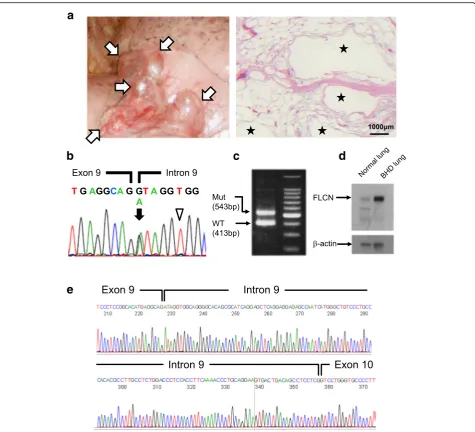
detect-able. He underwent pulmonary wedge resection via video
assisted thoracoscopic surgery (VATS). Intrathoracic
ob-servation revealed transparent cysts 3
–
30 mm in diameter
distributed in the pleura (Fig.
2a
, left). After VATS, the
pa-tient has recovered without complication, and has been
receiving periodic medical check-ups. From the family
his-tory and radiological and clinical findings, the patient was
suspected of BHD.
a
b
Fig. 1Family tree and radiological findings. (a)The patient is indicated by an arrow. Four members including the patient had episodes of pneumothorax, indicated by black.(b)Computed tomography shows multiple pulmonary cysts (indicated by arrows)
Pathological finding
The resected lung tissue contained several cystic lesions.
Microscopically, these cysts were incorporated into
peripheral alveolar tissue in one region and interstitial
tissue or visceral pleura in another area (Fig.
2a
, right).
Most of the cysts developed in contact with
bronchovas-cular bundles and/or interlobular septa. Flattened
pneu-mocytes lined the inner surface of the cysts, and the
lining cells were frequently exfoliated from the wall. The
cyst walls showed neither fibrous reaction nor active
inflammation, which was distinctively different from the
histology of emphysematous bullae. Other cystic lung
dis-orders such as lymphangioleiomyomatosis and chronic
obstructive pulmonary disease were also ruled out. The
characteristic histological features were consistent with
BHD-associated pulmonary cysts [
27
,
28
].
Mutation and expression analysis
Genetic counseling was performed, and informed
con-sent was obtained from the patient for
FLCN
genetic
a
b
c
d
e
testing and related molecular studies after approval of
the Institutional Review Board (IRB) of Yokohama City
University. Genetic analysis of
FLCN
identified a single
nucleotide mutation at the 5
′
-end of intron 9 (c.1062 +
1G > A) (Fig.
2b
). The mutation had been reported as
pathogenic in a previous study [
21
]. In addition, a single
nucleotide polymorphism (SNP) was detected in the
vicinity of the splice-site mutation (c.1062 + 6C > T). The
patient was finally diagnosed with BHD.
Previous studies have identified several sites of exon
skipping in
FLCN
mRNAs in patients with BHD [
23
–
25
].
The mutation in intron 9 (c.1062 + 1G > A) was predicted
to cause aberrant
FLCN
mRNA, but had not been
investi-gated. We therefore analyzed the patient
’
s
FLCN
at mRNA
and protein levels. Using primers covering exons 8
–
11
with RT-PCR, two products were clearly detected, i.e., a
wild-type band (413 bp) and a larger-sized band between
500 and 600 bp (Fig.
2c
). No candidate band for exon
skipping was observed. In Western blotting, predicted size
FLCN bands were detected in the BHD lung as well as in
a normal lung. No other specific band was detected in the
patient
’
s lung (Fig.
2d
). We further performed sequence
analysis of the RT-PCR products. A wild-type band was
confirmed to be composed of exons 9
–
10. On the other
hand, the larger-sized band of the mutant allele was found
between exons 9
–
10, extending from the beginning of
in-tron 9 for 130 bp (Fig.
2e
). The size of the mutant mRNA
was determined to be 543 bp. The complete size of intron
9 is 1836 bp; however, no larger band was detectable.
Moreover, we did not observe other candidates predicting
exon skipping. Reanalysis with RT-PCR using different
primers designed between exons 8
–
13 showed again an
identical 130 bp intron inserting between exons 9
–
10
(data not shown). The amino acid sequence predicted by
the mutant mRNA caused a frameshift of exon 10,
result-ing in premature termination after readresult-ing 77 amino acids
from the 5
′
-end of intron 9 (Additional file
1
Figure S1).
Discussion and conclusions
Splice-site mutations are expected to affect mRNA
trans-lation by either skipping the adjacent exon or misreading
the affected intron. Splice-sites are composed of acceptor
sites (the 3
′
-end of the intron) and donor sites (the 5
′
-end
of the intron). In BHD families, there are more acceptor
site than donor site mutations [
17
]. All of the cases in
which exon skipping was confirmed were acceptor site
mutations, such as c.397-1G > C, c.1063-2A > G and c.
1177-2A > G [
23
–
25
]. With regard to donor site
muta-tions, only one study has been reported thus far [
26
].
Ros-sing et al. used a mini-gene splicing assay to demonstrate
the presence of 2 simultaneous bands in the case of c.
1062 + 2 T > G; i.e., an additional 130 bp and an exon
skipping [
26
]. The former sequence was interpreted as a
misreading of intron 9 using a cryptic splice-site. Although
the mutation of the present case was located in the other
nucleotide (c.1062 + 1G > A), both mutations identically
read the first 130 bp of intron 9 and connected with exon
10. At the break point of intron 9, retention stopped
be-fore a guanine-thymine (GT) sequence (data not shown).
It is plausible that the GT sequence just after the break
point could have been misunderstood as a donor site. We
could not detect exon skipping in the present study, which
might owe in part to experimental design. We investigated
mRNA expression using the patient
’
s lung that contained
cystic lesions, whereas Rossing et al. used mRNA from
transfected COS-7 cells.
A partial intron retention (130 bp) and the following
104 bp of exon 10, which ended at a stop codon,
pre-dicted the translation of an additional 77 amino acids
between intron 9 (43 amino acids) and exon 10 (34
amino acids). In the latter amino acids involving exon
10, a frameshift occurred due to a guanine left behind
the 43 amino acids. We could not detect candidate
bands for the mutant protein in Western blotting
ana-lysis. Similar results were obtained in our previous study
of another patient
’
s lung with a splice-site mutation in
the acceptor site [
24
]. Although the possible presence of
FLCN variants that are undetectable by currently
avail-able antibodies cannot be excluded, these pathogenic
mRNAs might be degraded through the
nonsense-mediated mRNA decay system. Significant expression of
normal-sized FLCN in patients
’
lungs indicates that the
majority of normal-looking pneumocytes preserve FLCN
at the protein level in human BHD lungs. On the other
hand, FLCN protein is reduced or severely suppressed in
BHD-associated RCCs [
29
]. Since the mice with
Flcn
-de-pleted type II pneumocytes resulted in alveolar
enlarge-ment [
15
], undetectable levels of FLCN suppression in a
limited number of pneumocytes might also contribute to
cyst growth. The characteristic localization of cysts in
the vicinity of interlobular septa/bronchovascular
bun-dles and visceral pleura, as well as development of
elon-gated vascular network in subpleural cysts [
28
], suggest
that the cysts may originate from specific areas that
would slowly lead to cystic growth of the alveolar
epithe-lium with partial incorporation into stroma. A recent
in vitro study of pulmonary fibroblasts from BHD
pa-tients demonstrated impaired migration and matrix
pro-duction abilities, suggesting the roles of stroma at shear
stress-prone regions of the lung [
30
]. In this respect, we
observed a histopathological analogy between
BHD-associated pulmonary cysts and fibrofolliculomas of the
skin, the latter also showing cord-like growth of
follicu-lar epithelium in association with the surrounding
spe-cialized mesenchyme.
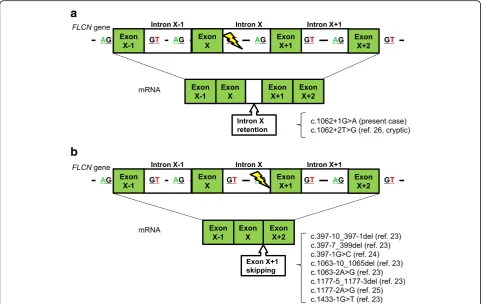
The results of the present case and previous studies that
demonstrate intron retention and exon skipping are
sum-marized in Fig.
3
. We hypothesize that mutations in donor/
acceptor sites may play critical roles for determining
mRNA processing. The possibilities of aberrant splicing
should be considered including condition-dependent
pro-cessing and cryptic splicing. Further study is needed to
de-termine whether splice-site mutations in other donor sites
also cause partial/complete intron retention or produce
exon-skipped mRNA in a condition-dependent manner.
Better understanding of mRNA processing from mutant
FLCN
will contribute to medical care of BHD patients.
Additional file
Additional file 1:Figure S1.Amino acid sequence predicted by intron
retention. Colored nucleotides are exons 9 and 10, and gray nucleotides starting from the mutated adenine (A, indicated by an arrow) are intron insertions. The predicted amino acid sequence is noted below codons in bold. A 130 bp intron retention leads to a frameshift from the beginning of exon 10, which results in premature termination (indicated by a rectangle). (PPTX 43 kb)
Abbreviations
BHD:Birt-Hogg-Dubé syndrome;FLCN:Folliculin; VATS: Video assisted thoracoscopic surgery
Acknowledgments
The authors thank Dr. Takashi Ohba for the help of genetic counseling, and Ms. Hiromi Soeda and members of the pathology laboratories in Saishunso National Hospital for excellent assistance.
Availability of data and materials
All data, without identifiers, will be available per reasonable request. The contact person is M. Furuya, email: [email protected].
Authors’contributions
MF, KH, MB, TI and RT analyzed and interpreted the data. KH and MB contributed to clinical management. MF, MB, and YN contributed to writing the manuscript. All authors read and approved the final manuscript.
Ethics approval and consent to participate
The studies of germline and somatic mutations ofFLCNand related molecular analyses were approved by the Institutional Review Boards of Yokohama City University (A161100001), and written informed consent for the studies was obtained from the patient. We confirmed that all processes were performed in accordance with the relevant guidelines including the CARE case report guidelines.
Consent for publication
Written informed consent for publication of the patient’s clinical details and/ or clinical images was obtained from the patient. A copy of the consent form is available for review by the editor of this journal.
Competing interests
The authors declare that they have no competing interests.
a
b
Funding: This work was supported in part by JSPS KAKENHI grant number 26460422 (M.F.) 15 K08374 (Y.N.), 15,604,475 (M.B.), 15,551,829 (M.B.) and Project Mirai Cancer Research Grants (M.F.) in the writing of the manuscript.
Publisher
’
s Note
Springer Nature remains neutral with regard to jurisdictional claims in published maps and institutional affiliations.
Author details
1Department of Molecular Pathology, Yokohama City University Graduate School of Medicine, 3-9 Fukuura, Kanazawa-ku, Yokohama 236-0004, Japan. 2
Department of Thoracic Surgery, Kumamoto Saishunso National Hospital, Kumamoto, Japan.3International Research Center for Medical Sciences, Kumamoto University, Kumamoto, Japan.4Department of Diagnostic Pathology, Kumamoto Saishunso National Hospital, Kumamoto, Japan. 5
Medical Mycology Research Center, Chiba University, Chiba, Japan. 6Department of Diagnostic Pathology, Chiba University Graduate School of Medicine, Chiba, Japan.
Received: 8 March 2017 Accepted: 19 April 2018
References
1. Menko FH, van Steensel MA, Giraud S, Friis-Hansen L, Richard S, Ungari S, Nordenskjold M, Hansen TV, Solly J, Maher ER. Birt-Hogg-Dube syndrome: diagnosis and management. Lancet Oncol. 2009;10(12):1199–206. 2. Toro JR, Wei MH, Glenn GM, Weinreich M, Toure O, Vocke C, Turner M,
Choyke P, Merino MJ, Pinto PA, et al. BHD mutations, clinical and molecular genetic investigations of Birt-Hogg-Dube syndrome: a new series of 50 families and a review of published reports. J Med Genet. 2008;45(6):321–31. 3. Nickerson ML, Warren MB, Toro JR, Matrosova V, Glenn G, Turner ML, Duray P,
Merino M, Choyke P, Pavlovich CP, et al. Mutations in a novel gene lead to kidney tumors, lung wall defects, and benign tumors of the hair follicle in patients with the Birt-Hogg-Dube syndrome. Cancer Cell. 2002;2(2):157–64. 4. Baba M, Hong SB, Sharma N, Warren MB, Nickerson ML, Iwamatsu A, Esposito
D, Gillette WK, Hopkins RF 3rd, Hartley JL, et al. Folliculin encoded by the BHD gene interacts with a binding protein, FNIP1, and AMPK, and is involved in AMPK and mTOR signaling. Proc Natl Acad Sci U S A. 2006;103(42):15552–7. 5. Hasumi H, Baba M, Hong SB, Hasumi Y, Huang Y, Yao M, Valera VA, Linehan
WM, Schmidt LS. Identification and characterization of a novel folliculin-interacting protein FNIP2. Gene. 2008;415(1–2):60–7.
6. Takagi Y, Kobayashi T, Shiono M, Wang L, Piao X, Sun G, Zhang D, Abe M, Hagiwara Y, Takahashi K, et al. Interaction of folliculin (Birt-Hogg-Dube gene product) with a novel Fnip1-like (FnipL/Fnip2) protein. Oncogene. 2008; 27(40):5339–47.
7. Hasumi H, Baba M, Hasumi Y, Lang M, Huang Y, Oh HF, Matsuo M, Merino MJ, Yao M, Ito Y, et al. Folliculin-interacting proteins Fnip1 and Fnip2 play critical roles in kidney tumor suppression in cooperation with Flcn. Proc Natl Acad Sci U S A. 2015;112(13):E1624–31.
8. Baba M, Toyama H, Sun L, Takubo K, Suh HC, Hasumi H, Nakamura-Ishizu A, Hasumi Y, Klarmann KD, Nakagata N, et al. Loss of Folliculin disrupts hematopoietic stem cell quiescence and homeostasis resulting in bone marrow failure. Stem Cells. 2016;34(4):1068–82.
9. Linehan WM, Srinivasan R, Schmidt LS. The genetic basis of kidney cancer: a metabolic disease. Nat Rev Urol. 2010;7(5):277–85.
10. Kouchi M, Okimoto K, Matsumoto I, Tanaka K, Yasuba M, Hino O. Natural history of the Nihon (Bhd gene mutant) rat, a novel model for human Birt-Hogg-Dube syndrome. Virchows Arch. 2006;448(4):463–71.
11. Chen J, Futami K, Petillo D, Peng J, Wang P, Knol J, Li Y, Khoo SK, Huang D, Qian CN, et al. Deficiency of FLCN in mouse kidney led to development of polycystic kidneys and renal neoplasia. PLoS One. 2008;3(10):e3581. 12. Hartman TR, Nicolas E, Klein-Szanto A, Al-Saleem T, Cash TP, Simon MC,
Henske EP. The role of the Birt-Hogg-Dube protein in mTOR activation and renal tumorigenesis. Oncogene. 2009;28(13):1594–604.
13. Baba M, Furihata M, Hong SB, Tessarollo L, Haines DC, Southon E, Patel V, Igarashi P, Alvord WG, Leighty R, et al. Kidney-targeted Birt-Hogg-Dube gene inactivation in a mouse model: Erk1/2 and Akt-mTOR activation, cell hyperproliferation, and polycystic kidneys. J Natl Cancer Inst. 2008;100(2):140–54.
14. Hasumi H, Baba M, Hasumi Y, Huang Y, Oh H, Hughes RM, Klein ME, Takikita S, Nagashima K, Schmidt LS, et al. Regulation of mitochondrial oxidative metabolism by tumor suppressor FLCN. J Natl Cancer Inst. 2012;104(22):1750–64.
15. Goncharova EA, Goncharov DA, James ML, Atochina-Vasserman EN, Stepanova V, Hong SB, Li H, Gonzales L, Baba M, Linehan WM, et al. Folliculin controls lung alveolar enlargement and epithelial cell survival through E-cadherin, LKB1, and AMPK. Cell Rep. 2014;7(2):412–23. 16. Hasumi Y, Baba M, Hasumi H, Huang Y, Lang M, Reindorf R, Oh HB,
Sciarretta S, Nagashima K, Haines DC, et al. Folliculin (Flcn) inactivation leads to murine cardiac hypertrophy through mTORC1 deregulation. Hum Mol Genet. 2014;23(21):5706–19.
17. Lim DH, Rehal PK, Nahorski MS, Macdonald F, Claessens T, Van Geel M, Gijezen L, Gille JJ, Giraud S, Richard S, et al. A new locus-specific database (LSDB) for mutations in the folliculin (FLCN) gene. Hum Mutat. 2010;31(1): E1043–51.
18. Schmidt LS, Linehan WM. Molecular genetics and clinical features of Birt-Hogg-Dube syndrome. Nat Rev Urol. 2015;12(10):558–69.
19. Benhammou JN, Vocke CD, Santani A, Schmidt LS, Baba M, Seyama K, Wu X, Korolevich S, Nathanson KL, Stolle CA, et al. Identification of intragenic deletions and duplication in the FLCN gene in Birt-Hogg-Dube syndrome. Genes Chromosomes Cancer. 2011;50(6):466–77.
20. Zhang X, Ma D, Zou W, Ding Y, Zhu C, Min H, Zhang B, Wang W, Chen B, Ye M, et al. A rapid NGS strategy for comprehensive molecular diagnosis of Birt-Hogg-Dube syndrome in patients with primary spontaneous pneumothorax. Respir Res. 2016;17(1):64.
21. Schmidt LS, Nickerson ML, Warren MB, Glenn GM, Toro JR, Merino MJ, Turner ML, Choyke PL, Sharma N, Peterson J, et al. Germline BHD-mutation spectrum and phenotype analysis of a large cohort of families with Birt-Hogg-Dube syndrome. Am J Hum Genet. 2005;76(6):1023–33. 22. Furuya M, Yao M, Tanaka R, Nagashima Y, Kuroda N, Hasumi H, Baba M,
Matsushima J, Nomura F, Nakatani Y. Genetic, epidemiologic and clinicopathologic studies of Japanese Asian patients with Birt-Hogg-Dube syndrome. Clin Genet. 2016;90(5):403–12.
23. Kunogi M, Kurihara M, Ikegami TS, Kobayashi T, Shindo N, Kumasaka T, Gunji Y, Kikkawa M, Iwakami S, Hino O, et al. Clinical and genetic spectrum of Birt-Hogg-Dube syndrome patients in whom
pneumothorax and/or multiple lung cysts are the presenting feature. J Med Genet. 2010;47(4):281–7.
24. Nishii T, Tanabe M, Tanaka R, Matsuzawa T, Okudela K, Nozawa A, Nakatani Y, Furuya M. Unique mutation, accelerated mTOR signaling and angiogenesis in the pulmonary cysts of Birt-Hogg-Dube syndrome. Pathol Int. 2013;63(1):45–55.
25. van Steensel MA, Verstraeten VL, Frank J, Kelleners-Smeets NW, Poblete-Gutierrez P, Marcus-Soekarman D, Bladergroen RS, Steijlen PM, van Geel M. Novel mutations in the BHD gene and absence of loss of heterozygosity in fibrofolliculomas of Birt-Hogg-Dube patients. J Invest Dermatol. 2007;127(3):588–93.
26. Rossing M, Albrechtsen A, Skytte AB, Jensen UB, Ousager LB, Gerdes AM, Nielsen FC, Hansen TV. Genetic screening of the FLCN gene identify six novel variants and a Danish founder mutation. J Hum Genet. 2017;62(2):151–7.
27. Koga S, Furuya M, Takahashi Y, Tanaka R, Yamaguchi A, Yasufuku K, Hiroshima K, Kurihara M, Yoshino I, Aoki I, et al. Lung cysts in Birt-Hogg-Dube syndrome: histopathological characteristics and aberrant sequence repeats. Pathol Int. 2009;59(10):720–8.
28. Furuya M, Nakatani Y. Birt-Hogg-Dube syndrome: clinicopathological features of the lung. J Clin Pathol. 2013;66(3):178–86.
29. Furuya M, Hong SB, Tanaka R, Kuroda N, Nagashima Y, Nagahama K, Suyama T, Yao M, Nakatani Y. Distinctive expression patterns of glycoprotein non-metastatic B and folliculin in renal tumors in patients with Birt-Hogg-Dube syndrome. Cancer Sci. 2015;106(3):315–23.
30. Hoshika Y, Takahashi F, Togo S, Hashimoto M, Nara T, Kobayashi T, Nurwidya F, Kataoka H, Kurihara M, Kobayashi E, et al. Haploinsufficiency of the folliculin gene leads to impaired functions of lung fibroblasts in patients with Birt-Hogg-Dube syndrome. Physiol Rep. 2016;4(21):e13025.