Robust IoT‑based nursing‑care support
system with smart bio‑objects
Cheng‑Fa Chiang
1,2†, Fang‑Ming Hsu
1†and Kuo‑Hui Yeh
1*†From
International Conference on Biomedical Engineering Innovation (ICBEI) 2016 Taichung, Taiwan.
28 October–1 November 2016
Background
With the rapid growth of information and communications technologies, such as Blue-tooth Low Energy (BLE), 3G/4G/5G and NFC/RFID, a comprehensive evolution of the Internet has given rise to a ubiquitous network consisting of mobile intelligent objects, called the Internet of Things (IoT). In IoT-based environments, “contactless data sens-ing” and “collecting and information analyzing and retrievsens-ing” are fundamental compo-nents for the provision of human value-added services in a more transparent and faster
Abstract
Background: The significant advancement in the mobile sensing technologies has brought great interests on application development for the Internet‑of‑Things (IoT). With the advantages of contactlessness data retrieval and efficient data processing of intelligent IoT‑based objects, versatile innovative types of on‑demand medical relevant services have promptly been developed and deployed. Critical characteristics involved within the data processing and operation must thoroughly be considered. To achieve the efficiency of data retrieval and the robustness of communications among IoT‑ based objects, sturdy security primitives are required to preserve data confidentiality and entity authentication.
Methods: A robust nursing‑care support system is developed for efficient and secure communication among mobile bio‑sensors, active intelligent objects, the IoT gateway and the backend nursing‑care server in which further data analysis can be performed to provide high‑quality and on‑demand nursing‑care service.
Results: We realize the system implementation with an IoT‑based testbed, i.e. the Raspberry PI II platform, to present the practicability of the proposed IoT‑oriented nursing‑care support system in which a user‑friendly computation cost, i.e. 6.33 ms, is required for a normal session of our proposed system. Based on the protocol analysis we conducted, the security robustness of the proposed nursing‑care support system is guaranteed.
Conclusions: According to the protocol analysis and performance evaluation, the practicability of the proposed method is demonstrated. In brief, we can claim that our proposed system is very suitable for IoT‑based environments and will be a highly com‑ petitive candidate for the next generation of nursing‑care service systems.
Open Access
© The Author(s) 2018. This article is distributed under the terms of the Creative Commons Attribution 4.0 International License (http://creat iveco mmons .org/licen ses/by/4.0/), which permits unrestricted use, distribution, and reproduction in any medium, provided you give appropriate credit to the original author(s) and the source, provide a link to the Creative Commons license, and indicate if changes were made. The Creative Commons Public Domain Dedication waiver (http://creat iveco mmons .org/publi cdoma in/zero/1.0/) applies to the data made available in this article, unless otherwise stated.
RESEARCH
*Correspondence: [email protected] †Cheng‑Fa Chiang, Fang‑ Ming Hsu and Kuo‑Hui Yeh contributed equally to this work
way than before. Among these services, in particular, the development of IoT-oriented nursing-care service systems are one the most promising and important directions, and are therefore a major focus of government and industry. A nursing-care service system is exploited for data collection, data storing, data retrieval and information display needed in nursing activities via modern information and communication technologies. With the advantages of contactlessness and efficiency brought by the data retrieval on intelligent IoT-objects, innovative types of on-demand nursing-care service systems have promptly been developed in these years. Meanwhile, the issue of system security and patient pri-vacy has been focused by governments and research community. The potential to reveal patient privacy and system security vulnerability may exist wherever personally identifia-ble information is collected, processed, or stored in a hospital information system. Based on our survey, we present the major principles during patient private data processing: (1) be processed and used for lawful purposes; (2) unauthorized or unlawful processing must be measured; (3) accountability is required; (4) consent for data processing must be guaranteed; (5) be processed with an adequate level of protection and (6) adequate and relevant to the purpose for which it is processed.
In this paper, we present a robust IoT-based nursing-care support system in which fixed environmental sensing objects and intelligent smart objects are deployed in the field and on patients, respectively, to support high-quality nursing-care service. To sat-isfy the security and privacy requirements, we argue that sturdy cryptographic primi-tives must be implemented on IoT-objects to construct robust communications among entities. Nevertheless, based on current semiconductor technology, most of IoT-objects cannot afford heavy cryptographic primitives, such as asymmetric cryptography, due to limited computational resources. Therefore, a refinement of the traditional secure com-munication scheme should be launched in terms of the performance standpoint. That is, we have to thoroughly consider the trade-off between efficiency and the robustness of the adopted cryptographic components to appropriately meet the hardware limita-tion of IoT-objects and the security requirements we need. According to the analyses, the robust cryptographic module with a reasonable and acceptable computation cost, i.e. SHA-384, SHA-215 and SHA-3 [1, 2], will be good candidate techniques to simultane-ously satisfy the security and performance requirements. In conclusion, we would like to demonstrate an efficient IoT-based communication mechanism for nursing-care service systems in which SHA-3 are mainly adopted as the major data protection technique to simultaneously achieve system security and patient privacy during the operation of the proposed system.
Things in e-health) [5]. Later, Torjusen et al. [6] verified that an enabler integrating into the ASSET adaptive security framework and provided an e-healthcare security frame-work via the IoT. Critical requirements for run-time verification are presented as formal specifications. After that, Bello and Zeadally [7] proposed an intelligent routing coop-eration scheme for device-to-device communication. The opcoop-eration of different network standards in the case of intermittent connection is considered in which the device will be affected by it’s limited resources. In 2016, Gope and Hwang [8] proposed an IoT appli-cation system for healthcare on body sensor networks (BSN), called BSN-Care, which is able to provide effective real-time monitoring, patient information management and security needs for healthcare. In order to achieve the claimed services, a comprehen-sive integration of clinical devices and efficient collection of data are demonstrated. Note that the authors also introduced a similar concept for secure communication on IoT in [9].
Yao et al. [10] modified the fast one-way accumulator, proposed by Nyberg [11], to build a lightweight multicast authentication mechanism. However, the proposed method is only applicable to the small-scale IoT networks. It is limited by it’s scalability. After that, Ning et al. [12] demonstrated an aggregation-based hierarchical authentication scheme. This method provides a strong security and is applicable to the U2IoT architec-ture. The main idea is to establish backward and forward anonymous data transmission among multiple targets. In addition, various techniques, i.e. directed path descriptors, homomorphism functions, and Chebyshev chaotic maps, are jointly applied for mutual authentication. Later, Hernández-Ramos et al. [13] proposed a framework for light-weight authentication and authorization. This presented framework is based on the ref-erence model proposed by the EU FP7 IoT-A project. Meanwhile, Kawamoto et al. [14] proposed a location-based authentication system, where ambient information from IoT-based sensors are collected and analyzed as the authentication tokens. To pursue high authentication accuracy, the proposed system automatically and continuously adjusts the system parameters according to surrounding environment situation. Next, Cirani et al. [15] proposed an IoT-OAS architecture with the characteristics of flexible, highly configurable, and easy-to-integrate with existing services. The authors further provide an authorization platform which can invoke an external OAuth-based authorization service. The evaluation of the proposed architecture is based on Contiki OS-based con-strained devices. In 2017, Cha et al. [16] demonstrated a privacy-aware mechanism for secure communication and efficient access-control among BLE-based devices. The pro-posed mechanism is based on elliptic curve cryptography. In addition, the authors pre-sented a framework for the management of security examination reports of BLE-based applications.
Methods
Targeted IoT communication scenario
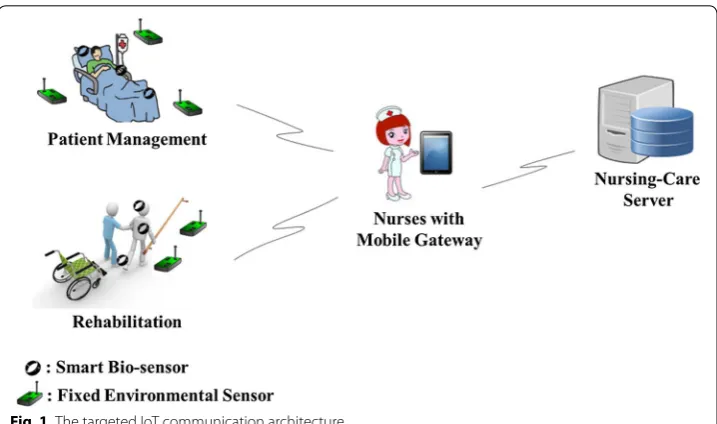
In this section, we introduce the underlying IoT communication architecture of our pro-posed nursing-care support system. Figure 1 demonstrates the scenario we target on, i.e. patient management and rehabilitation, in which fixed environmental sensors and medical sensing devices are deployed on field and on the patient, respectively, to support caregivers (such as nurse) in activities of patient care and rehabilitation. Three important components are existed in the identified IoT communication scenario, i.e. a backend nursing-care server, a mobile gateway (usually handheld by the caregiver), and intel-ligent devices (such as fixed sensor nodes or medical sensing devices). The intelintel-ligent devices are utilized for sensing and collecting environmental parameters and patients’ bio-data, while the caregiver will operate a handheld smart device as the mobile gateway to communicate with the intelligent devices. Note that the patient’s bio-data are such as electrocardiography, electroencephalography, electromyography and blood pressure retrieved from the patient. After that, with the environmental data and the patient’s bio-data, the caregiver can identify patient’s need in a faster way. More accurate and timely treatment services will then be able to deliver to the patients.
The IoT‑based nursing‑care support system
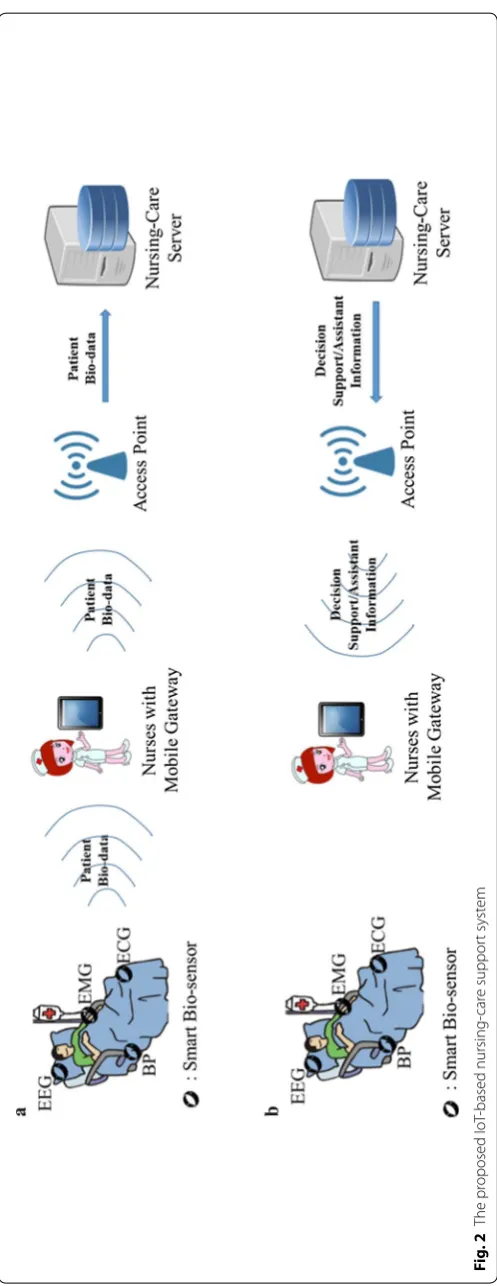
In this section, we present the proposed nursing-care support system in which IoT-based intelligent devices are adopted on the patient and the corresponding environment (e.g., Fig. 2). From Fig. 2a, the nurse first utilizes his/her handheld mobile gateway to retrieve the data from smart bio-objects. All of the retrieved data will be forwarded to the back-end nursing-care server. At the backback-end server, a further data analysis for the mining of the patient’s needs will be performed. Then, in Fig. 2b, decision support/assistant infor-mation will be derived and delivered to the nurse to support better-quality nursing care services on the patient.
In general, the proposed system consists of two phases, i.e. the registration phase and the authentication phase. In the registration phase, the security credentials will be
Fig
. 2
T
he pr
oposed Io
T‑
based nursing
‑car
e suppor
t syst
securely agreed and shared among the communication entities, i.e. intelligent devices (smart bio-objects and fixed environmental sensors), the mobile gateway and the nurs-ing-care server, in advance. Next, an authentication phase is operated to secure all of the communication and data exchange among the communication entities. The proposed nursing-care support system is able to achieve the following security requirements: (a) to guarantee mutual authentication among intelligent devices, the mobile gateway and the nursing-care server; (b) to provide anonymity and un-traceability for intelligent devices; (c) to resist against forgery attack and replay attack and (d) to securely establish a robust session key between the mobile gateway and the nursing-care server.
The registration phase of the proposed system
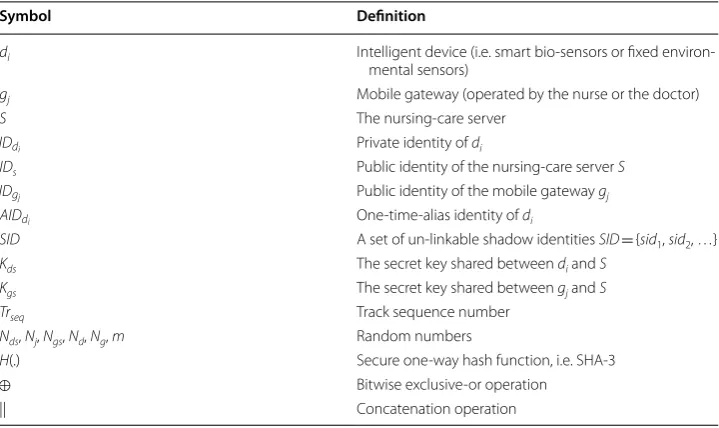
Before introducing our proposed system, we present the symbols and abbreviations throughout this study in Table 1. In the first stage of the registration phase, an intelligent device di (i.e. smart bio-sensors or fixed environmental sensors) sends its identity IDdi to the nursing-care server S as a registration request. On receipt of the request from di, the
nursing-care server S generates a random number Nds and uses its identity IDs to
com-pute a secret value Kds=H
IDs||Nds||IDdi
. Next, the nursing-care server S calculates a set of un-linkable shadow identities SID = {sid1, sid2, …} for di, where each sidj∈SID and
sidj=H
IDdi||Nj||Kds
. Note that Nj is a random number used for deriving each sidj
value. Moreover, a track sequence number Trseq is generated for fast identification of
intelligent device di during the authentication process as well as for preventing replay
attacks. The Trseq will be stored and updated at both the nursing-care server S and the
device di after each authentication session. In that case, the nursing-care server S is able
to check the freshness of an incoming request from di, and to achieve a fast
identifica-tion of di via Trseq at the backend database during the authentication session. Finally, the
nursing-care server S issues a security credential containing
IDdi, Kds,SID,Trseq,H(.)
to the intelligent device di. At the same time, the nursing-care server will maintain a
Table 1 Notations throughout this study
Symbol Definition
di Intelligent device (i.e. smart bio‑sensors or fixed environ‑
mental sensors)
gj Mobile gateway (operated by the nurse or the doctor)
S The nursing‑care server
IDdi Private identity of di
IDs Public identity of the nursing‑care server S
IDgj Public identity of the mobile gateway gj
AIDdi One‑time‑alias identity of di
SID A set of un‑linkable shadow identities SID = {sid1, sid2, …}
Kds The secret key shared between di and S
Kgs The secret key shared between gj and S
Trseq Track sequence number
Nds, Nj, Ngs, Nd, Ng, m Random numbers
H(.) Secure one‑way hash function, i.e. SHA‑3
⊕ Bitwise exclusive‑or operation
record
IDdi,Kds,SID,Trseq,H(.)
corresponding to di at the backend database. Note
that H(.) denotes a secure one-way hash function such as SHA-3. On the other hand, the registration phase between the mobile gateway gj and the nursing-care server S are
launched in a similar way. The mobile gateway gj send its identity IDgj to the nursing-care
server as a registration request. Next, the nursing-care server S calculates
Kgs=H
IDs||Ngs||IDgj
with a newly generated random number Ngs, and shares a
secu-rity credential containing the secrets, i.e. IDgj and Kgs, with gj. The nursing-care server also maintains a tuple IDgj, Kgs,H(.)
corresponding to the mobile gateway gj at the
backend database.
The authentication phase of the proposed system
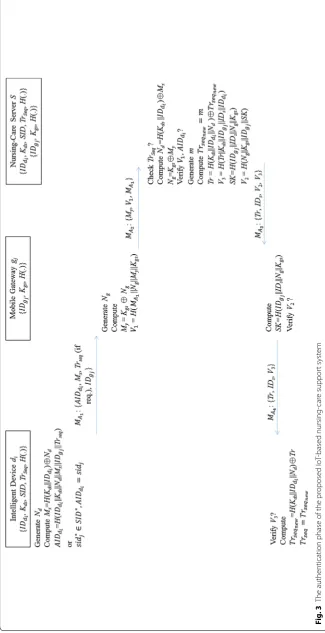
In the authentication phase, we consider that a caregiver (with a mobile gateway) would like to provide on-demand nursing care services to patients via contactless and real-time data collection and analysis mechanisms. Under the insecure IoT communi-cation architecture, an authenticommuni-cation procedure is needed to establish a secure com-munication channel for data exchange among intelligent devices, the mobile gateway and the nursing-care server. The detailed communication procedures of the authenti-cation phase are as shown in Fig. 3.
• Intelligent Device di→ Mobile Gateway gj:MA1 =
AIDdi, Nx,Trseq(if req.),IDgj
First, the intelligent device di generates a random number Nd and calculates two val-ues, i.e. Mx =H
Kds||IDdi
⊕Nd and AIDdi=HIDdi||Kds||Nd||Mx||IDgj||Trseq
. Next, di constructs a message MA1 =
AIDdi,Mx,Trseq,IDgj
and sends MA1 as an
authentication request to the mobile gateway gj. Note that, if the value Trseq shared between the intelligent device di and the nursing-care server S is out of synchroniza-tion, di needs to choose a fresh shadow identity sidj from SID as the value AIDdi .
Then, di sends MA1 =
AIDdi,Mx,IDgj
to the mobile gateway gj as an authentica-tion request.
• Mobile Gateway gj→ Nursing-Care Server S: MA2 =
My,V1,MA1
Once the mobile gateway gj receives the authentication request from the intelligent device di, gj first generates a random number Ng and computes My=Kgs⊕Ng and V1=HMA1
Ng My||Kgs
. After that, gj sends MA2 =My,V1,MA1 to the
nurs-ing-care server S.
• Nursing-Care Server S → Mobile Gateway gj:MA3 = {Tr,IDs,V2,V3} Upon obtaining the incoming message MA2 =
My,V1,MA1
, the nursing-care server S first checks whether the track sequence number Trseq is in the request or not. If it is, S performs step (1). If Trseq is not included in MA2 , S performs step (2).
• Step (1): Check the validity of Trseq. If it holds, look for the corresponding tuple via
Trseq from the backend database. Otherwise, terminate the connection. If Trseq is valid, S derives Nd=H
Kds||IDdi
Fig
. 3
T
he authentication phase of the pr
oposed Io
T‑
based nursing
‑car
e suppor
t syst
and AIDdi . That is, S will examine (a) whether the received value V1 and the
com-puted value H MA1
Ng My||Kgs
are equal or not, and (b) whether the received value AIDdi and the computed value H =
IDdi||Kds||Nd||Mx||IDgj||Trseq
are equal or not. Note that if Trseq in the request does not match the one maintained in the database, the nursing-care server S will reject the request and terminate the connection. A new request from the device di will be asked for in which one of the fresh shadow identities sidj will be picked up from the list SID as an anonymous identity of di. In that case, the step (2) will be launched.
• Step (2): The server S will verify the freshness and validity of AIDdi=sidj . If
the nursing-care server S cannot identify the sidj from the backend database, the server will terminate the connection. Next, the S will request the intelligent device di to try with another valid shadow identity sidj.
If one of the above examinations, i.e. step (1) or (2), is passed, the nursing-care
server S will generate a random number m, and set Trseqnew =m . After
that, S calculates Tr=H
Kds||IDdi||Nd
⊕Trseqnew, V3=H
Tr||Kds||IDgj||IDs||IDdi
,
SK =H
IDgj||IDs
Ng Kgs
and V2=H
Ng||Kgs||IDgj||SK
, where SK is a session key utilized for the next secure communication between the mobile gateway gj and the
nurs-ing-care server S. Eventually, S sends MA3 = {Tr,IDs,V2,V3} to the mobile gateway gj.
• Mobile Gateway gj→ Intelligent Device di: MA4 = {Tr,IDs,V3}
With the incoming message MA3 = {Tr,IDs,V2,V3} , the mobile gateway gj
com-putes SK′=H
IDgj||IDs
Ng Kgs
and H
Ng||Kgs||IDgj||SK
′ , and then check if
the received V2 is equal to the computed H
Ng||Kgs||IDgj||SK′
. If it holds, it is obvious that a session key SK is securely agreed by gj and S. After that, the mobile gateway gj sends MA4 = {Tr,IDs,V3} to the intelligent device di. With MA4 , the
device di derives H
Tr||Kds||IDgj||IDs||IDdi
and compares it with the received V3. If these two values are identical, di computes Trseqnew=H
Kds||IDdi||Nd
⊕Tr and sets Trseq =Trseqnew.
Protocol analysis and discussions
In this section, we present a formal security analysis of the communication proce-dures of the proposed IoT-based nursing-care support system and discuss whether all the proposed security claims can be achieved or not.
• Claim 1: To achieve mutual authentication among communication entities in the proposed nursing-care support system
Seven constructs is introduced as follows: (1) P believes X means that the principal P believes that X is true; (2) P sees X means that someone has sent a message containing X to P; (3) P said X denotes that P has actually sent a message including statement X at the current session of the protocol or before; (4) P controls X denotes that P has jurisdiction over X; (5) fresh(X) denotes that X has not been sent in a message; (6) P←→K Q means that the secret K is shared between the principals P and Q, and (7) {X}K means that the
X is encrypted or protected under the key K. Next, we presented five major rules as logi-cal postulates. First, in the message-meaning rule (referred to rule 1), we believe that if P believes P←→K Q and P sees {X}K, then we postulate P believes Q said X. Second, the nonce-verification rule (referred to rule 2) denotes that if P believes fresh (X) and P believes Q said X, then we postulate P believes Q believes X. Third, the jurisdiction rule (referred to rule 3) means that if P believes Q controls X and P believes Q believes X, then we postulate P believes X. Fourth, a rule 4 is identified for that if P sees (X, Y) then P sees X. In addition, if P believes P←→K Q and P sees {X}K, then P sees X. Fifth, the final rule 5 denotes that if one part of a formula is fresh, then the entire formula must also be fresh. If P believes fresh (X), then P believes fresh (X, Y). Finally, we demonstrate seven assumptions of our proposed system in the following.
• Assumption 1: di, S believe di
IDdi,Kds,SID,Trseq
←→ S
• Assumption 2: gj, S believe gj IDgi,Kgs
←→ S
• Assumption 3: di, S believe fresh(Nd) • Assumption 4: gj, S believe fresh(Ng) • Assumption 5: di believes fresh(m) • Assumption 6: di believes S controls Nd • Assumption 7: gj believes S controls Ng
Before the security analysis, we conduct the concrete realization of our proposed com-munication procedures as follows:
Step 1: di→gj:
AIDdi,Mx,Trseq(if req.),IDgj
, where AIDdi=H
IDdi||Kds||Nd||Mx||
IDgj||Trseq and Mx=H
Kds||IDdi
⊕Nd.
Step 2: gj→S:
My, V1,AIDdi,Mx,Trseq(if req.),IDgj
, where My=Kgs⊕Ng and
V1=HMA1
Ng My||Kgs
.
Step 3: S→gj: {Tr,IDs,V2,V3} , where Tr=HKds||IDdi||Nd
⊕Trseqnew,V2=
HNg||Kgs||IDgj||SK
, V3=H
Tr||Kds||IDgj||IDs||IDdi
and SK =H
IDgj||IDs
Ng Kgs .
Step 4: gj→di: {Tr,IDs,V3} , where Tr=H
Kds||IDdi||Nd
⊕Trseqnew and
V3=H
Tr||Kds||IDgj||IDs||IDdi
.
After that, the following steps show that the formal analysis of the mutual authentication:
1. gj sees{IDs, V2} (Step 3).
2. gj believe gj IDgi,Kgs
←→ S(Assumption 2).
4. gj believes fresh(Ng) (Assumption 4).
5. gj believes S believes {IDs, V2} [(3) and (4), inferred by Rule 2].
6. gj believes S controls{Ng} (Assumption 7).
7. gj believes {IDs, V2} [(5) and (6), Inferred by Rule 3]. 8. di sees {Tr, IDs, V3} (Step 4).
9. di believes di
IDdi,Kds,SID,Trseq
←→ S (Assumption 1).
10. di believes S said {Tr, IDs, V3} [(8) and (9), Inferred by Rule 1].
11. di believes fresh(Nd), fresh(m) (Assumption 3 and 5).
12. di believes S believes {Tr, IDs, V3} [(10) and (11), Inferred by Rule 2].
13. di believes S controls {Nd} (Assumption 6).
14. di believes {Tr, IDs, V3} [(12) and (13), inferred by Rule 3].
So far, we obtain the following results. gj believes S believes {IDs, V2} [From (5)]
gj believes {IDs, V2} [From (7)]
di believes S believes {Tr, IDs, V3} [From (12)]
di believes {Tr, IDs, V3} [From (14)]
Based on the assumption of the trustworthiness of S and the four results (5), (7), (12) and (14), both di and gj can authenticate with each other via S.
• Claim 2: To guarantee anonymity and un-traceability for each intelligent device in the proposed nursing-care support system
During the communication procedures of the proposed system, two
ran-dom numbers Nd and Ng are utilized to randomize the messages, such as
AIDdi,Mx,My,V1,Tr,V2andV3 , transmitted among the intelligent devices di, the mobile gateway gj and the nursing-care server S. The gj and S cannot obtain the real
identity of di. In other words, the identity IDdi is included in a randomized cipher text during each communication session. Therefore, we can claim that our proposed system can provide the anonymity, and the un-traceability can be guaranteed also. On the other hand, the shadow identity scheme in our system is adopted to deal with the condition of loss of synchronization between the intelligent device and the nursing-care server. Since the shadow identity is randomly chosen, it does not provide any clue for malicious attacks due to the un-linkable property of them.
• Claim 3: To resist against forgery attack and replay attack
Adversaries may counterfeit messages to deceive the legal communication entities, i.e. di, gj and S. However, without Nd, Ng, Kds and Kgs, it is hard to create a counterfeited but
legitimate messages such as My, V1,AIDdi,Mx,Trseq(if req.),IDgj
and {Tr, IDs, V2, V3}
for spoofing. Even if the adversaries launch a replay attack with a previously eaves-dropped message, the previously-used message cannot be successfully verified. This is because the random numbers Nd and Ng must be fresh and on-time valid at each session.
• Claim 4: To preserve data confidentiality via a secure transmission channel estab-lished between the mobile gateway and the nursing-care server
During the transmission of the proposed system, all of the messages
My,V1,AIDdi,Mx,Trseq(if req.),IDgj
and {Tr, IDs, V2, V3} are protected through a
secure one-way hash function (e.g., SHA-3), and two robust secrets Kds and Kgs chosen
by S. Without Kds and Kgs, it is difficult to retrieve any useful information from
transmit-ted cipher texts owing to the irreversibility of the one-way hash function. The proposed system thus provides data confidentiality. Moreover, according to the analysis of Claim 1, the mutual authentication of gj and S is achieved via V2. It is obvious that a session key
SK can securely be agreed by gj and S during our proposed authentication phase, and
this session key SK will then be exploited on the verification of V2. Therefore, we argue
that a robust channel will be established between the mobile gateway and the nursing-care server for secure communication.
Performance evaluation and results
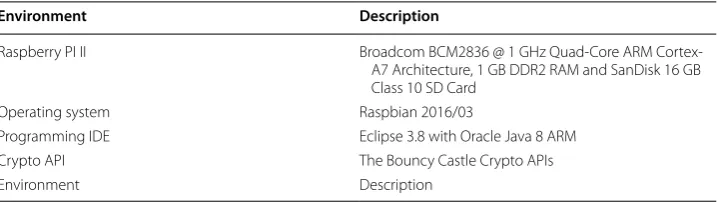
To evaluate the practicability of the proposed IoT-based nursing-care support system, we implement a demo system as a proof-of-concept and evaluate it’s performance. The implementation was established under the platform shown in Table 2, where the Raspberry PI II platform is simulated as an intelligent device operating with a smart-phone (as the mobile gateway) and a desktop computer (as the nursing-care server). Because a performance bottleneck occurring at the intelligent device is always in a high probability when compared to a smartphone and a desktop computer, in this implementation we focus on the performance evaluation of the intelligent device. A secure one-way hash function, i.e. SHA-3 (512 bits), and bitwise exclusive-or opera-tion are adopted. In addiopera-tion, in our system implementaopera-tion, “ IDdi , IDs, IDgj , Kds and
Kgs” are set to 96-bits and “SID, Trseq, Nds, Nj, Ngs, Nd, Ng and m” are set to 64-bits.
Each time SID contains 100 sidj values. The experiments are implemented via Oracle
Java 8 and Eclipse 3.8, and we implement the SHA-3 hash function with the support of Bouncy Castle Crypto APIs [19].
Table 3 presents the computation cost required in our proposed IoT-based nursing-care support system. During the registration phase, we need to perform (2 +k) times
of random number generation and (2 +k) times of one-way hash function. Note that k is the size of SID and in our implementation we set k as 100. In that case, in the registration phase we have to execute 102 times the random number generation and 102 times that of the one-way hash function, and we found that the total computation
Table 2 Implementation environment
Environment Description
Raspberry PI II Broadcom BCM2836 @ 1 GHz Quad‑Core ARM Cortex‑
A7 Architecture, 1 GB DDR2 RAM and SanDisk 16 GB Class 10 SD Card
Operating system Raspbian 2016/03
Programming IDE Eclipse 3.8 with Oracle Java 8 ARM
Crypto API The Bouncy Castle Crypto APIs
time is around 14.23 ms. Note that 7.09 ms is needed for 102 RN and 7.14 ms is required for 102 H. Next, in the authentication phase we require the execution time of 6.33 ms and 5.43 ms, respectively, to perform all of the cryptographic modules, such as random number generations, exclusive-or operations and the SHA-3 (512-bits) hash function, during a normal communication session. Our implementation presents that the computation cost will be majorly dominated by the SHA-3 hash function as the execution time of the random number generation and exclusive-or operation are comparatively slight. The execution time to perform all of the SHA-3 functions required in our proposed system takes around 94% of the total computation cost. It is obvious that the SHA-3 function may become a bottleneck in terms of the performance points when the scale of the network becomes larger. Note that, in our system implementation, the input bit sequences of SHA-3 function are 192 bits, 288 bits, 800 bits, 896 bits, 992 bits and 1728 bits.
Conclusions
In this paper, we present an efficient IoT-based nursing-care service system to support the caregiver (such as nurse/doctor/administrator) to provide better quality in nurs-ing care activities. In consideration of the trade-off between system security and com-putation efficiency, we adopt lightweight cryptographic modules as the major data protection technique in the communication procedures of our proposed nursing-care support system. A demo system is implemented as a proof of concept to show the practicability of the proposed method in which a reasonable and user-acceptable computation cost, i.e. at most 6.33 ms, is presented. Moreover, based on the analysis we conducted, the security robustness of the proposed nursing-care support system is guaranteed. In brief, we argue that our proposed system is very suitable for IoT-based environments and will be a highly competitive candidate for the next generation of nursing-care service systems.
Abbreviations
IoT: Internet‑of‑Things; BLE: Bluetooth Low Energy; NFC: near‑field communication; RFID: radio frequency identification; SHA: Secure Hash Algorithm; 6LoWPAN: IPv6 over Low‑Power Wireless Personal Area Networks; ASSET: adaptive security for smart Internet of Things in e‑health; BSN: body sensor networks.
Table 3 Execution time of the proposed IoT-based nursing-care support system
RN means random number
XOR means bitwise exclusive‑or operation H means the one‑way hash function SHA‑3 (512 bits) ak is the size of SID which contains ksidj values
Phase Computation cost Execution time (ms)
Registration (2 +k) RN + (2 +k) Ha 14.23 ms (i.e. 102RN + 102H)
Authentication 3RN + 6XOR + 14H (with Trseq) 6.33 ms (i.e. 3RN + 6XOR + 14H)
Declarations Authors’ contributions
CFC and KHY wrote the paper; KHY and FMH conceived and designed the proposed algorithm. All authors read and approved the final manuscript.
Author details
1 Department of Information Management, National Dong Hwa University, Hualien 97401, Taiwan, ROC. 2 Physical Educa‑ tion Center, National Dong Hwa University, Hualien 97401, Taiwan, ROC.
Acknowledgements Not applicable Competing interests
The authors declare that they have no competing interests. Availability of data and materials
The datasets used and/or analysed during the current study are available from the corresponding author on reasonable request.
Consent for publication Not applicable
Ethics approval and consent to participate Not applicable
Funding
Publication of this article was support in part by the Academia Sinica, in part by the Taiwan Information Security Center, and in part by the Ministry of Science and Technology, Taiwan under Grants MOST 105‑2221‑E‑259‑014‑MY3, MOST 105‑2221‑E‑011‑070‑MY3, MOST 105‑2923‑E‑182‑001‑MY3, and MOST 107‑2218‑E‑011‑012.
About this supplement
This article has been published as part of BioMedical Engineering OnLine Volume 17 Supplement 2, 2018: Proceedings of the International Conference on Biomedical Engineering Innovation (ICBEI) 2016. The full contents of the supplement are available online at https ://biome dical ‑engin eerin g‑onlin e.biome dcent ral.com/artic les/suppl ement s/volum e‑17‑suppl ement ‑2.
Publisher’s Note
Springer Nature remains neutral with regard to jurisdictional claims in published maps and institutional affiliations.
Published: 6 November 2018
References
1. Dang QH. Secure Hash Standard (SHS). NIST FIPS 180‑4; 2015. https ://csrc.nist.gov/csrc/media /publi catio ns/ fips/180/4/final /docum ents/fips1 80‑4‑draft ‑aug20 14.pdf. Accessed 11 Apr 2018.
2. Dworkin MJ. SHA‑3 standard: permutation‑based hash and extendable‑output functions. NIST FIPS‑202; 2015. https ://csrc.nist.gov/csrc/media /publi catio ns/fips/202/final /docum ents/fips_202_draft .pdf. Accessed 11 Apr 2018. 3. Jara AJ, Zamora MA, Skarmeta AF. Knowledge acquisition and management architecture for mobile and personal
Health environments based on the Internet of Things. In: Proceeding of the 11th IEEE international conference on trust, security and privacy in computing and communications; 2012. p. 1811–8.
4. Berhanu Y, Abie H, Hamdi M A test bed for adaptive security for IoT in eHealth. In: Proceeding of the international workshop on adaptive security; 2013. Article No. 5.
5. ASSET—Adaptive security for smart internet of things in eHealth. http://asset .nr.no/asset /index .php/ASSET _‑_Adapt ive_Secur ity_for_Smart _Inter net_of_Thing s_in_eHeal th. Accessed 11 Apr 2018.
6. Torjusen AB, Abie H, Paintsil E, Trcek D, Skomedal Å. Towards run‑time verification of adaptive security for IOT in eHealth. In: Proceeding of the 2014 European conference on software architecture workshops; 2014. Article No. 4. 7. Bello O, Zeadally S. Intelligent device‑to‑device communication in the internet of things. IEEE Syst J.
2016;10(3):1172–82.
8. Gope P, Hwang T. BSN‑care: a secure IoT‑based modern healthcare system using body sensor network. IEEE Sens J. 2016;16(5):1368–76.
9. Gope P, Hwang T. Untraceable sensor movement in distributed IoT infrastructure. IEEE Sens J. 2015;15(9):5340–8. 10. Yao X, Han X, Du X, Zhou X. A lightweight multicast authentication mechanism for small scale IoT applications. IEEE
Sens J. 2013;13(10):3693–701.
11. Nyberg K. Fast accumulated hashing. In: Proceeding of the 3rd fast software encryption workshop; 1996. p. 83–7. 12. Ning H, Liu H, Yang LT. Aggregated‑proof based hierarchical authentication scheme for the internet of things. IEEE
Trans Parallel Distrib Syst. 2015;26(3):657–67.
13. Hernández‑Ramos JL, Pawlowski MP, Jara AJ, Skarmeta AF, Ladid L. Toward a lightweight authentication and authori‑ zation framework for smart objects. IEEE J Sel Areas Commun. 2015;33(4):690–702.
• fast, convenient online submission •
thorough peer review by experienced researchers in your field • rapid publication on acceptance
• support for research data, including large and complex data types •
gold Open Access which fosters wider collaboration and increased citations maximum visibility for your research: over 100M website views per year •
At BMC, research is always in progress.
Learn more biomedcentral.com/submissions
Ready to submit your research? Choose BMC and benefit from:
15. Cirani S, Picone M, Gonizzi P, Veltri L, Ferrari G. IoT‑OAS: an OAuth‑based authorization service architecture for secure services in IoT scenarios. IEEE Sens J. 2015;15(2):1224–34.
16. Cha SC, Yeh KH, Chen JF. Toward a Robust Security Paradigm for Bluetooth Low Energy‑Based Smart Objects in the Internet‑of‑Things. Sensors. 2017. https ://doi.org/10.3390/s1710 2348.
17. Burrows M, Abadi M, Needham R. A logic of authentication. ACM Trans Comput Syst. 1990;8(1):18–36.
18. Yeh KH, Tsai KY, Hou JL. Analysis and design of a smart card based authentication protocol. J Zhejiang Univ Sci C. 2013;14(12):909–17.