R E S E A R C H A R T I C L E
Open Access
Structural, functional and molecular analysis of
the effects of aging in the small intestine and
colon of C57BL/6J mice
Wilma T Steegenga
1*, Nicole JW de Wit
1,2, Mark V Boekschoten
1,2, Noortje IJssennagger
1,2, Carolien Lute
1,
Shohreh Keshtkar
1, Mechteld M Grootte Bromhaar
1,2, Ellen Kampman
1, Lisette C de Groot
1and Michael Muller
1,2Abstract
Background:By regulating digestion and absorption of nutrients and providing a barrier against the external environment the intestine provides a crucial contribution to the maintenance of health. To what extent aging-related changes in the intestinal system contribute to the functional decline associated with aging is still under debate.
Methods:Young (4 M) and old (21 M) male C57BL/6J mice were fed a control low-fat (10E%) or a high-fat diet (45E%) for 2 weeks. During the intervention gross energy intake and energy excretion in the feces were measured. After sacrifice the small and large intestine were isolated and the small intestine was divided in three equal parts. Swiss rolls were prepared of each of the isolated segments for histological analysis and the luminal content was isolated to examine alterations in the microflora with 16S rRNA Q-PCR. Furthermore, mucosal scrapings were isolated from each segment to determine differential gene expression by microarray analysis and global DNA methylation by pyrosequencing.
Results: Digestible energy intake was similar between the two age groups on both the control and the high-fat diet. Microarray analysis on RNA from intestinal scrapings showed no marked changes in expression of genes involved in metabolic processes. Decreased expression of Cubilin was observed in the intestine of 21-month-old mice, which might contribute to aging-induced vitamin B12 deficiency. Furthermore, microarray data analysis revealed enhanced expression of a large number of genes involved in immune response and inflammation in the colon, but not in the small intestine of the 21-month-old mice. Aging-induced global hypomethylation was observed in the colon and the distal part of the small intestine, but not in the first two sections of the small intestine.
Conclusion: In 21-month old mice the most pronounced effects of aging were observed in the colon, whereas very few changes were observed in the small intestine.
Keywords: Aging, Small intestine, Colon, Transcriptomics, Fat, Diet, DNA methylation, C57BL/6J mice, Morphology, Microbiota
* Correspondence:[email protected] 1
Division of Human Nutrition, Wageningen University, Wageningen, The Netherlands
Full list of author information is available at the end of the article
Background
The most well established functions of the small intes-tine are the digestion of food and absorption of nutri-ents. The main functions of the colon are the absorption of water and electrolytes and provide a reservoir for the fermentation of undigested macronutrients. To protect the body against detrimental invaders from the outside world, the intestine is armed with a complex and robust immune system [1,2]. The colon is also host to a broad variety of microorganisms that not only are responsible for the fermentation of undigested nutrients and the synthesis of essential vitamins, but also play a crucial role in the establishment of a proper immune system in postnatal life [1]. Recently, we have shown that physio-logical adaptations in the small intestine to dietary chal-lenges may play a causal role in the development of diseases such as obesity and/or insulin resistance [3].
To enable these exclusive functions, the intestine has a unique and highly specialized tissue structure. A high effi-ciency of digestion and absorption is made possible by an enormous surface area created by intestinal folds, villi, microvilli, crypts and the glycocalyx in the small intestinal lumen. This large surface area facilitates optimal contact between food and digestive enzymes and creates a huge capacity for active and passive up-take of nutrients. In con-trast to the small intestine, in the colon the increase in the surface area is realized by microvilli and crypts. The enor-mous contact area at the same time increases the risk of infections by either pathogens entering the body via the diet or by enteric commensal bacteria colonizing the intes-tinal lumen. Protection against invading microorganisms is provided by several defense mechanisms. Besides a mucous layer present on top of a continues layer of epithelial cells covering the surface of the intestine, a wide variety of im-munological cells and tissue structures are present in the mucosa and submucosa of the intestinal wall [1,4,5].
Like all organs, the gastrointestinal tract does not es-cape the adverse effects of aging and various anomalies related to the digestive system occur with increasing fre-quency in our rapidly aging Western society. Impaired taste sensation, problems with swallowing, slower gastric emptying and intestinal and colonic transit, and altered levels of satiety hormones have been reported in the eld-erly [6-10]. To what extent impaired functioning of the small and large intestine contributes to the undernour-ished state often observed in the elderly is currently under debate. Aging-induced morphological [11-13] as well as functional changes in the intestine have been reported [8,14,15]. However, since these effects are often very subtle and the intestinal system has a highly adaptive and extensive reserve capacity [14], it is still questionable whether these changes play a role in aging-related malnutrition. Furthermore, it has been shown that aging can cause bacterial overgrowth in the small
intestine [16,17] and promote changes in microbial com-position in the colon [18-20]. In addition, reported age-related changes in DNA methylation of the mouse intestine [21] might play a role in the altered gene expression levels observed in the duodenum and colon of aging mice [22]. Together these observations demon-strate that although certain aspects of the aging intestine have been studied in a variety of independent studies, a comprehensive overview of the different features of the aging intestine is still lacking. Such a comprehensive study may prove essential to our understanding of how intestinal malfunction contributes to the undernourished condition often observed in the elderly.
In this study, we have carried out a detailed compari-son of functional, structural and molecular features of the small intestine and the colon of 4- and 21-month-old male C57BL/6J mice. Mice of both age groups were exposed for two weeks to a low-fat or a high-fat diet to analyze the adaptive capacity of the intestine. During the intervention period body weight and the efficiency of en-ergy up-take were measured. After sacrifice the small in-testine and colon were isolated to analyze tissue morphology, luminal bacterial content and mucosal gene expression and DNA methylation. The results obtained in this study imply that at the age of 21 months, the in-testine of C57BL/6J mice is functionally and structurally remarkably comparable to that of their 4-month-old counterparts. On a molecular level the main age-related changes in 21-month-old mice were found in the third part of the small intestine, and in particular in the colon.
Methods Ethics statement
The institutional and national guidelines for the care and use of animals were followed and the experiment was approved by the Local Committee for Care and Use of Laboratory Animals at Wageningen University (code number: drs-2010048b).
Animals and diets
Of each age group, half of the mice received a low-fat diet while the other half of the mice received a high-fat purified diet, as described in our previous study [3]. Both diets were based on Research Diets’formulas D12450B/ D12451, with adaptations regarding type of fat (palm oil instead of lard) and carbohydrates (Research diet ser-vices, Wijk bij Duurstede, The Netherlands). Thus, the high-fat diet mimics the ratio of saturated to monoun-saturated to polyunmonoun-saturated fatty acids (40:40:20) in an average Western style human diet. The energy density of all nutrients except fat and starch was equal. After 2 weeks of diet intervention all mice were anaesthetized with a mixture of isofluorane (1.5%), nitrous oxide (70%) and oxygen (30%) in the postprandial state. From all sacrificed mice the small intestine and the colon were excised. The small intestine was divided in three equal parts, cut open longitudinally and shaken thoroughly in an eppendorf tube containing 1 ml PBS to isolate the lu-minal content. The lulu-minal content of the colon was isolated removing the fecal parts with a spatula. After washing the proximal, middle and distal part of the small intestine and the colon in PBS Swiss rolls were prepared of the middle part of each segment for histo-morphological analysis. For mRNA expression analysis and global DNA methylation analysis scrapings were made of the mucosa and submucosa of the remaining part of each section, snap frozen in liquid nitrogen and stored at -80°C. Scrapings were crushed on liquid nitro-gen and divided into two portions, one for RNA and the other for DNA isolation.
Energy intake and excretion
Food intake of each individual mouse was recorded during the run-in and the diet intervention period. Feces were collected from individual mice over a period of 24 hours and freeze dried after which the total amount of feces per mouse was measured. Energy content of the feces was determined with a bomb calorimeter (Isothermal Bomb Calorimeter, Cal2K, South Africa). The efficiency of en-ergy intake was calculated by the formula: ((total enen-ergy intake–total energy exertion)/total energy intake)*100%.
RNA isolation
Total RNA was isolated using TRIzol reagent (Invitrogen Breda, The Netherlands) according to the manufacturer’s instructions. The RNA was treated with DNAse and puri-fied on columns using the RNAeasy microkit (Qiagen, Venlo, the Netherlands). RNA concentration was mea-sured on a NanonDrop ND-1000 UV–vis spectrophotom-eter (Isogen, Maarsen, The Netherlands) and RNA integrity was checked on an Agilent 2100 Bioanalyzer (Agilent Technologies, Amsterdam, The Netherlands) with 6000 Nano Chips according to the manufacturer’s instructions. RNA was judged as suitable only if samples
showed intact bands of 18S and 28S ribosomal RNA subu-nits, displayed no chromosomal peaks or RNA degrad-ation products, and had a RNA integrity number (RIN) above 8.0.
Microarray hybridization and analysis
Equal amounts of total RNA of all six young mice per diet group were pooled for the proximal, middle and dis-tal part of the small intestine respectively and for the colon. For the old mice the same procedure was applied, but now all eight mice per diet group were taken. One hundred nanogram of pooled RNA was used for Whole Transcript cDNA synthesis (Affymetrix, Santa Clara, CA). Hybridization, washing and scanning of Affymetrix GeneChip Mouse Gene 1.0 ST arrays were carried out according to standard Affymetrix protocols. All arrays of the small intestine were hybridized in one experiment, and all colon samples were hybridized together in a sec-ond microarray experiment. Data analysis of the small intestine and colon was done separately. Arrays were normalized using the Robust Multi-array Average method [23,24]. Probe sets were defined according to Dai et al. [25]. In this method probes are assigned to unique gene identifiers, in this case Entrez IDs. The probes on the Gene 1.0 ST arrays represent 20,985 Entrez IDs. For the analysis only genes were taken into account that had an intensity value of > 50 on at least one array. Pancreas-specific genes (http://biogps.org) were removed from the analysis in order to omit an ef-fect of potential pancreatic contamination. Changes in gene expression were calculated as fold change between young and old mice or between a high-fat and low-fat diet. For further analysis we used a fold change cut-off of > 2.0 to minimalize the inclusion of false positive dif-ferentially expressed genes. Array data have been sub-mitted to the Gene Expression Omnibus, accession number GSE39975.
cDNA synthesis and real-time quantitative PCR
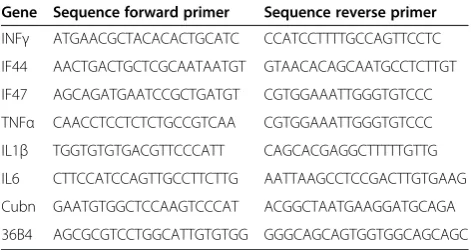
To validate the microarray data and to check for inter-animal variation, RNA’s from individual mice were used. For each individual sample, single-stranded complemen-tary DNA (cDNA) was synthesized from 1 μg of total RNA using the Reverse transcription system (iScript, Biorad) following the supplier's protocol. cDNA was PCR amplified with Platinum Taq DNA polymerase (all reagents were from Invitrogen). Primer sequences were retrieved from the online PrimerBank database [26], or otherwise designed using the Primer3 program [27] and the sequences of the primers used are listed in Table 1.
following thermal cycling conditions were used: 2 min at 94°C, followed by 40 cycles of 94°C for 15 s and 60°C for 45 s. PCR reactions to validate aging-induced differential gene expression were performed in duplicate and all samples were normalized to 36B4 expression.
Histochemistry
Four-micrometer sections of paraffin-embedded parts of the proximal, middle and distal segment of the small in-testine and of the colon were mounted on Superfrost microscope slides. These sections were dewaxed in xy-lene and rehydrated in a series of graded alcohols. After staining with Meyer's hematoxylin/eosine sections were mounted with DePex mounting medium (Gurr, BDH, Poole, Dorset, UK).
Bacterial DNA extraction
DNA was extracted from the freeze-dried luminal content of the 4 sections of the intestine using the method described by Salonen et al. [28]. In short, ap-proximately 0.1 g was used for mechanical and chem-ical lysis using 0.5 ml buffer (500 mM NaCl, 50 mM Tris–HCl (pH 8), 50 mM EDTA, 4% SDS) and 0.25 g of 0.1 mm zirconia beads and 3 mm glass beads. Nu-cleic acids were precipitated by addition of 130 μl, 10 M ammonium acetate, using one volume of iso-propanol. Subsequently, DNA pellets were washed with 70% ethanol. Further purification of DNA was performed using the QiaAmp DNA Mini Stool Kit (Qiagen, Hilden, Germany). Finally, DNA was dis-solved in 200 μl Tris/EDTA buffer and its purity and quantity were checked spectrophotometrically (ND-1000, nanoDrop technologies, Wilmington, USA).
16S rRNA Q-PCR
To quantify total bacteria using 16 S rRNA-specific pri-mers Q-PCR analysis was in carried out as described above with a few modifications. The used primer se-quence used were: 5’ -ACTCCTACGGGAGGCAGCAG-3’ and 5’-ATTACCGCGGCTGCTGG-3’ The Q-PCR conditions used were: 95°C for 10 min, followed by
35 cycles of denaturation at 95°C for 15 sec, annealing temperature of 60°C for 20 sec, extension at 72°C for 30 sec and a final extension step at 72°C for 5 min.
DNA isolation from scrapings of the small intestine and the colon
Genomic DNA was isolated from the crushed scraping by using DNeasyWBlood and Tissue Kit (Qiagen, Venlo, the Netherlands) according to the manufacturer’s instructions. The DNA was treated with RNase and eluted in Tris/EDTA buffer (pH 9.0). DNA purity and quantity were checked spectrophotometricaly (ND-1000, nanoDrop technologies, Wilmington, USA).
DNA methylation analysis
700 ng of genomic DNA for each sample was bisulfite-treated using EZ-96 DNA Methylation-Gold™ Kit (Zymo Research, USA) and eluted in 16 μL of M-Elution Buffer. Included in the bisulfite-treatment was a separate methylation curve consisting of a mix of low and highly methylated mouse genomic DNA (0%, 25%, 50%, 75% and 100% of highly methylated DNA (EpigenDx, Worcester, USA)). The B1-element assay was performed in a 45 μL PCR reaction con-taining 6 μL of bisulfite-treated genomic DNA, Pyro-Mark PCR Master Mix, CoralLoad Concentrate according to manufacturer’s instructions and 0.4 μM of each primer (Qiagen, Venlo, the Netherlands). The following thermal cycling conditions were used: 15 min at 95°C, followed by 45 cycles of 94°C for 30 s, 54°C for 30s, and 72°C for 40s, followed by a final elongation step at 72°C for 10 min. The primer sequence used for forward and biotinylated reverse primer were 5’-TTGGTTATTTTGGAATTTATTTT GTAGAT-3’ and 5’-biotin-TAATAACACACACCTTT AATCCCAACA-3’ respectively. B1-element methylation analysis was performed using Pyromark™ pyrosequencing technology (Biotage AB, Uppsala, Sweden). The PCR product was purified and made single-stranded using the Pyrosequencing Vacuum Prep Tool according to the man-ufacturer’s instructions (Qiagen, Venlo, The Netherlands). Sequencing primer (5’-TTTGGAATTTATTTTGTAGAT TAG-3’) was annealed to the purified single-stranded PCR product and pyrosequencing was performed using the Q24 Pyrosequencing System (Qiagen, Venlo, The Netherlands) and CpG methylation was analyzed with the provided software.
Statistical analysis
Physiological data are reported as the mean ± the stand-ard error (SE). The differences between the mean values were tested for statistical significance by a one-way ANOVA. P-values < 0.05 are considered statistically significant.
Table 1 Sequences of the primers used for Q-PCR analysis
Gene Sequence forward primer Sequence reverse primer
Results
A high-fat diet, but not aging, affects intestinal function and morphology
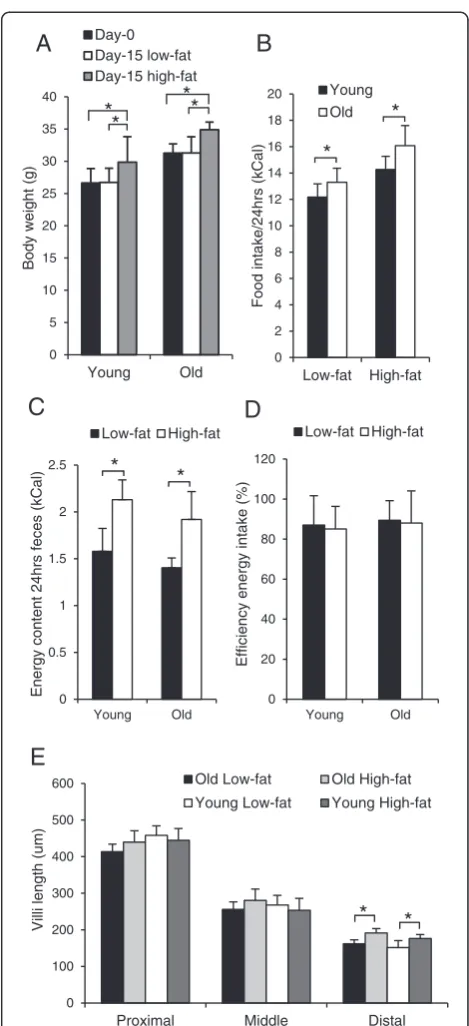
To analyze changes in the ability of the intestine of aging mice to respond to a high-fat challenge, young and old male C57BL/6J mice were exposed to a control low-fat (10E%) or to a high-fat diet (45E%) and sacrificed at the age of 4 and 21 months. The specific diets were provided for two weeks since the results of our previous study showed a clear response in young mice fed a high-fat diet for this time period [3]. Although body weight of the young mice was lower than that of the old mice, both age groups showed a similar and significant weight gain after 2 weeks exposure to a high-fat diet (Figure 1A). Both young and old mice consumed significantly more energy (E)% on the high-fat diet than on the low-fat diet (Figure 1B), but no significant difference was found between the two age groups. In addition, remnant energy in feces from mice that received the high-fat diet was significantly higher than from mice fed the low-fat diet. This effect was also similar in young and old mice (Figure 1C). Based on gross energy intake and fecal out-put, we calculated that digestible energy uptake was equally efficient in young and old mice (Figure 1D). Taken together, these results indicate that the intestine of 21-month-old C57BL/6J mice is still fully capable in absorbing energy from the diet under both a low-fat condition and in response to a high-fat dietary challenge.
To perform its unique functions, the intestine requires a highly specialized tissue structure. Morphometric analysis of H&E stained sections of the proximal, middle and distal part of the small intestine showed, as expected, a marked decrease in villi length in the successive segments of the small intestine. However, again no significant differences between old and young mice were observed (Figure 1E). In the distal part of the small intestine a small but signifi-cant increase in villi length was observed after 2 weeks ex-posure to a high-fat diet in both old and young mice. No difference in crypt depth and villi width was found be-tween old and young mice in all three parts of the small intestine (data not shown). In the colon, no differences be-tween young and old mice in crypt depth on H&E stained sections or in the number of proliferating cells as mea-sured by Ki67 staining were observed (data not shown). Thus, no changes were found in the functional capacity as well as in the tissue morphology of the intestine between 4- and 21- month-old mice.
Aging-induced changes in gene expression are more pronounced in the colon than in the small intestine
To evaluate the molecular effects of aging, microarray analysis was carried out on RNA isolated from scrapings derived of the proximal, middle and distal part of the small intestine and of the colon after two weeks of dietary
0 2 4 6 8 10 12 14 16 18 20
Low-fat High-fat
Food intake/24hrs (kCal)
Young
Old
*
*
0 5 10 15 20 25 30 35 40
Young Old
Body
w
e
ight (g)
Day-0 Day-15 low-fat Day-15 high-fat
*
*
*
*
A
C
B
D
*
0 0.5 1 1.5 2 2.5
Young Old
Energy
content
24hrs
feces
(kCal)
Low-fat High-fat
0 100 200 300 400 500 600
Proximal Middle Distal
Villi length
(um)
Old Low-fat Old High-fat
Young Low-fat Young High-fat
*
*
E
0 20 40 60 80 100 120
Young Old
Efficiency
energy
intake
(%)
Low-fat High-fat
*
intervention. A fold change threshold (2.0 fold) was ap-plied for the identification of differentially expressed genes to determine the most prominent changes in gene expres-sion. The results presented in Figure 2A show that in mice fed a low-fat diet, aging altered expression of only a lim-ited number of genes in the small intestine. However, aging changed expression of a much larger number of genes in the colon, under both low-fat and high-fat condi-tions. In mice fed a high-fat diet the distal part of the small intestine showed a relative pronounced aging re-sponse, but in the proximal and middle segment gene expression between young and old mice turned out to be highly similar. Remarkably, while in the colon aging pre-dominantly induced gene expression, in the small intestine aging mainly suppressed gene expression.
By comparing the total number of differentially expressed genes by aging under low-fat and high-fat
conditions in all segments of the intestine together we found that most of the genes that were over 2-fold regu-lated in mice fed a low-fat diet were also reguregu-lated in mice fed a high-fat diet (Figure 2B). Interestingly, a comparison of the 3 segments of the small intestine revealed that only 2 genes were over 2-fold regulated in all segments under either low-fat or high-fat conditions (Figure 2C). Further-more, 27 genes were differentially expressed in the colon as well as in one or more segments of the small intestine in response to aging (Figure 2D). However, of these 27 genes 15 were oppositely regulated (see Additional file 1: Table S1).
Increased expression of genes involved in immune response and inflammation in the colon of aged mice
Ingenuity Pathway Analysis (IPA) was applied on the genes showing aging-induced differential expression in
0 10 20 30 40 50 60 70 80 90
Pro
ximal
Middle Distal Colon
Pro
ximal
Middle Distal Colon
Low-fat High-fat
# Aging-induced
differentially
expressed
genes
Down-regulated Up-regulated
A
B
Aging whole intestine LF (111) Aging whole intestine HF (162)
C
Small intestine LF+HF (124) Colon LF+HF (104)
D
Proximal LF+HF (45)
Middle LF+HF (28)
Distal LF+HF (75)
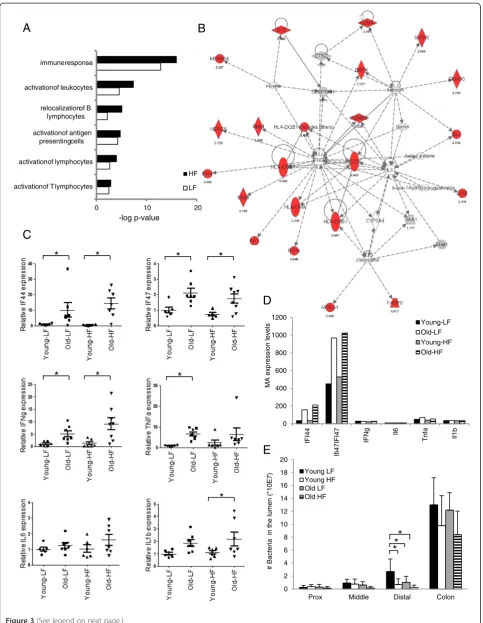
the colon to obtain insight into which pathways and net-works these genes contribute to. As can be seen in Figure 3A, the group of genes showing enhanced expres-sion in the colon of 21-month-old mice was dominated by genes involved in immune response and inflamma-tion. To compare the differential response of this func-tional category between the small intestine and the colon in more detail, we selected all genes involved in immune response and inflammation (based on gene ontology) showing over 2-fold differential expression in old mice compared to young mice in at least one of the four segments of the intestine. The results presented in Additional file 2: Table S2 show a large number of genes with increased expression under both low-fat and high-fat conditions specifically in the colon of aging mice. Additional file 2: Table S2 and the IPA network pre-sented in Figure 3B shows that a large number of IFNγ -responsive genes are present amongst the genes displaying enhanced expression in the colon of aging mice. However, since basal gene-expression levels of IFNγ itself were below the threshold of our microarray analysis in all isolated samples, this gene was not included in the analysis. Q-PCR analysis revealed that expression levels of IFNγ in the colon were indeed ex-tremely low, but that significantly enhanced expression in response to aging could be observed (Figure 3C). This expression pattern is similar to that of two IFNγ respon-sive genes (IF44 and IF47) that showed over 2- fold in-duction in the colon of old mice (Figure 3C, D). Low grade chronic inflammation is a common phenomenon during aging [29]. By applying Q-PCR analysis on colon samples of the 4- and 21-month-old mice we found that, in line with our microarray results, basal expression of three well-established pro-inflammatory cytokines, TNFα, IL1βand IL6 was very low in both young and old mice (Figure 3C, D). Enhanced expression of TNFαand IL1βwas observed in the colon of aging mice while only minor and insignificant effects were found for IL6. Taken together it can be concluded that although basal expression of various pro-inflammatory cytokines is very low, a significant increase could be observed in the colon of aging mice.
To determine whether the observed changes in expres-sion of genes involved in immune response and inflam-mation were due to alterations in the microflora, 16S rRNA Q-PCR analysis was carried out to analyze the total number of bacteria present in the luminal content of the three segments of the small intestine and of the colon. The results presented in Figure 3E show that, as expected, by far the largest number of bacteria was found in the colon, but no significant changes in total bacterial content between young and old mice were observed. In the distal part of the small intestine a de-cline in the number of bacteria was found in old mice,
but this effect was only significant in mice fed a low-fat diet. In addition, relative abundance of Bacteriodetes and Firmicutes was measured in the colon to determine changes in composition of microbiota. However, no aging-induced changes were observed for these domin-ant phyla (data not shown).
Together these results indicate that the group of genes showing enhanced expression in the colon of aging mice is dominated by genes involved in im-mune response and inflammation, but this effect cannot be explained by changes in the total number of bacteria present in the lumen or changes in the Bacteriodetes/Firmicutes ratio.
Decreased expression of Cubilin in the intestine of aging mice
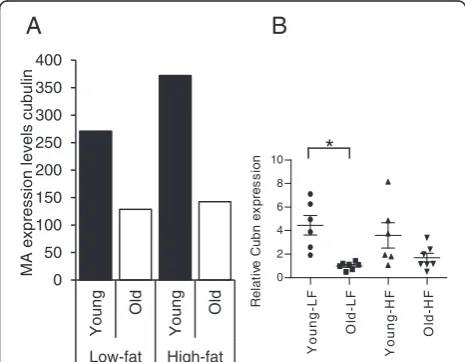
The microarray data presented in Figure 2A show that only a limited number of genes are differentially expressed in the small intestine of aging mice. In line with the observation that energy absorption between young and old mice IPA analyses of the microarray data did not reveal aging-induced changes in common meta-bolic pathways of macronutrients in the small intestine. Since micronutrient deficiency is common in the elderly we searched for differentially expressed genes involved in micronutrient metabolism. Our microarray data set revealed several genes involved in micronutrient metab-olism showing differential expression in the intestine of aging mice. In 21-month-old mice over 2-fold reduction in the expression of Cubilin (Cubn), a gene that med-iates the transfer of intrinsic factor-vitamin B12 complex across the epithelial membrane, was found in the colon (Figure 4A). These results could be validated by Q-PCR analysis (Figure 4B). Also in the proximal and middle part of the small intestine of old mice decreased Cubn expression was observed, although these effects were less pronounced than in the colon (data not shown). In addition, basal expression of cytochrome b reductase 1 (Cybrd1), a gene involved in iron metabolism, and metallothionein 2 (MT2) involved in zinc and copper metabolism, showed over 2-fold higher expression in the small intestine of aging mice. However, since expression of both genes is increased and no concomitant differen-tial expression of transporters involved in absorption of these minerals was found it is currently not clear whether these effects contribute to altered micronutrient metabolism in the intestine of aging mice.
0 10 20 activationof T lymphocytes
activationof lymphocytes activationof antigen
presentingcells relocalizationof B
lymphocytes activationof leukocytes
immuneresponse
HF
LF
-log p-value
A
B
C
*
*
*
*
*
*
*
*
0 200 400 600 800 1000 1200
IF
I44
Ifi47IFI47
IF
Ng Il6
Tnf
a
Il1b
MA ex
pression lev
e
ls Young-LF
Old-LF Young-HF Old-HF
D
0 2 4 6 8 10 12 14 16 18 20
Prox Middle Distal Colon
# Bacteria
in the
lumen (*10E7)
Young LF Young HF Old LF Old HF
E
*
*
*
A high-fat dietary challenge affects gene expression in the small intestine of young and old mice
In addition to the changes in basal gene expression be-tween old and young mice, the microarray data were analyzed to compare the ability of the intestine to re-spond to a high-fat dietary challenge between the two age groups. As can be seen in Figure 5A, two weeks ex-posure to a high-fat diet showed, as expected, only a limited effect on gene expression in the colon of both young and old mice. A much stronger response to the high-fat diet was found in the small intestine where also a differential response between old and young mice could be observed. While in young mice the response towards a high-fat diet declined in subsequent sections of the small intestine, in old mice the effect became stronger in the more distal located parts. An overview of all genes showing over 2-fold change in expression in at least one of the 4 segments of the intestine in response to a high-fat dietary challenge is presented in Additional file 3: Table S3.
IPA analysis applied to the genes regulated in response to a high-fat diet in the small intestine of young and old
mice indicated that, although the number of genes showing over 2-fold regulation differed between young and old mice, the same pathways were affected in both age groups (Figure 5B and Additional file 4: Table S4). The most pronounced difference in the fat response be-tween old and young mice was detected in the distal part of the small intestine. Analysis of the microarray data revealed that in this segment of the small intestine a large number of genes involved in immune response and inflammatory processes were down-regulated in re-sponse to a high-fat diet in old mice (see Additional file 3: Table S3).
Taken together these results imply that although the number of genes over 2-fold regulated by a high-fat diet-ary challenge is different between young and old mice, the same pathways were affected in the two age groups. This suggests that the intestine of the old mice seems still highly capable in handling a high-fat dietary challenge.
Decreased global DNA methylation in the intestine of aging mice
Pyrosequencing of B1 elements, a CpG rich repetitive se-quence present in the mouse genome, was carried out in DNAs isolated from the same scrapings as used for microarray analysis. As can be seen in Figure 6 a signifi-cant decrease in global DNA methylation was found in the distal part of the small intestine and the colon under both low-fat and high-fat conditions in the 21-month-old mice. Also in the proximal part of the small intes-tine, where the methylation status of the B1 element was found to be lower than in the other segments of the in-testine, decreased methylation of the B1 element was found in 21-month-old mice, athough this effect was not significant. No change in global DNA methylation was found in the middle part of the small intestine. Further-more, the results presented in Figure 6 show that two weeks exposure to a high-fat diet did not induce signifi-cant changes in global DNA methylation in young as well as in old mice in all 4 sections of the intestine.
Discussion
The importance of appropriate functioning of the gut for the maintenance of health has been generally
Rel
a
ti
ve
Cub
n ex
pres
s
ion
Youn
g
-L
F
Ol
d
-L
F
Yo
u
n
g
-HF
Ol
d
-H
F
0 2 4 6 8 10
A
B
0 50 100 150 200 250 300 350 400
Young
Ol
d
Young
Ol
d
Low-fat High-fat
MA expression
levels
cubulin
*
Figure 4Effect of aging on Cubn expression in the colon. (A) Microarray analysis and (B) Q-PCR analysis revealed decreased expression of Cubn in the colon of aging mice that have received either a low-fat or high-fat diet.
(See figure on previous page.)
A
0 10 20 30 40 50 60 70 80
Pro
ximal
Middle Distal Colon
Pro
ximal
Middle Distal Colon
Young Old
# Regulated
genes
by
a high-fat
diet
Down-regulated
Up-regulated
0 5 10 15
Hepatic System Disease Gastrointestinal Disease Vitamin and Mineral
Metabolism Small Molecule
Biochemistry Lipid Metabolism
Young Proximal
Young Middle
Young Distal
Old Proximal
Old Middle
Old Distal
-Log p-value
B
Figure 5Differential gene expression induced by a high-fat diet in the 4 segments of the intestine.(A) The number of genes showing at least 2-fold up or down-regulation in the proximal, middle or distal part of the small intestine or in the colon in 4 and 21-month-old mice. (B) IPA analysis revealed the major functional categories to which the differentially expressed genes in the small intestine belong.
Youn
g-LF
Youn
g-HF
Old-LF Old-HF
Youn
g-LF
Youn
g-HF
Old-LF Old-HF
Youn
g-LF
Youn
g-HF
Old-LF Old-HF
60.0 62.0 64.0 66.0 68.0 70.0 72.0 74.0 76.0 78.0
Youn
g-LF
Youn
g-HF
Old-LF Old-HF
Proximal Middle Distal Colon
Methylation
B1
element
*
*
accepted. However, to what extent aging-induced func-tional decline in the small intestine and colon have a causal effect on the impaired health status of the in-creasing number of elderly in our modern Western soci-ety is still an unresolved issue. A large number of studies have already zoomed in on different features of the aging intestine separately, but in this study we have examined functional, structural and molecular effects of aging in the mouse small and large intestine. The adult life in C57BL/6J mice is characterized by different phases. The young adult phase starts at 3 and ends at 6 months of age and reflects a human age ranging from 20 to 30 years. Mice are considered to be in their old phase when they are between 18 and 24 months of age repre-senting a human age ranging from 56 until 69 years [30,31]. By comparing energy intake between C57BL/6J mice at the age of 4- and 21-months, we found no re-duction in either the efficiency of energy absorption of the control 10E% fat diet or of the 45E% high-fat diet. The fact that energy intake is not altered in the mice im-plies that capacity to digest and absorb macronutrients by the gastrointestinal tract does not decline with age. In line with this observation, our microarray data discloses no significantly altered pathways in macronutrient me-tabolism in aging mice up to the age of 21-months. A previous study has analyzed gene expression regulation in the duodenum and colon of aging rats [32]. Similar to our findings this study also observed a higher number of differentially expressed genes in the colon compared to the small intestine. Furthermore, in agreement with our results they found that in the colon, aging caused mainly increased gene expression, while in the small intestine most of the differentially expressed genes were decreased. However, while in our study the number of altered genes involved in metabolic processes was very low, Lee and colleagues reported altered expression of genes involved in nutrient digestion and absorption and energy metabolism, although this observation was not further supported by additional functional analyses [32]. Differences between aging in rats and mice, different segments of the intestine analyzed or the use of scrap-ings versus whole intestine are factors that might con-tribute to the discrepancy between the obtained results.
Although we did not observe marked changes in ex-pression of genes involved in macronutrient metabolism, changes in expression levels of genes playing a role in micronutrient metabolism including Cubn were detected. Cubn is of crucial importance for the absorp-tion of vitamin B12 by mediating the transfer of the in-trinsic factor-vitamin B12 complex over the apical membrane of enterocytes [33]. Our microarray data show decreased expression of Cubn in the proximal and middle part of the small intestine as well as in the colon of aging mice. Vitamin B12 deficiency occurs frequently
in elderly humans [34,35] and has been shown to play a causal role in a variety of diseases like depression and impaired cognition [36,37], cardiovascular diseases [38] and osteoporosis [39,40]. Vitamin B12 deficiency in the elderly is mainly due to reduced food intake and, pre-dominantly, malabsorption. It is believed that insufficient release of vitamin B12 from food and impaired coupling to intrinsic factor (IF) due to chronic atrophic gastritis [35] represent the underlying mechanisms of the malab-sorption. However, our results imply that reduced ex-pression of Cubn might contribute to the impaired absorption of vitamin B12 in the intestine and that this decreased expression puts the elderly at risk of becom-ing vitamin B12 deficient.
While aging-induced molecular responses occurred predominantly in the colon, in contrast, the major changes in gene expression induced by a high-fat dietary challenge were found in the small intestine. Furthermore, while IPA analysis of the differentially expressed genes showed that aging did not cause major changes in metabolic pathways, genes involved in a variety of metabolic processes dominated the molecular response induced by the high-fat diet, con-firming the results of our previous study [3]. Inter-estingly, exposure to a high-fat diet for two weeks resulted in increased villi length in the distal part of the small intestine in young and old mice. One could speculate that the capacity of the proximal and mid-dle part of the small intestine is insufficient to clear the intestinal content of all lipids and/or fatty acids in case of a diet containing 45E% of fat. As a conse-quence, the final part of the small intestine is exposed to increased amounts of fat affecting the tis-sue structure in this part of the small intestine. The fact that the dietary composition affects tissue morphology of the intestine implies that identical nu-tritional conditions are of crucial importance to analyze aging-induced changes in tissue morphology of the intestine. In line with some other studies we did not observe aging-induced morphological changes in any of the 4 segments of the intestine while other studies reported changes in tissue morphology of the intestine as a consequence of aging. The inconsist-ency in the published data might be explained by dif-ferences in species used in the different studies or the different age groups that were compared. How-ever, part of the diversity in effects might also be caused by artifacts induced by differences in the dietary conditions [13,41-44].
immune system are one of the hallmarks of the aging body. Immunosenescence is the functional decline of the adaptive immune system brought on by natural aging whereby protection against infection by pathogens and the effectiveness of vaccination decline [45,46]. The sec-ond aging-induced change in the immune system is called inflammaging which is characterized by a low-grade chronic inflammation process that contributes to the pathogenesis of many age-related diseases [47-49]. A large variety of cells with a defense function are present especially in the lamina propria and the submucosa of the intestine accomplishing immune protection via the innate as well as by the adaptive immune response. Interestingly, our microarray and Q-PCR data clearly show that activity of both branches of the immune sys-tem is enhanced in response to aging exclusively in the colon but not in the small intestine of old mice. Expres-sion levels of well-established pro-inflammatory cyto-kines like IFNγ, TNFα, IL6 and IL1β turned out to be extremely low in the colon of both old and young mice and below the threshold of our microarray analysis. These low expression levels are probably due to the fact that these cytokines are predominantly produced by im-mune cells in the mucosa which is a rather low percent-age of cells in relation to all cells present in the intestinal tissue. Q-PCR analysis confirmed the very low basal expression levels of these pro-inflammatory cyto-kines, yet a weak but significant induction of IFNγTNFα and IL-1βin the colon of aging mice was observed. This result suggests that low-grade inflammation might be present in the colon of the aging mice in our study, al-though it should be noted that no altered expression of a number of established inflammation markers like Toll-like receptors (TLRs), C-type lectin receptors (CLRs) and retinoic acid-inducible receptors (RLRs) [50] was detectable.
Changes in the gut microbiota in terms of compos-ition and functionality during the process of aging have previously been reported [19,20,51] and it has been postulated that these changes might contribute to the development of immunosenescence and inflam-maging [18,52]. To establish whether the enhanced expression of genes playing a role in the immune sys-tem are due to modifications in the microbiota we measured the total number of all bacteria and of the two most prominent phyla colonizing the colon, Bac-teriodetes and Firmicutes, in the luminal content of the colon. We did not observe aging-related changes. More advanced techniques like pyrosequencing are required to determine whether total number of bac-teria and changes in the composition of the micro-biota might play a causal role in the observed changed expression of immune-related genes in the colon of our aging mice. Although it is difficult to
assess the physiological consequences of the enhanced expression of genes involved in inflammation and im-mune response, it seems most likely that this effect is important for the health status of the aging colon.
Interestingly, also colorectal cancer, which occurs with increased frequency in the elderly, has been related to an altered immune status of the colon [53-55]. The fact that we only found increased ex-pression of immune-related genes in the colon, but not in the small intestine is intriguing since tumor formation is a very rare event in the small intestine and molecular evidence explaining the extreme dif-ference in incidence of tumor formation in the two segments of the intestine is currently still lacking. In contrast to what has previously been found in the colon of aging rats [22], none of the well-established genetic markers of colorectal cancer (i.e. APC, KRAS, p53 etc.) or genes involved in cell cycle arrest and apoptosis [56] showed marked differential ex-pression in the colon of the old mice in our study. This observation might be related to the fact that colorectal cancer is only a rare spontaneous event in C57BL/6J mice and that specific predisposing muta-tions [57] or carcinogenic agents [58,59] are required to induce colorectal cancer in this mouse strain. Apart from genetic events epigenetic modifications have become important markers of tumor develop-ment, in particular of colorectal tumors [60]. Hypo-methylation of repetitive sequences is frequently observed in tumor tissue, but is also recognized to be an established feature of normal aging tissue [60]. Interestingly, our results show differential demethyla-tion between the various segments of the intestine of normal old mice. Since no significant demethylation in the proximal part of the small intestine is observed, it can be speculated that this part of the intestine is less prone to tumor development. Fur-ther research is required to prove this hypothesis and to establish whether changes in DNA methyla-tion are responsible for the altered levels of gene expression observed in the colon of our aging mice in line with what previously has been reported [21].
Conclusion
the micronutrient deficiencies frequently occurring in the aging segment of our society. Furthermore, it can be speculated that the decrease in global DNA methylation and the altered status of the immune system of the colon might play a causal role in the decreased health status of this organ at old age.
Additional files
Additional file 1: Table S1.All genes differential expressed in one or more segments of the intestine in old mice fed a low-fat or high-fat diet.
Additional file 2: Table S2.Immune response and inflammatory genes regulated in old mice fed a low-fat or high-fat diet.
Additional file 3: Table S3.All genes differential expressed in one or more segments of the intestine in response to a high-fat diet.
Additional file 4: Table S4.Genes present in the IAP functional categories presented in Figure 5B regulated by a high-fat diet in the distal part of the small intestine in young and old mice.
Competing interests
The authors declare that they have no competing interests.
Authors’contributions
WS, NW, NIJ, EK, LG and MM participated in the design and/or supervision of the study. CL, SK and MG performed the experimental work such as sample preparation, Q-PCR, Global DNA methylation, histological analysis. MG hybridized the microarrays. MB assessed the quality control of the microarrays and performed the IAP analysis. WS and MB performed microarray analysis and drafted the manuscript. NW, MB, NIJ, EK, LG and MM provided valuable feedback on the initial draft. All authors read and approved the final manuscript.
Acknowledgements
This work was financially supported by Nutrigenomics Consortium, TI Food and Nutrition, the“Jan Dekkerstichting/Ludgardine Bouwmanstichting”, Amsterdam and SVGO, Heelsum.
Author details
1Division of Human Nutrition, Wageningen University, Wageningen, The Netherlands.2The Netherlands Nutrigenomics Centre, TI Food and Nutrition, Wageningen, The Netherlands.
Received: 27 April 2012 Accepted: 17 August 2012 Published: 28 August 2012
References
1. Garrett WS, Gordon JI, Glimcher LH:Homeostasis and inflammation in the intestine.Cell2010,140(6):859–870.
2. Santaolalla R, Fukata M, Abreu MT:Innate immunity in the small intestine. Curr Opin Gastroenterol2011,27(2):125–131.
3. de Wit NJ, Bosch-Vermeulen H, de Groot PJ, Hooiveld GJ, Bromhaar MM, Jansen J, Muller M, van der Meer R:The role of the small intestine in the development of dietary fat-induced obesity and insulin resistance in C57BL/6J mice.BMC Med Genomics2008,1:14.
4. Meier J, Sturm A:The intestinal epithelial barrier: does it become impaired with age?Dig Dis2009,27(3):240–245.
5. Barbosa T, Rescigno M:Host-bacteria interactions in the intestine: homeostasis to chronic inflammation.Wiley Interdiscip Rev Syst Biol Med 2010,2(1):80–97.
6. Benelam B:Satiety and the anorexia of ageing.Br J Community Nurs2009, 14(8):332–335.
7. Bhutto A, Morley JE:The clinical significance of gastrointestinal changes with aging.Curr Opin Clin Nutr Metab Care2008,11(5):651–660. 8. Drozdowski L, Thomson AB:Aging and the intestine.World J Gastroenterol
2006,12(47):7578–7584.
9. McDonald RB, Ruhe RC:Changes in food intake and its relationship to weight loss during advanced age.Interdiscip Top Gerontol2010,37:51–63.
10. Salles N:Basic mechanisms of the aging gastrointestinal tract.Dig Dis 2007,25(2):112–117.
11. Lee EK, Jung KJ, Choi J, Kim HJ, Han YK, Jeong KS, Ji AR, Park JK, Yu BP, Chung HY:Molecular basis for age-related changes in ileum: involvement of Bax/caspase-dependent mitochondrial apoptotic signaling.Exp Gerontol2010,45(12):970–976.
12. Martin K, Kirkwood TB, Potten CS:Age changes in stem cells of murine small intestinal crypts.Exp Cell Res1998,241(2):316–323.
13. Trbojevic-Stankovic JB, Milicevic NM, Milosevic DP, Despotovic N, Davidovic M, Erceg P, Bojic B, Bojic D, Svorcan P, Protic M,et al:Morphometric study of healthy jejunal and ileal mucosa in adult and aged subjects.Histol Histopathol2010,25(2):153–158.
14. Woudstra T, Thomson AB:Nutrient absorption and intestinal adaptation with ageing.Best Pract Res Clin Gastroenterol2002,16(1):1–15.
15. Kirkwood TB:Intrinsic ageing of gut epithelial stem cells.Mech Ageing Dev 2004,125(12):911–915.
16. Lappinga PJ, Abraham SC, Murray JA, Vetter EA, Patel R, Wu TT:Small intestinal bacterial overgrowth: histopathologic features and clinical correlates in an underrecognized entity.Arch Pathol Lab Med2010, 134(2):264–270.
17. Rana SV, Bhardwaj SB:Small intestinal bacterial overgrowth.Scand J Gastroenterol2008,43(9):1030–1037.
18. Tiihonen K, Ouwehand AC, Rautonen N:Human intestinal microbiota and healthy ageing.Ageing Res Rev2010,9(2):107–116.
19. Biagi E, Nylund L, Candela M, Ostan R, Bucci L, Pini E, Nikkila J, Monti D, Satokari R, Franceschi C,et al:Through ageing, and beyond: gut microbiota and inflammatory status in seniors and centenarians.PLoS One2010,5(5):e10667.
20. Claesson MJ, Cusack S, O'Sullivan O, Greene-Diniz R, de Weerd H, Flannery E, Marchesi JR, Falush D, Dinan T, Fitzgerald G,et al:Composition, variability, and temporal stability of the intestinal microbiota of the elderly.Proc Natl Acad Sci USA2011,108(Suppl 1):4586–4591.
21. Maegawa S, Hinkal G, Kim HS, Shen L, Zhang L, Zhang J, Zhang N, Liang S, Donehower LA, Issa JP:Widespread and tissue specific age-related DNA methylation changes in mice.Genome Res2010,20(3):332–340. 22. Englander EW:Gene expression changes reveal patterns of aging in the
rat digestive tract.Ageing Res Rev2005,4(4):564–578. 23. Bolstad BM, Irizarry RA, Astrand M, Speed TP:A comparison of
normalization methods for high density oligonucleotide array data based on variance and bias.Bioinformatics2003,19(2):185-193. 24. Irizarry RA, Bolstad BM, Collin F, Cope LM, Hobbs B, Speed TP:Summaries
of Affymetrix GeneChip probe level data.Nucleic Acids Res2003,31(4):e15 25. Dai MH, Wang PL, Boyd AD, Kostov G, Athey B, Jones EG, Bunney WE, Myers
RM, Speed TP, Akil H et al:Evolving gene/transcript definitions significantly alter the interpretation of GeneChip data.Nucleic Acids Research2005,33(20).
26. Wang X, Seed B:A PCR primer bank for quantitative gene expression analysis.Nucleic Acids Res2003,31(24):e154.
27. Rozen S, Skaletsky H:Primer3 on the WWW for general users and for biologist programmers.Methods Mol Biol2000,132:365–386. 28. Salonen A, Nikkilä J, Jalanka-Tuovinen J, Immonen O, Rajilic-Stojanovic M,
Kekkonen RA, Palva A, de Vos WM:Comparative analysis of fecal DNA extraction methods with phylogenetic microarray: effective recovery of bacterial and archaeal DNA using mechanical cell lysis.J Microbiol Methods2010, In Press, Corrected Proof.
29. Cevenini E, Caruso C, Candore G, Capri M, Nuzzo D, Duro G, Rizzo C, Colonna-Romano G, Lio D, Di Carlo D,et al:Age-related inflammation: the contribution of different organs, tissues and systems. How to face it for therapeutic approaches.Curr Pharm Des2010,16(6):609–618.
30. Flurkey K, Currer JM, Harrison DE:The Mouse in Aging Research. InThe Mouse in Biomedical Research. 2nd edition. Edited by Fox JG, Davisson MT, Quimby FW, Barthold SW, Newcomer CE, Smith AL: Elsevier Inc; 2007: 637–672.
31. http://research.jax.org/faculty/harrison/ger1vLifespan1.html.
32. Lee HM, Greeley GH Jr, Englander EW:Age-associated changes in gene expression patterns in the duodenum and colon of rats.Mech Ageing Dev 2001,122(4):355–371.
33. Kozyraki R:Cubilin, a multifunctional epithelial receptor: an overview. J Mol Med2001,79(4):161–167.
35. Wolters M, Strohle A, Hahn A:Cobalamin: a critical vitamin in the elderly. Prev Med2004,39(6):1256–1266.
36. Selhub J, Troen A, Rosenberg IH:B vitamins and the aging brain.Nutr Rev 2010,68(Suppl 2):S112–S118.
37. Miller AL:The methionine-homocysteine cycle and its effects on cognitive diseases.Altern Med Rev2003,8(1):7–19.
38. McCully KS:Homocysteine, vitamins, and vascular disease prevention.Am J Clin Nutr2007,86(5):1563S–1568S.
39. Tucker KL, Hannan MT, Qiao N, Jacques PF, Selhub J, Cupples LA, Kiel DP: Low plasma vitamin B12 is associated with lower BMD: the Framingham Osteoporosis Study.J Bone Miner Res2005,20(1):152–158.
40. Vaes BL, Lute C, van der Woning SP, Piek E, Vermeer J, Blom HJ, Mathers JC, Muller M, de Groot LC, Steegenga WT:Inhibition of methylation decreases osteoblast differentiation via a non-DNA-dependent methylation mechanism.Bone2010,46(2):514–523.
41. Corazza GR, Frazzoni M, Gatto MR, Gasbarrini G:Ageing and small-bowel mucosa: a morphometric study.Gerontology1986,32(1):60–65. 42. Holt PR, Pascal RR, Kotler DP:Effect of aging upon small intestinal
structure in the Fischer rat.J Gerontol1984,39(6):642–647. 43. Lipski PS, Bennett MK, Kelly PJ, James OF:Ageing and duodenal
morphometry.J Clin Pathol1992,45(5):450–452.
44. Warren PM, Pepperman MA, Montgomery RD:Age changes in small-intestinal mucosa.Lancet1978,2(8094):849–850.
45. Lang PO, Govind S, Michel JP, Aspinall R, Mitchell WA:Immunosenescence: Implications for vaccination programmes in adults.Maturitas2011, 68(4):322–330.
46. Ostan R, Bucci L, Capri M, Salvioli S, Scurti M, Pini E, Monti D, Franceschi C: Immunosenescence and immunogenetics of human longevity. Neuroimmunomodulation2008,15(4–6):224–240.
47. Chung HY, Cesari M, Anton S, Marzetti E, Giovannini S, Seo AY, Carter C, Yu BP, Leeuwenburgh C:Molecular inflammation: underpinnings of aging and age-related diseases.Ageing Res Rev2009,8(1):18–30.
48. Jylhava J, Hurme M:Gene variants as determinants of longevity: focus on the inflammatory factors.Pflugers Arch2010,459(2):239–246.
49. Iannitti T, Palmieri B:Inflammation and genetics: an insight in the centenarian model.Hum Biol2011,83(4):531–559.
50. Rakoff-Nahoum S, Bousvaros A:Innate and adaptive immune connections in inflammatory bowel diseases.Curr Opin Gastroenterol2010,
26(6):572–577.
51. Woodmansey EJ:Intestinal bacteria and ageing.J Appl Microbiol2007, 102(5):1178–1186.
52. Biagi E, Candela M, Franceschi C, Brigidi P:The aging gut microbiota: new perspectives.Ageing Res Rev2011,10(4):428–429.
53. Yasui Y, Tanaka T:Protein expression analysis of inflammation-related colon carcinogenesis.J Carcinog2009,8:10.
54. Hussain SP, Hofseth LJ, Harris CC:Radical causes of cancer.Nat Rev Cancer 2003,3(4):276–285.
55. Lashner BA, Provencher KS, Bozdech JM, Brzezinski A:Worsening risk for the development of dysplasia or cancer in patients with chronic ulcerative colitis.Am J Gastroenterol1995,90(3):377–380.
56. Fearon ER:Molecular genetics of colorectal cancer.Annu Rev Pathol2011, 6:479–507.
57. McCart AE, Vickaryous NK, Silver A:Apc mice: models, modifiers and mutants.Pathol Res Pract2008,204(7):479–490.
58. Clapper ML, Cooper HS, Chang WC:Dextran sulfate sodium-induced colitis-associated neoplasia: a promising model for the development of chemopreventive interventions.Acta Pharmacol Sin2007,28(9):1450–1459. 59. Bissahoyo A, Pearsall RS, Hanlon K, Amann V, Hicks D, Godfrey VL, Threadgill
DW:Azoxymethane is a genetic background-dependent colorectal tumor initiator and promoter in mice: effects of dose, route, and diet. Toxicological sciences: an official journal of the Society of Toxicology2005, 88(2):340–345.
60. Carmona FJ, Esteller M:Epigenomics of human colon cancer.Mutat Res 2010,693(1–2):53–60.
doi:10.1186/1755-8794-5-38
Cite this article as:Steegengaet al.:Structural, functional and molecular analysis of the effects of aging in the small intestine and colon of C57BL/6J mice.BMC Medical Genomics20125:38.
Submit your next manuscript to BioMed Central and take full advantage of:
• Convenient online submission
• Thorough peer review
• No space constraints or color figure charges
• Immediate publication on acceptance
• Inclusion in PubMed, CAS, Scopus and Google Scholar
• Research which is freely available for redistribution