ISSN: 2306-9007 Nava-Macali (2017) 811
I
www.irmbrjournal.com June 2017I
nternationalR
eview ofM
anagement andB
usinessR
esearchVol. 6 Issue.2
R
M
B
R
Knowledge Sharing Behavior Among CBA Students
JOSEPHINE NAVA-MACALI, MBA
University of Perpetual Help System Laguna Faculty, College of Business and Accountancy
Email: [email protected]
Abstract
The study was conducted to determine the degree of knowledge sharing support system and the degree of knowledge sharing behavior among 98 CBA students. This study utilized the descriptive correlation research design. The study found out that the respondents are very much convinced that their instructors motivate students to share whatever knowledge imparted to them; the students consider information technology as a means to support their willingness to share information they have learned; the respondents agree to share their classmates their classmates all the resource materials which can be useful academically; the respondents are assured that the knowledge they share would help their classmates improve their academic performance; the respondents agreed to make use of the internet available at home or at the university; that the respondent’s knowledge sharing behavior s dependent to their degree knowledge sharing support system in terms of instructor’s support, and lastly, the respondent’s knowledge sharing behavior is dependent to their degree of knowledge sharing support system in terms of technology support.
Key Words: Knowledge Sharing, Support System, Information Technology, Academic Performance.
Introduction
Knowledge is defined as the know-how, experience, insights and capabilities that assist teams and individuals in making correct and rapid decisions, taking actions and creating new capabilities. (Gorelick & Tantawy-Monsou, 2005).
Knowledge exists in tacit and explicit forms, which are complementary and symbiotic. Tacit knowledge can be defined as the skills, ideas and experiences that the people have in their minds and are therefore difficult to access because it is not often codified and may not necessarily be easily expressed (Chugh, 2015). Eucker states that tacit knowledge consists of „know-how‟, „know-what‟ and „know-who‟ that someone acquire and accumulate through practical experience, that they are often not even aware that they possess and that they cannot really be learned in any other way. (Eucker,2007 Explicit knowledge is a knowledge that can be readily articulated, codified, accessed and verbalized. (Hellie, 2010)
ISSN: 2306-9007 Nava-Macali (2017) 812
I
www.irmbrjournal.com June 2017I
nternationalR
eview ofM
anagement andB
usinessR
esearchVol. 6 Issue.2
R
M
B
R
In a traditional classroom setting knowledge can effectively and easily be shared through the internet and in various activities such as story telling, reporting, group dynamics, mentoring and coaching that has a direct link towards the set learning objective. Effectivity of knowledge sharing could be evidently expressed through the students input.
There are situations wherein knowledge is not shared effectively despite its benefits and this could be attributed to various physical, technological, cultural and personality factors. According to Riege (2005) there are several potential individual factors that hinder people from sharing knowledge, these includes: poor communication and interpersonal skills, difference of age & gender, differences of educational levels, lack of trust in people because they misuse knowledge or take unjust credit for it, lack of trust in the accuracy and credibility of knowledge due to source and differences in national culture or ethnic background, and values and belie associated with it.
Knowledge sharing depends on the habit and willingness of the knowledge worker to seek out and/or be receptive to these knowledge sources. The right culture, incentives and so on must therefore be present. Knowledge sharing takes place when the information or knowledge is shared by individuals within the group and during the process the information or knowledge also will be negotiated and refined until it becomes common knowledge to the group.
This research is projected to help contribute in developing a general understanding about the knowledge-sharing behavior of university students; what motivations to share among other students; and what factors that inhibit or barriers that could lead students abstaining from the practice of knowledge sharing.
This study aims to answer the problems such as (1) what is the degree of knowledge-sharing support system experienced by the respondents in terms of instructor‟s support and technology support, (2) what is the knowledge-sharing behaviors among the respondents along willingness to learn, ability to learn, and resources to share, and (3) is there a significant relationship between the degree of knowledge-sharing support system experienced by the respondents and other knowledge-sharing behavior?
Review of Related Literature
Knowledge can be seen as a personal intellectual asset to which people hold on to themselves unless there are encouragement and facilitation to share (Yu, Lu, and Liu, 2009). Co-construction of knowledge happens when the learner reflects on newly shared knowledge, justify and define them, reevaluate them and define them and externalize them by transforming the internal processes into public processes (Choi, Land and Turgeon, 2005). It is an activity through which knowledge (namely, information, skills, or expertise) is exchanged among people, friends, families, communities or organization. (Serban and Luan (2002); Hasmath and Hsu (2006). It arises from individual‟s effort to transfer knowledge to others within the organization. Taylor. Successful sharing also depends on the recipient‟s ability to and willingness to learn (Taylor, 2006).
Knowledge sharing has been gaining attention among researches and business managers. Numerous studies (e.g Ardichvili, Page & Wentling, 2003) have examined factors influencing knowledge sharing in an organizational context. Factor associated with knowledge sharing have been categorized into three groups: individual, organizational and technological and since this study is about knowledge sharing students, organizational fact ors are modified into classroom factors.
ISSN: 2306-9007 Nava-Macali (2017) 813
I
www.irmbrjournal.com June 2017I
nternationalR
eview ofM
anagement andB
usinessR
esearchVol. 6 Issue.2
R
M
B
R
Student‟s ability to share knowledge is alongside with the corporate world‟s interest in recruiting employee who possess diversified social skills and ability to share a message across to others clearly and unambiguously (Begonia & Carmen, 2011). Individual‟s ability to share positively influences knowledge sharing (Wangpipatwong, 2009).
Attitude towards knowledge refers to the positive and negative feelings an individual has towards the intention to share knowledge. Social exchange posits that social exchange engenders social rewards, such as feeling of approval, status and respect (He and Wei 2009); Hsu et al, 2007)). The educational institution emphasizes the importance of verbal rewards in the form of feedback and praise (Deci et al. 2001).
The challenge of knowledge sharing is for the students to continuously learn and effectively utilize these knowledge that they have learned. When people are confident in their ability to share useful knowledge, they are highly motivated to do so (Cho, Li, & Su,2007). Individual‟s ability to share and individual‟s individuals‟ willing to share positively influence knowledge sharing (Van de Hooff, 2003).
Competition is another factor to address. People do not share knowledge because they are afraid to lose their exclusiveness, the knowledge individual posses is their intellectual property which gives them a personal advantage they can leverage for the organization they are working for (Choi, Li, & Su, 2007). In class room context student will keep knowledge form classmates to gain a competitive advantage in grades.
Numerous researchers noted that knowledge sharing depends on communication skills both verbal and written (Reige, 2005). Yogeesha (2013), found that teacher support has a significant influence on knowledge sharing among students while (Volady, 2013) and (Wangpipatwong, 2009) found that instructor support has no influence on knowledge sharing of students.
Munoz, in his studies indicated that students are devoted the use of Web 2.0 technologies (i.e blogs, twitter, podcasts, wikis, social network sites, virtual world, video sharing and photo sharing (Munoz & Toner, 2009). In his study, Wahlroos revealed that the benefits of experience with social media have a significant impact of personal factors while the influence of costs was not supported by the study. (Wahlroos, 2010).
Technology infrastructure facilitates easy communication which is the key to knowledge sharing (Kim & Lee, 2004). Technology can be considered to be an important contribution to connectivity since it enables long distance collaboration; technology also act as a facilitator to encourage and support knowledge sharing by making knowledge sharing easier and effective (Riege, 2005). The importance of social networking was also highlighted by Zaquout & Abbas (2012) and Weit, et al (2012).
Many educational institutions and organizations have employed online learning systems and virtual learning communities to support knowledge sharing (Chen, Chen & Kinshuk, 2009). Technology support significantly influences knowledge sharing behavior knowledge sharing among students, while technology availability has no significant has no influence on knowledge sharing of students (Wangpipatwong, 2009).
Methodology
This study utilized the descriptive correlation research design. Descriptive correlation methods permit investigators to see whether there is a link or association between the variables of interest (Weiten, 2010). The respondents of this study were 98 students from the College of Business and Accountancy.
ISSN: 2306-9007 Nava-Macali (2017) 814
I
www.irmbrjournal.com June 2017I
nternationalR
eview ofM
anagement andB
usinessR
esearchVol. 6 Issue.2
R
M
B
R
conducting the survey, first the researcher asked the permission of the prospective respondents to conduct the survey. After acquiring the approval, the researcher explained the directions of answering questionnaire clearly and understandably to the respondents and personally conducted the survey. The questionnaire was retrieved after the respondents had answered the questionnaires. The responses were tallied and summarized and were subjected to statistical treatment of data.
Ethical Consideration
The researcher explained to the respondents the purpose of the study, its objectives and they will be subjected to certain interview and the information gathered from them will be treated with utmost confidentiality.
Results and Discussion
Degree of Knowledge-Sharing Support System Experienced by the Respondents
Table 1 Degree of Knowledge-Sharing Support System in terms of Instructor‟s Support Indicators
My instructors…
Weighted
Mean Interpretation Rank
1. support us in sharing knowledge with other classmates
3.29 Agree
(High Degree)
1.5
2. encourage us to discuss with other classmates 3.27 Agree
(High Degree)
3
3. gives us rewards such as verbal praise and score when sharing knowledge with others
3.29 Agree
(High Degree)
1.5
Average Weighted Mean 3.28 Agree
(High Degree)
Table 1 shows the degree of knowledge-sharing support system experienced by the respondents in terms of instructor support. As shown, the items “my instructors support us in sharing knowledge with other classmates” and “my instructors gives us rewards such as verbal praise and score when sharing knowledge with others” both obtained a weighted mean of 3.29 and was verbally interpreted as high degree. Item “my instructors encourage us to discuss with other classmates got a weighted mean of 3.27 also interpreted as high degree. An average weighted mean of 3.28 was obtained and it was verbally interpreted as high degree. This means that the respondents are very much convinced that their instructors motivate students to share whatever knowledge imparted to them.
Table 2 Degree of Knowledge-Sharing Support System in terms of Technology Support Indicators
IT makes it easier…
Weighted
Mean Interpretation Rank
1. for me to share knowledge with my classmates 3.22 Agree
(High Degree)
2
2. for me to have knowledge relevant to me. 3.21 Agree
(High Degree)
3
3. for me to have knowledge in contact with my
classmates who have knowledge that is important to me.
3.31 Agree
(High Degree)
1
Average Weighted Mean 3.25 Agree
(High Degree)
ISSN: 2306-9007 Nava-Macali (2017) 815
I
www.irmbrjournal.com June 2017I
nternationalR
eview ofM
anagement andB
usinessR
esearchVol. 6 Issue.2
R
M
B
R
is important to me” was ranked number 1 with a weighted mean of 3.31. The item IT makes it easier for me to share knowledge with my classmates” and “IT makes it easier for me to have knowledge relevant to me and for me to have knowledge in contact with my classmates who have knowledge that is relevant to me” were both interpreted as high degree having obtained weighted means of 3.22, and 3.21 respectively. An average weighted mean of 3.25 with verbal interpretation of high degree was obtained. This means that the respondents consider information technology as a means to support their willingness to share information they have learned.
Knowledge-Sharing Behavior among the Respondents
Table 3 Knowledge-Sharing Behavior among the Respondents in terms of Willingness to Share Indicators
I am willing to…
Weighted
Mean Interpretation Rank
1. share course materials with my classmates 3.28 Agree 1
2. discuss new ideas with my classmates 3.26 Agree 2
3. share knowledge that I acquire with my classmates
3.17 Agree 3
Average Weighted Mean 3.23 Agree
Table 3 shows the knowledge sharing behavior among respondents in terms of willingness to share. Willingness to share materials with my classmates, willingness to discuss new ideas with my classmates, and willingness to share knowledge that I acquire with my classmates shows a weighted mean of 3.28, 3.26 and 3.17 respectively, and all was verbally interpreted as Agree. An average weighted mean of 3.23 was obtained and it was verbally interpreted as Agree. This means that the respondents agree to share with their classmates all the resource materials that could be useful academically.
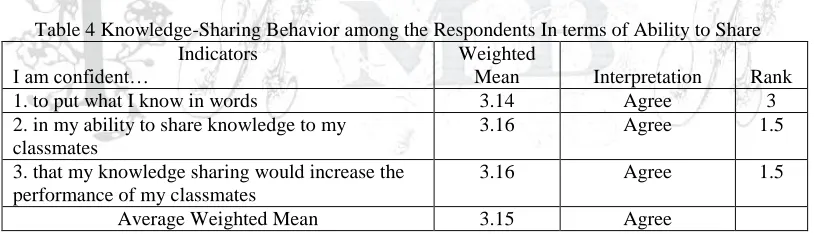
Table 4 Knowledge-Sharing Behavior among the Respondents In terms of Ability to Share Indicators
I am confident…
Weighted
Mean Interpretation Rank
1. to put what I know in words 3.14 Agree 3
2. in my ability to share knowledge to my classmates
3.16 Agree 1.5
3. that my knowledge sharing would increase the performance of my classmates
3.16 Agree 1.5
Average Weighted Mean 3.15 Agree
Table 4 shows knowledge sharing behavior among the respondents in terms of ability to share. To put what I know in words, to put my ability to share knowledge to my classmates and that my knowledge sharing would increase the performance of my class shows a weighted mean of 3.14, 3.16, and 3.16 respectively and was verbally interpreted as Agree. An average weighted mean of 3.15 was obtained and it was verbally interpreted as Agree. This means that the respondents are assured that the knowledge they share would help their classmates improve their academic performance.
Table 5-Knowledge-Sharing Behavior Among the Respondents in terms of Resources to Share
Indicators Weighted Mean Interpretation Rank
1. IT tools are available for sharing knowledge such as email, web board and windows live messenger
3.17 Agree 2
2. I have access to internet at home or at university 3.18 Agree 1
3. I experienced difficulties in accessing the existing communication channel for sharing knowledge
3.15 Agree 3
ISSN: 2306-9007 Nava-Macali (2017) 816
I
www.irmbrjournal.com June 2017I
nternationalR
eview ofM
anagement andB
usinessR
esearchVol. 6 Issue.2
R
M
B
R
Table 5 shows the knowledge sharing behavior among the respondents in terms of resources to share. IT tools are available for sharing knowledge such as email, web board and windows live messenger, I have access to internet at home or at university, and I experienced difficulties in accessing the existing communication channel for sharing knowledge obtained a weighted mean of 3.17, 3.18 and 3.15 respectively. All obtained a verbal interpretation of Agree. An average weighted mean of 3.17 was obtained and was verbally interpreted as Agree. This means that the respondents agreed to make use of the internet available at home or at the university.
Relationship Between the Degree of Knowledge-Sharing Support System Experienced by the Respondents and their Knowledge-Sharing Behavior
Table 6-Relationship Between the Degree of Knowledge-Sharing Support System Experienced by the Respondents in terms of Instructor‟s Support and their Knowledge-Sharing Behavior
Knowledge-Sharing Behavior Pearson r p value Interpretation
Willingness to Share 0.536 0.000 Significant
Ability to Share 0.262 0.009 Significant
Resources to Share 0.373 0.000 Significant
0.01 level of significance
Table 6 shows the significant relationship between the degree of knowledge-sharing support system experienced by the respondents in terms of Instructor‟s Support and their knowledge-sharing behavior. As shown, knowledge sharing behavior in terms of willingness to share, ability to share and resources to share obtained computed p values of 0.000, 0.009, and 0.000 respectively all are lower than 0.01 level of significance. This means that the degree of knowledge-sharing support system experienced by the respondents in terms of instructor‟s support are significantly related to their knowledge sharing behavior. This means that their knowledge sharing behavior is dependent to their degree of knowledge sharing support system in terms of instructors‟ support.
Relationship Between the Degree of Knowledge-Sharing Support System Experienced by the Respondents and their Knowledge-Sharing Behavior
Table 7-Relationship Between the Degree of Knowledge-Sharing Support System Experienced by the Respondents in terms of Technology Support and their Knowledge-Sharing Behavior
Knowledge-Sharing Behavior Pearson r p value Interpretation
Willingness to Share 0.545 0.000 Significant
Ability to Share 0.374 0.001 Significant
Resources to Share 0.427 0.000 Significant
0.01 level of significance
ISSN: 2306-9007 Nava-Macali (2017) 817
I
www.irmbrjournal.com June 2017I
nternationalR
eview ofM
anagement andB
usinessR
esearchVol. 6 Issue.2
R
M
B
R
Conclusions
Based on the findings presented above, the conclusions are the following: The respondents are very much convinced that their instructors motivate students to share whatever knowledge imparted to them; the respondents consider information technology as a means to support their willingness to share information they have learned; the respondents agree to share with their classmates all the resource materials that could be useful academically; the respondents are assured that the knowledge they share would help their classmates improve their academic performance; the respondents agreed to make use of the internet available at home or at the university; that the respondents‟ knowledge sharing behavior is dependent to their degree of knowledge sharing support system in terms of instructors‟ support; and lastly, the respondents‟ knowledge sharing behavior is dependent to their degree of knowledge sharing support system in terms of technology support.
Utilization
Faculty members need to include in their syllabus peer tutoring tasks as part of learning outcomes. Through peer tutoring, students will not only apply what they have learned but also be more involved in facilitating learning.
Student Personnel Services personnel could make use of this research‟s data to create academic clubs wherein knowledge sharing could be reinforced. This could be done through regular conduct of mini lectures and open forums among students.
It experts need to design intranet-based programs wherein students and faculty cold posts and share academic information that could help other students reinforce their learning
References
Ardichvili, A., Page, V. & Wentling. (2003) Motivation and Barriers to participa
Chen, I.Y., Chen, N.S., & Kinshuk. (2009). Examining the Factors Influencing Participants‟ Knowledge Sharing Behavior in Virtual Learning Communities. Educational Technology & Society, 12(1),134-148.
Cho, N., Li, G.Z., & Su, C Z. (2007). An Empirical study on the effect of individual factors on knowledge sharing by knowledge type. Journal of Global Business and Technology, 3(2), 1-15.
Choi, I., Land, S.M., & Turgeon, A. J. (2005). Scaffolding peer questioning strategies to facilitate metacognition during online small group discussion. Instructional science, 33(5-6), http://dx.doi.org/10.1007/s11251-005-1277-4
Chugh, R. (2015). Do Australian Universities Encourage Tacit Knowledge Transfer? In Proceedings of the
7th International Joint Conference on Knowledge Discovery, Knowledge Engineering and Knowledge
Management, ISBN 978-989-758-158-8, pages 128-135. DOI:
Deci, E.L., R. Koestner, R.M. Ryan (2001) “Extrinsic Reward and Extrinsic Motivation in Education: Reconsidered Once Again” Review of Educational Research, 71(1), pp.1-27.
Eucker, T.R., 2007. Understanding the Impact of Tacit Loss. Knowledge Management Review, 10(1) Gorelick, C. and B. Tantawy-Monsou, 2005. For performance through learning, knowledge management is
the critical practice. The Learning Organization, 12(2):125.
Hasmath, Reza; Hsu, Jennifer Y.J. (2016). “Communities of Practice and NGO Sector in China. International Society for Third Sector Research Conference (Stockholm, Sweden) June 28-July 1:1. Hellie, Sebastien: Sun, Ron (2010). Incubation, Insight, and Creative Problem Solving: A Unified Theory
and a Connectionist Model. Psychology Review, 117 (3): 994-1024.doi:10.1037/a0019532
ISSN: 2306-9007 Nava-Macali (2017) 818
I
www.irmbrjournal.com June 2017I
nternationalR
eview ofM
anagement andB
usinessR
esearchVol. 6 Issue.2
R
M
B
R
Hsu, M. et al, 2007 Knowledge sharing behavior in Virtual communities: The relationship between trust, self efficacy, and outcome expectation, Journal of Human-Computer Studies, (65), pp. 153-169 Munoz, C.L. & Towner, T.L., (2009). Opening Facebook: How to Use Facebook in the College
Classroom. Society for Information Technology and Teacher Education Conference (pp. 1-13). Charleston: Networking it.
Reige, A. (2005). Three- dozen knowledge sharing barriers managers must consider. Journal of Knowledge of Management, 9(3), 18-35.
S. Kim and H, Lee, “Organizational Factors affecting knowledge sharing capabilities in E-Government: An Empirical study.” Proceedings of the 2004 annual national digital government research, Seattle, WA 2004.
Stanley Cavell, “Knowing and Acknowledging,” Must We Mean What We Say? (Cambridge University Press, 2002), 238-266
Serban, Andrea M, Luan, Jing (2002). “An Overview of Knowledge Management” (PDF). University of Kentucky. Retrieved 17, April 2013.
Taylor, E.Z., 2006. The Effect of Incentives on Knowledge Sharing in Computer- Mediated Communication: An Experimental Investigation. J. Information Systems, 20(1):103-116
Van de Hooff, B. & Huysman, M. (2009). Managing Knowledge sharing: Emergent & engineering approaches. Information & Management, 46 (1), 1-8.
Volady, L. (2013). An Investigation of Factors Influencing Knowledge Sharing Among Undergraduate Teacher Education Students. Adelaide, South Australia:wordpress.com. Retrieved September 9, 2013,
from http://voladyooo2.wordpress.com/knowledge-sharing-among-undergraudate-students/
Wahlroos, J.K. (2010) Social Media as a Form of Organizational Knowledge Sharing. A Case Study on Employee Participation at Wartsila. Helsinki: unpublished thesis of the University of Helsinki.
Retrieved July 2, 2013, from
http://helda.helsinki.fi/bitstream/handle10138/24624/Thesis.Johanna.Wahlroos.pdf?sequence=1 Wangpipatwong, (2009). Factors influencing Knowledge Sharing Among University Students, Proceedings
of the 17th International Conference on Computers in Education [CDROM] (pp. 800-807). Hong Kong: Asia-Pacific Society of Computers in Education.
Wei, C., Choy, C., Chew, G., & Yen, Y. (2012) Knowledge sharing patterns of undergraduate students, Library review, 61(5), 327=344.
Yogeesha, H. (2013), March). Factors Influencing Knowledge Sharing Among Undergraduate Engineering Students. Research Journal Science and IT Management, 02(5), 47-52. Retrieved September 9, 2013 from
http://www.theinternationaljournal.or/ojs/index.php?journal=rjtsm&page=article&op=view&path%5B %D=1699&path%5B%5D=pdf