©2014, IJCSMA All Rights Reserved, www.ijcsma.com 54
A FRAMEWORK FOR TRACKING
CRIMINALS USING IMAGE-BASED
HEIGHT DETECTION TECHNIQUES
Oyekanmi E.O
1, Oluwadare S.A
2, Alese B.K
2 1Department of MATHS/STAT/CIS, Achievers University, Owo,
Ondo State, Nigeria [email protected]
2
Department of Computer Science, The Federal University of Technology, P.M.B. 704, Akure, Ondo State, Nigeria
Abstract
In recent times, the problem of terrorism has approached a global dimension. The operation of terrorists are indiscriminate. Hence, tracking them requires careful planning, preparation and cooperation among security operatives and nations. Since terrorists have sinister motives, they often hide their identities or use falsified identities. In order to forestall terrorist’s attacks, intelligence and warning systems are put in place for detecting and preventing future attacks. In this study, we present a framework for tracking criminals using imaged-based height detection techniques. The framework involves four case studies of different postures. An algorithm was developed to capture the intrinsic parameters. The model developed was able to detect, both in the local as well as global, a person’s height with no fore-knowledge of the zooming rate with which the picture was taken. Matlab R2009a was used as a programming tool in the implementation of the developed algorithm.
Keywords: Height detection, image-based, criminal tracking, terrorism
1. Introduction
This study deals with a framework for criminal height detection via submitted image of the person. The proposed method provides a new approach to anomalous person’s height detection via calibrated camera. Different approach had been used for background elimination modeling in the past, but Pixel level density difference of the criminal (pdd) is used to determine his/her height from the image frame. The measured pdd is modeled on the submitted person’s full picture, taking into consideration both the intrinsic and the extrinsic
parameters of the objects in the submitted frame. Scene model is used to determine the snapshot distance of the object. An algorithm is developed to capture the intrinsic parameter which is our major priority to achieving our aim. Criminal detection could be very difficult and challenging task for security agencies especially in a situation where the crime-person is showing chameleon-action in posture since the criminal may use mask or other forms of disguise. Hence, face-recognition may not be effective in detecting him/her.
©2014, IJCSMA All Rights Reserved, www.ijcsma.com 55
presents a new approach. Existing systems that perform person’s identification and tracking have several advantages, but also have drawbacks. For instance, Roger Clarke (2004), reports that people’s hands do not differ enough for [hand geometry] to be used as an identification system. The Economist (2003) posits that “around 5% of people do not have readable fingerprints”. Leyden (2002) reports that comprehensive tests of 11 consumer-oriented biometric products showed that the devices were “more of the nature of toys than of serious security measures” and that large-scale application of iris technology (by the UNCHR in Afghanistan) has not been used to generate measures of reliability and quality.
Facial recognition is one of the soft-biometric means of tracking criminals, yet it has some drawbacks like eye colour which are easily influenced by light situation. Also, in the use of facial recognition it has been found that there could be a situation where a short person is having a tall face and vice-versa. Hence, it may not be used to judge accurately.
Height has been long used in forensic measures to detect possible suspects, it is however, not distinctive enough to be used in biometric identification. Hence, estimating the heights of the tracked subjects using any camera and assuming any distance in capturing could provide us with an important additional feature, thereby making the object tracking over different scenes more robust. For instance, (BenAbdelkader et. al., 2002) developed a parametric method to automatically identify people in low-resolution video by estimating the height and stride parameters.
In this case study, we focus on uncovering patterns of criminal identity deception based on actual criminal records and suggest an algorithmic approach to revealing deceptive identities.
This paper is organized as follows. Section 2 gives related work on this topic and brief overview of the system. Detailed explanations for each stage are discussed in Section 3. In Section 4, the implementation is presented. In section 5 the results and discussion are presented. The conclusion to the study was drawn in section 6.
2. Related Works
It is a common practice for criminals to lie about their personal data. Hence, the ability to validate identity can be used as a warning mechanism and the deception signals the intent to commit future offenses. Terrorists do not act alone but rather they operate in a network. They may be linked together through various social, ideological, religious and communication networks. This network may be complex to unravel. Hence, there is the need to properly understand the way relationships are formed or communication is maintained within or between terrorist groups. Previous studies have shown that the link structure of the web represents a considerable amount of latent human annotation (Gibson, 1998). Thus, by analyzing and visualizing hyperlink structures between terrorist-generated web sites and their contents, we could discover the structure and organization of terrorist group networks, capture network dynamics, and understand their emerging activities. So an intelligent web portal, called Dark Web Portal, to help terrorism researchers collect, access, analyze, and understand terrorist groups was developed (Chen and Reid, 2004).
Height detection of objects can be used both for soft-biometrics and as an object tracking feature. Unwanted area are eliminated and the focus object is extracted to determine the identification features (Jeges and Máté, 2006), and use it to search for similar subject in a smaller set of possible candidates. For object tracking, it can be used for temporal and spatial correspondence analysis as well or simultaneously for both in case of disjoint cameras (Madden and Piccardi, 2005).
©2014, IJCSMA All Rights Reserved, www.ijcsma.com 56
methods of human height estimations can be found in the literature, like the one in (Bernardin et al., 2006), where the acoustic source localization of the speaking person is used for this purpose.
Also, anonymous motion sensors were used in rooms and switch sensors on daily-use objects, and resident activity models to identify and track their activities and locations. They propose using a particle filter that uses Markov state transition and sensor use models learned from short term training data, obtained using a tag and track approach or manual labelling. The main advantage of this approach is that the simple single-pixel sensors are cheap and easy to install, and are not perceived to be invasive or inconvenient. However, an important drawback of this approach is low accuracy: this system was reported to have 70% accuracy when 3 residents over a week-long period are used. These accuracy rates may be level-headed for some applications, but mystifying the identities of residents more than a third of the time could cause problems in the case of medical monitoring (Wilson and Atkeson, 2005).
a. Overview of Anthropometry
Since the time of Quételet, anthropometry, means the measurement of the entire human body (living or upon the dissecting-room table) with the view to determine the respective proportions of its parts” (Topinard, 1881). Between the end of the 19th century and the first decades of the 20th century, anthropometry was extensively employed in several fields (Landogna Cassone, 1950; Drusini, 1986) which include:
i. Forensics and criminal anthropology and the idea that science had to make its voice heard in court (Guarnieri, 1986). In Italy Cesare Lombroso (1835-1909), by employing the new anthropometrical instruments, wanted to prove that the aberrations of the moral sense and mind were related to body anomalies and especially of the skull (Lombroso, 1878; Bulferetti, 1975; Villa, 1985).
ii. The Signalement anthropométrique of Alphonse Bertillon (1853-1914) who set up an identification system based on physical measurements (Bertillon, 1891). This method was employed by several police to identify criminals.
iii. The Antropometria militare and the studies of Ridolfo Livi (1856-1920) to determine the propensity to military service (Livi, 1896-1905).
iv. The clinical anthropometry employed by constitutional medicine and especially in the Italian school of Achille De Giovanni (1838-1916).
b. Application of Anthropometry: Bertillon System
The French criminologist, Alphonse Bertillon, in 1879 developed a system for identifying people, especially criminals. Some of the anthropometric measurements recorded by this system are as follows:
i. body: height standing, reach from fingertips to fingertips, length of trunk and head, or height sitting; ii. head: length and width, length and width of right ear;
iii. limbs: length of left foot, length of left middle finger, length of left little finger, length of left forearm. These measurements are recorded on cards and classified according to the length of the head. (Bertillon, 2007).
©2014, IJCSMA All Rights Reserved, www.ijcsma.com 57
3. System Design
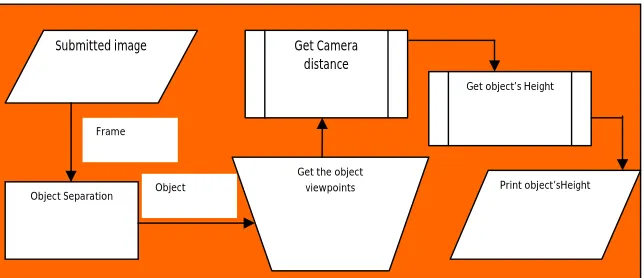
The distance with which the snapshot is taken from the camera is first determined by measuring the upper point P2 and lower point P1 of the tracked object (person). These parameters are passed to the algorithm
presented in the next section of this paper to get the camera distance of the object from the image frame. The height of person is measured based on 2-D view image provided by obtaining the distance of the object using two markers. The first marker is placed at the top of the head ( ) while the second marker is placed at the feet above the ground ( ). The equation is stated as follows:
Given an Image frame
I | {
} with dimension
; the camera distance C
dis
calculated as
C
d=
(1)
H
o=
(2)
Where Ho is the object (Person’s) height, D
refis the defined distance reference value to
capture the tallest and shortest person-2.23m. is the threshold value ±0.5
a. Camera Distance Estimation
A lot of researches have been carried out on getting the focal length of an object from camera; two of the techniques used are discussed below:
i. Use of extrinsic parameter of the camera only. This involves the use of the view angle, under which the bottom of the object (the feet of the person) is visible, the altitude of the camera from the floor and the orientation of its optical axis (IstvánKispál, 2011).
ii. Calibrated camera to track the extrinsic parameter via different observation timing( Srinivasan, 2011).
Print object’sHeight Get object’s Height
Get the object viewpoints Object
Submitted image
Frame
Object Separation
Get Camera distance
©2014, IJCSMA All Rights Reserved, www.ijcsma.com 58
However, with the use of Matlab software and image processing techniques the following steps (algorithm) was used the study:
1. Get an image file as input.
2. Read the image using imread() function of Matlab.
3. Manually select the Top point (head of the person) and the Bottom point of the object (feet of the person) if the object is standing uprightly to get the pixel length value ELSE
4. Use anthropometric measure method by Alphonse Bertillon to get the object pixel length value.
5. Get the image dimension.
6. Get the ratio of the distance measured in either step 3 or 4 above of the object and the actual length of the image in step 5
7. The Scale ratio in (6) is the camera distance.
b. Object’s Height Estimation
What we deed was to convert the scale used to a defined scale ratio of 2.23m (our defined distance to capture the tallest and the shortest person) and the result is the object height value/estimation. The error value in this case is ≤ ±0.5.
4. System Implementation
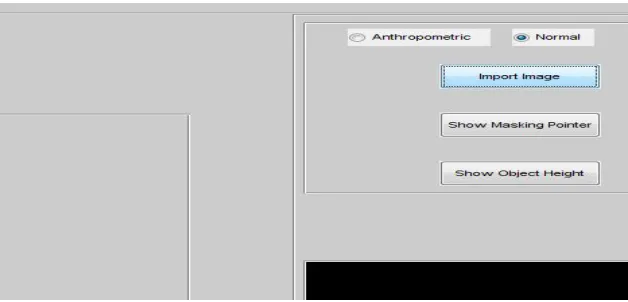
We simulated different person’s images in different posture form into our algorithm using MATLAB with different camera pixel rating. The following results were obtained.
.
©2014, IJCSMA All Rights Reserved, www.ijcsma.com 59
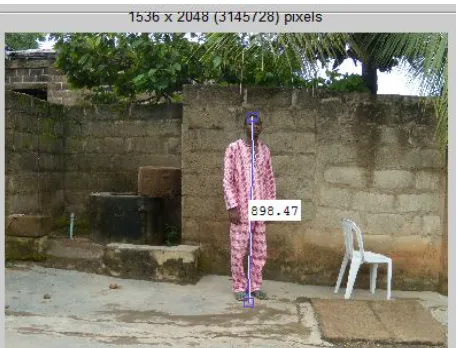
Figure 3a: Person’s height while standing with 8.0MP
Camera
©2014, IJCSMA All Rights Reserved, www.ijcsma.com 60 Figure 4a: Person’s height while standing with
3.0MP
©2014, IJCSMA All Rights Reserved, www.ijcsma.com 61
Result Analysis
5. Results and Discussion
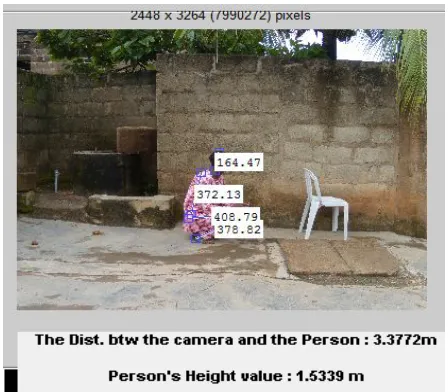
The results obtained using two different cameras with pixel values 3.0MP and 8.0MP are as shown in Table 1 below. The actual height of the person used in the study is 1.7m. The distance used for capturing the tallest and smallest person is 2.23m. The results displayed in Table 1 are based on the pictures depicted in Figures 3a to 4c. The object heights used ranges between 1.28 and 1.87. The percentage difference obtained ranges between 0% and 24.7%. Table 2 further revealed that the standard deviation and standard error are 0.207 and 0.084 respectively.
Figure 4b: Person’s height while sitting with 3.0MP Camera
©2014, IJCSMA All Rights Reserved, www.ijcsma.com 62
Table 1: Results of the Person’s Height at different posture Figure
number
Experimented Object’s Height (m) Difference % Difference 3a 1.61 0.09 5.3 3b 1.43 0.27 15.9 3c 1.87 -0.17 10.0 4a 1.70 0 0 4b 1.28 0.42 24.7 4c 1.53 0.17 10.0 Table 2: Descriptive Statistics
N Statistic Minimum Statistic Maximum Statistic Mean Statistic Standard Error Standard Deviation Statistic 6 1.28 1.87 1.57 0.084 0.207
6. Conclusion
In this paper, a framework for tracking of human height using image-based technique was developed. In addition, the developed method could be used in photogrammetry and robot vision. Because of the simplicity of the approach, computation-intensive techniques, such as pattern recognition and image analysis methods, may not be required for obtaining a satisfactory measurement. The analysis of the results obtained from our experiments showed that crime-persons could be tracked using image-based techniques with minimal error rate. The next phase of our research is to combine facial recognition technique with image-based technique in the authentication of the tracked crime-person.
Acknowledgments
The authors would like to thank Mr. O.A. Ogundoro and Dr. J.O. Adjene from Achievers University, Owo, Ondo State Nigeria for the idea of anthropometric measurement approach and proof-reading respectively.
NOTE: All the references to the Morpologia del corpo umano (1891) are from the english edition (1909).
References
[1] Bertillon A. 1891. Identification anthropométrique. Instructions. English Edition 1909, Gauthier Villars, Paris.
[2] Microsoft® Student 2007 [DVD]. “Bertillon System.” Redmond, WA: Microsoft Corporation, 2006. Bulferetti L. 1975. Cesare Lombroso. Utet, Torino.
[3] BenAbdelkader C., Cutler R., and Davis L., 2002. “Person identification using automatic height and stride estimation,” 16th International Conference on Pattern Recognition, 2002, vol. 4, pp. 377 – 380. [4] Drusini A. 1986. Achille De Giovanni (1838- 1916) e il metodo morfologico-clinico. Acta Medicae
©2014, IJCSMA All Rights Reserved, www.ijcsma.com 63
[5] ErnJeges, LászlóMáté, 2006. Model-based human ear identification. World Automation Congress, 5th International Forum on Multimedia and Image Processing (IFMIP).
[6] Guarnieri P. 1986. Misurare le diversità. In G. Barsanti et al. (eds.): Misura d’uomo. Strumenti, teorie e pratiche dell’antropologia e della psicologia sperimentale tra ‘800 e ‘900’, pp. 119- 171. Istituto e Museo di Storia della Scienza, Firenze.
[7] Hsin-Chun T., Wen-Chi W., Wang J, and Jhing-Fa W. (2009). "Long Distance Person Identification Using Height Measurement and Face Recognition", IEEE. http://140.116.240.3/conference/ISAD/files/N28951358-a.pdf
[8] KeniBernardin, Hazim K. E. and Rainer S. 2006. Multimodal Identity Tracking in a Smartroom; 3rd IFIP Conference on ArtificialIntelligence Applications and Innovations (AIAI).
[9] Landogna C. F. 1950. Antropometria. Enciclopedia medica italiana, pp. 1518-1542, Edizioni scientifi che Sansoni, Firenze.
[10] Livi R. 1896-1905. Antropometria militare. Parte I: Dati antropologici etnologici e Atlante della geografia antropologica d’Italia (Roma, 1896); parte II, Dati demografici e biologici (Roma, 1905).
Giornale Medico del Regio Esercito, Roma.
[11] Lombroso C. 1878. L’uomo delinquente in rapport all’antropologia, giurisprudenza e discipline carcerarie. Bocca, Torino.
[12] Lv, Zhao, Nevatia, 2002. Self-Calibration of a camera from video of a walking human.Proceedings of the 16th International Conference on Pattern Recognition, p562-571.
[13] Madden C. and Piccardi M., 2005. Height measurement as a session-based biometric for people matching across disjoint camera views.
[14] Roger C. 2004."Biometric Insecurity", ,Xamax Consultancy Pty Ltd, Canberra Visiting Professor, Baker & McKenzie Cyberspace Law & Policy Centre, U.N.S.W.,
http://www.rogerclarke.com/DV/AusCERT0405.ppt
[15] Topinard P. 1881. Observations upon the methods and processes of Anthropometry. Journal of the Anthropological Institute of Great Britain and Ireland, 10: 212-224.
[16] Wilson D. and Atkeson C., 2005. Simultaneous tracking and activity recognition (STAR) using many anonymous, binary sensors. In The Third International Conference on Pervasive Computing.Springer. [17] Villa R. 1985. Il deviante e i suoi segni. C. L. e l’origine dell’antropologia criminale in Italia. Angeli,
Milano.
Research groups and links
[1] Chen and Reid, 2004 -The Dark Web
Portal.http://ai.arizona.edu/mis596a/book_chapters/isi/Chapter_5.pdf [2] Gibson 1998 - Dark Web Link Analysis and
©2014, IJCSMA All Rights Reserved, www.ijcsma.com 64
[3] IstvánKispál - Human Height Estimation Using a Calibrated Camera. http://www.Human_height_estimation_using_a_calibrated_camera.pdf
[4] Srinivasan V. - Using Height Sensors for Biometric Identification in Multi-resident Homes.http://www.HeightPervasive-3.pdf
A Brief Authors Biography
Ezekiel Olufunminiyi Oyekanmi is a lecturer in the Department of Mathematics/Statistics/Computer and Information System, Achievers University, Owo, Ondo State, Nigeria. He obtained his Bachelor of Technology from Ladoke Akintola University of Technology, Ogbomoso and Master of Science in Computer Science from the University of Ibadan, Nigeria. He is currently on his doctorate degree in Computer Science. He is a software developer and has carried out a lot of online projects and desktop applications. He is proficient in C#, PHP/MySql, Java and Matlab languages. His research interests are in the area of image processing, intelligent language processing, data analysis; and computer security.
Samuel Adebayo Oluwadare is a lecturer in the Department of Computer Science, The Federal University of Technology, Akure, Nigeria. He holds Master of Technology and Ph.D Degrees in Computer Science. Before joining the Department, he had over 10 years experience as Systems Programmer at the University Computer Centre where he rose to the position of Senior Systems Programmer. His research interests include design and analysis of algorithms, high performance computing, evolutionary computing, database management system; computer-based statistical analysis; and Information and Communications Technology. He has published several papers in both local and international journals. Apart from academic work, he has served as consultant to governments and World Bank Agencies.