Gayathri V
et al
, International Journal of Computer Science and Mobile Applications,
Vol.2 Issue. 4, April- 2014, pg. 65-70
ISSN: 2321-8363
©2014, IJCSMA All Rights Reserved, www.ijcsma.com 65
A MOBILE MULTIMEDIA CLOUD
COMPUTING ON THE WEB
Gayathri V
1, Priyadarsini K
21
Department of CSE, SRM University, [email protected]
2Department of CSE, SRM University, [email protected]
Abstract
The healthcare industry has begun to utilize web-based systems and cloud computing infrastructure to develop and creasing array of online personal health record (PHR) systems. Although these systems provide the technical capacity to store and retrieve medical data in various multimedia formats, including images, ideas, voice, and text, individual patient use remains limited by the lack of intuitive data representation and visualization techniques. As such, further research is necessary to better visualize and present these records, in ways that make the complex medical data more intuitive. In this study, we present a web-based PHR visualization system, called the 3D medical graphical avatar (MGA), which was designed to explore web-based delivery of a wide array of medical data types including multi-dimensional medical images; medical videos; text-based data; and spatial annotations. Mapping information was extracted from each of the data types and was used to embed spatial and textual annotations, such as regions of interest (ROIs) and time-based video annotations. Our MGA itself is built from clinical patient imaging studies, when available. We have taken advantage of the emerging web technologies of HTML5 and WebGL to make our application available to a wider base of users and devices. We analyzed the performance of our proof-of-concept prototype system on mobile and desktop consumer devices. Our initial experiments indicate that our system can render the medical data in a fashion that enables interactive navigation of the MGA
Keywords: Medical Graphical Avatar (MGA), Regions of Interest (ROIs), Personal Health Record (PHR), Cloud Mobile Gaming (CMG)
1. INTRODUCTION
Gayathri V
et al
, International Journal of Computer Science and Mobile Applications,
Vol.2 Issue. 4, April- 2014, pg. 65-70
ISSN: 2321-8363
©2014, IJCSMA All Rights Reserved, www.ijcsma.com 66
2. SYSTEM DESIGN
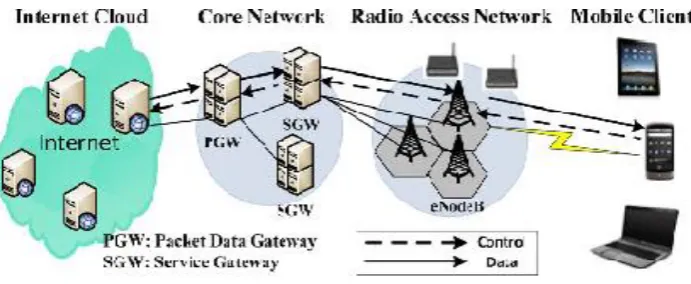
Utilizing available cloud computing and storage resources, we expect a heterogeneous set of Cloud Mobile Media services and applications to emerge, with different types of consumer experiences and advantages enabled. In this section, we first describe the typical end-to-end control and data flow architecture of CMM applications. Next, we categorize the existing and expected CMM applications, and analyze for each category the cloud infrastructure and platform needs, advantages and user experiences enabled, and challenges to make the applications successful. Fig.1 shows the overall architecture, including end-to-end flow of control and data between the mobile devices and the Internet cloud servers, for a typical CMM application. A typical CMM application has a small footprint client on the mobile device, which provides the appropriate user interfaces (gesture, touchscreen, voice, text based) Subsequently, the multimedia data produced by the cloud, either as a result of processing using the cloud computing resources, and/or retrieval from cloud storage resources, is transmitted downlink through the CN and RAN back to the mobile device.
The CMM client then decodes and displays the results on the mobile device display. From the above description, and as shown in Fig. 1, a typical CMM application will be highly interactive, with some types of applications needing near real-time response times. Note that for certain types of CMM applications, the control and data flow may deviate from that shown in Fig. 1. For example, for CMM applications like Cloud based Media Analytics described later, the application may not always be initiated by a mobile CMM client (like in Fig. 1), and may collect data from both the client and the cloud to provide analytics to other CMM applications. This summarizes the different categories of mobile multimedia applications that already are, or can potentially be, driven by the use of the cloud, including storage, download and synchronization applications, audio and video streaming applications, interactive applications like multi-way video Conferencing, interactive advertisements, and mobile remote desktop, rich rendering based applications like mobile multi-user gaming and augmented reality, and cloud based media analytics that will provide better understanding of user preferences and experiences, and drive personalized mobile services. For each category of CMM applications, we list the IaaS and PaaS features that will be needed, including some which are available today, and some that need to be developed. We also list the advantages of each category of CMM applications, including what multimedia experience can be enabled that cannot be supported currently, and the challenges that need to be addressed to make the application category successful.
As discussed before, Mobile Cloud Storage is the most commonly used category of CMM application/service today, with offerings from Amazon, Apple, Dropbox, Funambol, and Google, among others. These services provide diverse capabilities, including storing documents, photos, music and video in the cloud, accessing media from any device anywhere irrespective of the source of the media and/or the device/platform used to generate the media, and synchronizing data/media across multiple devices a typical user owns.
Gayathri V
et al
, International Journal of Computer Science and Mobile Applications,
Vol.2 Issue. 4, April- 2014, pg. 65-70
ISSN: 2321-8363
©2014, IJCSMA All Rights Reserved, www.ijcsma.com 67
To study the impact of wireless networks on the quality of CMM applications, we conducted experiments with a Cloud Mobile Gaming (CMG) application we have developed, which as described in Section II is a highly interactive cloud based rendering application: gaming commands are transmitted uplink from the mobile device to the cloud servers, and the rendered video needs to be streamed downlink from the server to the mobile client in near real time. Since this application is highly sensitive to response time, we measured uplink delay, downlink delay, and round-trip response time. The experiments were conducted under different network conditions data samples collected under three different conditions: when the network was not loaded (data collected at mid night), when the network was loaded (data collected at 5 pm), and when the network was loaded and the signal conditions were not strong (data collected at 6 pm, and inside a building). Media architecture, showing control and data flows.
3. ADAPTIVE RENDERING PARAMETERS AND SETTINGS
The first step in enabling dynamic game rendering adaptation in the CMG approach is to identify the adaptive rendering parameters and adaptive rendering settings. A game may have many different rendering parameters, but only a few of them have obvious impacts on CommC or CompC. An ―adaptive rendering parameter‖ must be able to adapt at least one of CommC or CompC. An ―adaptive rendering setting‖ is a set of values for the adaptive rendering parameters which affect CommC, CompC or both. As discussed in Section IV-A, reducing the number of objects in the graphic scene file or reducing the complexity of rendering operations could lead to the decreases in CommC and CompC. Based on the above principles, we identify four common parameters which we believe are suitable for rendering adaptation in most 3D games
3.1 REALISTIC EFFECT
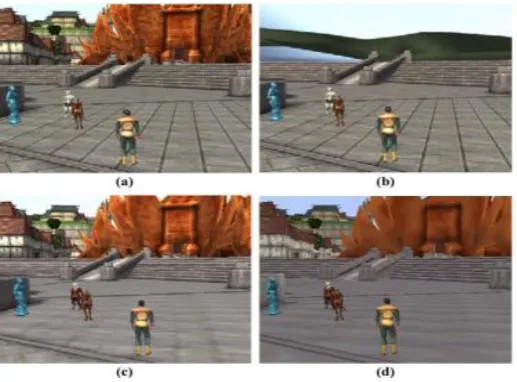
Realistic effect basically includes four parameters: color depth, anti-aliasing, texture filtering, and lighting mode. Each of the four parameters only affects part of graphic rendering. Varying any one of them may not reduce the graphic rendering load. Thus when we reduce/increase the realistic effect, we vary all four parameters.
3.2 TEXTURE DETAIL
This is also known as Level of Detail (LOD). It refers to how large and how many textures are used to present objects. The lower texture detail level, the lower resolution the textures have the surfaces of objects get blurred as we decrease the texture detail.
3.3 VIEW DISTANCE
This parameter determines which objects in the camera view will be included in the resulting frame, and thereby should be sent to the display list for graphic rendering.
3.4 ENVIRONMENT DETAIL
Gayathri V
et al
, International Journal of Computer Science and Mobile Applications,
Vol.2 Issue. 4, April- 2014, pg. 65-70
ISSN: 2321-8363
©2014, IJCSMA All Rights Reserved, www.ijcsma.com 68
Figure 2.Derivation of the Complexity Model (C)
Having defined adaptive rendering parameters and settings, we next use the game Planeshift (PS) as an example to explain how to derive the complexity model, where we have also elaborately studied how different adaptive rendering settings affect the CommC and CompC. Subsequently, we also have studied the impacts on CommC and CompC when video encoding setting, or video resolution, or server GPU is changed. This will help to demonstrate that the key concept that communication complexity and computation complexity can be affected by different rendering settings is broadly applicable, no matter what kind of video resolution or video encoding setting, and no matter what kind of graphic GPU is used.
4. CHARACTERIZ ING CommC AND CompC
Four adaptive rendering parameters are selected for game PS, with their possible. We conduct experiments to characterize CommC and CompC for every possible rendering setting obtained using the values of parameters. The experiments are conducted on a desktop server which integrates a NVIDIA Geforce 8300 graphic card. Video resolution used is VGA. The video codec used is X264, and its encoding method is set to Variable Bit Rate (VBR). The Quantization Parameter (QP) is 25, while the encoding frame rate is 15 fps and the size of Group of Pictures (GOP) is 30. We have randomly selected several different gaming scenes. In each test scene, for each rendering setting, we let the game avatar roam in the gaming world along the same route. We measure the average compressed video bit rate and GPU utilization in each experiment test to calculate the CommC and CompC.
5. CONCLUSION
Gayathri V
et al
, International Journal of Computer Science and Mobile Applications,
Vol.2 Issue. 4, April- 2014, pg. 65-70
ISSN: 2321-8363
©2014, IJCSMA All Rights Reserved, www.ijcsma.com 69
REFERENCES
[1] Adaptive Mobile Cloud Computing to Enable Rich Mobile Multimedia Applications Shaoxuan Wang and Sujit Dey, Senior Member, IEEE
[2] Canalys,Smart PhonesOvertakeClient PCs, Feb. 2011. [Online].Available: http://www.canalys.com/newsroom/smart-phones-overtakeclient-pcs-2011.
[3] IDC, More Mobile Internet Users Than Wireline Users in the U.S. by 2015, Sep. 2011. [Online]. Available: http://www.idc.com/getdoc.jsp?containerId=prUS23028711.
[4] Juniper Research, Mobile Cloud: Smart Device Strategies for Enterprise & Consumer Markets 2011-2016, Jul. 2011. Online]. Available:http://juniperresearch.com/.
[5] MarketsAndMarkets, World Mobile Applications Market—Advanced Technologies, Global Forecast (2010-2015), Aug. 2010. [Online].Available: http://www.marketsandmarkets.com/.
[6] GSMA OneAPI. [Online]. Available: https://gsma.securespsite.com/ access/ Access 20API 20 Wiki/Home.aspx.
[7] S.Wang and S. Dey, ―Rendering adaptation to address communication and computation constraints in cloud mobile gaming,‖ in Proc. IEEE GLOBECOM, Miami, FL, USA, Dec. 2010.
[8] ARCchart, The Mobile Cloud: Market Analysis and Forecasts, 2011.
[9] Cisco, Cisco Visual Networking Index: Forecast and Methodology, 2011-2016, 2012.
[10]3D Game System Requirements. [Online]. Available: http://www.game-debate.com.
[11] Anandtechiphone Performance Reviews. [Online]. Available: http:// www. anandtech. com.
[12] S.Wang and S. Dey, ―Cloud mobile gaming: Modeling and measuring user experience in mobile wireless networks,‖ in Proc. ACM SIGMOBILE MC2R, 2012, vol. 16, no. 1, pp. 10–21.
[13] S. Wang and S. Dey, ―Modeling and characterizing user experience in a cloud server based mobile gaming approach,‖ in Proc. IEEE GLOBECOM, Honolulu, HI, USA, Dec. 2009.
[14] Y.-T. Lee et al., ―World of warcraft avatar history dataset,‖ in Proc. ACM Multimedia Syst., 2011.
[15] Asia Times, Game still on at Tencent, Mar. 2010. [Online]. Available: http://www.atimes.com/ atimes/ China_Business/ LC24Cb01.html.
[16] Planeshift. [Online]. Available: http://www.planeshift.it/.
[17] S. Wang and S. Dey, ―Addressing response time and video quality in remote server based internet mobile gaming,‖ in Proc. IEEE WCNC, Sydney, Australia, Mar. 2010.
[18] H. Ahlehagh and S. Dey, ―Video caching in radio access network,‖ in Proc. IEEE WCNC, Paris, France, Apr. 2012.
[19] H. Ahlehagh and S.Dey, ―Hierarchical video caching in wireless cloud: Approaches and algorithms,‖ in Proc. IEEE ICC Workshop on Realizing Advanced Video Optimized Wireless Networks, Ottawa, ON,
Canada, Jun. 2012.
[20] G. Lee, B. Chun, and R. Katz, ―Heterogeneity-aware resource allocation and scheduling in the cloud,‖ in Proc. 3rd USENIX Workshop Hot Topics in Cloud Comput., Jun. 2011.
Gayathri V
et al
, International Journal of Computer Science and Mobile Applications,
Vol.2 Issue. 4, April- 2014, pg. 65-70
ISSN: 2321-8363
©2014, IJCSMA All Rights Reserved, www.ijcsma.com 70
[22] S.Wang, Y. Liu, and S. Dey, ―Wireless network aware cloud scheduler for scalable cloud mobile gaming,‖ in Proc. IEEE ICC, Ottawa, ON, Canada, Jun. 2012.[23] WoW Basic Demographics. [Online]. Available: http://www.nickyee.com/ Daedalus/ archives-/001365.php.
A Brief Author Biography
1
Gayathri V –Gayathri is pursuing MTECH CSE in SRM University who is interested in Cloud Computing research. She holds MCA and working in a software concern.
2