ISSN: 2306-9007 Manzoor, Fonseka, Bashir & Hussain (2014) 232
I
www.irmbrjournal.com March 2014I
nternational Review ofM
anagement andB
usiness Research Vol. 3 Issue.1R
M
B
R
Determinants and Factor Dependency of FDI
A study of Pakistan and China
MUHAMMAD SUHAIB MANZOOR
Lecturer, Department of Management Sciences, University of Lahore, Pakistan
E-mail: [email protected]
M. MOHAN. FONSEKA
School of Management, Xi’an Jiaotong University, No 28, Xianning West Road, Xi’an, Shaanxi 710049, China.
E-mail: [email protected]
USMAN BASHIR
Assistant Professor, Department of Management Sciences, University of Lahore, Pakistan
Email: [email protected]
MUNTAZIR HUSSAIN
PhD Research Scholar, International Islamic University, Islamabad, Pakistan
Email: [email protected]
Abstract
Purpose of this paper is to investigate the Determinants of foreign direct investment (FDI), factors playing a vital role in FDI flow and variation of determinants in Economical, Environmental, Infrastructural, Human capital, Trade and Terrorism dimensions in a country analysis of China and Pakistan. A data set ranging from 1995-2011 is used, widely collected from different data sources and generalized linear models (GLMs) with Dummy variables for country analysis in a model is used for Econometric model justification. Research finds that FDI dependency on different variables change among both countries and with this best determinants as well as least affecting determinants differ in both countries. In case of China, Economical, Environmental, Trade and Terrorism dimensions are explained affecting the flow of FDI. In Pakistan, Economical, Environmental, Infrastructural, Human capital Trade and Terrorism dimensions are appropriated for describing the FDI attraction. Where, GDP, corruption, number of registered patents, internet, unemployment, import & exports and terrorism are the robust variables in FDI determination. Researchers focus only on two countries and generally the FDI determinants differ from area to area depending upon the policies and geographical location of an area. The paper is original in its contribution in all perspective and FDI determinants are analyzed in a border sense to evaluate the most feasible and acceptable set of determinants.
Key Words: Foreign Direct Investment (FDI), Economical, Environmental, Infrastructural, Human capital, Trade, Terrorism, China, Pakistan.
Introduction
ISSN: 2306-9007 Manzoor, Fonseka, Bashir & Hussain (2014) 233
I
www.irmbrjournal.com March 2014I
nternational Review ofM
anagement andB
usiness Research Vol. 3 Issue.1R
M
B
R
policies aimed at to seek FDI, creating strong incentives for investors to get the FDI. Developing countries look at new sources to acquire FDI and they realized it as good source against trade and opened the door with less barrier and more incentives to utilize it. China shows tremendous growth from the last three decades and it became an importance in the global economy, especially in Asia, has only recently begun reforming its financial market and integrating it into the regional and global structures (Chan, dang and Yan, 2012). The flow of FDI has changed towards developing countries like China and it is increasing steadily. Currently, China is the second largest country that realized FDI as compare to whole world. On the other hand, Pakistan is among the larger countries by population1 and area in Asia. However, it is straggle to attract sufficient FDI in order to achieve its developing goals. Interesting, there is a growing influence of China in Pakistan2. In recent years, Chinese investments show rapid growth in Pakistan compare to other countries. In this ground, it is important to understand and unveil different factors affecting the policies aimed at to seek FDI, creating strong incentives for investors to get the FDI.
In general, investors do invest beyond their home country and it depends on a number of factors: to get production and manufacturing benefits in a country, to gain benefits from country strengths like, low labour cost, skilled labour force and stable political conditions. On the other hand some investors want and like to enjoy the benefits of first movers in a particular economy. A best depiction is described in knowledge-capital model by (Carr 2001). Thus, the knowledge-capital flow in the form of FDI depends mainly on advantages of host country and on the motives of investment by investor. Worries about investment decision by an investor stem from the determinants of FDI and their behaviour. The FDI decision on the hand, hinges on the characteristics of a particular country or location and the level of investment.
The FDI helps a lot to become economically stable and to prosper, created more jobs, to increase exports, to improve labour skills and gave access to improved technology to China (Sunn1998; Kamath 1990). Studies of Azam (2010) and Adhikary (2011) show a significant and positive relation of FDI and economic
growth of a country and countries try to make good policies to seek more FDI. Mottaleb (2010) pointed out
that FDI not only provides capital to developing countries but also endow with technology and employment to people. FDI enriched with more factors contributing to the economic and financial prosperity. In this study, we investigate where FDI gave investors more opportunities to invest and identify the new factors that contribute to FDI determination in China and Pakistan. The main purpose of this study is to reveal the main determinants of FDI in China and Pakistan. Further, in a comparative study of China and Pakistan, we compare determinants of both countries and analyze which kinds of determinants are important for attracting FDI. This study will help investor and policy maker while making a decision and will elaborate the weak and strong determinants which will provide choices for a better judgment. Further, our findings will help to investors to assess the condition of different countries with same threats and opportunities for FDI. Particularly, we believe that finding of this study enhance the understanding of policy makers and regulators in order to attract and effective use of FDI in China and Pakistan.
According to the literature, number of studies has been conducted to identify the best determinants of FDI, but no clear explanation came out at the acceptance of generalized set of explanatory variables that can be
treated as a significant measure of determinates of FDI.Moosa (2006) argues that, what are the particular
aspects and criteria to estimate the determinants of FDI in a particular country? It is essential to unveil the determining factors to understand well the behaviour, why some countries are better in seeking FDI inflows as compare to others and what are the generalized factors effecting FDI in an economy. We will fill this research gap in our study and enhance the literature on determinants of FDI related to developing countries.
1 Pakistan is at 4th number in Asia according to Wikipedia.
http://en.wikipedia.org/wiki/List_of_Asian_countries_by_population
2
ISSN: 2306-9007 Manzoor, Fonseka, Bashir & Hussain (2014) 234
I
www.irmbrjournal.com March 2014I
nternational Review ofM
anagement andB
usiness Research Vol. 3 Issue.1R
M
B
R
As Jadhav (2012)try to answer of the question why FDI determinants are so important? Because they do
facilitates the decision of policy makers as well as of the investors and help them to monitor the flow of FDI. Finding of our study will support to Jadhav (2012) argument and enhance the literature related to
developing countries which compete on FDI.
It is intuitive that FDI flow depends on the economical, environmental (institutions and business factors), infrastructural, human capital, trade and terrorism in a country. As the focal point and necessity of this study is to reveal the main determinants of FDI. With this in mind, we study whether determinants remain same or change in this comparative study of China and Pakistan, based on the assumption that factors will change due to the fact that China is second largest FDI seeker in the world and have different challenges in seeking as well stabilizing FDI as compare to Pakistan.
As Blonigen (2004) concludes that FDI determinants that influence the level of FDI activity vary methodically across less developed countries and developed countries. With this, a study based on result shows us a better way to distribute the best as well as least affecting FDI determinant variables in both economies. In this study, we able to support that factors determine the level of FDI activity also vary
methodically among developing countries and enhance the Blonigen (2004) argument.
Literature Review
A large number of variables have been studied that show a relation with FDI in the form of theories of FDI or either in the form of hypothesis to show a measuring sense of cause and effect relationship of determinants of FDI. From the investor point of view, FDI is categorized into different categories
depending upon the need of investment and situations in domestic as well as in global market.
Dunning (1993) describes FDI can be horizontal FDI, if its purpose is to serve local and regional consumers by local production in a host country. This type of FDI results in exports alternatives in a host country and investor gets benefit by reaching nearer to consumer markets in a host country. On the other hand vertical FDI, particularly as it occur in manufacturing sector in which firms Invest in other countries to get resources such as, natural resources, raw material, labour etc. that are not available in home country. These two types have their own importance and a number of factors affect the form of FDI in a particular country.
Kok (2009) argues that investor do invest in another country than home country on the basis of the type of project, host country environment and how investor can get benefit from it. In a good way of analysis of FDI within states of US Coughlin (1991) argues that investment decision is related with cost and profit and the decision is made based on the factors that contribute more to this relationship .If costs factors are high and show negative relation with FDI than investor will avoid to invest.
Jadhav (2012) uses different factors categorized into three dimensions and checks the effect of political, institutional and economical factors with FDI. He has founded that economical dimension is more significant as compare to institutional and political in an analysis of BRICS. Literature is also filled with some inconsistent results that are due to different type of variables used and also due to different type of methodology applied on a data set.
ISSN: 2306-9007 Manzoor, Fonseka, Bashir & Hussain (2014) 235
I
www.irmbrjournal.com March 2014I
nternational Review ofM
anagement andB
usiness Research Vol. 3 Issue.1R
M
B
R
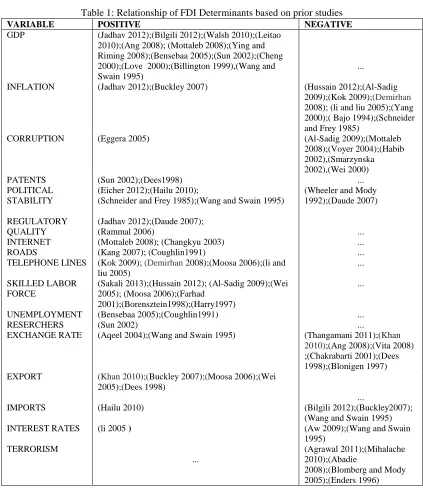
Table 1: Relationship of FDI Determinants based on prior studies
VARIABLE POSITIVE NEGATIVE
GDP (Jadhav 2012);(Bilgili 2012);(Walsh 2010);(Leitao
2010);(Ang 2008); (Mottaleb 2008);(Ying and Riming 2008);(Bensebaa 2005);(Sun 2002);(Cheng 2000);(Love 2000);(Billington 1999),(Wang and Swain 1995)
...
INFLATION (Jadhav 2012);(Buckley 2007) (Hussain 2012);(Al-Sadig
2009);(Kok 2009);(Demirhan
2008); (li and liu 2005);(Yang 2000);( Bajo 1994);(Schneider and Frey 1985)
CORRUPTION (Eggera 2005) (Al-Sadig 2009);(Mottaleb
2008);(Voyer 2004);(Habib 2002),(Smarzynska 2002),(Wei 2000)
PATENTS (Sun 2002);(Dees1998) ...
POLITICAL STABILITY
(Eicher 2012);(Hailu 2010);
(Schneider and Frey 1985);(Wang and Swain 1995)
(Wheeler and Mody 1992);(Daude 2007)
REGULATORY QUALITY
(Jadhav 2012);(Daude 2007);
(Rammal 2006) ...
INTERNET (Mottaleb 2008); (Changkyu 2003) ...
ROADS (Kang 2007); (Coughlin1991) ...
TELEPHONE LINES (Kok 2009); (Demirhan 2008);(Moosa 2006);(li and
liu 2005)
...
SKILLED LABOR FORCE
(Sakali 2013);(Hussain 2012); (Al-Sadig 2009);(Wei 2005); (Moosa 2006);(Farhad
2001);(Borensztein1998);(Harry1997)
...
UNEMPLOYMENT (Bensebaa 2005);(Coughlin1991) ...
RESERCHERS (Sun 2002) ...
EXCHANGE RATE (Aqeel 2004);(Wang and Swain 1995) (Thangamani 2011);(Khan
2010);(Ang 2008);(Vita 2008) ;(Chakrabarti 2001);(Dees 1998);(Blonigen 1997)
EXPORT (Khan 2010);(Buckley 2007);(Moosa 2006);(Wei
2005);(Dees 1998)
...
IMPORTS (Hailu 2010) (Bilgili 2012);(Buckley2007);
(Wang and Swain 1995)
INTEREST RATES (li 2005 ) (Aw 2009);(Wang and Swain
1995) TERRORISM
...
(Agrawal 2011);(Mihalache 2010);(Abadie
2008);(Blomberg and Mody 2005);(Enders 1996)
ISSN: 2306-9007 Manzoor, Fonseka, Bashir & Hussain (2014) 236
I
www.irmbrjournal.com March 2014I
nternational Review ofM
anagement andB
usiness Research Vol. 3 Issue.1R
M
B
R
Demirhan (2008) concludes in his cross sectional analysis that country with less Inflation is good in attracting more FDI. Host country volatile inflation rate discourages FDI and create problems for investors for price setting, as devaluation of currency is also associated with inflation rate and reduce the earning of the investor (Buckley 2007). Hussain (2012), Al-Sadig (2009) and Kok (2009) use inflation as a measure of economic measurement of a country and find that it hinders the flow of FDI and has negative relation with FDI. Less as well as stable inflation in developing countries results in attraction of FDI.
Poverty in general is considered to be an opportunity to be a first mover to take advantage of investment in a particular economy. Poor countries have less technology and fewer facilities with poor standard of living. Summer (2005) argues that poverty cannot be missed as it has strong effect and influence in making the FDI policy. Investor can get benefits in the form of low wages, unemployment, income inequality and scare capital in a country. Reisen (2001) and Khalid (2012) find that FDI plays a key role in economic development of a country and reducing poverty and have a positive relation with poverty.
Smarzynska (2002) argues that corruption increase burden of foreign investor, increase the value of the contract as well makes contract more dependent on local partner and also reduce the fairness of bureaucracy of host country. A higher intensity of corruption is usually related with an unfavorable country environment. In a cross section analysis of 89 developed and less developed countries, Habib and Zurawicki (2002) find that corruption tends to hinder FDI. On the other hand, Eggera (2005) argues that corruption is an incentive for a forgeries investor and has positive relation with FDI. He argues that this happens mostly in low income countries, where government officials take money as a share from investor profits. Where Habib and Zurawicki (2002), Smarzynska (2002), Wei (2000) and Mottaleb (2008) argue that corruption has a negative relation with FDI and investor perceive it as a risk and tend to avoid in making investment in a country with more corruption.
A country with a high number of registered patents shows that the environment for business is safe and law enforcement in the country is well established .Investor feels worry about the threat of stealing and copy of the trademarks, industrial designs and innovation. Sun (2002) who uses patents as a measure of the level of scientific research and level of human capital with collaboration of expenditures of R&D in country finds that it is a prominent variable and has a strong relation with FDI. Dees (1998) also finds a positive relation of FDI with number of patents registered in host country and argues that investor perceive it a positive and good sign to secure his investment in a country and it predicts as good sign of business environment in host country .
Political stability generally effects the decision whether to invest or not in a particular location (Dunning 1993 and Moosa 2006). It is linked with the country risk which indicates the political actions that interrupt the sales or cause harm to property or personnel which includes, riots, operational limitations reducing their abilities to carry out certain actions, and governmental invasion of property and it is used widely by the researchers as a measure of the institutional performance in a country. Chakrabarti (2001), Wheeler and Mody (1992) and Wang and Swain (1995) argue that political risk has a negative relationship with FDI and prevent FDI. Eicher (2012), Hailu (2010), Schneider and Frey (1985) and Wang and Swain (1995) show that FDI is strongly connected with the political stability and it assures an investor a sign of good business environment and against this, political instability hinders the FDI. Countries with good business environment and good infrastructure seem to be good in seeking and attracting FDI.
ISSN: 2306-9007 Manzoor, Fonseka, Bashir & Hussain (2014) 237
I
www.irmbrjournal.com March 2014I
nternational Review ofM
anagement andB
usiness Research Vol. 3 Issue.1R
M
B
R
quality they can increase the flow of FDI. Rammal (2006) also finds that regulatory quality is positively related with FDI and investor likes to invest in a host country with high trade openness and good regulatory, economic and investment policies. Koenig (2011) finds that countries with good policies and those having less price controlling policies attracted more FDI and investor likes to invest in such economies against those where price regulations are monitored and altered by the country institutions and are quite volatile.
Borensztein (1998) argues that for transmission of technology, technology import and export, technology adoption and human capital possession are important factors.FDI boost the level of technology in a host country by different channels like multinational corporations. By this the economy of a country flourishes. As developing countries mostly lack in technology and FDI is a good way to fill technology gap by the transfer of technology from developed countries to developing countries (Kok 2009).
In cross country analysis of 14 source and 53 host countries, Changkyu (2003) finds that FDI inflows increase to more than 20 percent when internet users in a host country are 10 percent.In a era of globalization, internet users in a country accounts for the well developed infrastructure of the country and investor look it as an ease to conduct business operation and with the use of E-commerce, internet is the main place for business to grow as well as it can lessen the cost of holding inventories by allowing large suppliers to detour retailers and contact customers directly. Mottaleb (2008) concludes that countries with good infrastructure attract more FDI and by this the economic condition of those countries boost. Kang (2007) finds that highway variable is significant and is positive for coastal areas but it is negative for non coastal areas. Roads in a country can influence the FDI if the country have good roads and highways that link big as well as small cities, so making transportation flow smoothly and giving an investor an opportunity to save logistics and transportation cost. Coughlin (1991) finds that FDI is positively related with this variable and enrich the infrastructure measure with air transport and railway variables.
Kok (2009) argues in Analyses of FDI determinants in developing countries that telephone lines
(communication) are the best significant and positive determinant of FDI. Number of telephones per 1,000
inhabitants is used as a measure of infrastructure development by many researchers (Asiedu 2002 and
Mottaleb 2008). Good infrastructure of a country attracts investor and increase the flow of FDI as
Demirhan (2008), li (2005) and Moosa (2006) find that telephone lines used as a measure of infrastructure have a positive and significant impact on FDI.
Al-Sadig (2009), Wei (2005), Moosa (2006), Farhad (2001), Borensztein (1998) and Harry (1997) find that
skilled labour force has a positive relation with FDI and does not hamper the flow of FDI. Availability of skilled labour force is an important factor and considered by researcher while estimating the determinants of FDI. Hussain (2012) finds that increasing the level of skilled labour force result in to an increase in the attainment of more FDI. Al-Sadig (2009) argues that skilled labour force with 1 percent level of significance and having a positive impact is a good and robust variable for determining the effect of different variables with FDI.
Unemployment is assumed to be as a measure of availability of labour force at minimal wage rate in a country .Unemployment in country gives an investor benefits to choose good and competitive people at his
own principles and this factor attracts FDI by having a positive relation (Head 1998). On the other hand it
also allows an investor to use the skilled people on multiple tasks and in his own way. Bensebaa (2005) uses unemployment as a measure of the labour availability and finds that high unemployment rate prevailing in a country attract more FDI and this factor is a good determinant of FDI.
ISSN: 2306-9007 Manzoor, Fonseka, Bashir & Hussain (2014) 238
I
www.irmbrjournal.com March 2014I
nternational Review ofM
anagement andB
usiness Research Vol. 3 Issue.1R
M
B
R
hand it also can be placed in an order to find the R&D affect on FDI, as Tomiura (2007) finds that it has a positive association with FDI and it is a robust variable.
Exchange rate is considered to be an effective determinant of FDI. The general behaviour of FDI associated with exchange rate is that in case of appreciation of host country currency, FDI will increase and in case of depreciation of host country currency, FDI will decrease. In accordance to this if a firm invests with an approach to get higher future profit, than according to (Edwards 1990) the appreciation of host country currency will provide better opportunity and investment level will increase. Besides this, Sung (2000) stipulated both positive and negative relation based on the decisions made by the investor on factors, like risk, cost and timing to start business. Contrary to these FDI increases, if currency of host country is lower or depreciated, as investor will spend less on assets and other business cost by enjoying the benefits of difference between home and host country currency (Walsh 2010).
Aqeel (2004) argues that coefficient for exchange rate can be positive if foreign investors are taking into consideration it as lower cost of capital and negative if they are expecting a higher return on their investments. Khan (2010) finds that FDI increase to 0.41percent with a 1 percent decrease in Pakistani currency exchange rate. So deprecation in Pakistani currency increases FDI. while examining the effect of volatility in exchange rate on FDI in ASIAN countries, Chaudhary (2012) argues that volatility can be due to Production Flexibility and Risk Aversion arguments, where Production Flexibility has positive relationship of exchange rate volatility with FDI and Risk Aversion arguments has inverse.
Export by a firm or an aggregate of firms in an industry to a foreign market were related to the firm’s investment or production or employment in that market. Export orientation for a country is very important for attracting FDI. the decision to invest in a country depend to a great extent on, whether the host country facilitate and is export promoting and Cheaper business costs and EP are the main contributing factor in attracting FDI and also it helps in economic growth of a host country. Moosa (2006) has used export as a percentage of GDP and concludes that developed countries with high openness attract more FDI. The higher export to GDP ratio, the more will be FDI in a country based on the relationship of FDI to trade openness and also it shows the degree and extent of export oriented FDI attraction in a country.
Wei (2005) argues that China is a best place for producing in bulk and doing business with export orientation .Sung (2000) argues that China likes export oriented FDI and it resulted into the development of China mainland while giving a lot of benefits to Hong Kong.
Bhagwati (I978) argues that host country likes to attract such FDI that can reduce its imports and can improve the exports. It also depends what a country is importing? As in case of China, Buckley (2007) finds in his work of Chinese outward FDI determinants that imports are significant but are negatively associated with FDI. The purpose of this variable is to check the same thing as Wang and Swain (1995) did, to find out the relation between FDI and import and to conclude whether it hinders the FDI flow or FDI is a substitute of imports. Imports in a country provide opportunities for local investor to produce alternatives of imported goods but it need technology, resources and skilled labour. Besides this as Hailu (2010) argues that for a foreign investor it can be in negative form affecting the imports when he will decide to invest in country in the same industry by which imports will be substituted.
If a foreign investor finances his investment through borrowing from a host country, it increases the host country interest rates. Harrison (2003) argues in his work that foreign firms face fewer obstacles than domestic firms for getting credit and some time incentives offered by policy maker in a country especially developing ones enrich this opportunity for foreign firms. Wei (2005) finds that, interest rate is a fragile variable and have positive relation sign in case of China and negative in case of India. Aw (2009) reports that interest rate are significant but have negative sign under the test of ADF and PP unit root test.
ISSN: 2306-9007 Manzoor, Fonseka, Bashir & Hussain (2014) 239
I
www.irmbrjournal.com March 2014I
nternational Review ofM
anagement andB
usiness Research Vol. 3 Issue.1R
M
B
R
While accessing the political risk and its effect on FDI, Matthias and Carsten (2007) argues that terrorism is the main contributing factor to detain FDI, whether it is in the form of a religious one or other. Terrorism in a country effects business sectors, industries as well as human resource. Czinkota (2010) in his work, says that terrorism effects the business internally and externally, its policies, strategies and human resource. Hussain (2010) finds that the different types of terrorism are affecting the in Pakistan. Khan (2011) argues that decline of FDI in Pakistan is due to political instability, East Asian financial crises and war against terrorism.
Econometric Model and Data Description
Based on the prior research, we specified the econometric model. We introduce a dummy variable for explaining the country effect into the model with 0 for China and 1 for Pakistan. The econometric model is specified below.
(FDI)t = α +ß1 (ECO) t+ ß2(ENV) t+ ß3 (INFRA) t + ß4 (HUM) t + ß5(TRA) t+ ß6 (TERR) t
+ +µt
Where, (FDIt) refers to the total foreign direct investment in current US $ in a specific country from the
time period of 1995 to 2011. ECO describes the economical dimension, ENV is for environmental, INFRA shows the infrastructure dimension, HUM is for human capital, TRA is used for trade and TERR is for terrorism in model. Where µt , is an error term. The model will testify each dimension variables individually to explain the best affect of each variable as well as dimension on the FDI.
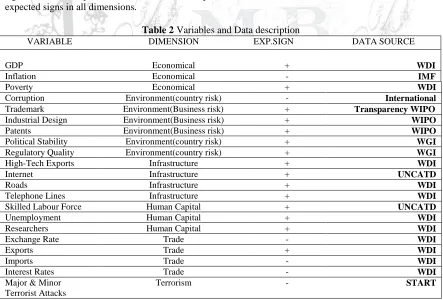
A set of explanatory variables are being used into six dimensions with their expected signs. The expected signs are based on prior studies or theoretical explanations. Table 2 shows the variables, data sources and expected signs in all dimensions.
Table 2 Variables and Data description
VARIABLE DIMENSION EXP.SIGN DATA SOURCE
GDP Economical + WDI
Inflation Economical - IMF
Poverty Economical + WDI
Corruption Environment(country risk) - International
Trademark Environment(Business risk) + Transparency WIPO
Industrial Design Environment(Business risk) + WIPO
Patents Environment(Business risk) + WIPO
Political Stability Environment(country risk) + WGI
Regulatory Quality Environment(country risk) + WGI
High-Tech Exports Infrastructure + WDI
Internet Infrastructure + UNCATD
Roads Infrastructure + WDI
Telephone Lines Infrastructure + WDI
Skilled Labour Force Human Capital + UNCATD
Unemployment Human Capital + WDI
Researchers Human Capital + WDI
Exchange Rate Trade - WDI
Exports Trade + WDI
Imports Trade - WDI
Interest Rates Trade - WDI
Major & Minor Terrorist Attacks
ISSN: 2306-9007 Manzoor, Fonseka, Bashir & Hussain (2014) 240
I
www.irmbrjournal.com March 2014I
nternational Review ofM
anagement andB
usiness Research Vol. 3 Issue.1R
M
B
R
Note: WDI, IMF, WIPO, WGI, UNCATD and START denote respectively the Data bases World Development Indicators, International Monetary Fund, World Intellectual Property Organization, World Governance Indicators, United Nations Conference on Trade and Development and Study of Terrorism and Responses to Terrorism.
Results and Discussion
To estimate and to investigate the affect of the explanatory variables in each dimension on dependent variable (FDI), Table 3 and 4 show the results of each dimension in both countries.
Table 3
Results of Economical Model and Environmental Model (Country Risk and Business Risk)
Economical Model Environmental Model (Country Risk)
Environmental Model (Business Risk) variable Coefficient variable Coefficient variable Coefficient
China Pakistan China Pakistan China Pakistan
GDP .900**
(2.587)
5.030*** (6.036)
Corruption 5360384019*
(1.862)
-214646708*** (-3.765)
Trade mark 69.663***
(3.475)
241.005*** (3.606)
Inflation -.402. (-.169)
-2.780*** (-3.649)
Pol.Stability -16870110. (-.800) -1501720.96*** (-2.722) Industrial Design 163.075*** (3.116) -2306.994. (-.911)
Poverty .006. (.914)
.035*** (3.18)
Reg.Quality 1961069.9. (.148)
838892.3*** (3.716)
Patents -355.903***
(-4.676)
23315.212** (2.304)
Adj. R2 .881 .820 Adj. R2 .430 .633 Adj. R2 .898 .722
F-stat. 43.30 2
25.316 F-stat. 5.025 10.181 F-stat. 47.711 14.867
Note: single * represents 10 percent significant level, double ** represents 5 percent significant level and triple *** shows significant level of 1 percent. Where, the dot (.), Shows that result is insignificant for a variable. The parenthesis shows the results of T. statistics for a variable.
For China, the economical model explains that GDP is the robust variable and it shows that market size is a prominent determinant of FDI. This proves the market size hypothesis, that larger market size, greater will be FDI. Inflation is negatively related but it is not significant, which shows in China inflation is low but
still affecting the decision of the investor. The model of China shows 90 percent variation in FDI in China
due to GDP, inflation and poverty. In case of Pakistan, GDP is positively related and is significant at 1 percent significance level. FDI tend to increase up to 5.03 percent due to 1 percent increment of GDP, which shows that market size is the robust determinant in seeking FDI and larger market size gives more opportunities to an investor with more profit getting ways. Whereas inflation is significant and negatively related to FDI, with 1 percent increase in inflation, FDI reduce to 2.78 percent, which proves that inflation deters FDI and it is negatively affecting the FDI.
Poverty is positively related in Pakistan model and it supports the prediction that more poverty is positively related with FDI and gives more opportunities to investor. The results show that there are more opportunities for an investor in Pakistan as compare to China with more good market but inflation makes this market risky as compare to China. The model shows that GDP is the robust determinants and it shows that bigger market size contribute in the attraction of FDI, while inflation hampers the flow of FDI.
We split the environment dimension into two further parts namely country risk and business risk. The results
are evaluated by employing the two models. First, we show country risk model in the Table 3. The results
shows that China is less risk country and country risk is low as corruption is also positively related to FDI with 10 percent significance level and it shows us the role of Guanxi3 in China. Other variables are
3 Guanxi(关系 / guānxi) denotes the relationship in Chinese society that results into exchange of favour as
ISSN: 2306-9007 Manzoor, Fonseka, Bashir & Hussain (2014) 241
I
www.irmbrjournal.com March 2014I
nternational Review ofM
anagement andB
usiness Research Vol. 3 Issue.1R
M
B
R
insignificant for China in this model. In contrast, corruption is negatively related to FDI in Pakistan and is also significant at 1 percent level, with an increase in corruption level in Pakistan, FDI deters to a larger amount, which shows that investor prevent to invest in a country with more corruption and consider the business environment of a country unsuitable for investment. With corruption, political stability is also negatively related, which shows that Pakistan is facing problem of political instability and this factor also is a hurdle in attracting FDI to Pakistan. On the other hand, regulatory quality is positively related to FDI. The results show that China is a giant seeker of FDI due to less corruption level that makes the country environment more suitable and feasible for investment, where the corruption and political stability is a big threat of an investor to invest in Pakistan, making the country business environment less friendly to investor.
Second, we also show business risk model in the Table 3. The estimation results for registered trademarks
and industrial designs in China are showing positive relation with FDI and are significant but the number of patents registered in China have negative relation, with 1 percent increase in patents result into a decrease in FDI up to 356 percent. The patents relation with FDI in China is negative due to the risk that is inherent in Chinese market and the risk of the theft of intellectual property in China is more common as in case of patents which are a hurdle in the flow of investment. The model explains the China business risk situation with a 91 percent variation in FDI with the use of these variables. Trademark is positive and it is significant at 1percent significance level in Pakistan and the estimation shows that this variable has strong contribution in seeking FDI. The coefficient of industrial designs is negative and is insignificant. The result of patent in Pakistan model is positively related in contrast to China model and is significant at 5 percent significance level. This difference can be due to the fact that Pakistan market is smaller and with less multinational companies operating within the country boundary. The two models describe well the variation in explanatory variables for accessing business environment in both countries and show that factors differ according to country.
ISSN: 2306-9007 Manzoor, Fonseka, Bashir & Hussain (2014) 242
I
www.irmbrjournal.com March 2014I
nternational Review ofM
anagement andB
usiness Research Vol. 3 Issue.1R
M
B
R
percent significance level and shows a good variation in FDI.The roads are negatively related to FDI and
significance level lies within 10 percent which shows that larger area makes transportation cost to increase.
High technology exports are negatively related to FDI, showing the impact of technology gap in deterring FDI. This means that Pakistan is less advanced in technology and less skilled people as well as inadequate advance infrastructure. On the other hand, telephone, internet and roads are positively related to FDI and are significant, proving the best way to measure the infrastructure of a country, showing that larger market size provides opportunities but also creates some problems as it has a relation with infrastructure as it is obvious from results in case of China.
Table 4 shows that results for human capital dimension are describing that skilled labour force in China is insignificant and also the number of researchers in China is insignificant. The only variable that is significant is unemployment and it is positively affecting the FDI. With 1 percent increase in unemployment, FDI increase to 3.4 percent, which shows that employment, gives opportunities to an investor to seek good labour at minimal wages and to use extensive labour force. Even the China has largest population size in world, but still it is failed to gauge the human capital flow within well managed hands to cope the problem of skilled labour force.
For Pakistan, the human capital model explains the variation of FDI up to 74 percent .Skilled labour force is negatively related to FDI and is significant showing that with an increase in skilled labour force variable, FDI tend to reduce, which shows that a country with less skilled labour force deters FDI on the basis of the deficiency of people knowledge and skills to use well the technical tools and to work well on machines. Unemployment is also positively related and is significant. But the number of researchers’ variable in a country is also insignificant as it is in case of China.
For FDI- Trade relations, the results in the Table 4 are showing that in China, exports are positively related
and it is significant at 1 percent level.This shows that China has adopted export oriented FDI policies and
with 1 percent increase in exports, FDI increase to 0.129 percent. Imports are negatively related and it is insignificant. The results support the argument that a country can get more benefits from FDI, if it has export oriented policies than import promotion regime. Whereas the interest rate and exchange rate are positively related to FDI at 1 percent significance level respectively. This explains that these two factors are affecting positively as they are minimum and are controlled well and these variables are not a hurdle in the flow of FDI
If we examine the results for Pakistan, we will see different results. The exports are negatively related to FDI and it is significant at 5 percent level. With 1 percent increase in exports, FDI reduce to 0.34 percent. On the other hand, imports are positively related and are significant, these results show that Pakistan is more dependent on imports and FDI flow is based on imports. The estimation of coefficient for interest rate is negative and is significant. Interest rate is more affecting than other variables and with 1 percent increase in interest rate, the FDI reduce to 0.002 percent. Exchange rate is also negatively affecting the FDI and it is significant at 1 percent level. The model explains that for an investor China is a good market with less provoking factors like interest rate and exchange rate as they are high and volatile in case of Pakistan.
ISSN: 2306-9007 Manzoor, Fonseka, Bashir & Hussain (2014) 243
I
www.irmbrjournal.com March 2014I
nternational Review ofM
anagement andB
usiness Research Vol. 3 Issue.1R
M
B
R
It is observable from the results that FDI flow depends on the all the described dimension in a country and inside the dimension, different variable used has different effect on FDI which gives a meaning to the determinants of FDI. This study helps to explain these effects in Pakistan and in China, but it still has some limitations. These variables and dimensions can be generalized only in a specific area and in a country as Blonigen (2004) concluded, even we can assume and can estimate the determinants to be remaining same in a country having same threats and opportunities, but somehow the factors still show a deviation from one area to another. We suggest studying FDI determinants in a different region within a country as a future research and it will be useful to policy makers for their policy decision and it is important to investors make their decision where he can invest within a country for getting maximum benefits.
Conclusion
In order to estimate and to explain the determinants of FDI in a more elaborated and suitable form by the use of dimensions among two countries, China and Pakistan we find that for most of the variables ,the results are consistent and are in accordance to the prior studies for the period of 1995 to 2011.In case of China ,the good economic condition with less inflation, good business environment with less risk , good trade dimension and less terrorism are the considerable dimensions affecting the flow of FDI as compare to infrastructural and human capital dimensions. GDP, inflation, trade mark, industrial design, patents, high technology exports, roads, internet, unemployment, export, imports, exchange rate and interest rate are the strong determinants of FDI in China. On the other hand, corruption, poverty, political stability, regulatory quality, telephone, skilled labour, researchers and terrorism are the fragile one.
The results shows FDI in Pakistan is linked with economic dimension with more inflation and more poverty, business environment with more risk ,with good infrastructure , human capital with less skilled people, trade with more volatile conditions and reliability on imports and with terrorism. The terrorism is affecting the FDI movement more as compare to China. The results are significant for most of the variables used in the dimensions for Pakistan as compare to China. With effect to this, we find that variables change among two countries.The variables explain that inflation is negative and high in Pakistan, showing that prices of the good are high, corruption is high , technology gap is still residing in the economy ,with less skilled labour force ,volatile exchange and interest rates and with more terrorism making the country to gain less as compare to others.
Based on the results, it is arguable that FDI decision and movement is associated with all the dimensions and the variables. The factors change from negative to positive in both countries and FDI determinants are different in many dimensions in both countries.The results present that there are more opportunities for an investor in Pakistan with technology gap more reliability on imports but different types of risks, terrorism, political instability are hurdle in the free movement of FDI. This study also find enhanced set of explanatory variables with better knowledge of their effects on FDI as in case of patents, export and
terrorism variables in China and in Pakistan. This study supported the earlier work in a more
comprehensive way and elaborate the in depth view of FDI relation with explanatory variables as mentioned in the literature.
References
Abadie, A., & Javier, G. (2008). Terrorism and the World Economy. European Economic Review, 5(1),
1-27.
Adhikary, B.K. (2011). FDI, Trade Openness, Capital Formation, and Economic Growth in Bangladesh: A
Linkage Analysis. International Journal of Business and Management ,6(1).16-28.
ISSN: 2306-9007 Manzoor, Fonseka, Bashir & Hussain (2014) 244
I
www.irmbrjournal.com March 2014I
nternational Review ofM
anagement andB
usiness Research Vol. 3 Issue.1R
M
B
R
Al-Sadig, A. (2009). The Effects of Corruption on FDI Inflows. Cato Journal ,29(2), 267-294.
Ang,J.B. (2008). Determinants of foreign direct investment in Malaysia. Journal of Policy Modeling
,30(2008),:185–189.
Aqeel,A., & Nishat.M. (2004). The Determinants of Foreign Direct Investment in Pakistan. Annual PSDE
Conference, Islamabad.
Asiedu, E. (2002). On the determinants of foreign direct investment to developing countries: if Africa
different? World Development ,30(1),107-119.
Aw, Y.T., & Tang,T.C. (2009). The Determinants of Inward Foreign Direct Investment: the Case of
Malaysia. Journal of Policy Modeling ,30(1),185-189.
Azam, M. (2010). An Empirical Analysis of the Impacts of Exports and Foreign Direct Investment on
Economic Growth in South Asia. Interdisciplinary Journal of Contemporary Research in Business, 2
(7). 249.
Bajo-Rubio, O., & Sosvillo-Rivero,S. (1994). An econometric analysis of foreign direct investment in
Spain, 1964–89. Southern Economic Journal, 61(1), 104–120.
Bensebaa,F.B. (2005). Agglomeration economies and location choice: Foreign Direct Investment in
Hungary. The Economics of Transition, 13(4), 605-628.
Bhagwati, J. N. (1978). Anatomy and Consequences of Exchange Control Regimes. Studies in International Economic Relations, 1(10), National Bureau of Economic Research, New York.
Bilgili,F., Tülüce,N.S.H., & Dogan.I. (2012). The determinants of FDI in Turkey: A Markov
Regime-Switching approach. Economic Modelling, 29(2012), 1161–1169.
Billington, N. (1999). The Location of Foreign Direct Investment: An Empirical Analysis. Applied
Economics,31(1), 65-76.
Blomberg, S. B., & Mody, A. (2005). How Severely Does Violence Deter International Investment?
Claremont Colleges Economics Departments Working Paper No 2005-01.
Blonigen, B.A. (1997). Firm-specific assets and the link between exchange rates and foreign direct
investment. American Economic Review, 87(3), 447-465.
Blonigen,B.A., &Wang,M. (2004). Inappropriate pooling of wealthy and poor countries in empirical FDI studies.National Bureau of Economic Research Working paper,http://www.nber.org/papers/w10378 Borensztein,E., Gregorio,J.D., & Lee,J.W. (1998). How does foreign direct investment affect economic
growth? Journal of International Economics,45(1), 115–135.
Buckley,P.J., Clegg, L. J., Cross,A.R., Liu,X., Voss,H ., & Zheng P. (2007) The Determinants of Chinese
Outward Foreign Direct Investment. Journal of International Business Studies, 38(4),499-518.
Carr, D. L., Markusen, J. R., & Maskus, K. E. (2001). Estimating the Knowledge-Capital Model of the
Multinational Enterprise. American Economic Review, 91(3), 693-708.
Chakrabarti, A. (2001). The Determinants of Foreign Direct Investment: Sensitivity Analyses of
Cross-Country Regressions. Kyklos, 54(1), 89–114.
Chan, K. S., Dang, V. Q.T., & Yan, I. K. (2012). Effects of Financial Liberalisation and Political
Connection on Listed Chinese Firms’ Financing Constraints. The World Economy, 35(4), 483-499.
Changkyu, C. (2003). Does the Internet stimulate inward foreign direct investment? Journal of Policy Modeling, 25,319–326.
Chaudhary,G.M., Shah.S.Z.A., Bagram,M.M.M. (2012). Do Exchange Rate Volatility Effects Foreign
Direct Investment? Evidence from Selected Asian Economies. Journal of Basic and Applied Scientific
Research, 2(4), 3670-368.
Cheng, L.K., & Kwan, Y.K. (2000). what are the determinants of the location of foreign direct investment?
The Chinese experience. Journal of International Economics, 5(2), 379–400.
Coughlin, C.C., Terza, J.V., & Arromdee, V. (1991). State characteristics and the location of foreign direct
investment within the United States. Review of Economics and Statistics,73 (4), 675–683.
ISSN: 2306-9007 Manzoor, Fonseka, Bashir & Hussain (2014) 245
I
www.irmbrjournal.com March 2014I
nternational Review ofM
anagement andB
usiness Research Vol. 3 Issue.1R
M
B
R
Daude,C.,& Stein,E. (2007). The quality of institutions and foreign direct investment. Economics & Politics, 19(3), 317 – 344.
Dees,S. (1998). Foreign Direct Investment in China: Determinants and Effects. Economics of Planning, 31(2), 175–194.
Demirhan, E.,& Masca,M. (2008). Determinants of Foreign Direct Investment flows to developing countries: A cross-sectional analysis. Prague Economic papers, (4), 356-369.
Dunning, J. H. (1993). Multinational Enterprises and the Global Economy: Harlow, Essex: Addison Wesley publishing Co.
Edwards, S. (1990). Capital flows, foreign direct investment, and debt-equity swaps in developing
countries. Cambridge, M. A: National Bureau of Economic Research. Working Paper No 3497.
Eggera,P., & Winnerb,H. (2005). Evidence on corruption as an incentive for Foreign Direct Investment.
European Journal of Political Economy, 21, 932– 952.
Eicher,T.S, Helfman, L., & Lenkoski,A. (2012). Robust FDI determinants: Bayesian Model Averaging in
the presence of selection bias. Journal of Macroeconomics, 34(3), 637–651.
Enders, W., & Sandler, T. (1996). Terrorism and Foreign Direct Investment in Spain and Greece. Kyklos,
49(3), 331–352.
Farhad,N., Alberto,P., & Ali,Y. (2001). Human Capital and FDI Inflows to Developing Countries: New
Empirical Evidence. World Development, 29(9), 1593-1610.
Habib M., & Zurawicki L. ( 2002). Corruption and foreign direct investment. Journal of International Business Studies,33(2), 291–307.
Hailu,Z.A.(2010). Impact of Foreign Direct Investment on Trade of African Countries. International
Journal of Economics and Finance, 2(3), 122-133.
Harrison, A.E., & McMillan, M.S. (2003). Does Direct Foreign Investment Affect Domestic Credit
Constraints. Journal of International Economics, 61(1), 73-100.
Harry,G. B., & Sun.X. (1997). The distribution of foreign direct investment in China. The World Economy,
20, 339–361.
Head, K., Ries, J., & Ruckman, K. (1998). Industry agglomeration and the location of foreign affiliates. Research in Global Strategic Management, 6, 53–85.
Hussain, S.E. ( 2010). Terrorism in Pakistan: incident patterns, terrorists’ characteristics, and the impact of
terrorist arrests on terrorism. publicly accessible Penn Dissertations, paper 136.
http://repository.upenn.edu/edissertations/136
Hussain,F., & Kimuli,C.K.(2012). Determinants of Foreign Direct Investment Flows to Developing Countries. SBP Research Bulletin, 8(1), 14-31.
Jadhav,P. ( 2012). Determinants of foreign direct investment in BRICS economies: Analysis of economic, institutional and political factor. Journal of Social and Behavioral Sciences, 37,5 – 14.
Kamath, S.J.(1990). Foreign direct investment in a centrally planned developing economy: The Chinese
case. Economic Development and Cultural Change, 39(1), 107–130.
Kang,S.J., & Lee,H.S. ( 2007). The determinants of location choice of South Korean FDI in China. Japan
and the World Economy, 19(4), 441–460.
Khan, R.E.A., & Nawaz.M.A. (2010). Economic Determinants of Foreign Direct Investment in Pakistan. J Economics , 1(2), 99-104.
Khan,M.A., Khan,S.A.( 2011). Foreign Direct Investment and Economic Growth in Pakistan: A Sectoral
Analysis. Pakistan Institute of Development Economics Islamabad PIDE working papers 67.
Koenig, P.,Megan, M. (2011). Regulatory policy and the location of bio pharmaceutical foreign direct
investment in Europe. Journal of Health Economics, 30(5), 950– 965.
Kok,R., & Ersoy.B.A. (2009). Analyses of FDI determinants in developing countries. International Journal
of Social Economics, 36(1), 105 – 123.
Leitao, N. C. (2010). Foreign Direct Investment: The Canadian Experience. International Journal of
ISSN: 2306-9007 Manzoor, Fonseka, Bashir & Hussain (2014) 246
I
www.irmbrjournal.com March 2014I
nternational Review ofM
anagement andB
usiness Research Vol. 3 Issue.1R
M
B
R
Li,X., & Liu,X. (2005). Foreign direct investment and economic growth: an increasingly endogenous
relationship. Worm Development,33(3), 393-407.
Love, J., Lage-Hidalgo, F. (2000). Analysis of the determinants of U.S. direct investment in Mexico.
Applied Economics, 32(10), 1259–1267.
Matthias, B., & Carsten,H.( 2007). Political Risk, Institutions and Foreign Direct Investment. European Journal of Political Economy, 23(2), 397-415.
Mihalache, A.S. (2010). Who’s afraid of political violence? Evidence from industry level FDI flows.
http://www.allacademic.com/meta/p413893_index.html
Moosa, I.A. Cardak, B.A. (2006). The determinants of foreign direct investment: An extreme bounds
analysis. Journal of Multinational Financial Management, 16(2), 199–211.
Mottaleb, K. A. and Kalirajan, K. (2010). Determinants of Foreign Direct Investment in Developing
Countries: A Comparative Analysis. Australia South Asia Research Centre, ANU Working Paper,
2010/13.
Mottaleb,K.A. (2008 ). Determinants of Foreign Direct Investment and Its Impact on Economic Growth in
Developing Countries. MPRA Paper No. 9457.
Rammal,H.G., & Zurbruegg, R. (2006). The impact of regulatory quality on intra-foreign direct investment
flows in the ASEAN markets. International Business Review, 15(4), 401–414.
Reisen, H., & Soto,M. (2001). Which types of capital inflow foster developing country growth?
International Finance, 4(1), 1–14.
Resmini, L. (2000). The Determinants of Foreign Direct Investment in the CEECs. Economics of
Transition, 8(3), 665–89.
Sakali, C. (2013). Determinants of Foreign Direct Investment (FDI) in Bulgaria: An econometric analysis
using panel data. Journal of Economics and Business, 16(1), 73-97.
Schneider, F., & Frey, B. S. (1985). Economic and Political Determinants of Foreign Direct Investment.
World Development, 13(2), 161-175.
Smarzynska, B. K., & Wei, Shang-Jin. (2002). Corruption and cross-border investment: firm-level
evidence. William Davidson Institute Working Paper 494:1-29.
Summer,A. (2005). Is foreign direct investment good for the poor? A review and stock take. Development
in Practice, 15(3), 269-285.
Sun, H. (1998). Macro-economic impact of direct foreign investment in China, 1979-96. The World
Economy, 21(5), 675–694.
Sun, Q.,Tong.W., & Yu.Q. (2002). Determinants of foreign direct investment across China. Journal of International Money and Finance, 21, 79–113.
Sung, H., & Lapan, H.E. (2000). Strategic foreign investment and exchange rate uncertainty. International
Economic Review, 41(2), 411-423.
Sung,Y.W. ( 2000). Costs and Benefits of Export-Oriented Foreign Investment: The Case of China. Asian
Economic Journal,14(1).
Thangamani,B., Xu,C., & Zhong,C. (2011). Determinants and Growth Effect of FDI in South Asian
Economies: Evidence from a Panel Data Analysis. International Business Research,4(1), 43-50.
Tomiura,E. (2007). Foreign outsourcing, exporting, and FDI: A productivity comparison at the firm level. Journal of International Economics, 72(1), 113–127.
Vita,G.D., & Abbott,A. (2008). Do exchange rates have any impact upon UK inward foreign direct
investment? Journal ofApplied Economics, 39(20), 2553-2564.
Voyer, P.A., & Beamish, P.W. (2004). The Effect of Corruption on Japanese Foreign Direct Investment.
Journal of Business Ethics,50(3), 211–24.
Wagner, D.(2006). The Impact of Terrorism on Foreign Direct. IRMI.
http://www.irmi.com/expert/articles/2006/wagner02.aspx
Walsh,J.P., & Yu,J. (2010). Determinants of Foreign Direct Investment: A Sectoral and Institutional
ISSN: 2306-9007 Manzoor, Fonseka, Bashir & Hussain (2014) 247
I
www.irmbrjournal.com March 2014I
nternational Review ofM
anagement andB
usiness Research Vol. 3 Issue.1R
M
B
R
Wang, Z.Q., & Swain, N.J. (1995). The determinants of foreign direct investment in transforming
economies: evidence from Hungary and China. Review of World Economics, 131(2), 359–382.
Wei, Shang-Jin., & Shleifer,A. (2000). Local Corruption and Global Capital Flows’, Brookings Papers on
Economic Activity, 2000(2), 303-354.
Wei,W. (2005). China and India: Any difference in their FDI performances? Journal of Asian Economics,
16(4), 719–736.
Wheeler, D., & Mody,A. (1992). International Investment Location Decisions: The Case of U.S. firms.
Journal of International Economics, 33(1), 57–76.
Yang, J.Y.Y., Groenwold, N., Tcha, M. (2000). The determinants of foreign direct investment in Australia.
Economic Record, 76(232), 45–54.
Ying,L., & Riming.C. (2008). Function simulation of FDI, foreign trade and regional GD in China. Journal
of Economics and Foreign Trade Studies. 1(3), 232-243.
Zaman,K., Khan,M.M., & Ahmad,M. (2012). The relationship between foreign direct investment and