Published online September 23, 2014 (http://www.sciencepublishinggroup.com/j/sjc) doi: 10.11648/j.sjc.s.2014020602.11
ISSN: 2330-0981 (Print); ISSN: 2330-099X (Online)
A study of effect of dye structure on polyelectrolyte
induced metachromasy
Nandini Ratnakar
Department of Chemistry, MITE, Moodabidri-574 226 (DK), Karnataka, India
Email address
To cite this article:
Nandini Ratnakar. A Study of Effect of Dye Structure on Polyelectrolyte Induced Metachromasy. Science Journal of Chemistry. Special Issue: Polyelectrolytes & Dyes. Vol. 2, No. 6-2, 2014, pp. 1-7. doi: 10.11648/j.sjc.s.2014020602.11
Abstract:
The interaction of two cationic dyes, namely, Azure B (AB) and Pinacyanol chloride (Pcyn) with an anionic polyelectrolyte, namely, sodium carrageenate (NaCar) has been investigated by Spectrophotometric method. The polymer induced metachromasy in the dyes resulting in the shift of the absorption maxima of the dyes towards shorter wavelengths. The stability of the complexes formed between Azure B and sodium carrageenate was found to be lesser than that formed between Pinacyanol chloride and sodium carrageenate. This fact was further confirmed by reversal studies using alcohols, urea surfactants and electrolytes. The interaction parameters revealed that binding between Azure B and sodium carrageenate was mainly due to electrostatic interaction while that between Pinacyanol chloride and carrageenate is found to involve both electrostatic and hydrophobic forces. The effect of the structure of the dye and its relation to metachromasy has been discussed.Keywords:
Cationic Dyes, Metachromasy, Sodium Carrageenate, Dye Structure, Aggregation1. Introduction
Metachromasy is a well-known phenomenon in the case of dye-polymer interactions and is generally found in the case of aggregation of cationic dyes on anionicpolymers [1-4]. Metachromasy is related to the interaction of cationic dyes with polyanions where a single individual compound is formed by the interaction of the dye cation and the chromotrope polyanionic polymer. Several physiochemical parameters such as molecular weight of each repeating unit, stoichiometry of the dye-polymer complex, binding constant, and other related thermodynamic parameters like free energy, enthalpy, and entropy changes can be evaluated using
polymer-dye interactions.Biological activity of
macromolecules depends on its tertiary conformation. Conformation of the polyanions controls the induction of metachromasy of aqueous dye solution. Although there are several reports on metachromasy of various classes of acidic polysaccharides and different synthetic polyanions [5, 6]. Cyanine dyes, which are cationic in nature, have widely been used to probe biological systems such as helical structure of DNA, tertiary conformation of bacterial polysaccharides and other polymers.
As these dye having high light absorptivity, they can be used as optical probes in studying membranes, micelles and
interaction between polyelectrolytes and oppositely charged surfactants [23, 24] has been investigated due to its importance in both fundamental and applied fields. [25]. Comprehensive studies of a variety of cationic surfactants with anionicpolyelectrolytes, have been reported [26-32]. Cationic dyes that interacted with Heparin mostly fell in the Thiazine group such as MethyleneBlue [33-35]. Azure A [36, 37], Azure B [38, 39]. Hence the objective of the present study is to compare the extent of metachromasy induced by sodium carrageenate in the cationic dyes Azure B and Pinacyanol chloride and to evaluate the thermodynamic parameters of interaction and to study the extent of reversal by using alcohols, urea, surfactants and electrolytes which is an indirect evidence for the stability of the metachromatic complex formed. The effect of dye structure on metachromasy has also been discussed.
2. Materials & Methods
2.1. Apparatus
The spectral measurements were carried out using Shimadzu UV-2500 Spectrophotometer using a 1cm quartz cuvette
.
2.2. Reagents
Azure B (AB) was obtained from (Hi Media, Germany) and used as received.Pinacyanol chloride (Pcyn), was obtained from (Acros Media, Germany). sodiumcarrageenate (NaCar) (Loba Chemie, India) were used without further purification; Methanol, (MeOH) ethanol(EtOH) and 2-Propanol (PrOH) (Merck, India) were distilled before use. Urea, sodium chloride and potassium chloride were obtained from (Merck, India). Sodium laurylsulphate and sodium dodecylbenzenesulphonate (Lobachemie, India) were obtained from (Loba Chemie, India) .
3. Methods
3.1. Determination of Stoichiometry of Polymer-Dye Complex
Increasing amounts of polymer solution(0.0- to 5x10⁻³M) were added to a fixed volume of dye solution (0.5ml,1x10-3M) in case of Azure B and (0.5ml,1x10-3M) of dye to increasing amount of polymer solution (0.0-2.5x10⁻³M ) in case of pinacyanol chloride in different sets of experiments and the total volume was made up to 10ml by adding distilled water in each case. The absorbances were measured at 645 nm and 545 nm in case of AB-Car and at 600 nm and 486 nm in case of Pcyn-Car complex.
3.2. Study of Reversal of Metachromasy Using Alcohols and Urea
For measurements of the reversal of metachromasy, solutions containing polymer and dye in the ratio 2.0:1.0 were made containing different amount of alcohol. The total
volume was maintained at 10ml in each case. The absorbances were measured at 645 nm and 545 nm in case of AB-NaCar and at 600 nm and 486 nm in case of Pcyn-NaCar. Similarly, polymer-dye solutions containing different amounts of urea (1-8M) were made and the absorbances were measured at 645 nm and at 545 nm in case of AB-NaCar complex and at 600 nm and at 486 nm in case of Pcyn-NaCar complex.
3.3. Study of Reversal of Metachromasy Using Surfactants and Electrolytes
For measurements of the reversal of metachromasy, solutions containing polymer and dye in the ratio 2.0:1.0 were made containing different amount of surfactants or (1x10⁻⁷M – 1x10⁻²M) were made in case of AB-NaCar and (1x10⁻⁶M-0.1M) in case of Pcyn-NaCar The total volume was maintained at 10ml in each case. The absorbances were measured at 645 nm and 545 nm in case of AB-NaCar and at 600 nm and 486 nm in case of Pcyn-NaCar. Similarly, polymer-dye solutions containing different amounts of electrolytes(1x10⁻⁶M-0.1M) in case of AB-NaCar and (1x10
-7M-1x10⁻²M) in case Pcyn-NaCar were made and the
absorbances were measured at 645 nm and at 545 nm in case of AB-NaCar complex and at 600 nm and at 486 nm in case of Pcyn-NaCar complex. A plot of absorbance at 545 nm in case of Azure B and at 600 nm in case of Pinacyanol chloride Vs molar concentration of surfactants or electrolytes were made to determine the concentration of surfactants and electrolytes needed for complete reversal of metachromasy.
3.4. Determination of Thermodynamic Parameters
The thermodynamic parameters were determined by measuring the absorbances of the pure dye solution at the respective monomeric band and metachromatic band in the temperature range (360C-540C).The above experiments were
repeated in presence of the polymers at various polymer-dye ratios (2, 5, 8 and 10).
4. Results & Discussion
Figure 1. Absorption spectrum of AB-NaCar at various P/D ratios
Figure 2. Absorption spectra of Pcyn-NaCarcomplex at various P/D ratios
4.1. Determination of Stoichiometry
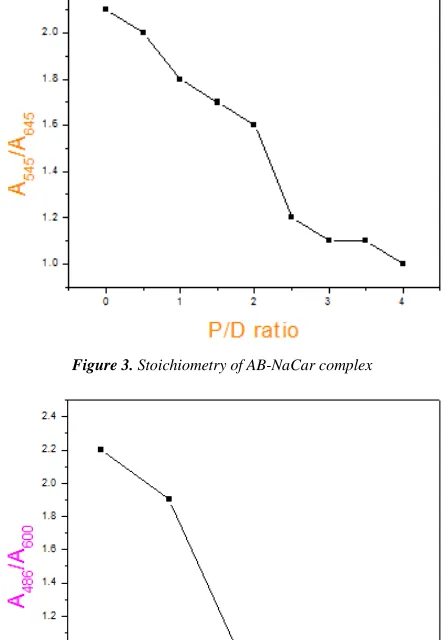
To determine the stoichiometry of the polymer-dye complex, a plot of A545/A645 versus the polymer/dye ratio was
made for AB-NaCar system. A similar procedure was repeated with Pcyn- NaCar complex also. The stoichiometry of AB-NaCar complex was found 1: 2 which indicates that the binding is at alternate anionic sites. This indicates that every potential anionic site of the polyanion was associated with the dye cation and aggregation of such dye molecules was expected to lead to the formation of a card pack stacking of the individual monomers on the surface of the polyanion so that the allowed transition produces a blue-shifted metachromasy [42].The results were in good agreement with the reported values for interaction of similar dyes withpolyanions[43] .While in case of Pcyn-NaCar complex the stoichiometry is 1:3 and the binding is at alternate anionic sites. This indicates that there is lesser overcrowding and more aggregation of the bound dyes on the polymer chain in the latter case than in the former case. Similar results were reported in case of binding of Pinacyanol chloride on poly(methacrylicacid) &poly(styrenesulfonate) systems [44].The stoichiometry results are obtained by plotting
A645/A545 orA600/A486 Vs P/D ratio in each case.The results
are shown in (Fig. 3 and Fig. 4) respectively.
Figure 3. Stoichiometry of AB-NaCar complex
Figure 4. Stoichiometry of Pcyn-NaCar complex
4.2. Reversal of Metachromasy Using Alcohols and Urea
Figure 6. Reversal of metachromasy on addition of alcohols(Pcyn-NaCar)
The metachromatic effect is presumably due to the association of the dye molecules on binding with the polyanion which may involve both electrostatic and hydrophobic interactions. The destruction of metachromatic effect may occur on addition of low molecular weight electrolytes, alcohols or urea. The destruction of metachromasy by alcohol and urea is attributed to the involvement of hydrophobic bonding has already been established [45-49].The efficiency of alcohols in disrupting
metachromasy was found to be in the order
methanol<ethanol< 2- propanol, indicating that reversal becomes quicker with increasing hydrophobic character of the alcohols. The above facts are further confirmed in the present system .On addition of increasing amount of alcohol to the polymer/dye system at P/D=2.0, the original monomeric band of dye species is gradually restored. The efficiency of the alcohols, namely methanol, ethanol and 2- propanol, on destruction of metachromasy were studied. In case of AB-NaCar system 45 % methanol, 35 % ethanol, 25 % 2- Propanol were sufficient to reverse metachromasy 60 % methanol, 50 % ethanol, 40 % 2- Propanol were required to reverse metachromasy in Pcyn- NaCar system. From the plot of A545/A645 or A486/A600 (Fig.5 and Fig.6) against the
percentage of alcohols or molar concentration of urea, the percentage of alcohols or molar concentration of urea, needed for complete reversal has been determined. The concentration of urea to reverse metachromasy is found to be as high as 4.5 M in AB-Car system and 5 M in case of Pcyn-NaCarsystem (Fig. 7 & Fig. 8).This indicates that the metachromatic complex formed between Pcyn-NaCar is more stable than that between AB-NaCar complexes. Similar reports are available in literature for reversal of metachromasy in anionic polyelectrolyte/cationic systems by addition of alcohols or urea [50-51].
Figure 7. Reversal of metachromasy on addition of urea(AB-NaCar)
Figure 8. Reversal of metachromasy on addition of urea(Pcyn-NaCar)
4.3. Reversal of Metachromasy Using Surfactants
Figure 10. Reversal of metachromasy on addition of surfactants(PNaCar)
The strength and nature of interaction between water soluble polyelectrolytes and oppositely charged surfactants depend on the characteristic features of both the polyelectrolytes and the surfactants. The charge density, flexibility of the polyelectrolyte and the hydrophobicity of the non-polar part and the bulkiness of the polar part also play a vital role in the case of polysaccharide-surfactant interaction [52].On adding increasing amounts of sodium laurylsulphate and sodium dodecylbenzenesulphonate to AB-NaCar complex the molar concentrations of Sodium laurylsulphate and Sodium dodecylbenzenesulphonate needed to cause reversal was found to be 1x10⁻⁴M and 1x10
-3M in case of AB-NaCar and 1x10⁻³M and 1x10⁻²M in case of
Pcyn-NaCar system. These results agree with those reported earlier in literature [53].Thus the addition of surfactants causes the production of micelles. Thus the surfactant molecules interacted with the polymer by replacing the cationic dye. The release of dye molecules from the dye-polymer complex in presence of cationic surfactants revealed that surfactants interacted electrostatically [54] with the anionic site of the polymer and thus the dye becomes free. The ease of reversal of metachromasy can be correlated with its chain length thus the binding between oppositely charged polymer surfactant is primarily by electrostatic forces which is reinforced by hydrophobic forces. From the plot of absorbance at 645 nm in case of Azure B or Absorbance at600 nm in case of Pinacyanol chloride against molar concentration of surfactants, the molar concentration of surfactants needed for complete reversal of metachromasy has been determined. The results are shown in (Fig. 9 and Fig. 10) respectively.
4.4. Determination of Interaction Parameters
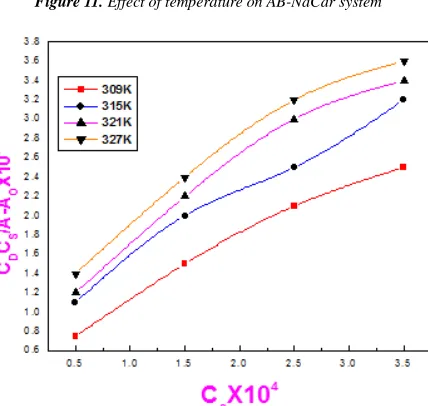
The interaction constant KC for the complex formation
between AB and NaCar and Pcyn-NaCar was determined by absorbance measurements at the metachromatic band at four different temperatures taking different sets of solutions containing varying amounts of polymer (CS) in a fixed
volume of the dye solution (CD). The value of Kc was
obtained from the slope and intercept of the plot of CDCS/
(A-AO) against Cs shown in Fig.11 &Fig.12.
Figure 11. Effect of temperature on AB-NaCar system
Figure 12. Effect of temperature on Pcyn-NaCar system
In each case the thermodynamic parameters of interaction, namely ∆H, ∆G and ∆S were also calculated .The results are given in Table 1 and Table 2.
Table 1. Thermodynamic parameters of interactionfor Pcyn-NaCar
Temp KC ∆G ∆ H ∆S
309K 5400 -4.156
315K 3500 -4.577 -2.4576 -0.046
321K 2644 -4.714
327K 1811 -4.816
Table 2. Thermodynamic parameters of interaction for AB-NaCar
Temp KC ∆G ∆H ∆S
309K 7000 -5.255
315K 2933 -5.455 -8.945 -0.023
321K 1600 -5.815
327K 1052 -6.095
b)Calculated from the thermodynamic equation ∆G = -RTln Kc
c)Calculated graphically by plotting ln Kc against 1/T according to Van’t Hoff equation
ln Kc = -∆ H/RT +C
d)Calculated from the thermodynamic expression ∆G =∆ H – T∆S
4.5. Effect of Structure of Dye
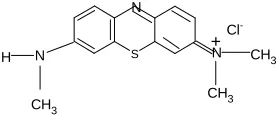
The structures of and Pinacyanol chloride and Azure B are given in (Fig. 13and Fig.14) respectively. It is evident that Azure B, being a rigid planar cationic dye and hence a small distance between the adjacent anionic sites on the polyanion will be more favorable for binding resulting in stacking arrangement, on the other hand Pinacyanolchloride being larger in size is more hydrophobic and hence induces greater aggregation. Thus in this case the distance between the two adjacent dye molecules will be greater and the dye molecules are oriented like a stair case which agrees with the reported literature [55,56] Furthermore the dye molecules are arranged in a parallel and stacked manner within the aggregates resulting in a hypsochromic shift.
CH-CH=CH
N
CH2CH3
N
CH2CH3
+ Cl
-Figure 13. Structure of Pinacyanol chloride
S N CH3
CH3 + N CH3 N Cl -H
Figure 14. Structure of Azure B
5. Conclusions
The polymers sodium carrageenate induced metachromasy in the dye Azure B and Pinacyanol chloride. The monomeric band occurs at 645 nm and 600 nm while the metachromatic band occurred at 545 nm in the case of AB-NaCar and at 486 nm in the case of Pcyn-NaCar. The spectral shifts are higher in the case of Pcyn-NaCar (114 nm) than in case of AB-NaCar (100 nm). These results are further confirmed by the reversal studies using alcohols, urea, electrolytes and surfactants. The thermodynamic parameters further confirm the above fact. It is thus evident from the above studies that both electrostatic and non-ionic forces contribute towards the binding process. Based on the results it can be concluded that the Pinacyanol chloride is more effective in inducing metachromasy in sodium carrageenate than Azure B.Cooperativity in binding is observed to occur due to
neighbour interactions among the bound dye molecules at lower P/D ratios leading to stacking. The stacking tendency is enhanced by the easy availability and close proximity of the charged sites.
References
[1] AMitra,R.KNath, SBiswas.,A.K., Chakraborty, A.K., Panda MitraA., J.Photochrem.Photobiol, A: Chem, vol.111, 1997, pp 157.
[2] A.Mitra, A.K.Chakraborty, J.Photochem.Photobiol.A:Chem., vol.178, 2006, pp198.
[3] R.W Horbin., Biochemie.Biochem., vol.77, 2002, pp 3.
[4] BergeronJ.A., M. J Singer, Biophys.Biochem.Cytol. vol.4,1958, pp.433.
[5] M.K.Pal ,B.K.Ghosh,Makromol.Chem.vol. 181,1980, pp1459 .
[6] Norden B., Kubista M., in: B.Samori, E.W.Thulstrup (Eds.), Polarized Spectroscopy ofordered systems, vol.242, Kulwer Academic Publisher, Dordrecht, Holland, 1988.
[7] Sabate R., EsterlichJ., J.Phys.ChemB, vol.107, 2003, pp.4137.
[8] von Berlepsch H., Kirstein S., Bottcher, C, Langmuir, vol.18, 2002, pp.769.
[9] Sabate R., Gallardo M., De la Maza A., J.Esterlich,
Langmuir,vol.17,2001, pp.6433.
[10] Berret J.F., Cristobal G., Hervel P., Oberdisse J., Grillo I., vol.E9, Eur.Phys J 2002, pp.301.
[11] Meszaos R., Varga, I., Gilanyi T., J.Phys.Chem.B vol.117, 2005, pp.13538.
[12] Monteux C . ,WilliamsC.E., Meunier J., Anthony O., BergeronV., LangmuirVol.20,2004,pp. 57.
[13] Honda C., Kamizono H.,.Matsumoto K., Endo K., J.Colloid
Interface Sci vol.278.2004, pp.310.
[14] MoulikS.P., GuptaS,.DasA.R., Makromol.Chem,vol.181,
1980,pp. 1459.
[15] Lee J., Moroi Y,,J.Colloid Interface Sci. 2 vol.273, 2004, pp.645.
[16] Mesa C.L., J.Colloid Interface Sci . vol.286, 2005, pp.148.
[17] Konradi R., Ruhe J., Macromolecules vol.38, 2005, pp.6140.
[18] VilletiM., BorsaliA., Crespo R., SoldiV., Fukada K.,
Macromol.Chem.Phys. vol.205, 2004, pp.907.
[19] Fundin J, Hansson P., Brown W., Lidegran I., Macromolecules vo.30, 1997, pp.1118.
[20] Mitra A., Nath A. R., and ChakrabortyA.K., Colloid Polym
Sci. , vol.271,1993, pp.1042.
[21] Panda A.K., Chakraborty A.K., J.Colloid Interface Sci. vol.203,1998, pp.260.
[23] Jain N. , Trabelsi S., Guillot S., Meloughlin D. , Langevin D., Leteiller P., Turmine, M., Langmuir, vol..20,2004, pp.8496.
[24] Bakshi M.S., Varga I., GilanyiT., J.Phys.Chem.B, vol. 109, 2005, pp.13538.
[25] Balomenou L., and Bokias G., Langmuir, vol. 21,2005, pp.9038.
[26] Bakshi M.S., and Sachar S.,Colloid Polym.Sci. vol.283, 2005, pp.671.
[27] Romani A.P., Gehlen M.H., Itri R., Langmuir, vol.21,2005, pp.127.
[28] Wang C., Tam K.C., Langmuir, vol.18,2002, pp. 6484.
[29] Sjogren H ., Ericsson C.A., Evenas J., Ulvenlund S., Biophys
J., vol.89, 2005, pp.4219 .
[30] Zhu D.M., EvansR.K., Langmuir, 2006, 22, pp.3735.
[31] Chatterjee A., Moulik S.P., Majhi P.R., and Sanyal S.K.,
Biophys Chem.vol.98, 2002, 98, pp.313.
[32] Mata J., Patel J., Jain N., Ghosh G., Bahadu, P., J.Colloid
Interface Sci. 2006, 297 , pp.797.
[33] Jiao Q.C., Liu Q., Sun C., and He H., Talanta, vol.1095,1999, pp.48.
[34] Liu Q., and Jiao Q.C ., Spectrosc.Lett., vol.31, 1998, pp.913.
[35] Jiao Q.C. and Liu Q., Spectrochim. Acta, 1vol.55A,999, pp.1667.
[36] Jiao Q.C and Liu Q., Anal.Lett. vol.31,1998, pp.1311.
[37] Jiao Q.C., and Liu Q, Spectrosc.Lett.vol.31, 1998, pp.1353.
[38] Hugglin D., Seiffert, A., Zimmerman, W, Histochemistry, vol.86,1986, pp.71.
[39] Mitra A., Nath R.K., and Chakraborty A.K., Colloid Polym.
Sci., vol.271,1993, pp.1042.
[40] Basu. S., Gupta A.K., and Rohatgi-Mukherjee K.K, J.Indian
Chem. Soc.1vol.59,982, pp.578 .
[41] Pal M.K., SchubertM. J. Histochem Cytoche., vol.9,1961,pp. 673.
[42] Pal M.K,, and Ghosh B.K., Macromol.Chem, vol.181,1980, pp. 1459.
[43] Pal M.K and Ghosh B.K., Macromol.Chem. vol.180,1979, pp.959.
[44] Pal M.K and Schubert M ., J.Phys.Chem., vol.17,1963,pp.182.
[45] Frank. H.S., and Evans M.W., J.Chem.Phys. vol.17,1945, pp.507.
[46] Kauzmann W., Advan.Protein.Chem.vol.14, 1959, pp1.
[47] Bruning and Holtzer A., J.Am.Chem Soc.,vol.83,1961, pp.4865.
[48] WhitneyP.L., and Tanford C., J.Biol.Chem vol.237,1962, pp.1735 .
[49] Mukerjee P., and Ray A. , J.Phys.Chem. vol.67,1963, pp.190.
[50] Frank H.S. and Quist A.S., J.Chem.Phys.,1 vol. 34, 961, pp.604.
[51] Rabinowitch E., Epstein., L.F J. Am. Chem. Soc., vol. 63, 1941, pp.69.
[52] Romani A.P., Gehlen M.H. and Itri R., Langmuir, vol.21,2005, pp.127.
[53] Levine A., Schubert M., J.Am.Chem.Soc., vol.74, 1958, pp.5702.
[54] Dasgupta S., Nath R.K., Biswas S., Hossain J., Mitra A., and Panda A.K., Colloids SurfA: Physicochem Eng.Aspects, vol.302, 2007, pp.17.
[55] RoseNJ; DragoRS; Journal of American Chemical Society, 1vol.81,959, pp.6138.