ISSN: 2306-9007 Akhtar, Bano, Bano, Zia, & Jameel (2016) 519
I
www.irmbrjournal.com June 2016I
nternationalR
eview ofM
anagement andB
usinessR
esearchVol. 5 Issue.2
R
M
B
R
Capital Structure Impact on Banking Sector Performance in
Pakistan
NAEEM AKHTAR
Lecturer; Department of Management Sciences University of Okara, Pakistan
E-mail: [email protected]
MISBAH BANO
Student of MBA; Department of Management Sciences University of Okara, Pakistan
Email: [email protected]
SIDRA BANO
Student of MBA; Department of Management Sciences University of Okara, Pakistan
Email: [email protected]
HAFIZ TAHIR ZIA
Student of MBA; Department of Management Sciences University of Okara, Pakistan
Email: [email protected]
NASRULLAH JAMEEL
Student of MBA; Department of Management Sciences University of Okara, Pakistan
Email: [email protected]
Abstract
Capital is considering blood of bank strength. Since, it helps banking sector to operate activities. In the event of difficulties it enables banks to operate continuously in viable and sound manners and solves the difficulties. This study examined the effect of capital structure (debt to equity) on profitability, liquidity, tangibility, interest rate and growth rate to measure performance of banking sector of Pakistan. For this study include five banks annual reports between 2005 and 2015. The research work use pooled analysis to summarize the data for correlation and regression. The result shows that there are positive significant relationships between profitability, tangibility, liquidity, interest rate, and growth rate and capital structure. The paper that major player such as policy maker, bank manager and financial analyst to understand the variables that impact that effect the Pakistani banking industries and increase competitiveness in banking industries. I have short of time and use only eleven years financial reports of five banks. Future researcher should propose to increase numbers of banking and include more variables.
ISSN: 2306-9007 Akhtar, Bano, Bano, Zia, & Jameel (2016) 520
I
www.irmbrjournal.com June 2016I
nternationalR
eview ofM
anagement andB
usinessR
esearchVol. 5 Issue.2
R
M
B
R
Introduction
Firms who engage with business take deposit from surplus unit give loan to deficit unit and earn profit. (Atkin, 1921) . Different person describe bank is drive from word bancus means “bench. in start Jews doing business transaction in a bench . and some once describe bank word drive from German word back which means back after that it change with bank .it is said in I talian language “ banco.
The history of banking start every interest point people has excess wealth they do not know how to use it .so, people need a person who protect their wealth from theft. Goldsmith was first person who take money and return when demanded it is first stage. In second stage goldsmith use medium of exchange and in third stage he proper start business and give interest for depositing (saab, 2012).
Banking in Pakistan
In Pakistan banking sectors face different challenges since 1947. Pakistan banking face limited resource, poor management, political instability, socio economic condition. After establishing state bank of Pakistan I July 1948 it takes control of banks and provides rules to improve position 1956. And encourage private sector to invest to make more financial institution to improve economy. In 1974 all commercial banks nationalize. But due to poor performance it again privatize in 1990. In Pakistan on June 2010, 36 commercial banks (25 private, 4 public and 7 foreign ) and 9087 branches allocated in Pakistan (Dr Asif Ali Shah, 2012).
In Pakistan banking company ordinance can be apply. This ordinance can be spread out all over the Pakistan or it come in Pakistan at force. The provisions of sections 6, 13, 25, 25A, 25AA, 29, 31, 32, 33, 40, 41, 41A, 41B, 41C, 41D, 42, 47, 48, 49, 51, 58, 83, 84 and 94 section of banking company ordinance describe the monetary and credit policy of state bank of Pakistan that impose on commercial bank. (banking company ordinace 1962).
Capital Struture
Financing is a most important element in any firm. It is backbone of any firm. So financing manager wants to make capital structures (debt, equity) that are best for firm. The capital structure is important for better performance. There are different types (100% equity, 100% debt, x% debt and y% debt). Capital structure is relationship between debt and equity. And it is most critical issue that effect on performance (Lawal Babatunde Akeem1, 2014).
Decisions on capital structure are depend upon cost of capital. Capital structures are depending upon major factors like economical, political and institution. Capital structure of an organization can be choices on risk, return and time period of return. Capital structure can also depend upon growth, size, profitability, tangibility, liquidity, interest rate. (myroshnichenko, 2004).
Profitability
ISSN: 2306-9007 Akhtar, Bano, Bano, Zia, & Jameel (2016) 521
I
www.irmbrjournal.com June 2016I
nternationalR
eview ofM
anagement andB
usinessR
esearchVol. 5 Issue.2
R
M
B
R
Growth Rate
Research conducted on developing countries shows that capital structure directly effect on firm performance and economic growth rate. Capital structure fulfills the expectation of stockholder and creditor. Theory of capital structure shows that capital structure fulfills the need of stakeholder and help to economic growth. (Dr. Nwankwo, Effect of Capital Structure of Nigeria Firms on Economic Growth, 2014)
Interest Rate
Cost agency theory and Jensen and Meckling (1976) and the free-cash-flow theory proposed by Jensen (1986) define capital structure directly related to performance of an organization. Classical Modigliani-Miller theorem (1958) state the fact debt to equity ratio. In Arrow-Debreu environment debt suggest more debt in capital structure. Researchdescribe two benefit of debt capital structure first is only interest payable not tax payable it’s enhance the width of firm .second one is cash flow freely there are not restriction cash reserve and pay dividend. But in other side some managers prefer to equity on capital structure due to that there are not pay fixed amount of interest. And equity is necessary to attract debtor. When bank use portfolio in capital structures there less chance of spoilt. Cash flow theory cannot support debt attitude. More debt negative impacts on firm return on equity, operating profit margin, total productivity. (Iavorskyi, 2013).
Tangibility
Research shows that assets defined the capital structure or financing decision in any types of firm. In Croatia small and medium size firm use tangibles assets to obtained more loans. Aim of conducting this research to find out relationship between capital structure and tangibility in medium and small companies in Croatia. In this study take 500 medium and small companies and data are taken 6 years 2005 to 2010 annual reports. There are different results for small and medium companies. For small term companies shows negative relationship between tangibility and capital structure. And positive relationship between tangibility and large companies. And medium size use less interest rate as compare to small size firm. Result similar to principle short term assets finance use for short term financing and long term assets use long term financing (Harc, 2015).
Liquidity
Research conducted to test hypothesis tangibility and capital structure, and profitability and capital structure. Population is commercial banks listed on gulf cooperation council stock market. And sample use 10 year data 2001 to 2010 of 47 GCC. Result shows that 80 finance though debt in commercial banks. Long term debt are important for banks. (AL-Mutairi & Naser, 2015)
Study Background
ISSN: 2306-9007 Akhtar, Bano, Bano, Zia, & Jameel (2016) 522
I
www.irmbrjournal.com June 2016I
nternationalR
eview ofM
anagement andB
usinessR
esearchVol. 5 Issue.2
R
M
B
R
industry one is benchmarks and every others firm compare its. Study shows that same capital structure use in banking sector as in non-financial institution. Different capital structure required for different firm according to risk associate with it. Most study found that there are negative relationship between LEVARAGE and profit. Market behavior also effect on capital structure. Some time to take competitive advantage reduce profitability in Srilanka bank (Niresh J. A., Capital Structure and Profitability in Srilankan Banks, 2012). Oligopoly also creates adverse effect on impact profitability ratio on capital structure. Through oligopoly most firm take competitive advantage and take more debt. Normally see that shareholder invest more and more at the time of boom and less at the bad time period because shareholder has limited liabilities. In industry most financial institute as challenge to build relationship between debt and equity to gain competitive advantage and maintain profitability. There is negative relationship between profitability with debt to equity and debt to assets ratio. Today business environment is very complex that create stress and effect on bank profit. Good technology, employee skill and time management effect capital structure that cause profit of bank.
In Pakistan banking sector increase continuously .it is beneficial for Pakistan. It is problem to find out the relationship significant or not between capital structure and profitability (Muhammad Raghib Zafar, Impact of Capital Structure on Banking Profitability, 2016).
Tangibility of assets is an important variable to describe debt to total assets ratio. Tangible assets explain the capital structure within the firm. Trade off theory describe there are positive relationship between tangibility and capital structure. (Jennifer Skoogh, The Impact of Tangible Assets on Capital Structure An analysis of Swedish listed companies, 2015) Bank tangibility give benefit to bank but people did not like to take long term loan against tangibility. Tangibility on capital structure effect demand assets. Different tangibility required to different bank on same capital structure. Large firm size takes large debt. Owner equity is less so manager does not take full consideration. Firm size and debt has not significant. liquidity has negative effect on domestic economy, saving, deposit rate, gross national income, inflation rate , private income, foreign private income, cash reserve ratio, inflation rate.
Liquidity management is useful for bank to pay its short term obligation as well as going to pay long-term obligation .liquidity ratio has positively impact on ROA and ROE. When debt to equity ratio will increase than performance of banking become poor. Liquidity, solvency and profitability are strongly relationship with each other. They effect positively and negatively each other. (Waqas Bin Khidmat, 2014). Highly liquid assets give negative impact on economy. Bank cannot full fill all demand and supply. More highly liquid assets cannot earn high return. Liquidity assets create negative effect on leverage. Many kind of harder are take place on disposition of assets.
Efficient Capital structure increase wealth of stakeholder. Poor and inefficient capital structure increase cost. if effectively manage capital structure then firm size , profitability, growth has positive related with capital structure and cost of capital( interest or dividend ) negative to each other. (Wanyoike Charles Githira, 2015). Conventional bank and Islamic banking growth rapidly, there are strong competition they innovate new product to build strong position in market and increase share for maintaining share it is necessary to build strong position internally then its performance increase and researched at mature growth size impact negative relation with performance. And increasing operating expanse decrease ROA and ROE (S., 2011).
ISSN: 2306-9007 Akhtar, Bano, Bano, Zia, & Jameel (2016) 523
I
www.irmbrjournal.com June 2016I
nternationalR
eview ofM
anagement andB
usinessR
esearchVol. 5 Issue.2
R
M
B
R
Problem Statement
Due to inadequacy in capital structure, banking sector effected. To determined effectors such as tangibility, liquidity, interest rate, profitability, size and growth rate that measure performance of banks in Pakistan.
Objectives
To explore the relationship between liquidity and capital structure To identify relationship between profitability and capital structure. To determined relationship between tangibility and capital structure To find out relationship between interest rate and capital structure
To investigate relationship between economic growth rate and capital structure
Research Questions
What is relationship between liquidity and capital structure? What is relationship between profitability and capital structure? What is relationship between tangibility and capital structure? What is relationship between interest rate and capital structure?
What is relationship between economic growth rate and capital structure?
Research Significant
The significant of this study to assess the impact of capital structure that having on banking sector performance in developing countries i-e Pakistan. How it impact on banking sector and tell how it increase its performance. How liquidity, intangibility, profitability, economic growth rate, interest rate significant to take edge. How banking sector play important role in develop Pakistan economy.
It is hope that these studies provide information banks, governments and further researcher that factor that guide to improve performance. It also tells how portfolio helps to reduce risk. It helps to introduce those factor that influence on capital structure and way to take edge. The result of this study will helpful for financial market, financial institution ,government and investor in understanding the factor liquidity, profitability, tangibility, interest rate ,and economic rate impact on capital structure .at last it is act as reference for further researcher
Literature Review
Profitability
ISSN: 2306-9007 Akhtar, Bano, Bano, Zia, & Jameel (2016) 524
I
www.irmbrjournal.com June 2016I
nternationalR
eview ofM
anagement andB
usinessR
esearchVol. 5 Issue.2
R
M
B
R
types of relation positive and negative between variable. Leverage has positively and directly influence on liquidity and size of bank. Leverage has negative relation with profit and growth variable. data collected from 26 banks (Sidra Amjad, 2013).
Researchers conduct a study on small and medium enterprise in Kenya. Data collect 2009 to 2013 five year. This study help to describe relationship between profitability of assets and enterprise performance has significant with assets performance. (Mirie Mwangi, 2014). Research conduct on medium and small enterprise in Brazilian to determine the capital structure of listed companies in stock exchange. Researcher cannot involve private enterprise in study while role of private enterprise is most important in GDP of varies country. Research use primary and secondary data collection method both. data take 1994 to 2006 (13 year).result shows that there leverage is negatively related to profit , leverage relates positively with profit, leverage is positively related to size, leverage depend upon risk and leverage is negative related to age of firm (Wilson Toshiro Nakamura, 2010).
Researcher conduct study on non life insurance company in turkey. Data collect of 24 non-life insurance companies 8 years. Data collect from observing 192 panels. Profitability is analysis by two different variables: sales profitability ratio and technical profitability ratio. Result shows that premium growth rate, age of the company, current Ratio and, loss ratio effect on profitability of non insurance company. (Kaya, 2015).
Research shows that there are negative relation with financial leverage and profitability. When firm is profitable then operating cost increase. Difficult to decrease cost against profit. Flexibility in capital structure help to reduce operating cost against profit. (Zhiyao Chen, 2013).
Research conduct in listed companies in Tehran. variable use in this study profitability, size, tangible assets, growth rate , tax rate , face value to market value and return on assets. Data collect 61 companies in Tehran of 4 year. Panels are used for data collection. This study show significant relation relationship between capital structure and firm size, the relationship between capital structure and corporate growth rate, capital structure and profitability, the relationship between and capital structure and tangible assets, but the relationship between capital structure and the effective tax rate has no relation (Hossein Keshavarz, 2016).
Liquidity
Decision making on capital structure is highly depends upon liquidity .it will increase long term value of firm. (Kajananthan, 2013). In Asset liquidity on capital, leverage is positively relation with liquidity assets and secures debt. it is more economic and help to take quick decision (SIBILKOV, 2007). Researchers conducted on small and medium size business shows that capital structure should more liquid. (KARANJA, 2013). 2008 to 2012 study show that liquidity and capital structure has not influence on profitability of firm .they consider other factor involve that impact on firm profit. (Velnampy.T, 2014). Long term firms were more liquid .inventory increase the leverage but cash in current assets decrease the short and long term leverage. (Nataša Šarlija, 2012).
ISSN: 2306-9007 Akhtar, Bano, Bano, Zia, & Jameel (2016) 525
I
www.irmbrjournal.com June 2016I
nternationalR
eview ofM
anagement andB
usinessR
esearchVol. 5 Issue.2
R
M
B
R
monitory policy. Finding indicate that earnings capability, asset quality, liquidity, capitalization, size, managerial efficiency response according monetary policy (Akbostanc, 2012).
Research conducted to find out relationship between liquidity, profitability, size and capital structure. Research conducted on 34 firms and financial statements are taken 7 years (2006-2012) of listed narobi securities exchange. Firm size play vital role inlding capital structure (incentive, common stock, debt) Research delineate profitability, size are positive and liquidity are negative related with capital structure. Market value of share return and risk decide the capital structure.(Thomas, 2014)
Tangability
A research show that impact of, tangibility, size and retain earning has indirect relation between firm liquidity. In auto sector consisting of subsector such as auto parts, vehicles and trailer. Data are taken of twenty two firm financial statements that are issue by state bank of Pakistan. (Qadar Bakhsh Baloch, 2015).
Profitability, size, tangibility is directly proportion to total debt while opportunities are indirectly related with total debt. Researcher used as a sample panel of 33 big companies. And years are taken 1990-2004. (Rafiu Oyesola Salawu, 2008).
Tangibility of assets show describes debt to total asset ratio. Tangibility also explains capital structure. Tangibility is an important element to describe debt to total assets ratio. 2005 to 2014 years data taken of listed companies in Sweden as a sample (Jennifer Skoogh, 2015). Tangible assets Show Company in strong position .creditor mostly invest in those assets that are more tangible because in the time bankrupt they sale them. Tangibility is explained through salability of firm assets. Various methods are used for demand and supply of various tangible assets such as building, land, machine and equipment’s. Tangibility include those assets that play important role in making profit and not easily liquidate (Murillo Campello, 2010).
Nigeria stock exchange shows there is positive relation between tangible asset and leverage of company. Researches are conducted in Nigeria stock exchange. Purpose of conduct this study to find out financing behavior in developing country i.e. Nigeria. Finding describes in Nigeria it cannot follows the observed behavior. (A. O. Olakunle, 2014).
Interest
Research Study conducted in banking sector in Kenya’s. Panels are used of data collection. The effect of monetary policy rate (interest rate) is positive to build capital structure but it is not always significant. Credit risk, Bank size measure the total loan, operating cost, return on assets significant influence interest rate spread. Small banks small spread rate as corporate to large banking companies (Maureen Were, 2014). High interest increase people do not take loan and banking performance go down. (Ömer Iskenderoğlu, 2011).
ISSN: 2306-9007 Akhtar, Bano, Bano, Zia, & Jameel (2016) 526
I
www.irmbrjournal.com June 2016I
nternationalR
eview ofM
anagement andB
usinessR
esearchVol. 5 Issue.2
R
M
B
R
provided resource, then firm and bank go to long term long term investment beside short term investment. (Dr. Nwankwo, 2014).
Growth Rate
Varies stages of economic develop counties I-e Pakistan, Japan and Malaysia shows that capital structure are significant in economic development. Capitalization decisions of corporate are important in economic decision. Financial intermediaries like banks and firm fulfill the requirement of financing decision. Second way get financing is issue share in stock exchange. Multiple debates on capital structure but it are till continuous .study shows that use multiple mixtures of debt and equity Companies play important role in economic development. Financial institute play important role in economic and industries development (MAHMUD, 3003).
Research conducted in developing country Nigeria. Data is collected 60 agro base firm. Data are taken from 5 year of firm. Regression and descriptive method is used. Education and Growth of firm has significant with short and long term debt ratio. Size, business risk, and profitability significant with short term debt ratio. And age of firm, assets structure, gender of owner has significant with long term debt ratio. (Bassey, 2013).
Research organized in banking companies in Ethiopia to evaluate the financial performance. Data are collect 12 years through panel. Research is descriptive nature. Bank performances are significant to macroeconomic variable. (Kokobe Seyoum Alemu, 2013). Researches are conducted to find out the type of capital structure are choice in small or rapidly growing firm. Data are taken from 405 firm, data are taken from high growth 27.2%. research shows that management preference ,tax , cost agency , signaling theory and information asymmetry impact on capital structure.(Norton, 1991).The purpose of this research to determined the performance growth and various ratio.of Islamic banking in Pakistan. Result shows that there are positive relationship between equity ratio, total assets, and ratio of financing to total assets.there are zero significant of liquidity ratio (Rajha & Alslehat, 2014).
Framework
Research Hypothesis
H1: There is significant relationship between liquidity and capital structure H2: There is significant relationship between profitability and capital structure. H3: There is significant relationship between tangibility and capital structure H4: There is significant relationship between interest rate and capital structure
Tangibility
Profitability
Liquidity ratio (LIQ)
Interest rate
Growth rate (EGRW)
ISSN: 2306-9007 Akhtar, Bano, Bano, Zia, & Jameel (2016) 527
I
www.irmbrjournal.com June 2016I
nternationalR
eview ofM
anagement andB
usinessR
esearchVol. 5 Issue.2
R
M
B
R
H5: There is significant relationship between economic growth rate and capital structure
Methodology
Research is conducted on MCB bank of Pakistan. The purpose of this study is determined of capital structure impact on banking performance. Data are taken from financial annual reports of banks 2005 to 2015 total eleven years. It is descriptive methodology and quantitative.
Context
It is descriptive methodology and quantitative. Data are collected from past financial statement of MCB bank limited, ABL, Askari Bank, UBL and Bank Alfalah from 2005 to 2014.
Profitability
Profit is key element in every organization. There are different methods used for checking profitability. In banking sector profit mostly depends upon difference between interest give and take on deposit and credit. Profitability of bank measure through net profit divided by total sale(revenue) and multiplies 100.
Profitability=net profit/total revenue*100
Liquidity
In liquidity take only quick ratio. Quick ratio includes most quick assets (liquid assets-inventory-prepare expense) that is divided by total liabilities. It shows that bank has most quick assets to pay current liabilities.
quick ratio=cash+ balance with securities/total assets*100
Growth Rate
Pecking order theory and agency cost theory describe the relationship between capital structure and growth rate. High Degree of deposit increase growth rate.
Growth rate= advances / total assets *100
Tangibility
In firm debt holder and shareholders have different interest. Lender determined the value (fixed assets to total assets) and level of finance debt. Fixed assets directly relate to tangible assets. If firm assets tangible than it high tangible. In banking capital structure depend upon tangibility.
Tangibility=total fixed assets/total assets*100
Interest Rate
In banking sector, different rate in charge for taking and giving deposit. Take only interest earn to determined capital structure. It is calculated though mark up or interest earn divided by advances and multiply by 100
Interest rate= markup or interest earned/advances*100
Population
ISSN: 2306-9007 Akhtar, Bano, Bano, Zia, & Jameel (2016) 528
I
www.irmbrjournal.com June 2016I
nternationalR
eview ofM
anagement andB
usinessR
esearchVol. 5 Issue.2
R
M
B
R
Sample Size
Sample is subset of total target population. Population is total Muslim commercial bank, united bank limited (UBL), Askari bank limited, allied bank limited (ABL), Alfalah bank limited. Recently eleven years 2005 to 2015 are taken. Eleven years are used as a sampling size.
Research Instrument
Financial statements of Muslim commercial bank, united bank limited (UBL), Askari bank limited, allied bank limited (ABL), Alfalah bank limited after audit are used as a research instrument. Whole data draw from financial statements to determine the performances of bank.
Data Collection
A financial statement of Muslim commercial bank, united bank limited (UBL), Askari bank limited, allied bank limited (ABL), Alfalah bank limited is used for data that are issue after audit and instrument is financial statements.
Data Analysis
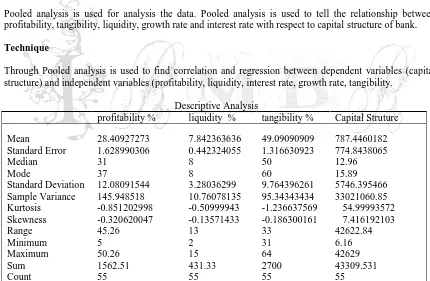
Pooled analysis is used for analysis the data. Pooled analysis is used to tell the relationship between profitability, tangibility, liquidity, growth rate and interest rate with respect to capital structure of bank.
Technique
Through Pooled analysis is used to find correlation and regression between dependent variables (capital structure) and independent variables (profitability, liquidity, interest rate, growth rate, tangibility.
Descriptive Analysis
profitability % liquidity % tangibility % Capital Struture
Mean 28.40927273 7.842363636 49.09090909 787.4460182
Standard Error 1.628990306 0.442324055 1.316630923 774.8438065
Median 31 8 50 12.96
Mode 37 8 60 15.89
Standard Deviation 12.08091544 3.28036299 9.764396261 5746.395466 Sample Variance 145.948518 10.76078135 95.34343434 33021060.85 Kurtosis -0.851202998 -0.50999943 -1.236637569 54.99993572 Skewness -0.320620047 -0.13571433 -0.186300161 7.416192103
Range 45.26 13 33 42622.84
Minimum 5 2 31 6.16
Maximum 50.26 15 64 42629
Sum 1562.51 431.33 2700 43309.531
Count 55 55 55 55
ISSN: 2306-9007 Akhtar, Bano, Bano, Zia, & Jameel (2016) 529
I
www.irmbrjournal.com June 2016I
nternationalR
eview ofM
anagement andB
usinessR
esearchVol. 5 Issue.2
R
M
B
R
Correlation
profitability
% liquidity % tangibility %
interest rate %
growth rate %
Capital Struture
profitability % 1
liquidity % -0.1698225 1
tangibility % -0.03277553 -0.0479457 1
interest rate % 0.066711923 -0.20821838
-0.064003328 1
growth rate % -0.08792887 0.170997749 0.087158033 0.128021148 1 CAPITAL
STRUTURE -0.09614601 0.132186717 0.113652363
-0.019218869 0.16753809 1
Profitability has strong relation 1 with profitability. Table shows liquidity value is-0.1698225%.Liquidity has inverse relation with profitability. Tangibility value is -0.03277553%.tangibility has inverse relation with profitability. When the value of tangibility decrease profitability increase. Interest rate has positive relation with profitability. Interest rate is .06675% that shows when interest rate increase profit increase. Growth rate value is –0.0879% that shows growth rate has inverse relation with profitability. Liquidity has strong relation 1 with liquidity. Table shows tangibility value is -0.0479457%. Interest rate has negative relation with liquidity. Growth rate has positive effect with liquidity. Capital structure has positive relation with liquidity.
Tangibility has 1 relationship with tangibility. There are positive relationship between tangibility and interest rate. The value of growth rate is positively tangibility with 0.087158033.capital structure has positively with tangibility with 0.113652363%. The % of growth rate and capital structure has positively with interest rate earned with respectively 0.128021148% and 0.019218869%. Capital structure has growth rate 0.16753809%.
Regression
Summary output
Regression Statistics
Multiple R 0.233055842
R Square 0.683150254
Adjusted R Square 0.631834414 Standard Erro
r 5866.344929
Observations 55
The value of r square is 68%. That shows that dependence of dependent variable capital structure has strong relation with independent variable independent variable profitability, liquidity, and tangibility, interest rate and growth rate. Adjusted R show the dispersion of data. In the table value of adjusted R shows 63% in one side.
Anova
Df SS MS F Significance F
Regression 5 96851147.01 19370229.4 0.002628589 0.001
Residual 49 1686286139 34414002.83
ISSN: 2306-9007 Akhtar, Bano, Bano, Zia, & Jameel (2016) 530
I
www.irmbrjournal.com June 2016I
nternationalR
eview ofM
anagement andB
usinessR
esearchVol. 5 Issue.2
R
M
B
R
This table shows that significant level is 0.001.it shows strong relations between dependent variable and independent variables. So we accept the H1 and H0 is rejected. There is significant relationship between liquidity and capital structure .there is significant relationship between profitability and capital structure. There is significant relationship between tangibility and capital structure. There is significant relationship between interest rate and capital structure. There is significant relationship between economic growth rate and capital structure
Coefficients t Stat P-value
Intercept -6122.27072 -1.052216346 0.002
profitability % -30.0147193 -0.446143001 0.001
liquidity % 179.2043423 0.695093784 0.003
tangibility % 830.7309064 0.743083779 0.004
interest rate % -0.16914272 -0.030619993 0.001
growth rate % 80.01858694 0.94248162 0.002
The table shows that in intercept p< 0.002; profitability value of p< 0.001; liquidity value of p<0.003; tangibility value of p<0.004; interest rate value<.001 and growth rate value is p<0.002.
Conclustion
This study was conducted to determine the capital structure of Pakistani banks. It define how factors such as profitability, liquidity, tangibility, interest rate and growth rate related to capital structure of banking sector in Pakistan. This study is covering the five banks financial annual report from 2005 to 2015. This study defined examine that capital structure affect the performance of banking industries as sited by varies previous study.
This research study can be use as a database because it before this study cannot conduct these five banks and years 2005 -2015 in Pakistan. Pooled is used for analysis the data. By using pooled analysis to find regression, correlation. The result of regression shows that liquidity; tangibility; growth rate have negative effect on students performance. Interest rate has positive elation with profitability. Interest rate has negative relation with tangibility. Growth rate and capital structure have positive relation with tangibility. In regression the value of r square show 23.3 that shows there are strong relation between dependent variable and independent variable. Our result supports to previous research paper.
The finding of this study shows that capital structure effect on banking performance like profitability, liquidity, tangibility, interest rate and growth rate. This study supports the previous research study that conducted on similar sectors in Pakistan and other countries.
Limitation
ISSN: 2306-9007 Akhtar, Bano, Bano, Zia, & Jameel (2016) 531
I
www.irmbrjournal.com June 2016I
nternationalR
eview ofM
anagement andB
usinessR
esearchVol. 5 Issue.2
R
M
B
R
Recommendations
This research study includes only eleven years for data. For future study should be carried out next years (after 2015) or extension no years eleven to 20 years. This research study conduct in Pakistan, it is suggested apply same variables in an others countries. It is also suggest that in profitability, tangibility, liquidity, interest rate (earn), growth rate measures from others formulas and methods. It also suggested that studies should carries by other factors.
References
A. O. Olakunle, e. O. (2014). Assessing the impact of asset tangibility on capital structure: choice for listed firms in nigeria. Journal of applied economics and business.
A.s. Arul lawrence, a. V. (2012). School environment and academic achievement of standard ix students.
Journal of educational and instructional studies in the word , 2 (3).
Adeyemi, s. B. (2014). Ct of gender on secondary school students' achievement. European journal of educational studies , 6 (1).
Adeyemi, s. B. (2014). Effect of gender on secondary school students' achievement. European journal of educational studies , 6 (1).
Adeyemi, s. B. (2014). Effect of gender on secondary school students' achievement in map work. European journal of educational studies, 6(1).
Ahmadreza elahi, b. M. (2015). A study on the correlation between liquidity leverage and real earnings management. Int. J. Rev. Life. Sci , 61-66.
Ajiwoju, a. J. (2015). Effect of gender and school location on secondary school. International journal of research in humanities, arts and literature (impact: ijrhal), 3 (6), 17-24.
Akbostanc, e. A. (2012, august). An empirical analysis of the bank lending channel in turkey. Erc working papers in economics .
Akpan, d. N. (2015). Effect of study habit on academic achievement of agricultural science students in senior secondary schools in emohua local government area of rivers state, nigeria. International journal of education and evaluation, vol. 1 no.3,.
Alfredo mart´in-oliver, a. S.-f. (2013). Banks’ equity capital frictions, capital ratios, and interest rates: evidence from spanish banks. International journal of central banking, vol. 9 no. 1, 183-225.
Al-mutairi, a., & naser, k. (2015). Determinants of capital structure of banking sector in gcc:an empirical investigation. Asian economic and financial review, 959-972.
Amedu, o. I. (2015). The effect of gender on the achievement of students in biology using the jigsaw method. Journal of education and practice, vol.6, no.17.
Anjali nag1, h. V. (2009, october 7). Gender differences, work stressors and musculoskeletal disorders in weaving industries. Original journal, 339–348.
Anwar, d. E. (2013). A correlational study of academic achievement. Excellence international journal of education and research, 1 (2).
Astin, a. W. (1984, july). Student involvement: a developmental theory for higher education. Journal of
college student development, 518-530.
Atkin, j. (1921). Duhaime.org iearn law. Retrieved from
http://www.duhaime.org/legaldictionary/b/bank.aspx. Banking company ordinace 1962. (n.d.).
Bassey, n. E. (2013). Analysis of the determinants of capital structure:evidence from unlisted agro-based firms in nigeria 2005-2010. Journal of agricultural science, 1 (4), 36-47.
Busari, a. (2014). Academic stress among undergraduate students: measuring the effects of stress inoculation techniques. Mediterranean journal of social sciences, vol 5 no 27.
By pilar marin, b. B. (2008). The school environment and adolescent well-being: beyond academics. Cheng, h. (2014). Determinants of capital structure in asian firms: new evidence on the role of firm level
ISSN: 2306-9007 Akhtar, Bano, Bano, Zia, & Jameel (2016) 532
I
www.irmbrjournal.com June 2016I
nternationalR
eview ofM
anagement andB
usinessR
esearchVol. 5 Issue.2
R
M
B
R
Cretsinger, m. A. (2003, august). Academic competitiveness among. Publication manual of the american psychological association, sixth edition , 33.
Cuseo, j. (n.d.). Student success: definition, outcomes, principles and practices. Published by the national resource center for the first-year experience & students in transition, university of south carolina. Dania, p. O. (2014). Effect of gender on students academic achievement in secondary school social studies.
Journal of education and practice, vol.5, no.21,, 2222-1735.
Delli, m. (2014). The university time mangement skill in term of student acedemic life satisfaction and academic acheivement level. 9(20), 1090-1096.
Dr asif ali shah, d. A. (2012). A narrative description of banking sector in pakistan. Interdisciplinary
journal of contemporary research in business, 4, 638-656.
Dr. M. Khata jabor, d. K. (2011). The influence of age and gender on the students’ achievement in mathematics. International conference on social science and humanity, 6.
Dr. Nwankwo, o. F. (2014). Effect of capital structure of nigeria firms on economic growth. Mediterranean journal of social sciences mcser publishing, rome-italy , vol 5 no 1, 515-520.
Dr. Ranjana choudhury, d. K. (2012). Influence of attitude towards mathematics and study habit on. International journal of engineering research , 2 (6), 192-196.
Ebenuwa-okoh, e. (2010). Influence of age, financial status, and gender on academic. J psychology, , 1 (2), 99-103.
Fatoba joseph oba, a. A. (2014). Effects of gender on students’ attitude to physics in secondary schools in oyo state, nigeria. European scientific journal , vol.10, no.7, 1857- 7431.
Feld, l. D. (2011, april). Student stress in high-pressure college preparatory.
Goodwin, m. E. (2008). Gender role conflict, depression, and personality's effect on help seeking behaviors, attitudes, and academic performance.
Gowthami, p. P. (n.d.). Sources of academic stress – A study on management students. 12-43.
Goyal, a. (2013). Impact of capital structure on performance of listed public sector banks in india.
International journal of business and management invention, volume 2 issue 10ǁ, .35-43.
Hannah, r. (2013). The effect of classroom environment on student. Vol. 63, no. 8.
Harc, m. (2015). The relationship between tangible assets and capital structure of small and medium-sized companies in croatia. Croatian academy of sciences and arts.
Hegseth, m. N. (2011, august). Cellular responses induced by environmental stress factors in arctic seabird chicks.
Hipp, j. (2012, 4). The achievement gap from the student’s perspective. Master of social work clinical research papers .
Hoffmacan, t. (1994). Time management: test of a process model. Journal of applied psychology, vol. 79. No. 3,, 381-391.
Hossein keshavarz, p. S. (2016). The relationship between different factors with capital structure of companies listed in tehran stock exchange. A journal of economics and management, 5 (2), 52 to 69. Iavorskyi, m. (2013). The impact of capital structure on firm performance: evidence from ukraine. Jackson, o. A. (2008, march 3). The impact of the 9/11 terrorist attacks on the us economy. Jennifer skoogh, p. S. (2015, spring). The impact of tangible assets on capital structure.
Jennifer skoogh, p. S. (2015). The impact of tangible assets on capital structure an analysis of swedish listed companies.
Jens henrik haahr, t. K. (2005, november). Explaining student performance.
K. Vasanta rao, s. V. (2015). Effect of study habits, mental health. Indian journal of reseach, vol: 4 (issue: 6).
Kajananthan, r. A. (2013). Liquidity and capital structure: special reference to sri lanka telecom plc.
Advances in management & applied economics, vol. 3,, 89-99.
Kamarudin rafidah, a. A. (2009). The impact of perceived stress and stress factors on academic performance of pre-diploma. International journal of siencetic reseach in education, vol. 2(1),, 13-26. Karanja, m. G. (2013). The effect of capital structure on financial performance of small and medium
ISSN: 2306-9007 Akhtar, Bano, Bano, Zia, & Jameel (2016) 533
I
www.irmbrjournal.com June 2016I
nternationalR
eview ofM
anagement andB
usinessR
esearchVol. 5 Issue.2
R
M
B
R
Kaya, e. Ö. (2015). The effects of firm-specific factors on the profitability of non-life insurance companies in turkey. International journal of financial studies, 3 (2227 - 7072), 510 to 529.
Kim shahabudin, a. T. (2010, march). Managing time at university: a learning development perspective on issues and effective interventions.
Kokobe seyoum alemu, b. D. (2013). Determinants of financial performance of commercial banks in ethiopia. International journal of engineering technology and scientific innovation, 1 (3), 182 - 199. Lawal babatunde akeem1, e. T. (2014). Effects of capital structure on firm’s performance:empirical study
of manufacturing companies in nigeria. Journal of finance and investment analysis, 3, 39-57.
Mahmud, m. (2003, winter). The relationship between economic growth and. Capital structure of listed companies: evidence , 727–750.
Mahmud, m. (3003). The relationship between economic growth and capital structure of listed companies: evidence of japan, malaysia, and pakistan. The pakistan development review, 727–750.
Manging enviroment stress in work place. (n.d.). Family services employee assistance programs .
Maryam khodaveisi, g. S. (2015). The relation between time management and job stress in physical education lecturers and faculty members of hamedan universities. Sport science, 60‐63.
Maureen were, j. W. (2014, 4). What factors drive interest rate spread of commercial banks? Empirica levidencefrom kenya. Review of development finance, 73-88.
Mercanlioglu, ç. (2010). The relationship of time management to academic performance of master level students. International journal of business and management studies, 2 (1).
Mirie mwangi, n. K. (2014). The effect of capital structure on the financial performance of small and medium enterprises in thika sub-county, kenya. International journal of humanities and social science, 1.
Mohamed, i. I. (2014). Academic stress and anxiety among faculty of nursing students. Journal of american science, 10(3).
Mubeen mujahid, m. A. (2014). Impact of capital structure on banking performance. Research journal of finance and accounting, vol.5, no.19,.
Muhammad raghib zafar, f. Z. (2016). Impact of capital structure on banking profitability. International journal of scientific and research publications, Volume 6, issue 3,, 186-193.
Muhammad raghib zafar, f. Z. (2016). Impact of capital structure on banking profitability. International journal of scientific and research publications, 6 (3).
Murillo campello, e. G. (2010, february 28). Asset tangibility and capital structure.
Musise tessema, k. R. (2012). Effect of gender on college students’ satisfaction and achievement: the case of a. International journal of business and social science, 3.
Mussarat jabeen khan, s. A. (winter 2013). Effect of perceived academic stress on students’ performance.
Fwu journal of social sciences, vol. 7,, 146-151.
Myroshnichenko, o. (2004). Determinant of capital struture of ukrainian corporation.
Nataša šarlija, m. H. (2012). The impact of liquidity on the capital structure: A case study of croatian firms. Vol. 3 no.1.
Nikitha s, t. T. (2015). Effectiveness of academic stress management programme on academic stress and academic performance among higher secondary students in selected schools of udupi district. Nitte university journal of health science, 6 (5).
Niresh, b. J. (2012). Capital structure and profitability in srilankan banks. Global journal of management
and business research, volume 12 version 1.0 (13).
Niresh, j. A. (2012). Capital structure and profitability in srilankan banks. Global journal of management and business research, 12 (13).
Norton, e. (1991). Capital structure and small growth firms. The journal of entrepreneurial finance, 1 (2). Odeh. R. C, 1. O. (2015). Influence of school environment on academic achievement of students.
International journal of recent scientific research, vol. 6,, 4914-4922.
Olivier de bandt, b. C. (2014, august). Does the capital structure affect banks’ profitability? Pre and post-financial crisis evidence from significant banks in france. Autorité de contrôle prudentiel et de résolution, , 1-30.
ISSN: 2306-9007 Akhtar, Bano, Bano, Zia, & Jameel (2016) 534
I
www.irmbrjournal.com June 2016I
nternationalR
eview ofM
anagement andB
usinessR
esearchVol. 5 Issue.2
R
M
B
R
Ömer iskenderoğlu, y. B. (2011). Firm size and capital structure decisions: evidence from turkish lodging companies. International journal of economics and financial issues, 1, 1-11.
Onuekwe, e. M. (2015). Influence of study habits on the academic achievement of students. International journal of innovative education research, 3(4), 15-22.
Owusu-acheaw, m. (2014, 5 6). Reading habits among students and its effect on academic performance: a study of students. Library philosophy and practice (e-journal), 1130.
Pehlivan, a. (2013). The effect of the time management skills of students taking a financial accounting course on their course grades and grade point averages. International journal of business and social science, 4 (5).
Phdc. Sheeba farhan, a. P. (2015). Impact of stress, self-esteem and gender factor. International journal on new trends in education and their implications, 6 (2).
Pollard, d. S. Gender, achievement, and african-american students’ perceptions of their school experience. 28(4), 341-356.
Qadar bakhsh baloch, a. I. (2015). Impact of firm size, asset tangibility and retained earnings on financial leverage: evidence from auto sector, pakistan. Abasyn journal of social sciences. , vol: 8 (1), 143-155. Rafiu oyesola salawu, a. A. (2008). The determinants of capital structure of large non-financial listed firms
in nigeria. The international journal of business and finance research, 2.
Rajha, d. S., & alslehat, d. Z. (2014). The effect of capital structure on the performance of islamic banks.
Interdisciplinary journal of contemporary research in business, 5.
Ramakrishnan, s. (2012, may). Sectoral analysis on capital structure determinants among the malaysian listed firms.
Rekha srivastava, s. J. (2011). The effect of school and area on academic self-. Delhi psychiatry journal, vol. 14 no.2, 331-336.
Rodriguez, h. (2005, novermber). First accounting course:a comparetivr study between public and private university puerto rico.
Rogers, n. S. (n.d.). Stress, anxiety and depression in law students: how student behaviours affectstudent wellbeing . 565-587.
Ronald b. Lumpkin, i. (2013). School facility condition and academic outcomes. International jornal of facility mangement, vol.4, no.3.
S., b. S. (2011, january). Performance analysis of islamic banking:some evidence from saudi arabian banking sector.
Saab, m. (2012). Maney bankin and finance.
Sakineh taghizadeh koohanjani, s. K. (2015). Efficacy time management skills training on academic performance of high school female students in shiraz. Indian journal of fundamental and applied life sciences, 5 (3), 1048-1054.
Salem alrahimy, t. A. (2014). The impact of time management on academic achievement of students at irbid private university (field study). Damascus univ. Journal.
Sarath a. Nonis, g. H. (2011). Revisiting the relationship between time management and job performance.
World journal of management, 3 (2), 153-171.
Schneider, m. (2002, november). Do school facilities academic outcome.
Sibilkov, v. (2007, november 14). Asset liquidity and capital structure. 229-4369.
Sidra amjad, b. S. (2013, 2 28). Determinants of capital structure ;what can be the determinants of capital structure of banking sector of pakistan? International conference .
Simon-oke, o. O. (2013). Real interest rate and savings mobilization in nigeria. International journal of development and economic sustainability (vol. 1, no 2.), 28-40.
Steve higgins, e. H. (2005, febraury). The impact of school. Design councial . Stress management. (n.d.). Academic skills center .
Teacher gender and student academic achievement. (2015, january). Rel midwest educational laboraty at america institution research .
ISSN: 2306-9007 Akhtar, Bano, Bano, Zia, & Jameel (2016) 535
I
www.irmbrjournal.com June 2016I
nternationalR
eview ofM
anagement andB
usinessR
esearchVol. 5 Issue.2
R
M
B
R
Upadhyaya, r. (2011). Analyzing the sources and impact of segmentation in the banking sector: a case study of kenya.
Velnampy.t, v. A. (2014). Capital structure, liquidity position and their impact onprofitability: a study of listed telecommunication firms incolombo stock exchange (cse), sri lanka. Research journal of finance and accounting , vol.5, no.9,, issn 2222-1697 (paper) issn 2222-2847 (online).
Wachilonga, l. W. (2013,). Firm size and capital structure decisions: evidence from hotel and lodging smes in eldoret municipality, kenya. International journal of academic research in business and social sciences, 3.
Wanjirumaina, m. (2015). Determinants of interest rate spread among commercial banks of kenya.
Wanyoike charles githira, d. T. (2015). Capital structure determinants among companies quoted in securities exchange in east africa. International journal of education and research, 3.
Waqas bin khidmat, m. U. (2014). Impact of liquidity & solvency on profitability chemical sector of pakistan. 6 (3).
Wilding, b. A. (2004). The relation of depression and anxiety to. British journal of psychology, 95, 509-521.
Wilson toshiro nakamura, d. F. (2010). Capital structure in brazilian small and medium enterprises: a panel study. 1 to 18.