Chandrakant Naikodi, International Journal of Computer Science and Mobile Applications, Vol.5 Issue. 10, October- 2017, pg. 10-16 ISSN: 2321-8363 Impact Factor: 4.123
VITALITY EFFICIENT LOAD BALANCING IN
CHARACTER DIVERSE NODES OF A WSN
Chandrakant Naikodi
Visiting Professor, CSE, CiTech, Bangalore, Karnataka, India Email:[email protected]
Abstract: Vitality proficient load adjusting in a Wireless Sensor Network needs to appropriate workloads over different registering nodes in view of its kind of usefulness, for example, temperature detecting, light detecting and so forth remembering of vitality cost. Subsequently, vitality effective load adjusting can be accomplished and it advances asset utilization, expand throughput, boost network lifetime, limit reaction time and keep away from overload by conveying work among comparable kind of sensor nodes with vitality proficient courses. This will make utilization of various sensor nodes with load adjusting instead of a solitary sensor hub which may build unwavering quality through repetition. Physical group speaks to an arrangement of nodes which are physically neighbors to a hub, where as logical group speaks to an arrangement of nodes which are grouped in view of its usefulness. Vitality productive courses can be assessed in virtual groupings (PG-Physical Group, LG-Logical Group), course will be picked in light of the cost of vitality inspite of the course belongingness.
Keywords: WSN, Energy Efficient, Load Balance, Heterogeneous, Logical Group, Physical Group
1. Introduction
A Wireless Sensor Network (WSN) is set of sensor nodes which conveys by means of wireless connections and these can’t have an interesting topology. These nodes will helpfully go their information through the WSN to a principle area. Load adjusting in WSN includes dissemination of all computational and communicational exercises more than at least two nodes in the network. This load adjusting can enable us to diminish the execution to time of the exercises and to ensure that every one of the assets exhibit in the framework are used ideally.
In a perfect world load adjusting algorithm chooses the hub for process execution in light of the accessible data about every one of the assets exhibit in the network. Load adjusting algorithms can be Static, Dynamic and Adaptive. Static algorithms takes choices utilizing from the earlier learning of the network, subsequently the overhead involved in static algorithms is just about zero. On account of dynamic algorithms, choices depend on framework state data (the loads at nodes), consequently they acquire overhead in the accumulation, stockpiling and investigation of network state. Adaptive Algorithms is somewhat unique algorithms which adapt their exercises by powerfully changing the parameters of the algorithm to suit the changing network state. WSNs require suitable algorithm that make wise utilization of the limited vitality assets of the heterogeneous sensor nodes, henceforth we require legitimize the calculation cost before executing load on it !
2. Literature Survey
Chandrakant Naikodi, International Journal of Computer Science and Mobile Applications, Vol.5 Issue. 10, October- 2017, pg. 10-16 ISSN: 2321-8363 Impact Factor: 4.123
Paper [7] proposed a load-adjusted grouping algorithm [13] for Wireless Sensor Networks on the premise of their separation and thickness appropriation. In the group, nodes can join the bunch head by considering the bunch size and correspondence radius.
Further, load adjusting with vitality efficiency[9][1] includes two sections [11]. Initial segment being deciding the quantity of bunch heads in light of the nodes’ appropriation and correspondence radiuses and second being to choose the group heads as indicated by the remaining vitality, versatility, number of single-hub bunch and separations to group heads from their part nodes and to the server from group heads.
Paper [6] proposed an engineering where new applications can be quickly created through adaptable administration structure. This engineering serves to blockage control and load-adjusting which adaptively adjust the work load over multipaths. In this algorithm, an assessment metric and way empty proportion is utilized to assess and locate an arrangement of connection disjoint ways from every single accessible way. Over this algorithm, a limit sharing algorithm is connected to part the packets into various portions that will be conveyed by means of multipaths to the goal relying upon the way empty proportion.
In paper [10], creator have researched the load adjusting impact of stochastic steering in undirected and coordinated WSNs with arbitrarily situated nodes. Presumed that stochastic directing does not really accomplish vitality effective load adjusting in undirected networks. They have dissected the execution of the disseminated and decentralized stochastic steering algorithm, to be specific expander steering technique, expander steering strategy performed fundamentally better regarding packet transmission delay while accomplishing vitality proficient load adjusting in coordinated networks.
In Paper [12], proposes Secure Load Balancing (SLB) convention that utilizes pseudo-sinks that are a little number of exceptional, carefully designed sensor nodes with additional computational, stockpiling, and vitality assets. This algorithm mitigates precision issue by safely transferring information from congested bunches to close-by free groups or pseudo-sinks.
In Paper [5], creators have contemplated the potential vitality protection parameters and accomplishing greatest network lifetime
by adjusting the activity all through in the WSN. They have demonstrated that conveying the movement produced by every sensor hub through numerous ways instead of utilizing a solitary way permits huge vitality reserve funds, henceforth they proposed another systematic model for load-adjusted frameworks.
Paper [3] discusses vitality productive steering in WSN which isn’t clear inspite of having Directed Diffusion information driven steering convention. Information is sent through all sink nodes forcing the overhead of sending pointless information, henceforth creator has proposed a Multi-Sink Directed Diffusion (MSDD) to address this issue by sending information toward the closest sink. This convention executes a load-adjusting by choosing the following closest sink after the vitality level of nodes in the first way falls beneath a specific limit esteem.
3. Proposed Techniques and Implementation
Chandrakant Naikodi, International Journal of Computer Science and Mobile Applications, Vol.5 Issue. 10, October- 2017, pg. 10-16 ISSN: 2321-8363 Impact Factor: 4.123
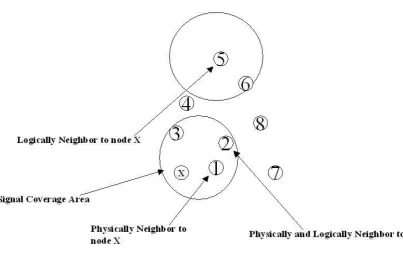
one of a kind and logically grouped in view of the indistinguishable usefulness of sensor nodes, yet a hub can have more than one group’s Ids to show that it can take part in more than one element extraction e.g., seismic tremor location and avalanche perception. At whatever point a sensor hub sends a packet with LG Id to its neighbors, if any neighbors are logically and physically accessible inside the scope region then such nodes can get this packet or else any quick neighbor can pass this packet to its prompt neighbor et cetera, until the point when it ranges to proper LG nodes. Here Group Id is only Logical Group ID which is speaking to the arrangement of nodes of comparative practically, subsequently correspondence between various groups is simple in view of the group Ids. In Fig. 1, hub 1 and 5 are in PG(Physical Group) and LG to the hub X separately, however hub 2 is incorporated into both groups(LG and PG). In each LG, each hub can get the packets which is said for whole group, yet nodes of PG are neighbors subsequently intrigued hub can get these packets.
Figure 1. WSN Group Formation
Chandrakant Naikodi, International Journal of Computer Science and Mobile Applications, Vol.5 Issue. 10, October- 2017, pg. 10-16 ISSN: 2321-8363 Impact Factor: 4.123
4. Conclusion
Vitality effective load adjusting is extremely basic assignment in Wireless Sensor Network which streamlines asset utilization, amplify throughput, boost network lifetime, limit reaction time and evade overload by circulating work among comparative kind of sensor nodes with vitality proficient courses/ways. This paper proposes a vitality effective load adjusting among sensor nodes in view of the logical or potentially physical grouping of Wireless Sensor Nodes.
The result is empowering consequently it is worth of utilizing proposed algorithm for vitality effective load adjusting in heterogeneous WSN.