Subhamay Ghosh
1, 4, A, D, E, F, Balázs Ittzés
1, 5, B, C, Lajos Bogár
1, B, D, Tamás Kõszegi
3, B, C,
Péter Örs Horváth
2, B, D, Lászlo Cseke
2, C, D, András Papp
2, C, D, Sándor Márton
1, 4, A, D, E, FA Comparison of Pre-Operative Nutritional Status
with Post-Operative Morbidity and Mortality
in Obese Esophageal Surgery Patients*
1 Department of Anaesthesiology and Intensive Therapy, University of Pécs, Hungary 2 Department of Surgery, University of Pécs, Hungary
3 Department of Laboratory Medicine, University of Pécs, Hungary
4 Department of Anaesthesia and Perioperative Medicine, St. Boniface Hospital, University of Manitoba, Winnipeg, Canada.
5 Department of Anaesthesia, North Devon District Hospital, Barnstaple, UK
A – research concept and design; B – collection and/or assembly of data; C – data analysis and interpretation;
D – writing the article; E – critical revision of the article; F – final approval of article; G – other
Abstract
Objectives. The nutrition state of obese patients scheduled to undergo esophageal surgery was evaluated using two nutritional score systems: the mini nutritional assessment (MNA) and the prognostic and nutritional index (PINI). A further comparison of various proteins, lymphocytes and cholesterol was performed using biochemical tests. These factors were compared with post-operative morbidity and mortality in a prospective, descriptive clini-cal study.
Material and Methods. The study included 34 obese patients undergoing esophagus resection due to cancer, who were examined over four years using both scoring systems to analyze whether nutritional status influences the out-come of surgery. The patients were divided into four groups based on the severity of the outout-come and their MNA and PINI scores were analyzed.
Results. There were no significant differences between the nutritional status of survivors and deceased patients. The European Society for Parenteral and Enteral Nutrition (ESPEN) nutritional risk score was 1.35 ± 0.47 for Group I and 1.47 ± 0.58 for Group II (p = 0.62). With respect to severe morbidity there was no significant ence between Group III and Group IV: 2.01 ± 2.28 vs. 1.02 ± 3.67 (p = 0.54). Although there were minor differ-ences, there were no major variations seen in the MNA or PINI scores comparing the four examined groups. No significant changes were observed in the biochemical parameters.
Conclusions. The study found no differences between post-operative morbidity or mortality and the pre-operative nutrition status of obese patients who underwent surgery due to esophageal cancer (Adv Clin Exp Med 2014, 23, 5, 763–768).
Key words: morbidity, mortality, nutrition, obesity, esophagectomy.
Adv Clin Exp Med 2014, 23, 5, 763–768 ISSN 1899–5276
ORIGINAL PAPERS
© Copyright by Wroclaw Medical University
Evidence from animal and clinical experi-ments shows that malnutrition increases post-op-erative morbidity and mortality following elec-tive surgery [1, 2]. However, many clinical studies have failed to show that pre-operative nutrition improves clinical outcome. Nutritional support has the potential for both risks and benefits, de-pending upon the type of therapy and the patient
selection [3, 4]. If the therapy is used on patients who have a low risk of malnutrition-related com-plications, the results may reflect complications re-sulting from the therapy itself. If patients at risk for malnutrition-related complications receive nutri-tional support, then the benefits from the therapy may outweigh the risks and the post-operative out-come may be improved. Although malnutrition
contributes to morbidity, studies of pre-operative nutrition often include well-nourished patients unlikely to benefit from therapy [5]. The situation is further complicated in cases of obesity. A recent meta-analysis on patients undergoing esophagec-tomy for cancer showed that on the one hand con-ditions like diabetes have a significant impact on the risk of anastomotic leakage and atrial fibrilla-tion in obese patients, and on the other hand obese patients had significantly better long term survival than non-obese patients [6].
Extensive surgical intervention performed on cancer patients with malnutrition is accompanied by chronic fasting that can result in increased mor-bidity and mortality during the post-operative pe-riod. Verification of a direct correlation is compli-cated, but in patients with malnutrition, impaired wound healing and decreased immune respons-es can lead to damaged cardiac or skeletal muscle function and an increase in post-operative compli-cations, which may be accompanied by increased mortality, prolonged hospitalization and elevated healthcare costs [7, 8].
Malnutrition affects all the organs except for the brain. The cells of the renal tubule suffer at-rophy; the composition of the intestinal bacteri-al flora shifts towards a dominance of pathogenic bacteria; and intestinal cells suffer atrophy due to decreased protein intake that favors bacterial trans-location. The causes for malnutrition are multifac-torial and range from physiological to iatrogenic. As a rapid response to the hypermetabolism as-sociated with critical illness, adequate nutritional support must be delivered promptly [9, 10]. Ac-cording to a study by Larrea et al., the incidence of malnutrition is 79% higher in patients with esoph-ageal cancer than in patients with other types of gastrointestinal tumors [11].
The evaluation of pre-operative nutrition sta-tus includes the patient’s nutritional history, an-thropometric examinations and laboratory tests. Tissue injury influences plasma protein concentra-tions, causing a rapid decrease in albumin, trans-ferrin, pre-albumin and retinol binding protein levels, while the concentration of acute phase pro-teins increases. The prognostic inflammatory and nutritional index (PINI) was developed by Ingen-bleek and Carpentier to evaluate the nutritional and inflammatory status of critically ill patients. The PINI scoring system is based on albumin, gly-coprotein acid and C-reactive protein levels [12]. It has been found to be a sensitive parameter for patients with physical trauma, burn injuries, infec-tion or cardiac diseases [13]. Since most tradiinfec-tional nutritional assessment methods for advanced can-cer patients are difficult to complete due to high costs and inaccuracy, Nelson et al. evaluated the
PINI in advanced disease. The results of the study showed significantly elevated PINI scores in pa-tients with advanced cancer, anorexia and weight loss. These scores were higher in critically ill inten-sive care patients [14].
The aim of the present study was to evaluate the nutritional status of morbidly obese patients using nutritional histories based on questionnaires recommended by the European Society for Paren-teral and EnParen-teral Nutrition (ESPEN), the Mini Nu-tritional Assessment (MNA) scoring system, reg-ular biochemical parameters and the PINI score. These factors were compared with post-operative morbidity and mortality in a prospective, descrip-tive clinical study.
Material and Methods
The study included 34 obese patients (BMI ≥ 30) scheduled for esophagus resection due to cancer over a period of 4 years. Following approval from the regional ethics committee, all the patients were informed about the study in detail and informed consent was obtained.
All the patients underwent transhiatal esoph-agectomy, during which none of the groups were exposed to transfusion. A jejunostomy tube was put in place during the operation and used for re-hydration, administering isotonic sodium chloride 0.9% solution at the rate of 10 mL/h. Following that, on the first post-operative day, rehydra-tion was given at 15 kcal/kg of body weight; on the second post-operative day at 20 kcal/kg; on the third day at 25 kcal/kg; and starting from the fourth post-operative day patients received enter-al nutrition (Fresubin, Fresenius) at 30 kcenter-al/kg un-til oral nutrition was resumed. The patients were not given any additional parenteral nutrition as supplements.
Each patient’s nutritional history was evalu-ated in accordance with ESPEN and MNA guide-lines prior to surgery. The ESPEN evaluation of nutritional history consists of 2 parts: an initial evaluation and a final summary. If the score is 3 or more, that means surgery puts the patient at high risk [15].
After the ESPEN nutritional history, the MNA was performed [16]. The MNA was developed pri-marily for the evaluation of surgical risks in senior patients, but (unlike the ESPEN score) the nutri-tional history is complemented by anthropomet-ric examinations.
n = 27), or between those who recovered without complications (Group III, n = 24) and those with severe complications like pneumonia, artificial res-piration, inotropic therapy, anti-arrhythmia treat-ment (Group IV, n = 10). Along with pre-opera-tive body mass index, blood samples were taken 24 h prior to surgery to determine the biochemical parameters of the patients’ nutritional status, such as total protein, albumin, retinol binding protein, pre-albumin, transferrin, transferrin-saturation lymphocyte count and cholesterol levels.
Statistical Analysis
The data are shown as mean values and stan-dard deviations. The statistical analysis was carried out using the Statistical Program for Social Scienc-es for Windows (SPSS), using Mann-Whitney and Kolmogorov-Smirnov tests and an analysis of vari-ance (ANOVA). Statistical significvari-ance was set at p < 0.05.
Results
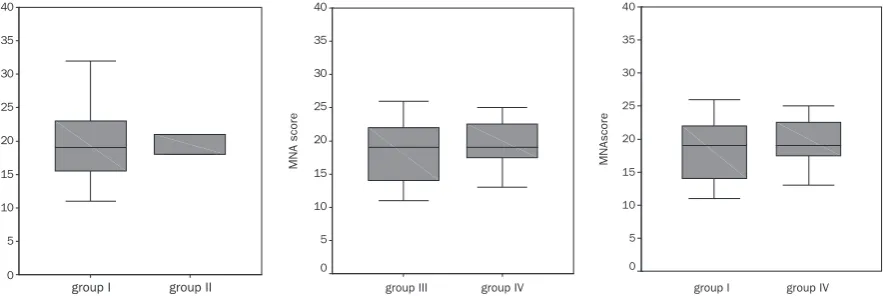
No differences in nutritional status was found between the survivors and the deceased patients. The ESPEN score was 1.35 ± 0.47 for Group I and 1.47 ± 0.58 for Group II (p = 0.62). With respect to severe morbidity, there was no difference between Groups III and IV: 2.01 ± 2.28 vs. 1.02 ± 3.67, p = 0.54. There was no variation seen in the pre-op-erative MNA score when comparing the deceased patients (Group I) and those recovering with se-vere complications (Group IV, Fig. 1c). The com-parison of the MNA scores of Groups I and II is shown in Fig. 1a, and between Groups III and IV in Fig. 1b.
Nutritional Status Parameters
in Relation to Morbidity and
Mortality
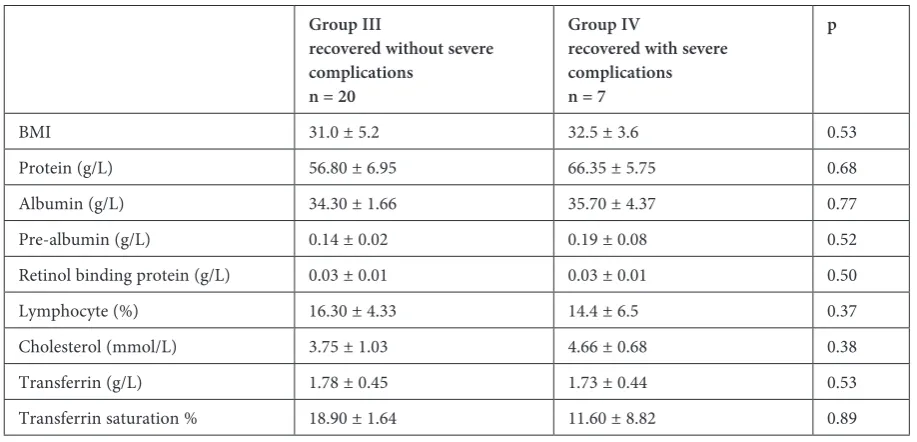
Table 1 summarizes the BMI and biochemical parameters for Group I (the deceased patients) and Group II (the survivors); Table 2 presents the data for Group III (those recovering without complica-tions) and Group IV (survivors with severe compli-cations). Table 3 shows a comparison of the demo-graphic data of the patients studied and the cancer stages of the survivors and the deceased patients; no statistically significant differences were found be-tween the groups in any of these parameters. The cause of death in Group I patients was septic shock leading to multiple organ dysfunction syndrome. Post-operative pulmonary complications were di-agnosed using radiological, clinical and microbio-logical features. Respiratory failure was diagnosed by arterial blood gas analysis with or without ven-tilatory support. Besides respiratory complications, other complications included cardiac, renal and he-patic failure as well as stroke. Surgical complications included anastomotic leakage, chylothorax, hemor-rhage and gastric outlet obstruction. The 30-day mortality was defined as death within 30 days of the esophageal resection, whereas any death in the hos-pital after surgery was recorded as a hoshos-pital death.
PINI Scores in Relation
to Mortality and Morbidity
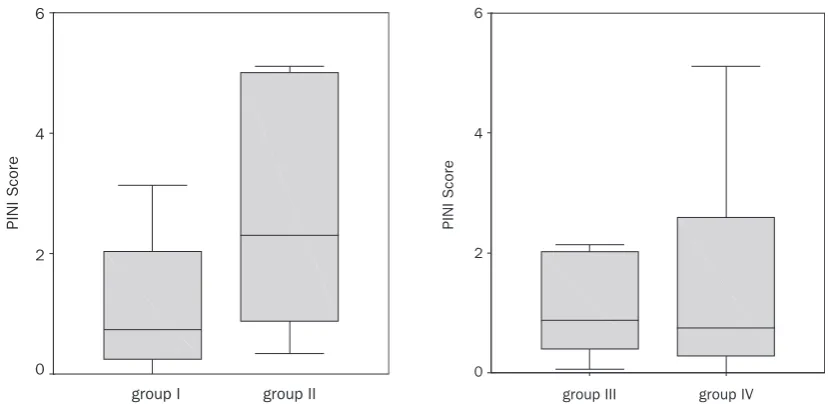
No statistically significant differences were observed between pre-operatively evaluated PINI scores and post-operative mortality or morbidity
Fig. 1. Differences in the patients’ morbidity and mortality in relation to their nutritional history evaluated using the MNA scoring system. A – shows the comparison between Group I (deceased patients) and Group II (survivors). B– is a comparison between patients recovering with no complications (Group III) and those with severe complica-tions (Group IV). C – shows a comparison of Group I and Group IV. The data are represented in “box-plot” format, with minimum-maximum, median and inter-quartile range values are shown. Differences between the groups were verified by ANOVA analysis
group I group II
MNA scor
e
40
35
30
25
20
15
10
5
0
group III group IV
MNA scor
e
40
35
30
25
20
15
10
5
0
group I group IV
MNAscor
e
40
35
30
25
20
15
10
5
Table 1. Comparison of biochemical parameters of nutritional status and post-operative mortality in Group II (survivors) and Group I (deceased patients)
Group II (survivors) n = 27
Group I (deceased) n = 7
p
BMI 33.00 ± 4.37 30.00 ± 3.29 0.53
Protein (g/L) 60.5 ± 8.10 63.60 ± 6.15 0.90
Albumin (g/L) 34.60 ± 4.16 32.40 ± 3.59 0.42
Pre-albumin (g/L) 0.20 ± 0.07 0.19 ± 0.08 0.90
Retinol binding protein (g/L) 0.03 ± 0.01 0.02 ± 0.01 0.44
Lymphocyte (%) 15.10 ± 8.29 17.30 ± 5.37 0.42
Cholesterol (mmol/L) 4.30 ± 1.02 3.77 ± 1.07 0.34
Transferrin (g/L) 1.89 ± 0.39 1.9 ± 0.37 0.90
Transferrin saturation % 22.4 ± 9.32 26.7 ± 11.14 0.34
The data are shown as mean values and standard deviations. The Mann-Whitney U test was used for the statistical analysis.
Table 2. Comparison of biochemical parameters of nutritional status and post-operative morbidity in patients who recov-ered without severe complications (Group III) and those who recovrecov-ered with severe complications (Group IV)
Group III
recovered without severe complications
n = 20
Group IV
recovered with severe complications n = 7
p
BMI 31.0 ± 5.2 32.5 ± 3.6 0.53
Protein (g/L) 56.80 ± 6.95 66.35 ± 5.75 0.68
Albumin (g/L) 34.30 ± 1.66 35.70 ± 4.37 0.77
Pre-albumin (g/L) 0.14 ± 0.02 0.19 ± 0.08 0.52
Retinol binding protein (g/L) 0.03 ± 0.01 0.03 ± 0.01 0.50
Lymphocyte (%) 16.30 ± 4.33 14.4 ± 6.5 0.37
Cholesterol (mmol/L) 3.75 ± 1.03 4.66 ± 0.68 0.38
Transferrin (g/L) 1.78 ± 0.45 1.73 ± 0.44 0.53
Transferrin saturation % 18.90 ± 1.64 11.60 ± 8.82 0.89
The data are shown as mean values and standard deviations. The Mann-Whitney U test was used for the statistical analysis.
Table 3. Comparison of demographic data and cancer staging of Group II (survivors) and Group I (deceased patients)
Group II (survivors) n = 27
Group I (deceased) n = 7
SD
Age (years) 54.15 57.33 5.39
Gender (M/F) 60.5 ± 8.10 63.60 ± 6.15
Height (cm) 165 167 4.22
Weight (kg) 86 69 3.33
Stage of the cancer T3 T3 0.44
(Fig. 2). The comparison of Groups I and II is pre-sented in Fig. 2a; the comparison between Groups III and IV is shown in Fig. 2b.
Discussion
According to the literature, it is of vital impor-tance to evaluate patients’ pre-operative nutritional status and identify those suffering from severe mal-nutrition, because it influences the development of post-operative complications and concomitant ex-penditures. Clinical malnutrition has been shown to have serious implications for recovery from dis-ease, trauma and surgery. It is generally associat-ed with increasassociat-ed morbidity and mortality in both acute and chronic conditions. As a result of this, the duration of hospital treatment is significantly longer in malnourished patients and is associated with higher costs [17, 18].
The current study addressed the question of whether the evaluation of pre-operative nutrition-al status in patients with esophagnutrition-al cancer has any predictive value for post-operative morbidity and mortality. The evaluation of the patients’ nutri-tional status was performed using the ESPEN and MNA score systems. Neither of the two score sys-tems indicated any difference in the patients’ post-operative morbidity or mortality.
Total Protein and Albumin
A decrease in classical nutritional status param-eters increases the incidence of post-operative in-fectious complications [19]. Although albumin is
a good indicator of chronic malnutrition, it is not a sensitive indicator of either malnutrition or the efficiency of nutritive therapy due to its relatively long half-life. Also, the serum level of albumin can decrease during various inflammatory responses. In the present study, preoperative mean values of patients for total protein and albumin were with-in the normal range and malnutrition could not be confirmed on the basis of their values. A possible explanation is that the body decomposes skeletal muscle to maintain albumin and total protein lev-els. This could be supported by the patients’ insig-nificant drop in BMI during the preparations for surgery and their stay in the hospital, as all preop-erative samples were taken 24 h before the proce-dure, and were in parallel with normal albumin and total protein values. It probably would have been more appropriate to determine the patients’ 3-methyl-histidin levels, which are a sensitive indi-cator of protein loss, but unfortunately those data were not available.
Retinol Binding Protein
and Pre-Albumin
Several studies have shown that the two most sensitive biochemical parameters for predicting post-operative morbidity and mortality are pre-albumin and retinol binding protein [20]. How-ever, this was not confirmed in the current study. It is conceivable that the liquid intake of patients with esophagus cancer had decreased, and that the subsequent exsiccation led to a relative increase in the concentration of these negative acute-phase proteins.
Fig. 2. Differences between pre-operative PINI scores and post-operative morbidity or mortality. A – shows the parison between Group I (deceased patients) and Group II (survivors). B – between patients recovering with no com-plications (Group III) and those with severe comcom-plications (Group IV). The data are represented in “box-plot” format, with minimum-maximum, median and inter-quartile range values are shown. Differences between the groups were verified by ANOVA analysis
group I group II
PINI Scor
e
6
4
2
0
group III group IV
PINI Scor
e
6
4
2
In summary, using a prospective, descriptive clinical study and evaluating the pre-operative nu-tritional status of obese patients with esophagal cancer, no differences were found to correlate with post-operative morbidity or mortality. However, one of the major drawbacks of the current study was the small number of patients, which makes sta-tistical analysis very difficult. It is very rare to see
obese patients with esophageal cancer and as cur-rent evidence is seen only in the early stage of can-cer [21], this would suggest that more research is needed in this area. Considering the importance of nutrition in obese cancer patients undergoing sur-gery, the current results suggest that further inves-tigation in the form of a multicenter study would be appropriate.
Acknowledgements. The authors thank the nursing staff of the departments of Surgery and Anesthesiology and Intensive Care at the University of Pécs for their enormous contribution throughout this work.
References
[1] Kudsk KA, Stone JM, Carpenter G, Sheldon GF: Enteral and parenteral feeding influences mortality after hemog-lobin-E.coli peritonitis in normal rats. J Trauma 1983, 23, 605–609.
[2] Gianotti L, Braga M, Nespoli L, Radaelli G, Beneduce A, Di Carlo V: A randomized controlled trial of preope-rative oral supplementation with a specialized diet in patients with gastrointestinal cancer. Gastroenterology 2002, 122, 1763–1770.
[3] Braga M, Gianotti L, Nespoli L, Radaelli G, Di Carlo V: Nutritional approach in malnourished surgical patients: a prospective randomized study. Arch Surg 2002, 137, 174–180.
[4] Bozzetti F, Braga M, Gianotti L, Gavazzi C, Mariani L: Postoperative enteral versus parenteral nutrition in mal-nourished patients with gastrointestinal cancer: a randomized multicentre trial. Lancet 2001, 358, 1487–1492.
[5] Kudsk KA, Tolley EA, DeWitt RC: Preoperative albumin and surgical site identify surgical risk for major postop-erative complications. J Parenter Enteral Nutr 2003, 27, 1–9.
[6] Kayani B, Okabayashi K, Ashrafian H: Does obesity affect outcomes in patients undergoing esophagectomy for cancer? A meta-analysis. World J Surg 2012, 36, 1785–1795.
[7] Kyle UG, Unger P, Mensi N, Genton L, Pichard C: Nutrition status in patients younger and older than 60 years at hospital admission: a controlled population study in 995 subjects. Nutrition 2002, 18, 463–469.
[8] Braunschweig C, Gomez S, Sheean PM: Impact of declines in nutritional status on outcomes in adult patients hospitalized for more than 7 days. J Am Diet Assoc 2000, 100, 1316–1322.
[9] Huang YC: Malnutrition in the critically ill. Nutrition 2001, 17, 745–746.
[10] Quirk J: Malnutrition in critically ill patients in intensive care units. Br J Nurs 2000, 9, 537–541.
[11] Larrea J, Vega S, Martinez, Torrent JM, Vega V, Núñez V: The nutritional status and immunological situation of cancer patients. Nutr Hosp 1992, 7, 178–184.
[12] Ingenbleek Y, Carpentier YA: A prognostic inflammatory and nutritional index scoring critically ill patients. Int J Vitam Nutr Res 1985, 55, 91–101.
[13] Gottschlich MM, Baumer T, Jenkins M, Khoury J, Warden GD: The prognostic value of nutritional and inflam-matory indices in patients with burns. J Burn Care Rehabil 1992, 13, 105–113.
[14] Nelson KA, Walsh D: The cancer anorexia-cachexia syndrome: a survey of the Prognostic Inflammatory and Nutritional Index (PINI) in advanced disease. J Pain Symptom Manage 2002, 24, 424–428.
[15] Kondrup J, Allison SP, Elia M, Vellas B, Plauth M: ESPEN guidelines for nutrition screening 2002. Clin Nutr 2003, 22, 415–421.
[16] Vellas B, Guigoz Y, Garry PJ: The Mini Nutritional Assesment (MNA) and its use in grading the nutritional state of elderly patients. Nutrition 1999, 15, 116–122.
[17] McAleese P, Odling-Smee W: The effect of complications on length of stay. Ann Surg 1994, 220, 740–744.
[18] Norman K, Pichard C, Lochs H, Pirlich M: Prognostic impact of disease-related malnutrition. Clin Nutr 2008, 27, 5–15.
[19] Putwatana P, Reodecha P, Sirapo-ngam Y, Lertsithichai P, Sumboonnanonda K: Nutrition screening tools and the prediction of postoperative infectious and wound complications: comparison of methods in presence of risk adjustment. Nutrition 2005, 21, 691–697.
[20] Dos Santos Junqueira JC, Cotrim Soares E, Rodrigues Corrêa Filho H, Fenalti Hoehr N, Oliveira Magro D, Ueno M: Nutritional risk factors for postoperative complications in Brazilian elderly patients undergoing major elective surgery. Nutrition 2003, 19, 321–326.
[21] Budrewicz-Czapska K, Szelachowski P, Strutyńska-Karpińska M, Nienartowicz M, Pelczar P: Assessment of nutritional status in patients with esophageal and esophago-gastric cancer. Adv Clin Exp Med 2011, 20, 2, 199–203.
Address for correspondence:
Subhamay Ghosh
Anesthesia and Perioperative Medicine St. Boniface Hospital, University of Manitoba 409 Tache Ave.
Winnipeg R2H2A6 Canada
Tel.: +1 204 237 25 80 E-mail: [email protected]
Conflict of interest: None declared