Introduction
Pain is defined by the International Association for the Study of Pain (IASP) as an “unpleasant sensory and emotional experience, associated with actual or potential tissue damage or described in terms of such damage”.1 It can be steady, throbbing, stabbing, aching, pinching or described in many other ways as being either acute or chronic pain. Acute pain is usually more severe and lasts for a short time, whilst chronic pain normally persists for a much longer period of time.2 Most chronic pain experienced by patients is musculoskeletal pain, headache or abdominal pain.2 The pain definition can be applied to any patient regardless of age, however paediatric pain expression is dependent on the child’s cognitive development and sociocultural background. Children normally learn from their parents, using simple words of expressing pain (such as ‘ouch’) or pointing to the body part in which they feel the pain.3
Pain involves sensory, physiological, cognitive, affective, behavioural and spiritual components and can therefore be classified as a multidimensional phenomenon with emotions (affective component), behavioural responses to pain (behavioural component), beliefs, attitudes, spiritual and cultural attitudes about pain, and the cognitive component of pain control.3 All of these aspects can alter the way in which pain is experienced (sensory component) by modifying the transmission of noxious or unpleasant stimuli to the brain (physiological component).3
Pain is both a sensory and emotional, personal experience and this often challenges the assessment of pain in paediatrics, especially in younger children, resulting in pain assessments being
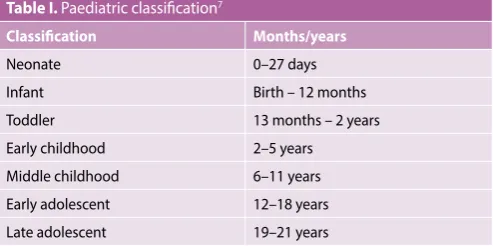
very complex.4 The sensory aspects of the pain experience are dependent on the age of the child. Children older than four years of age can usually talk about their pain; at the age of six to eight years they can use the visual analogue pain (VAP) scales in the same manner as adults. However, their capacity to describe pain increases with age and changes throughout their developmental stages3,5 and for this purpose the ages of paediatric patients are categorised according to the National Institute of Child Health and Human Development (NICHD), 2015, which contains paediatric terminology developed by Eunice Kennedy Shriver in the United States of America.6 The psychological age of children will influence their perception of pain (see Table I).
Table I. Paediatric classification7
Classification Months/years
Neonate 0–27 days
Infant Birth – 12 months
Toddler 13 months – 2 years Early childhood 2–5 years Middle childhood 6–11 years Early adolescent 12–18 years Late adolescent 19–21 years
Pain presentation in children normally falls into one of the following three categories3:
• Mild acute presentations of conditions such as otitis media and sore throat, which can be managed at the primary healthcare level.
Paediatric pain management
Schellack N1, BCur, BPharm, PhD (Pharmacy)Matimela M2, BPharm
1 Associate Professor, Department of Pharmacy, Faculty of Health Sciences, Sefako Makgatho Health Sciences University 2 Academic Intern, Department of Pharmacy, Faculty of Health Sciences, Sefako Makgatho Health Sciences University
Correspondence to: Prof Natalie Schellack, e-mail: [email protected] Keywords: analgesic, paediatric pain, NSAID, opioid, non-opioid, paracetamol, ibuprofen
Abstract
Pain is defined by the International Association for the Study of Pain (IASP) as an “unpleasant sensory and emotional experience, associated with actual or potential tissue damage or described in terms of such damage”. It can be steady, throbbing, stabbing, aching, pinching or described in many other ways as being either acute or chronic pain. This pain definition can be applied to any patient, regardless of his/her age, however, paediatric pain expression is dependent on the child’s level of cognitive development and sociocultural background. Children older than four years of age can usually talk about their pain; at the age of six to eight years they can use the visual analogue pain (VAP) scale in the same manner as adults. Nevertheless, their capacity to describe pain increases with age and changes throughout their developmental stages. This article provides an overview of paediatric pain management.
• Acute presentations such as burns, fractures and severe abdominal pain, which require assessment and management at the secondary level of care.
• Long-term conditions that require ongoing management of pain, such as rheumatological disorders, cancer pain and pain without an identifiable cause.
The four most commonly used systems that the healthcare worker can use to classify the pain presentation are as follows3:
• The pathophysiological mechanism of pain (nociceptive or neuropathic pain);
• The duration of pain (chronic or acute, breakthrough pain); • The aetiology (malignant or non-malignant); and
• The anatomical location of the pain.
Paediatric pain assessment
Proper assessment of paediatric pain is necessary to ensure the correct diagnosis and guidance in pain management interventions.4 Children normally experience physical and psychological pain, whilst their family may experience the emotional and social consequences as the results of pain. It is difficult to measure pain, especially in children, due to its subjectivity—healthcare workers have to rely on reports from the parents, and pain management techniques, tools and scales.5 However it is imperative that healthcare professionals should be able to detect pain, especially in different age groups, where parents may not always be available, with the tools designed to track the child’s pain experience and pain control over time.5
Methods available to measure pain in paediatric patients
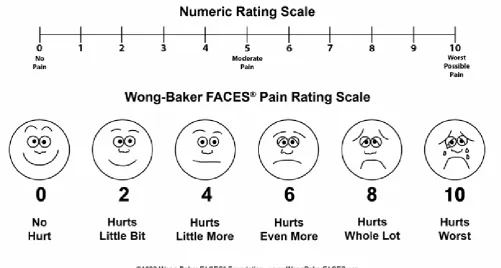
Self-reporting and behaviour are often used to measure pain intensity in paediatrics. Self-reports are normally nonverbal or verbal, however they require a level of cognitive understanding from the child to give a reliable response.8 They are assessed by asking patients to rate their pain on a numerical rating scale and if the child is unable to understand numerical concepts, then by using a Visual Analogue Scale (VAS). Refer to Figure 1. The VAS is used in children above the age of eight, whereby the patient marks a point on a line pointing to, or marking a certain level of pain alternatively using a pain scale with different faces which consists of a set of discrete facial expressions indicative of a pain state.9 The child is shown the series of faces limited to a maximum of five or six categories ranging in increasing stages of distress and asked to identify the one they most relate to from a neutral expression to one of an intense face with tears.10 These scales have been found to correlate well in children aged three to seven years old.
Lastly the Poker Chip Tool may be used, where the child is given a set of chips that represent ‘hurt’ and asked how many pieces (with four red pieces in total) their pain equals. The tool is applicable for children between the ages of three and 12 years. It is a simple, quick-to-use tool, requiring minimal instruction and it is easily reproducible.11 VAS measurement, however, has gained advantage over the measuring scales because of its easy administration, low cost, and the fact that it has extensive evidence as a valid rating indicator for paediatric pain experience. A normal VAS consists of a 100 mm horizontal line indicating ‘no pain’ at the left endpoint and ‘worst pain possible’ at the right endpoint. Pain intensity will be calculated by measuring the distance from the left side of the
scale to the child’s mark.9,11 The VAS scale has shown to be one of the most recommended scales to display a correlation with the parents’ rating scales and those of medical personnel.
A behavioural measurement is often utilised when communication is difficult, mostly used with neonates, infants and younger children. It is used to assess any behavioural changes displayed by children as indicative of pain and distress.9 The measure consists of an assessment of crying, facial expression, body posture and movement.10 This scale is often recommended to be used in combination with the individual self-report completed by children, particularly those between three and seven years of age, with a sufficient level of cognitive understanding to provide reliable results.12
Non-pharmacological management of
paediatric pain
Treatment strategies should be based on the findings of the assessment and should address the contributing factors.1 Hence, it is imperative for healthcare professionals to be able to follow a child-centred or individualised approach to managing pain.5 This approach involves the participation of the parent and the child during the procedure, depending on the level of understanding.13 The child will either choose, associate and communicate during the process of the procedures. To ensure effective and positive results, the procedure should be done in a child-friendly environment, using appropriate pharmacological and non-pharmacological interventions with routine pain assessment and reassessment.10
The management of pain is multi-faceted. Effective reduction of pain includes modifying the different options stated below14: • Environmental: Reducing the environmental sensory input, this
includes reducing the light and noise levels.
• Behavioural: Providing physical boundaries, for example skin-to-skin contact, and in the instance of young babies, using kangaroo mother care (KMC) and breastfeeding.
• Pharmacological: Appropriate use of analgesia.
One of the most frequently used approaches to guide children away from the pain in an emergency setting is called the ‘distraction approach’. It is most useful when adopted according to the developmental level of the child. Distractions are divided into two groups, passive and active distraction.11 ‘Passive distraction’ is when the healthcare professional (e.g. the nurse) is involved during the procedure by singing, talking or reading a book to the child while the procedure is taking place, to move the focus of the child from the procedure and pain.11 Conversely, ‘active distraction’ involves the child’s participation in activities during the painful procedure.
Currently these approaches have been highly recommended as the strongest evidence base for efficacy of psychological intervention for reducing pain in children and this is routinely recommended in the paediatric setting.11
Pharmacological treatment of paediatric pain
The analgesics used in the management of pain are typically classified as being either non-opioid agents, or agents.Non-opioid analgesics
The following non-opioid related medicines are available for managing pain in children: paracetamol, and the nonsteroidal anti-inflammatory drugs (NSAIDs), for example naproxen, ibuprofen and mefenamic acid.5 They adequately treat mild pain and moderate-to-severe pain in combination with other medicines, particularly opioids, to provide more effective relief and reduce adverse effects.5
Paracetamol
Paracetamol is one of the drugs of choice in pain management during the postoperative period in children due to its excellent safety profile and lack of any significant side-effects.6 It acts as a prodrug, with an active cannabinoid metabolite. In the brain and spinal cord, paracetamol follows deacetylation to its primary amine (p-aminophenol) which is conjugated with arachidonic acid to form N- arachidonolylphenolamide, a compound known as an endogenous cannabinoid. The involved enzyme is fatty acid amide hydrolase.15 N-arachidonolylphenolamide is an agonist at the Transient Receptor Potential Cation Channel, Subfamily V, Member 1 (TRPV1) receptors and an inhibitor of cellular anandamide uptake, which leads to increased levels of endogenous cannabinoids, inhibiting cyclooxygenases in the brain at concentrations that are probably not attainable with analgesic dosages of paracetamol.15 It is of interest to note that a cannabinoid-1 receptor antagonist, given at a dosage level that completely prevents the analgesic activity of a selective cannabinoid receptor agonist, completely inhibits the analgesic activity of paracetamol as well. This fact allows us to explain the mechanism of action of paracetamol in more detail.15 Despite this finding, however, the definite proof that the analgesic and antipyretic effects of paracetamol are dependent on COX-inhibition is still unclear. Hence, it works effectively when combined with codeine for more effective control of moderate-to-severe pain and discomfort.15
Paracetamol-induced hepatotoxicity has been reported with a high dose above the recommended dose for paediatrics which is 20 mg/kg/dose 8 hourly and a maximum of 60 mg/kg/24 hours, pointing to the fact that paracetamol may have a narrow therapeutic index.8 Paracetamol is available orally, in several tablet and liquid formulations, however the dosage should be guided by the age and general condition of the patient.4
useful route of administration, absorption of analgesics may vary in children, because of its unreliable bioavailability when using suppositories, thus limiting its applicability.16 Most importantly, the slow onset of action caused by a limited rate of rectal absorption is a disadvantage in postoperative analgesia hence the use of liquid formulation is highly recommended in children that are able to swallow the oral formulation.
Nonsteroidal anti-inflammatory drugs
The nonsteroidal anti-inflammatory drugs (NSAIDs), such as ibuprofen, diclofenac, ketorolac and mefenamic acid, have analgesic and anti-inflammatory properties, which are useful in the management of postoperative pain.15 NSAIDs work by inhibiting the enzyme, cyclooxygenase (COX), which catalyses the conversion of arachidonic acid to prostaglandin E2. Aspirin, however, should rather be avoided in paediatric practice (due to its potential for causing Reye’s syndrome, especially in children between the ages of four to 12 years).
Ibuprofen is one of the most frequently used NSAIDs for mild and moderate pain, because of its availability in a liquid form, allowing for easy administration to younger children.17 The medicine has gained advantage in the market as it is available as an over-the-counter medication for fever reduction, as well as pain relief in infants and children. Studies have shown ibuprofen to be superior in terms of its safety profile, compared to ketorolac. However, ketorolac has been used as a single agent for the treatment of postoperative pain, especially when used as an adjuvant to opioid analgesia, in children and adolescents following painful interventional procedures.1
Mefenamic acid is a potent inhibitor of cyclooxygenase with both central and peripheral analgesic action. It has efficacy and tolerability in paediatric patients with fever and is helpful in treating febrile illness in the paediatric populations.18 It is recommended as a suitable alternative, second-line treatment as antipyretic in selected children, however more clinical evidence is still required for wider routine use.18
If pain is constantly present, analgesics should be administered on a regular time schedule, i.e. ‘by the clock’, whereby the medicine is administered at a fixed time interval with dosages tailored according to the patient’s pain, with the next dosage given before peak time effect of the previous dosage has worn off. This will result in more predictable and consistent levels of analgesia.3,5
The following should be taken into account when prescribing analgesia to children3:
• Accurate dosing calculation based on an up-to-date measurement of weight.
• Prescribed strengths of liquid formulations should be double checked.
• Ensure that the total volume of medicine does not exceed what is required.
• Ensure the child is not on any over-the-counter medicines, to avoid medicine duplication.
The use of paracetamol and ibuprofen should be individualised according to the child’s age and weight to ensure the most effective therapeutic effect. Certain conditions such as malnutrition, a poor nutritional state and the administration of other medicines should be taken into consideration, because they might have an influence on the metabolism rate of paracetamol and ibuprofen, for example.3 Table II provides an overview of the dosage ranges for pain relief with paracetamol and ibuprofen.
Table II. Recommended dosages of paracetamol and ibuprofen for the relief of pain in neonates, infants and children (oral route)3
Medicine Neonates
from 0 to 29 days
Infants from 30 days to 3 months
Infants from 3 to 12 months or children from 1 to 12 years
Maximum daily dosage
Paracetamol 5–10 mg/kg every 6–8 hours
10 mg/kg every 4–6 hours
10–15 mg/kg every 4–6 hours
Neonates, infants and children: 4 dosages per day
Ibuprofen - - 5–10 mg/kg every 6–8 hours
Children: 40 mg/kg/day
Opioid analgesics
Opioid analgesics will provide analgesia for moderate to severe pain, for the vast majority of children and with a wide margin of safety.8 This group includes the following examples: codeine, morphine, oxycodone, methadone, fentanyl and pethidine. Challenges may be faced with these medicines in terms of dosing difficulties in the paediatric setting, especially during the first several months of life for infants.19 Therefore, pharmacokinetic differences should be understood when dosing for children versus adults, to avoid severe adverse effects such as unwanted sedation and respiratory depression.4 Therefore, concomitant administration of an opioid with ibuprofen can reduce the amount of opioid analgesic required for pain control.
Pethidine, morphine and fentanyl
child’s pain severity assessment. However, the long-term use of opioids is associated with constipation; therefore, children should receive a combination of a stool softener and stimulant laxative as prophylaxis when it is anticipated that these agents will be used over an extended period of time.19,20
Morphine is well established as the first-line strong opioid and is available in both immediate-release and prolonged-release formulations.20 Immediate-release tablets are used to individualise patient dosages and have an adequate dosage for pain control. Prolonged-release oral formulations improve patient compliance by allowing longer dosing intervals. Oral morphine solution is usually used for persistent pain and given to children who are able to swallow.20
The use of a pain scale to manage pain is a crucial part of effective opioid therapy because these medicines do not have a so-called ceiling effect. Therefore it is imperative to ensure an appropriate dosage that provides effective analgesia with manageable side-effects. A suitable opioid antagonist, such as naloxone, should also be available in the healthcare facility for the management of possible adverse effects or opioid-related complications.3
When pain management is no longer needed, slow withdrawal of opioids may be necessary to prevent abstinence syndrome, with continuous monitoring of the vital signs. This may require tapering the daily dosage whilst monitoring the level of pain, and with continuous reassessment to ensure that the patient is pain free.20
Regional analgesia
Regional analgesia includes peripheral nerve blocks and central blockade of the neuro-axis (i.e. spinal and epidural analgesia).21 Epidural analgesia can be administered caudally, near the tip of the tailbone, or from the lumbar region, between the vertebral bones of the lower spine, either continuously via an epidural catheter, or as a single injection.13,21 This is recommended to be
done by trained healthcare professionals, and close observation is essential for careful monitoring of the effects of the regional anaesthesia. Regional analgesia is often used preoperatively in combination with general anaesthesia, and postoperatively in combination with other analgesics (e.g. morphine or paracetamol) to reduce pain.20 There are factors to consider in neonates that can affect the pharmacokinetics of medicines compared to adults, such as a reduction in hepatic blood flow and an immature enzyme system, hence proper calculations should be done as differences in protein binding in the neonate can result in dosage accumulation and possible toxic effects.21
Adjuvant therapy
Adjunctive therapy is sometimes necessary to manage the side-effects of medications for pain, provide symptom relief, treat anxiety and manage related or underlying conditions.3,22 This is because patients with chronic pain are more likely to report anxiety, depression, neuropathic pain and significant activity limitations.3,22 Examples of adjuvant medicines include corticosteroids, anxiolytics, antidepressants, hypnotics and anticonvulsant/antiepileptic agents.3,22 However, the use of adjuvants has not been fully established because of insufficient evidence for their use in the management of pain in children.5
A step-wise approach
The World Health Organization’s (WHO) ‘analgesic ladder’ serves as the mainstay of treatment for the relief of pain together with psychological and rehabilitative modalities.3,22 This multidimensional approach offers the greatest potential for maximising analgesia and minimising adverse effects. According to literature about 70–90% of pain is relieved when clinicians apply the WHO ladder appropriately.3,22
According to the WHO, the key concepts to the effective management of pain are as follows:
Non-opioid analgesics: Aspirin, paracetamol or ibuprofen;
With / without an adjuvant*
Weak opioid analgesics: Codeine, dextropropoxyphene, tramadol
or buprenorphine; With / without a non-opioid, such as
aspirin, paracetamol or ibuprofen; With / without an adjuvant*
Strong opioid analgesics: Morphine, hydromorphone, oxycodone,
buprenorphine or tapentadol*; With / without a non-opioid, such as
aspirin, paracetamol or ibuprofen; With / without an adjuvant* Mild to moderate pain
Moderate pain
Severe pain
Persistent or worsening pain
[*Examples of adjuvants include corticosteroids, antidepressants, hypnotics and anticonvulsants/antiepileptic agents.]
• By mouth: If possible analgesics should be given by mouth. • By the clock: Analgesics should be given at fixed time intervals
and the dosage should be titrated according to the patient’s pain, and the next dosage should be given before the previous dosage has fully worn off.
• For the individual: The choice and dosages of the analgesics should be tailored to the needs and circumstances of the particular patient.
• By the ladder: The well-known WHO ladder, illustrated in Figure 2, advocates a step-wise approach to the use of analgesics, as explained below.
Step 1: Non-opioids (e.g. aspirin, paracetamol or ibuprofen) are used for mild to moderate pain.
Step 2: Weak opioids (e.g. codeine phosphate, dihydrocodeine, tramadol and buprenorphine) are recommended for moderate pain, used alone or in combination with one of the non-opioids mentioned in step 1.
Step 3: Strong opioids (morphine, hydromorphone, oxycodone, buprenorphine and tapentadol) may be used alone or in combination with a non-opioid (from the first step) for severe pain.
If the patient’s pain is already severe, it is recommended that the physician should move to the third level of the ladder immediately, rather than starting with the first two.
As illustrated by Figure 2, opioids play an important role in the management of, not only acute and chronic pain, but also in the management of moderate to severe pain.3,22 However, certain barriers limit the effective use of opioids in the management of pain:
• Concerns about the use of opioids from healthcare workers, family members and patients; these concerns may be related to the side-effects and risk of dependence when using the opioids. • Development of tolerance to the chronic use of opioids.
Conclusion
The effective management of children with pain will improve as pain management education expands and as the issue of paediatric pain is given greater public awareness. Children of all ages deserve to be treated with effective pain treatment options. Various methods are made available to assist healthcare professionals and parents in assessing paediatric pain.
Non-pharmacological and Non-pharmacological stepwise management are often applied for children with chronic or recurrent pain associated with medical disease or injury. However, healthcare professionals should also be able to recognise that paediatric pain treatment is essential, even when the child is unable to report pain due to his/ her cognitive developmental state.
References
1. Lundgren C, Mohr W (Editors). SA Acute Pain Guidelines. South African Journal of Anaes-thesia. 2009;15(6).
2. Srouji R, Ratnapalan S, Schneeweiss. Pain in children: Assessment and nonpharmacologi-cal management. Division of Pediatric Emergency Medicine, Department of Pediatrics, The hospital for sick children, university of Toronto, 555 University Avenue, Toronto, ON,Canada M5G1X8. May 2010.
3. WHO guidelines on the pharmacological treatment of persisting pain in children with medical illnesses. 2012. [Homepage on internet]. Available from: http://www.who.int/ medicines/areas/quality_safety/guide_perspainchild/en/
4. Cohen LL, Lemanek K, Blount RL, et al. Evidence-based assessment of pediatric pain. Jour-nal of Pediatric Psychology, 2007,10,1093.
5. Verghese ST, Hannallah RS. Acute pain management in children. Journal of Pain Research, 2010,3:105-123.
6. The International Consensus Group for Neonatal Pain. New guidelines for management of neonatal pain. Archives of Pediatrics and Adolescent Medicine. 2001;155(2):173-180. 7. Shriver EK. National Institute of Child Health and Human Development (NICHD). Pediatric
Terminology: Current efforts, 2015. https://www.nichd.nih.gov (Accessed 03 May 2016). 8. Lloyd-Thomas AR. Pain management in peadiatric patients. British Journal of Anaesthesia,
1990,64:85-104.
9. Chambers CT, Craig KD, Bennett SM. The impact of maternal behaviour on children’s pain experiences: An experimental analysis. Jounal of Pediatric Pschology, 2002,27(3),293-301. 10. Christo PJ, Mazloomdoost D. Cancer pain and analgesia. 2008. Annals of the New Academy
of Sciences, (1138):278-298.
11. Diedericks J. Postoperative pain management in the paediatric patient. South African Fam-ily Practice. 2006;48(3):37-42.
12. American Academy of Pediatrics, Committee on Psychosocial Aspects of Child and Family Health. The assesment and management of acute pain in infants, children and adolescents. 2001,108 (3):793-797.
13. Module 6 Pain Management, Peaditric Pain Management, 2003.
14. Joint Statement by the American Academy of Pediatrics Committee on Fetus and New-born and The Canadian Pediatric Society – Fetus and NewNew-born Committee. Prevention and Management of Pain and Stress in the Neonate. Pediatrics. 2000; 105 (2): 454-4 15. Ottani A, Leone S, Maurizio S, et al. The analgesic activity of paracetamol is prevented
by the blockade of cannabinoid CB1 receptors. European Journal of Pharmacology. 2006;531(1);280-281.
16. Kolloffel WJ, Driesseb FGWHM, Goldhoorn PB. Rectal administration of paracetamol: a comparison of a solution and suppositories in adult volunteers. Pharm World Sci, 1996;18 (1):26-9.
17. Gray L, Watt L, Blass EM. Skin-to-skin contact is analgesic in healthy newborns. 2000. Pediatrics, 105:e14. Available from: http://pediatrics.aappublications.org/cgi/content/ full/105/1/e14
18. Likar R. Transdermal buprenorphine in the management of persistent pain – safety as-pects. Therapeutics and Clinical Risk Management. 2006:2(1):115-125.
19. Bouwmeester J, Van Dijk M, Tibboel D. Human neonates and pain. Human endpoints in animal experiments for biomedical research.
20. Palermo TM, Valrie CR, Karlson CW. Family and parent influences on pediatric chronic pain. American Psychological Association 2014. Department of Anesthesiology and Pain Medi-cine, University of Washington and Center for Child Health, Behaviour and Development, Seattle Children’s Research Institute, Seattle, Washington; Vol 69 (2),142-152.
21. Breivik H, Borchgrevink PC, Allen SM, et al. Assessment of pain, British Journal of Anaes-thesia, 2008,101 (1):17-24.