Rajeev Kumar
Dept. of Pharmaceutics, School of Pharmacy, Bharat Institute of Technology, By-Pass Road, Partapur, Meerut-250103 [Uttar Pradesh] India.
E-mail: [email protected] Address for correspondence
Access this article online www.japer.in
Design, Fabrication and Characterization of Mirtazapine Loaded
Floating Tablets
INTRODUCTION
Recently there have been great revolutions in the field of pharmaceuticals in designing of new techniques for drug delivery. Many conventional drug delivery systems have been designed by various researchers to modulate the release a drug over an extended period of time and release. [1] The rate and extent of drug absorption from conventional formulations may vary greatly depending on the factors such as physicochemical properties of the drug, presence of excipients, physiological factors such as presence or absence of food, pH of the gastro-intestinal tract. However, drug release from oral controlled release dosage forms may be affected by pH, GI motility and presence of food in the GI tract. [2] Drugs can be
delivered in a controlled pattern over a long period of time by the process of floating drug delivery system. Drug delivery from this system is not influenced by the different physiological factors within the gut lumen and the release characteristics can be predicted easily from the known properties of the drug and the dosage form. [3]
Effervescent floating drug delivery systems generate gas (CO2), thus reduce the density of the system and remain buoyant in the stomach for a prolonged period of time and released the drug slowly at a desired rate. [4] Floating drug delivery systems (FDDS) had been found as significant drug delivery systems offering several advantages in the delivery of actives as they improve drug absorption because of increased gastric retention time (GRT) so that dosage form retain more time at the site of absorption. FDDS have mechanism of Controlled release drug delivery system. With a local action they release drug in the stomach for its therapeutic action. They minimize the mucosal irritation due to drugs, by drug releasing slowly at a controlled rate. Floating drug delivery system, deliver
Research Research Research
Research ArticleArticleArticleArticle
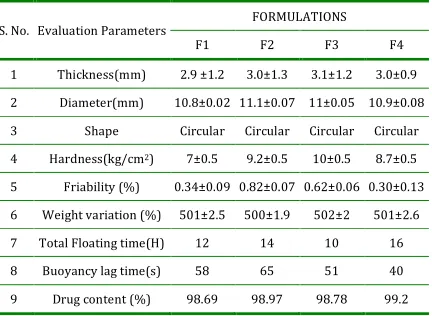
The aim of performing the present research work was to formulate and evaluate the sustained release floating tablets of Mirtazapine an Antidepressant which was used as model drug with a rapid and complete, absorption but, due to first-pass metabolism, absolute bioavailability is 50%. HPMC K4M and Carbopol 934 as hydrophilic polymers were used as matrix forming polymer and sodium bicarbonate was used as an effervescence generating agent to provide buoyancy to the tablet. The HPMC K4M and Carbopol 934 were incorporated in varying ratio to see the effect of polymer concentration on the in-vitro release of the Mirtazapine Floating Tablet. All the powdered excipients along with API were compressed using direct compression technique. All the formulations were characterized for various physicochemical properties like thickness, hardness, friability, weight variation, total floating time, buoyancy lag time, drug content, and in vitro drug release studies. From the investigation, the result for the optimized formulation F4 was found to be 3.0±0.9mm, 8.7±0.5kg/cm2, 0.30±0.13%, 501±2.6% respectively and the total floating time, buoyancy lag time, drug content, and in vitro drug release studies16 h, 40 sec, 99.2% and 85.42% respectively. The formulation F4 comprising 4:1 ratio of Carbopol 934 and HPMC K4M has shown promising results. The result findings have clearly shown release retarding effect of the polymeric combination when used in 1:4 proportions.
Key words: Floating tablets, Sustained release, Mirtazapine, Carbopol 934, HPMC K4M, Antidepressant
ABSTRACT ABSTRACT ABSTRACT ABSTRACT
Upendra Nagaich, Rajeev Kumar*, Promila Sharan, Spriya Sharan, Neha Gulati, Amit Chaudhary
Department of Pharmaceutics, School of Pharmacy, Bharat Institute of Technology, By-Pass Road, Partapur, Meerut – 250103 [Uttar Pradesh] India.
the drug in a large extent and the delivery nature is independent of the physiological factors of the gastrointestinal tract and these systems can be utilized for systemic as well as targeted delivery of drugs. FDDS may be used in the treatment of gastrointestinal disorders such as gastro-esophageal reflux. There is better patient compliance and ease of administration. This is site-specific drug delivery system. [5]
FDD system should have advantage of single dose for the whole duration of treatment and it should deliver the active drug directly at the specific site. Control release implies the predictability and reproducibility to control the drug release, drug concentration in target tissue and optimization of the therapeutic effect of a drug by controlling its release in the body with lower and less frequent dose. For local and sustained drug delivery to stomach and the proximal small intestine to treat certain conditions, prolonging gastric retention of the therapeutic moiety may offer numerous advantage including improve bioavailability, therapeutic efficacy and possible reduction of the dose size. [6]
Mirtazapine being a slightly water soluble drug. Mirtazapine is an antidepressant introduced by Organon International in 1996 used for the treatment of moderate to severe depression. Mirtazapine has a tetracyclic chemical structure and is classified as a noradrenergic and specific serotonergic antidepressant (NaSSA). It is the only tetracyclic antidepressant that has been approved by the Food and Drug Administration to treat depression.
The objective of the present research work was to design, formulate and characterize floating tablets of mirtazapine and to study the effect of various concentrations of polymer on the in-vitro drug release.
MATERIALS AND METHODS
Materials
Mirtazapine was obtained as a gift sample from Ind-Swift Laboratories Ltd., Chandigarh, Carbopol 934, Hydroxy Propyl Methyl Cellulose (HPMC K4M),
sodium bicarbonate, talc, manitol were purchased from Central Drug House (CDH), New Delhi. All other chemicals and solvents used were of analytical grade. Method of Preparation of Mirtazapine Floating
Tablet
Effervescent Floating tablets containing Mirtazapine were prepared by direct compression technique using varying concentrations of different grades of polymers of HPMC K4M and Carbopol 934 with sodium bicarbonate, manitol are geometrically mixed all the powders were passed through sieve No #80. Talc was finally added as lubricant. The blend was directly compressed using tablet compression machine of flat-faced punch in a single punch compression machine (KI-150, Khera Instrument Ltd, New Delhi, India). The tablets were off white, round and flat. The hardness of the tablets was kept constant. Four formulations were prepared and coded them from F1 to F4. The detail of composition of each formulation is given in Table 1. [7]
EVALUATION PARAMETERS
Pre-compression Evaluation
Angle of repose
The funnel method was used to determine angle of repose of powder. The accurately weighed amount of granules was poured to flow freely through the funnel on to the surface. The height of funnel was adjusted in such a way that the tip of the funnel touched the apex of the powder blend. The diameter of the granules cone formed was measured and angle of repose was calculated using the following equation.
Tan Q= h/r
Where, h is height of the powder cone, r is radius of powder cone. [2] [8]
Bulk density
no further change in volume was noted. LBD and TBD were calculated using as the following equation. [2] [8] LBD= Weight of the powder /Untapped volume of the packing
TBD=Weight of the powder / Tapped volume of the packing
Compressibility index
Compressibility index of powder was calculated by determining Hausner ratio and Carr’s index.
Hausner ratio = Pmin / Pmax
Where, Pmin is initial bulk density or (LBD) and Pmax is tapped bulk density or (TBD).
It is a test to evaluate the LBD and TBD of a powder and the rate at which it is packed down. It is the direct measure of the potential powder arch or bridge strength and stability and calculated by equation. [2] [8]
Carr’s index (%) = [TBD-LBD] X 100 / TBD
Post-compression Evaluation
Physical Appearance
The shapes and texture of compressed tablets were examined by visual means. Thickness and diameter was measured and noted by using a calibrated vernier caliper. Three tablets of each formulation were selected randomly and average thickness was measured. [9]
Hardness
Hardness of 6 tablets from each formulation was determined using Monsanto hardness tester (cadmach, Ahmedabad, India). The reading was noted in kg/cm2 which indicates the pressure required to break the tablets. [8]
Friability
For each formulation, pre-weighed tablet samples (6 tablets) were placed in the Roche friabilator (Veego, Mumbai, India) which was then operated for 100 revolutions to check lose in weight. The friability (F) was calculated using the formula. [8] [10]
F = (1- W / W0) × 100
Where, Wo is the initial weight and W is the final weight of the tablets.
Weight Variation Studies
Weight variation studies were carried out as per official Pharmacopoeia. Twenty tablets were randomly selected from each formulation and weight individually. The average weight was calculated. By comparing the individual weights to the average weight, tablet weight variation was determined. Not more than two of the individual weights should deviate from the average weight by more than 5%. [10] Floating Time
The time between introduction of dosage form and its buoyancy on simulated gastric fluid and the time during which the dosage form remain buoyant were measured. The time taken for dosage form to emerge on surface of medium called floating Lag Time (FLT) or Buoyancy Lag Time (BLT) and total duration of time (TFT). [11]
Swelling Characteristics (Water Uptake Study)
The swelling properties of tablet containing drug were determined by placing the tablet in the dissolution test apparatus, in 900 ml of 0.1 N HCl at 37± 0.5 C. The tablets were removed periodically from dissolution medium. After draining free from water tissue paper, these were measured for weight gain. Swelling characteristics were expressed in terms of percentage water uptake (WU %). [11]
WU % = Weight of swollen tablet – Initial weight of the tablet X 100
Initial weight of the tablet
Drug Content
For the drug content study, twenty tablets were weighed, crushed and powdered. An amount of the powder equivalent to 100 mg of Mirtazapine was taken and dissolved in 100 ml of pH 6.8 buffer, filtered, diluted suitably and analyzed for drug content at 330 nm to 360 nm using UV-Visible double beam spectrophotometer (UV 2201 SYSTRONICS). [12]
In Vitro DrugRelease Studies
(5 ml) were withdrawn at specified intervals of time and analyzed for drug content by measuring the absorbance. The volume withdrawn at each time interval was replaced with fresh quantity of dissolution medium. Cumulative percent of Mirtazapine released was calculated and plotted against time. [13]
Stability Studies
All the compressed formulations were subjected to test their stability for a period of 2 months at different temperatures i.e. room temperature (RT), freezing temperature (FT 2- 4oC) and accelerated temperature and humidity (45±5 oC/75% RH). All formulations were then evaluated for drug content and physical appearance. [14]
No color change (+), Slight color change (++), mottling (-) Drug Release Kinetics
All the compressed tablet formulations were subjected for release kinetics study so as to know the mechanism of drug release. The data obtained after in vitro drug release study was fitted in different equations i.e. zero order, first order, Higuchi kinetics and Korsmeyer Peppas Equation. The data is represented in Table 8. [13]
RESULTS AND DISCUSSION
Mirtazapine loaded Floating Drug Delivery system based tablets were prepared by direct compression method and evaluated for the treatment of improving muscle warding off drowsiness etc. as use as gastro retentive drug delivery system to increase its local action and bioavailability. The entire tablet formulations confirmed to the requirements as per I.P. i.e. Hardness, % Friability, Thickness, Weight Variation and content uniformity. The weight variation of the tablet varied between 501 to 502 mg. The percent deviation was within the range i.e. 5% which is in the acceptable range as per pharmacopoeial specifications. [10] In all the formulations, the hardness values specifies good mechanical strength and the hardness of the tablets
components as the hardness range of different formulations was found to be between 7±0.02 to 9.2±0.09 kg/cm2. The friability was ranged from 0.30±0.07 to 0.82±0.10 % which indicates the formulated tablets are least friable. The drug content was ranged from 92.69±0.25 to 99.2±0.37 %. This may be due to the higher concentration of carbopol 934 was present in F4 formulation. The in vitro drug release was ranges from 79.69 to 85.2 % therefore the optimized formulation were found to be F4. The buoyancy floating time was ranged from 65 to 40 sec and total floating time was ranged from 10 to 16 h for various formulations. All the formulations were subjected to curve fitting analysis which indicated that the drug release followed the zero order kinetics (r2 = 0.936), followed by Higuchi and first order kinetics. The value of n in Korsmeyer Peppas equation is less than 0.5 which reveals Quasi Fickian diffusion. It indicates swelling and diffusion of drug from the polymeric matrices. [15]
CONCLUSION
The present study showed that the hydrophilic polymer like Carbopol could be used as a floating material to design sustained release formulations of water-soluble drug with desired quality and release characteristics. It was found that 4:1 ratio of Carbopol 934 and HPMC K4M, showed higher buoyancy time with sustained cumulative percent drug release when compared with the drug release observed with other varying proportions of HPMC K4M and Carbopol 934. The significant reduction in the release of drug provided by Carbopol 934 and HPMC K4M could make it a potential material for its application in other pharmaceutical dosage forms.
ACKNOWLEDGEMENT
India for providing necessary facilities to carry out this research work.
Table 1: Composition of Mirtazapine loaded Floating Tablet
S. No. Ingredients (mg/Tablet) FORMULATIONS F1 F2 F3 F4
1 Mirtazapine 200 200 200 200
2 HPMC K4M 40 30 20 10
3 Carbopol (934) 10 20 30 40
4 Sodium bicarbonate 70 70 70 70
5 Talc 10 10 10 10
6 Manitol 170 170 170 170
Total 500 500 500 500
Table 2: Various Precompression Evaluation Parameters for Powder Blend
S.
No. Parameters
Formulations
F1 F2 F3 F4
1 Angle of repose(Q) 25.88 26.55 26.71 27.25
2 Bulk density(gm/ml) 0.475 0.495 0.526 0.589
3 Tapped density(gm/ml) 0.622 0.685 0.537 0.698
4 Compressibility index
(%) 25.02 12.45 13.56 13.82
Table 3: Various Postcompression Evaluation Parameters of Compressed Tablets
S. No. Evaluation Parameters
FORMULATIONS
F1 F2 F3 F4
1 Thickness(mm) 2.9 ±1.2 3.0±1.3 3.1±1.2 3.0±0.9 2 Diameter(mm) 10.8±0.02 11.1±0.07 11±0.05 10.9±0.08 3 Shape Circular Circular Circular Circular 4 Hardness(kg/cm2) 7±0.5 9.2±0.5 10±0.5 8.7±0.5
5 Friability (%) 0.34±0.09 0.82±0.07 0.62±0.06 0.30±0.13 6 Weight variation (%) 501±2.5 500±1.9 502±2 501±2.6 7 Total Floating time(H) 12 14 10 16 8 Buoyancy lag time(s) 58 65 51 40 9 Drug content (%) 98.69 98.97 98.78 99.2
Table 4: Release Kinetics Study of various Mirtazepine Loaded Floating Formulations
FORMULATI ONS
Zero order release
First order release
Higuchi kinetics
Korsmeyer Peppas R2 K R2 K R2 K R2 n
F1 0.985 7.54 0.652 0.118 0.952 27.81 0.82 0.439 F2 0.979 7.636 0.644 0.128 0.948 28.17 0.817 0.446 F3 0.971 7.747 0.635 0.135 0.946 28.68 0.811 0.456 F4 0.965 8.202 0.632 0.139 0.936 30.29 0.807 0.463
Table 5: Stability studies for F1
Days
F1
Physical appearance Drug content (%)
RT FT AT RT FT AT
0 + + + 98.69±21 98.69±21 98.69±21
7 + + + 98.39±23 98.39±13 98.39±23
14 + + ++ 98.33±42 98.31±22 98.36±42
28 ++ + ++ 98.28±32 98.27±41 97.88±32
35 ++ ++ ++ 98.18±12 98.21±12 97.48±12
45 ++ ++ - 97.93±23 98.13±17 97.23±23
60 - - - 97.78±12 97.98±25 97.08±12
Table 6: Stability studies for F2
Days
F2
Physical appearance Drug content (%)
RT FT AT RT FT AT
0 + + + 98.97±12 98.97±12 98.97±12
7 + + + 97.96±23 97.96±23 97.87±23
14 + + + 97.94±42 97.87±42 97.76±42
28 + + + 97.88±32 97.85±32 97.65±32
35 + + - 97.78±12 97.75±12 97.59±12
45 ++ - - 97.53±23 97.32±23 97.21±23
60 - - - 97.38±12 97.21±12 97.03±12
Table 7: Stability studies for F3
Days
F3
Physical appearance Drug content (%)
RT FT AT RT FT AT
0 + + + 98.78±13 98.78±13 98.78±13
7 + + + 98.68±12 98.71±67 98.72±40
14 + + ++ 98.43±23 98.69±32 98.68±12
28 ++ + ++ 98.28±12 98.48±43 98.54±42
35 - ++ - 98.18±27 98.33±15 98.31±12
45 - - - 98.07±20 98.04±12 98.19±12
60 - - - 97.9±09 97.81±24 97.81±23
Table 8: Stability studies for F4
Days
F4
Physical appearance Drug content (%)
RT FT AT RT FT AT
0 + + + 99.2±13 99.2±13 99.2±13
7 + + + 99.1±12 99.01±67 99.02±40
14 + + + 98.99±23 98.98±32 98.97±12
28 + + + 98.96±12 98.95±43 98.95±42
35 + + ++ 98.93±37 98.92±25 98.90±12
45 ++ ++ ++ 98.89±20 98.87±12 98.88±12
60 ++ ++ ++ 98.87±19 98.86±34 98.85±23
Fig.1:In-vitro Cumulative Percent Drug Release of Mirtazapine loaded Floating Tablets.
REFERENCES
1. Jagdale S.C., Agavekar A.J., Pandya S.V., Kuchekar
Bhanudas S., and Chabukswar A.R. Formulation and
Evaluation of Gastroretentive Drug Delivery System of
Propranolol Hydrochloride AAPS PharmSciTech, 2009;
Vol. 10, No. 3.
2. Sathiyaraj S., Devi R.D., Hari V.B. Lornoxicam gastro
retentive floating matrix tablets Design and in vitro
evaluation. J. Adv. Pharm. Technol. Res. 2011;
2:156-62.
3. Arora G., Malik K., Singh I., Arora S., Rana V.
Formulation and evaluation of controlled release
matrix mucoadhesive tablets of domperidone using
salvia plebeian gum. J. Adv. Pharm. Technol. Res. 2011;
2:163-9.
4. Negi J.S., Trevdi A., Khanduri P., Negi V., Kasliwal N.
Effect of bioadhesion on initial in vitro buoyancy of
effervescent floating matrix tablets of ciprofloxacin
HCL. J. Adv. Pharm. Technol. Res. 2011; 2:121-7.
5. Jain S., Srinath M.S., Narendra C.,ReddyS.N., Sindhu A.
Development of a Floating Dosage Form of Ranitidine
Hydrochloride by Statistical Optimization Technique. J.
Young. Pharm. 2010; 2(4): 342–349.
6. Sathish D., Himabindu S., Kumar Y.S., Shayeda., Rao
Y.M. Floating drug delivery systems for prolonging
gastric residence time: a review. Curr. Drug. Deliv.
2011; 8(5):494-510.
7. Aswatha Ram H.N., Lachake P., Kaushik U., Shreedhara
C. S. Formulation and evaluation of floating tablets of
liquorice extract. Pharmacognosy Res. 2010; 2(5):
304–308.
8. Lachman L., Liberman H.A., The Theory and Practices
of Industrial Pharmacy, special Indian ed.2009,
reprint. 2010; 296-320.
9. Kumar A., Shinde J., kumar M., Patil S., Harinath N.
More, Formulation and Evaluation of an Oral Floating
Tablet of Cephalexin Indian. J.Pharm. Educ. Res. 2010;
44(3):41-50.
10. Indian Pharmacopoeia 2007. Ministry of Health and
Family Welfare. Government of India Published by The
Indian Pharmacopoeial Commission.Ghaziabad.2010,
II, 751-753.
11. Patel A., Modasiya M., Shah D., Patel V. Development
and In Vivo Floating Behavior of Verapamil HCl
Intragastric Floating Tablets AAPS. Pharm. Sci. Tech.
March 2009;10(1):310-315.
12. Abdelbary A., El-Gazayerly O.N., El-Gendy N.A., and Ali
Adel A. Floating Tablet of Trimetazidine
Dihydrochloride: An Approach for Extended Release
with Zero-Order Kinetics AAPS PharmSciTech
2010;11(3):1058-1067.
13. Gharti K.P., Thapa P., Budhathoki U., and Bhargava A.
Formulation and in vitro evaluation of floating tablets
of hydroxypropyl methylcellulose and polyethylene
oxid SSSe using ranitidine hydrochloride as a model
drug. J Young Pharm. 2012; 4(4): 201–208.
14. Remunan C., Bretal M., Nunez A., Bila Jato J.L.
Accelerated stability of sustained release tablet
prepared with Gelucire. Int J Pharm 1992; 80:151-159.
15. Tomar M., Tomar N., Gulati N., Nagaich U., Chaudhary
A, Rastogi B.V. Formulation and evaluation of caffeine
loaded floating tablets. J Adv Pharm Edu Res
2012;2(3):128-136.
How to cite this article: Upendra Nagaich, Rajeev Kumar*, Promila Sharan, Spriya Sharan, Neha Gulati, Amit Chaudhary; Design, Fabrication and Characterization of Mirtazapine Loaded Floating Tablets; J. Adv. Pharm. Edu. & Res. 2013: 3(2): 55-60.