195
Microemulsion
Drug
Delivery
System:
For
Oral
Bioavailability
Enhancement of Glipizide
Biresh K Sarkar*1, Shiv S. Hardenia2
1. Sri Balaji College of Pharmacy, Jaipur, India.
2. College of Pharmacy, Indore Professional Studies (IPS) Academy, Knowledge Village,
Agra-Bombay Road, Rajendra Nagar, Indore (Madhya Pradesh), India.
*Corresponding author: [email protected]
ABSTRACT:
Glipizide (GZ) is a widely used oral hypoglycemic drug with very poor water solubility.
The purpose of this study was to enhance the dissolution rate and bioavailability of this
drug by developing a novel delivery system i.e. microemulsion (ME), and to study effect
of microemulsion (ME) on the oral bioavailability of Glipizide. Capmul® MCM-based ME
formulation with Cremophor® EL as surfactant and Transcutol® as co-surfactant, was
developed for oral delivery of Glipizide. Optimized ME was evaluated for its
transparency, viscosity, percentage assay etc. Solubilisation capacity of the ME system
was also determined. The prepared ME was compared with the pure drug solution and
commercially available tablet for in vitro drug release. The optimized ME formulation
containing Glipizide, Capmul® MCM (6.5%), Cremophor® EL (25%), Transcutol® P
(7.5%) and distilled water, showed higher in vitro drug release, as compared to plain
drug suspension and the commercially available drug. These results demonstrate the
potential use of ME for improving the bioavailability of poor water soluble compounds,
such as Glipizide.
Keywords: Glipizide, microemulsion, bioavailability, Solubilisation.
INTRODUCTION:
Glipizide (GZ) is a second-generation sulfonylurea that can acutely lower the blood
glucose level in humans by stimulating the release of insulin from the pancreas and is
typically prescribed to treat non-insulin-dependent diabetes mellitus. The drug is
insoluble in water, and its dissolution is considered to be a rate-determining step (i.e.,
an effective factor) in its absorption from the gastrointestinal fluids [1]. Microemulsion
196
absorption of lipophilic drugs [2-5]. The main aim of this study was to improve the
bioavailability of GZ by preparing its ME. In vitro stability of formulation was assessed.
In the present study, ME formulation was prepared using Capmul® MCM (HLB =
5.5-6.0), Cremophor® EL (HLB = 14), Transcutol® P (HLB = 4) and distilled water by water
titration method. The effects of formulation variables on different physicochemical
characteristics were studied. An in vitro diffusion study was performed using a synthetic
membrane.
MATERIALS AND METHODS:
Materials
GZ was obtained from Novopharm Formulations Pvt. Ltd. Gujarat, India. Capmul®
MCM, Labrafac® CC, Cremophor® EL, Labrasol® and Transcutol® P were obtained
from Colorcon Asia (Mumbai). All other chemicals were used of reagent grade.
Preparation of ME
ME formulations were prepared by the water titration method by varying the ratio of oil,
surfactant, co-surfactant, and water; keeping the concentration of GZ constant in each
case. The drug was mixed in an accurate quantity of oil (Capmul® MCM), and to that,
surfactant (Cremophor® EL) and co-surfactant (Transcutol® P) were added and mixed
gently for 10 minutes with the help of a magnetic stirrer at room temperature. The
mixture was then finally titrated with distilled water until a stable and transparent ME
was obtained. ME formulation was optimized through the formulation (oil: surfactant,
surfactant: co-surfactant and oil: water ratios) and process variables (time and speed).
Percentage transmittance was evaluated during the optimization [6].
Characterization and evaluation of ME
Percentage transmittance
Transparency of both optimized ME formulation and its diluted forms (10 and 100
times with distilled water) was determined by measuring percentage transmittance
through ultraviolet (UV) spectrophotometer (UV-1601-220xShimadzu). Percentage
transmittance of samples was measured at 276 nm using purified water as blank [7].
Rheological measurements
The rheological behavior of ME (different dilutions) was evaluated using Brookfield
197
Conductivity study
Electrical conductivity of ME was measured using a conductometer [(CM 180
conductivity meter (Elico, India)] at ambient temperature.
Determination of Drug content in the ME
ME formulation was analyzed for drug content using the UV spectrophotometer.
In vitro release studies
In vitro release studies were performed using a modified Franz diffusion cell at 37 ± 20C.
A dialysis membrane, with a pore size of 2.4 nm was used. ME of drug (GZ), plain drug
suspension and suspension of commercially available GZ were placed in the donor
compartment. The receptor compartment was filled with dialysis medium (23 ml of
phosphate buffer pH 6.8). At a fixed time interval of one hour, five milliliters of the
sample was withdrawn from the receiver compartment through a side tube and
analyzed spectrophotometrically [8].
RESULTS AND DISCUSSION:
Solubility study
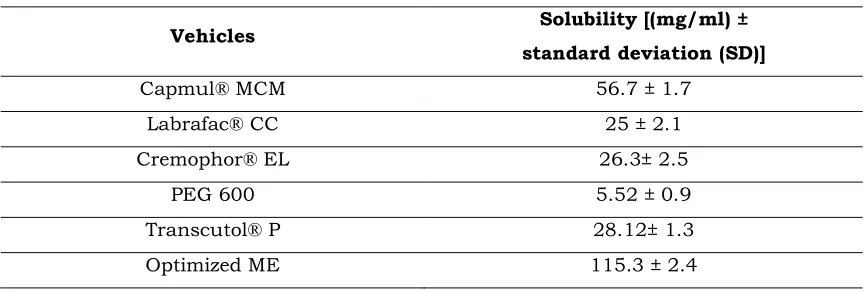
The solubility data of GZ in various vehicles are provided in Table 1. Capmul® MCM
showed higher solubilising capacity compared to other vehicles. Hence, Capmul® MCM
was selected as the oil phase. Cremophor® EL and Transcutol® P were selected as the
surfactant and co-surfactant respectively for the preparation of optimized ME.
Table 1.Solubility studies in various vehicles
Vehicles Solubility [(mg/ml) ±
standard deviation (SD)]
Capmul® MCM 56.7 ± 1.7
Labrafac® CC 25 ± 2.1
Cremophor® EL 26.3± 2.5
PEG 600 5.52 ± 0.9
Transcutol® P 28.12± 1.3
Optimized ME 115.3 ± 2.4
Percentage transmittance
Percentage transmittance of ME after 10 times and 100 times dilution was 98.59% and
198
Determination of drug content
Drug content in the optimized ME formulation was found to be 98.31 %.
Rheological study
The structure and type of ME system was characterized by rheological measurements.
Results obtained from the viscosity study reveals that viscosity increased from 52.59 cP
to 75.38 cP, with increasing water content which then gradually decreased (Figure 1).
This may be due to the fact that the system transforms from W/O through
bicontinuous structure to O/W system.
Figure 1: Viscosity changes of ME with increasing water content
Electro-conductivity measurement
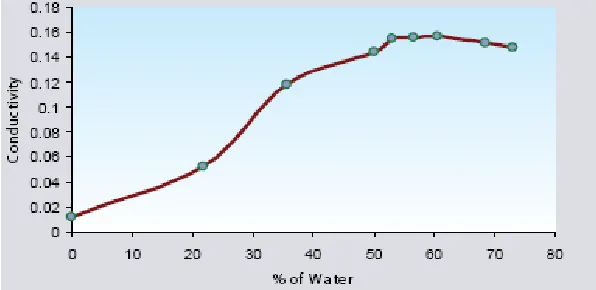
Results indicated that electrical conductivity increased rapidly up to 52.94% of the
aqueous phase addition. Therefore it was not affected significantly with further addition
of the aqueous phase (Figure 2).
199
In vitro release of drug
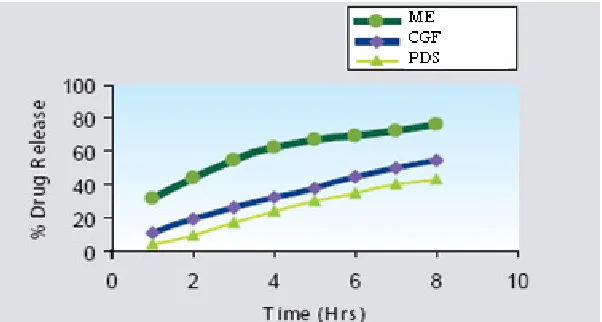
Results of the in vitro drug release from the optimized ME, plain drug suspension and
the commercially available drug are shown in Figure 3. Drug release (in hours) from
optimized ME, plain drug suspension and the commercially available drug, were found
to be 76.14%, 55.11% and 60.15% respectively. ME showed higher drug release as
compared to plain drug suspension and the commercially available GZ, which may be
due to the solubility-enhancing component of the surfactant and co-surfactant.
Figure 3: In vitro drug release of drug from Microemulsion (ME), Commercially Glipizide Formulation (CGF) and Plain Drug Suspension (PDS)
CONCLUSION:
The developed ME, containing Capmul® MCM (6.5%), Cremophor® EL (25%),
Transcutol® P (7.5%), and distilled water, was found to be a transparent fluid. ME
showed higher in vitro drug release when compared with plain drug suspension and the
commercially available drug. Hence, it can be concluded that the ME formulation can
be employed to improve the bioavailability of a poorly soluble drug like; Glipizide.
However, further studies in higher animals and humans need to be performed before
this formulation can be commercially exploited.
REFERENCES:
1. Rx List web site, Description of glipizide,
http/www.rxlist.com/cgi/generic/glipxl.htm (Copyright 1998, Mosby Inc.,Mosby’s
200
2. Kang BK, Lee JS, Chon SK, Development of microemulsion drug deliverysystem for
oral bioavailability enhancement of simvastatin in beagle dogs. Int J Pharm. 2004;
274:65-73.
3. Dressmann JB, Reppas C. in vitro-in vivo correlations for lipophilic, poorly
water-soluble drugs. Eur J Pharm Sci, 2000; 11: 73-80.
4. Patel D, Sawant KK. Oral bioavailability enhancement of acyclovir by self
microemulsifying drug delivery systems. Drug Dev Ind Pharm. 2007; 33:1318-1326.
5. Abbofazeli R, Lawrence MJ. Investigation into the formation and characterization of
phospholipids ME.II: pseudoternary phase diagram of system containing
waterlecithin- isopropyl myristate and alcohol: influence of purity of lecithin. Int J
Pham. 1994; 106:51-61.
6. Acharya A, Sanyal SK, Moulik SP. Formation and characterization of
pharmaceutically useful microemulsion derived from isopropyl myristate, Brij 30,
isopropyl alcohol and water. Current Science. 2001; 8:362-370.
7. Kawtikwar PS, Kulkarni NP, Yadav S, Sakarkar DM. Formulation and evaluation of
an anti-epileptic, drug-loaded microemulsion for nose to brain delivery. Asian
Journal of Pharmaceutics. 2009; 20:143-147.
8. Ghosh PK, Umrethia M, Majithiya RJ, Murthy RSR. Preparation and
physicochemical characterization of aprylocapryl macrogol-8-glycerides