S. Divya Teja Banda
Department of Pharmacology, Sri Sai Aditya Inst. of Pharmaceutical Sciences and Research, Surampalem, East Godavari Dist. A.P
Email: [email protected] Address for correspondence
Access this article online
Anti-Diabetic, Anti-Hyperlipidemic and Anti Oxidant activities of
“ATH-2K13” in Streptozotocin induced Diabetic Rats
INTRODUCTION
Diabetes mellitus is a metabolic disorder of multiple aetiology characterized by chronic hyperglycaemia with disturbances of carbohydrate, fat and protein metabolism resulting from defects in insulin secretion, insulin action or both1. Globally by 2030
this number is estimated to rise up to 435 million2.
There is a lot of progress in the treatment and management of the DM now a day. Many health organisations and social service organisations have been trying as good as they can. But it is not only sufficient but also peoples they also try to get awareness and take precautionary measurements to overcome this disorder, at least to reduce the victim count. Now a day along with allopathic medicine there is wide range of research is going on herbal formulation to find supplement. Herbal formulation is the safest type of dosage form to treat many disorders. Diabetes can be managed by diet,
exercise, and chemotherapy. However, the pharmacological drugs are either too expensive or have undesirable side effects or contraindications3.
In the present study of screening of anti-diabetic, anti hyperlipedimic and anti-oxidant activities we were using three herbals. So this is a poly herbal formulation and we named it as ATH-2K13.The major herbals present in this formulation were
Phyllanthus umbilicus, Curcuma longa, and honey.
Two test doses were prepared for screening called 100mg/kg and 200mg/kg. However among all type of formulations herbal formulations are safest and less toxic4.
MATERIALS AND METHODS
Procurement and identification of plant material
The dried rhizomes of Curcuma longa, fruits
Phyllanthus umbilicus and honey were collected. The dried rhizomes were neatly cleaned and kept under shade drying and the fruits of Phyllanthus umbilicus were taken and cleaned and washed thoroughly and cut in to small pieces. These pieces were also kept under shade drying. Pure Honey is taken and preserved at cool place. Curcuma longa is
Research Research
Research ArticleArticleArticleArticle
Diabetes is the most widely seen metabolic disorder and it is not only a metabolic disorder but also induce some serious disorder like diabetic retinopathy, neuropathy, nephropathy, cardiovascular damage and cataracts etc. The main objective of the present work is to study the anti-diabetic, anti-hyperlipedimic and anti-oxidant activities “ATH-2K13”which was a poly herbal formulation. There are many methods used to induce the diabetes normally, but among all the methods one of the widely accepted method is chemical method of induction and it is easier to induce the diabetes also. As a part of induction we were choosing Streptozotocin as a diabetic control. The standard drug used in the present work was glibenclamide. The two test doses taken in the present study were 100mg/kg and 200mg/kg. Acute toxicity studies and OGTT tests were conducted before screening as safety evaluation of new formulation. The total duration of the study was 14days after 48 hours of diabetes induction to the rats. Total five groups of containing albino Wistar rats of either sex were taken for the evaluation. After 14 days of study blood was collected and serum was separated for the biochemical evaluation. Body weight and blood glucose levels were checked daily.
Keywords: ATH-2K13, Streptozotocin, anti-diabetic, anti-oxidant anti hyperlipedimic, acute toxicity studies, OGTT, 14days.
ABSTRACT ABSTRACT ABSTRACT ABSTRACT
*S. Divya Teja Banda1, K. Ravi Shankar1,T. Jaya Prakash1, Firasat Ali2 *Department of Pharmacology, Sri Sai Aditya Inst. of Pharmaceutical Sciences and Research, Surampalem, East Godavari Dist. A.P. 1Department of Pharmacology, School of
Pharmaceutical Sciences & Technology, Jawaharlal Nehru Technological University, Kakinada-533003 2Department of Pharmacology, Sigma
Inst.of Clinical Research & Development Ltd. Prashanthi Nagar, Ida-Kukatpally, Hyderabad
commonly called as turmeric and Phyllanthus umbilicus is commonly called as Amla.
Preparation of the extract
The rhizomes of Curcuma longa and dried fruits of
Phyllanthus umbilicus were taken and powdered. The Fine powder was taken for extraction. The dried powder is submitted to successive extraction by soxhlet apparatus with 100%methanol at 72degrees temperature for 18hrs. All the extract was filtered through membrane filter and then the extract dried in room temperature. Then the suspension of herbals was prepared by adding equal quantities of methanolic extract of Amla and turmeric, Honey. In the preparation of this poly herbal formulation tween 80 is used as suspending agent. 100mg/kg body weight and 200mg/kg body weight doses were prepared5.
Drugs and chemicals
Streptozotocin was used as a standard drug. Glibenclamide (Batch no: G080851) was a gifted sample from TABLETS INDIA LTD, Chennai. Standard Glucose estimation kits were procured from ROBONIK (INDIA) PVT.LTD, Mumbai. Enzymatic kits for the estimation of lipid profile were obtained from CHEMA DIAGNOSTICA (INDIA).
Animals
Healthy adult albino rats of Wister strain of either sex between the age of 2-3 months and weighing 200-300 grams were used for the present study. The animals were housed individually in polypropylene cages, maintained under standard conditions (12 hours light and12 hours dark cycle, 24±5°C and 40-60% humidity) 6. They were fed with standard rat
pellet diet (National Institute for Nutrition, Hyderabad) and provided water ad libitum. All the animals are collected from central animal house SICRA LABS PVT.LTD, KUKATPALLY, HYDERABAD and all experiments were conducted according to the ethical norms approved by CPCSEA, Ethical committee IAEC reg. no. (769/2011/CPCSEA).
EXPERIMENTAL
Phytochemical Screening:
A preliminary phytochemical screening of methanolic extracts was carried by using standard procedures. The phytochemicals presented in the extracts were shown in table 1 and 2.
Acute Oral Toxicity Studies
Acute oral toxicity studies7 of the extracts were
carried out as per the OECD guidelines, draft guidelines 423 adopted and received from Committee for the Purpose of Supervision and Control of Experiments on Animals (CPCSEA), Ministry of social justice and empowerment, Government of India. Albino wistar rats (n=30) were fasted for 16 to 18hrs and were divided into four groups of 6 animals each and the treatment protocol was described below. Before the drug administration, blood samples were collected by spinning the tail vein for the estimation of glucose levels at regular intervals.
Treatment protocol:
All the rats were randomized into five groups comprising of six animals in each group as given below.
Group I : normal rats received 100mg of ATH-2K13 Group II : normal rats received 200mg/kg ATH-2K13 Group III: normal rats received 500mg/kg ATH-2K13 Group IV: normal rats received 750mg/kg ATH-2K13 Group V: normal rats received 1000mg/kg ATH-2K13
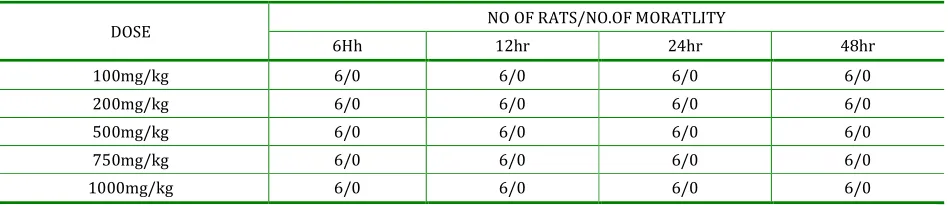
ATH-2K13of various doses were administered orally using an intra-gastric tube and monitored for 48hrs.After the administration of single dose of ATH-2K13 no mortality rates are observed. It was shown in table no.1
ORAL GLUCOSE TOLERANCE TEST
Treatment protocol
All the rats were randomized into five groups comprising of six animals in each group as given below.
Group I: normal rats received (10% acacia mucilage) Group II: normal rats received glucose
Group III: normal rats received 5mg/kg glibenclamide. Group IV: normal rats received 100mg/kg ATH-2K13 Group V: normal rats received 200mg/kg ATH-2K13
ATH-2K13(100mg/kg, 200mg/kg) and Glibenclamide (5mg/kg)8 were administered orally
using an intra-gastric tube. After 30mins of the administration of standard and poly herbal formulation ATH-2K13 orally 1% glucose is administered. Immediately blood glucose levels were monitored at 0hr, 1hr, 2hr, 4 hr. and6 hrs. By using “Glucocheck” blood glucose testing instrument after the administration of single dose of 1%glucose. It was shown in table no.2
Anti-diabetic activity Treatment protocol:
All the rats were randomized into five groups comprising of six animals in each group as given below.
Group I : normal rats received (10% acacia mucilage) Group II : Diabetic control received 65mg/kg 0f Streptozotocin.
Group III: normal rats received 5mg/kg glibenclamide. Group IV: normal rats received 100mg/kg ATH-2K13. Group V: normal rats received 200mg/kg ATH-2K13. Induction of experimental diabetes
It is a chemical method of diabetes induction.
Diabetes was induced by using Streptozotocin.
Streptozotocin (65 mg/kg) was dissolved in ice cold
citrate buffer (pH 4.3) immediately before use. The
Streptozotocin solution10 was injected through I.P
route in the dose of 65 mg/kg in rats. 5 % glucose
solution was administered orally for 24 hrs. This
administration was to prevent mortality due to
initial hypoglycemia induced by Streptozotocin.
After 48 hrs. Of STZ injection, fasting blood glucose
levels were tested by using glucose
oxidase-peroxidase reactive strips of Gluco-check digital
blood sugar monitoring instrument. All the four
groups Rats showing fasting blood glucose more
than 250 mg/kg were considered diabetic and used
for further study.
Anti-Diabetes and Anti-hyperlipidemia
studies
Collection of blood samples and estimation of Biochemical parameters
The total duration of the treatment of grouped animals with the standard extracts of ATH-2K13was 14 days. After 48hrs of the induction of STZ in regular interval days the blood glucose was monitored for all the five groups’ .On 1st day, 3rd
day,5th day, 7th day, 14th day the blood glucose levels
were monitored. On the 15th day, blood samples (Approximately 0.5ml) were collected from overnight fasted rats by puncturing the retro orbital sinus, under mild ether anaesthesia for biochemical estimations11. Blood samples were not allowed to
clot for 30 min and serum was separated by centrifugation at 3000rpm and it is preserved for the estimation of total serum cholesterol, LDL-C, HDL-C, VLDL-C, SGOT, and SGPT. The obtained results were mentioned in table no.4.
Determination of serum lipid profile
Serum cholesterol, triglycerides, LDL-C, HDL-C, SGOT and SGPT were determined by using standard enzymatic kits obtained from ROBONIK (INDIA) PVT.LTD, Mumbai.
In-vivo Anti-oxidant Activity
After the14 days of screening of anti-diabetic and anti-hyperlipedimic activities on 15th day after the
collection of blood from all groups animals by puncturing the retro orbital sinus the blood was collected and undergone for centrifugation at 3000rpm the serum was separated. The animals were then sacrificed and the liver was collected for the estimation of anti-oxidant activity of the test formulation. Liver was rapidly excised, rinsed in ice-cold saline. The 10%w/v homogenate was prepared by using 0.15M KCI, centrifuged at 800 g for 10 min at 4°C12. The supernatant fluid which is obtained
GSH, SOD, and Catalase. The obtained results were mentioned in table no.5
Glutathione
Glutathione (GSH) was estimated by using Elman’s reagent (5, 5- di thio bis-(2-nitrobenzoic acid) [DTNB]). The sulfhydryl groups present in glutathione forms a colour complex with DTNB, which was measured by colorimeter at 412 nm. The amount of glutathione was determined using its molar extinction coefficient of 13600/m/cm and expressed in terms of µ mol/mg of protein13.
Estimation of SOD
Estimation of SOD was done by auto oxidation of hydroxylamine at pH 10.2, which was accompanied by reduction of NBT, and the nitrite produced in the presence of EDTA was detected colorimetrically14.
One enzymatic unit of SOD is the amount in the form of proteins present in 100 ìl of 10% liver homogenate required to inhibit the reduction of 24 mm NBT by 50% and is expressed as units per milligram of protein.
Estimation of catalase
Catalase activity was estimated by determining the decomposition of H2O2 at 240 nm in an assay
mixture containing phosphate buffer15. One
international unit of catalase utilized is that amount that catalyses the decomposition of 1 mm H2O2/min/mg of protein at 37°C.Catalase activity
was calculated using the milli molar extinction coefficient of 0.07 and expressed in terms of micromole per minute per milligram of protein.
Statistical analysis:
All the values of body weight, fasting blood sugar, and biochemical estimations were expressed as mean ± standard error of mean (S.E.M.) and analysed for ONE WAY ANOVA and post hoc Dennett’s t-test using computerized Graph Pad Prism In Stat version 5.0, Graph Pad software. Differences between groups were considered significant at P<0.001 and very significant at P < 0.0001 levels.
RESULTS
In the present study we have employed the screening of anti-diabetic, anti-hyperlipedimic and anti-oxidant activities of ATH-2K13 formulation in Streptopzotocin induced diabetic rats. It is a chemical method of induction. To induce the type-1 diabetes mellitus 65mg/kg body weight of Streptozotocin is used. This dose is given by dissolve in normal saline solution and administered through intraperitoneal route. Before the major screening is employed acute oral toxicity studies and oral glucose tolerance test was conducted and the results were shown in table no-3and 4.The blood glucose levels were gradually decreased from day 1 to day 14.The regular interval blood glucose levels were shown in table no-5. The in-vivo anti-oxidant data was mentioned in table no-6. The total biochemical parameters of blood serum were mentioned in table no.7.The obtained data is biochemical estimations were expressed as mean ± standard error of mean (S.E.M.) and analysed for ONE WAY ANOVA and post hoc Dennett’s t-test using computerized Graph Pad Prism In Stat version 5.0, Graph Pad software. Differences between groups were considered significant at P<0.001 and very significant at P < 0.0001 levels.
DISCUSSION
385.72±10.4 to128.14±3.2. The test group 2 (200mg/kg) blood glucose level is decreased from 378.82±9.3 to108.22±2.50.. From the table no-6significant changes takes place in the anti-oxidant properties of enzymes GSH, SOD and Catalase. From the table no-7 significant changes takes place in the serum profile after the treatment of Streptozotocin groups with standard and test drug doses.
CONCLUSION
ATH-2K13 is a combination methanolic extract of dried fruits of Amla, dried rhizomes of turmeric. Honey itself acts as a vehicle. It had shown some effect in the treatment of Diabetes mellitus,
hyperlipidaemia and it was a good anti-oxidant too. The significant p-value <0.0001 in Streptozotocin induced diabetic rats. The main mechanism of action of poly herbal formulation is to stimulates the b-cells of pancreas there by it reduces hyperglycaemic levels of blood glucose and it also efficiently acts on the lipid profile also. So we the are suggested for further research.
ACKNOWLEDGEMENT
The authors are thankful to the Dr. C Ramesh, SICRA labs Pvt. Ltd, Hyderabad and Miss G V N Kiranamai for their valuable suggestions in the research work and guidance.
Table 1: Phytochemicals constituents of Curcuma longa
Phyto constituents Curcuma longa
Alkaloids Carbohydrates
Glycosides Tannins Proteins and amino
acids Saponins
Steroids Flavonoids
+ + + + + + + + +
Table 2: Phytochemicals constituents of Phyllanthus umbilicus
Phyto constituents Embilica officinalis
Alkaloids Carbohydrates
Glycosides Tannins Proteins and amino acids
Saponins Flavonoids
Phenols
+ + + + + - + +
Table 3: Acute Oral Toxicity Studies of ATH-2K13
DOSE NO OF RATS/NO.OF MORATLITY
6Hh 12hr 24hr 48hr
100mg/kg 6/0 6/0 6/0 6/0
200mg/kg 6/0 6/0 6/0 6/0
500mg/kg 6/0 6/0 6/0 6/0
750mg/kg 6/0 6/0 6/0 6/0
Table 4: Effect of ATH-2K13 on blood glucose level (mg/dl) in Streptozotocin diabetic rats on day 1 of the treatment (OGTT)
TREATMENT FASTING BLOOD GLUCOSE LEVEL (mg/dl)
0hr 1h 2hr 4hr 6hr 24hr
Normal 94±4.15 82±2.45 78.7±4.1 84.8±2.5 92.3±4.0 98.5±2.5
Control (Streptozotocin
65mg/kg)
88.5±1.81 75±3.70 74.4±3.15 85±2.8 91.2±2.2 97.4±3.0
DC + Glibenclamid
(5mg/kg) 86.5±2.51 75.8±1.71 68±3.57 61±2.2*** 72.4±2.7*** 82.5±1.4*** DC+ATH-2K13
(100mg/kg) 82±2.8 77.5±2.8 70.1±3.6 72.6±3.2*** 80.5±2.5*** 91.2±3.0*** DC+ATH-2K13
(200mg/kg) 92.5±3.12 82.7±3.6 78±2.80 82.2±3.5*** 90.5±3.03*** 95.5±3.21**
Values are expressed as Mean ± SEM; *P<0.01; **P<0.001; ***P<0.0001
Table 5: Effect ATH-2K13 on blood glucose level (mg/dl) in Streptozotocin induced diabetic rats
TREATMENT FASTING BLOOD GLUCOSE LEVELS (mg/dl)
1st day 3rd day 5th day 7th day 14th day
Normal 100.32±3.0 85.7±1.1 90±1.4 105.12±1 80.14±3
D.Control(Streptozotocin
65mg/kg) 400.1±5.20 385.4±4.20 405.25±5.2 402.7±8.21 225.4±7.8
DC+Glibenclamide(5mg/kg) 151.8±8.4*** 127.7±4.2*** 95.4±4.14** 85.4±2.4*** 75.02±4.3***
DC+ATH-2K13(100mg/kg) 385.72±10.4*** 318.62±8.20*** 246.62±7.5*** 157.1±2.4*** 128.14±3.2***
DC+ATH-2K13(200mg/kg) 378.82±9.3*** 289.2±3.15*** 178.2±6.3*** 146.8±3.33*** 108.22±2.50*** Values are expressed as Mean ± SEM; *P<0.01 **P<0.001; ***P<0.0001
Table 6: Effect of ATH-2K13 on liver homogenate in Streptozotocin induced diabetic rats after 14 days treatment. (In-vivo Anti-oxidant activity of ATH-2K13)
GROUP GSH
(mg/100g tissue) SOD (Units/mg protein) CAT (U/mg protein)
Normal 64.22±4.32 5.8 ± 1.1 90.24±2.7
D.Control(Streptozotocin
65mg/kg) 34.12 ±3.11** 3.11 ±0.1* 65.01±4.9**
DC + Glibenclamide(5mg/kg) 52.8 ±3.1** 4.92 ±1.4* 82.12 ±3.15*
ATH-2K13(100mg/kg) 48.3 ±3.9** 4.24 ±0.14** 77.21 ±4.2**
ATH-2K13(200mg/kg) 56.70 ±5.16** 4.9 ±1.1* 80.48 ±5.26*
Table 7: Effect of ATH-2K13 on serum lipid profile in Streptozotocin induced diabetic rats after 14 days treatment
TREATMENT TC(mg/dl) HDL-C LDL-C TG(mg/dl) SGOT(U/L) SGPT(U/L) ALP(U/L)
Normal 105.6±1.3 44.2±3.00 34.24±1.2 78.30±2.3 88.54±2.2 33.14±1.5 120.4±1.0 D.Control
(Streptozotocin 65mg/kg)
137.6±2.5 25.65±1.9 64.14±2.22 165.8±1.92 278.0±1.7 96.91±0.45 266.8±1.1
DC + Glibenclamide
(5mg/kg) 117.6±1.9*** 51.3±2.62** 42.35±2.8*** 100.6±2.9*** 154.7±2.5*** 44.14±1.9*** 129.7±2.03*** DC+ATH-2K13
(100mg/kg) 150.9±2.03*** 39.10±1.4 51.4±2.8*** 129.2±2.4*** 185.5±2.25** 52.9±1.1** 148.0±1.0** DC+ATH-2K13
(200mg/kg) 135.6±2.13*** 50.7±1.9** 44.32±2.11*** 108.9±3.45*** 165.4±1.20*** 48.4±1.0*** 134.6±2.24**
REFERENCES
1. Kaleem M, Medha P, Ahmed QA, Asif M, Bano B.
Beneficial effects of Annona squamosa extract in
streptozotocin-induced diabetic rats. Singapore Med
J 2008; 49: 800-804.
2. Menaka CT, Ravirajsinh NJ, Ansarullah T, Ranjitsinh
VD, Ramachnadran AV. Prevention of high fat diet
induced insulin resistance in C57BL/6J mice by Sida
rhomboidea ROXB. Extract. JHealth Sci 2010; 56:
92-98.
3. Sunil C, Latha PG, Suja SR, Shine VJ, Shyamal S, Anuja
GI, et al.Effect of ethanolic extract of Pisonia alba
Span. leaves on blood glucose levels and histological
changes in tissues of alloxan induced diabetic rats.
Int J Appl Res Nat Prod 2009; 2: 4-11.
4. Sunil C, Latha G, Mohanraj KP, Kalichelvan V,
Agastian P. α-Glucosidase inhibitory and antidiabetic
activities of ethanolic extract of Pisonia alba Span.
leaves. Int J Integr Biol 2009; 6:41-45.
5. Lala PK, lab manuals of pharmacognosy, CSI
publishers and distributors Kolkata 1993.
6. Vijay S, Patel V, Chitra P, Lakshmi Prasanna,
Krishnaraju V. Hypoglycemic and other related
actions of Tinosporsa cordifolia roots in alloxan
induced rats. India J Pharmacol: 2008: 183-5.
7. OECD/OCDE, OECD Guidelines for the testing of
chemicals, revised draft guidelines 423: Acute Oral
toxicity- Acute toxic class method, revised document,
CPCSEA, Ministry of Social Justice and
Empowerment, Govt. of India; 2000.
8. A. Navitha, D. A. Helen Sheeba, C. RameshM. Sartaj
Banu,Hypoglycemic and anti-diabetic activity of
ethanolic extract ofCatharanthus pusillus (murray)
g.don.IOSR Journal of PharmacyISSN: 2250-3013,
www.iosrphr.orgVolume 2 Issue 4 July-August 2012
PP.17-21.
9. Mohammed Fazil Ahmed, Syedmohammed Kazim,
Syed Safiullah Ghori, Syeda Sughramehjabeen, Shaik
Rasheed Ahmed,Shaikmehboob Ali, and Mohammed
Ibrahim, (2010), “Antidiabetic Activity of Vinca
Rosea Extracts in Alloxan-InducedDiabetic
Rats”, International Journal of Endocrinology,
Vol.2010
10. Adaramoye OA, Adeyemi EO. Hypoglycemic
andhypolipidemic effects of fractions from kolaviron,
a biflavonoid complex from Garcinia kola in
streptozotocin induced diabetes mellitus rats. J.
Pharma.Pharmacol. 2006; 58:121-8.
11. U.S. Sharma1, A. Kumar Anti-diabetic effect of Rubus
ellipticus fruit extracts in alloxan induced diabetic
rats Journal of Diabetology, June 2011; 2:4
12. S.Divya Teja.Banda, Firasat Ali, D. Suneetha. In-Vivo
Anti-Oxidant of “ATH-2K13” in Normal and CCl4
Induced Rats IJTPR, September2013– November
2013, 5(3), 55-58.
13. Buetler E, Duron O, Kelly BM. Improved method for
determination of blood glutathione. J Lab Clin Med
1963; 61:882–8.
14. Kono Y. Generation of superoxide radical during
autoxidation of hydroxylamine and an assay for
superoxide dismutase. Arch Biochem Biophys 1978;
186:189–95.
15. Luck H. In. Methods of enzymatic analysis. Academic
Press, New York, 1971; 3: 885-894.
How to cite this article: *S. Divya Teja Banda1, K. Ravi Shankar1,T. Jaya Prakash1, Firasat Ali2; Diabetic, Anti-Hyperlipidemic and Anti Oxidant activities of “ATH-2K13” in Streptozotocin induced Diabetic Rats; J. Adv. Pharm. Edu. & Res. 2013: 3(4): 487-493.