Pavan Kumar Potturi
MSN Laboratories Pvt Ltd, Hyderabad Email: [email protected] Address for correspondence
Access this article online www.japer.in
Comparative and Optimization of administration of
Dexlansorazole through nasogastric tubes using an oral liquid
vehicle as a suspending agent
1.0 INTRODUCTION
Proton pump inhibitors (PPIs) are widely used for the
treatment of various acid-related disorders. For
intensive care patients Stress-induced gastrointestinal
tract bleeding (SGIB) is common, Dexlansoprazole is a
PPI that suppresses gastric acid secretion by specific
inhibition of the (H+,K+)-ATPase in the gastric parietal
cell. By acting specifically on the proton pump,
dexlansoprazole blocks the final step of acid
production, and reduces the associated mortality. The
PPIs are sensitive to gastric acid and are formulated to
resist breakdown in the stomach and favour intestinal
absorption [1-5]. The intensive care patients are unable
to swallow for this reason, PPIs have to be
administered by gastric tube after dispersion of
pellets or pellets in water, or in some fruit juices [6-7]. A
number of studies have already been conducted on
the administration of omeprazole [6-10], lansoprazole
[6,9-13] through nasogastric tubes.
The objective of the study was to compare the
suitability of administration of dexlansoprazole
delayed release capsules 60 mg through nasogastric
(NG) tube 16F. In this study, mainly we observe
optimum medium for delivery, mode of
administration and the behaviour of the enteric
coated pellets when administered through nasogastric
tubes 16F. These experimental conditions as close as
possible to clinical practice.
2.0MATERIALS AND METHODS
2.1 Materials:
Dexlansoprazole DR capsules 30 mg (Kapedex) was
supplied by Tap pharmaceuticals and formulated in
our lab. The dexlansoprazole DR capsules was
formulated in gelatin capsules containing enteric
coated pellets or pellets which are gastric resistant
pellets. The pellets were dispersed in apple juice or
water, and injected into the nasogastric tube using a
60 ml catheter-tip syringe with the plunger (Becton
Dickinson). Two types of 16 French gauge
gastroduodenal tubes were used: polyurethane tubes Research
Research Research
Research ArticleArticleArticleArticle
Proton pump inhibitors (PPIs) are widely used for the treatment of various acid-related disorders. For intensive care patients Stress-induced gastrointestinal tract bleeding (SGIB) is common, Dexlansoprazole is a PPI that suppresses gastric acid secretion by specific inhibition of the (H+,K+)-ATPase in the gastric parietal cell. The aim of this study was to compare the behavior of the dexlansoprazole during the transit of the pellets through the nasogastric tube and to optimize the mode of administration. In this experiment we designed to study the influence of four variables: the tube material (silicone or polyurethane), the solvent used to disperse the pellets (water or apple juice), the mode of administration and the rinse volume . We counted the pellets before administration to tube and at the tube outlet, and assayed the dexlansoprazole by UV spectrometry. The assay showed that transit of dexlansoprazole through the tube, was nearly 85.5 to 99.6%. There is asignificant improvement was obtained by the variables ‘diluent’ and ‘mode of administration’. The variable ‘rinse’ had a significant influence. Dexlansoprazole is thus the choice of Proton pump inhibitor for the treatment of patients by nasogastric tube, using a polyurethane tube and a rinse 10 ml of apple juice.
Keywords: Dexlansoprazole, water, apple juice and nasogastric tube. ABSTRACT
ABSTRACT ABSTRACT ABSTRACT Pavan Kumar Potturi1#,
Yajamans Sudhakar2
1 Formulation Research and Development, MSN Laboratories Pvt Ltd, Hyderabad. 2 Govt.Womens Polytechnic College, Kadapa.
(Salem type, length 120 cm, internal diameter 3.8 mm
) and silicone tubes (Levin type, length 125 cm,
internal diameter 3 mm, Vygon). Apple juice
(Tropicana 100%, 1284CB, Schreiber Dynamix
Dairies) and purified water.
2.2 Method:
The administration solvents (Water and apple juice)
and NG tubes used in our experiments were chosen as
closely as possible to those commonly used in
intensive care to compare the recovery of kapidex and
our lab product.
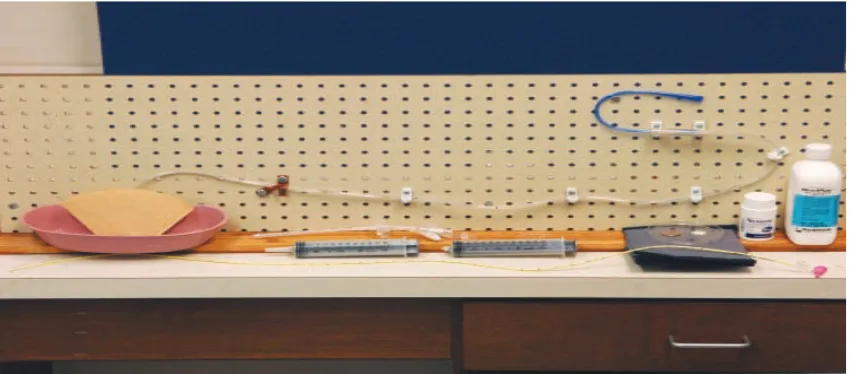
Administered the dexlansoprazole pellets through the
nasogastric tube positioned (figure 1), as it would be
in a reclining patient. In this study we observed the
influence of four variables: the 16 French gauge tube
material (silicone or polyurethane), the nature of the
solvent (water or apple juice), the rinse volume and
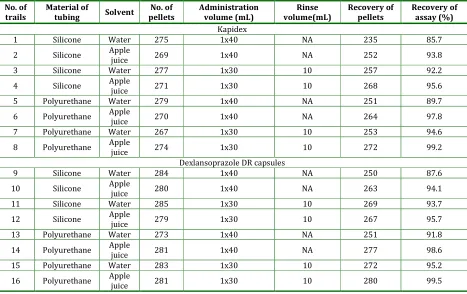
the administration pattern. We have carried out 16
separate experiments (Table 1), each repeated three
times. Before each administration, the tubes were
rinsed with the solvent chosen to carry the pellets.
Procedure:
One Dexlansoprazole 30-mg capsule was then opened
and the pellets emptied into 60 ml catheter-tip
syringe. Added water or apple juice to the syringe up
to the mark. The plunger was then replaced and, with
the tip up, the syringe side to side shaken until the
pellets in the tip moved into the body of the syringe.
The syringe containing the mixture was always
shaken during the administration to prevent pellets
adhering to the syringe wall and the tip requires
elevation and lowering to prevent accumulation of the
pellets near the tip and we maintained a constant flow
rate of injection to limit tube obstruction. The pellets
were then recovered in a plastic beaker placed under
the end of the tube and repeat the same for Kapidex as
mentioned in table 1.
Figure 1: Tubing position
2.3. Analysis of samples:
The pellets were collected at exit of tube, counted and
were analyzed for assay of dexlansoprazole to
compare the Kapidex to our lab product.
2.3.1. Assay of active ingredient
The suspension of pellets collected at the tube exit
was filtered on a 0.45 mm screen to recover the
pellets. These were then dissolved in pure methanol.
After complete dissolution by sonication, the
suspension filtered through 0.45 micron filter. The
clear solutions obtained were then diluted 10-fold and
assayed by UV spectrophotometry at 285 nm. We
determined the percentage of active ingredient
recovered at the tube exit relative to the initial dose
injected into the tube.
2.3.2. Counting of pellets
In addition to the assay, the pellets were counted
No. of trails
Material of
tubing Solvent
No. of pellets
Administration volume (mL)
Rinse volume(mL)
Recovery of pellets
Recovery of assay (%) Kapidex
1 Silicone Water 275 1x40 NA 235 85.7
2 Silicone Apple
juice 269 1x40 NA 252 93.8
3 Silicone Water 277 1x30 10 257 92.2
4 Silicone Apple
juice 271 1x30 10 268 95.6
5 Polyurethane Water 279 1x40 NA 251 89.7
6 Polyurethane Apple
juice 270 1x40 NA 264 97.8
7 Polyurethane Water 267 1x30 10 253 94.6
8 Polyurethane Apple
juice 274 1x30 10 272 99.2
Dexlansoprazole DR capsules
9 Silicone Water 284 1x40 NA 250 87.6
10 Silicone Apple
juice 280 1x40 NA 263 94.1
11 Silicone Water 285 1x30 10 269 93.7
12 Silicone Apple
juice 279 1x30 10 267 95.7
13 Polyurethane Water 273 1x40 NA 251 91.8
14 Polyurethane Apple
juice 281 1x40 NA 277 98.6
15 Polyurethane Water 283 1x30 10 272 95.2
16 Polyurethane Apple
juice 281 1x30 10 280 99.5
* For each experiment, three assays were done.
Table 1: Experiments performed to compare the impact of material-related and administration pattern-related parameters on dexlansoprazole transit through nasogastric tubes
3.0 RESULTS
The assay of the dexlansoprazole showed a recovery
rate of 85.7 to 99.6% with significant variations
between administration pattern and solvent. No
significant difference was found regards
concentration of active ingredient or quantity of
pellets obtained at the tube exit.
In this study, we observed a significant change in the
quantity of pellets collected from one administration
pattern to another (85.2 to 99.6% of dexlansoprazole
recovered, with a variability of about 15%). The
‘solvent’ and ‘administration pattern’ factors gave
significant improvement in the recovery of pellets.
The ‘rinse volume’ also influence to the recovery of
pellets.
4. DISCUSSION
4.1.1. Influence of administration pattern
We investigated whether it was preferable to
administrate the dexlansoprazole pellets. Hence, the
administration pattern also influenced the recovery of
pellets by using different administration patterns,
rinse volume.
4.1.2. Influence of solvent
In intensive care patients the solvents most often used
are water and fruit juice (e.g., apple juice, orange
juice). We consider apple juice (pH:3.2) because it
maintains an acidic medium. the enteric coating
pellets maintain and shows gastro-resistance
property when they arrive in the stomach.
Accordingly, we preferred to focus our study on the
two solvents recognised as being suited to the
administration of dexlansoprazole by nasogastric
tube: water and apple juice. When we used water and
apple juice the recovery was observed 72 % and 86%.
Finally the study shows that there is a significant
difference to recovery of pellets between these two
solvents to recover the pellets.
The analysis of pellet size suggested some possible
explanations for the tube obstruction observed and
demonstrated by measurement of the pellets and by
the inconsistency of the pellet size based on
concentrations and quantities of pellets obtained. All
the administrations of dexlansoprazole was
accompanied by a dual evaluation of the final quantity
recovered: by assay and by counting of pellets. This
dual evaluation revealed the variations in pellet size.
4.2.2. Influence of nature of tubing
We observed that the nature and material of the tube
played a significant role in the delivery of
dexlansoprazole DR pellets (polyurethane tubes
favoured the flow of dexlansoprazole pellets).
However, it is impossible to correlate this difference
to the tube material because for the same gauge (16
French), the two types of tube used did not have the
same internal diameter. The 16 French gauge silicone
tube had a smaller internal diameter than the 16
French polyurethane tube (3mm versus 3.8 mm).
Thus, the influence of the tube material on the
behaviour of the dexlansoprazole pellets is not
precisely known.
5.0 CONCLUSION
Based on the above data, 99.0 % of pellets recovered
from polyurethane nasogastric tube (16F) with apple
juice as a solvent for both Kapidex and our lab
products are similar in nature. Hence dexlansprazole
is the choice for the treatment of intensive care
patients through a nasogastric tube using a
polyurethane tube, apple juice 30 ml as a solvent and
10 ml as a rinse for the administration can be
considered.
6.0 ACKNOWLEDGEMENT
Author’s are thankful to Dr.J.Sreekanth, Senoir General
Manager of Formulation Research and Development,
MSN Labs Pvt Ltd, Mr.R.Amarnath, Senior manager of
Formulation Research and Development, Natco
Pharma Ltd and Mr.K.Venkateswara rao, Manager of
Formulation Research and Development, Natco
Pharma Ltd for technical assistance and providing all
necessary facilities to carry out this research work.
7.0 REFERENCES
1. Keith M. Olsen and Margaret L. Hitzeman ; Dexlansoprazole MR in the Management of Gastroesophageal Reflux Disease, Clinical Medicine:
Therapeutics 2009:1 1641-1652
2. Vakily M, Lee RD, Wu J, et al. , Drug interaction studies with dexlansoprazole modified release (TAK-390MR), a proton pump inhibitor with a dual delayed-release formulation: results of four randomized, double-blind, crossover, placebo-controlled, single-centre studies. Clin Drug Investig 2009; 29(1) :35-50.
3. http://www.accessdata.fda.gov/drugsatfda_docs/nd a/2009/022287s000_ChemR.pdf
4. http://www.druginformation.com/RxDrugs/D/Dexl ansoprazole%20Delayed%20Release%20Capsules.h tml#Description
5. http://dailymed.nlm.nih.gov/dailymed/drugInfo.cfm ?id=23042#nlm34089-3
6. Dunn A, White CM, Reddy P et al. Delivery of omeprazole and lansoprazole granules through a nasogastric tube in vitro. Am J Health-Syst Pharm.
1999; 56:2327-30.
7. Messaouik D, Sautou-Miranda V, Bagel- Boithias S et al. Comparative study and optimisation of the administration mode of three proton pump inhibitors by nasogastric tube. Int J Pharm. 2005; 299:65-72.
8. Larson, C., Cavuto, N.J., Flockhart, D.A., Weinberg, R.B., 1996. Bioavailability and efficacy of omeprazole given orally and by nasogastric tube. Dig. Dis. Sci. 41, 475–479.
9. McAndrews, K.L., Eastham, J.H., 1999. Omeprazole and lansoprazole suspensions for nasogastric administration. Am. J. Health- Syst. Pharm. 56, 81. 10. Sharma, V.K., Peyton, B., Spears, T., Raufman, J.P.,
Howden, C.W., 2000. Oral pharmacokinetics of omeprazole and lansoprazole after single and repeated doses as intact capsules or as suspensions in sodium bicarbonate. Aliment. Pharmacol. Ther. 14, 887–892.
of the contents of a capsule dosage formulation through a nasogastric tube. Clin. Ther. 18, 833–842. 12. Doan, T.T., Wang, Q., Griffin, J.S., O’Dea, R.F., Pan, W.J.,
2001. Comparative pharmacokinetics and pharmacodynamics of lansoprazole oral capsules and suspension in healthy subjects. Am. J. Health-Syst. Pharm. 58, 1512–1519.
13. Freston, J., Chiu, Y.-L., Pan, W.J., Lukasik, N., Taubel, J., 2001. Effect on 24-hour intragastric pH: a
comparison of lansoprazole administered nasogastrically in apple juice and pantoprazole administered intravenously. Am. J. Gastroenterol. 96, 2058–2065.
How to cite this article: Pavan Kumar Potturi, Yajamans Sudhakar2; Comparative and Optimization of
administration of Dexlansorazole through nasogastric tubes using an oral liquid vehicle as a suspending agent; J. Adv. Pharm. Edu. & Res. 2014: 4(1): 75-79.