Information Technology and Control 2017/3/46 308
Text Skew Detection Using
Combined Entropy Algorithm
ITC 3/46Journal of Information Technology and Control
Vol. 46 / No. 3 / 2017 pp. 308-318
DOI 10.5755/j01.itc.46.3.15797 © Kaunas University of Technology
Text Skew Detection Using Combined Entropy Algorithm
Received 2016/07/26 Accepted after revision 2017/07/20
http://dx.doi.org/10.5755/j01.itc.46.3.15797
Corresponding author: [email protected]
Darko Brodić
University of Belgrade, Technical Faculty in Bor, Vojske Jugoslavije 12, 19210 Bor, Serbia e-mail: [email protected]
Zoran N. Milivojević
College of Applied Technical Sciences, Aleksandra Medvedeva 20, 18000 Niš, Serbia e-mail: [email protected]
This paper proposes the algorithm for text skew estimation based on the combined entropy calculation. The method consists of three steps. In the first step, it calculates the horizontal and vertical projection profiles. In the second step, the horizontal and vertical entropy for the rough angles is calculated. In the last step, the hori-zontal and vertical entropy calculation for the smooth angles is performed. The calculated entropy creates the two cost functions: horizontal and vertical. The position where each of cost functions has an absolute minimum represents horizontal and vertical estimated text skew angle. In the last step, it estimates the text skew angle as a mean of horizontal and vertical estimated text skew angles. The functionality, correctness and robustness of the proposed algorithm is investigated by the experiment, which is based on DISEC'13 document database. The obtained results are promising. They confirm that the method correctly estimates text skew angle.
KEYWORDS: algorithm, document image processing, entropy, optical character recognition, text skew.
1. Introduction
Document digitalization is typically carried out by a scanner. As a consequence of this process, the text skew is introduced [30]. Accordingly, the text skew is an unavoidable in digitized document. Humans are very sensitive to any presence of text skew. They can register the text skew of at least 0.1° [13].
Optical character recognition (OCR) is a computer
309 Information Technology and Control 2017/3/46
Hence, the text skew detection and correction is the prerequisite to any recognition step in the OCR sys-tem. As a consequence, the text skew detection rep-resents a mandatory stage in the OCR system [2]. Many different methods have been proposed for the text skew detection in document images [4]. They are usually classified into the following groups: (i) methods based on projection profiles, (ii) clustering of nearest neighbor’s methods, (iii) cross-correlation methods, (iv) methods based on the Hough transform, (v) Fourier transforms methods, (vi) moment based methods, (vii) straight-line fitting methods, and (viii) other methods. However, some researchers classify text skew estimation algorithms into the four catego-ries [15]: (i) projection profiles, (ii) Hough transforms, (iii) nearest neighbor clustering, and (iv) interline cross-correlation. Essentially, the above categoriza-tion can be modified in the following way: (i) Trans-formation methods, (ii) Feature extraction methods, (iii) Clustering methods, and (iv) Hybrid methods. The algorithms based on the mathematical transfor-mations, which extract text features into the space different from image one, are considered as trans-formation methods. Essentially, they convert image space into some other space. After finding a solution in that space, the information is translated into image space in the form of the text skew estimation. They include methods like Hough transform [2], [31], [33], Fourier transform [26], Radon transform [1], [16], log-polar transform [6].
Feature extraction methods perform some geometri-cal and morphologigeometri-cal transformation as well as im-age processing in the imim-age space in order to extract the feature(s), which are used for the estimation of the text skew. They include methods like morphology [22], [35], moments [5], cross-correlation [7], linear regression [32], straight-line fitting [8], [20], connect-ed-components [11], [29], projection profiles [17], [23], [27], [28].
Clustering methods perform the extraction of particu-lar type of data characterized by some feature(s) from the database. Typically, these methods can be used for any kind of data given in a big database. According to their methodology and given criteria, the extraction of certain data is performed. These types of methods need to be adjusted for solving the text skew estimation problem. They include methods like K-nearest neigh-bor [12], [14], [19], fuzzy c-regression models [18].
Hybrid methods combine different aforementioned techniques using additional preprocessing steps. Pre-processing steps are used to improve the efficiency of the certain algorithm by solving some of its disadvan-tages, which are present in its basic form. In this way, they represent complex algorithms or systems that are computer time intensive, but efficient in the esti-mation of the text skew [9], [10], [21], [34].
From the aforementioned methods, we choose to ex-plore the extension of the projection profiles method, which is classified as a feature extraction method. A method based on the projection profiles is widely used to detect the text skew angle. It is an easy method which sums up the pixels in the rotated document im-age creating a histogram at each possible angle. Then a cost function is applied to these histograms. The op-timization of the cost function detects the text skew angle. The extension of this method is given in [3], by introducing the entropy concept. Furthermore, the combination of the vertical and horizontal projection profiles method is introduced in [25].
The aim of this paper is to describe an algorithm for the text skew estimation based on the entropy. Ac-cordingly, we suggest the optimization of previously proposed entropy method [3], which leads to speeding up the algorithm by the factor up to 4 times. Further-more, the method is extended by calculating entropy from vertical projection profiles, too. As a result, the two different methods estimate the text skew angle: (i) horizontal based entropy and (ii) vertical based entro-py. Finally, their combination in the form of the mean is calculated. It gives the best estimation result. This approach is called a combined entropy algorithm. It is similar to the one given in [25], which used both hori-zontal and vertical projection profiles to calculate the text skew of the image. However, our approach uses an entropy calculation instead of projection profile ones, which represents the extension to the method given in [3], [25]. The proposed combined entropy as well as each of the entropy algorithms is tested using a document database DISEC'13 during the experiment [24]. The results of the experiment are compared to the well-known Chou’s algorithm [8], Mascaro’s algo-rithm [20], and validated according to the widely ac-cepted methodology [24].
Information Technology and Control 2017/3/46 310
quantify the tested algorithm. Section 5 shows the experimental results and discusses them. Section 6 draws conclusions.
2. Entropy Based Method
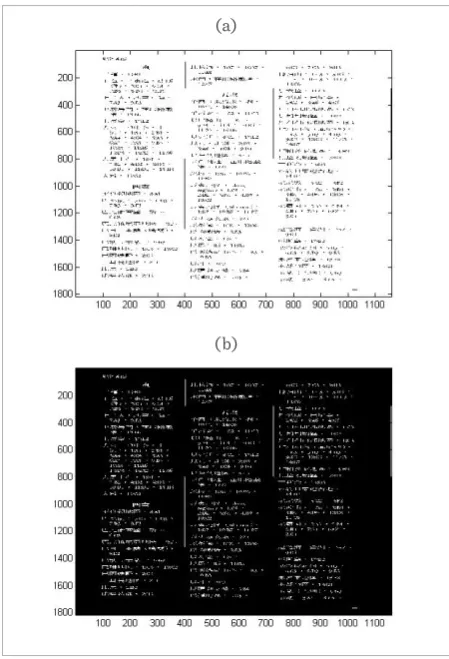
The proposed algorithm detects the text skew angle in a document image by calculating entropy of the projection profiles. The preprocessing stage, which includes cleaning of documents, extracting blocks and denoising images [3] is out of the scope of our approach. Figure 1 shows the flow diagram of the pro-posed algorithm in a general manner.
The proposed method is applied to the binary image B(i, j) with M rows and N columns.
Figure 2 shows the initial binary image B ((a) skewed for 0.11°, (b) complementary image).
Figure 1
The flow diagram of the entropy based algorithm
Figure 2
The Initial binary image: (a) skewed for the angle of 0.11°, (b) complementary image
3
Start
Min Entropy? θprefinal= θstart θstart= -15 θend= 15
Entropy calculation θstart stepc θend
θstart= θstart+ stepc
Min Entropy? θfinal= θprefinal Image rotation for θprefinal- stepc
Entropy calculation θprefinal – stepc stepf θprefinal + stepc
θprefinal= θprefinal+ stepf
Skew detection θfinal
End Image rotation for θstart
Figure 1. The flow diagram of the entropy based algorithm
(a)
4 (b)
Figure 2. The Initial binary image: (a) skewed for the angle of 0.11, (b) complementary image
The horizontal projection profile of the binary image B is calculated as:
1
( ) N ( , )
j HPP i B i j
(1)where i = 1, ..., M represents the row and j = 1, ..., N represents the column of the image B. Each element of the horizontal projection profiles HPP(i) represents the sum of the pixel values in the corresponding row. Similarly, the vertical projection profile of the binary image B is calculated as:
1
( ) M ( , )
i VPP j B i j
(2)where i = 1, ..., M represents the row and j = 1, ..., N of the image B. Currently, each element of the vertical projection profiles VPP(j) represents the sum of the pixel values in the corresponding column.
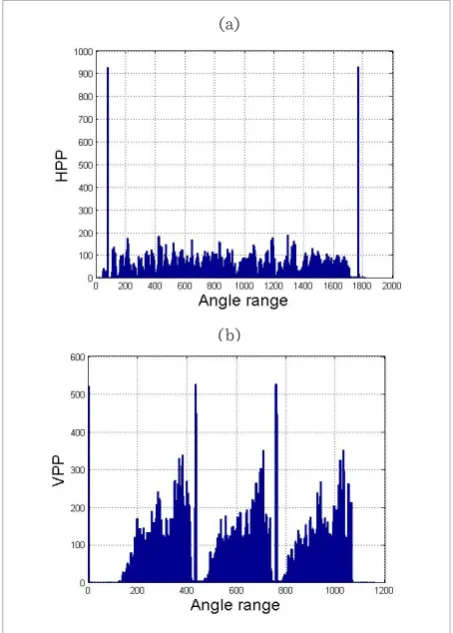
Figure 3 (a) and (b) shows a corresponding horizontal and vertical projection profiles (HPP and VPP) for document image given in Figure 2 (b).
Currently, the number of pixels per row (horizontal projection profiles) is under observation. It is clear that the highest value will be received when the text is unskewed. Hence, the procedure of rotating skewed image in the range of angles with certain angle step will establish the HPP.
(a)
3 Start
Min Entropy?
θprefinal= θstart
θstart= -15 θend= 15
Entropy calculation
θstart stepc θend
θstart= θstart+ stepc
Min Entropy?
θfinal= θprefinal
Image rotation for θprefinal- stepc
Entropy calculation
θprefinal – stepc stepf θprefinal + stepc
θprefinal= θprefinal+ stepf
Skew detection θfinal
End Image rotation for θstart
Figure 1. The flow diagram of the entropy based algorithm
(a) (a)
(b)
The horizontal projection profile of the binary image B is calculated as:
1
( ) N ( , )
j
HPP i B i j
=
=
∑
(1)311 Information Technology and Control 2017/3/46
(b) (a) 1
( ) M ( , )
i
VPP j B i j
=
=
∑
(2)where i = 1, ..., M represents the row and j = 1, ..., N of the image B. Currently, each element of the vertical projection profiles VPP(j) represents the sum of the pixel values in the corresponding column.
Figure 3 (a) and (b) shows a corresponding horizon-tal and vertical projection profiles (HPP and VPP) for document image given in Figure 2 (b).
Currently, the number of pixels per row (horizontal projection profiles) is under observation. It is clear that the highest value will be received when the text is unskewed. Hence, the procedure of rotating skewed image in the range of angles with certain angle step will establish the HPP.
Figure 3
Projection profiles for skewed image (0.1°): (a), Horizontal Projection Profile (HPP) and (b) Vertical Projection Profile (VPP)
4 (b)
Figure 2. The Initial binary image: (a) skewed for the angle of 0.11, (b) complementary image
The horizontal projection profile of the binary image B is calculated as:
1
( ) N ( , )
j
HPP i B i j
(1)where i = 1, ..., M represents the row and j = 1, ..., N represents the column of the image B. Each element of the horizontal projection profiles HPP(i) represents the sum of the pixel values in the corresponding row. Similarly, the vertical projection profile of the binary image B is calculated as:
1
( ) M ( , )
i
VPP j B i j
(2)where i = 1, ..., M represents the row and j = 1, ..., N of the image B. Currently, each element of the vertical projection profiles VPP(j) represents the sum of the pixel values in the corresponding column.
Figure 3 (a) and (b) shows a corresponding horizontal and vertical projection profiles (HPP and VPP) for document image given in Figure 2 (b).
Currently, the number of pixels per row (horizontal projection profiles) is under observation. It is clear that the highest value will be received when the text is unskewed. Hence, the procedure of rotating skewed image in the range of angles with certain angle step will establish the HPP.
(a)
5
(b)
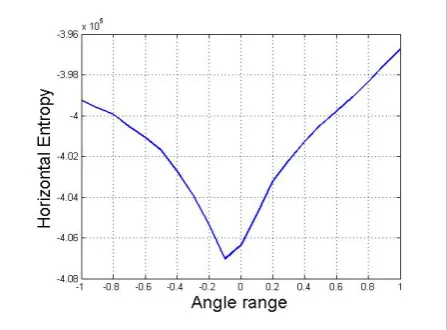
Figure 4. The horizontal entropy cost function Ehfor the skewed image (0.11) established by rotating the image using angles
from -15 to +15 with the step 1 (minimum determines θh,prefinal)
Using horizontal projection profiles as a basis, we can introduce the concept of horizontal entropy Eh. The entropy is determined as a statistical measure of ima-ge randomness. The horizontal entropy, i.e. the entro-py per row is calculated as [3]:
(
)
1
( ) M ( ) log ( )
h i
E i HPP i HPP i
=
=
∑
- ⋅ (3)If the text-line has more randomness in its texture, then Eh (i) will receive higher values. In the original algorithm [3], the full range of Eh(i) is used for calcu-lation of the cost function Eh.
Similarly, vertical entropy Ev can be defined. The vertical entropy, i.e. the entropy per column is calcu-lated as:
(
)
1
( ) N ( ) log ( )
v j
E j VPP j VPP j
=
=
∑
- ⋅ (4)Hence, the full range of Ev(j) is used for calculation of the cost function Ev.
Typically, in order to detect the text skew with the ac-curacy of 0.1° in the text skew range from -15° to +15°, it is necessary to calculate all entropy values for the text images rotated by the step of 0.1°, i.e. 300 times. To reduce the search space for the text skew angle de-tection, a simple optimization technique is proposed, which is less computer time intensive than the one given in [25]. In our case the number of calculations will be only 40 times.
Information Technology and Control 2017/3/46 312
Figure 5 illustrates the vertical entropy cost function Ev for document image given in Figure 2 (b) with the accuracy of 1°.
To correctly detect the text skew angle (with the ac-curacy of 0.1°), we have to explore the neighborhood of the cost function minimum Eh and Ev, respectively. Hence, in the second stage the subrange around the prefinal text skew angle θh,prefinal and θv,prefinal given by Eh and Ev, which represent the current minimum of the cost function is examined.
Figure 4
The horizontal entropy cost function Ehfor the skewed
image (0.11°) established by rotating the image using
angles from -15° to +15° with the step 1° (minimum
determines θh,prefinal)
The final text skew should be in its nearby of 1° around the cost function minimum. Hence, we divide the step stepc of 1° equally to the left and right side around the minimum. Accordingly, the image is rotated from θpre-final- stepc/2 to θprefinal + stepc/2 with the finer step stepf. The step stepf is equal to 0.1°, in order to achieve the accuracy of 0.1°. The newly obtained result for the minimal entropy Eh or Ev represents the final estimat-ed text skew, i.e. θh,final or θv,final, respectively, with the accuracy of 0.1°.
Figure 6 illustrates the horizontal entropy cost func-tion Eh for document image given in Figure 2 (b) with the accuracy of 0.1°.
Figure 5
The vertical entropy cost function Evfor the skewed image
(0.11°) established by rotating the image using angles from
-15° to +15° with the step 1° (minimum determines θv,prefinal)
Figure 6
The horizontal entropy cost function Eh for the skewed
image (0.11°) established by rotating the image using
angles around the minimum cost function from -stepc/2 to
+stepc/2 with the step of 0.1° (minimum determines θh,final)
Figure 7 illustrates the vertical entropy cost function Ev for document image given in Figure 2 (b) with the accuracy of 0.1°.
The final detected minimum of the horizontal and vertical entropy cost function Eh and Ev represents the estimated text skew θh,final and θv,final obtained by the algorithm with the accuracy of 0.1°.
313 Information Technology and Control 2017/3/46
, ,
, h final2 v final
c final
θ θ
θ = + (5)
In the current case, it is also equal to 0.1°, because both θh, final and θv, final are equal to 0.1° with an error of 0.1°. However, the mean of these values achieves bet-ter accuracy of detected text skew, because it is less sensitive to noise and easy to follow multi-column disposition of the document [25].
Figure 7
The vertical entropy cost function Ev for the skewed
image (0.11°) established by rotating the image using
angles around the minimum cost function from -stepc/2 to
+stepc/2 with the step of 0.1° (minimum determines θv,final)
3. Experiment
The experiment consists of two parts. In the first part, a few text documents are rotated from -15° to +15° by the step of 0.1°. This experiment is used only to prove that our optimized approach is better than the origi-nal entropy based algorithm [3].
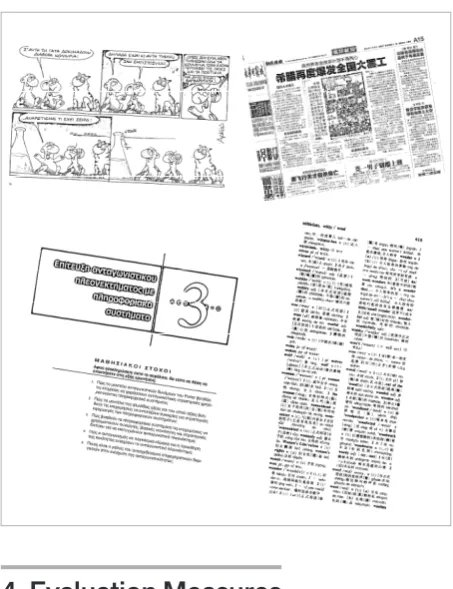
In the second part, the Document Image Skew Esti-mation Contest (DISEC'13) is used [24]. It is recog-nized as a standard tool for unbiased testing of the algorithms for the text skew detection. DISEC'13 consists of 20 different images that are ten times dif-ferently skewed, which creates the total of 200 im-ages. Furthermore, all these 200 images are used for exploring the quality of the text skew algorithm in predicting the document inclination. It includes plain text documents, newspaper samples, dictionary pag-es, book excerpts, documents with text, images and/
or drawings. The documents are written in different languages, like Chinese, English and Greek or their multilingual combination. Documents from the data-base are randomly rotated at different angles, ranging from -15° to +15°. The result of the experiment shows the deviation of the estimated text skew obtained by the tested algorithm and correct text skew value from DISEC'13 database (truth-table).
Figure 8 illustrates a few document images from DIS-EC'13 database.
Figure 8
Document image samples from DISEC’13 database
4. Evaluation Measures
Information Technology and Control 2017/3/46 314 1 ( ) X d Dist d AED X =
=
∑
(6)where d = 1, ..., X is the number of documents taken from the DISEC'13 database, and Dist(d) is the dis-tance between the estimated text skew and truth-ta-ble. In our case, we calculate three versions of the es-timated text skew, i.e. θh, final, θv, final and θc, final. At the end, the comparison will be made and the best version of the entropy based algorithm will be proposed. To cal-culate TOP80 measures, the distance Dist(d) should be sorted in ascending order. Then, the first 80% of the documents with the smallest Dist(d) was chosen to represent sDist(d) in order to calculate TOP80 as:
1 ( ) 80 Y d sDist d TOP Y =
=
∑
(7)where d = 1, ..., Y is the number of the first 80% of DIS-EC'13 documents, and sDist(d) is the list of the 80% documents with the smallest distance between the estimated text skew and truth-table. TOP80 char-acterizes 80% of the best text skew estimations pro-duced by tested algorithm.
The last proposed measure represents CE. It is calcu-lated as:
1 ( )
1 if ( ) 0.1
where ( )
0 otherwise X d K d CE X Dist d K d = = ≤ ° =
∑
(8) where 1 ( )1 if ( ) 0.1
where ( )
0 otherwise
X
d K d
CE X Dist d K d = = ≤ ° =
∑
This measure is given in percent. It is worth noting that 0.1° may be visible to a human observer [13]. Hence, it is chosen as the threshold element in eq. (8).
5. Results and Discussion
The results from the first part of the experiment are used to compare the original entropy based algorithm [3] with our optimized approach. Accordingly, the op-timized horizontal entropy algorithm is compared to
the original one, because the original algorithm is us-ing only horizontal entropy approach. These results are given in the min, max and average error manner. If we draw a parallel to the three aforementioned mea-sures, then min, max and average are calculated in ac-cordance to Dist(d). The obtained results are given in Table 1.
Error Original Entropy Horizontal Entropy (Optimized)
min 0.15 0.10
max 0.30 0.25
average 0.192 0.166 Table 1
The results of the original and optimized entropy based algorithms
Horizontal
Entropy EntropyVertical Combined Entropy
AED 0.118 0.079 0.098
TOP80 0.050 0.051 0.060
CE 72.00 70.00 76.00
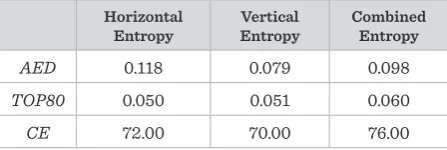
It is clear that the original algorithm is outperformed by our simplest horizontal entropy based algorithm in terms of error correctness. The second part of the ex-periment is much more important for the real valida-tion of the proposed versions of the entropy based al-gorithm. According to the measures AED, TOP80 and CE, all three versions of the entropy based algorithm for text skew detection are evaluated. The results are given in Table 2.
Table 2
The results of different entropy based algorithms
315 Information Technology and Control 2017/3/46
Chou et al.’s
algorithm Mascaro et al.’s algorithm
AED 1.198 0.556
TOP80 0.103 0.060
CE 45.50 57.00
The interpretation of the results linked to the AED measure shows that Mascaro et al.‘s algorithm com-pared to Chou et al.'s algorithm makes twice lower accumulated errors in estimating text skew. However, it is 5-6 times higher than any of our versions of the entropy based algorithm.
Furthermore, the CE measure shows the following: (i) Chou et al.'s algorithm estimated only 45.50% of all images with the error below or equal to 0.1°, (ii) Mascaro et al.‘s algorithm estimated 57.00% of the all images with the error below or equal to 0.1°. It is an ob-vious step forward in terms of optimization and cor-rectness of the algorithm. Still, the comparison with our simplest version of the entropy based algorithm shows that our algorithm has clear advantages. It can estimate the text skew with an error below or equal to 0.1° in 72.00% of cases. Even better, the combined en-tropy algorithm obtained the results of 76.00%. At the end, TOP80 measure shows that Chou et al.‘s algorithm has many big misses in the text skew esti-mation. On the contrary, Mascaro et al.‘s algorithm is much better in estimating text skew on the best 80.00% results. It can be said that it is almost on a par with different versions of the entropy based algorithm. From all above, it is clear that the proposed entropy based versions of the algorithm have the real poten-tial for text skew detection. Hence, it can be noted that any of our versions of the algorithm outperforms by a large margin Chou et al. and Mascaro et. al. algo-rithms. Obviously, the entropy based algorithm has a clear advantage over both of these algorithms. Furthermore, the comparison is made with the newly developed accurate text skew estimation algorithm based on Hough space derivatives [31], which in-cludes many steps and complex calculations. Various derivatives of the same algorithm with different val-ues of parameters are shown in Table 4.
Table 3
The results obtained from Chou et al.'s and Mascaro et al.'s algorithms
Table 4
The results of the algorithm based on Hough space derivatives
vertical
estimation estimationhorizontal weightsequal tuned on expe- rimental set
AED 1.088 0.165 0.103 0.115
TOP80 0.115 0.055 0.048 0.049
CE 53.10 68.71 73.61 73.74
If we compare our combined entropy algorithm with the best version of the algorithm based on Hough space derivatives (which is tuned on experimental set), then our algorithm has a better AED of 0.098 compared to 0.115 (margin of approximately 17%), and better CE of 76.00% compared to 73.74% (margin of approximately 3%), while TOP80 is slightly worse, i.e. 0.060 compared to 0.049 (margin of approximatel-ly 12%).
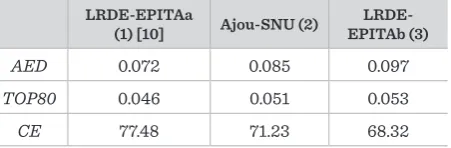
From above results, it can be noted that our algorithm has an advantage in correctly estimating text skew an-gles in the whole database of document. Hence, the ac-cumulated text skew error is smaller (AED measure). In addition, it makes smaller errors in predicting doc-ument text skew by the margin of 0.1° (CE measure). Still, the given algorithm has a better result if we take into account 80% of database documents with the smallest errors. Hence, it can be noted that in other 20% of database documents predicting errors is high. At the end, the comparison is made with the high per-formance complex algorithms, which includes many stages with complex calculations. These algorithms have won the best three places in the ICDAR contest. Their results are shown in Table 5.
If we compare these results with different versions of the entropy based algorithm, it is clear that the
pro-Table 5
The results of best algorithms on ICDAR contest
LRDE-EPITAa
(1) [10] Ajou-SNU (2) EPITAb (3)
LRDE-AED 0.072 0.085 0.097
TOP80 0.046 0.051 0.053
Information Technology and Control 2017/3/46 316
posed algorithm is on a par with these algorithms. In fact, it will be on the second place in this contest. However, it is worth noting that in some cases the entropy based algorithm (2-3 document images out of all) creates a rather high error in text skew estima-tion. Obviously, some kind of preprocessing would be helpful to reduce such errors. If it it going to be solved in further research, the proposed versions of the en-tropy based algorithm will outperform the best of the given complex algorithms.
6. Conclusion
The paper proposed the optimized entropy based algorithm for the text skew estimation as well as its extension by introducing the horizontal, verti-cal and combined entropy versions of the algorithm. The basic entropy method was optimized by incor-porating two stages with so-called rough and fine step rotation of the analyzed image. In this way, the proposed algorithm was speeding up introduc-ing a better accuracy. Furthermore, the extended version of the entropy algorithm based on the hori-zontal and vertical projection profiles is developed. As a final step, a combined algorithm is created
using horizontal and vertical entropy algorithm. All versions of the proposed algorithm were tested us-ing DISEC'13 database, which contains a variety of doc-ument images written in different scripts, including dif-ferent elements like images, comics and so on. Then, the proposed algorithm was compared to the well-known text skew estimation methods proposed by Chou et al. and Mascaro et al. Any version of our method shows clear advantages over these algorithms. At the end, the versions of the entropy based algorithm are compared to a newly developed complex algorithm as well as the complex algorithms used in the ICDAR contest. The ob-tained results of the experiment show that the proposed algorithm is on a par with these algorithms.
Future research will be toward improving the algorithm by adding some preprocessing techniques in order to further reduce the text skew estimation error.
Acknowledgments
This work was supported in part by the Grant of the Ministry of Education, Science and Technological Development of the Republic Serbia, as a part of the project TR33037.
References
1. Aithal, P. K., Karnataka, M., Rajesh, G., Siddalingas-wamy, P. C., Acharya, D. U. A Novel Skew Estimation Approach Using Radon Transform. International Con-ference on Hybrid Intelligent Systems (HIS), Mellaca, 2011, 1-4. https://doi.org/10.1109/HIS.2011.6122070 2. Amin, A., Fischer, S. A Document Skew Detection
Method Using the Hough Transform. Pattern Analy-sis and Applications, 2000, 3(3), 243-253. https://doi. org/10.1007/s100440070009
3. Arvind, K. R., Kumar, J., Ramakrishnan, A. G. Entro-py Based Skew Correction of Document Images. Pat-tern Recognition and Machine Intelligence (PReMI 2007), LNCS 4815, Kolkata, 2007, 495-502. https://doi. org/10.1007/978-3-540-77046-6_61
4. Brodić, D., Milivojević, D. R. An Algorithm for the Es-timation of the Initial Text Skew. Information Tech-nology and Control, 2012, 41(3), 211-219. https://doi. org/10.5755/j01.itc.41.3.1249
5. Brodić, D., Milivojević, Z. N. Estimation of the Hand-written Text Skew Based on Binary Moments. Radioen-gineering, 2012, 21(1), 162-169.
6. Brodić, D., Milivojević, Z. N. Log-Polar Transformation as a Tool for Text Skew Estimation. Elektronika Ir Elek-trotechnika, 2013, 19(2), 61-64. https://doi.org/10.5755/ j01.eee.19.2.3471
7. Chaudhuri, A., Chaudhuri, S. Robust Detection of Skew in Document Images. IEEE Transactions on Image Processing, 1997, 6(2), 344-349. https://doi. org/10.1109/83.551708
8. Chou, C. H., Chu, S. Y., Chang, F. Estimation of Skew An-gles for Scanned Documents Based on Piecewise Cover-ing by Parallelograms. Pattern Recognition, 2007, 40(2), 443-455. https://doi.org/10.1016/j.patcog.2005.10.030 9. Dhanya, D., Ramakrishnan, A. G., Pati, P. B. Script
Sad-317 Information Technology and Control 2017/3/46
hana, 2002, 27(1), 73-82. https://doi.org/10.1007/ BF02703313
10. Fabrizio, J. A Precise Skew Estimation Algorithm for Document Images Using KNN Clustering and Fou-rier Transform. International Conference on Image Processing (ICIP), Paris, 2014, 2585-2588. https://doi. org/10.1109/ICIP.2014.7025523
11. O’Gorman, L., Kasturi, R. Executive Briefing: Document Image Analysis. IEEE Computer Society Press, 1997, 1-127.
12. Hashizume, A., Yeh, P. S., Rosenfeld, A. A Method of De-tecting the Orientation of Aligned Components. Pattern Recognition Letters, 1986, 4(2), 125-132. https://doi. org/10.1016/0167-8655(86)90034-6
13. Hull, J. J. Document Analysis Systems II. S. L. Tay-lor (Eds.), World Scientific, 1998, 40-64. https://doi. org/10.1142/9789812797704_0003
14. Jiang, X., Bunke, H., Widmer-Kljajo, D. Skew Detection of Document Images by Focused Nearest-Neighbor Clustering. 5th International Conference on Document Analysis and Recognition, Bangalore, 1999, 629-632. 15. Jung, K., Kim, K., Jain, A. K. Text Information
Ex-traction in Images and Video: A Survey. Pattern Recog-nition, 2004, 37(5), 977-997. https://doi.org/10.1016/j. patcog.2003.10.012
16. Kapoor, R., Bagai, D., Kamal, T. S. A New Algorithm for Skew Detection and Correction. Pattern Recog-nition Letters, 2004, 25(11), 1215-1229. https://doi. org/10.1016/j.patrec.2004.03.020
17. Li, S., Shen, Q., Sun, J. Skew Detection Using Wavelet Decomposition and Projection Profile Analysis. Pattern Recognition Letters, 2007, 28(5), 555-562. https://doi. org/10.1016/j.patrec.2006.10.002
18. Lin, C.-T., Fan, K.-W., Yeh, C.-M., Pu, H.-C., Wu, F.-Y. High-Accuracy Skew Estimation of Document Imag-es. International Journal of Fuzzy Systems, 2006, 8(3), 119-126.
19. Lu, Y., Tan, C. L. Improved Nearest Neighbor Based Ap-proach to Accurate Document Skew Estimation. 7th International Conference on Document Analysis and Recognition (ICDAR’03), Edinburgh, 2003, 503-507. 20. Mascaro, A. A., Cavalcanti, G. D. C., Mello, C. A. B. Fast
and Robust Skew Estimation of Scanned Documents Through Background Area Information. Pattern Rec-ognition Letters, 2010, 31(11), 1403-1411. https://doi. org/10.1016/j.patrec.2010.03.016
21. Meng, G., Pan, C., Zheng, N., Sun, C. Skew Estimation of Document Images Using Bagging. IEEE Transactions
on Image Processing, 2010, 19(7), 1837-1846. https:// doi.org/10.1109/TIP.2010.2045677
22. Najman, L. Using Mathematical Morphology for Docu-ment Skew Estimation. SPIE DocuDocu-ment Recognition and Retrievals XI, SPIE Proceedings, 2004, 5296, 182-191. 23. Papandreou, A., Gatos, B. A Novel Skew Detection
Technique Based on Vertical Projections. 11th Interna-tional Conference on Document Analysis and Recog-nition (ICDAR’11), Beijing, 2011, 384-388. https://doi. org/10.1109/ICDAR.2011.85
24. Papandreou, A., Gatos, B., Louloudis, G., Stamatopou-os, N. ICDAR2013 Document Image Skew Estimation Contest (DISEC'13). 12th International Conference on Document Analysis and Recognition, (ICDAR’13), Washington, 2013, 1444-1448.
25. Papandreou, A., Gatos, B., Perantonis, S. J., Gerardis, I. Efficient Skew Detection of Printed Document Imag-es Based on Novel Combination of Enhanced ProfilImag-es. International Journal on Document Analysis and Rec-ognition (IJDAR), 2014, 17(4), 433-454. https://doi. org/10.1007/s10032-014-0228-5
26. Peake, G. S., Tan, T. N. A General Algorithm for Docu-ment Skew Angle Estimation. 4th International Confer-ence in Image Processing (ICIP), Santa Barbara, 1997, 2, 230-233. https://doi.org/10.1109/ICIP.1997.638728 27. Postl, W. Detection of Linear Oblique Structures and
Skew Scan in Digitized Documents. International Con-ference on Pattern Recognition (ICPR), Paris, 1986, 687-689.
28. Sadri, J., Cheriet, M. A New Approach for Skew Correc-tion of Documents Based on Particle Swarm Optimiza-tion. 10th International Conference on Document Anal-ysis and Recognition (ICDAR’09), Barcelona, 2009, 1066-1070. https://doi.org/10.1109/ICDAR.2009.268 29. Sarfraz, M., Mahmoud, S. A., Rasheed, Z. On Skew
Es-timation and Correction of Text. International Con-ference on Computer Graphics, Imaging and Visuali-sation (CGIV’07), Bangkok, 2007, 308-313. https://doi. org/10.1109/CGIV.2007.63
30. Sarfraz, M., Rasheed, Z. Skew Estimation and Correc-tion of Text Using Bounding Box. 5th InternaCorrec-tional Conference on Computer Graphics, Imaging and Vi-sualization (CGIV’08), Penang, 2008, 259-264. https:// doi.org/10.1109/CGIV.2008.10
Information Technology and Control 2017/3/46 318
32. Shivakumara, P., Hematha Kumar, G., Guru, D. S., Naga-bhushan, P. A Novel Technique for Estimation of Skew in Binary Text Document Images based on Linear Re-gression Analysis. Sadhana, 2005, 30(1), 69-85. https:// doi.org/10.1007/BF02710080
33. Srihari, S. N., Govindaraju, V. Analysis of Textual Imag-es Using the Hough Transform. Machine Vision and Ap-plications, 1989, 2(3), 141-153. https://doi.org/10.1007/ BF01212455
34. Stahlberg, F., Vogel, S. Document Skew Detection Based on Hough Space Derivatives. 13th International Con-ference on Document Analysis and Recognition, (IC-DAR’15), Tunis, 2015, 366-370.
35. Sun, C., Si, D. Slant Correction for Document Images Using Gradient Direction. 4th International Confer-ence on Pattern Recognition (ICPR), Santa Barbara, 1997, 1, 142-146.
Summary / Santrauka
This paper proposes the algorithm for text skew estimation based on the combined entropy calculation. The method consists of three steps. In the first step, it calculates the horizontal and vertical projection profiles. In the second step, the horizontal and vertical entropy for the rough angles is calculated. In the last step, the hori-zontal and vertical entropy calculation for the smooth angles is performed. The calculated entropy creates the two cost functions: horizontal and vertical. The position where each of cost functions has an absolute minimum represents horizontal and vertical estimated text skew angle. In the last step, it estimates the text skew angle as a mean of horizontal and vertical estimated text skew angles. The functionality, correctness and robustness of the proposed algorithm is investigated by the experiment, which is based on DISEC'13 document database. The obtained results are promising. They confirm that the method correctly estimates text skew angle.