J TT
ISSN 0974-7907 (Online)
ISSN 0974-7893 (Print)
15 February 2019 (Online & Print)
Vol. 11 | No. 2 | 13195–13250
Building evidence for conservation globally
10.11609/jott.2019.11.2.13195-13250
www.threatenedtaxa.org
PLATINUM
OPEN
ACCESS
Journal of Threatened Taxa
EDITORS
Founder & Chief Editor Dr. Sanjay Molur
Wildlife Information Liaison Development (WILD) Society & Zoo Outreach Organization (ZOO), 12 Thiruvannamalai Nagar, Saravanampatti, Coimbatore, Tamil Nadu 641035, India
Deputy Chief Editor Dr. Neelesh Dahanukar
Indian Institute of Science Education and Research (IISER), Pune, Maharashtra, India
Managing Editor
Mr. B. Ravichandran, WILD, Coimbatore, India
Associate Editors
Dr. B.A. Daniel, ZOO, Coimbatore, Tamil Nadu 641035, India Ms. Priyanka Iyer, ZOO, Coimbatore, Tamil Nadu 641035, India
Dr. Mandar Paingankar, Department of Zoology, Government Science College Gadchiroli, Chamorshi Road, Gadchiroli, Maharashtra 442605, India
Dr. Ulrike Streicher, Wildlife Veterinarian, Eugene, Oregon, USA
Editorial Assistant
Vidya Mary George, Bengaluru, India
Editorial Board Ms. Sally Walker
Founder/Secretary, ZOO, Coimbatore, India
Dr. Robert Lacy
Department of Conservation Biology, Chicago Zoological Society (also known as the Brookfield Zoo), Brookfield, Illinois 60513 USA; and Committee on Evolutionary Biology, University of Chicago
Dr. Russel Mittermeier
Executive Vice Chair, Conservation International, Arlington, Virginia 22202, USA
Prof. Mewa Singh Ph.D., FASc, FNA, FNASc, FNAPsy
Ramanna Fellow and Life-Long Distinguished Professor, Biopsychology Laboratory, and Institute of Excellence, University of Mysore, Mysuru, Karnataka 570006, India; Honorary Professor, Jawaharlal Nehru Centre for Advanced Scientific Research, Bangalore; and Adjunct Professor, National Institute of Advanced Studies, Bangalore
Dr. Ulrike Streicher, DVM
Wildlife Veterinarian / Wildlife Management Consultant, 1185 East 39th Place, Eugene, OR 97405, USA
Stephen D. Nash
Scientific Illustrator, Conservation International, Dept. of Anatomical Sciences, Health Sciences Center, T-8, Room 045, Stony Brook University, Stony Brook, NY 11794-8081, USA
Dr. Fred Pluthero Toronto, Canada
Dr. Martin Fisher
Cambridge, UK
Dr. Ulf Gärdenfors
Professor, Swedish Species Information Center, SLU, Uppsala, Sweden
Dr. John Fellowes
Honorary Assistant Professor, The Kadoorie Institute, 8/F, T.T. Tsui Building, The University of Hong Kong, Pokfulam Road, Hong Kong
Dr. Philip S. Miller
Senior Program Officer, Conservation Breeding Specialist Group (SSC/IUCN), 12101 Johnny Cake Ridge Road, Apple Valley, MN 55124, USA
Prof. Dr. Mirco Solé
Universidade Estadual de Santa Cruz, Departamento de Ciências Biológicas, Vice-coordenador do Programa de Pós-Graduação em Zoologia, Rodovia Ilhéus/Itabuna, Km 16 (45662-000) Salobrinho, Ilhéus - Bahia - Brasil
English Editors
Mrs. Mira Bhojwani, Pune, India Dr. Fred Pluthero, Toronto, Canada Mr. P. Ilangovan, Chennai, India
Web Design
Mrs. Latha G. Ravikumar, ZOO/WILD, Coimbatore, India
Typesetting
Mr. Arul Jagadish, ZOO, Coimbatore, India Mrs. Radhika, ZOO, Coimbatore, India Mrs. Geetha, ZOO, Coimbatore India Mr. Ravindran, ZOO, Coimbatore India
Fundraising/Communications
Mrs. Payal B. Molur, Coimbatore, India
Editors/Reviewers
Subject Editors 2016-2018
Fungi
Dr. B. Shivaraju, Bengaluru, Karnataka, India
Prof. Richard Kiprono Mibey, Vice Chancellor, Moi University, Eldoret, Kenya Dr. R.K. Verma, Tropical Forest Research Institute, Jabalpur, India Dr. V.B. Hosagoudar, Bilagi, Bagalkot, India
Dr. Vatsavaya S. Raju, Kakatiay University, Warangal, Andhra Pradesh, India Dr. D.J. Bhat, Retd. Professor, Goa University, Goa, India
Dr. G.P. Sinha, Botanical Survey of India, Allahabad, India
Plants
Dr. N.P. Balakrishnan, Ret. Joint Director, BSI, Coimbatore, India Dr. Shonil Bhagwat, Open University and University of Oxford, UK Prof. D.J. Bhat, Retd. Professor, Goa University, Goa, India Dr. Ferdinando Boero, Università del Salento, Lecce, Italy Dr. Dale R. Calder, Royal Ontaro Museum, Toronto, Ontario, Canada Dr. Cleofas Cervancia, Univ. of Philippines Los Baños College Laguna, Philippines Dr. F.B. Vincent Florens, University of Mauritius, Mauritius
Dr. Merlin Franco, Curtin University, Malaysia
Dr. Francesco Dal Grande, Senckenberg Gesellschaft für Naturforschung, Frankfurt Dr. V. Irudayaraj, St. Xavier’s College, Palayamkottai, Tamil Nadu, India Dr. B.S. Kholia, Botanical Survey of India, Gangtok, Sikkim, India Dr. Christoph Kueffer, Institute of Integrative Biology, Zürich, Switzerland
Dr. Pankaj Kumar, Kadoorie Farm and Botanic Garden Corporation, Hong Kong S.A.R., China Dr. V. Sampath Kumar, Botanical Survey of India, Howrah, West Bengal, India
Dr. H.C. Nagaveni, Institute of Wood Science and Technology, Bengaluru, India Dr. K.S. Negi, NBPGR, Nainital District, Uttarakhand, India
Dr. A.J. Solomon Raju, Andhra University, Visakhapatnam, India Dr. Vijayasankar Raman, University of Mississippi, USA
Dr. B. Ravi Prasad Rao, Sri Krishnadevaraya University, Anantpur, India Dr. K. Ravikumar, FRLHT, Bengaluru, Karnataka, India
Prof. Satish C. Verma, Panjab University, Chandigarh, Punjab, India Dr. Aparna Watve, Pune, Maharashtra, India
Dr. Qiang Liu, Xishuangbanna Tropical Botanical Garden, Yunnan, China
Dr. Noor Azhar Mohamed Shazili, Universiti Malaysia Terengganu, Kuala Terengganu, Malaysia Dr. M.K. Vasudeva Rao, Shiv Ranjani Housing Society, Pune, Maharashtra, India
Prof. A.J. Solomon Raju, Andhra University, Visakhapatnam, India Dr. Mandar Datar, Agharkar Research Institute, Pune, Maharashtra, India Dr. M.K. Janarthanam, Goa University, Goa, India
Dr. K. Karthigeyan, Botanical Survey of India, India Dr. Errol Vela, University of Montpellier, Montpellier, France Dr. P. Lakshminarasimhan, Botanical Survey of India, Howrah, India Dr. Larry R. Noblick, Montgomery Botanical Center, Miami, USA Dr. K. Haridasan, FRLHT, Bengaluru, India
Invertebrates
Dr. Deepak Apte, Bombay Natural Hisotry Society, Mumbai, India. Dr. R.K. Avasthi, Rohtak University, Haryana, India (Orthoptera) Dr. D.B. Bastawade, Maharashtra, India (Araneae)
Dr. Partha Pratim Bhattacharjee, Tripura University, Suryamaninagar, India Dr. Ferdinando Boero, Università del Salento, Lecce, Italy
Dr. Kailash Chandra, Zoological Survey of India, Jabalpur, Madhya Pradesh, India (Lepidoptera) Dr. Arthur Y.C. Chung, Sabah Forestry Department, Sandakan, Sabah, Malaysia
Dr. H.C. Paulo Corgosinho, Bairro Universitário, Frutal, Brazil Dr. B.A. Daniel, ZOO/WILD, Coimbatore, India (Lepidoptera)
Dr. Ansie Dippenaar-Schoeman, University of Pretoria, Queenswood, South Africa (Aran) Dr. Rory Dow, National Museum of natural History Naturalis, The Netherlands (Odonata) Dr. Alexander Ereskovsky, IMBE, Marseille, France (Spongillidae)
Dr. Brian Fisher, California Academy of Sciences, USA Dr. Richard Gallon, llandudno, North Wales, LL30 1UP Dr. Hemant V. Ghate, Modern College, Pune, India
Dr. Mohammad Hayat, Aligarh Muslim University, Aligarh, India (Hymenoptera) Dr. Tadashi Kawai, Wakkanai Fisheries Research Institute, Hokkaido, Japan (Crustacea) Dr. S. Ajmal Khan, Annamalai University, Parangipettai, India (Corals)
Dr. Ragnar Kinzelbach, University of Rostock, Rostock, Germany Dr. Ian J. Kitching, Natural History Museum, Cromwell Road, UK
Publisher Host
Wildlife Information Liaison Development Society Zoo Outreach Organization
www.wild.zooreach.org www.zooreach.org
No. 12, Thiruvannamalai Nagar, Saravanampatti - Kalapatti Road, Saravanampatti, Coimbatore, Tamil Nadu 641035, India
Ph: +91 9385339863 | www.threatenedtaxa.org Email: [email protected]
continued on the back inside cover Caption: Diverse! Colourful! Almost Magical! Beetles are all around us from
Monogr
aph
DOI:https://doi.org/10.11609/jott.4216.11.2.13195-13250 | ZooBank: urn:lsid:zoobank.org:pub:783951FE-11E9-453E-BCFE-7DF8CCC9E538
Editor: Arkady Lelej, Russian Academy of Sciences, Vladivostok, Russia. Date of publication: 15 February 2019 (online & print) Manuscript details: #4216 | Received 22 April 2018 | Final received 08 February 2019 | Finally accepted 10 February 2019
Citation:Ruchin, A. & A. Antropov (2019). Wasp fauna (Hymenoptera: Bethylidae, Chrysididae, Dryinidae, Tiphiidae, Mutillidae, Scoliidae, Pompilidae, Vespidae, Sphecidae, Crabronidae & Trigonalyidae) of Mordovia State Nature Reserve and its surroundings in Russia. Journal of Threatened Taxa 11(2): 13195–13250; https:// doi.org/10.11609/jott.4216.11.2.13195-13250
Copyright: © Ruchin & Antropov 2019. Creative Commons Attribution 4.0 International License. JoTT allows unrestricted use, reproduction, and distribution of this article in any medium by adequate credit to the author(s) and the source of publication.
Funding: Joint Directorate of the Mordovia State Nature Reserve and Smolny National Park (Saransk, Russia); Zoological Museum of Moscow University (Moscow, Russia).
Competing interests:The authors declare no competing interests.
Author details:Аlexander B. Ruchin, Doctor of Sciences (in Biology), docent. Director of the Joint Directorate of the Mordovia State Nature Reserve and National Park “Smolny”. Honoured Ecologist of the Republic of Mordovia. Member of the Association Board of Directors of Russian Nature Reserves and National Parks. Member of the Public Chamber of the Republic of Mordovia. He consists in the Expert Council on Protected Areas of the Ministry of Natural Resources of Russia. He is a member of the Saint Petersburg Union of Scientists, the Society of Biotechnologists of Russia, the A.M. Nikolsky Herpetological Society, the Russian Entomological Society. Аlexander Antropov, Zoological Museum of Moscow University, кандидат биологических наук, старший научный сотрудник. He is a member of the Russian Entomological Society.
Author contribution: Both authors made equal contribution to a paper.
Acknowledgements: Many thanks to P.V. Cherenkov (Sarov), G.B. Semishin (Saransk), and L.V. Egorov (Cheboksary) for the help in collection of material and photographing, and to P. Rosa (Italy) for the help in identifying some Chrysididae species.
Wasp fauna (Hymenoptera: Bethylidae, Chrysididae, Dryinidae,
Tiphiidae, Mutillidae, Scoliidae, Pompilidae, Vespidae,
Sphecidae, Crabronidae & Trigonalyidae) of Mordovia State
Nature Reserve
and its surroundings in Russia
Аlexander Ruchin 1 & Аlexander Antropov 2
1 Joint Directorate of the Mordovia State Nature Reserve and Smolny National Park, Dachnyi Lane, 4, Saransk, Republic of Mordovia 430011, Russia.
2 Zoological Museum of Moscow University, Bol’shaya Nikitskaya Ulitsa, 2, Moscow 125009, Russia. 1 [email protected] (corresponding author), 2 [email protected]
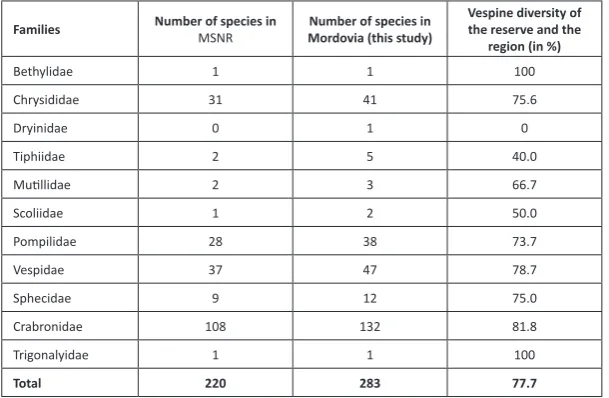
Abstract: Information is presented on 249 vespine species from 11 families in two regions of Mordovia (including Mordovia State Nature Reserve (MSNR)) and three districts of Nizhny Novgorod region (including Sarov) in Russia. Of these, 31 species are new to the Republic of Mordovia. Fauna of separate families of wasps in Mordovia State Nature Reserve is represented by 220 species: one species in Bethylidae, 31 in Chrysididae, two in Tiphiidae, two in Mutillidae, one in Scoliidae, 28 in Pompilidae, 37 in Vespidae, nine in Sphecidae, 108 in Crabronidae, and one in Trigonalyidae. The biodiversity of wasps in the reserve is very high. Of the 283 species of wasps in Mordovia, 220 (77.7%) are found within the reserve. Species characteristics such as geographic distribution and certain aspects of biology are also provided. There is an obvious extension of the ranges of three species, Priocnemis fastigiata, Sceliphron deforme, and Scolia hirta, to the north.
Keywords: Geographic distribution, Nizhny Novgorod region, range extension, Republic of Mordovia, Russia, Vespomorpha.
ISSN 0974-7907 (Online) ISSN 0974-7893 (Print)
PLATINUM OPEN ACCESS
Russian abstract: Аннотация: В статье приведены сведения о 249 видах из 11 семейств осообразных двух районов Мордовии (включая Мордовский заповедник) и трех районов Нижегородской области (включая г. Sarov). Из них 31 вид является новым для Республики Мордовия. Фауна отдельных семейств ос Мордовского заповедника представлена 220 видами: Bethylidae – 1 вид, Chrysididae – 31, Tiphiidae – 2, Mutillidae – 2, Scoliidae – 1, Pompilidae – 28, Vespidae – 37, Sphecidae – 9, Crabronidae – 108, Trigonalyidae – 1. Биоразнообразие осообразных заповедника очень высокое. Из 283 видов ос Мордовии 220 видов (77,7%) обитают в его пределах. Приводятся такие характеристики видов, как географическое распространение, некоторые аспекты биологии. Отмечены факты расширения ареалов в северном направлении трех видов: Priocnemis fastigiata, Sceliphron deforme и Scolia hirta.
INTRODUCTION
Hymenoptera is one of the largest groups of insects, including more than 153,000 species in the world fauna (Peters et al. 2017). This group includes Vespomorpha, one of the largest infraorders that comprises several superfamilies and more than 92,000 species (Aguiar et al. 2013). At the same time, the distribution of a huge number of these species is still poorly understood. New works are published all the time containing information on range refinement of already-described species (Ponomarenko & Olmi 2007; Mokrousov 2011; Ćetković et al. 2011; Antropov & Mokrousov 2016; Nemkov 2016, 2017a,b,c,d; Ruchin & Artaev 2016; Antropov 2017a,b; Danilov 2017; Danilov & Mokrousov 2017; Fateryga 2017; Lelej 2017; Lelej & Fadeev 2017; Loktionov & Lelej 2017; Mokrousov 2017b; Mokrousov & Lelej 2017; Rosa et al. 2017a) as well as descriptions of new species from the European part of Russia (Loktionov et al. 2016; Mokrousov 2017a; Rosa et al. 2017b). On the territory of the Republic of Mordovia (central part of Russia), however, this group of insects began to be studied actively only in recent years (Ruchin & Shibaev
2008; Ruchin et al. 2009; Mokrousov et al. 2009, 2013; Mokrousov 2010a,b; Ruchin & Kurmaeva 2010; Ruchin 2011, 2015; Ruchin & Lengesova 2012; Ruchin & Zryanin 2013; Ruchin & Antropov 2014, 2016; Ruchin & Egorov 2017).
The high species richness of this group and the mass nature and diversity of its representative’s biology make it one of the most significant among many terrestrial biocenoses. This article is devoted to the study of wasp fauna, a large group of stinging Hymenoptera, excluding bees (Apoidea: Apiformes) and ants (Formicoidea), inhabiting Mordovia State Nature Reserve (MSNR) and
its surroundings in Russia.
MATERIAL AND METHODS
Mordovia State Nature Reserve is located in Temnikov District of the Republic of Mordovia on a forested right brink of the river Moksha and covers an
area of 321.62km2. From the north, the border runs along the river Satis — the right tributary of Moksha, further to the east — along the river Arga, which flows into the Satis. The western border runs along the rivers Chernaya, Satis, and Moksha. From the south, the forest-steppe approaches, naturally delineating the boundary of the reserve (Image 1).
The forestland of the reserve belongs to the mixed
coniferous-broad leaved forest zone at the
forest-steppe border. Forest communities occupy 89.3% of the total territory. Vegetation cover of MSNR in general has a taiga character with a definite gravitation towards a nemoral complex with vegetation fluctuations. Forest-steppe elements are typical for this territory. Pine
Pinus sylvestris L. is the main forest-forming breed in
the reserve. It forms pure or mixed plant communities in the southern, central, and western parts of MSNR. Birch Betula pendula Roth and birch groves are the
second largest forest communities in the reserve. These are predominantly secondary communities at the sites of pine forest fellings and burnts. Young birch forests are especially abundant in the area that suffered from wildfire in 2010. Linden groves are located mainly in the northern part of the reserve. These are secondary plant communities that arose on the site of pine forests and lime-spruce forests. Oak forests occupy a relatively small area of the reserve. They are common in the floodplain of Moksha in the western part of the reserve. Spruce (formed mainly by Picea abies L.) and alder forests (formed by Alnus glutinosa (L.) Gaertn.) are located mainly in the floodplains of the rivers and streams (Pushta, Vyaz-Pusta, Vorskliaj, and Arga) and occupy small areas. Plant communities of small-leaved species (birch, aspen, and alder) are often formed on the sites of burnt forests (Khapugin et al. 2016; Ruchin & Makarkin 2017). The main areas of floodplain meadows are located along the river Moksha in the southwest of MSNR . The territory of the reserve is nominally divided into quarters, which are numbered starting from the north and then from west to east. There are forest houses (cordons) in some places of the reserve, often situated next to large forest glades (Image 2).
The research material was collected from April to September in 2008, 2009, and 2011–2017 using the generally accepted entomologic methods of field research (Fasulati 1971). The bulk of the material was collected in the MSNR. Since the insects of the studied group are quite active and capable of moving, we also provide information about materials from the vicinity of MSNR, namely, from the territories of Temnikov and Elniki districts of the Republic of Mordovia, as well as Pervomaisk, Diveevsk, and Voznesenskoe districts of the Nizhny Novgorod region. All material was collected by the first author (in other cases, the collector is indicated separately). The determination of the material was held by A.V. Antropov. In total, more than 1,400 specimens were studied. About 60 quarters of the reserve were investigated.
species the references to the literature on the species from the territory of MSNR and its surroundings, the new collecting grounds in the reserve and the surrounding area (unpublished data), date of collection, the number of specimens collected, the information on general distribution and biology (for some species), as well as remarks (if any). Due to the flat character of the
landscape, we didn’t indicate altitude above sea level when we indicated coordinates. New records for the Republic of Mordovia are marked with an asterisk (*) and new records for the territory of the reserve with two asterisks (**). The question mark symbol (?) indicates the findings of species that require confirmation by modern material. The hyphen (-) symbol indicates the
Image 1. Main biotopes of the Mordovia State Nature Reserve. A - floodplain meadow (quar. 401, © A.B. Ruchin), B - meadow near the Inorski cordon (© G.B. Semishin), C - sphagnum pine forest along sand dunes (quar. 336, © O.N. Artayev), D - birch forest (quar 420, © O.N. Artaev), E - glade (quar 446, © O.N. Artaev), F - pine forest with spruce (quar 383, © O.G. Grishutkin).
A
C
E
B
D
species that were excluded from the wasp list fauna of
the reserve for various reasons that are indicated as
remarks.The abbreviations used in the list are as follows: RM - Republic of Mordovia, NNR - Nizhny Novgorod Region, MSNR - Mordovia State Nature Reserve, quar. - quarter, cord. - cordon, Distr. - district, ex. - exemplar (specimen). Latin species names are provided according to online resources (Catalogue of Life website 2018; Chrysis.net 2018; Fauna Europaea 2018).
SPECIES LIST
Superfamily Chrysidoidea
Family Bethylidae
? Epyris minor Kieffer, 1906
Literature: Mokrousov et al. 2013.
General distribution: Russia (the south of the European part), northern Africa, Romania, Czech Republic, Slovakia, and Hungary (Macek et al. 2007; Lelej & Fadeev 2017).
Remark: The species requires additional refinement of range in the European part of Russia.
Family Chrysididae
SubfamilyCleptinae
Cleptes nitidulus (Fabricius, 1793) Literature: Mokrousov et al. 2013.
General distribution: Russia (the European part from the northwest till Crimea and northern Caucasus, and western Siberia), Europe, and Turkey (Rosa et al. 2017a).
Biology: It is a parasite of the larvae of the sawflies
Nematus and Euura (Tenthredinidae).
Subfamily Chrysidinae
Tribe Elampini
Elampus albipennis Mocsáry, 1889 Literature: Ruchin & Antropov 2016.
Material: RM: 1 female, 18.vii.2016, MSNR, quar. 278 (54047’51”N & 43012’27”E); 1 female, 18.vii.2016, quar. 303 (54047’17”N & 43012’32”E); 1 female, 9.vi.2016, quar. 331 (54046’43”N & 43012’37”E).
General distribution: Russia (the European part from the centre and the south, including Crimea, Siberia, and Primorsky Krai), eastern Europe, Saudi Arabia, United Arab Emirates, Turkey, Turkmenistan, and Iran (Rosa et al. 2017a).
Remark: The species is confirmed in MSNR.
* Elampus bidens (Förster, 1853)
Material: RM: 1 female, 2.vii.2016, Temnikov Distr.,
Kushki (54029’49” N 43016’11”E).
General distribution: Russia (European part from the west and the centre, Siberia, and Amur region), the Mediterranean, Caucasus, Turkey, and Japan (Hokkaido, Honshu, Shikoku, and Kyushu) (Rosa et al. 2017a).
* Elampus constrictus (Förster, 1853) (= Elampus
ambiguus Dahlbom, 1854)
Material: RM: 1 female, 18.vii.2016, MSNR, quar. 278 (54047’51”N & 43012’27”E); 1 female, 18.vii.2016, quar. 303 (54047’17”N & 43012’32”E); 1 female, 9.vi.2016, quar. 331 (54046’43”N & 43012’37”E).
General distribution: Russia (the European part from the northwest till Crimea and northern Caucasus, Urals, Altai, Buryatia, Transbaikalia, Amur region, and Primorsky Krai), Europe, northern Africa, and northern China (Móczár 1964; Rosa et al. 2017a).
Biology: It is a brood parasite of digger wasps
Mimesa (Crabronidae).
Elampus panzeri (Fabricius, 1804)
Material: NNR: 1 ex., 27.v.2016, Sarov (54055’08” N
43017’40”E), coll. P.V. Cherenkov.
General distribution: Russia (the whole European part, Siberia, and Primorsky Krai), Europe, Caucasus, Turkey, and northeastern China (Rosa et al. 2017a).
Biology: It is a brood parasite of digger wasps Mimesa bicolor (Jurine, 1807), M. equestris (Fabricius, 1804), and
M. lutaria (Fabricius, 1787) (Crabronidae).
Hedychridium coriaceum (Dahlbom, 1854)
Literature: Mokrousov et al. 2013; Ruchin & Antropov 2014.
General distribution: Russia (the European part from the northwest till northern Caucasus and Urals), Europe, and Turkey (Rosa et al. 2017a).
Biology: It is a brood parasite of digger wasps
Lindenius albilabris (Fabricius, 1793) (Crabronidae).
Hedychridium elegantulum du Buysson, 1887
Literature: Mokrousov et al. 2013 (as Hedychridium elongatulum Du Buysson, 1887).
General distribution: Russia (the European part from the centre till northern Caucasus) and European Mediterranean (Rosa et al. 2017a).
Biology: It is a probable brood parasite of digger wasps Miscophus bicolor Jurine, 1807 (Crabronidae).
Hedychridium krajniki krajniki Balthasar, 1946 Literature: Rosa et al. 2017b.
from the centre till northern Caucasus) and European Mediterranean (Rosa et al. 2017a).
Hedychridium roseum (Rossi, 1790) Literature: Mokrousov et al. 2013.
General distribution: Russia (the whole European part, Urals, Siberia, Amur region, Khabarovsk, and Primorye), Europe, Azerbaijan, Georgia, Abkhazia, and northeastern China (Rosa et al. 2017a).
Biology: It is a brood parasite of digger wasps Astata boops (Schrank, 1781), Tachysphex pompiliformis
(Panzer, 1804), and, probably, Dryudella stigma
(Panzer, 1809) and Harpactus tumidus (Panzer, 1801) (Crabronidae).
Hedychridium zelleri (Dahlbom, 1845) Literature: Mokrousov et al. 2013.
General distribution: Russia (from the west and the centre of the European part till northern Caucasus) and Europe (Rosa et al. 2017a).
Biology: It is a brood parasite of digger wasps
Miscophus niger Dahlbom, 1844 and M. concolor
Dahlbom, 1844 (Crabronidae).
* Hedychrum chalybaeum Dahlbom, 1854
Material: RM: 1 female, 18.vii.2016, MSNR, quar. 303 (54047’17”N & 43012’32”E); 1 female, 18.vii.2016, quar. 331 (54046’43”N & 43012’37”E); 1 female, 23.vii.2016, Elniki Distr., Novoyamskaya Sloboda (54044’24”N &
43042’59”E); 1 female, 23.vii.2016, Malye Mordovskie Poshaty (54041’00”N & 43043’50”E).
General distribution: Russia (the European part, Siberia, Amur region, and Primorsky Krai), Europe, Mongolia, and central and northeastern China (Rosa et al. 2017a).
Biology: It is a brood parasite of digger wasps Cerceris interrupta (Panzer, 1799) (Crabronidae).
Hedychrum gerstaeckeri Chevrier, 1869 Literature: Mokrousov et al. 2013.
Material: RM: 1 female, 24.vii.2016, Temnikov Distr., Polyanki (54044’27”N & 43029’04”E).
General distribution: Russia (the European part, Siberia, Amur region, Khabarovsk Krai, and Primorsky Krai), Europe, Georgia, eastern China, and Japan (Rosa et al. 2017a).
Biology: It is a brood parasite of digger wasps Cerceris rybyensis (Linnaeus, 1771) and C. ruficornis (Fabricius,
1793) (Crabronidae).
* Hedychrum longicolle Abeille de Perrin, 1877
Material: RM: 1 female, 19.vii.2015, Elniki Distr., Novye Shaly (54042’13”N & 43038’25”E); NNR: 1 ex., 18.vi.2015, Sarov (54055’08” N 43017’40”E), coll. P.V. Cherenkov (Image 3).
General distribution: Russia (the centre and the south of the European part, including Crimea and northern Caucasus, Urals, western Siberia, and Primorsky Krai), west and south of Europe, north of Africa, Syria, Turkey, Georgia, Kazakhstan, Turkmenistan, and China (Rosa et al. 2017a).
Biology: It is a brood parasite of digger wasps (Crabronidae).
Hedychrum nobile (Scopoli, 1763)
Literature: Mokrousov et al. 2013; Ruchin & Antropov 2014.
Material: RM: 2 female, 12.vii.2014, MSNR, quar. 86 (54053’38”N & 43035’59”E); 1 female, 1 male, 11.vii.2015, quar. 301 (54047’19”N & 43010’36”E); 1 male, 16.vii.2015, quar. 442 (54043’56”N & 43015’02”E); 1 female, 18.vi.2016, quar. 115 (54051’46”N &
43009’26”E); 1 female, 18.vii.2016, quar. 358 (54046’05”N & 43011’44”E); 1 female, 20.vi.2015, Temnikov Distr., Russkoe Karaevo (54040’55”N, 43013’52”E); 5 female, 9 male, 15.viii.2015, Purdoshki (54040’04”N & 43032’33”E); 1 female, 1 male, 19.vii.2015, Elniki Distr., Novye Shaly (54042’13”N & 43038’25”E).
General distribution: Russia (the European part from the northwest till Crimea, Urals, Tuva, and Siberia), Europe, Caucasus, and Abkhazia (Rosa et al. 2017a).
Biology: It is a brood parasite of digger wasps Cerceris arenaria (Linnaeus, 1758), C. rybyensis (Linnaeus, 1771),
C. quadrifasciata (Panzer, 1799), and C. quadricinta
(Panzer, 1799) (Crabronidae) (Polidori et al. 2010).
Hedychrum rutilans Dahlbom, 1854 Literature: Mokrousov et al. 2013.
Material: NNR: 1 ex., 23.vi.2016, Sarov (54055’08” N
43017’40”E), coll. P.V. Cherenkov.
General distribution: Russia (the European part, including Crimea and northern Caucasus, Urals, and eastern Siberia), Europe, northern Africa, Turkey, Azerbaijan, and Georgia (Rosa et al. 2017a).
Biology: It is a brood parasite of digger wasps
(Thunberg, 1784) (Crabronidae) (Polidori et al. 2010).
Hedychrum virens Dahlbom, 1854 Literature: Ruchin & Antropov 2016.
Material: RM: 1 male, 12.vii.2014, Temnikov Distr., Alkaevo (54035’49”N & 43022’35”E); 1 female, 15.viii.2015, Purdoshki (54040’04”N & 43032’33”E).
General distribution: Russia (the centre and the south of the European part, including Crimea, Urals, and western Siberia), west and south of Europe, the Middle East, Turkey, Azerbaijan, and Georgia (Rosa et al. 2017a).
Biology: It is a brood parasite of digger wasps Cerceris tuberculata (de Villers, 1789) (Crabronidae).
* Holopyga chrysonota (Förster, 1853)
Material: RM: 1 male, 16.vii.2016, MSNR, Pushta (54042’50”N & 43013’32”E).
General distribution: Russia (the European part, including Crimea and northern Caucasus, Urals, and Siberia), Mediterranean Europe, Caucasus, and northern China (Rosa et al. 2017a).
Biology: It is a brood parasite of digger wasps (Crabronidae).
Omalus aeneus (Fabricius, 1787) Literature: Mokrousov et al. 2009.
Material: RM: 1 female, 13.vi.2016, MSNR, quar. 421 (54043’52’’N, 43007’06”E).
General distribution: Russia (the European part from the northwest to the south, including Crimea and northern Caucasus, Urals, Siberia, Amur region, Khabarovsk Krai and Primorsky Krai, Sakhalin, and Kuril Islands), Europe, northern Africa, Georgia, Uzbekistan, northern and eastern China, Japan (Hokkaido, Honshu, and Kyushu), and North America as a result of accidental importation (Rosa et al. 2017a).
Biology: It is a brood parasite of digger wasps
Passaloecus corniger Shuckard, 1837, P. eremita Kohl, 1893, P. gracilis (Curtis, 1834), P. singularis Dahlbom, 1844, P. turionum Dahlbom, 1844, Pemphredon lethifer
(Shuckard, 1837), P. lugubris (Fabricius, 1793), and
Psenulus pallipes (Panzer, 1798) (Crabronidae). Females lay eggs on live aphids at the wasps’ hunting grounds, but do not penetrate into their nests.
Remark: The species is confirmed in MSNR.
* Omalus biaccinctus (du Buysson, 1893)
Material: RM: 1 female, 18.vii.2016, MSNR, quar. 331 (54046’43”N & 43012’37”E).
General distribution: Russia (the European part from the northwest to the south, including Crimea), Europe,
and the Middle East (Rosa et al. 2017a).
Biology: It is a brood parasite of digger wasps
Passaloecus turionum Dahlbom, 1844, P. gracilis (Curtis, 1834), and P. eremita Kohl, 1893 (Crabronidae). Females lay eggs on live aphids at the wasps’ hunting grounds, but do not penetrate into their nests.
Philoctetes bidentulus (Lepeletier, 1806) Literature: Mokrousov et al. 2013.
General distribution: Russia (the European part, including northern Caucasus, Urals, and Siberia), European Mediterranean, northern Africa, the Middle East, Turkey, and Caucasus (Rosa et al. 2017a).
Biology: It is a brood parasite of digger wasps
Psenulus pallipes (Panzer, 1798) (Crabronidae).
Philoctetes sareptanus (Mocsáry, 1889) Literature: Ruchin & Antropov 2016.
Material: RM: 1 female, 27.v.2016, MSNR, quar. 360 (54046’13”N & 43013’31”E); 1 female, 11.vi.2016, quar.
364 (54046’24”N & 43017’45”E).
General distribution: Russia (the European part, including northern Caucasus, Urals, Irkutsk region, and Khabarovsk Krai) and Iran (Rosa et al. 2017a).
Remark: The species is confirmed in MSNR.
Philoctetes truncatus (Dahlbom, 1831)
Literature: Feoktistov 2011 (as Chrysellampus truncastus Dhlb.).
General distribution: Russia (the centre and the east of the European part, Urals, and Siberia), Europe, and northern Africa (Rosa et al. 2017a).
Biology: It is a brood parasite of digger wasps
Diodontus tristis (Vander Linden, 1829) (Crabronidae).
Pseudomalus auratus (Linnaeus, 1758) Literature: Ruchin & Antropov 2016.
General distribution: Russia (the European part from the northwest till Crimea and the northern Caucasus, Urals, Siberia, Kamchatka, and Primorsky Krai), Europe, northern Africa, Caucasus, northern China, Korea, Japan (Hokkaido, Honshu), and North America as a result of accidental delivery (Rosa et al. 2017a).
Biology: It is a brood parasite of digger wasps
Passaloecus corniger Shuckard, 1837, P. eremita Kohl, 1893, P. insignis (Vander Linden, 1829), P. gracilis
(Curtis, 1834), P. monilicornis Dahlbom, 1842, P.
singularis Dahlbom, 1844, P. turionum Dahlbom, 1844,
(Vander Linden, 1829) (Crabronidae).
Pseudomalus pussillus (Fabricius, 1804)
Literature: Plavilshchikov 1964 (as Ellampus pusillus
F.); Mokrousov et al. 2013.
Material: RM: 1 female, 5.vii.2016, MSNR, quar. 324 (54046’28”N & 43005’40”E); 1 female, 21.v.2017, cord. Inorski (54044’15”N & 43008’53”E).
General distribution: Russia (the European part from the northwest till Crimea and northern Caucasus, Urals, and Siberia), Europe, northern Africa, Caucasus, and Kazakhstan (Rosa et al. 2017a).
Biology: It is a brood parasite of digger wasps
Passaloecus eremita Kohl, 1893, P. insignis (Vander Linden, 1829), and Pemphedron lethifer (Shuckard, 1837) (Crabronidae).
Remark: The species is confirmed in MSNR.
Tribe Chrysidini
? Chrysidea pumila (Klug, 1845)
Literature: Plavilshchikov 1964 (as Chrysogona pumila Kl.).
General distribution: Russia (the European part from the centre to northern Caucasus and Urals), south of Europe, and northern Africa (Rosa et al. 2017a).
Remark: The species requires further research to be confirmed in Mordovia.
Chrysis analis Spinola, 1808
Literature: Mokrousov et al. 2009; Feoktistov 2011. General distribution: Russia (the European part from the northwest till Crimea and northern Caucasus, and Urals), south of Europe, and Caucasus (Rosa et al. 2017a).
Biology: It is a brood parasite of solitary wasps Osmia andrenoides Spinola, 1808 (Apidae, Megachilinae).
Chrysis bicolor Lepeletier de Saint Fargeau, 1806 Literature: Mokrousov et al. 2013; Ruchin & Antropov 2014.
Material: RM: 1 female, 28.vii.2015, MSNR, quar. 79 (54053’11”N & 43029’18”E); 1 female, 12.vii.2014, quar. 86 (54053’38”N & 43035’59”E); 1 female, 11.vii.2015, quar. 301 (54047’19”N & 43010’36”E); 1 female, 16.viii.2015, quar. 324 (54046’28”N & 43005’40”E); 1 female, 4.vii.2015, quar. 368 (54046’37”N & 43021’45”E); 1 female, 19.vii.2015, Elniki Distr., Novye Shaly (54042’13”N & 43038’25”E).
General distribution: Russia (the European part from the northwest till Crimea and northern Caucasus, Urals, Siberia, Amur region, Khabarovsk Krai and
Primorsky Krai, and Sakhalin), Europe, northern Africa, and Caucasus (Rosa et al. 2017a).
Biology: It is a brood parasite of digger wasps
Tachysphex obscuripennis (Schenck, 1857), T.
pompiliformis (Panzer, 1804), and Dinetus pictus
(Fabricius, 1793) (Crabronidae).
* Chrysis cerastes Abeille, 1877
Material: RM: 1 female, 2.vii.2017, MSNR, cord. Inorski (54044’15”N & 43008’53”E).
General distribution: Russia (the European part from the north till northern Caucasus and Altai), south of Europe, Azerbaijan, and Caucasus (Rosa et al. 2017a).
Biology: It is a brood parasite of solitary Vespidae
Syneuodynerus egregius (Herrich-Schäffer, 1839) (Vespidae, Eumeninae).
? Chrysis comparata Lepeletier de Saint Fargeau, 1806
Literature: Plavilshchikov 1964 (as Chrysis chevrieri
Mock.).
General distribution: Russia (the European part from the centre till Crimea and northern Caucasus, and Urals), south of Europe, northern Africa, and Caucasus (Rosa et al. 2017a).
Remark: The species requires further research to be confirmed in Mordovia.
Chrysis fulgida Linnaeus, 1761
Literature: Ruchin & Antropov 2014, 2016.
General distribution: Russia (the European part from the northwest to northern Caucasus, Urals, Siberia, Amur region, Kamchatka, and Primorsky Krai), Europe, Caucasus, and northeastern China (Rosa et al. 2017a).
Biology: It is a brood parasite of the solitary Vespidae Symmorphus allobrogus (de Saussure, 1955),
S. bifasciatus (Linnaeus, 1761), S. crassicornis (Panzer, 1798), S. murarius (Linnaeus, 1758) and, perhaps,
Ancistrocerus parietum (Linnaeus, 1758) (Vespidae, Eumeninae).
Chrysis ignita (Linnaeus, 1758)
Literature: Redikortsev 1938; Plavilshchikov 1964; Mokrousov et al. 2009, 2013; Ruchin & Antropov 2014.
Material: RM: 1 female, 31.v.2015, MSNR, quar. 345 (54047’13”N & 43026’30”E); 1 female, 2.viii.2014, Pushta (54042’50”N & 43013’32”E); 1 female, 12.vii.2017, cord. Inorski (54044’15”N & 43008’53”E), coll. G.B. Semishin.
northern China, and Korea (Rosa et al. 2017a).
Biology: It is a brood parasite of solitary Vespidae
Ancistrocerus auctus (Fabricius, 1793), A. gazella
(Panzer, 1798), A. nigricornis (Curtis, 1826), A. parietinus
(Linnaeus, 1761), A. parietum (Linnaeus, 1758), A.
scoticus (Curtis, 1826), A. trifasciatus (Müller, 1776), and also, probably, Gymnomerus laevipes (Shuckard, 1837), Euodynerus posticus (Herrich-Schäffer, 1841),
Allodynerus delphinalis (Giraud, 1866), and Symmorphus bifasciatus (Linnaeus, 1761) (Vespidae, Eumeninae).
Chrysis longula Abeille de Perrin, 1879 Literature: Ruchin et al. 2009.
General distribution: Russia (the European part from the northwest till Crimea and northern Caucasus, Urals, and Siberia), Europe, and central Asia (Rosa et al. 2017a).
Biology: It is a brood parasite of solitary Vespidae
Ancistrocerus antilope (Panzer, 1798), A. parietinus
(Linnaeus, 1761), Euodynerus posticus (Herrich-Schäffer, 1841), Symmorphus crassicornis (Panzer, 1798), and S.
murarius (Linnaeus, 1758) (Vespidae, Eumeninae).
* Chrysis rutilans Olivier, 1790
Material: RM: 1 female, 22.vii.2017, Elniki Distr., Malye Mordovskie Poshaty (54041’00”N & 43043’50”E).
General distribution: Russia (the European part from the northwest till Crimea and northern Caucasus, Urals, Siberia, and Primorsky Krai), Europe, northern Africa, Caucasus, China, and Japan (Rosa et al. 2017a).
Biology: It is a brood parasite of solitary Vespidae
Gymnomerus laevipes (Shuckard, 1837), Jucancistrocerus caspicus Giordani Soika, 1970, and Katamenes flavigularis (Blüthgen, 1951) (Vespidae, Eumeninae).
* Pseudochrysis neglecta (Shuckard, 1836)
Material: RM: 1 female, 31.v.2014, Elniki Distr., Malye Mordovskie Poshaty (54041’00”N & 43043’50”E).
General distribution: Russia (the European part from the northwest till Crimea and northern Caucasus, Urals, Siberia, and Khabarovsk Krai), Europe, Turkey, Tajikistan, northwestern China, and North America (Rosa et al. 2017a).
Biology: It is a brood parasite of solitary Vespidae
Odynerus reniformis (Gmelin, 1790), O. spinipes
(Linnaeus, 1758), and, probably accidentally,
Ancistrocerus parietum (Linnaeus, 1758) and
Gymnomerus laevipes (Shuckard, 1837) (Vespidae,
Eumeninae).
Trichrysis cyanea (Linnaeus, 1758)
Literature: Mokrousov et al. 2009, 2013; Feoktistov 2011; Ruchin & Antropov 2014.
Material: RM: 1 male, 13.vi.2016, quar. 422 (54043’55”N & 43007’39”E); NNR: 1 ex., 14.vi.2015, Voznesenskoe Distr., Alamasovo (54054’03”N &
43008’56”E), coll. P.V. Cherenkov (Image 3).
General distribution: Russia (the European part from the northwest till Crimea and northern Caucasus, Urals, Siberia, Amur region, Kamchatka, Khabarovsk Krai and Primorsky Krai, and Sakhalin), Europe, northern Africa, central Asia, northern China, Korea, and Japan (Hokkaido & Honshu) (Rosa et al. 2017a).
Biology: It is a brood parasite of digger wasps
Trypoxylon figulus (Linnaeus, 1758) and Pemphredon rugifer (Dahlbom, 1844) [Crabronidae], and Auplopus carbonarius (Scopoli, 1763) and Deuteragenia sp. (Pompilidae).
Remark: The species is confirmed in the territories adjacent to MSNR.
Tribe Parnopini
Parnopes grandior (Pallas, 1771)
Literature: Plavilshchikov 1964; Ruchin & Antropov 2014, 2016; Ruchin & Egorov 2017; Ruchin et al. 2019.
Material: RM: 1 female, 22.vii.2017, Elniki Distr., Novye Shaly (54042’13”N & 43038’25”E).
General distribution: Russia (the European part from the northwest till Crimea and northern Caucasus, Urals, and Siberia), Europe, northern Africa, central Asia, Azerbaijan, and Caucasus (Rosa et al. 2017a).
Biology: It is a brood parasite of digger wasps Bembix rostrata (Linnaeus, 1758) (Crabronidae).
Family Dryinidae
? Gonatopus lunatus Klug, 1810
Literature: Mokrousov et al. 2013.
General distribution: Russia (the European part from the centre to northern Caucasus, Urals, and Siberia), Europe, Morocco, the Middle East, Turkey, Kazakhstan, central Asia, Mongolia, and Korea (Lelej & Loktionov 2017).
Biology: It is a parasitoid of leafhoppers [Cicadellidae, Deltocephalinae, and Aphrodinae] (Olmi 1994).
confirmed in Mordovia. It is not yet registered in MSNR.
Superfamily Vespoidea
Family Tiphiidae
Tiphia femorata Fabricius, 1775
Literature: Redikortsev 1938; Plavilshchikov 1964; Mokrousov et al. 2009, 2013; Feoktistov 2011; Ruchin & Antropov 2014.
Material: RM: 1 female, 11.vii.2015, MSNR, quar. 142 (54051’12”N & 43009’21”E); 1 female, 11.vii.2015, quar. 301 (54047’19”N & 43010’36”E); 1 female, 27.vii.2014, quar. 384 (54045’33”N & 43012’44”E); 3 female, 12.vii.2014, 24.viii.2017, quar. 86 (54053’38”N &
43035’59”E); 1 female, 28.vii.2015, quar. 82 (54053’12”N & 43032’46”E); 5 female, 25.vii.2009, 23.viii.2017, 24.viii.2017, cord. Inorski (54044’15”N & 43008’53”E), coll. G.B. Semishin; 1 female, 19.vii.2016, quar. 330 (54046’44”N & 43011’09”E); 1 female, 24.vii.2016, quar. 399 (54046’40”N & 43027’27”E); 4 female, 24.viii.2017, quar. 368 (54046’37”N & 43021’45”E); 2 female, 1 male, 24.viii.2017, quar. 80 (54053’11”N & 43030’22”E); 1 female, 5.ix.2017, Pushta (54042’50”N & 43013’32”E); 1 female, 12.vii.2014, Temnikov Distr., Alkaevo (54035’49”N &
43022’35”E); 2 female, 24.vii.2016, Polyanki (54044’27”N & 43029’04”E); 2 female, 19.vii.2015, 22.vii.2017, Elniki Distr., Malye Mordovskie Poshaty (54041’00”N &
43043’50”E); 2 female, 19.vii.2015, 22.vii.2017, Novye Shaly (54042’13”N & 43038’25”E); 2 female, 23.vii.2016, Novoyamskaya Sloboda (54044’24”N & 43042’59”E); 2 female, 23.vii.2016, Cherlyaj (54045’53”N & 43040’58”E).
General distribution: Russia (the European part, Urals, eastern Siberia, and Amur region), Europe, northern Africa, Turkey, Iran, Tajikistan, Kyrgyzstan, Kazakhstan, Mongolia, and North America as a result of accidental importation (Mokrousov & Lelej 2017).
Biology: It occurs from July to September. Parasite
of larvae of Amphimallon solstiale (Linnaeus, 1758),
Anisoplia austriaca Herbst, 1783, and some other Scarabaeidae.
Tiphia minuta Vander Linden, 1827 Literature: Ruchin & Antropov 2014.
Material: RM: 1 female, 23.vii.2016, Elniki Distr., Malye Mordovskie Poshaty (54041’00”N & 43043’50”E).
General distribution: Russia (the European part from the northwest to northern Caucasus, Altai, Irkutsk region, and Primorsky Krai) (Mokrousov & Lelej 2017).
Biology: It is a parasite of larvae of Scarabaeidae. Remark: The species is confirmed in the territories
adjacent to MSNR.
Tiphia unicolor Lepeletier de Saint Fargeau, 1845 Literature: Mokrousov et al. 2013.
Material: RM: 1 female, 11.vii.2015, MSNR, quar. 301 (54047’19”N & 43010’36”E); 1 male, 21.vii.2013, quar. 368 (54046’37”N & 43021’45”E); 1 female, 6.vii.2013, Temnikov Distr., Lavrentevo (54029’44”N & 43002’41”E); 1 female, 19.vii.2015, Elniki Distr., Malye Mordovskie Poshaty (54041’00”N & 43043’50”E).
General distribution: Russia (the centre and the south of the European part, northern Caucasus, and Altai), European Mediterranean, and Turkey (Mokrousov & Lelej 2017).
Biology: It is a parasite of larvae of Scarabaeidae.
Family Mutillidae
Myrmosa atra Panzer, 1801
Literature: Mokrousov et al. 2013.
Material: RM: 1 male, 4.vii.2015, MSNR, quar. 288 (54048’27”N & 43022’03”E); 2 male, 18.vii.2017, quar. 380 (54045’06”N & 43008’34”E).
General distribution: Russia (the European part from the northwest till Crimea and northern Caucasus, Urals, and Siberia), Europe, Turkey, ? Iran, Kazakhstan, and Kyrgyzstan (Lelej 2017).
Biology: It is a brood parasite of digger wasps
Lindeniusalbilabris (Fabricius, 1793), L. panzeri (Vander Linden, 1829), Crabro peltarius (Schreber, 1784),
Crossocerus palmipes (Linnaeus, 1767), C. wesmaeli
(Vander Linden, 1829), Diodontus tristis (Vander Linden, 1829), and Oxybelus uniglumis (Linnaeus, 1758) (Crabronidae).
Smicromyrme rufipes (Fabricius, 1787) Literature: Mokrousov et al. 2013.
Material: RM: 1 male, 3.vii.2016, MSNR, quar. 338 (54047’06”N & 43019’40”E).
General distribution: Russia (the European part from the northwest till Crimea, Urals, and Siberia) (Lelej 2017).
Biology: It is a brood parasite of spider wasps Evagetes
[Pompilidae], of digger wasps Astata boops (Schrank, 1781), Tachysphex, Miscophus spurius (Dahlbom, 1832), Palarus variegatus (Fabricius, 1781), Oxybelus bipunctatus Olivier, 1812, O. uniglumis (Linnaeus, 1758), Crossocerus wesmaeli (Vander Linden, 1829),
and Cerceris arenaria (Linnaeus, 1758) (Crabronidae), as well as of solitary bees Halictus [Apidae, Halictinae] and
Family Scoliidae
Scolia hirta Schrank, 1781
Literature: Ruchin & Antropov 2016; Ruchin &
Artaev 2016.
Material: RM: 1 ex., 15.vii.2017, MSNR, Pushta (54042’50”N & 43013’32”E); NNR: 6.viii.2014, 8.viii.2014, 9.ix.2017, Sarov (54055’08” N 43017’40”E), 4 ex., coll. P.V. Cherenkov (Image 3).
General distribution: Russia (the European part from the centre till Crimea and northern Caucasus, Urals, and Siberia), Europe, Cyprus, Israel, Turkey, Caucasus, Abkhazia, Iran, Turkmenistan, Uzbekistan, Kazakhstan, and Mongolia (Lelej & Mokrousov 2017; Mokrousov & Lelej 2017).
Biology: The hosts are flower chafers Protaetia morio (Fabricius, 1781), P. speciosissima (Scopoli, 1786), P. splendidula (Faldermann, 1835), Cetonia aurata (Linnaeus, 1761), Liocola lugubrisHerbst, 1786, and Tropinota hirta (Poda, 1761) (Klausnitzer 2013). Predators are parasitic flies of Conopidae.
Family Pompilidae Subfamily Ceropalinae
Ceropales maculata (Fabricius, 1775)
Literature: Redikortsev 1938; Plavilshchikov 1964; Mokrousov et al. 2013; Ruchin & Antropov 2016.
Material: RM: 1 female, 18.vii.2016, MSNR, quar. 358 (54046’05”N & 43011’44”E); 1 female, 24.vii.2016, quar. 398 (54046’22”N & 43025’48”E); 1 male, 19.vii.2016, quar. 330 (54046’44”N & 43011’09”E); 1 female, 6.viii.2017, quar. 419 (54045’39”N & 43022’50”E).
General distribution: Russia (the European part from the northwest till Crimea and northern Caucasus, Urals, Siberia, Amur and Magadan regions, Chukotka, Khabarovsk Krai and Primorsky Krai, Sakhalin, and Kuril Islands), Europe, northern Africa, Cyprus, Armenia, Azerbaijan, Georgia, Israel, Lebanon, Jordan, Turkey, Syria, Iran, Iraq, Turkmenistan, Kazakhstan, Kyrgyzstan, Mongolia, China, Korea, and Japan (Honshu) (Loktionov & Lelej 2017).
Biology: Brood parasite of spider wasps Priocnemis exaltata (Fabricius, 1775), Agenioideus cinctellus
(Spinola, 1807), Anoplius infuscatus (Vander Linden, 1827), A.nigerrimus (Scopoli, 1763), A. viaticus (Linnaeus, 1758), Arachnospila anceps (Wesmael, 1851), A. rufa
(Haupt, 1927), Auplopus carbonarius (Scopoli, 1763),
and Episyronrufipes (Linnaeus, 1758) (Pompilidae).
Subfamily Pepsinae
Auplopus carbonarius (Scopoli, 1763)
Literature: Mokrousov et al. 2013; Ruchin &
Antropov 2014.
Material: RM: 1 female, 15.vi.2016, MSNR, quar. 429 (54044’31”N & 43014’59”E); 1 female, 28.vi.2015, quar. 249 (54049’39”N & 43032’08”E); 1 female, 16.vii.2017, cord. Podrubnyi (54047’51”N & 43008’48”E); 1 female, 19.v.2014, cord. Podrubnyi, 1 female, 6.viii.2017, cord. Inorski (54044’15”N & 43008’53”E), coll. G.B. Semishin; 12 female, 19.v.2014, 18.vii.2014, 19.vii.2015, 5.vii.2016, 21.vii.2016, 23.vii.2016, 5.viii.2016, 11.vii.2017, 23.vii.2017, 24.vii.2017, 5.ix.2017, 18.ix.2017, Pushta (54042’50”N & 43013’32”E).
General distribution: Russia (the European part, Altai, western and eastern Siberia, Amur and Magadan regions, and Khabarovsk Krai and Primorsky Krai), Europe, northwestern Africa, the Middle East, Turkey, Iran, Kazakhstan, Tajikistan, Mongolia, northern China, Korea, and Japan (Hokkaido, Honshu, Shikoku, Kyushu, and Tsushima) (Loktionov & Lelej 2017).
Biology: Nests are in the shape of separate oval
clay cells located in shelters under rocks, under
bark, or in abandoned xylophagus tunnels. Prey: spiders from families Salticidae, Clubionidae, Oxyopidae, Gnaphosidae, Agelenidae, Thomisidae, Lycosidae, Segestroodae, and Anyphaenidae. During transportation, the female usually separates the legs of the victim. Predators: parasitoid wasps Picardiella melanoleuca (Gravenhorst, 1829) (Ichneumonidae).
Caliadurgus fasciatellus (Spinola, 1808) Literature: Mokrousov et al. 2009, 2013.
Material: RM: 1 female, 17.viii.2014, MSNR, quar. 397 (54046’17”N & 43025’44”E); 1 female, 23.vii.2016, Elniki Distr., Cherlyaj (54045’53”N & 43040’58”E); NNR: 1 female, 16.vii.2017, Voznesenskoe Distr., Zarya (54050’08”N & 43007’08”E); 1 male, 16.vii.2017, Svobodnyi (54050’47”N & 43007’48”E).
General distribution: Russia (the European part from the northwest to northern Caucasus, Urals, Altai, eastern Siberia, Amur region, Kamchatka, Khabarovsk Krai and Primorsky Krai, and Sakhalin), Europe, Cyprus, Turkey, Kazakhstan, Kyrgyzstan, Mongolia, and North America as a result of introduction (Loktionov & Lelej 2017).
Biology: Nests are in dense soil of open and forest biotopes. Prey: spiders Meta (Tetragnathidae), Araneus alsine (Walckenaer, 1802), A. diadematus (Linnaeus, 1758), and Araniella cucurbitina (Clerck, 1757) (Araneidae).
– Cryptocheilus octomaculatus (Rossi, 1790)
quadripunctatus F.).
General distribution: Russia (the European part (the south, northern Caucasus, and Crimea)) (Tobias 1978); Europe (western, southern, and eastern), Morocco, Algeria, Tunisia, Turkey, Cyprus, Syria, Israel, Iran, Kyrgyzstan, Turkmenistan, and Tajikistan (Ghahari et al. 2014; Loktionov & Lelej 2017).
Remark: It is distributed much more southerly. We exclude this species from the fauna of the reserve and
the region.
Cryptocheilus versicolor (Scopoli, 1763) Literature: Mokrousov et al. 2013.
Material: RM: 1 female, 15.viii.2015, Temnikov Distr., Alkaevo (54035’49”N & 43022’35”E).
General distribution: Russia (the European part from the centre till Crimea and northern Caucasus, and Urals), Europe, Cyprus, Turkey, and Kyrgyzstan (Eversmann 1849; Tobias 1978; Loktionov & Lelej 2017).
Remark: The species is confirmed in the territories adjacent to MSNR.
Deuteragenia bifasciata (Geoffroy, 1785)
Literature: Ruchin & Antropov 2014 (as Dipogon bifasciatus (Geoffroy, 1785)), 2016.
Material: RM: 1 female, 14.vi.2016, MSNR, quar. 384 (54045’33”N & 43012’44”E).
General distribution: Russia (the European part from the northwest till Crimea and northern Caucasus, Urals, Siberia, Amur and Magadan regions, Khabarovsk Krai and Primorsky Krai, and Sakhalin), Europe, Georgia, Kazakhstan, Kirghizia, Korea, and Japan (Hokkaido, Honshu, Shikoku, and Kyushu) (Loktionov & Lelej 2017).
Biology: They build nests in rotten wood and abandoned burrows of other insects. Prey: spiders Clubionidae, Dysteruidae, Salticidae, and Diaea dorsata
(Fabricius, 1777) (Thomisidae).
Remark: The species is confirmed in MSNR.
Deuteragenia vechti Day, 1979
Literature: Mokrousov et al. 2013; Ruchin & Antropov 2016.
Material: RM: 1 female, 10.vii.2014, MSNR, cord. Inorski (54044’15”N & 43008’53”E), coll. G.B. Semishin.
General distribution: Russia (the European part from the northwest to the southeast, Urals, Siberia, Amur and Magadan regions, Chukotka, Khabarovsk Krai and Primorsky Krai, Sakhalin, and Kuril Islands), Europe, Kazakhstan, Kyrgyzstan, and Japan (Hokkaido, Honshu) (Loktionov & Lelej 2017).
Biology: They build nests in abandoned xylophagous
tunnels in wood. Prey: spiders Clubiona(Clubionidae).
Priocnemis agilis (Shuckard, 1837) Literature: Mokrousov et al. 2013.
General distribution: Russia (the European part from the northwest till Crimea and northern Caucasus, Altai, and Irkutsk region), Europe, Cyprus, Turkey, Uzbekistan, Kazakhstan, and Kyrgyzstan.
Priocnemis cordivalvata Haupt, 1927
Literature: Redikortsev 1938 (Priocnemis
cordivalvatus Hpt.); Plavilshchikov 1964 (Priocnemis cordivalvatus Hpt.); Mokrousov et al. 2013.
General distribution: Russia (the European part from the northwest to northern Caucasus, Krasnoyarsk Krai, and Irkutsk region), Europe, central Asia, and Mongolia (Loktionov & Lelej 2017).
Priocnemis coriacea Dahlbom, 1843 Literature: Ruchin et al. 2009.
Material: RM: 1 male, 11.v.2016, MSNR, quar. 448 (54042’37”N & 43012’29”E).
General distribution: Russia (the European part from the centre till Crimea and northern Caucasus, and Urals), Europe, and Turkey (Loktionov & Lelej 2017).
Biology: Prey: spiders Lycosidae and Gnaphosidae.
Remark: The species is confirmed in MSNR.
Priocnemis exaltata (Fabricius, 1775)
Literature: Redikortsev 1938 (Priocnemis gibbus
Scop.); Plavilshchikov 1964 (Priocnemis exultatus Pz.,
Priocnemis gibbus Scop.); Mokrousov et al. 2013; Ruchin & Antropov 2014.
Material: RM: 1 female, 18.vii.2016, MSNR, quar. 331 (54046’43”N & 43012’37”E); 1 female, 9.viii.2014, quar. 413 (54045’12”N & 43016’54”E); 1 female, 22.viii.2015, quar. 434 (54045’04”N & 43019’02”E); 2 female, 11.vii.2015, cord. Podrubnyi (54047’51”N & 43008’48”E); 1 female, 13.viii.2016, quar. 446 (54043’13”N & 43013’23”E); 1 female, 24.viii.2017, quar. 368 (54046’37”N & 43021’45”E); 1 female, 24.vii.2016, Temnikov Distr., Polyanki (54044’27”N & 43029’04”E); 1 female, 23.vii.2016, Elniki Distr., Malye Mordovskie Poshaty (54041’00”N & 43043’50”E).
General distribution: Russia (the European part from the northwest till Crimea, Urals, and Siberia). Europe, Turkey, Iran, Kazakhstan, and Kyrgyzstan (Loktionov & Lelej 2017).
* Priocnemis fastigiata Haupt, 1934
Material: RM: 1 female, 6.viii.2017, MSNR, quar. 420 (54045’29”N & 43024’19”E); 1 female, 23.vii.2016, Elniki Distr., Malye Mordovskie Poshaty (54041’00”N &
43043’50”E).
General distribution: Russia (the centre and the southeast of the European part), European Mediterranean, Austria, Hungary, and Turkey (Straka 2011; Loktionov & Lelej 2017).
Remark: The range extends to the northwest.
Priocnemis gussakowskiji Wolf, 2004
Literature: Mokrousov et al. 2013 (as Priocnemis confusor Wahis, 2006).
General distribution: Russia (the centre and, perhaps, the south of the European part), Europe, Jordan, Turkey, and Kazakhstan (Loktionov & Lelej 2017).
Priocnemis minuta (Vander Linden, 1827) Literature: Mokrousov et al. 2013.
General distribution: Russia (the European part from the centre till Crimea and northern Caucasus, Buryatia, Amur region, and Primorsky Krai), Europe, Turkey, Cyprus, Kazakhstan, Kyrgyzstan, and Turkmenistan (Loktionov & Lelej 2017).
Priocnemis parvula Dahlbom, 1845 Literature: Mokrousov et al. 2013.
General distribution: Russia (the European part from the northwest till Crimea and northern Caucasus, Siberia, Amur and Magadan regions, Khabarovsk Krai and Primorsky Krai, and Sakhalin), Europe, Tunisia, Jordan, Turkey, Uzbekistan, and Kyrgyzstan (Loktionov & Lelej 2017).
Biology: Nests in sandy soil. Prey: spiders Pardosa prativaga (L.Koch, 1870), P. pullata (Clerck, 1757),
Xerolycosa miniata (C.L. Koch, 1834) [Lycosidae],
Haplodrassus soerenseni (Strand, 1900) (Gnaphosidae),
and Evarcha arcuata (Clerck, 1757) (Salticidae).
Priocnemis perturbator (Harris, 1780)
Literature: Ruchin et al. 2009; Mokrousov et al. 2013; Ruchin & Antropov 2014.
Material: RM: 1 female, 25.v.2015, MSNR, quar. 342 (54046’21”N & 43023’23”E); 1 female, 10.v.2015, quar. 368 (54046’37”N & 43021’45”E); 3 female, 18.v.2014, 7.vi.2015, quar. 399 (54046’40”N & 43027’27”E); 1 female, 6.v.2015, quar. 431 (54044’31”N & 43017’14”E); 1 female, 16.v.2015, quar. 408 (54044’57”N & 43011’47”E); 1 female, 6.vi.2015, Temnikov Distr., Vesely (54033’09”N
& 43001’19”E).
General distribution: Russia (the European part from the northwest till Crimea and northern Caucasus, Urals, Altai, and Irkutsk region), Europe, Cyprus, Turkey, Georgia, Iran, Uzbekistan, and Kyrgyzstan (Loktionov & Lelej 2017).
Biology: Nests in loose soil, often in existing cavities. Prey: spiders Trochosa terricola Thorell, 1856 (Lycosidae), Gnaphosidae, and Thomisidae, which female wasps place into the prepared cavity in the soil (Edwards & Telfer 2002).
* Priocnemis pusilla Schiødte, 1837
Material: RM: 1 female, 7.vii.2016, MSNR, quar. 411 (54045’05”N & 43014’54”E).
General distribution: Russia (the European part from the northwest till Crimea and northern Caucasus, Omsk region, and Krasnoyarsk territory), Europe, Turkey, Georgia, Iran, Kyrgyzstan, Turkmenistan, and Mongolia (Loktionov & Lelej 2017).
Biology: Nests in loose soil in existing cavities. Prey: spiders Clubionidae and Salticidae.
Priocnemis schioedtei Haupt, 1927 Literature: Mokrousov et al. 2013.
General distribution: Russia (the European part from the northwest till Crimea and northern Caucasus), Europe, Turkey, Kazakhstan, and Mongolia (Loktionov & Lelej 2017).
Biology: Nests in loose soil in existing cavities. Prey: spiders Clubionidae, Gnaphosidae, Salticidae, and Lycosidae (Edwards & Telfer 2002).
* Priocnemis vulgaris (Dufour, 1841)
Material: RM: 1 female, 11.vi.2016, MSNR, quar. 389 (54045’50”N & 43017’50”E); 4 female, 13.vi.2016, quar. 435 (54043’41”N & 43007’59”E); 1 female, 26.vi.2016, quar. 403 (54044’40”N & 43006’57”E); 1 female, 13.vi.2016, Pushta (54042’50”N & 43013’32”E).
General distribution: Russia (the European part from the northwest to northern Caucasus), south of Europe, Turkey, Iran, Kazakhstan, Uzbekistan, Kyrgyzstan, and Tajikistan (Loktionov & Lelej 2017).
SubfamilyPompilinae
Anoplius concinnus (Dahlbom, 1829) Literature: Mokrousov et al. 2013.