DYNAMIC DOMAIN DECOMPOSITION APPLIED TO HOPPER
DISCHARGE SIMULATION BY DISCRETE ELEMENT METHOD
Darius Markauskas
Laboratory of Numerical Modelling, Vilnius Gediminas Technical University Saultekio St. 11, Vilnius, LT-10223, Lithuania
e-mail: [email protected]
Arnas Kaeniauskas
Laboratory of Parallel Computing, Vilnius Gediminas Technical University Saultekio St. 11, Vilnius, LT-10223, Lithuania
Algirdas Maknickas
Department of Information Technologies, Vilnius Gediminas Technical University Saultekio St. 11, Vilnius, LT-10223, Lithuania
Abstract. The paper presents the development of dynamic domain decomposition applied to hopper discharge simulation by the discrete element method (DEM). Parallel neighbour search algorithm, non-blocking interprocessor communication and dynamic load balancing are implemented in the DEM code. Parallel speed-up analysis is per-formed solving the complex hopper discharge problems containing 100000 and 300000 particles. The influence of the granular flow character on the load balance is investigated.
1. Introduction
The discrete element method became widely reco-gnized after the pioneering work published by Cundall and Strack [3]. The main advantage of the DEM is a possibility to model highly complex particle systems using the basic data on individual particles without making oversimplifying assumptions. The method al-lows simulation of motion and interaction between the particles, taking into account the microscopic geomet-ry and various constitutive models. Over the past de-cade, the DEM was utilised in a variety of industrial applications [2].
The DEM has been extensively applied to examine different phenomena inside the granular materials. The granular flow from hoppers and silos has a wide range of applications in industry [29]. The conducted re-search is mainly focused on three aspects: wall stress/ pressure, discharge rate and internal properties. The study of the bulk material pressure on the walls of a hopper is very important for hopper design [7]. The prediction of the discharge rate is of importance for the effective operation and control of a transport sys-tem, and is difficult due to inhomogeneous solid dis-tribution, irregular velocity profile and diverse particle size [15]. It is very important to understand the micro-scopic structure and its relations to the mechanisms
governing hopper flow [20]. DEM simulation takes into account the discrete nature of granular materials, and therefore is very effective for this purpose. The combined approach of DEM and averaging method offers a convenient way to link fundamental under-standing generated from DEM-based simulations to engineering application often achieved by continuum modelling [28].
The main disadvantage of the DEM technique, in comparison with the well-known continuum methods, is impressive computational resources necessary to solve large-scale industrial problems. The complex character of hopper flow could require large number of particles and short time steps resulting in a long computing time.
Naturally, for the solution of industrial-scale prob-lems, parallelization becomes an obvious option for significantly increasing computational capabilities. Early attempts to parallelize particle computations were based on two main ideas: force decomposition and domain decomposition. In the first class of me-thods, a pre-determined set of force computations is assigned to each processor. Such methods have shown good performance for shared memory computers [19, 23], but the global character of the employed algorithms produces interprocessor communication
overhead on distributed memory machines. Recent attempts to perform straightforward parallelization of DEM codes by using OpenMP did not result in very high parallel efficiency and scalability [6]. In the second class of methods, the domain decomposition [21] is employed. The basic idea of this technique is the partitioning of the computational domain into subdomains, each being assigned to a processor. The subdomains exchange data with each other through their boundaries [4]. Efficient and scalable shared and distributed memory parallelization is achieved in the area of molecular dynamics [10, 11], because the simple mechanics of interparticle contact is employed. Parallel visualization of particle systems on multi-core computer clusters is investigated in [13].
The design of parallel DEM algorithms presents a new challenge to computational scientists. Consider-able efforts have been expended by scientists to design reconfigurable co-processors for DEM simulations [24] and even to optimize DEM codes for GPUs [22]. Two basic types, static or dynamic domain decom-position strategies, are extensively used in solving the time-dependent problems. Static domain decomposi-tion works by assuming the fixed interdomain boun-daries [12, 17]. The influence of material polydispersi-ty to the performance of static domain decomposition is presented in [14]. More flexible, but more comp-licated dynamic decomposition algorithms [9] allow us to move boundaries during the simulation keeping load balancing of individual processors.
The parallel DEM algorithms employing the do-main decomposition differ from analogous parallel processing in the continuum approach [4]. During hopper discharge moving particles dynamically change the workload configuration [16], making paral-lelization of DEM software much more difficult and challenging. The cubic decomposition methods and hierarchical trees employ moving boundaries to keep optimal shaped subdomains [5, 27]. Dual-level do-main decomposition reduces the memory size per pro-cessor of the calculation [11, 26]. As the degree of natural algorithmic concurrency inherent in explicit time integration procedures is high, dynamic domain decomposition can yield high speed-up on different hardware configurations [25].
In spite of a considerable progress in developing parallel DEM software, its application to the solution of large-scale problems is rather limited. Only re-cently, some successful attempts have emerged in tackling problems of a similar nature [2, 25]. More-over, the presented speed-up analyses are rarely per-formed solving complex applications. In the present research, the developed dynamic domain decomposi-tion is applied to simulate hopper discharge problem. A particular manifest of this paper is twofold: to measure a parallel speed-up of the developed soft-ware, and to investigate the influence of the granular flow character to the workload balance.
The paper is organized as follows. In Section 2, governing relations and the methodology of the
discrete element method are described. Section 3 dis-cusses the developed algorithm of dynamic domain decomposition. In Section 4, parallel performance analysis and numerical results are presented, while the concluding remarks are given in Section 5.
2. Governing relations and DEM methodology
The dynamic behaviour of the non-cohesive fric-tional visco-elastic particle system governed by the Newton’s second law is considered. Three translations and three independent rotations expressed in terms of the forces and torques at the centre of the i-th particle are as follows:
i i i
dt d
m x2 F
2 , (1) i i i dt d
I T
2 2
, (2)
where mi, and Ii are mass and inertia moments, while
vectors xi and Ti initiate the position of the particle
centre and the orientation of particle i, respectively. Vectors Fi and Ti present the sum of contact force
Fi,cont, and gravity force Fi, grav as well as the
corres-ponding torques: g F F i N i j j ij i
¦
mz , 1 , (3)
¦
¦
z z u N i j j ij cij N i j j ij contact i i , 1 , 1, T d F
T
T , (4)
where dcij is particle geometry-dependent vector,
poin-ting from the particle center to contact center.
The employed interparticle contact model consi-ders a combination of elasticity, viscous damping and friction force effects. Actually, the contact between two material particles is modelled by a spring and dashpot in both the normal and tangential directions and an additional slider in tangential direction. Thus, the interparticle force vector Fij describing the contact
between the particles i and j may be expressed in terms of normal and tangential components Fn,ij and
Ft,ij, respectively. The normal component Fn,ij
present-ing a repulsion force comprises elastic and viscous in-gredients. The tangential component Ft,ij reflects static
or dynamic frictional behaviour. The static force de-scribes friction prior to gross sliding and comprises elastic and viscous ingredients, while the dynamic force describes friction after gross sliding and is expressed by the Coulomb’s law. Interparticle friction is defined by internal friction coefficient P.
Then contact search is performed only between par-ticles in neighbouring cells.
The dynamical state of all particles at the time t, resulting from the action of the particle forces (3)-(4), is obtained by numerical integration of the equations of motion (1)-(2). The solution of these equations is obtained by the explicit 5th - order Gear’s predictor-corrector scheme with a constant time increment 't. The details of these procedures can be found in [1].
3. Parallel algorithm and load balancing
The presented research is focused to the develop-ment of DEMMMAT_PAR code [17, 18], while pa-rallel algorithms are extended to support dynamic load balancing. Parallelization of software is based on the dynamic domain decomposition, considered to be one of the most efficient coarse grain strategies for scien-tific and engineering computations.
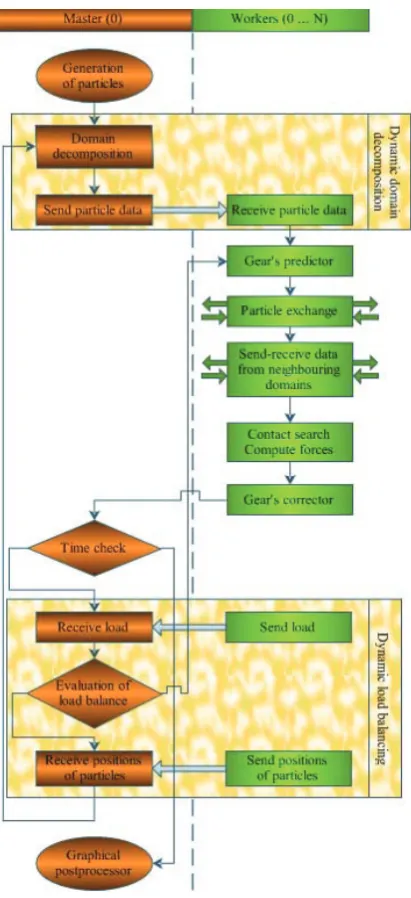
Figure 1. Parallel DEM algorithm
The parallel algorithm (Figure 1) is designed as follows. Initially, the pre-processor generates particles. The master processor divides the three-dimensional domain into the approximately equal subdomains containing a roughly equal number of particles. Pa-rallel planes are employed to achieve this purpose. Then, the generated particles are assigned to relevant processors, while the particle data are distributed by using MPI calls. Thus, the initial domain decompo-sition including interprocessor communication is fi-nished.
The main CPU time-consuming computational procedures of the DEM software are time integration and computation of contact forces, including contact detection. These intensive tasks are performed by the workers including the zero MPI process, which also serves as the master. The implemented domain decom-position perfectly parallelizes time integration perfor-med in the time loop without any interprocessor communication. Each processor computes Gear’s predictor and Gear’s corrector independently by using locally stored data. Fast contact detection based on a parallel version of the cell algorithm presents more challenge because it requires interprocessor communi-cation. Some neighbouring cells of the processed cell may belong to another processor. The processors need to exchange the information about the particles, which are near the division boundaries in the nearby subdomains.
The communication between workers is designed as follows. The initial portion of communications is performed after completing the Gear’s predictor step, when the processors exchange particles as they move from one subdomain to another. This interprocessor communication is optional, requiring sending-receiv-ing a small amount of data. However, it needs exten-sive manipulation on the data structures. It is worth noting that the conventional codes based on the con-tinuum approach do not perform the described com-munication. The main portion of communications is performed to exchange particle data from the cells near the division boundaries. The employed commu-nication model is created for grid networks. The received particle co-ordinates are placed as contiguous data directly into the arrays containing local particles. No time is spent for rearranging the data, except for creating the buffered messages for interprocessor communication. The inherent synchronisation of this message passing algorithm ensures good performance of parallel computation on the distributed memory PC clusters. The communications are performed by the non-blocking MPI routines MPI_ISEND and MPI_ IRECV, which significantly improve parallel efficien-cy of the code.
performing the dynamic load balancing presents some challenges due to a complex code structure, program-ming efforts and computational costs. A fast and simple iterative algorithm based on moving planes (Figure 2) is implemented to achieve satisfactory load balancing. During the analysis, the particles move from one subdomain to another. Significantly different numbers of particles in the subdomains indicate the load imbalance, but the precise load can be evaluated measuring time of computations performed by each processor. The load coefficients representing the time consumed per particle computations are calculated for each subdomain. Thus, the global load can be evaluated multiplying numbers of particles in subdo-mains by relevant load coefficients. The user controls the allowable load imbalance by specifying predefined percentage. New decomposition is performed, when the load change in any subdomain reaches a predefi-ned value. The positions of planes are iteratively ad-justed in such a way that the number of particles multiplied by load coefficients in each subdomain would be as close as possible to the average value. However, during the dynamic decomposition, particles and their data should be exchanged between the pro-cessors, which insignificantly increases the overall communication time.
Figure 2.Dynamic domain decomposition
4. Numerical results and discussions
The hopper discharge computations and parallel speed-up measurements were performed on Vilnius Gediminas Technical University cluster VILKAS (Rocks Cluster, CentOS release 5.4, x86_64 architec-ture) based on multi-core architecture. The cluster consists of 23 nodes including Intel® Core2Quad Q6600 2.40GHz CPU (2x4MB L2 cache and bus fre-quency equal 1067 MHz), 4x1GB DDR2 800 RAM, 320GB HDD (SATA II Extensions and 16 MB cache). Nodes are connected to 1Gbps Ethernet LAN by D-Link DGS 1224T Gigabit Smart Switch (24-Ports 10/100/1000Mbps Base-T Module).
4.1. Hopper discharge simulation
The problems associated with handling flow of granular materials in hoppers are of great significance in pharmaceutical, food, cement and chemical indust-ries. The challenges relevant to particle segregation, the effects of granular material vibration, attrition, for-mation of blockage or erratic flow zones, dust ex-plosions and wall collapses are encountered during the operation period of hoppers. The discrete approach enables simulation of the dynamical behaviour of granular material by direct introspection of physical effects of individual particles on the resulting beha-viour of flowing granular material.
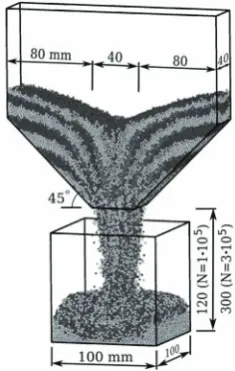
Figure 3. Geometry of the hopper discharge problem
The hopper discharge actually means the flow of the particles and their falling from the hopper due to the opening of the orifice. The configuration of hopper is presented in Figure 3. The rigid container walls are considered to be fixed frictional boundaries. The di-mensions of the orifice are 40 x 40 mm.
Granular material is modelled as the assemblies of non-cohesive spherical particles N = 100000 and
N = 300000. The particle radii Ri varying over the
range from 1.95 to 2.35 mm are generated with uni-form distribution. The total volume V of the material is equal to V = 5.2810-4 m3 for N = 1105 particles and
V = 1.58410-3 m3 for N = 3105 particles. Elasticity modulus of the particle is equal to E = 1106 Pa, the restitution coefficient is equal to 0.5. Interparticle fric-tion is characterized by the fricfric-tion coefficient = 0.4. Material parameters for particle-wall interactions are assumed to be the same as those used for describing the interparticle relations.
4.2. Parallel performance analysis
The parallel performance of computations was evaluated by measuring the speed-up Sp
p p
t t
S 1 , (5)
where t1 is the program execution time for a single
processor; tp is the wall clock time for a given job to
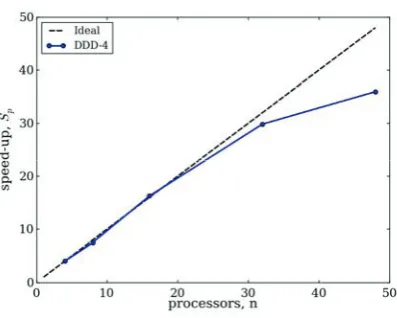
execute on p processors. The benchmark tests are repeated up to ten times and the averaged values are presented in figures. The parallel performance tests carried out on the PC cluster VILKAS are presented in Figure 4 and Figure 5. The speed-up (5) gained rela-tive to a sequential run as a function of the number of processors is shown for the systems consisting of 100000 and 300000 particles.
Figure 4. Speed-up measured performing static domain decomposition and dynamic domain decomposition
Figure 5. Parallel speed-up measured simulating the large system consisting of 300000 particles
Figure 4 shows quantitative comparison of speed-ups measured performing static domain decomposi-tion and dynamic domain decomposidecomposi-tion of the hopper containing N = 100000 particles. It is well known fact that Intel® Core2Quad processors lack sufficient parallel performance, when four memory intensive processes are executed per node. Thus, speed-ups (5) attained executing four processors per node are
compared with those executing two processors per node in order to illustrate this phenomenon. The curves “DDD-2” and “DDD-4” represent speed-ups of dynamic domain decomposition obtained by running two processes per node and four processes per node, respectively. The curves “SDD-2” and “SDD-4” repre-sent speed-ups of static domain decomposition measu-red by executing two processes per node and four processes per node, respectively. The special curve “Ideal” illustrates the ideal speed-up. The hopper solu-tion domain can easily be divided to four subdomains neglecting the dynamic character of particle flow. Therefore, very close values of speed-up are measured for four processes. The satisfactory static subdivision of the hopper domain to eight or more subdomains is more challenging or even impossible. Thus, the dyna-mic domain decomposition significantly outperforms the static decomposition. When the number of proces-ses is small and two procesproces-ses run per node (the curve “DDD-2”), the measured speed-up is close to linear. The reduction of the speed-up owing to communica-tion overhead is obtained for 16 processes. The paral-lel speed-up is largely determined by the ratio of local computations over interprocessor communications. As the number of processors increases, for a fixed prob-lem size, the communication cost eventually become dominant over the local computation cost.
Figure 5 shows parallel speed-up measured simu-lating larger system consisting of 300000 particles. It is difficult to simulate this system by using one pro-cess, because of long computing time. A slight reduc-tion of the speed-up is obtained by using 48 processes, because of the limited decomposition topology leading to communication overhead. The direct comparison of the measured speed-up with the results of other authors seems to be complicated, because of different hardware platforms and software implementations. Despite of that, the parallel speed-up reported in the present paper can compete with that reported in the overviewed literature. The presented results show that the implemented dynamic domain decomposition is well designed for simulation of hopper discharge on the PC clusters.
Figure 7. Time variation of the number of particles per processor
A highly efficient parallel implementation requires a well balanced workload among the processors. Figure 6 shows the dynamic load balance achieved by using four processors. The total workload increases slightly while particles rapidly change their positions. It can be explained by the fact that, initially, arrays of the particle data are ordered according to neighbour-hood of the particles. This procedure was not repeated during computations, therefore, large changes of par-ticles’ positions lead to the cache miss. Figure 7 plots the time variation of the number of particles per pro-cessor. The workload is well balanced while proces-sors work on very different numbers of particles. Comparison of these figures shows that the workload cannot directly be defined by the number of particles.
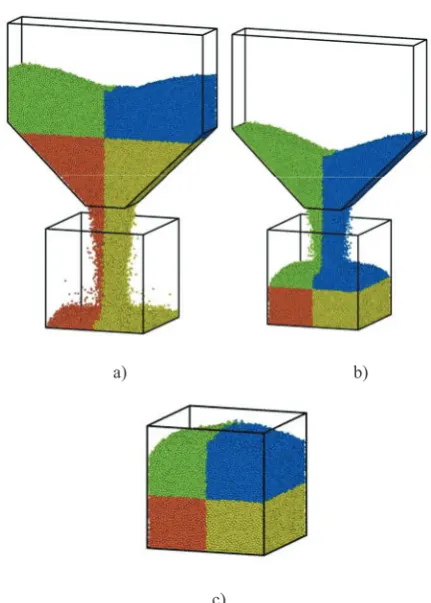
The discussed phenomena can be explained by the fact that the amount of computations strongly depends on the number of contacts between particles. Figure 8 plots time variation of particles’ contacts, while Figure 9 illustrates the hopper discharge at different time instances. At the beginning of computations, it is dif-ficult to balance the workload, because particles fall from the hopper and reach the bottom (Figure 9a). Thus, the number and the character of the contacts changes very quickly (Figure 8). At t=0.7s all falling particles belong to the upper subdomains (Figure 9b), which leads to the small number of contacts and the large number of particles. Figure 9c illustrates the moment when all particles are in the lower box. It is clear that at t=1.2s smaller number of particles and larger number of contacts are in the lower subdomains. Finally, it can be concluded that the number of particles is inversely proportional to the number of contacts in the processor, which leads to the balanced workload.
Figure 8. Time variation of particles’ contacts
a) b)
c)
Figure 9. Hopper discharge simulated by 4 processors: (a)t=0.2s, (b) t=0.7s, (a) t=1.2s
5. Conclusions
on the granular flow character. Moreover, the load ba-lance is significantly influenced by the number of contacting particles.
References
[1] R. Baleviius, R. Kaianauskas, A. Džiugys, A. Maknickas, K. Vislaviius. DEMMAT code for numerical simulation of multi-particle systems dyna-mics. Information Technology and Control, 2005, Vol. 34(1), 71–78.
[2] P.W. Cleary. Industrial particle flow modelling using discrete element method. Engineering Computations, 2009,Vol. 26(6), 698–743.
[3] P.A. Cundall, O.D.L. Strack. A discrete numerical model for granular assemblies. Geotechnique, 1979, Vol. 29(1), 47–65.
[4] C.H. Dowding, O. Dmytryshyn, T.B. Belytschko. Parallel processing for a discrete element program. Computers & Geotechnics, 1999, Vol. 25(4), 281–285.
[5] F. Fleissner, P. Eberhard. Parallel load-balanced si-mulation for short-range interaction particle methods with hierarchical particle grouping based on ortho-gonal recursive bisection. Int. J. Numerical Methods in Engineering, 2008, Vol. 74(4), 531–553.
[6] G. Frenning. An efficient finite/discrete element pro-cedure for simulating compression of 3D particle assemblies. Computer Methods in Applied Mechanics and Engineering, 2008, Vol. 197(49–50), 4266–4272.
[7] T.J. Goda, F. Ebert. Three-dimensional discrete ele-mentsimulations in hoppers and silos. Powder Technology, 2005, Vol. 158(1–3), 58–68.
[8] K. Han, Y.T. Feng, D.R.J. Owen. Performance com-parisons of tree-based and cell-based contact detection algorithms.Engineering Computations: Int. J. Compu-ter-Aided Engineering and Software, 2007, Vol. 24(2), 165–181.
[9] B. Hendrickson, K. Devine. Dynamic load balancing in computational mechanics. Computer Methods in Applied Mechanics and Engineering, 2000, Vol. 184(2–4), 485–500.
[10] B. Hess, C. Kutzner, D. van der Spoel, E. Lindahl. GROMACS 4: algorithms for highly efficient, load-balanced, and scalable molecular simulation. J. Che-mical Theory and Computation, 2008, Vol. 4(3), 435– 447.
[11] J. Hutter, A. Curioni. Dual-level parallelism for ab initio molecular dynamics: reaching teraflop perfor-mance with the CPMD code. Parallel Computing, 2005,Vol. 31(1), 1–17.
[12] A. Jabbarzadeh, J.D. Atkinson, R.I. Tanner. A pa-rallel algorithm for molecular dynamics simulation of branched molecules. Computer Physics Communica-tions, 2003, Vol. 150(2), 65–84.
[13] A. Kaeniauskas, R. Pacevi, A. Bugajev, T. Katke-viius. Efficient visualization by using ParaView software on BalticGrid. Information Technology and Control, 2010, Vol. 39(2), 108–115.
[14] R. Kaianauskas, A. Maknickas, A. Kaeniauskas, D. Markauskas, R. Baleviius. Parallel discrete ele-ment simulation of poly-dispersed granular material. Advances in Engineering Software, 2010, Vol. 41(1), 52–63.
[15] H. Kruggel-Emden, S. Rickelt, S. Wirtz, V. Sche-rer. A numerical study on the sensitivity of the discrete element method (DEM) for hopper discharge. J. Pressure Vessel Technology, 2009, Vol. 131(3), 031211.
[16] J.W. Landry, G.S. Grest, S.J. Plimpton. Discrete element simulations of stress distributions in silos: crossover from two to three dimensions. Powder tech-nology, 2004, Vol. 139(3), 233–239.
[17] A. Maknickas, A. Kaeniauskas, R. Kaianauskas, R. Baleviius, A. Džiugys. Parallel DEM software for simulation of granular media. Informatica, 2006, Vol. 17(2), 207–224.
[18] D. Markauskas, R. Kaianauskas, A. Džiugys, R. Navakas. Investigation of adequacy of multi-sphere approximation of elliptical particles for DEM simulations. Granular Matter, 2010, Vol. 12(1), 107– 123.
[19] D.R.J. Owen, Y.T. Feng. Parallelized finite/discrete element simulation of multi-fracturing solids and discrete systems. Engineering Computations, 2001, Vol. 18(3–4), 557–576.
[20] D.R. Parisi, S. Masson, J. Martinez. Partitioned dis-tinct element method simulation of granular flow within industrial silos. ASCE J. Engineering Mecha-nins, 2004, Vol. 130(7), 771–779.
[21] S. Plimpton. Fast parallel algorithms for short range molecular dynamics. J. Computational Physics, 1995, Vol. 117(1), 1–19.
[22] C.A. Radeke, B.J. Glasser, J.G. Khinast. Large-scale powder mixer simulations using massively pa-rallel GPU architectures. Chemical Engineering Science, 2010, Vol. 65(24), 6435–6442.
[23] M. Renouf, F. Dubois, P. Alart. A parallel version of the non smooth contact dynamics algorithm applied to the simulation of granular media. J. Computational and Applied Mathematics, 2004, Vol. 168(1-2), 375-382.
[24] B.C. Schäfer, S.F. Quigley, A.H.C. Chan. Accelera-tion of discrete element method (DEM) on a recon-figurable co-processor. Computers & Structures, 2004, Vol. 82(20-21), 1707–1718.
[25] J.H. Walther, I.F. Sbalzarini. Large-scale parallel discrete element simulations of granular flow. Engi-neering Computations, 2009, Vol. 26(6), 688–697.
[26] F. Wang, Y.T. Feng, D.R.J. Owen, J. Zhang, Y. Liu. Parallel analysis of combined finite/discrete element systems on PC cluster. Acta Mechanica Sini-ca, 2004, Vol. 20(5), 534–540.
[27] D. Zhang, C. Jiang, S. Li. A fast adaptive load ba-lancing method for parallel particle-based simulations. Simulation Modelling Practice and Theory, 2009, Vol. 17(6), 1032–1042.
[28] H.P. Zhu, Z.Y. Zhou, R.Y. Yang, A.B. Yu. Discrete particle simulation of particulate systems: theoretical developments. Chemical Engineering Science, 2007, Vol. 62(13), 3378–3396.
[29] H.P. Zhu, Z.Y. Zhou, R.Y. Yang, A.B. Yu. Discrete particle simulation of particulate systems: A review of major applications and findings. Chemical Enginee-ring Science, 2008, Vol. 63(23), 5728–5770.