Tewksbury, D. 2012. Crowdsourcing Homeland Security: The Texas Virtual BorderWatch and Participatory Citisenship. Surveillance & Society 10(3/4): 249-262.
Doug Tewksbury
Niagara University, USA. [email protected]
Abstract
This paper investigates the development of a new logic of labor and surveillance: the application of Crowdsourcing, an approach of distributive, collaborative labor over web-based networks, to the defense of the U.S.-Mexico border. I explore this issue through the case of the Texas Virtual BorderWatch, a network of governmental web-based surveillance cameras mounted at the U.S.-Mexico Border that can be patrolled by anyone with an internet connection. Programs such as the Texas Virtual BorderWatch have proven to be neither particularly effective nor cost-efficient, yet they continue, leading the question of what other logics must justify the sustained funding of these types of programs? I argue that the crowdsourcing of border security represents a new trajectory in the approach to governance and surveillance under Neoliberalism, able to use the power of participatory platforms developed under Web 2.0 as tools to offload the responsibilities of surveillance and security from the state to the populace at little to no cost. Furthermore, the Texas Virtual BorderWatch creates participatory “citizen-soldiers” in the War on Terror, able to welcome the front lines of surveillance into the household, among the most private of spaces. Yet in each case, these practices serve as but one example of the type of decentralized, interactive experiments of reproducing power dynamics that are representative of the Neoliberal movement’s aim to politicize the cultural practices of everyday life.
Introduction
Shortly following the attacks of September 11th, there emerged a new discourse in both popular and academic circles on the state and structure of citizenship. Conversations on this concept had long concerned the construction and motivation of individual practices of citizenship (particularly in recent thought on biopolitical tendencies), but this one was materially and discursively different. Rather than focusing on the libertarian principles of citizenship functioning as protecting the rights of the individual from the state, this new articulation centered on the individual’s participation in the defense of not only the territorial homeland but also of the homeland’s ideological way of life (Andrejevic 2006; Packer 2006; Yesil 2006). The idea had smoldered for some time under the Neoliberal movement’s cultivation of an atomized yet docile body politic, yet this new trajectory drastically rearticulated individuals’ responsibility to the state as perhaps the central governing tactic for the post-9/11 era (Giroux 2006; Harvey 2005).
The years since then have seen scholarly approaches toward the concept take on a tone of generalized unease, as new technologies of control shift increasingly toward the biopolitical in the flows of everyday life (Agamben 1998; Foucault 2008; Hardt and Negri 2000; 2004; 2009). Biopolitical technologies of control commonly repurpose truly democratic principles and practices into strategies of governance, and as such, the emergence of participatory media culture can be read as a phenomenon that reflects a new, sustained logic of governance intersecting between the dominant global parties—nation-states,
multinational corporations, supranational organizations, and rouge collectives of resistant insurgencies— that battle for the resources of their national or popular polities. It is the discourse surrounding this linking of meaning that becomes central to winning the hearts, minds, and indeed, the productive practices of populations.
In order to understand this exigency and its effect on the articulation of citizenship, it is necessary to place these discourses in the context of cultural practices (Hardt and Negri 2000, 2004; Giroux 2006; Miller 2007. The scale and scope of these changes in everyday cultural practice have been noted by a number of researchers on such themes as, for example, the rise of disaster preparedness (Andrejevic 2006; Hay 2006), mobility and surveillance (Packer 2006; 2008), the securitization of information (Bratich 2006), and the rise of public video surveillance (Yesil 2006). Each approach shares a common theme in the newly constituted discipline of what Booth (2005) terms Critical Security Studies, in addition to a common focus in critically examining cultural practices and mediations of these practices for the post-9/11 era. This is a particularly useful way of unpacking the underlying embeddedness of media in the flows of power that increasingly define everyday life, flows that are often relatively opaque. And as such, recent conversations have emerged from a larger dialogue: the negotiation of power differentials at the mediated sites where citizenship, technology, and power intersect.
This paper contributes to these conversations by exploring the governing management of the populace by new mediations of citizenship through the use of participatory media, Web 2.0 (O’Reilly 2005). I explore this trend through the study of one technology in particular—crowdsourcing, a decentralized and distributed network model for managing collective labor over space—and the recent emergence of initiatives of government such as the Texas Virtual BorderWatch, a network of web-based cameras that allow any citizen with an internet connection to patrol the U.S.-Mexico border from their home, office, or mobile device, what Caldwell (2006) calls “virtual posse” of sorts to monitor and attempt to prevent illegal immigration.
I argue that mediated cultural practices such as these are indicative of certain and specific articulations of citizenship that serve to encourage practices that reproduce and expand existing power dynamics. This era is one where it is necessary to at least consider the goals of the globally powerful—which Robinson (2004) notes includes the cooperation of not only the Transnational State (TNS) but also the Transnational Capitalist Class (TCC)—and the way in which these goals intersect with the practices of everyday life through governance, surveillance, and most importantly, the labor of citizens. Particularly in terms of mediated networks of information, the tools developed to manage and govern labor in the private sphere have increasingly been appropriated by the state as an ongoing series of experiments to manage its citizenry through cultivating self-governance (Foucault 2008; Hardt and Negri 2000, 2004, 2009).
At the center of this paper are three claims:
• First, the crowdsourcing of security through programs such as the Texas Virtual BorderWatch is
representative of recent strategies in governance that not only offload the responsibility, cost, and labor of security and surveillance onto the private sector, but also function as a productive force in fostering a populace willing to welcome the war on terror into the home.
• Second, the crowdsourcing of security is representative of a central principle of the Neoliberal
movement: shifting the conceptualization of citizenship away from rights and instead toward responsibilities to the state. This rearticulation creates a citizenry of what Andrejevic (2006) calls “interactive citizen-soldiers,” capable of participating in the labor of their own defense and viewing homeland security as an interactive project, a mediated civic duty.
• Third, and perhaps most importantly, these two functions are yet further evidence of the continual
These experiments, designed as market-centered, interactive strategies of divesting risk, fit firmly within the movement’s political and economic goals, namely, the creation of a docile yet interactive culture designed to participate in the reproduction of existent power dynamics. Central to this discussion is an overarching question: how are new, participatory technologies of citizenship linked to post-9/11 technologies of governance, and what are the implications of these new practices on the very practices of citizenship in the liberal democratic state?
Managing the Labor of Citizenship: Crowdsourcing and Government 2.0
The rise of what O’Reilly (2005) termed Web 2.0 was signified by a shift in the very conceptualization of the internet and the world wide web in modern cultural life. Whereas the web was previously thought of as a repository of information, a distributed network of content produced by centralized entities, there emerged a number of new technologies in the early- to mid-2000s that reflected a shift in the conceptualization of this technology’s form and function, from a place of information retrieval to participatory and collaborative platform, utilizing a multitude of approaches in a virtual space that enabled both user-generated content and user labor under a large body of technologies.
The term Web 2.0 has been applied to numerous technologies, products, and approaches. This shift is an indication that the trajectory of web functionality is increasingly directed away from a centralized, linear, mass communication structure and toward a more open distributed network, a concept loosely defined as “The Crowd” (Howe 2006a; Shirky 2008). The crowd is an amorphous concept used to define the usually anonymous collective grouping of a mass of individuals under some sort of materially solidifying shape. While the study of the amalgamation of peoples is not a new phenomenon—the long history of the modern era can be typified as the study of the benefits and complications that occur when people mass together—the view of the crowd in the network society has at its center the question of labor (Brabham 2008; Tapscott and Williams 2006).
Labor Management and Distributed Networks
The management of labor within any organization or institution is of primary importance to the maintenance and reproduction of that body, and is a fundamental question that one must in establishing a goal or desired objective. As a distributed network platform, Web 2.0 has emerged from a generalized shift in thought toward managing projects and information in the network era (Barabasi 2002). Web 2.0 signifies new approaches to labor and capital, such as the creation of a more efficient and innovative problem-solving environment by allowing mass collaboration on a task and the opening of new economic markets by expanding and targeting an increased number of smaller niche commercial markets, or the collection of user data. More simply, it allowed the utilization of users’ day-to-day activities in order to make predictive choices that would determine an organization’s action for their commercial or political projects (Howe 2006b; O’Reilly 2005; OECD 2007).
Crowdsourcing
At the forefront of these new models of labor is crowdsourcing. In June of 2006, Jeff Howe wrote a brief article for Wired magazine responding to observations he had made regarding multiple new collaborative business models that emerged with the rise of the network society. Rather than using a small number of well-paid experts or professionals to accomplish a task, collaboration over network structures created new models of labor for the information age by connecting and amassing the efforts of a large number of unpaid or low-paid amateurs. Howe explains:
Simply defined, crowdsourcing represents the act of a company or institution taking a function once performed by employees and outsourcing it to an undefined (and generally large) network of people in the form of an open call. This can take the form of peer-production (when the job is performed collaboratively), but is also often undertaken by sole individuals. The crucial prerequisite is the use of the open call format and the large network of potential laborers.
(2006a: para. 4)
Crowdsourcing draws its name from its related concept—outsourcing—both of which have at their center a shared goal of managing economies of labor. While the traditional notion of outsourcing represents a divestment of American resources to foreign markets with lower human labor costs to the organization, crowdsourcing represents a similar shift in an online context through the use of massive collaboration networks. It functions much along the lines of the SETI@home project begun in the early 2000s, where The Search for Extraterrestrial Life (SETI), an organization monitoring radio transmissions from space, harnessed the aggregated processing power of tens of thousands of home computers connected to the internet in a network structure rather than building its own massive, centralized server. This innovative case of a centralized organization addressing a problem through a decentralized network of individuals offers a vision of things to come.
Crowdsourcing works with a market model of rewards, a meritocracy of sorts, under the assumption that with the possibilities of network functions, the collective labor of a large number of amateurs will outperform a small number of professionals (Brabham 2008; Howe 2008). This is true in terms of the quantity of the crowd’s output—this technology usually yields far more unusable results than it does usable--yetthe with increased filtering technology or financial incentives, the cost and labor of sorting results which yield the greatest value to the beneficiary will be far less than that needed to develop these ideas in-house. Traditionally, innovation was the result of large capital investment in resources, personnel with specialized knowledge, or research and development. Crowdsourcing works differently by offering cash or other non-monetary rewards to amateur or private innovators to solve problems. Companies are able to outsource the creation of knowledge (as well as offloading the financial risk involved with the creation of that knowledge) to the crowd rather than taking them on as internal liabilities. With crowdsourcing, the company bears no sunk costs into research and development, no overhead of facilities or equipment or operating costs, no inventory or insurance, as the burden of each of these elements is shifted onto the mass of the crowd (Brabham 2008; Howe 2008).
funds and other securities. Threadless.com (2010) is “a community-based tee shirt company with an ongoing, open call for design submissions” where users submit original designs to the site. The 1500 or so designs submitted each week are voted upon, and the best ten are put into production where they can be purchased by anyone, with the designer getting a $2000 cash prize and store credit. InnoCentive (2010), a research and development clearinghouse primarily dealing with life sciences, business, chemistry, computer science, engineering, enables an open call where both for-profit and non-profit organizations can post a problem to be solved along with criteria of what constitutes a successful solution. Cash prizes of between $5000 and $1,000,000 are offered for completion. There is no shortage of examples, from British Petroleum crowdsourcing solutions to its 2010 Gulf of Mexico oil disaster, to the development of creative works, to NASA using a crowdsourcing competition to re-design the glove used in astronauts’ spacesuits.
Yet like all technology, the uses of crowdsourcing are not always as altruistic to either markets or democratic institutions. In 2008, global consulting firm Deloitte Touche Tohmatsu published a research white paper, Change Your World or Your World Will Change You: The Future of Collaborative Government and Web 2.0. In this document, designed to offer the company’s services to governmental organizations, Deloitte discusses the power of using the collaborative, network platform as a more reflexive and adaptable way for government to harness the power of citizens:
Web 2.0 is integral to building this new collaborative government capability. Although its applications have thus far been used mainly for decidedly non-governmental and more social or consumer-focused activities, such as photo sharing, online networking, podcasting and peer-to-peer file sharing, this is beginning to change….the public sector is falling behind the general population and business community in embracing Web 2.0 technologies. Yet, the business case for government-focused Web 2.0 adoption is overwhelming. The potential for governments to contribute to improved societal outcomes by embracing online collaboration and information sharing is now clear.
(2008: 4)
Governmental agencies have long appropriated the strategies, techniques, and technologies developed in the private sector for a wide range of uses, applying them to its own political, economic, and social needs (Hardt and Negri 2000, 2004, 2009; Hay 2006; Klein 2007). To be clear, there are places in government where the uses of new technology, including Web 2.0 are beneficial to citizens by allowing for more democratic citizen participation in decision-making, critique, research, and policy. Yet Deloitte’s case, however, also reflects a clear shift in the logic of governance through its focus on “improved societal outcomes,” a phrase that embodies the great potential of living in a democratic society but also raises a flag of warning for cultural critics. The control of populations has long had an intricate link to the application of new technologies, from Bentham’s panopticon to today’s cutting edge algorithmic processing of large sets of data for terrorism prediction. Yet while technology’s role as a problem-solving strategy for clearly defined improved societal outcomes is rife with possibilities, there are equal possibilities for the uses of technology as a mechanism of social control. We see both in this paper’s case study: The Texas Virtual BorderWatch.
Amassing the Virtual Posse: The Texas Virtual BorderWatch
Central to his campaign for Governor, though, was the issue of policing the U.S.-Mexico border. The issue of illegal immigration always burns brightly in the American Southwest, and conservative Texans took up the debate, making illegal immigration a theme that Perry used as a focal point, particularly in response to the 31 per cent cut in federal funds for border security that Texas faced that year (Perry 2006). Citing that “Texas must never wait for Washington to act,” Perry’s office announced a new initiative to combat illegal border crossings: the Texas Border Watch, later rebranded as the Texas Virtual BorderWatch (Perry 2006). Using five million dollars of state funds, a networked system of cameras was planned to monitor the border for illegal crossings along several high-traffic border-crossing sites.
This was not the first time that cameras were used to monitor the U.S.-Mexico border: stationary cameras had long been in use in high-traffic areas, as well as more technologically advanced surveillance mechanisms, such as cameras mounted on flying drones, mobile elevated towers, manned and unmanned hot-air balloons and blimps, as well as the Department of Homeland Security’s aborted attempt to build a 28-mile ‘virtual fence’ of cameras in the Arizona desert (Hsu 2008, 2010).
Yet the Texas Virtual BorderWatch program differed from these previous efforts in two distinct ways. First, rather than procuring land rights through purchasing or leasing properties along border migration routes, or by claiming them through eminent domain as had often been done in the name of border defense (Ober 2009), the cameras were to be placed on the private property of willing citizens, both on the border and off the border along migratory routes. In his announcement of the program, Perry described the initiative as “[working] with voluntary participation of private landowners, Texas will use $5 million to begin placing hundreds of surveillance cameras along criminal hotspots and common routes used to enter this country”, with cameras covering vast stretches of farm and ranchland located directly on the border and, notably, “not the neighborhoods where families will continue to enjoy their privacy” (Perry 2006). As of April 2010, nineteen private landowners had volunteered their property for the program (Grissom 2010).
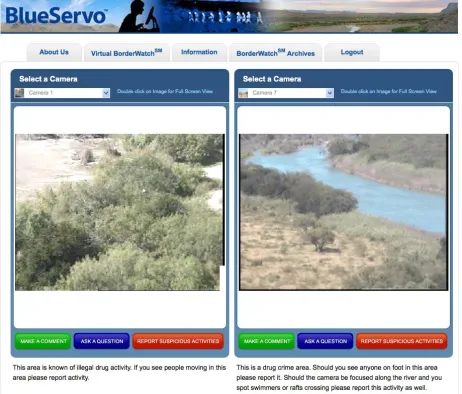
Secondly, the video feed of the cameras was fed to the web in real-time. When one thinks of the labor involved in monitoring video surveillance, the common image is of a band of authority figures seated in front of a wall of video monitors ready to notify enforcement agencies of criminal activity. The Texas Virtual BorderWatch instead fed live video footage into the homes and workplaces of not only American citizens but individuals around the globe. Should a viewer witness what they perceived to be an illegal border crossing, they were able to send notification to a dispatch agent by clicking on a “Report Suspicious Activity” button on the screen. Under the auspices of creating a nationwide “neighborhood watch,” the cameras were to be online 24 hours per day, equipped with night-vision technology (however the ability to zoom and thermal imaging are planned for the future and were not part of the program’s initial stages) and viewed through a dedicated interface on the website www.texasborderwatch.com (see Figure 1).
The Texas Border Watch trial website went live on 3 November 2006 for a 27-day test run with ten cameras online. During that time, the program reported 28 million hits with 221,562 registered users during its 639 hours of operation before the test site was closed on 30 November (Texas Virtual BorderWatch 2008). There were problems, however, ranging from poor visibility to malfunctioning cameras to the site’s server’s crashing from the overwhelming number of visitors. In the end, Perry’s office announced that the month-long trial resulted in the arrest of ten illegal immigrants, although there were questions as to the nature of these arrests and how many could actually be attributed to the Texas Border Watch (Grissom 2008, 2010).
traffic than the system used in the 2006 trial (Shannon 2008). The initiative would undergo a number of starts and stops before being housed in the Texas Border Sheriff's Coalition (TBSC), a non-profit administrator of several state-funded law-enforcement grants, which in turn contracted out to BlueServo, LLC, a small startup based out of San Angelo, TX. The Texas Border Watch was rebranded the Texas Virtual BorderWatch, self-described as “a public-private partnership to deploy the Virtual Community Watch, an innovative real-time surveillance program designed to empower the public to proactively participate in fighting border crime” (Texas Virtual BorderWatch 2010a). In 2011, the program was housed under the Texas Department of Public Safety and continued to be administered by BlueServo (Reay 30 Sept. 2011).
Figure 1. (Texas Virtual BorderWatch 2010c)
and has further compensated the company for several heavily redacted camera invoices, totalling more than $130,000 (“Invoices” 2008-2009). The contract states that the site is expected to sell advertisements in order to become financially self-sufficient in the undetermined future, as is also noted on their webpage, “BlueServo anticipates that high volume of traffic to its website will generate advertising revenue to defray the operations cost of the Virtual Community Watch to the Texas Border Sheriff's Coalition” (Texas Virtual BorderWatch 2010b). Each page currently has one banner ad for Amazon.com. TBSC Executive Director Don Reay acknowledged this failure, stating, “If we’ve fallen short on one thing, it’s that. The site should be self-sustaining by now. But it’s a small company with a small staff: the president of the company is the one climbing the poles to install the cameras” (Personal Communication, June 8 2010). As of May 2010, Reay asserted that The Texas Virtual BorderWatch registered 161,737 “Virtual Texas Deputies” and sustained more than 74 million hits (not including numbers from the trial run). Nearly 10 per cent of the viewers of the site were from international sources—more than 192 different countries, according to Reay—including a bar in Australia that maintained a 24-hour feed for its patrons (Luscombe 2009). The average time spent on the site per viewer visit was just over 11 minutes, a relatively noteworthy time-per-visit metric for a website.
The site itself was comprised of 19 streaming video links of stationary, non-zoomable cameras equipped with thermal imaging technology that allow users to detect body heat in the dark of night, although as of this writing, only seven were active. After registering with the site by submitting user information and answering a number of questions (example: “Do you think the border is adequately protected from crime and terrorism? [Yes/No/Skip]”), the user becomes a “Virtual Texas Deputy” and is able to access real-time video footage. The cameras are along the U.S.-Mexico border in locations that TBSC’s Reay notes are kept secret so that border crossers won’t be aware of their existence and change their routes, and are zoomable and pannable only by BlueServo staff, not users. On the site, each video feed is given a short description (15 of the 19 mentioned that the sites are known drug and/or crime sites, but none of the 19 explicitly mention immigration). The viewer window allows simultaneous viewing of two cameras in a dedicated window, each of which has below it a button labeled, “Report Suspicious Activity” that will submit a message via email to law enforcement, sent anonymously.
The site also offers an archive of notable video footage, featuring groups or individuals crossing rivers, walking through the desert, or cars being driven through desert or loaded. While almost all of the 64 videos of crossings in this archive state that authorities were notified, as of this writing, only one of these shows any sort of law enforcement presence on-camera. Furthermore, while some of these videos contain illegal crossings or illegal activities, there is little information provided on the outcome of the activity on each clip.
Despite watching a number of the camera feeds for dozens of hours, there was very little activity on any of the cameras besides occasional wildlife, such as birds and bats. The site is, frankly, unprofessional. The video is buggy and, despite the several years since the site’s beta testing, it often does not function correctly in either its streaming or its coding, it regularly freezes or crashes the user's web browser, and several pages of the site contain numerous dead links. Its ‘about us’ self-description is largely based on a 2008 press release from Governor Perry’s office, and its self-run Facebook page is equally problematic, with posts that are pragmatically (and grammatically) questionable:
With all that is happening now on the Texas boarder [sic] it is more important now for everyone to keep their eyes open and try to help stop people from entering the country and possiable [sic] prevent more violance [sic]. To all of those that are watching awesome job!
(BlueServo Facebook Page 2010a)
secure our boarders[sic]!
(BlueServo Facebook Page 2010b)
4 people standing next to the water; I did not report because they were not carrying any bags or attempting to cross. They actual [sic] just look to be fishing the river. If they were carrying bundles of bags I would have reported.
(Blueservo Facebook Page 2010c)
Furthermore, even without these issues of the company’s professional image, there are real limitations on this program’s potential efficacy. The footage that is provided is presented in a small window (approximately 400x300 pixels) and is relatively low-resolution, resulting in grainy footage. The choices of location and the framing of images are questionable, and several cameras are unusable for their stated goal. For example, Camera 7 (“This is a drug crime area. Should you see anyone on foot in this area please report this activity.”) is mounted on a mountain or tall radio tower at such a high perspective that ground detail is unperceivable, as is Camera 9 (“In this area you are looking for persons coming from the right heading towards the left. They may or may not be carrying backpacks. Please report this activity.”), and Camera 13 (“This is a known drug traffic area. If you see persons on foot carrying backpacks or packages please report this activity”). Camera 19 (“Report anyone crawling through this culvert”) monitors a locked grate over an access tunnel from a distance of approximately five feet. Clearly, it is very unlikely that someone would sit in front of his or her computer for hours, watching a video image of a locked grate framed in extreme close-up.
Furthermore, due to the fact that it is filming panoramic scenes, often at a distance, it is difficult to determine if the camera is actively operating or broadcasting a still image or possibly archived footage. I often suspected the latter, as I would regularly check the site during daylight hours in Texas and receive streaming footage that would be of night time scenes, and vice versa. The contract between the TBSC and BlueServo mandates at least an 85 per cent operational uptime (“Contract for Services” 2008); TBSC’s Reay maintains that they have a record of approximately 90 per cent uptime (personal communication 2010 June 8).
The Ongoing Experiment of Homeland Security
In terms of effectiveness, the first two years of the Texas Virtual BorderWatch’s operation do not appear to have achieved its stated goal of providing a cost-effective way to deter or capture illegal immigrants and drug smugglers. As of May 2010:
• Of the State’s goal of 200 cameras along the U.S.-Texas border, only 29 were established, of which
only 19 were active, approximately one for every 63 miles of Texas’ 1200-mile border. As of this writing, there were only seven active.
• Of the State’s goal of 1200 arrests in 2008 alone, the first two years of operation yielded 26 in total, at
a cost of approximately $153,800 per arrest (Grissom 2010).
• Of the State’s goal of 4500 immigration referrals, there were just a few dozen. TBSC’s Don Reay
argues that you cannot measure deterrence, although their deterrent nature is questionable, given the cameras’ sparseness and crossers’ unawareness that these cameras exist in the first place.
• While the State set no goals for the amount of drugs seized, the first two years of operation yielded a
reported total of 8,763 pounds of marijuana (U.S. Congress, May 5, 2010).
• Of the State’s goal of at least $25,000 in cash forfeitures, there were none (Grissom 2010).
and at least five actively critique it as at best ineffective, at worst, a waste of taxpayer money (Luscombe 2009; Grissom 2008, 2010).
In short, the Texas Virtual BorderWatch appears to have failed at almost every goal that was set for the program, whether technologic, economic, pragmatic, or political. Yet the Texas State Legislature continues to appropriate $2 million per year for this program. Given its sustained operation, there must be other explanations for its continued existence.
Experimental Insecurity
The Texas Virtual BorderWatch is representative of just one of many ongoing experiments in biopolitical governance incorporated as tenets of the ongoing and ever-changing philosophy of Neoliberalism. Biopolitics, a concept emerging primarily from the work of Michel Foucault (2008), frames these dynamics as an interaction between the citizen and the state as an ongoing series of experiments in governance, strategies in control meant to regulate citizens’ lives through their own everyday lived practices. Giroux (2006) concisely sums Foucault’s nuanced argument:
[Biopolitics is] an attempt to think through the convergence of life and politics, locating matters of life and death within our ways of thinking about and imagining politics. Central here is the task of reformulating the meaning of politics and how it functions within the contemporary moment to regulate matters of life and death, and, in turn, how such issues are intimately related to both the articulation of community and the social, and the regulation, care and development of human life. Within this discourse, politics is no longer understood exclusively through a disciplinary technology centered on the individual body…the body is understood primarily as an object of power…subject to those immaterial means of production that produce ways of life that enlarge the targets of control and regulation.
(2006: 12-13)
In other words, if the relationship between the state and the citizen is largely defined as the state’s attempts to maintain power through the regulation of its citizens, then it is the material and immaterial labor of citizens themselves that provide continuity for this power dynamic (Hardt and Negri 2000, 2004, 2009; Lazzarato 2009). Biopolitical production has been vital to the rise of Neoliberalism as a political philosophy, and for good reason: it is a strategy designed as market-centered strategy of divesting risk, fundamental to the Neoliberal movement’s primary goal of cultivating an interactive yet controlled culture capable of reproducing of existent power dynamics (Harvey 2005; Hay 2006; Virilio 2000). The technologies used under the Neoliberal state shift away from a disciplinary police force (which does little within the private sphere to further the goals of the state) to one of citizen self-regulation. The role of the state also shifts from enforcement of laws to one of management of its resources (Agamben 1998; Foucault 2008; Hardt and Negri 2000, 2004, 2009).
In other words, the responsibility of citizenship has taken on a new, added burden of homeland defense. This offloading of state responsibilities creates of what Hay (2006) calls a “moral economy,” a lived arrangement whereby individuals act out safety in their everyday lives as a self-governing behavior in order to defend both physical and economic security of the state:
The assimilation of economic well-being to national security re-frames the war on terror as a domestic policy issue—a domestication suggested by the terms ‘homeland’, which evokes a xenophobic nationalism—while simultaneously offloading the responsibilities of national defense onto the populace in the form of individual economic duties and decision-making. According to such an account, the decisions we make in household administration have a crucial role to play in so-called homeland security. Self-government is crucial to homeland self-defense. The goal of Homeland Security becomes an alibi not just for the adoption of ‘neo-liberal’ economic policies but for conducting various governmental experiments in security and mobilizing the technical resources of self-governance and person securitization that accord with such policies.
(2006: 339)
Yet insecurity has its purposes, too, and ones most often used for less than admirable ends, or at least rarely used as a path to a more viable democracy, as Foucault notes, “The motto of liberalism is: ‘Live dangerously’…that is to say, individuals are constantly exposed to danger, or rather, they are conditioned to experience their situation, their life, their present, and their future as containing danger” (2008: 66).
Exploiting the fears of a worried public can serve the political or economic advantages of those who wish to capitalize on the anxieties caused by uncertainty (Agamben 2005; Hardt and Negri 2000, 2004). As the events that occurred in the years following 9/11 showed, as much as we like to think that the public has become more attuned to identifying fear appeals that exist through nationalistic and ethnic jingoism than in past conflicts, the geometric expansion of mass communication media has provided new tools for those in power to uphold their advantage at the expense of the less powerful. The tactics may be different, but the underlying principle is nothing new, for the threat (or fabrication) of insecurity has long been a powerful method for ensuring power through the creation (or fabrication) of security. It is what Paul Virilio means when he says that, “faced with the ubiquity of risk, often even of a major risk of disaster for humanity, the issue of fearmanagement becomes crucial once more” (2007: 16, italics in original).
Perpetual Warfare, Perpetual Preparation
Technologies such as the Texas Virtual BorderWatch serve as a reminder that the threat of terrorism in the post-9/11 world is both absolute and perpetual—Bratich (2006) calls this the “new normal”—but perhaps more importantly, they represent a shift in the space of security. Rather than being fought on a traditional battlefield, the use communication technology can shift the sites where power is exercised from the borderland to the home, a new model of preparedness in the growing trend of the security-industrial complex that creates a “citizen-solider” able to participate in the War on Terror, while the purposes of government, both economic and political, are served at little to no cost (Andrejevic 2006). The arguments of the State are apparently legitimated by their claims for everyone’s involvement in defending the country in providing a shift toward the self-actualization of citizens, yet more troubling is the further push toward the Neoliberal ideal of self-empowerment roles that place the individual first and the state in a supporting role (Giroux 2006; Harvey 2005; Packer 2006).
represents the trend of shifting the citizen from preparedness for attack to participating in the prevention of attack, the active versus the reactive, where information supplements the traditional destructive and defensive weapons, and the forces of governance reach into the very heart of the private lives of citizens.
Home/Land Security: The Biopolitics of Household Safety
Yet fundamentally tied in with our conceptualization of security is the idea of the safest of places: the home. The home represents a long history of both privacy and safety, the inner sanctum where one is free to exercise rights of citizenship without interference, with ostensibly minimal invasion from unwanted political forces (Hay 2006; Berry, Kim and Spigel 2010). Yet the connection of biopolitical threats to the household we like to think that the fundamental traits of citizenship and reason give us the capacity to clearly and rationally assess a situation and make a decision based on sound reasoning, the real or imagined threats to one’s safety remind us that the human search for security is indeed primordial (Booth 2005).
While there have been threats in the past that infiltrated the home as reminders of larger political forces— most notably the 1950s and 1960s trend of building fallout shelters on one’s property—the participation was abstract and unable to span space and time to the sites where the threat was taking place. The bomb shelter was a defensive move, a reactive, preventative measure of ensuring safety. Yet as we move further into the information age where biopolitics becomes a primary governing strategy, the immaterial labor of citizens becomes a weapon (Hardt and Negri 2000, 2004). The simple act of living becoming a participatory act through both the preparation for and the participation in the prevention of attack, the maintaining of a constant state of readiness. As Virilio notes, “war is no longer in its execution…[war] isn’t acted out in repetition but in infinite preparation” (1997: 92).
Concluding Remarks
Texas Virtual BorderWatch has a number of implications on the influence and exercise of politics that are indicative of the relationship between the state and its citizens under Neoliberalism. Yet as a technology of governance, it leads to an exploitative relationship between the state and the citizen that allows the state to shirk on what is perhaps the most primary of its responsibilities: the protection of the country’s national borders. But more troubling is the network modeling of border surveillance in the state’s individualization of the strategies of governance. The U.S.-Mexico borderlands are continually framed as a security threat to American political and economic well-being, a passageway for terrorists to enter the country. There have been no known cases of a terrorist entering the country from the U.S./Mexico border, yet there are repeated attempts to frame illegal immigration as an invasion. Bringing the war on terror to the homes of American families takes what has been labeled as a threat to national security to the personal level and creates the virtual patrolling of the border as a participatory civic action. The only adequate response to this threat on the American way of life is for society to defend itself.
As a final thought, Virilio reminds us that defining the adversary in an era of biopolitical governance is often done only through subjective perspective:
War is in every way an art, a theatre of operation where stratagems are essential to deceive the enemy (and the allies) with respect to the action taking place—and from this come the terms for the dissimulating tactics of war: camouflage, disinformation…But above all, the field of battle is a field of perception which must be organized in such a way as to control the movements of the adversary…
(2002: 135-6)
If the predominant question faced by the state in the 20th century was how to defend the sovereign against adversaries in the physical spaces where borders were drawn, the primary goal of the information age will be how to define not only the virtual or material spaces of conflict but the very nature of adversary, itself. For if an instance such as the so-called War on Terror turns its focus inward to the very citizens that the state protects, these citizens become both the subject and object of security. The rise of technologies such as crowdsourcing shows us that the roles and responsibilities of citizens under Neoliberalism are undergoing a drastic reorganization, a complicated relationship that raises concerns about long-held beliefs about the nature of sovereignty, the state, the citizen, and even the fundamentals of a well-functioning liberal democracy. Yet it is our job as critical scholars to raise these concerns, and as we see the rise of discourse highlighting the liberating potential of new technologies and networks of information sharing, we must remember that everything is not always as it seems.
References
Agamben, Giorgio. 2005. State of exception. Chicago: University of Chicago Press.
———. 1998. Homo sacer: Sovereign power and bare life. Translated by Daniel Heller-Roazen. Palo Alto: Stanford University Press.
Anderson, Chris. 2004. The long tail. Wired.
———. 2006. The long tail : why the future of business is selling less of more. New York: Hyperion. Andrejevic, Mark. 2006. Interactive (in)security. Cultural Studies 20 (4): 441–458.
Barabási, Albert-László. 2002. Linked: The new science of networks. Cambridge, MA: Perseus Pub.
Berry, Chris, So-Yong Kim and Lynn Spigel. 2010. Electronic elsewheres: Media, technology, and the experience of social
space. Minneapolis: University of Minnesota Press.
Blueservo Facebook Page. 2010a. Posting date 27 May 2010. Accessed 8 June 2010. Available: https://www.facebook.com/pages/Blue-Servo/116369541709753
———. 2010b. Posting date 22 May 2010. Accessed 8 June 2010. Available: https://www.facebook.com/pages/Blue-Servo/116369541709753
———. 2010c. Posting date 27 April 2010. Accessed 8 June 2010. Available: https://www.facebook.com/pages/Blue-Servo/116369541709753
Booth, Ken. 2005. Critical explorations. In: Critical security studies and world politics, ed. Ken Booth, viii–ix. Boulder, CO: Lynne Rienner Publishers.
Brabham, D. C. 2008. Crowdsourcing as a Model for Problem Solving: An Introduction and Cases. Convergence: The
International Journal of Research into New Media Technologies Convergence: The International Journal of Research
into New Media Technologies 14 (1): 75–90.
Bratich, Jack. 2006. Public secrecy and immanent security. Cultural Studies 20 (4): 493–511.
Caldwell, Elizabeth. 2006. Texas to Install Border Web Cameras.”CBS News Online, June 9. http://www.cbsnews.com.
Contract for Services by and Between Blueservo, LLC, and Texas Border Sheriffs Coalition for the Texas Border Watch Program. 2008.
Deloitte Touche Tohmatsu. 2008. Change Your World or Your World Will Change You: The Future of Collaborative Government and Web 2.0. http://www.deloitte.com.
Foucault, Michel. 2008. The birth of biopolitics: Lectures at the College de France, 1978-1979. Basingstoke: Palgrave Macmillan.
Giroux, Henry A. 2006. Stormy weather: Katrina and the politics of disposability. Boulder, CO: Paradigm Publishers. Grissom, Brandi. 2010. Border Watch Meets Lowered Expectations in Fourth Year. The Texas Tribune, April 20.
http://www.texastribune.com.
———. 2008. Gov. Perry’s Border Camera Plan Hits Snag. The El Paso Times, May 30. http://www.elpasotimes.com. Hardt, Michael, and Antonio Negri. 2009. Commonwealth. Cambridge, MA: Harvard University Press.
———. 2000. Empire. Cambridge, MA: Harvard University Press.
Harvey, David. 2005. A brief history of neoliberalism. Oxford and New York: Oxford University Press. Hay, James. 2006. Designing homes to be the first line of defense. Cultural Studies 20 (4): 349–377. Howe, Jeff. 2006a. “The Rise of Crowdsourcing.” Wired.
———. 2006b. “Crowdsourcing: Crowdsourcing: A Definition.” Crowdsourcing. http://crowdsourcing.typepad.com/cs/2006/06/crowdsourcing_a.html.
Hsu, Spencer. 2010. Work to Cease on ‘Virtual Fence’ Along U.S.-Mexico Border. The Washington Post, March 16. http://www.washingtonpost.com/wp-dyn/content/article/2010/03/16/AR2010031603573.html.
———. 2008. “Virtual Fence” Along Border To Be Delayed. The Washington Post, February 28, sec. Politics. http://www.washingtonpost.com/wp-dyn/content/article/2008/02/27/AR2008022703747.html.
InnoCentive.com. 2010. Solver Discussion Forum. Innocentive.com. https://gw.innocentive.com/ar/board/challenge/9383447. “Invoices for Camera Purchases by BlueServo, LLC.” 2008.
iStockphoto.com. 2010. Frequently Asked Questions. Istockphoto.com. http://www.istockphoto.com/faq.php.
Keen, Andrew. 2007. The cult of the amateur: How today’s internet is killing our culture. New York: Doubleday/Currency. Klein, Naomi. 2007. The shock doctrine: The rise of disaster capitalism. New York: Metropolitan Books/Henry Holt.
Lazzarato, Maurizio. 2009. Neoliberalism in Action Inequality, Insecurity and the Reconstitution of the Social. Theory, Culture &
Society 26 (6): 109–133.
Libert, Barry and Jon Spector. 2008. We are smarter than me : how to unleash the power of crowds in your business. Upper Saddle River, NJ: Wharton School Pub.
Luscombe, Richard. 2009. Patrol Watches Texas-Mexico Border - from Pub in Australia. The Guardian. http://www.guardian.co.uk/world/2009/mar/23/texas-mexico-patrol-webcam-australia. Marketocracy.com. 2010. Welcome to Marketocracy. Marketocracy.com. http://www.marketocracy.com.
Miller, Toby. 2007. Cultural citizenship cosmopolitanism, consumerism, and television in a neoliberal age. Philadelphia: Temple University Press..
Navarro, Mireya. 2007. Demand for Pictures Turns Amateurs into Paparazzi. SFGate.
http://www.sfgate.com/bayarea/article/Demand-for-pictures-turns-amateurs-into-paparazzi-3300674.php#src=fb. O’Reilly, Tim. 2005. What Is Web 2.0? O’Reilly.net. http://oreilly.com/web2/archive/what-is-web-20.html.
Ober, Lauren. 2009. Crossing the Line. Seven Days, September 30. http://www.7dvt.com/2009crossing-line.
OECD. 2007. Participative Web and User-Created Content: Web 2.0, Wikis and Social Networking. Orgnaization for Economic
Co-Operation and Development.
http://www.oecd.org/sti/interneteconomy/participativewebanduser-createdcontentweb20wikisandsocialnetworking.htm.
Packer, Jeremy. 2008. Mobility without mayhem: Safety, cars, and citizenship. Durham: Duke University Press. ———. 2006. Becoming bombs: Mobilizing mobility in the war of terror. Cultural Studies 20 (4): 378–399. Perry, Rick. 2006. Perry Authorizes More Border Security Funding, Virtual Border Watch Program. Press Release.
http://www.governor.state.tx.us/ divisions/press/pressreleases/PressRelease.2006-06-01.1612. Reay, Don. 2010, June 8. Personal interview with the author.
Robinson, William I. 2004. A theory of global capitalism: Production, class, and state in a transnational world. Baltimore: Johns Hopkins University Press.
Shannon, K. 2008. State Cancels Border Camera Program Request for Now. Associated Press, May 16. http://hosted.ap.org. Shirky, Clay. 2008. Here comes everybody: The power of organizing without organizations. New York: Penguin Press. Surowiecki, James. 2005. The wisdom of crowds. New York: Anchor Books.
Tapscott, Don and Anthony D Williams. 2006. Wikinomics: How mass collaboration changes everything. New York: Portfolio. Texas Virtual BorderWatch. 2010a. “About Us.” Texas Virtual BorderWatch. http://www.texasborderwatch.com/about.php. ———. 2010b. “About BlueServo.” Texas Virtual BorderWatch. http://www.texasborderwatch.com/about.php.
———. 2010c. Screen Capture taken Nov. 8, 2010. Texas Virtual BorderWatch. http://www.texasborderwatch.com/. ———. 2008. Texas Border Watch Test Site. Texas Virtual BorderWatch. http://www.texasborderwatch.com. Threadless.com. 2010. About Threadless. Threadless.com. http://www.threadless.com/help.
Tzortzis, Andreas. 2006. Amateurs Get In on the Paparazzi Beat. The New York Times, August 14. http://query.nytimes.com/gst/fullpage.html.
U.S. Congress. 2010, May 5. Senate. Caucus on International Narcotics Control. Testimony: Donald L. Reay, Executive Director, Texas Border Sheriff’s Coalition. 111th Cong., 2nd sess.
Virilio, Paul. 2007. The original accident. Cambridge and Malden, MA: Polity. ———. 2002. Desert screen : war at the speed of light. London; New York: Continuum. ———. 2000. The information bomb. London and New York: Verso.