This is an open access journal, and articles are distributed under the terms of the Creative Commons Attribution-Non Commercial-Share Alike 4.0 License, which allows others to remix, tweak, and build upon the work non-commercially, as long as appropriate credit is given and the new creations are licensed under the identical terms.
© 2017 Journal of Advanced Pharmacy Education & Research | Published by SPER Publication 387
Nurses’ knowledge and attitude towards management of
patients with heart failure
Hala Mohamed Sanad
Assistant Professor, BSN coordinator, Nursing Department-WHO Collaborating Center for Nursing Development, College of Health Sciences, University of Bahrain, P.O. Box: 32038, Salmanya, Kingdom of Bahrain
Correspondence: Hala Mohamed Sanad, Assistant Professor, BSN coordinator, Nursing Department-WHO Collaborating Center for Nursing Development, College of Health Sciences, University of Bahrain, P.O. Box: 32038, Salmanya, Kingdom of Bahrain, Email: [email protected]
ABSTRACT
Nurses specialized in heart failure management constitute a vital key agent in assessing the signs and symptoms of cardiac deterioration, monitor therapy compliance, afford education, psychosocial support, and counseling. Additionally, they act as the healthcare liaison for the patients and their families at any stage of the disease. The study aimed to assess cardiac care nurses' knowledge and attitude towards management of patients with heart failure.
Method: A descriptive cross-sectional design was used with a convenience sample of 153 nurses. The data was collected through self-administered questionnaire.
Findings: The study findings revealed generally low knowledge of the management of patients with heart failure among the nurses. Moreover, the nurses’ attitudes towards management of heart failure patients tended to be positive.
Conclusion: The nurses do not have an adequate knowledge of the managing heart failure patients whereas their related attitudes tend to be positive. The deficient knowledge would certainly have a negative impact on the quality of their practice, and consequently on patients’ outcomes. They need training to improve their knowledge and attitudes, especially concerning heart failure disease condition. Bahraini nurses, particularly females with long years of experience need to be the first targeted by such staff development activities
Keywords: Heart Failure, Nurses’ Knowledge, Attitude, Management
Introduction
Heart failure is a clinical syndrome in which the heart cannot pump adequate amount of blood to support the metabolic demands of the body [1]. The incidence and prevalence rates of
heart failure have increasing trends worldwide, both in developed and developing countries, particularly with the increasing aging in various populations [2]. It presents a leading
cause of hospital admissions [3]. Moreover, the high health
illiteracy among the patients suffering heart failure poses more burden on healthcare providers to adopt strategies that can help these patients deal with their chronic lifelong illness [4]
. The nurse role is of paramount importance in this respect [5]
. During the last few decades, the nursing profession witnessed an expansion of the roles and responsibilities of nurses, with the ultimate goal of improving patient outcomes. Thus, nurses are now allowed to prescribe medications in certain areas and in some countries such as Nigeria [6]. Nurses specialized in heart
failure management constitute a vital key agent in assessing the signs and symptoms of cardiac deterioration, monitoring therapy compliance, affording education, as well as providing psychosocial support and counseling. Furthermore, they act as healthcare liaison for the patients and their families at any stage of the disease [7]
. These roles would lead to significant improvement in patient outcomes [8]
. Furthermore, an
Access this article online
Website: www.japer.in E-ISSN: 2249-3379
How to cite this article:Hala Mohamed Sanad. Nurses’ Knowledge and attitude towards management of Patients with heart failure. J Adv Pharm Edu Res 2017;7(4):387-393.
innovative heart failure nurse curriculum was proposed by Riley et al. [9] in Germany in order to prepare nurses for the new roles
and responsibilities assigned to them in their care for heart failure patients. In the same vein, the American Association of Heart Failure Nurses had a recent Position Paper on the Certified Heart Failure Nurse Knowledge Certification for this purpose [10]
.
Three essential strategies are adopted in heart failure management: namely pharmacologic, device/surgical, and lifestyle management. Nurses have a critical input in each of these strategies in both inpatient and outpatient settings [11].
Thus, nurses’ knowledge and attitude can help patients with heart failure to manage their disease effectively. However, researches addressing nursing care of patients with heart failure were mainly focused on assessing nurses’ performance and on knowledge related to patient education [12, 13] and palliative care [14]
. Meanwhile, studies investigating how well nurses are equipped with adequate knowledge and attitudes underlying their skills related to management of these patients are limited. Exploring the knowledge and attitudes towards heart failure management among the nurses working in Bahrain could help nursing administrators to improve patient care through identifying knowledge and attitude gaps and learning needs. Therefore, the aim of this study is to assess cardiac care nurses' knowledge and attitude towards management of patients with heart failure, and to generate hypotheses regarding nurses’ demographic data that may influence this.
Material and Methods
Research design and setting
A descriptive cross-sectional design was used to conduct this study at two governmental hospitals in Bahrain.
Participants
A convenience sample of 153 nurses was recruited from two governmental hospitals. No inclusion or exclusion criteria were set except providing direct care to patients with heart failure. The sample size was calculated to estimate a 95% confidence interval for the mean knowledge score with 5.0 width and 15.0 standard deviation using the single mean equation for sample size [15]
, and accounting for a non-response rate of about 10%.
Data collection tool
The researcher designed a self-administered questionnaire based on pertinent literature. It consisted of three sections. The first section was for nurse’s demographic characteristics such as age, gender, marital status, nationality, years of experience, etc. The second section was intended to assess nurse’s knowledge regarding the management of heart failure. It included 30 multiple choice questions categorized as follows: 11 questions for heart failure disease condition, 8 questions for
pharmacological management, and 11 questions for nursing management. For scoring, the correct responses were scored “1” and the incorrect “zero.” For each section and for the total score, the sum obtained was divided by the number of items, and then converted into a percent score. Means, standard deviations and medians were calculated for each section and for the total knowledge score.
The last section of the questionnaire was an attitude scale. It included 18 statements exploring the nurse’s attitude towards management of a patient with heart failure. The responses were on a 5-point Likert scale from “strongly agree” to “strongly disagree.” These were scored from 5 to 1 respectively, and the scoring was reversed for negative statements so that higher scores indicate more positive attitude. The scores of the items were summed-up and averaged by dividing by the number of items. Means, standard deviations, and medians and quartiles were computed.
The tool was rigorously revised by a panel of experts in medical and nursing cardiology for face and content validity, and necessary modifications were done. The reliability of the attitude scale was tested in a pilot study conducted on 20 nurses through assessing its internal consistency. It showed good level of reliability with Cronbach Alpha Coefficients 0.798. The tool was then finalized based on the pilot results.
Procedure
The researcher met with each eligible nurse in the setting and provided them with the instructions concerning their filling-in. The questionnaire was filled individually in the presence of the researcher to avoid any communication among nurses and to provide any clarifications needed. Approximately 10-15 minutes were taken from each nurse to complete the questionnaire. The filled forms were collected by the researcher and revised on-site to ensure completeness of the data. Data was collected over a four-month period.
Statistical analysis
Data analysis was done using the statistical software SPSS version 20. Spearman rank correlation test was used for the inter-relations among quantitative and ranked variables. Linear regression analysis was used to identify the factors independently influencing nurse’s knowledge and attitude score. The level of statistical significance was set at p<0.05.
Ethical considerations
withdraw at any time no questions asked. Total anonymity and confidentiality were guaranteed, with reassurance that the collected information would be used only for research purposes.
Results
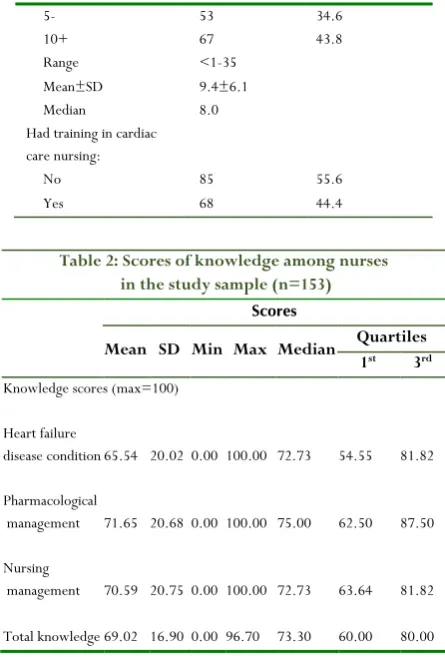
The study sample consisted of 153 nurses, mostly females (86.3%), whose age ranged between 18 and 60 years with median 34 of years (Table 1). The majority of the nurses were non-Bahraini (71.9%), and married (84.3%). As for their job characteristics, more than half were holding a bachelor degree in nursing (58.8%), with experience years ranging between less than one to 35 years (median 8 years), and more than half of them (55.6%) had no previous training in cardiac care nursing. As demonstrated in Table 2, nurses’ knowledge of heart failure disease condition had the lowest score with mean 65.54. Conversely, pharmacological management had the highest mean score (71.65). The total score ranged between 0.00 and 100.00, with median 73.30.
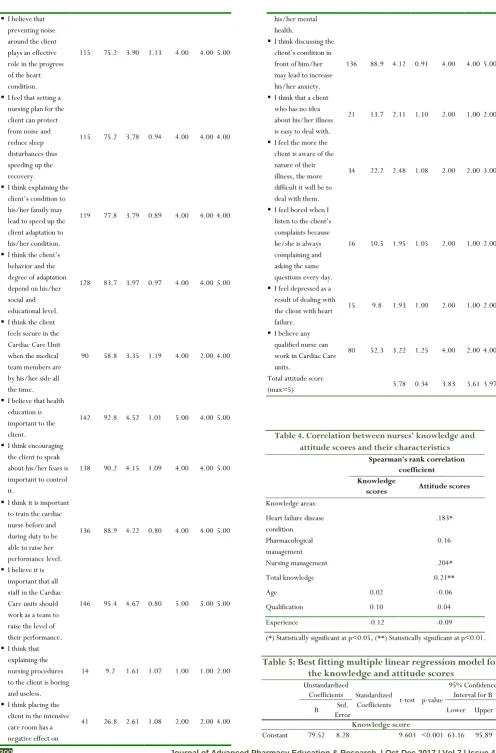
Table 3 indicates generally high percentages of agreement upon most positive attitude statements, with medians 4.00 or 5.00, and low percentages of agreement upon most negative ones, with medians mostly 1.00 or 2.00. There were only few exceptions. These were the relatively low percentage of agreement upon the statement “I think the client feels secure in the Cardiac Care Unit when the medical team members are by his/her side all the time,” and the high percentage of agreement upon the statement “I think discussing the client’s condition in front of him/her may lead to increase his/her anxiety.” Overall, the total mean attitude score was 3.83 of a maximum score of 5.00.
Table 1. Socio-demographic and job characteristics of nurses in the study sample (n=153)
Frequency Percent
Gender:
Male 21 13.7 Female 132 86.3
Age:
<30 42 27.5
30- 82 53.6
40+ 29 19.0
Range 18-60 Mean±SD 34.5±7.3 Median 34
Nationality:
Bahraini 43 28.1 Non-Bahraini 110 71.9
Marital status:
Unmarried 24 15.7 Married 129 84.3
Nursing qualification:
Diploma 63 41.2 Bachelor 90 58.8
Experience years:
<5 33 21.6
5- 53 34.6
10+ 67 43.8
Range <1-35 Mean±SD 9.4±6.1 Median 8.0 Had training in cardiac care nursing:
No 85 55.6
Yes 68 44.4
Table 2: Scores of knowledge among nurses in the study sample (n=153)
Scores
Mean SD Min Max Median Quartiles
1st 3rd
Knowledge scores (max=100)
Heart failure
disease condition 65.54 20.02 0.00 100.00 72.73 54.55 81.82
Pharmacological
management 71.65 20.68 0.00 100.00 75.00 62.50 87.50
Nursing
management 70.59 20.75 0.00 100.00 72.73 63.64 81.82
Total knowledge 69.02 16.90 0.00 96.70 73.30 60.00 80.00
As displayed in Table 4, statistically significant weak positive correlations were revealed between the attitude score and nurse’s knowledge score of heart failure disease condition and nursing management, as well as with the total knowledge score (r=0.204). Meanwhile, no correlations of statistical significance could be revealed between nurses’ knowledge or attitude scores areas and their age, qualification, or experience years.
In multivariate analysis (Table 5), the nurse’s non-Bahraini nationality was identified as the only factor independently and significantly positively influencing their knowledge score. Conversely, the nurse’s female gender and experience years were negative factors. However, the model only explains about 8% of the variation in this score. As regards attitude, the table indicates that the nurse’s knowledge score was the only factor independently and significantly positively influencing this score, and it explains 7% of its variance. None of the other nurse’s characteristics had a significant independent influence on their knowledge or attitude scores.
Table 3. Attitude towards heart failure patients among nurses in the study sample (n=153)
Agree/Strong
agree Score (max=5)
No. % Mean SD Median Quartiles
1st 3rd I feel that the nursing
care for the client has a direct effect on the patient’s physical and mental health.
I believe that preventing noise around the client plays an effective role in the progress of the heart condition.
115 75.2 3.90 1.13 4.00 4.00 5.00
I feel that setting a nursing plan for the client can protect from noise and reduce sleep disturbances thus speeding up the recovery.
115 75.2 3.78 0.94 4.00 4.00 4.00
I think explaining the client’s condition to his/her family may lead to speed up the client adaptation to his/her condition.
119 77.8 3.79 0.89 4.00 4.00 4.00
I think the client’s behavior and the degree of adaptation depend on his/her social and educational level.
128 83.7 3.97 0.97 4.00 4.00 5.00
I think the client feels secure in the Cardiac Care Unit when the medical team members are by his/her side all the time.
90 58.8 3.35 1.19 4.00 2.00 4.00
I believe that health education is important to the client.
142 92.8 4.52 1.01 5.00 4.00 5.00
I think encouraging the client to speak about his/her fears is important to control it.
138 90.2 4.15 1.09 4.00 4.00 5.00
I think it is important to train the cardiac nurse before and during duty to be able to raise her performance level.
136 88.9 4.22 0.80 4.00 4.00 5.00
I believe it is important that all staff in the Cardiac Care units should work as a team to raise the level of their performance.
146 95.4 4.67 0.80 5.00 5.00 5.00
I think that explaining the nursing procedures to the client is boring and useless.
14 9.2 1.61 1.07 1.00 1.00 2.00
I think placing the client in the intensive care room has a negative effect on
41 26.8 2.61 1.08 2.00 2.00 4.00
his/her mental health.
I think discussing the client’s condition in front of him/her may lead to increase his/her anxiety.
136 88.9 4.12 0.91 4.00 4.00 5.00
I think that a client who has no idea about his/her illness is easy to deal with.
21 13.7 2.11 1.10 2.00 1.00 2.00
I feel the more the client is aware of the nature of their illness, the more difficult it will be to deal with them.
34 22.2 2.48 1.08 2.00 2.00 3.00
I feel bored when I listen to the client’s complaints because he/she is always complaining and asking the same questions every day.
16 10.5 1.95 1.05 2.00 1.00 2.00
I feel depressed as a result of dealing with the client with heart failure.
15 9.8 1.93 1.00 2.00 1.00 2.00
I believe any qualified nurse can work in Cardiac Care units.
80 52.3 3.22 1.25 4.00 2.00 4.00
Total attitude score
(max=5) 3.78 0.34 3.83 3.61 3.97
Table 4. Correlation between nurses' knowledge and attitude scores and their characteristics
Spearman's rank correlation coefficient Knowledge
scores Attitude scores
Knowledge areas: Heart failure disease condition
.183*
Pharmacological management
0.16
Nursing management .204* Total knowledge 0.21**
Age 0.02 -0.06
Qualification 0.10 0.04 Experience -0.12 -0.09
(*) Statistically significant at p<0.05, (**) Statistically significant at p<0.01.
Table 5: Best fitting multiple linear regression model for the knowledge and attitude scores
Unstandardized
Coefficients Standardized
Coefficients t-test p-value
95% Confidence Interval for B B Std.
Error Lower Upper
Knowledge score
Female
gender -10.37 3.87 -0.21 2.682 0.008 -18.01 -2.73
Non-Bahraini nationality
7.89 2.98 0.21 2.645 0.009 1.99 13.78
Experience
years -0.51 0.22 -0.18 2.304 0.023 -0.94 -0.07 r-square=0.081 Model ANOVA: F=5.455, p=0.001 Variables entered and excluded: age, qualification, marital status, department, experience, unit, training courses
Attitude score
Constant 67.45 2.37 28.406 <0.001 62.76 72.14 Knowledge
score 0.12 0.03 0.27 3.480 0.001 0.05 0.18 r-square=0.07 Model ANOVA: F=12.109, p=0.001 Variables entered and excluded: age, gender, nationality, qualification, marital status, department, experience, unit, training courses
Discussion
The present study revealed generally low knowledge of the management of patients with heart failure among the nurses in the study settings. This is noticed in all three areas of knowledge. The striking finding is that the minimal score in each of the three areas, as well as in the total of the form, was zero, which indicates that at least one of the participating nurses know nothing about the physical examination of the patient with heart failure. This finding is an alarming one since it may jeopardize patients’ wellbeing and safety[16]
. Nonetheless, a study in the United States reported similarly low levels of nurses’ knowledge of heart failure, with correct answers ranging between 14 and 100%[17].
On the other hand, the present study findings demonstrated that the maximum score in each of the three areas and in the total form was 100.00. This indicates that at least one of the nurses had fully correct knowledge about the management of the patients with heart failure. Furthermore, the third quartiles of the knowledge score in the three areas, as well as in the total score, were 80.00 or higher, which means that at least one-fourth of the participating nurses had the “pass” mark for knowledge adopted in the study settings. Similarly, low scores of knowledge were reported among nurses in South Korea regarding the care of patients with heart failure, especially regarding palliative care management[18].
Looking at the median scores of the nurses in the present study, the total median is less than the pass score of 80% required for practicing nurses in the study settings. Thus, at least one-half of the nurses have no passing score for their knowledge of the management of the patient with heart failure. In agreement with this, a study in Connecticut reported low scores of nurses’ knowledge of heart failure, which improved significantly after implementation of an educational intervention[19]
. On the same line, a study in Orlando found that nurses had knowledge deficits regarding heart failure management and self-care[20]
. Similar findings were also revealed in a study of nurses in Cyprus, and the author recommended improving their related knowledge and skills[21].
The nurses’ deficient knowledge in the current study is most evident in the areas of heart failure disease condition. This might be explained by the fact that the nurses’ actual practice with heart failure patients is more related to pharmacological and nursing management. The disease condition could be considered as more theoretical than practical knowledge that may not be needed as the knowledge directly related to heart failure management. This situation needs urgent interventions in order to help graduating nurses to make optimum use of their knowledge of heart failure in improving their practices as pointed out by Paul and Hice[22]
. Moreover, as shown by Sterne et al[3]
, improved nurses’ knowledge of heart failure led to decreased rates of hospital readmissions among these patients. Concerning the factors that may have a significant association with nurses’ knowledge of the management of the patient with heart failure, the present study identified the nationality, gender and experience years. The relation with nationality might have two different explanations. The first is the difference in the educational background and training, with variable emphasis on nurses’ roles and responsibilities, which is in congruence with Rushforth[23] who described the wide variability in teaching of
'History Taking and Physical Assessment' (HTPA) in the United Kingdom and other European countries. The second could be related to the lower feeling of job security among non-Bahraini nurses who, being expatriate, continually tend to improve their knowledge and skills in order to retain their jobs.
As regards the negative association of the knowledge with the female gender, it could be explained by the fact that male nurses are often more recently graduated since the introduction of males in the bachelor degree program of nursing started only a few years ago in many countries. Being recent graduates, they may have better retention of knowledge. The negative relation with the experience years provides more support to this explanation. A similar significant relation between nurses’ knowledge and their gender was reported in a study in Iran[24]
. Conversely, a study in the United States reported that nurses’ pass score of knowledge related to heart failure had no significant relation with their demographics, including gender[25]
.
the oriental culture that tends to hide facts from patients to save him/her any anxious feelings. However, hiding the truth could lead to tragedies as mentioned by Heyer[26]. Moreover, a study
in Japan demonstrated that miscommunication with the patient and failure to properly break the bad news lead to more anxiety[27]
.
As for the factors influencing the attitude score of the current study nurses towards management of patients with heart failure, the correlation and regression analyses identified the knowledge score as the only factor independently and positively related to it. This indicates that providing proper knowledge to the nurses would lead to improvement of their attitudes. Consequently, this would be reflected positively on their patients’ management and outcomes. In agreement with this, a study in South Korea demonstrated a significant positive association between nurses’ knowledge and attitudes towards palliative management of the patients with heart failure[18]
. Moreover, a recent study in Malaysia[28]
showed improvements in cardiac nurses’ attitudes with the improvement of their knowledge.
Conclusion and Recommendations
In conclusion, the nurses in the study setting do not have an adequate knowledge of the management of patients with heart failure, whereas their related attitudes tend to be positive. The deficient knowledge would certainly have a negative impact on the quality of their practice, and consequently on patients’ outcomes. They need hands-on training to improve their knowledge and attitudes, especially concerning heart failure disease condition. Bahraini nurses, particularly females with long experience years need to be the first targeted by such staff development activities.
Acknowledgements
We thank Dr. Mohamed Amin, Dr. MouzaSuwaileh, Dr. Shereen Al Shaikh, Dr. Adel Mashreqi, Dr. Nizar Bukamal, and Mrs. Nawah Saleh for their effort in reviewing the tool.
References
1. Lindenfeld J., Albert N.M., and Boehmer J.P., 2010. Evaluation and management of patients with acute decompensated heart failure: HFSA 2010 comprehensive heart failure practice guidelines. Journal of Cardiac Failure; 16(6): e134-e156. Available at:www.guidelines.gov/content.aspx? id=23908& search=heart+failure
2. 2Richards D.A., and Borglin G., 2011. Complex interventions and nursing: looking through a new lens at nursing research. Int J Nurs Stud.; 48(5):531-3.
3. Sterne P.P., Grossman S., Migliardi J.S., and Swallow A.D., 2014. Nurses' Knowledge of Heart Failure:
Implications for Decreasing 30-Day Re-Admission Rates. Medsurg Nurs.;23(5):321-9.
4. Cajita M.I., Cajita T.R., and Han H.R., 2016. Health Literacy and Heart Failure: A Systematic Review. J Cardiovasc Nurs.;31(2):121-30. doi: 10.1097/JCN. 0000000000000229.
5. Delgado J.M., and Ruppar T.M., 2015. Health Literacy in Older Latinos with Heart Failure: A Systematic Review. J CardiovascNurs.
6. Ogedegbe G., Gyamfi J., Plange-Rhule J., Surkis A., Rosenthal D.M., Airhihenbuwa C., Iwelunmor J., and Cooper R. ,2014. Task shifting interventions for cardiovascular risk reduction in low-income and middle-income countries: a systematic review of randomised controlled trials. BMJ Open.;4(10): e005983. doi: 10.1136/bmjopen-2014-005983.
7. Angelidou D., 2010.Caring for the Heart Failure Patient: Contemporary Nursing Interventions. Hospital Chronicles; 5(1 Sup): 22-29.
8. Pang P.S., Collins S.P., Miró Ò., Bueno H., Diercks D.B., Di Somma S., Gray A., Harjola V.P., Hollander J.E., Lambrinou E., Levy P.D., Papa A., and Möckel M. ,2015. The role of the emergency department in the management of acute heart failure: An international perspective on education and research. Eur Heart J Acute Cardiovasc Care. 2015 Aug 11.pii: 2048872615600096. 9. Riley J.P., Astin F., Crespo-Leiro M.G., Deaton C.M.,
Kienhorst J., Lambrinou E., McDonagh T.A., Rushton C.A., Stromberg A., Filippatos G., and Anker S.D. ,2016. Heart Failure Association of the European Society of Cardiology heart failure nurse curriculum. Eur J Heart Fail.;18(7):736-43. doi: 10.1002/ejhf.568. Epub 2016 May 25.
10. Trupp R.J., Penny L., and Prasun M.A., 2016.American Association of Heart Failure Nurses Position Paper on the Certified Heart Failure Nurse - Knowledge (CHFN-K) Certification. Heart Lung.;45(3):291-2. doi: 10.1016/j.hrtlng.2016. 03.006.
11. Millane T., Jackson G., Gibbs C.R., and Lip G.Y.H., 2000. ABC of heart failure: Acute and chronic management strategies. BMJ: British Medical Journal; 320(7234): 559.
12. Ekong J., Radovich P., and Brown G., 2016. Educating Home Healthcare Nurses About Heart Failure Self-Care. Home Healthc Now.;34(9):500-6. doi: 10.1097/NHH.0000000000000453.
14. 14 Ziehm J., Farin E., Schäfer J., Woitha K., Becker G., and Köberich S., 2016. Palliative care for patients with heart failure: facilitators and barriers - a cross sectional survey of German health care professionals. BMC Health Serv Res.; 16(a):361. doi: 10.1186/s12913-016-1609-x. 15. Hulley S.B., Cummings S.R., Browner W.S., Grady D.,
and Newman T.B., 2013. Designing clinical research: an epidemiologic approach. 4th ed., Philadelphia, PA:
Lippincott Williams & Wilkins, Appendix 6D, page 80. 16. Watkins T., Whisman L., and Booker P., 2016.Nursing
assessment of continuous vital sign surveillance to improve patient safety on the medical/surgical unit. J Clin Nurs.;25(1-2):278-81. doi: 10.1111/jocn.13102. 17. Fowler S., 2012.Improving community health nurses'
knowledge of heart failure education principles: a descriptive study. Home Healthc Nurse.;30(2):91-9; quiz 100-1. doi: 10.1097/NHH.0b013e318242c5c7.
18. Kim S., and Hwang W.J., 2014. Palliative care for those with heart failure: nurses' knowledge, attitude, and preparedness to practice. Eur J Cardiovasc Nurs.;13(2):124-33. doi: 10.1177/1474515113519521. Epub 2014 Jan 6.
19. Roussel M.G., 2015. Improving Nurses' Knowledge of Heart Failure. J Nurses Prof Dev.;31(4):211-7. doi: 10.1097/NND.0000000000000164.
20. Mahramus T., Penoyer D.A., Frewin S., Chamberlain L., Wilson D., and Sole M.L., 2014.Assessment of an educational intervention on nurses' knowledge and retention of heart failure self-care principles and the Teach Back method. Heart Lung.;43(3):204-12. doi: 10.1016/j.hrtlng.2013.11.012. Epub 2014 Feb 20. 21. Kalogirou F., Lambrinou E., Middleton N., and Sourtzi
P., 2013. Cypriot nurses' knowledge of heart failure self-management principles. Eur J Cardiovasc Nurs.;12(2):159-66. doi: 10.1177/1474515112440367. Epub 2012 Mar 28.
22. Paul S., and Hice A., 2014.Role of the acute care nurse in managing patients with heart failure using evidence-based care. Crit Care Nurs Q.;37(4):357-76. doi: 10.1097/CNQ.0000000000000036.
23. Rushforth H., 2008. Reflections on a study tour to explore history taking and physical assessment education. Nurse Educ Pract.;8(1):31-40. Epub 2007 Apr 20. 24. Sarani H., Balouchi A., Masinaeinezhad N., and
Ebrahimitabas E., 2015. Knowledge, Attitude and Practice of Nurses about Standard Precautions for Hospital-Acquired Infection in Teaching Hospitals Affiliated to Zabol University of Medical Sciences (2014). Glob J Health Sci.;8(3):193-8. doi: 10.5539/gjhs. v8n3p193.
25. Mahramus T.L., Penoyer D.A., Sole M.L., Wilson D., Chamberlain L., and Warrington W., 2013.Clinical nurse
specialist assessment of nurses' knowledge of heart failure. Clin Nurse Spec.;27(4):198-204. doi: 10.1097/NUR. 0b013e3182955735.
26. Heyer G., 2015. The making of a tragedy: perversion in the perception of truth. J Anal Psychol.;60(5):642-56. doi: 10.1111/1468-5922.12177.
27. Katsuki A., Ogasawara K., Miyata N., Yoshioka C., and Yamagishi H., 2009. [How to tell a patient the truth? --a case report from a psycho-oncology outpatient clinic]. [Article in Japanese] Gan to Kagaku Ryoho.;36(9):1511-4.