R E S E A R C H A R T I C L E
Open Access
Estimation methods with ordered exposure
subject to measurement error and missingness
in semi-ecological design
Hyang-Mi Kim
1*, Chul Gyu Park
2, Martie van Tongeren
3and Igor Burstyn
4Abstract
Background: In epidemiological studies, it is often not possible to measure accurately exposures of participants even if their response variable can be measured without error. When there are several groups of subjects, occupational epidemiologists employ group-based strategy (GBS) for exposure assessment to reduce bias due to measurement errors: individuals of a group/job within study sample are assigned commonly to the sample mean of exposure measurements from their group in evaluating the effect of exposure on the response. Therefore, exposure is estimated on an ecological level while health outcomes are ascertained for each subject. Such study design leads to negligible bias in risk estimates when group means are estimated from ‘large’ samples. However, in many cases, only a small number of observations are available to estimate the group means, and this causes bias in the observed exposure-disease association. Also, the analysis in a semi-ecological design may involve exposure data with the majority missing and the rest observed with measurement errors and complete response data collected with ascertainment.
Methods: In workplaces groups/jobs are naturally ordered and this could be incorporated in estimation procedure by constrained estimation methods together with the expectation and maximization (EM) algorithms for regression models having measurement error and missing values. Four methods were compared by a simulation study: naive complete-case analysis, GBS, the constrained GBS (CGBS), and the constrained expectation and maximization (CEM). We illustrated the methods in the analysis of decline in lung function due to exposures to carbon black.
Results: Naive and GBS approaches were shown to be inadequate when the number of exposure measurements is too small to accurately estimate group means. The CEM method appears to be best among them when within each exposure group at least a ’moderate’ number of individuals have their exposures observed with error. However, compared with CEM, CGBS is easier to implement and has more desirable bias-reducing properties in the presence of substantial proportions of missing exposure data.
Conclusion: The CGBS approach could be useful for estimating exposure-disease association in semi-ecological studies when the true group means are ordered and the number of measured exposures in each group is small. These findings have important implication for cost-effective design of semi-ecological studies because they enable
investigators to more reliably estimate exposure-disease associations with smaller exposure measurement campaign than with the analytical methods that were historically employed.
Keywords: Constrained estimation, EM algorithm, Group-based strategy, Isotonic regression, Measurement errors
*Correspondence: [email protected]
1Department of Mathematics and Statistics, University of Calgary, Calgary, Canada
Full list of author information is available at the end of the article
Background
Measurement error problems are common in a variety of fields. Long-term blood pressure, nutrient intake, or con-centration of pollutants are just some example of variables [1]. Measurement errors should be taken into account in any inferential procedure. In fact, exposure measure-ment error causes bias of parameter estimates and loss of power for detecting relationships among variables [2]. In epidemiological cohort studies of occupational and envi-ronmental exposures, individual exposures are measured with errors and often not available for all members of the study, while health outcome measures are obtained for all individuals without measurement error. In such settings, a commonly employed approach is to derive exposure esti-mates via a group-based strategy (GBS, also known as semi-individual or semi-ecological study design). Individ-uals are grouped according to shared attributes, such as job title or work area, and assigned an exposure score, usu-ally the mean of some concentration measurements made on samples drawn from the group. This amounts to single imputation of missing value, and is commonly used for all the individuals in the group [3].
In some settings the use of a group-based strategy for assigning exposure scores can result in a less biased esti-mate of an exposure-disease association than the case of using individual exposures measured with errors. How-ever, it is often the case that there are only a few exposures measured in each group. Unlike the case with large num-ber of observations in each group, the GBS incurs severe bias to the estimation.
Very often, groups of subjects are formed according to the level of a certain attribute. Then, it is reasonable to assume that the groups are also ordered in the same (or opposite) way. This information could be incorpo-rated in inference for more precise analysis [4]. In order to incorporate the group ordering information, we use a constrained method and thereby achieve an improvement in estimation by correcting the reverse ordering possi-bly appearing in sample group means. The GBS with this correction will be referred to as the constrained group-based strategy (CGBS). If this correction is incorporated in the expectation-maximization (EM) algorithm, it will be called the constrained EM method (CEM).
The following assumptions were made for the purposes of our study: a normal exposure distribution (a log-transformation for log-normally distributed exposures was applied in the example), known constant error vari-ance components (sensitivity study), no systematic error, non-differential measurement error and no correlation among errors. We also focus on the scenario in which the disease under study is neither common nor extremely rare. Throughout this paper, we define exposures as inten-sity or concentration of substance, ignoring complica-tions that arise from time-varying exposure patterns and
accumulation of dose due to long-term exposure. The mechanism for missingness in exposure is ignorable.
Our aim is to examine the use of the constrained method when group means are ordered and the exposures are mis-measured and not available completely in an epi-demiological cohort. We discuss only simple linear and logistic response models in this manuscript, but they can be extended to models with several additional variables with no measurement error. We consider two cases for exposure: (1) observations for exposures are completely available but measured with errors and (2) a large portion of exposure data are missing while the other are mea-sured with errors. Also, we assume that the distributions of groups are severely overlapped, that is, the distance among the population group means is small.
Methods
In this section, we provide models, a brief review for the GBS when the number of observed exposures is large and the group means are far apart, isotonic regression, and the implication of using the isotonic regression. For the considerations described in Background, we attempt to improve the existing methods by introducing CGBS in the specific case of the GBS and CEM that incorporate the group ordering information.
Models
We assume that the true exposure for the gth group is normally distributed with fixed population group mean
μg, g = 1, 2,· · ·,G, and common variance σ2. These mean exposures are assumed to be ordered according to groups, i.e., μ1 ≤ μ2 ≤ · · · ≤ μG, which is reason-able if the subjects in the higher indexed group experience more exposure on the average. Given this ordering infor-mation, we postulate a classical exposure measurement error model as follows:
Wgi=μg+γgi+ηgi=Xgi+ηgi, (1)
where Wgi represents the observed exposure on the ith subject in the gth group, Xgi represents the true expo-sure on the subject;μg is thegth group mean exposure, g = 1,· · ·,G;γgi ∼ N(0,σb2)is a random effect due to subjecti,i=1,· · ·,ngin group g;ηgi∼N(0,ση2)is a mea-surement error occurring when evaluating the amount of exposure. We assumeηgiare mutually independent. Also, Xgi andηgiare assumed to be independent as usual. For the association between exposure and response, we con-sider simple linear and logistic regression models given, respectively, by
whereβ0andβ1are the intercept and the slope parame-ters andgi∼N(0,σ2), and
P[Ygi=1|Xgi]≡p(Xgi;β)=(β0+β1Xgi),
whereYgiis a binary variable for the health outcome and
(t)=exp(−t)/[ 1+exp(−t)].
GBS
As mentioned earlier, GBS assigns the same amount of exposure (sample mean) to all the subjects in the same group. LetWg be the average of the observed measure-ments for groupg. Then, the conditional expectation of the true exposure given the observed group mean in this case is E[Xgi|Wg]= Wg +(m− 1)(Wg −μg), where m = cov(Xgi,Wg)/var(Wg). If the number of subjects in each group is sufficiently large, then Wg ≈ μg and soE[Xgi|Wg] can be well approximated byWg. Thus, in this case, aquasi-Berksonerror model [5] can be postu-lated between the assigned sample mean (Wg) and true exposures (Xgi), i.e.
Xgi=Wg+egi, E[egi|Wg]=0. (2)
While the performance of this approximation depends on the sample size, it works well even with a moderate size of sample. This postulation is analogous to the Berkson error model in the sense that the conditional expecta-tion of the true exposure given the observed exposure is exactly the same as the observed exposure. However, it is not a true Berkson error model because the group mean (Wg) is not independent of the error (egi). Further, the conditional expectation of responseYgigiven the observed sample mean value,Wgfor the linear models is
E[Ygi|Wg]=β0+β1E[Xgi|Wg]
and for logistic regression models, by using the approxi-mation to probit regression model when the disease is not rare,
E[P(Ygi =1|Xgi)|Wg]≈
β0 +β1E(Xgi|Wg)
≈ E[c(β0+β1Xgi)]|Wg
where c, the correcting factor for the approximation between logistic and probit models,β0 andβ1 are func-tions of the conditional mean E(Xgi|Wg) and variance V(Xgi|Wg), especiallyβ
1=
β1
c2β2
1V(Xgi|Wg)+1
, and(t)is
the cumulative density function of the standard normal distribution [6]. In conclusion, if the number of observed
values is large,E[Xgi|Wg]≈Wg, and whenV(Xgi|Wg)≈
σb2is small, then there is no bias for linear and negligi-ble bias for logistic models [5]. However, as the number of observed values gets smaller, the approximation by using the GBS results in more severe bias. Our goal is to search for an improved method by incorporating the group ordering information.
Constrained GBS
The isotonic regression is the weighted least-squares fit of unconstrained mean estimates subject to a set of speci-fied ordering constraints. In case of a simple linear order considered here, the isotonic regression ofwwith weight vectorα=(α1,· · ·,αG)is defined as the solution to
Minμ G
g=1
(wg−μg)2αg subject to μ1≤μ2≤ · · · ≤μG.
For computing this isotonic regression, let
Av(i,j)= αiwi+αi+1wi+1+ · · · +αjwj αi+αi+1· · · +αj
, 1≤i≤j≤G.
Then, as discussed in Robertson et. al. [7], thegth com-ponent value of the isotonic regression is represented as
μ∗g =max
l≤g minj≥g Av(l,j), g=1,· · ·,G, (3)
and can be easily obtained by the Pool-Adjacent-Violators Algorithm (PAVA) (see Chapter 2 of [4] for details).
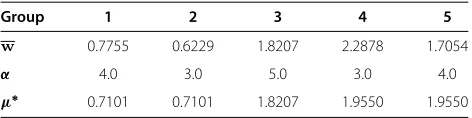
Table 1 shows an example. Let us assume that the population means of five groups should be increasingly ordered. But we observed reverse orderings between the first two. With weight vectorα = (4, 3, 5, 3, 4), the com-ponents (μ∗) of group means (w) are corrected by iso-tonization. In case of GBS, the observed group means may not be properly ordered if the sample sizes for exposures are small. The reverse ordering in group mean estimates could result in serious bias to the estimators of regres-sion parameters. This type of bias could be avoided by using the isotonic regression that satisfies the ordering constraint for the population means. In the constrained
Table 1 An example of isotonic regression
Group 1 2 3 4 5
w 0.7755 0.6229 1.8207 2.2878 1.7054
α 4.0 3.0 5.0 3.0 4.0
GBS, we adjust the estimated group means to satisfy the required ordering before the GBS is applied. In the model setting here, the component values in the isotonic regression will be used as exposure scores. By adding the ordering information underlying exposure group means in the estimation procedure, improvement of GBS could be possible to a certain extent without any complicated modification even when we have a small number of obser-vations for the exposure in each group. This constrained approach is referred to as CGBS. In CGBS, the mean vector,μ = (μ1,· · ·,μG), is estimated by the isotonic regression, μ∗, ofw = (w1,w2,· · ·,wG) with a weight vector composed of observed sample sizes.
Constrained Expectation and Maximization (CEM)
An EM method, introduced by Dempster et al. [8], is used for finding MLEs of parameters where the missing or latent variables are involved in the model. The EM algo-rithm is an iterative procedure that performs an expec-tation (E) step and maximization (M) step, alternately. In E-step, the conditional expectation of complete log-likelihood is computed based on the conditional distri-bution of unobservable variables given observed data and current estimates of parameters. In M-step, the expected likelihood function obtained in E-step is maximized and the current estimates of parameters are updated by the new ones. As discussed in Wu [9], if the likelihood func-tion is unimodal and satisfies some differentiability con-ditions, EM algorithm produces a sequence of estimates that converge to the actual MLE.
For constrained estimation (CEM), we impose the ordering constraints on μi’s in this M-step. While we can get closed form of constrained estimates in M-step in the simple linear case with measurement error but without missing in exposure, we usually need another iter-ative procedure for the maximization in M-step. A simple approach for the maximization in an M-step in our prob-lem is to update estimates alternately betweenμand other set of parameters. In other words, we first find the con-strained estimate of μ given current estimates of other parameters, and then using the updated estimate of μ, we maximize the expected log-likelihood with respect to other parameters in a usual manner. Here, we briefly dis-cuss how to find the constrained estimate ofμand other parameters in our iterative procedure in M-step.
CEM with measurement errors only in exposure
The EM method can be applied to measurement error problems by treating unobservable truexgias missing data values [2]. If there is no information on measurement error, a sensitivity analysis may be conducted for some predetermined values of error variances. We anticipate that the measurement error and the true variable distri-butions might be specified as normal linear models. The
observed data likelihood is obtained by integrating the completed data likelihood over all the unobservedx’s, and then maximized for MLE. The complete data likelihood forθ =(θ1,θ2,θ3)is
Lc(θ|y,w,x)= G
g=1 ng
i=1
f(ygi|xgi;θ1)f(wgi|xgi;θ2)f(xgi;θ3).
(4)
While we use f(·|·) for conditional densities, they can be identified based on their arguments. Integrating over the cases with unobservedx’s will give the observed data likelihood:
Lo(θ|y,w,x)= G
g=1 ng
i=1
f(ygi|xgi;θ1)f(wgi|xgi;θ2)f(xgi;θ3)dxgi
Letlc(θ;y,w,x) = lnLc(θ;y,w,x)−CwhereC is the constant term in logLc(θ;y,w,x). The E-step involves formulation of the quantityQ(θ|θ(t))such that
Q(θ|θ(t))=Eθ(t)[lc(θ;Y,W,X)|y,w] (5)
where the expectation is with respect to the conditional densityf(xgi|wgi,ygi;θ(t)). The conditional pdf ofXgigiven ygiandwgiis given by
f(xgi|ygi,wgi;θ )=
f(ygi|xgi;θ1)f(wgi|xgi;θ2)f(xgi;θ3)
f(ygi|xgi;θ1)f(wgi|xgi;θ2)f(xgi;θ3)dxgi .
When we maximize Q(θ|θ(t)), we may often encounter the problem of evaluating expectations that do not have a closed form. Then, a Monte Carlo method can be used in various ways. Also, in order to avoid the identifiabil-ity problem commonly arising from measurement error models, we assumeση2is known.
CEM with measurement errors and missing in exposure Methods for data with complex structure such as mea-surement errors, missingness and outliers were reviewed by Wu [10]. The EM method is used for estimation when measurement error or missingness is involved in responses [11]. Observations containing the cases with missing values in exposure can also be accommodated by the EM algorithm. If there are any constraints on mean exposures, we may use the constrained EM method that reflects such constraints in maximization procedure.
any missing value. Then, as we defined earlier, the com-plete data log-likelihood forθ is given by
lc(θ;y,w,x,y∗,w∗,x∗)=lc1(θ;y,w,x)+lc2(θ;y∗,w∗,x∗).
where lc is the log-likelihood with complete data, lc1 is
the log-likelihood with observed exposures, andlc2is the
log-likelihood with the missing exposures. Thus, it follows that
Q(θ|θ(t))=Eθ(t)[lc(θ;Y,W,X,Y∗,W∗,X∗)|y,w,y∗] =Q1(θ|θ(t))+Q2(θ|θ(t))
where Q1(θ|θ(t)) = Eθ(t)[lc1(θ;Y,W,X)|y,w] and Q2(θ|θ(t)) = Eθ(t)[lc2(θ;Y∗,W∗,X∗)|y∗]. Note that Q1(θ|θ(t)) is exactly the same as the conditional expec-tation obtained in E-Step in the case with measurement error only. Based on observations having missing val-ues in exposure, the second term of Q(θ|θ(t)) for linear regression model is expressed as
Q2(θ|θ(t))= − 1 2
⎛ ⎝G
g=1 n∗g
⎞
⎠(lnση2+lnσb2+lnσ2)
− 1
2σ2
G
g=1 n∗g
i=1
Eθ(t)[(Ygi∗−β0−β1Xgi∗)2|y∗gi]
− 1
2σ2 η
G
g=1 n∗g
i=1
Eθ(t)[(Wgi∗−Xgi∗)2|y∗gi]
− 1
2σb2
G
g=1 n∗g
i=1
Eθ(t)[(X∗gi−μg)2|y∗gi] . (6)
The conditional distribution (Xgi|ygi,wgi) fol-lows N(mx(ygi,wgi;θ ),vx(θ )) where mx(ygi,wgi;θ ) =
β1σb2ση2(ygi−β0)+(σ2ση2)wgi+σ2ση2μg
β12σb2σ2
η+σ2(σb2+ση2)
and vx(θ ) =
σ2σb2ση2
β12σb2σ2
η+σ2(σb2+ση2). Also, the conditional distribution
(Xgi∗,Wgi∗|y∗gi) follows a bivariate normal distribu-tion with mw∗(y∗gi;θ ),ρx∗w∗(θ ),vx∗(θ ), and vw∗(θ ),
where mx∗(y∗gi;θ ) = mw∗(y∗gi;θ ) =
σ2μg+β1σb2(y∗gi−β0)
σ2 +β12σb2
,
ρx∗w∗(θ ) =[ σ
2 σb2 σ2
σb2+σ2ση2+β12σb2ση2] 1
2, vx∗(θ ) = σ2σb2 σ2
+β12σb2 ,
andvw∗(θ )=
σ2σb2+σ2ση2+β12σb2ση2
σ2 +β12σb2
.
The second term Q2(θ|θ(t)) for logistic regression model is given by
Q2(θ|θ(t))= − 1 2
⎛ ⎝G
g=1 n∗g
⎞
⎠(lnση2+lnσb2)
+ G
g=1 n∗g
i=1
y∗giEθ(t)[ lnp(Xgi∗;β)|y∗gi]
+(1−y∗gi)Eθ(t)[ ln(1−p(X∗gi;β))|y∗gi]
− 1
2σ2 η
G
g=1 n∗g
i=1
Eθ(t)[(Wgi∗−Xgi∗)2|y∗gi]
− 1
2σb2
G
g=1 n∗g
i=1
Eθ(t)[(X∗gi−μg)2|y∗gi] . (7)
In order to maximize Q(θ|θ(t)), we need a Newton method as a part of each EM procedure. However, our investigations indicate that it does not take too long time to reach a convergence criterion. As mentioned earlier, the conditional expectations here do not have closed form of expressions, and thus we rely on a Monte Carlo method to evaluate them. For details of estimation procedure, read-ers are referred to the Additional file 1: Supplementary material of this paper.
Simulation study and results
Simulations were conducted to examine attenuation in regression coefficient estimates in linear and logistic mod-els with group-based exposure assessment and a disease with expected risk of about 10%. We considered a cohort with time-invariant exposure that segregates into five exposure groups. We further assumed that disease risk depended only on exposure intensity, not its duration. For each group, we generatedny=30 sets of complete obser-vations (exposure with measurement error and response) from the specified underlying model described in Section “Methods”. In order to allow missingness for exposure, a sample of nx = 10 or 20 exposure measurements were taken from the complete set of data (ny = 30) for each group. Here, the true regression coefficients were set to
β0 = −2 andβ1 =0.3 as the intercept and slope param-eters for both regression models. For both models, the exposures were assumed to be normally distributed with meansμg = 0.2+(g −1)δ, g = 1,· · ·, 5. We consider two cases:δ = 0.3 and 0.5. In order to see the impact of the between-subject variability, we investigated the results for different values ofσb2=0.3, 0.6, and 0.9. Three levels of measurement error variance were considered, that is,
mean square error (MSE) were evaluated based on 200 replications for each case.
We perform four estimation methods. The first method, named ‘naive’, is to analyze the complete data ignor-ing exposure measurement errors. The second approach (CEM) is the constrained EM algorithm developed for accommodating missing observations and measurement errors. The third method is to use the GBS and CGBS methods that assign a score (group mean for GBS or con-strained group mean for CGBS) to each group and fit a standard regression model to the data. In implement-ing the Monte Carlo CEM methods, we used the naive estimates as initial values for parameters. We present the empirical bias and MSE in (Additional file 2: Tables S1 and S2) for linear model and in (Additional file 2: Tables S3 and S4) for logistic model, respectively. Evidently, the results demonstrate that substantial bias is incurred if missing-ness and measurement error are not properly treated. The CEM adjusted fairly well the bias if there is no miss-ing. The CGBS is better than the GBS overall. When the portion of observed exposure data is small and they are exposed to severe measurement error, the CGBS performs much better than the other methods.
Specifically, in the linear model case (Additional file 2: Table S1), when the between-group contrast is small (δ =0.3), the naive estimate is seriously biased, but CEM method (with full measurements) has shown significant improvement. For example, the between-subject variabil-ity and the measurement error are moderate (σb2 = 0.6;
ση2 =0.5), the CEM estimate adjusts bias (0.9%) whereas the bias of naive estimates is about 40%. However, when the number of observed exposure data isnx = 10, in the same comparison, the bias of CGBS estimate is smaller than that of CEM estimate (2.8% vs. 5.1%). In the same set-ting, when measurement error is increased toση2 =0.75, all the estimators get more biased. But, the CGBS per-forms better than the others (3.0% vs. 20.4%(GBS) and 7.9%(CEM)). If the between group contrast is increased, the estimators get less biased for all methods but the pattern of bias among the estimation methods is similar to that of the case with the small between-group con-trast. As the between-subject variability increases, the bias of GBS and CGBS estimates increases, whereas the bias of CEM estimate decreases. For example, in (Additional file 2: Table S2), withδ=0.5 andnx =10 measurements, and the measurement error are moderate (ση2 = 0.5), as the between-subject variability increases fromσb2 = 0.3 to 0.9, the bias of CGBS estimate increased from 2.0% to 2.7%, whereas the CEM estimate decreased from 5.4% to 3.7%.
In the logistic regression (Additional file 2: Table S3), when the between-group contrast is small (δ = 0.3), the naive estimate is highly biased, whereas CEM method (with full measurements) adjusts the bias significantly. For
example, the between-subject variability and the measure-ment error are moderate (σb2= 0.6;ση2= 0.5), the CEM estimate adjusts bias (0.5%), whereas the bias of naive estimates is about 44%. However, when the number of observed exposure data is nx = 10, in the same com-parison, the bias of CGBS estimate is much smaller than that of CEM estimate (5.1% vs. 23.1%). In the same set-ting, If we increase measurement error toση2 = 0.75, all the estimates get worse. However, the CGBS shows better performance compared with the other methods (5.7% vs. 25%(GBS) and 27%(CEM)). As the between-group con-trast increases (Additional file 2: Table S4), the estimates are generally getting less biased. For example, whennx = 20,σb2=0.6, andση2=0.5, the bias of CEM estimate with
δ = 0.5 is 5.5% whereas the bias when δ = 0.3 is 7.3%. In the same comparison, the bias of CGBS estimate when
δ=0.5 is 11.8% whereas its bias withδ=0.3 is 26%. For both linear and logistic models, the MSE decreases as we increase the between-group contrast. The MSEs for the CEM estimators were generally smaller than those for the GBS and CGBS when the number of observed expo-sure is not too small. However, with small number of observations, the CGBS performs better than the CEM. Also, MSE gets larger if we increase the measurement error variability.
Application to respiratory symptoms and exposure to carbon black
A number of repeated cross-sectional studies with mea-surements of respiratory health of employees in the Euro-pean carbon black manufacturing industry, in relation to exposure to carbon black dust, were conducted [12]. In the second survey, exposure to respiratory dust in 19 factories in 7 European countries (Great Britain, France, Germany, Holland, Italy, Spain and Sweden) was determined among 1870 workers, resulting in 3290 measurements [13]. There were 8 job categories within 19 factories, and workers from each job title in each factory were selected randomly for monitoring of exposures. In addition, repeated expo-sure meaexpo-surements on the same worker were collected at random intervals to allow estimation of the between-and within- worker variances. Respiratory dust measure-ments were log- transformed to satisfy the assumption of normality. Lung function tests were carried out by the company medical officers, or their delegates, with a prop-erly maintained Vitalograph S Model dry wedge bellows spirometer calibrated with a 1 l syringe. The spirometer was calibrated by external specialists at the start of each data collection period and at 2 week intervals through-out the surveys. Values for forced expiratory volume in 1 second (FEV1) among others were estimated directly from the traces.
to check the assumption of the homogenous between-subject variability for all groupings. Comparison with Bayesian information criterion values in mixed-effect modelling indicated that there was no evidence for hetero-geneous between-subject variability in the data [14]. We used a subset (1414 workers) of the original data in which each subject within a group had exposure measurement and health outcomes were determined on every subject with one exposure measurement.
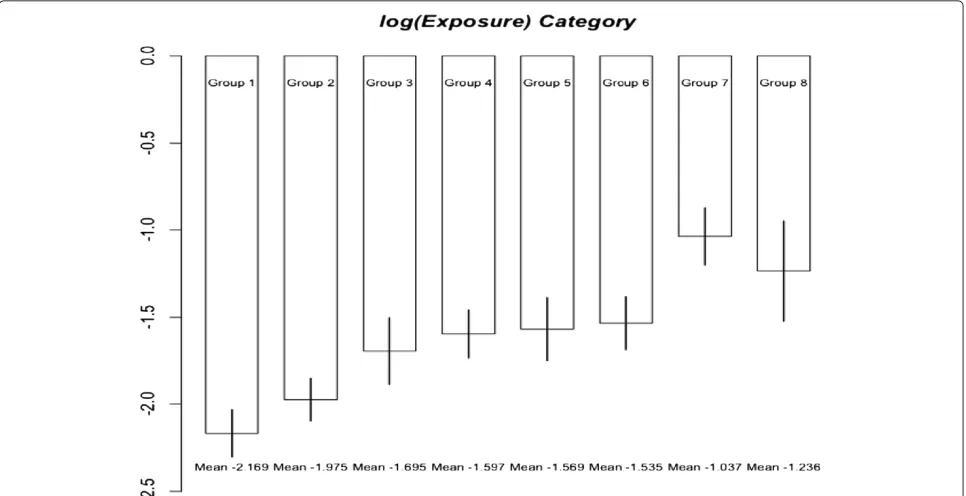
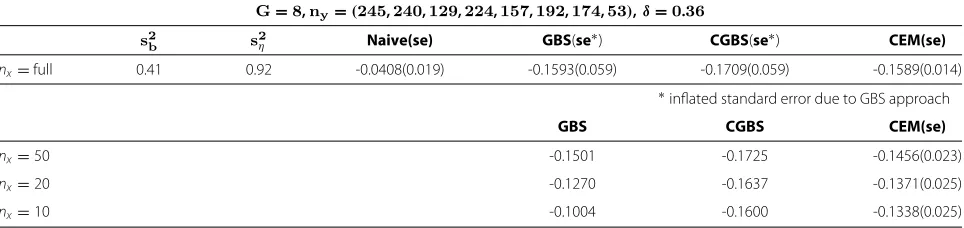
Figure 1 shows the means of log-exposures are ordered among the groups defined by job categories while there is an exception. In the presence of this ordering infor-mation, estimates of the slope parameter were obtained for different numbers of exposure data,nx = 10, 20, 50, selected randomly from each group of data. These esti-mates are listed in Table 2 to demonstrate the effect of the number of incomplete observations on the performance of analytical methods. For this, the mean estimates and their standard errors were evaluated from 200 randomly selected samples of size nx. However, in the case of no missing observations, the standard error ofβˆ1was com-puted based on the empirical information matrix in the context of Meilijson [15]. In the case of GBS or CGBS, the variance estimate for the response depends not only on model and measurement error variances but also on the variability of exposure and the slope of the regression function. This is because such methods treat responses in the same group as if they were observed at the group mean exposure. Thus, the standard errors from those methods
are inflated. Thus, we suggest to use the standard errors from CEM for general inference.
Furthermore, our simulation study indicates that the estimation by CEM is more reliable if data do not contain missing observations. Thus, we suggest in this example to use βˆ1 = −0.1589 as the best estimate ofβ1. Although GBS gave the estimated value incidentally closer to the suggested estimate than CGBS did, CGBS estimates can be expected to be more precise in general as shown in our simulation study. This argument becomes more clear when we compare estimates obtained from data sets con-taining missing observations. We see that CGBS estimates are stably closer to the suggested estimate regardless of the level of missingness. More specifically, with small sam-ple size, saynx = 10, GBS yielded estimate that is closer to naive analysis with little adjustment for measurement error compared with CGBS and CEM. This can be antic-ipated because GBS retains predominantly classical error structure in such case. Recall CEM estimators are more precise than CGBS estimators in simulations if there are no missing observations but less precise then CGBS esti-mators if a substantial portion of observations is missing in each group. The results also support the forementioned fact in the sense that those CGBS estimates are stably closer to the suggested “best” estimate in all cases with missing observations. Since the data set used here is the case of small intervals (δˆ = 0.36) and large measurement errors (ση2=0.92), this interpretation may apply limitedly to that particular situation.
Table 2 Application to respiratory symptoms and exposure to carbon black
G=8,ny=(245,240,129,224,157,192,174,53),δ=0.36
s2b s2η Naive(se) GBS(se∗) CGBS(se∗) CEM(se)
nx=full 0.41 0.92 -0.0408(0.019) -0.1593(0.059) -0.1709(0.059) -0.1589(0.014)
∗inflated standard error due to GBS approach
GBS CGBS CEM(se)
nx=50 -0.1501 -0.1725 -0.1456(0.023)
nx=20 -0.1270 -0.1637 -0.1371(0.025)
nx=10 -0.1004 -0.1600 -0.1338(0.025)
Grouping with job category: Estimate ofβ1(with standard error in parentheses)G: number of groups;nx: number of exposures per group;s: estimate variance of the between group distribution of log-transformed exposures;s2
b: estimate variance of the between worker distribution of log-transformed exposures; GBS: group-based strategy; CGBS: constrained group-based; Monte Carlo EM (CEM).
Discussion
Measurement error is concerned with bias problem occurring to the estimates of regression coefficients when the exposures are measured inaccurately or available through the recording of imperfect surrogates. If we, in addition to measurement error for observed exposure, have missing values for many exposure measurements possibly due to excessive cost or lack of data in retrospec-tive analyses, data analyses themselves face challenges that can not be overcome by standard approaches.
Natural orderings are found in many practical applica-tion. In a bioassay problem illustrated in Robertson et. al. [7], a pharmaceutical researcher may want to test if treat-ment effects are ordered according to dosage levels. In our example, jobs are categorized as administration area worker, laboratory assistant/electrician, fitter/welder, pro-cess/conveyor operator, and warehouse packer/shipping or cleaning (not office). The population means of car-bon black exposure among these job categories could be ordered increasingly (from administration in office to cleaning outside). Although there is one exception pos-sibly due to randomness, this ordering trend is justified by exposure data as shown in Figure 1. If this ordering information is ignored, the analysis would result in serious bias. We demonstrated that incorporating ordering infor-mation on group means in estiinfor-mation procedure brought a significant improvement. Although we focused on lin-ear and logistic regression models, it would be possible to extend this argument to more general models.
In environmental epidemiology, when we cannot directly measure the exposure where there is outcome data, various methods are used to predict the unknown exposure that are similar to group-based approach employed in occupational epidemiology.
When land-use regression models or spatial patterns of exposure are used to assign exposure to all resi-dents of an area, measurement error can have features of both classical-like and Berskon-like errors as discussed
in Szpiro et al. [16,17]. The Berkson-like component of error arises because the exposure model does not account for all sources of variation in true exposure. This is similar to our work in that the quasi-Berkson error we identified from the re-postulated model (2) is approx-imately independent of the assigned exposures [5]. It must be recalled, however, that quasi-Berkson error can be assured only when group means are estimated pre-cisely from a large sample. The contribution of our cur-rent work is to consider a challenging situation where we are dealing with a small number of observed expo-sure meaexpo-surements and between-group contrast is small and the quasi-Berkson model cannot be reliable. The analogy to work of Szpiro et al. [16] may be the case where empirical exposure model is constructed on limited data, as may well be commonly the situation in envi-ronmental epidemiology. In our case, however, there is no auxiliary variable to be used in modeling the true exposure but instead we have the ordering information among group mean exposures. Thus, the exposure prob-lem is more related to that of estimation rather than prediction. As a result, the expressions for Berkson-like and classical-Berkson-like error components in Szpiro et al. [16] have different interpretations in our problem. In fact, it is decomposed into within-group variability for the true exposure and estimation error for mean expo-sure. This is caused by the fact we used Wg instead of Wgi’s. It should be noted that reducing estimation error by incorporating the information on ordering of groups contributes to reduction in the bias of the esti-mated regression parameter arising from measurement errors and small sample samples of exposures from highly overlapped groups.
Conclusion
values instead of the naive group means. The simula-tions show that estimates with the CGBS method are improved significantly when the between-group contrast is small, measurement error variance is large and there are many missing observations. However, it should be used carefully because the bias reduction was achieved with some increased uncertainty (variance). The constrained expectation-maximization (CEM) method appears to be best when all or moderate number of exposures are observed with measurement errors. On the other hands, the CGBS has an advantage that it is easy to implement with no serious loss compared with the CEM that requires highly intensive computation. In fact, CGBS appears to have more desirable bias-reducing properties in presence of substantial proportion of missing values.
By incorporating group ordering information in GBS or EM, we can conduct more precise analysis for data sets that could be considered, otherwise, as too small a sample. For example, thousands of measurements were collected in the the analysis considered in the example we discussed here. But, the analysis could have been possible even with much less measurement efforts, say, as few as 10 measurements per exposure group (a total of 80 measure-ments), with CGBS or CEM. If we are interested only in bias reduction, this fact has an important implication for cost-effective studies when groups are ordered in terms of exposure mean. However, as we mentioned earlier, stan-dard errors of GBS or CGBS estimates are inflated and it is recommended to use those from the CEM method.
In conclusion, if groups are ordered according to expo-sure level, a constrained group- based expoexpo-sure assign-ment can be an effective and versatile approach to esti-mate the relationship between exposure and disease when exposure data are not available for all subjects under study. Although a large sample is typically required for precise estimation, we showed that even smaller samples could be used to obtain informative results in realistic settings by incorporating order relation among group exposure means. Note the availability of the ordering information contributed to reducing bias and increasing precision. However, if such partial information is not available or irrelevant to the response due to the nature of the prob-lem, this improvement cannot be expected. It should also be noted that if the number of observed measurements are not too small, the constrained EM approach may be recommended as a general analytical approach to semi-ecological study design. Finally, as a future study, we may develop an efficient simulation procedure that can ana-lyze comprehensively the impacts of relative variability in the group means, subject-specific exposure variation, and measurement error variance. Furthermore, we may extend the proposed approach so that it can be applicable to more complex data containing repeated measurements and clusters.
Additional files
Additional file 1: Supplementary material.Detail description for EM algorithm.
Additional file 2: Tables from Simulation Studies. Table S1.Empirical biasofβˆ1(with empiricalMSEin parentheses) in the linear model when between-group contrast is 0.3.Table S2.Empiricalbiasofβˆ1(with empiricalMSEin parentheses) in the linear model when between-group contrast is 0.5.Table S3.Empiricalbiasofβˆ1(with empiricalMSEin parentheses) in the logistic model when between-group contrast is 0.3. Table S4.Empiricalbiasofβˆ1(with empiricalMSEin parentheses) in the logistic model when between-group contrast is 0.5.
Competing interests
The authors declare that they have no competing interests.
Author’s contributions
HMK conceived the study, conducted the simulation study, carried out the statistical analysis, and drafted the manuscript. CGP contributed to the development of the statistical methods and interpretation of the findings, and participated in the drafting of the manuscript. MVT contributed to the drafting of the manuscript and interpretation of re-analysis of epidemiological data. IB helped develop the research question, participated in the interpretation of epidemiological examples and drafting of the manuscript. All authors read and approved the final manuscript.
Acknowledgements
The work of CG Park was supported by the National Science and Engineering Research council of Canada. We would like to thank Prof. Jon Ayres in the University of Birmingham for the valuable data used in this paper.
Author details
1Department of Mathematics and Statistics, University of Calgary, Calgary,
Canada.2School of Mathematics and Statistics, Carleton University, Ottawa, Canada.3Centre for Human Exposure Science, Institute of Occupational Medicine, Edinburgh, UK.4Department of Environmental and Occupational Health, Drexel University, Philadelphia, USA.
Received: 19 February 2012 Accepted: 20 August 2012 Published: 4 September 2012
References
1. Armstrong B:Effect of measurement error on epidemiological studies of environmental and occupational exposures.Occup and Environ Med1998,55:651–656.
2. Carroll R, Ruppert D, Stefanski L, Crainiceanu C:Measurement error in, Nonlinear Models (a modern perspective). Boca Raton, FL: Chapman & Hall/CRC, Taylor & Francis Group; 2006.
3. Tielemans E, Kupper L, Kromhout H:Individual- based and
group-based occupational exposure assessment: some equations to evaluate different strategies.Ann Occup Hyg1998,42:115–119. 4. Silvapulle M, Sen P:Constrained Statistical Inference. Hoboken, New Jersey:
John Wiley; 2005.
5. Kim H, Loomis D, van Tongeren M, Burstyn I:Bias in the estimation of exposure effects with individual- or group-based exposure assessment.J Exposure Sci Environ Epidemiol2011,21:212–221. 6. Thoresen M, Laake P:A simulation study of measurement error
correction methods in logistic regression.Biometrics2000,56:868–872. 7. Robertson T, Wright F, Dykstra R:Order restricted statistical inference. New
York: Wiley; 1988.
8. Dempster A, Laird N, Rubin D:Maximum likelihood from incomplete data via the EM algorithm (with discussion).J R Stat Soc, Ser B1977, 39:1–38.
9. Wu C:On the convergence properties of the EM algorithm.Ann Stat
1983,11:95–103.
10. Wu L, Mixed EffectsModelsforComplexData. Boca Raton, FL: Chapman & Hall/CRC, Taylor & Francis Group; 2010.
12. Gardiner K, Threthowan N, Harrington J, Rossiter C, Calvert I:Respiratory health effects of carbon black. A survey of European carbon black workers.Br J ind Med1993,50:1082–1096.
13. Gardiner K, Calvert I, van Tongeren M, Harrington J:Occupational Exposure to Carbon Black in its Manufacture: Data from 1987 to 1992.Ann Occup Hyg1996,40:65–77.
14. van Tongeren M, Burstyn I, Kromhout H, Gardiner K:Are variance components of exposure heterogeneous between time periods and factories in the European carbon black industry?Ann Occup Hyg2006, 50:55–64.
15. Melijson I:A fast improvement to the EM Algorithm on its own terms.
J R Stat Soc, Ser B1989,51:127–138.
16. Szpiro A, Sheppard L, Lumley T:Efficient measurement error correction with spatially misaligned data.Biostatistics2011,12:610–623. 17. Szpiro A JP, Sheppard L:Does more accurate exposure prediction
necessarily improve health effect estimates?Epidemiology2011, 22:680–685.
doi:10.1186/1471-2288-12-135
Cite this article as:Kimet al.:Estimation methods with ordered exposure subject to measurement error and missingness in semi-ecological design.
BMC Medical Research Methodology201212:135.
Submit your next manuscript to BioMed Central and take full advantage of:
• Convenient online submission
• Thorough peer review
• No space constraints or color figure charges
• Immediate publication on acceptance
• Inclusion in PubMed, CAS, Scopus and Google Scholar
• Research which is freely available for redistribution