CrossMark Published by DiscoverSys
ABSTRACT
Objective: The current study aims to provide valid information about
the causes and types of hospital deduction records via a systematic review.
Method: This systematic review was performed by searching the
databases including PubMed, Scopus, Science Direct, Ovid, Medline, Cochrane, ProQuest, and IranMedex, Magiran, Sid, and Medlib databases for studies without time limitation. Updates were added to the searches during the study. Search strategies included the combination of keywords including “Billing error” OR “Deductive” OR “Error payment” OR “Insurance claim” OR “Medical claim” OR “Improper payment” OR “Insurance reimbursement” OR “Medical payment” OR “payment error” with “Hospital” and “medical records”. The reference lists of each article were manually searched to find additional relevant articles. All records without time limitation, those written in Persian and English, and the ones investigating the types and causes of deductions in hospital inpatient bills records were included.
To determine the eligible records, two authors extracted the data independently; and discrepancies were resolved through discussion or, if required, through consultation with a third author. The quality of the articles was analyzed using STROBE checklist.
Results: The search strategy yielded 1,264 records from electronic
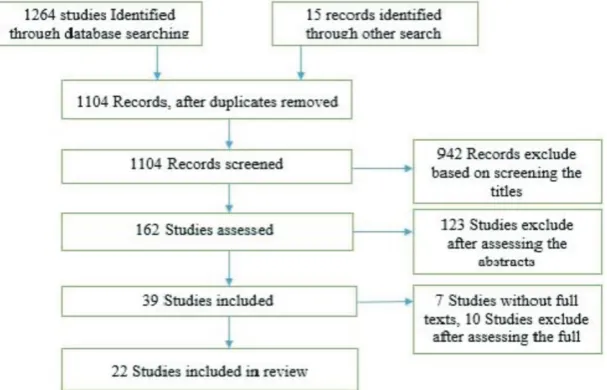
databases, and 15 records were identified by the manual search. After removing the duplicates and screening the database by titles and abstracts, 39 of these records remained. The full text of these 39 records was checked and, finally, 22 of them met inclusion criteria. The major causes of deductions in the documentation included human errors, incomplete document registration, documentation errors, added prices, added request, and calculation errors.
Conclusions: Education and cooperation of staff and collaboration of
all stakeholders such as hospitals, insurance organizations, and related staff in this field are necessary for conducting a substantial action to reduce hospital deduction.
Keywords: Deduction, Hospital, Systematic review, Insurance
Cite this Article: Mousarrezaei, M.T., Doshmangir, L., Jannati, A., Imani, A. 2019. Hospital deductions, types, and causes: A systematic review. Bali
Medical Journal 8(2): 302‑310. DOI:10.15562/bmj.v8i2.551
Hospital deductions, types, and causes:
A systematic review
Mohammad Taghi Mousarrezaei,1 Leila Doshmangir,2 Ali Jannati,2 Ali Imani2*
INTRODUCTION
Comparing the health care system in Iran with those of some developed countries shows the differ-ent role of public and private sectors in servicing and paying methods, which are related to hospital deductions. In Iran, primary health services (PHCs) are provided by the government, while hospital care (second and third level services) is provided by both private and public sector; however, the public sector has a bigger share. The hospital care (the second and third levels) costs in some of developed countries and Iran are mostly reimbursed through governmental budgets.1
Hospital as a center of healthcare services is considered a determinant of the success of health system and equitable expansion of healthcare. So, survey how to use facilities and available resources in this part and their efficiency has significant importance.2 A large share of hospitals’ incomes is
provided through contracts with insurance organi-zations and services provided to insured individ-uals.3 These organizations subtract some money
per month from all requested funds after auditing the received financial documents of hospitals, a
process known as insurance deductions.4 This
process is applied when requested services do not comply with provided services, requested fees are not in accordance with determined tariffs, and/or required services are not based on commitment services.5
The deduction is one of the controversial issues between insurance organizations and healthcare providers despite insurance rules and regulations. Consequently, insurance organizations impose heavy financial costs on healthcare providers during service delivery and in collecting and payment peri-ods.6 The unawareness of healthcare institutions
and insurance rules of deductions ultimately causes dissatisfaction in insured peoples, because, in some cases, this deduction imposes additional expenses to the patient and insured people. The added fees of medicine are one of these cases.7 Moreover,
hospi-tal deduction through wasting of resources and incomes cause a decrease in the hospital’s financial capacities.8
By precisely identifying the reasons of hospital deductions, a higher efficiency of hospitals can be 1Student Research Committee,
Faculty of Management and Medical Informatics, Tabriz University of Medical Sciences, Tabriz, Iran
2Department of Health Care
Management, Iranian Centre of Excellence in Health Management, Health Services Management Research Centre, Faculty of Management and Medical Informatics, Tabriz University of Medical Sciences, Tabriz, Iran
*Corresponding to:
Ali Imani, Department of Health Economics, Iranian Centre of Excellence in Health Management, Health Services Management Research Centre, Faculty of Management and Medical Informatics, Tabriz University of Medical Sciences, Tabriz, Iran [email protected]
Received: 2017‑03‑17 Accepted: 2017 ‑ 07‑24 Published: 2019‑08‑01
Volume No.: 8
Issue: 2
First page No.: 302
P-ISSN.2089-1180
E-ISSN.2302-2914
quality of healthcare services and preventing the waste of financial resources.9 In previous studies,
reasons and various types of deductions (insurance documents in patient files and surgeons’ wage10 and
causes such as added request and human resource errors11) were mentioned. However, to the best of
our knowledge, there is no systematic review about hospital deductions. This study was conducted to provide valid information about reasons and types of deductions in hospital records via a systematic review.
MATERIAL AND METHODS
In this systematic review, we searched the databases of the Cochrane Library, Medline, Scopus, Science Direct, and Proquest in January 2015. The research-ers utilized Google Scholar general search engine, and more specifically Scopus, Science Direct, Ovid, Medline, Cochrane, ProQuest, and PubMed. The search was performed using the following keywords as well as their Persian equivalents: “Deduction”, “Hospital”, and “Insurance”. Medical Subject Headings (MESH) terminology was used in PubMed. The Boolean logic was applied to combine the keyword deduction and its variants with the following search terms. Search strategies included the combination of three sets of keywords (“Billing error” OR “Deductive” OR “Error payment” OR “Insurance claim” OR “Medical claim” OR “Improper payment” OR “Insurance reimburse-ment” OR “Medical payreimburse-ment” OR “payment error”) with “Hospital” and “medical records”. All records without time limitation, those written in Persian and English and investigating about types and causes of deductions in hospital inpatient bills records were included and papers only referring
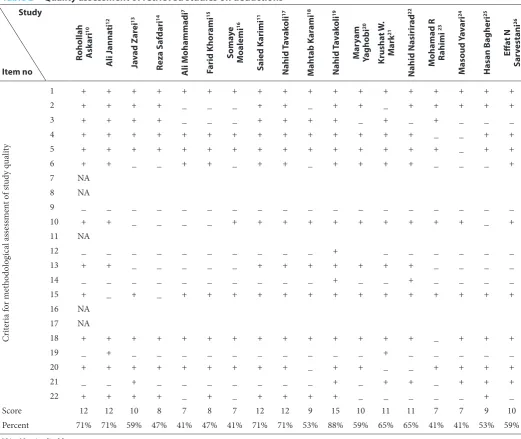
excluded. The reference lists of each article were manually searched to find additional relevant arti-cles. The retrieved articles were screened based on titles and abstracts and STROBE checklist was applied for evaluating the articles. STROBE is a checklist (Table 1) adopted from the Institute of Social and Preventive Medicine (ISPM), the University of Bern as a research tool for cross-sec-tional studies (http://www.strobe-statement.org). This checklist includes 22 items, but 5 items were ignored since they were not applicable for our study. We categorized the quality of included study in three levels including low, moderate, and high.
When the studies included an item, they were assigned the score 1; if that item did not exist in the study or insufficient data were offered, it was assigned the score 0. Finally, the sum of scores for the items was calculated: the studies with 70% of criteria (scored 12-17) acquired a high quality, those with 50-70 % of criteria (scored 8-11) had an average quality, and those having less than 50% of criteria (scored below 8) had a poor quality (Table 2).
All the retrieved English and Persian records were included in our study and then were imported in the summarized tables. The items extracted from the articles included study authors, year and type, and cause of deductions. Considering the qualita-tive nature of articles, we used content analysis to analyze the collected data.
RESULTS
The search strategy yielded 1264 records from elec-tronic databases, and 15 records were identified by the manual search. After removing the duplicates and screening the articles by titles and abstracts, 39 of these records remained. The full text of these 39 records was checked and, finally, 22 of them met inclusion criteria (Figure 1)
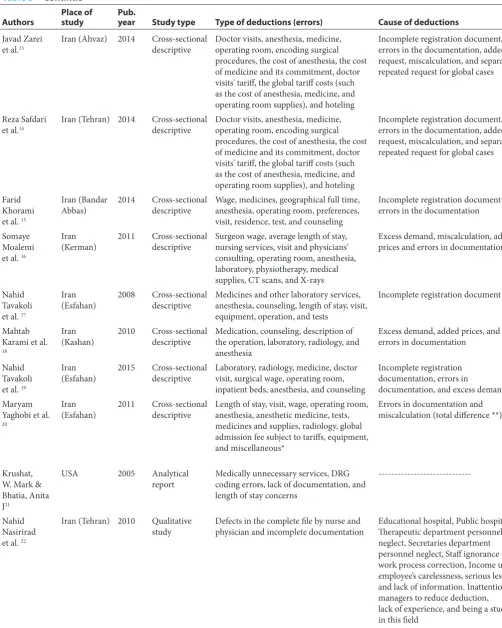
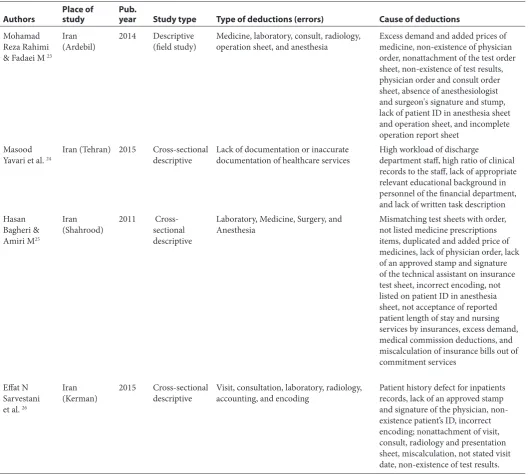
Checking 22 records resulted in 17 original research articles that were conducted in Iranian hospitals (Table 3), and 1 review article and 4 records related to deduction reports of the Office of Inspector General (OIG) in the United States of America.
Table1 STROBE
1 (a) The study design is indicated with a commonly used term in the title or the abstract.
(b) An informative and balanced summary of what was done and what was found is provided in the abstract. 2 The scientific background and rationale for the investigation being reported are explained.
3 Specific objectives, including any pre-specified hypotheses, are stated. 4 Key elements of study design are presented early in the paper.
5 The setting, locations, and relevant dates, including periods of recruitment, exposure, follow-up, and data collection are described. 6 The eligibility criteria and the sources and methods of selection of participants are given.
7 All outcomes, exposures, predictors, potential confounders, and effect modifiers are clearly defined. Diagnostic criteria are given, if applicable [Not Applicable].
8 For each variable of interest, sources of data and details of methods of assessment (measurement) are given. The comparability of assessment methods are described if there is more than one group [Not Applicable]
9 Any efforts to address potential sources of bias are described.
10 It explains how the study size was arrived at.
11 It explains how quantitative variables were handled in the analyses. If applicable, it describes which groupings were chosen and why [Not Applicable].
12 (a) All statistical methods, including those used to control for confounding, are described. (b) Any methods used to examine subgroups and interactions are described.
(c) It explains how missing data were addressed.
(d) If applicable, the analytical methods are explained, taking account the sampling strategy. (e) Any sensitivity analyses are described.
13 (a) Numbers of individuals at each stage of the study (e.g., numbers of the potentially eligible, examined for eligibility, confirmed eligible, included in the study, completing follow-up, and analyzed) are reported.
(b) Reasons for non-participation at each stage are given. (c) The use of a flow diagram is considered.
14 (a) The characteristics of study participants (e.g., demographic, clinical, and social) and information on exposures and potential confounders are given.
(b) The number of participants with missing data for each variable of interest is indicated. 15 The numbers of outcome events or summary measures are reported.
16 (a) Unadjusted estimates are given and, if applicable, confounder-adjusted estimates and their precision (e.g., 95% confidence interval). It makes clear which confounders were adjusted for and why they were included.
(b) Category boundaries are reported when continuous variables were categorized.
(c) If relevant, it considers translating estimates of relative risk into absolute risk for a meaningful time period [Not Applicable]. 17 Other analyses were done; e.g., analyses of subgroups and interactions, and sensitivity analyses are reported [Not Applicable]. 18 Key results are summarized with reference to study objectives.
19 The limitations of the study are discussed, taking into account sources of potential bias, or imprecision. Both the direction and magnitude of any potential bias are discussed.
20 A cautious overall interpretation of results is given, considering objectives, limitations, a multiplicity of analyses, results from similar studies, and other relevant evidence.
21 The generalizability (external validity) of the study results is discussed.
22 The source of funding and the role of the funders for the present study and, if applicable, for the original study on which the present article is based are given.
Table 3 The main types and causes of hospital deductions in retrieved studies
Authors Place of study Pub. year Study type Type of deductions (errors) Cause of deductions
Ali Mohammadi et al.7 Iran (Khorram Abad) 2013 Cross-sectional
descriptive The cost of anesthesia, hoteling cost, the cost of doctor visits and consulting, and global admission fee tariff
Incomplete registration document and errors in the documentation
Ruhollah
Askari et al.10 Iran (Yazd) 2011 Cross-sectional descriptive Surgeon wage, doctor visits, and medical deductions False documentation and added prices
Saied Karimi
et al.11 Iran (Esfahan) 2011 Cross-sectional descriptive Paraclinical costs, length of stay, operating room, wage, etc. Excess demand, miscalculation, and added prices
Ali Jannati
et al. 12 Iran (Tabriz) 2013 Cross-sectional descriptive Operating room supplies, length of stay, and surgeon wage Added price, added request, and Scientific Council deductions
Study
Item no
Rohollah Ask
ari 10 A li J anna ti 12 Ja vad Z ar ei 13 Reza S af dari 14 A li Mohammadi 7 Farid Khor ami 15 Soma ye Moalemi 16 Saied Karimi 11 Nahid T av ak oli 17 Mah tab Kar ami 18 Nahid T av ak oli 19 Mar yam Yaghobi 20 Krusha t W . Mark 21 Nahid Nasirir ad 22
Mohamad R R
ahimi 23 Masoud Y av ari 24 Hasan Bagheri 25 Effa t N Sar vestani 26 Cr iter ia f or m et ho do log ic al a ss es sm en t o f s tud y q ua lit y
1 + + + + + + + + + + + + + + + + + +
2 + + + + _ _ _ + + _ + + _ + + + + +
3 + + + + _ _ _ + + + + _ + _ + _ _ _
4 + + + + + + + + + + + + + + _ _ + +
5 + + + + + + + + + + + + + + + _ + +
6 + + _ _ + + _ + + _ + + + + _ _ _ +
7 NA
8 NA
9 _ _ _ _ _ _ _ _ _ _ _ _ _ _ _ _ _ _
10 + + _ _ _ _ + + + + + + + + + + _ +
11 NA
12 _ _ _ _ _ _ _ _ _ _ + _ _ _ _ _ _
13 + + _ _ _ _ _ + + + + + + + _ _ _ _
14 _ _ _ _ _ _ _ _ _ _ + _ _ + _ _ _ _
15 + _ + _ + + + + + + + + + + + + + +
16 NA
17 NA
18 + + + + + + + + + + + + + + _ + + +
19 _ + _ _ _ _ _ _ _ _ _ _ + _ _ _ _ _
20 + + + + + + + + + _ + + _ _ + + + +
21 _ _ + _ _ _ _ _ _ _ + _ + + _ + + +
22 + + + + _ + _ + + + + _ _ _ _ _ + _
Score 12 12 10 8 7 8 7 12 12 9 15 10 11 11 7 7 9 10
Percent 71% 71% 59% 47% 41% 47% 41% 71% 71% 53% 88% 59% 65% 65% 41% 41% 53% 59%
Table 3 Continue
Authors Place of study Pub. year Study type Type of deductions (errors) Cause of deductions
Javad Zarei
et al.13 Iran (Ahvaz) 2014 Cross-sectional descriptive Doctor visits, anesthesia, medicine, operating room, encoding surgical
procedures, the cost of anesthesia, the cost of medicine and its commitment, doctor visits' tariff, the global tariff costs (such as the cost of anesthesia, medicine, and operating room supplies), and hoteling
Incomplete registration document, errors in the documentation, added request, miscalculation, and separate repeated request for global cases
Reza Safdari
et al.14 Iran (Tehran) 2014 Cross-sectional descriptive Doctor visits, anesthesia, medicine, operating room, encoding surgical
procedures, the cost of anesthesia, the cost of medicine and its commitment, doctor visits' tariff, the global tariff costs (such as the cost of anesthesia, medicine, and operating room supplies), and hoteling
Incomplete registration document, errors in the documentation, added request, miscalculation, and separate repeated request for global cases
Farid Khorami et al. 15
Iran (Bandar
Abbas) 2014 Cross-sectional descriptive Wage, medicines, geographical full time, anesthesia, operating room, preferences, visit, residence, test, and counseling
Incomplete registration document and errors in the documentation
Somaye Moalemi et al. 16
Iran
(Kerman) 2011 Cross-sectional descriptive Surgeon wage, average length of stay, nursing services, visit and physicians’ consulting, operating room, anesthesia, laboratory, physiotherapy, medical supplies, CT scans, and X-rays
Excess demand, miscalculation, added prices and errors in documentation
Nahid Tavakoli et al. 17
Iran
(Esfahan) 2008 Cross-sectional descriptive Medicines and other laboratory services, anesthesia, counseling, length of stay, visit, equipment, operation, and tests
Incomplete registration document
Mahtab Karami et al.
18
Iran
(Kashan) 2010 Cross-sectional descriptive Medication, counseling, description of the operation, laboratory, radiology, and anesthesia
Excess demand, added prices, and errors in documentation
Nahid Tavakoli et al. 19
Iran
(Esfahan) 2015 Cross-sectional descriptive Laboratory, radiology, medicine, doctor visit, surgical wage, operating room, inpatient beds, anesthesia, and counseling
Incomplete registration documentation, errors in
documentation, and excess demand Maryam
Yaghobi et al.
20
Iran
(Esfahan) 2011 Cross-sectional descriptive Length of stay, visit, wage, operating room, anesthesia, anesthetic medicine, tests, medicines and supplies, radiology, global admission fee subject to tariffs, equipment, and miscellaneous*
Errors in documentation and miscalculation (total difference **)
Krushat, W. Mark & Bhatia, Anita J21
USA 2005 Analytical
report Medically unnecessary services, DRG coding errors, lack of documentation, and length of stay concerns
---Nahid Nasirirad et al. 22
Iran (Tehran) 2010 Qualitative
Authors Place of study Pub. year Study type Type of deductions (errors) Cause of deductions Mohamad
Reza Rahimi & Fadaei M 23
Iran
(Ardebil) 2014 Descriptive (field study) Medicine, laboratory, consult, radiology, operation sheet, and anesthesia Excess demand and added prices of medicine, non-existence of physician order, nonattachment of the test order sheet, non-existence of test results, physician order and consult order sheet, absence of anesthesiologist and surgeon's signature and stump, lack of patient ID in anesthesia sheet and operation sheet, and incomplete operation report sheet
Masood
Yavari et al. 24 Iran (Tehran) 2015 Cross-sectional descriptive Lack of documentation or inaccurate documentation of healthcare services High workload of discharge department staff, high ratio of clinical
records to the staff, lack of appropriate relevant educational background in personnel of the financial department, and lack of written task description Hasan
Bagheri & Amiri M25
Iran
(Shahrood) 2011 Cross-sectional descriptive
Laboratory, Medicine, Surgery, and
Anesthesia Mismatching test sheets with order, not listed medicine prescriptions items, duplicated and added price of medicines, lack of physician order, lack of an approved stamp and signature of the technical assistant on insurance test sheet, incorrect encoding, not listed on patient ID in anesthesia sheet, not acceptance of reported patient length of stay and nursing services by insurances, excess demand, medical commission deductions, and miscalculation of insurance bills out of commitment services
Effat N Sarvestani et al. 26
Iran
(Kerman) 2015 Cross-sectional descriptive Visit, consultation, laboratory, radiology, accounting, and encoding Patient history defect for inpatients records, lack of an approved stamp and signature of the physician, non-existence patient’s ID, incorrect encoding; nonattachment of visit, consult, radiology and presentation sheet, miscalculation, not stated visit date, non-existence of test results. * Miscellaneous deductions is the deduction due to the expired insurance card or other costs of service that is not mentioned in the above classification. For example, costs of laboratory services are included in this category.
** The difference in total is an amount of false deductions that occur due to mistakes in calculation and total deductions, and indeed these deductions have no adverse effect on the hospital.
medicines and supplies, and paraclinical costs (test and radiology). According to the OIG report, the most prevalent types of Medicare bill errors are the lack of medical necessity, followed by insufficient documentation, incorrect coding,21 documents
not provided because of other investigations,27,28
Deficiency in documentation,29 Medicaid or State
children’s health insurance program services that are not eligible for programs or persons, and docu-menting the members’ diagnoses.30
The main types and causes of hospital deduc-tions are shown in Table 3.
DISCUSSION
Hospital deductions are one of the most
information for hospital managers to pay attention to controlling hospital expenses and deductions.
Based on our results, the major causes of deduc-tions are related to human errors. The causes includ-ing incomplete document registration, errors in documentation, added request, and miscalculation and addition of prices and the most frequent types of deductions were related to surgeon wage, anesthesia, physician visit, medicine and operating room supplies, and paraclinical costs. In United States Medicare reports, the most frequent types of deductions are due to the inadequacy and deficiencies of documenta-tion, miscoding, and medically unnecessary services, services that are not eligible for programs, length of stay concerns, diagnostic related group coding errors, and lack of investigations. It is notable that these causes are originated from the human errors. Based on a study by Yavari et al., only a minority of the staff of the finance sector (including the income and discharge units) had an education background in accounting.24
Being an educational hospital, using students in the documentation process, lack of responsibility and the low experience of the training medical staff with an accurate and systematic recording of the care process can play a key role in the creation of these deductions.31
In another survey by Omrani et al., it was revealed that the majority of financial sector staff had not attended any training course related to the documentation of health care services and discharge process.24 In
addi-tion, most of the clerks and staff working in discharge unit did not have related educational background nor did they attend relevant course; in some cases, they even had no written task description.32 A large
number of the clinical records processed by an indi-vidual operator (an average of 20records per day) are another factor for the poor and incomplete documen-tation in the healthcare services.24
Various types of deductions were mentioned in the literature such as “surgery wage” derived from errors in encoding surgical procedures, disapproval of the operation sheet by the surgeon, lack of details of the surgery, and not registering the name, hospi-talization, and surgery dates,14 and “deductions due
to anesthesia services” derived from not having the anesthesia sheet copied, absence of anesthesiologist's signature, unavailability of patient’s ID, the anesthe-siologist’s absence, and carrying out the procedure by technicians.18 In “physician visits”, these
deduc-tions are due to sending invalid or distorted dates of prescriptions, sending the patient or pharmacy sheet instead of physician sheet, prescriptions unsigned or without the stamp of Iranian Medical Council number. In deductions related to “medicines and consumer goods”, these errors were derived from nonattachment of medicine and equipment
invoices, lack of an approved stamp and signature of the pharmacist in charge, lack of registration of time and medicine expiration date by the nurse, and distorted name, date, and type of medicine.10 Finally,
in the case of “paraclinical services such as tests and radiology”, these deductions are derived from the non-existence of test results, lack of physician order, lack of the stamp and signature of the radiologist in charge, and nonattachment of the test order sheet.18
“Additional fees” are another cause of deduc-tions found in the present research, originated from nonconformity of a requested tariff with insurance commitment tariff.11 In some studies, this problem
has been cited as the most common reason for deduction of medicines, operation report sheet, radiology, and laboratory.8
Another important cause for the hospital deduc-tion found in the systematic review of studies is adding a request that occurs when the requested services do not match the cases, committed by the insurer organization11 and derived from human
errors; i.e., the errors in documentation and miscal-culation (total difference). These deductions in the medicine section may be derived from numerous requests for medicine or the fact that insurance does not cover some medicines; besides, in the operation room ward they may be derived from the added request of surgery and anesthesia wage, requiring too much time for anesthesia services, and also the added request of adjusting codes.18
However, further large-scale studies are recom-mended for investigating the importance of the issue and the possible existence of other factors potentially contributing to hospital deductions and hospital income loss.
CONCLUSION
The results of this review demonstrated that there are various causes for inpatient bills deductions, and paying attention to them can play an important role in the financial management of hospitals. Since many factors are related to providing a service and its reception by the customer is effective in deduc-tions, this problem will not be solved unless imply-ing fundamental actions and substantial strategies. Thus, to reduce these deductions, it is necessary to find several related approaches in collaboration with all stakeholders such as hospitals, insurer organizations, and experts in this field.
CONFLICT OF INTERESTS
It was difficult to found keyword for deduction word in English databases since it has no equivalent word in English.
ACKNOWLEDGMENTS
This systematic review is the part of research that was financially supported by the Tabriz University of Medical Sciences. We appreciate all those who helped this research especially Dr. Vahide Zareh who helped us find the keywords.
ETHICAL CONSIDERATIONS
This study was approved by the Ethical Committee of Research of Tabriz University of Medical Sciences: (Ethics No. 5/4/6078)
REFERENCES
1. Khangah HA, Jannati A, Imani A, Salimlar S, Derakhshani N, Raef B. Comparing the Health Care System of Iran with Various Countries. Health Scope. 2016(Inpress). doi: 10.17795/jhealthscope-34459. 2. Sedghiani E. Healthcare problems and the role of hospitals
in developing countries. Journal of Health Administration. 1997; 1(1):59-78. URL: http://jha.iums.ac.ir/article-1-248-en.html
3. Criel B, Kegels G. A health insurance scheme for hospital care in Bwamanda district, Zaire: lessons and questions after 10 years of functioning. Tropical Medicine & International Health. 1997;2(7):654-72. doi:10.1046/j.1365-3156.1997. d01-349.x
4. Ibern P. Group health insurance and tax deductions ] spanish [Gaceta sanitaria. 1999; 13(3):236-8. PMID: 10515728
5. Rezapour A, Asefzadeh S. Study economic efficiency of teaching hospitals of Qazvin university of medical sciences (1999-2007). Journal of Guilan University of Medical Sciences. 2009;18(71):55-63.
6. Seidman RL, Pollack SB. Trends in Hospital Deductions from Revenue: Increases in Uncompensated Care and Payment Adjustments. Hospital topics. 1991;69(1):19-26. DOI: 10.1080/00185868.1991.9948450
7. Mohammadi A, Azizi AA, Cheraghbaigi R, Mohammadi R, Zarei J, Valinejadi A. Analyzing the Deductions Applied by the Medical Services and Social Security Organization Insurance toward Receivable Bills by University Hospitals of Khorramabad, Iran. Director General. 2013;10(2).
8. Karami M, Safdari R, Moini M. Reviewing the impact of deductions carried out social security insurance on finan-cial rights of patient in hospitals affiliated to Kashan uni-versity. Journal of Urmia Nursing and Midwifery Faculty. 2010;8(4):220_8.
9. Moridei S. Culture of social insurances. Tehran: Industrial Management. 2002. (In Persian)
10. Askari R, Dehghan HR, Bahrami MA, Keshmiri F. A survey in causes and rates of under reimbursement bills imposed on admitted patient's under social security insur-ance in medical teaching hospitals in Yazd province in 2008. Journal of Hospital. 2011;9(3):23-8.
11. Karimi S, Seyed F, Vesal S. The causes of deductions, insurance bills and proposed solutions in the hospi-tal in Isfahan Seyedolshohada-Isfahan University of
of (1392) in shams Tabriz hospitals and presenting sug-gestions approaches [dissertation]. Iran (IRI) Tabriz University of medical science. 2013.
13. Zarei J, Amirabbas A, Keshavarz K, Seyavashi E. The sur-vey of deductions applied by Medical Services and Social Security Insurances on patient bills at teaching hospitals affiliated to Ahvaz Jundishapur University of Medical Sciences. Journal of health information management. 2014;10(6):24-37.(In Persian)
14. Safdari R, Sharifian R, Ghazi Saeedi M, Masoori N, Azad Manjir Z. The amount and causes deductions of bills in Tehran University of Medical Sciences Hospitals. Journal of Payavard Salamat. 2011;5(2):61-70.
15. Khorrmmy F, Eshpala RH, Baniasadi T, Azarmehr N, Mohammady F. Prioritizing insurance deductions fac-tors of Shahid Mohammadi hospital inpatients records using Shannon Entropy, Bandar Abbas, Iran. Bimonthly Journal of Hormozgan University of Medical Sciences. 2014;17(1):77-82.
16. Moalemi S, Shamsabadi A, Meshkani Z, Alikiani A, A KK. Survey and comparison on the causes of deduction in admitted social insurance: Bahonar and Arjmand hos-pital in Kerman hoshos-pital.Journal of Hoshos-pital. 2011;8.(In Persian).
17. Tavakoli N, Saghaeyannejad S, Rezayatmand M, Moshaveri F, Ghaderi I. Deductions applied by Khadamat-e-Darman insurance company on patients' bills at teaching hospitals affiliated to Isfahan University of Medical Sciences. Health Information Management. 2008;3(2):53-61.
18. Karami M, Safdari R, Moini M. Impact of hospital deduc-tions imposed by the social security insurance on patient’s teaching hospitals of Kashan. Journal of Urmia Nursing And Midwifery Faculty. 2010;8(4):0-.
19. Tavakoli N, Jahanbakhsh M, Akbari M, Baktashian M, Hasanzadeh A, Sadeghpour S. The study of inpatient med-ical records on hospital deductions: An interventional study. J of Educat and Health Promot. 2015;4:38. Doi:
10.4103/2277-9531.157218.
20. Yaghobi M, Javadie M, Jandaghian M, Rejalian F, Farahabadie S M E, Mofid M, et al.. Evaluation of the social security deductions applied to surgery in selected teach-ing hospitals in Isfahan in the first half of 2011. Journal of Hospital. 2011;8(5):33-8. (In Persian).
21. Krushat WM, Bhatia AJ. Estimating payment error for Medicare acute care inpatient services. Health care financ rev. 2005;26(4):39.
22. Nasirirad N, Rashidian A, Joudaki H, Haghighi FA, Arab M. Assessing issues and problems in relationship between basic insurance organizations and university hospitals: a qualitative research. J of Hospital. 2010;9(1):5-18. (In Persian)
23. Rahimi Z A MR, Fadaei M. Study factors associated with health insurance deductions in governmental hospitals of Ardabil city [dissertation]: Islamic Republic Of Iran, Rasht Islamic Azad University; 2014.
24. Yavari M, Azimi L, Khosro Abadi G, Baladast M, Salaj Mahmoudi S, Vahidi S. Hospital Income Loss due to Incomplete Clinical Documentation: A Survey of Service Items and Potential Causes in the Iranian Teaching Hospitals. International Journal of Hospital Research. 2015; 4(3):137-141.
25. Bagheri H, Amiri M. Causes of Deductions Insurer to Document the Treatment of Patients in one Hospital in Iran. Journal of health care management. 2013; (4), 17-24 26. Norooz Sarvestani E, Pour Mohammadi K, Kavoosi Z,
Yousefi AR. The amount and causes insurance deduc-tions of Shohada-e Sarvestan hospital and ways to reduce it by using the techniques of problem-solving, 2012. Jornal Management Medical Information Sciences 2015; 2(2):122-32
28. Anonymous. Medicare improper payment rate continues to fall. Healthcare Financ Manage. 2002; 56(4):11-2. http:// search.proquest.com/docview/196366786?accountid=41307
29. Anonymous. PPS hospitals face billing error notices. Healthcare Financ Manage. 1995;49(9):5. http://search. proquest.com/docview/196367507?accountid=41307
30. CMS. CMS Issues Improper Payment Rates for Medicare, Medicaid and SCHIP. O & P Business News : Linking the Orthotic and Prosthetic Profession. 2009;18(2):26. http:// search.proquest.com/docview/200864940?accountid=41307
31. SeifRabiee M, Seddighi I, Mozdeh M, Dadras F, Shikohi M, Moradi A. A survey on situation of information registra-tion in educaregistra-tional hospital records related to Hamedan University of Medical Sciences in 2009. Science Journal of Hamdan University of Medical Science. 2009; 16(2):45-9.
32. Omrani MD, Faraj Zadeh F, Rashidi GH. The amount and reasons income deductions in hospitals of Shahid Beheshti University of Medical Sciences in 90. Med Coun IRI.2012; 30(3):265-71. [Persian].