Mechanical Properties of Normal to High Strength Steel Fibre
Reinforced Concrete
1Mya Sandar Win, 2 Dr. Khin Su Su Htwe
1Ph.D. Candidate, 2Professor
Department of Civil Engineering, Yangon Technological University, Yangon Technological University, Yangon, Myanmar
Email – 1[email protected], 2[email protected]
1. INTRODUCTION :
Concrete is the premier construction material across the world and the most widely used material in all types of civil engineering works. When tensile stresses are subjected to structures, the initial elastic deforms of unreinforced concrete is followed by micro cracking, localized macro cracking and finally fracture occurs. Although only conventional steel reinforcement has been used in structural concrete. Fibre reinforced concrete is a concrete mix that contains short discrete fibres that uniformly distributed and randomly oriented. Fibre material can be steel, carbon polypropylene, glass, nylon and polyester. High strength concrete with steel fibre increases tensile, compressive, durability and ductility and it has high energy absorption capacity.
The construction industry is facing with increasing demand for the construction of special structures like high rise buildings, nuclear power plants, long- span bridges, roads and underground structures etc. For these structures, advanced concrete composites which possess high compressive strength, tensile strength and superior durability properties have to be used. In the present study, addition of silica fume, superplasticizer and steel fiber are used to manufacture high strength concrete. The concrete compressive strength of about 30 MPa is normally used in construction and that of 50MPa is rarely used in high-rise structures. Nowadays, the increasing demand of high-rise structure is to apply the high strength concrete technology.
This research investigates the high strength concrete by using steel fibre and silica fume. The concrete member is historically reinforced with continuous reinforcing bars to withstand tensile stresses and compensate for the lack of ductility. Furthermore, steel reinforcement adopted to overcome high tensile stresses and shear stresses at a critical location in concrete member. Fibres are most generally discontinuous, randomly distributed throughout the cement matrices. The addition of fibre reinforcement can increase not only tensile properties but also energy absorption capacity of concrete matrices. In addition, silica fume is also the main ingredient for manufacturing high strength concrete because silica fume contains over 90% SiO2 which increases the long-term strength. Moreover, high strength concrete can be produced with low water by powder ratio. Superplasticizer is used to control the workability and slump.
In this research, high performance concrete mixing procedure was studied with coarse aggregate and with low water by cementitious material ratio. The amount of fibre in the concrete mix is measured as a percentage of total volume of concrete and it generally ranges from 0.5% to 1%. The amount of silica fume for high strength concrete ranges from 4% to 12%. Using high strength concrete make the reduction in member size resulting in an increase in floor space, a
Abstract: High-strength concrete is typically recognized as concrete with a 28-day cylinder compressive strength greater than 6000 psi or 42 MPa. The high strength concrete has highly brittle behaviour and this cause to add fibre to the concrete. This would also improve some other mechanical properties of high-strength concrete such as tensile strength and compressive strength. In the present study, addition of silica fume, superplasticizer and steel fibre are used to manufacture high strength concrete. According to the content of these ingredients, the properties of concrete will be changed. The variation of properties such as consistency, setting time, soundness, silt test and specific gravity will be found in this study. In mechanical properties, 7-days and 28-days compressive strengths are determined. The ingredients of steel fibre ratios are (0.5%, 1%) and the content of silica fume is (4%, 8% and 12%) as a partial replacement by weight of cement. To know the variation and workability, superplasticizer is added in (0.5%, 1% and 1.5%).Cold-drawn steel fibre with aspect ratio of 65 is used. Based on the results obtained, steel fibre1% and silica fume 8% with superplasticizer 2% is considered as the optimum dosage of the mix to get the high strength concrete within the consideration scope. The experimental results showed that as silica fume content increases from 4% to 8%, the compressive strength significantly increases and as the steel fibre volume friction increases from 0.5% to 1%, the compressive strength slightly increases.
Key words: Steel fibre, Silica fume, Superplasticizer, Physical and mechanical properties, Optimum dosage.
reduction in the quantity of concrete and consequent reduction in construction cost. It also has higher resistance to cracks propagation and chemical attacks. In this research, steel fibre with aspect ratio 65 was used in 0.5 %, 1 % and 1.5 % and silica fume was 8%.
2. LITERATURE REVIEW:
Fibre-reinforced concrete is a concrete mix that contains short discrete fibres that uniformly distributed and randomly oriented. It is generally agreed that additional steel fibre increases residual tensile, fracture energy, durability and ductility. The additional steel fibres have limited improvement before cracking of concrete matrix, however, steel fibres influence significantly on the post-cracking behaviour of the fibre reinforced composite material with the fibres bridging the crack openings leading to a higher resistance to cracks propagation and improvement in durability.Batson et al [1] studied the performance of steel fibre reinforced beam under shear action and concluded that shear reinforcement can be substituted by addition various quantities of steel fibres. They concluded that the adequate fibre percentage can provide effective reinforcement against shear failure.
However, Li [2] recommended that the cracking strength of concrete member has limited influence from additional of steel fibres with longer than 25 mm in length and dosages of less than 0.75% (volumetric ratio). Fibre constitutive standpoint and contribution of crack to the principal tensile strength of concrete, proceeding to crack are typically negligible. Mechanical properties of fibre (i.e., fibre anchorage) influenced the small crack opening and resisting tension [3]. Consequently, unlike plain concrete, a fibre-reinforced concrete (FRC) specimen with a sufficient dosage of fibres loaded in uniaxial tension will not completely fail after crack nucleates, but some residual tensile strength will be available in SFRC.
The failure mode of a potentially shear-critical member from a brittle shear failure to a ductile flexural failure when the sufficient dosage of fibre is added to the concrete mix [4]. This phenomenon of providing some stiffness across a crack also leads to various auxiliary practical benefits, such as the ability of the fibres to control concrete cover spalling [5], the reduction of deflections, [6] and reductions in crack widths and spacing [7,8].
3.EXPERIMENTALPROGRAMME:
A. Materials
A.1. Cement
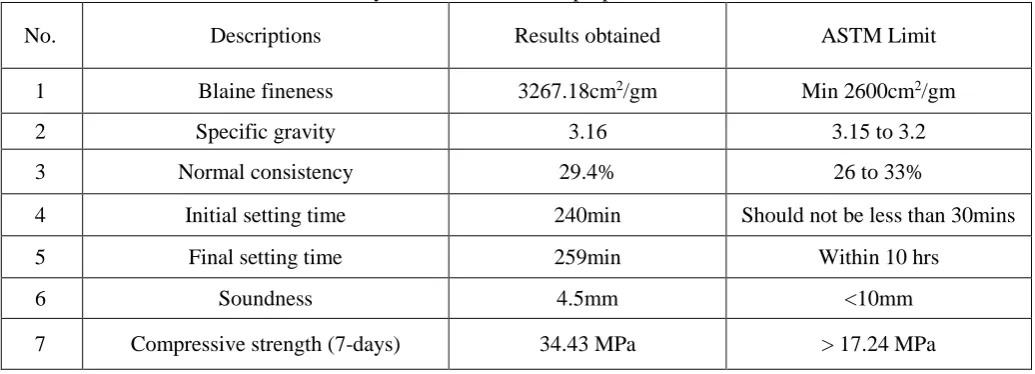
In this research, chemical compositions of Ordinary Portland Type I cement (Apache brand, Grade 42.5) was used. Physical and mechanical properties of cement are shown in Table 1. The specific gravity of cement available in the market is usually between 2.8 to 3.2 and the soundness should be less than 10mm. In this research, all testing results are within the specified limit of ASTM C191-04 [9].
Table 1: Physical and mechanical properties of cement
No. Descriptions Results obtained ASTM Limit
1 Blaine fineness 3267.18cm2/gm Min 2600cm2/gm
2 Specific gravity 3.16 3.15 to 3.2
3 Normal consistency 29.4% 26 to 33%
4 Initial setting time 240min Should not be less than 30mins
5 Final setting time 259min Within 10 hrs
6 Soundness 4.5mm <10mm
7 Compressive strength (7-days) 34.43 MPa > 17.24 MPa
A.2. Fine Aggregate
Table 2: Physical properties of fine aggregate
No. Description Result obtained ASTM Limit ASTM
1 Specific gravity 2.6 2.3 to 2.9 C128
2 Fineness modulus 2.73 2.3 to 3.1 C204
3 Bulk density 1650 kg/m3 1200 to 1750kg/m3 C29
4 Absorption 1.1% 0.5 to 4% C70
5 Moisture content 3.24% 0.5 to 4% C70
6 Silt test 1.3% 0 to 3% C117
A.3. Coarse Aggregate
Locally available aggregates (crushed stone) from Mandalay City, Myanmar are used as coarse aggregates in the investigation. The physical properties of coarse aggregate are shown in Table 3.
Table 3: Physical properties of coarse aggregate
No. Description Result obtained ASTM Limit ASTM
1 Specific gravity 2.6 2.3 to 2.9 C128
2 Bulk density 1650 kg/m3 1200 to 1750kg/m3 C29
3 Absorption 0.67% 0.5 to 4% C70
4 Moisture content 0.5% 0.5 to 4% C70
A.4. Silica Fume
Silica fume (MAPEI, Singapore) also referred to as micro silica or condensed silica fume is used as an artificial pozzolanic admixture. The use of silica fume with superplasticizer has been the backbone of high strength concrete. Silica fume (confirming to ASTM C 1240-15) [11] has spherical shape and diameter is about 0.1 micrometre. The amount of silica fume generally ranges from 10% to 30% as partial replacement of cement weight. In this research, silica fume 4%, 8% and 12% were investigated. Silica fume used in this research contains 96.693% of silicon dioxide. The physical properties of silica fume are shown in Table 4. According to the Table 4, the results of setting time and soundness are within the limit of ASTM standards. The silica fume is added 4%, 8% and 12% as a partial replacement by weight of cement and the final setting time increases gradually when the silica fume percent increases within the considerable limit.
Table 4: Properties variation of cement by adding silica fume Silica fume % by
cement weight Initial setting time(min) Final setting time(min)
Soundness (mm)
4 169 235 0.5
8 169 250 0.67
12 168 330 0.7
A.5. Superplasticizer
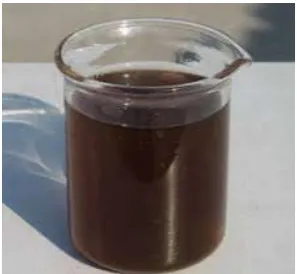
Superplasticizers are reducing admixture but their importance is significantly greater than that of the water-reducing admixture of the preceding section. Superplasticizer increases the workability and strength by water-reducing the amount of water in the mix. In high strength concrete with steel fibre, adding superplasticizer makes increasing in workability and required slump. Superplasticizer (Darex Super 20 or S 20) based in a liquid form was used in all concrete mixtures to get the required slump according to ASTM C494 [12].
A.6. Steel Fibre
In this investigation, modified cold-drawn wire with hook end obtained from DAEIN steel fibre (South
Korea) was used. Steel fibre has density of 7800 kg/m
3.
The fibres are added at volume friction of 0.5% and 1%.The properties of steel fibre are shown in Table 5.
Small fibre-volume fractions exhibit a larger scatter in fibre
distribution than higher fibre-volume fractions. Increase in the aspect ratio of the fibre usually segments the
flexural strength and toughness of the matrix. However, fibres with a higher aspect ratio (l
f/d
f) tend to result
"fibre ball" in the mix and potential reduction in workability of the mix. They may also reduce the permeability
of concrete and thus reduce bleeding of water.
Table 5: Physical and mechanical properties of steel fibre
No. Properties Steel Fibre
1 Length (mm) 35
2 Diameter (mm) 0.55
3 Aspect ratio (l/d) 80
4 Specific gravity(kg/m3) 7.8
5 Tensile strength (MPa) 1080
Figure 2: Hooked End Steel Fibre
A.7. Water
Mixing water is an important ingredient of concrete as it actively participates in chemical reaction with cementitious materials. Therefore, water should be clean and free from impurities like clay, loam and soluble salts. Water quality test results are shown in Table 6.
Table 6: Water quality test
No. Description Result ASTM C 94
1 pH 6.08 6-8
2 Total alkalinity 58 mg/l as CaCO3 Max 600
3 Chloride 25 mg/l Max 1000
4 Sulphate 2 mg/l Max 3000
5 Total solids 585 mg/l Max 50000
B. Experimental Methods and Test Procedure
B.1. Proportioning of concrete mixes
Some tests for physical properties such as consistency, setting time, soundness, specific gravity were carried out and normal strength concrete test results, silica fume (4%, 8%, 12%) were tested with superplasticizer (0.5%, 1% and 1.5 %) and steel fibre (0.5% and 1%) in trial mixing to get high strength concrete. In this investigation, trial mixes were tested for 7 days and 28 days. In all mixing of concrete mixture, mixings were based on ASTM standards.
Slump
is a most important factor in achieving a good floor surface with concrete. The purpose of this test is to
determine the consistency of a freshly mixed concrete by measuring the slump. The slump test of fresh
concrete was conducted according to ASTM C143 [13].
150mm x 150mm x 150mm cube size molds were used
Figure 3: Slump Test and Cube Casting
B.2. Compression Strength Test
The compressive strength of mix proportions with different steel fiber volumes were evaluated according to ASTM. The purpose of compression test is to determine the strength of the concrete mixture can achieve. The samples undergone compression test after curing process for 7days and 28 days. Cube Compressive strength test is as shown in Figure 4(a).
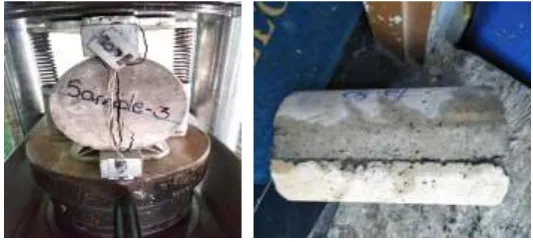
Figure 4: Compression Strength Test of (a) Cube and (b) Cylinder Concrete Specimen
For compressive and splitting tensile strength tests, 150 mm x 300 mm cylinders were used in this study. The compression test is performed in accordance with ASTM C39 [14]. Three numbers of cylinders are prepared for compressive strength test and they are conducted after 28 days of concrete curing on a 3000 KN universal testing machine. A uniform rate of loading 11.25 KN/sec is applied to the specimen until failure. Figure 4 (b) demonstrates the cube compressive strength test of concrete.
B.3. Splitting Tensile Test
Splitting tensile test is carried out according to ASTM C469 [15]. Three numbers of cylinder
specimens (150 x 300 mm) in dimension are prepared and tested in the universal testing machine with the rate
of 11.25 KN/sec after curing 28 days. Figure 5 shows the splitting tensile test. In this study, the unit weight of
the cylinder samples were found out between 2500-2600 kg/m³.
4. Experimental Results and Discussion:
4.1. Compressive Strength Test Result Discussion
The experimental results of mean compressive strength of cube specimens with varied w/c ratio of the all three concrete mixes at the age of 7days and 28days along with standard deviation are presented in Figure 5. The compressive strength increases initially with addition of water, which improve hydration of cement paste with increasing water content until the water cement ration is 0.36 .However, subsequent water addition leads to the reduction in strength as expected in the trend of w/c is 0.38. From the experimental results, it was observed that water cement ratio of 0.36 provide better compressive strength than those with higher water cement ratio, i.e. 0.38 and 0.4. The experimental results indicated that the compressive strength is directly proportional to the water-cement ratio of the concrete mix in M3. It has been generally observed that the compressive strength at the ages of 28 days increases as the water/cement ratio increases in 0.36 and 0.38.From Table 7, normal strength is tested with the various proportions of w/c ratio, fine and coarse aggregate. According to the 7 days and 28 days strength, M3 (44.25 and 59.65 MPa) with w/c ratio 0.36 is selected to add the silica fume.
Table 7: Results from the experimental compressive strength values for normal strength concrete
Trial No. Cement
(kg /m3)
F.A (kg/m3)
C.A
(kg/m3) W/C
7-days (MPa)
28-days (MPa)
M1 652 501 907 0.32 40.62 42.77
M2 600 544 907 0.34 48.2 51.97
M3 570 570 907 0.36 44.25 59.65
M4 543 592 907 0.38 40.43 55.56
M5 518 613 907 0.4 30.46 47.32
Figure 5: Compressive Strength Values of Normal Strength Concrete
In Table 8, normal strength result from table VII is added with the various proportion of silica fume (4%, 8% and 12%) by weight of the cement According to the 7 days and 28 days strength, M5 (42 and 64.7 MPa) with w/c ratio 0.36 and silica fume (8%) is selected to add the superplasticizer to get the high strength with low w/c ratio.
Table 8: Results from the experimental compressive strength values of normal strength concrete with silica fume (4%, 8% and 12%)
Trial No.
Cement (kg /m3)
F.A (kg/m3)
C.A
(kg/m3) W/C
Slump
(in)
Silica Fume (%)
7days (MPa)
28days (MPa)
M1 600 544 907 0.34 0.5 4 33 50.5
M2 600 544 907 0.34 0.5 8 31 47.2
M3 600 544 907 0.34 0.5 12 35 53.7
M4 570 570 907 0.36 2.5 4 33 49.8
M5 570 570 907 0.36 2 8 42 64.7
M6 570 570 907 0.36 1 12 34 51.7
M1 M2 M3 M4 M5
0 10 20 30 40 50 60
Compress
ive Str
ength(MPa)
Trial No. 7-days
M7 543 592 907 0.38 1.5 4 37 55.8
M8 543 592 907 0.38 1.1 8 31 47.7
M9 543 592 907 0.38 0.6 12 35 53.4
Figure 6: Compressive Strength Values of Normal Strength Concrete with Silica Fume (4%, 8% and 12%)
In Table 9, M5 (high strength concrete) result from table 8 is added with the various proportion of superplasticizer (0.5%, 1% and 1.5%) by volume of the concrete. After adding the various proportion of S20, according to the 7 days and 28 days strength, M3 with w/c ratio 0.36 and silica fume 8% and superplasticizer 1.5% is selected to add the steel fibre to get the high strength concrete with steel fibre.
Table 9: Results from the experimental compressive strength values of normal strength concrete with silica fume (8%) and superplasticiser (0.5%, 1% and 1.5%)
Trial No.
Cement (kg /m3)
F.A (kg/m3)
C.A (kg/m3)
S20 (%)
Slump (in)
7days (MPa)
28days (MPa)
M1 570 570 907 0.5 2.5 44 66.8
M2 570 570 907 1 3.2 44.1 66.9
M3 570 570 907 1.5 4 44 67.1
M4 570 570 907 0.5 0.9 39.1 59.5
M5 570 570 907 1 1 39.4 53.9
M6 570 570 907 1.5 1.5 33.9 48.4
M7 570 570 907 0.5 3.5 39.5 60.2
M8 570 570 907 1 4.7 41.8 63.7
M9 570 570 907 1.5 5.2 41.7 63.8
Figure7: Compressive Strength values of Normal Strength Concrete with Silica Fume (8%) and Superplasticizer (0.5%, 1% and 1.5%)
M1 M2 M3 M4 M5 M6 M7 M8 M9
0 10 20 30 40 50 60 70
Compress
ive Str
ength (MPa)
Trial No. 7-days
28-days
M1 M2 M3 M4 M5 M6 M7 M8 M9
0 10 20 30 40 50 60 70
Compress
ive Str
ength (MPa)
Trial No. 7-days
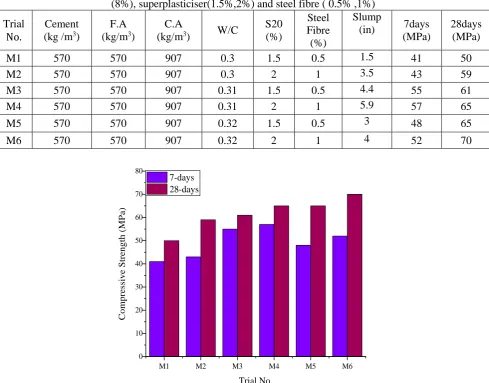
Table 11: Results from the experimental compressive strength values of normal strength concrete with silica fume (8%), superplasticiser(1.5%,2%) and steel fibre ( 0.5% ,1%)
Trial
No. (kg /mCement 3)
F.A (kg/m3)
C.A
(kg/m3) W/C
S20 (%)
Steel Fibre (%)
Slump
(in) 7days
(MPa)
28days (MPa)
M1 570 570 907 0.3 1.5 0.5 1.5 41 50
M2 570 570 907 0.3 2 1 3.5 43 59
M3 570 570 907 0.31 1.5 0.5 4.4 55 61
M4 570 570 907 0.31 2 1 5.9 57 65
M5 570 570 907 0.32 1.5 0.5 3 48 65
M6 570 570 907 0.32 2 1 4 52 70
Figure 8: Compressive Strength values of High Strength Concrete with Silica fume (8%), Superplasticizer (1.5%) and Steel fibre (0.5%, 1%)
According to the test result from Table 11, the influence of fibre volume percent and matrix proportion on the 28 days compressive strength of the observation can be found in Figure 8. As observed in Figure 8, increase in steel fibre volume percent causes reduction of compressive strength in low-grade concrete. In which, high strength concrete with 1% steel fibre volume gains 0.9% higher than in the strength of the control.
4.2. Splitting Tensile Strength Test Result Discussion
The maximum splitting tensile strengths of SFRC at the selected final mix design are 5.039 MPa, 4.787
MPa and 5.259 MPa at 28 days strength. This is due to the more cement paste in the mixture, the better bonding
strength of steel fibre with the matrix. Moreover, splitting tensile strength of high-grade concrete becomes
better with the increasing amount of steel fibres.
5. CONCLUSIONAND RECOMMENDATION: A. Conclusion
Based on the test results of investigation within the consideration scope, steel fibre content affects the strength and increasing steel fibre up to 1% cause the increase in compressive strength but difficult in workability and so more superplasticizer is needed. Within the considerable scope, the maximum strength is found in steel fibre 1%.Silica fume can be effectively used in high strength as a replacement by cement weight. According to this investigation within the scope, when more silica fume is added, the strength increases until the silica fume 8% range from 4% to 12%. Therefore, if the steel fibre reinforced concrete (SFRC) is used in structural applications, proper trials should be done with the desired type of fibre and local concrete making materials in order to perform different structural strengths. According to this research, 1% of steel fibre volume in high-grade concrete reveals the better and reasonable structural behaviour of concrete at optimum dosage of silica fume (8%), steel fibre (1%) and 0.32 water/cement ratio.
M1 M2 M3 M4 M5 M6
0 10 20 30 40 50 60 70 80
Compress
ive Str
ength (MPa)
Trial No. 7-days
B. Recommendation
Vebe concrete consistometer test and compacting factor test should be used to test the better workability test of SFRC. Other higher grades of concrete with different geometry and aspect ratio of steel fibre should be tested; the durability of steel fibre reinforced concrete should be studied. According to research, silica fume (8%), steel fibre (1%) and 0.32 water/cement ratio are recommended for reinforced concrete construction in Myanmar.
6. ACKNOWLEGMENT:
First and foremost the author thanks to Professor Dr. Nyan Myint Kyaw, Head of Civil Engineering Department of YTU for his support, guidance and suggestions. Special thanks to Dr. Khin Su Su Htwe, Professor, Civil Engineering Department of YTU, for her support and kind help and then, the support from Structural Laboratory, Department of Civil Engineering, Yangon Technological University, Yangon, Myanmar.
REFERENCES:
1. ACI 544.1R.: Sate-of-the-Art Report on fibre Reinforced Concrete American Concrete Institute, 1999. 2. CHAN, Y,and CHU,S.: Effect of Silica Fume on Steel Fibre Bond Characteristics in Reactive Powder Concrete
and Concrete Research Vol. 34, No 7, pp.1167-1172,2004. 3. Nyi Hla Nge , Notes on Concrete Technology.
4. ORGASS, M and KLUG, Y.: Steel Fibre Reinforced Ultra High Strength Concretes, Institutes for Structural Concrete and buildings Material, University of Leipzig, MFPA Leipzig GmbH, Lacer No.9 pp.12, 2004. 5. Konstantin Sobolev, (2004), The Develop of a New Method for the Proportioning of High Performance
Concrete Mixtures, Cement and Concrete composites, 26, pp. 901-907.
6. Wafa, S.F and Ashour , S.A.(1992), : Mechanical Properties of High Strength Fibre Reinforced Concrete.: AC I Materials Journal, 89 (5), pp. 449
7. Arnon Bentur and Sidney Minddess. (2007) Fibre Reinforced Cementitious Composites, 2nd ed. Taylor and Francis Group, London and New York.
8. Sidney Mindess, J. Francis Young and David Darwin. (2002) Concrete, 2nd ed. Prentice Hall, New Jersey. 9. American Standard Test Method for Time of Setting of Hydraulic Cement by Vicat Needle ASTM C191-04
10. American Standard Test Method for Concrete Aggregates ASTM C 33M-18
11. American Standard Test Method for Silica Fume Used in Cementitious Mixtures ASTM C1240-15
12. American Standard Test Method for Chemical Admixtures for Concrete ASTM C494M-17
13. American Standard Test Method for Slump of Hydraulic-Cement Concrete ASTM C143
14. American Standard Test Method for Compressive Strength of Cylindrical Concrete Specimens ASTM C39
15. American Standard Test Method for Static Modulus of Elasticity and Poisson’s Ratio of Concrete in