Available Online at www.ijpret.com 1410
INTERNATIONAL JOURNAL OF PURE AND
APPLIED RESEARCH IN ENGINEERING AND
TECHNOLOGY
A PATH FOR HORIZING YOUR INNOVATIVE WORK
INTRUSION DETECTION TECHNIQUES FOR MANET USING IMPROVED EAACK
POOJA P. MOKADAM1, PROF. PRAVIN G. KULURKAR2
1.M. Tech Student, CSE, VIT College of Engineering, Nagpur, India. 2.Professor & Head, CSE, VIT College of Engineering, Nagpur, India.
Accepted Date: 05/03/2015; Published Date: 01/05/2015
Abstract:A mobile ad hoc network (MANET) is a continuously self-administering, less-infrastructure network of mobile devices connected without wires. Each device in a MANET is free to move independently in more directions, and it can change its links to other devices frequently. Attacks like Denial of Service, Buffer overflows, Sniffer attacks and Application-Layer attacks have become a common issue today. The general challenge in building a MANET is equipping each device to continuously maintain the information required to its route traffic. Such networks may operate by itself or may be connected to the larger Internet. Every node works as both a transmitter and a receiver. They may contain one or multiple and different transceivers between nodes. This results in a highly – dynamic, autonomous topology on individual layer like Application Layer (Malicious code, Repudiation), Transport Layer (Session hijacking, Flooding) attacks on MANETs challenge the mobile infrastructure in which nodes can join and leave easily with dynamics requests. We need to develop efficient intrusion-detection mechanisms to protect MANET from attacks. To overcome attacks on Mantes we have to provide more security by expanding MANETS into industrial applications based on improved technology and reduced hardware cost. Here we developed a new intrusion detection system named Improved Enhanced Adaptive Acknowledgment (EAACK) specially designed for MANETs has been developed. EAACK demonstrates higher malicious-behavior detection rates in certain circumstances while does not greatly affect the network performances.
Keywords: Digital signature, digital signature algorithm (DSA), Enhanced Adaptive Acknowledgment (AACK) (EAACK), Mobile Ad hoc Network (MANET), Intrusion Detection System (IDS). Intrusion Detection; Network security; Network Attacks; Signature detection.
Corresponding Author: MS. POOJA P. MOKADAM
Access Online On:
www.ijpret.com
How to Cite This Article:
Pooja P. Mokadam, IJPRET, 2015; Volume 3 (9): 1410-1418
Available Online at www.ijpret.com 1411 INTRODUCTION
Over the past decade, there has been a growing interest in wireless networks, as the cost of mobile devices such as PDAs, laptops, cellular phones, etc have reduced drastically. The latest trend in wireless networks is towards pervasive and ubiquitous computing -catering to both nomadic and fixed users, anytime and anywhere. One of the most prevalent forms of wireless networks in use today is the Wireless Local Area Network (WLAN).In such a network, a set of mobile nodes are connected to a fixed wired backbone. An intrusion is a formal term describing the act of compromising a system. And detecting either failed or successful attempts to compromise the system is called an Intrusion Detection. Intrusion detection (ID) is a type of security management system for computers and networks.
By definition, Mobile Ad hoc Network (MANET) is a collection of mobile nodes equipped with both a wireless transmitter and a receiver that communicate with each other via bidirectional wireless links either directly or indirectly. One of the major advantages of wireless networks is its ability to allow data communication between different parties and still maintain their mobility. MANET solves this problem by allowing intermediate parties to relay data transmissions. This is achieved by dividing MANET into two types of networks, namely, single-hop and multi single-hop. In a single-single-hop network, all nodes within the same radio range communicate directly with each other.
On the other hand, in a multi hop network, nodes rely on other intermediate nodes to transmit if the destination node is out of their radio range in contrary to the traditional wireless network. MANET has a decentralized network infrastructure. MANET does not require a fixed infrastructure; thus, all nodes are free to move randomly [3], [4], [5]. MANET is capable of creating a self-configuring and self-maintaining network without the help of a centralized infrastructure, which is often infeasible in critical mission applications like military conflict or emergency recovery [13], [14]. Owing to these unique characteristics, MANET is becoming more and more widely implemented in the industry [9], [10]. However, considering the fact that MANET is popular among critical mission applications, network security is of vital importance. Unfortunately, the open medium and remote distribution of MANET make it vulnerable to various types of attacks.
Network Security Attacks
Available Online at www.ijpret.com 1412
computers. Security is described through the accomplishment of basic security properties, namely Data confidentiality, Authentication, Access control, Data Integrity and Non-repudiation [3].
b) Denial-of-Service (DOS) attacks
It is an attempt to forbid the authorized users from utilizing the requested service/ resource. A more advanced Distributed Denial of Service occurs when in a distributed environment the attacker sends or rather floods the server or a target system with numerous connection requests knocking the target system to the knees, leaving them no other option to restart their system.
Related Work
The Watchdog/Pathrater is a solution to the problem of selfish (or ―misbehaving) nodes in MANET. The system introduces two extensions to the DSR algorithm to mitigate the effects of routing misbehavior: the Watchdog, to detect the misbehaving nodes and the Pathrater, to respond to the intrusion by isolating the selfish node from the network operation
Intrusion Detection system in MANETS:
As discussed before, due to the limitations of most MANET routing protocols, nodes is MANETs assume that other nodes always cooperate with each other to relay data. This assumption leaves the attackers with the opportunities to achieve significant impact on the network with just one or two compromised nodes. To address this problem, Intrusion Detection System (IDS) should be added to enhance the security level of MANETs. If MANET can detect the attackers as soon as they enter the network, we will be able to completely eliminate the potential damages caused by compromised nodes at first time. IDSs usually act as the second layer in MANETs, and it is a great complement to existing proactive approaches [4] and presented a very thorough survey on contemporary IDSs in MANETs. In this section, we mainly describe three existing approaches, namely, Watchdog [6], TWOACK [7], and AACK [8].
B. Watchdog:
Available Online at www.ijpret.com 1413
node fails to forward the packet within a certain period of time, it increases its failure counter. Whenever a node’s failure counter exceeds a predefined threshold, the Watchdog node reports it as misbehaving. Furthermore, compared to some other schemes, Watchdog is capable of detecting malicious nodes rather than links. These advantages have made Watchdog scheme a popular. Watchdog scheme fails to detect malicious misbehaviors with the presence of
Ambiguous collisions
Receiver collisions
Limited transmission power
False misbehavior report
Collusion
Partial dropping.
C. TWOACK:
TWOACK is neither an enhancement nor a Watchdog based scheme and their motto is to resolve the receiver collision and limited transmission power problems of Watchdog, TWOACK detects misbehaving links by acknowledging every data packets transmitted over each three consecutive nodes along the path from the source to the destination. On retrieval of a packet, each node along the route is required to send back an acknowledgement packet to the node that is two hops away from it down the route. TWOACK is required to work on routing protocols such as Dynamic Source Routing (DSR) [1].The working process of TWOACK is demonstrated in Fig.1.TWOACK scheme successfully solves the receiver collision and limited transmission power problems posed by Watchdog.
Available Online at www.ijpret.com 1414 D. AACK:
It is based on TWOACK Acknowledgement (AACK) similar to TWOACK,AACK is an acknowledgement based network layer scheme which can be considered as a combination of a scheme call ACK (identical to TWOACK) and an end-to-end acknowledgement scheme called ACK. Compared to TWOACK, AACK significantly reduced network overhead while still capable of maintaining or even surpassing the same network throughput. Source node S will switch to TACK scheme by sending out a TACK packet. The concept of adopting a hybrid scheme in AACK greatly reduces the network overhead, but both TWOACK and AACK still suffer from the problem that they fail to detect malicious nodes with the presence of false misbehavior report and forged acknowledgement packets. The function of such detection schemes all largely depend on the acknowledgement packets. Hence, it is crucial to guarantee the acknowledgement packets are valid authentic to address this concern to adopt digital signature in proposed scheme EAACK.
Figure2: s-ack scheme node C is required to send back an acknowledge packet to node B
Problem Definition
Available Online at www.ijpret.com 1415 A. Scheme description:
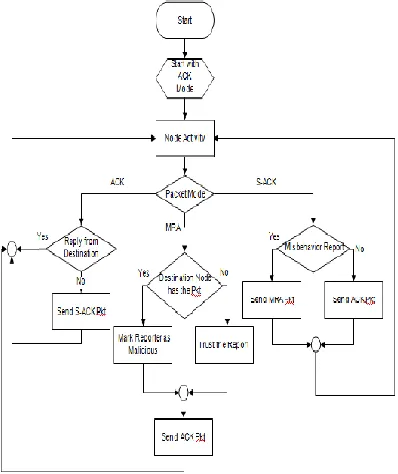
In this section, we describe our proposed Enhanced Adaptive Acknowledgement (EAACK) scheme in details. The approach described in this research paper is based on our previous work [2], where the backbone of EAACK was proposed and evaluated through implementation. In this work, we extend it with the introduction of digital signature to prevent the attacker from forging acknowledgement packets. EAACK is consisted of three major parts, namely: 1.Acknowledge (ACK), 2.Secure-Acknowledge (S-ACK) And 3. Misbehavior Report Authentication (MRA).
In order to distinguish different packet types in different schemes, we included a two-bit packet header in EAACK. Flowchart in fig 3 describing EAACK scheme. Please note that in my proposed scheme, I assume that the link between each node in the network is bidirectional. Furthermore, for each communication process, both the source node and the destination node are not malicious. Unless specified, all acknowledgement packets described in this research are required to be digitally signed by its sender and verified by its receiver.
B. ACK:
As discussed before, ACK is basically an end-to-end acknowledgement scheme. It acts as a part of the hybrid scheme in EAACK, aiming to reduce network overhead when no network misbehavior is detected.
C. S-ACK:
S-ACK scheme is an improved version of TWOACK scheme. The principle is to let each three consecutive nodes work in a group to detect misbehaving nodes. For each three consecutive nodes in the route, the third node is required to send an S-ACK acknowledgement packet to the first node. The intention of introducing S-ACK mode is to detect misbehaving nodes in the presence of receiver collision or limited transmission power.
D. MRA:
Available Online at www.ijpret.com 1416
MANETs, it is common to find out multiple routes between two nodes. By adopting an alternative route to the destination node, we circumvent the misbehavior reporter node. When the destination node receives an MRA packet, it searches its local knowledge base and compare if the reported packet was received. If it is already received, then it is safe to conclude this is a false misbehavior report and whoever generated this report is marked as malicious. Otherwise, the misbehavior report is trusted and accepted. By the adoption of MRA scheme, EAACK is capable of detecting malicious nodes despite the existence of false misbehavior report.
E. Digital Signature:
As discussed before, EAACK is an acknowledgement based IDS. All three parts of EAACK, namely: ACK, SACK and MRA are acknowledgement based detection schemes. They all rely on acknowledgement packets to detect misbehaviors in the network. Thus, it is extremely important to ensure all acknowledgement packets in EAACK are authentic and untainted. Otherwise, if the attackers are smart enough to forge acknowledgement. Packets, all of the three schemes will be vulnerable. In order to ensure the integrity of the IDS, EAACK requires all acknowledgement packets to be digitally signed before they are sent out, and verified until they are accepted. To address this concern, we implemented both DSA [11] and RSA [12] digital signature scheme in our proposed approach. The goal is to find the most optimal solution for using digital signature in MANET.
Available Online at www.ijpret.com 1417 IV. CONCLUSION
In this paper, we have presented novel IDS for MANET’s named as EAACK. This has top priority in network security issues. Because it was specially designed to prevent from attackers to initiating forged acknowledge packets. Packet-dropping has always been a major treat to security in MANETs. The result demonstrated positive performances against Watchdog, TWOACK and AACK in cases of receiver collision, limited transmission power and false misbehavior report. Though it generates more ROs in some cases, as demonstrated in our experiment, it can vastly improve the network’s PDR when the attackers are smart enough to forge acknowledgment packets compared it against other popular mechanisms in different scenarios through simulations.
V. REFERENCES
1. D. Johnson and D. Maltz, Dynamic Source Routing in ad hoc wireless networks, in Mobile
Computing. Norwell, MA: Kluwer, 1996, ch. 5, pp. 153–181.
2. N. Kang, E. Shakshuki, and T. Sheltami, “Detecting misbehaving nodes in MANETs”, in Proc.
12th Int. Conf. iiWAS, Paris, France, Nov. 8–10, 2010, pp. 216–222.
3. G. Jayakumar and G. Gopinath, “Ad hoc mobile wireless networks routing protocol— A
review,” J. Comput. Sci., vol. 3, no. 8, pp. 574–582, 2007.
4. B. Sun, “Intrusion detection in mobile ad hoc networks,” Ph.D. dissertation, Texas A&M
Univ., College Station, TX, 2004.
5. A. Tabesh and L. G. Frechette, “A low-power stand-alone adaptive circuit for harvesting
energy from a piezoelectric micropower generator,” IEEE Trans. Ind. Electron., vol. 57, no. 3, pp. 840–849, Mar. 2010.
6. S. Marti, T. J. Giuli, K. Lai, and M. Baker, “Mitigating routing misbehaviour in mobile ad hoc
networks,” in Proc. 6th Annu. Int. Conf. Mobile Comput. Netw. Boston, MA, 2000, pp. 255–265.
7. J.-S. Lee, “A Petri net design of command filters for semiautonomous mobile sensor
networks,” IEEE Trans. Ind. Electron., vol. 55, no. 4, pp. 1835–1841, Apr. 2008.
8. T. Sheltami, A. Al-Roubaiey, E. Shakshuki, and A. Mahmoud, “Video transmission
Available Online at www.ijpret.com 1418
9. K. Kuladinith, A. S. Timm-Giel, and C. Görg, “Mobile ad-hoc communications in AEC industry,”
J. Inf. Technol. Const., vol. 9, pp. 313–323, 2004.
10.K. Stanoevska-Slabeva and M. Heitmann, “Impact of mobile ad-hoc networks on the mobile
value system,” in Proc. 2nd Conf. m-Bus., Vienna, Austria, Jun. 2003.
11.Nat. Inst. Std. Technol., Digital Signature Standard (DSS) Federal Information Processing
Standards Publication, Gaithersburg, MD, 2009, Digital Signature Standard (DSS).
12.R. Rivest, A. Shamir, and L. Adleman, “A method for obtaining digital signatures and
public-key cryptosystems,” Commun. ACM, vol. 21, no. 2, pp. 120–126, Feb. 1983.
13.N. Nasser and Y. Chen, “Enhanced intrusion detection systems for discovering malicious
nodes in mobile ad hoc network,” in Proc. IEEE Int. Conf. Commun., Glasgow, Scotland, Jun. 24– 28, 2007, pp. 1154–1159.
14.M. Zapata and N. Asokan, “Securing ad hoc routing protocols,” in Proc. ACM Workshop