Initial Stage Decay Processes during Cosmic Decoupling
Thomas A. Kriz
Advanced Studies, Alpha Omega Research Foundation, Cedar Park, USA
Abstract
Cosmic decoupling, as a matter formation process, occurs in three stages, beginning with an interaction between cosmic radiation and quark family #3, followed by quark family #2, and then finally by quark family #1. The first two of these interaction sets fail to successfully produce stable baryon matter particles largely because of excessively large quark particle size and lack of adequate cosmic radiation energy levels needed to satisfy baryon particle energy binding requirements. This paper discusses the particular details of the decay processes that cause quark family #3 to fail in its attempt to produce stable hadron particles. Included are: 1) Meson particle decay, 2) Weak Interaction particle decay, 3) Higgs mechanism-based decay, and 4) Quantum based decay of large quark particles.Keywords
Cosmic decoupling, Meson decay, Weak interaction, Higg's mechanism, Quantum decay1. Introduction
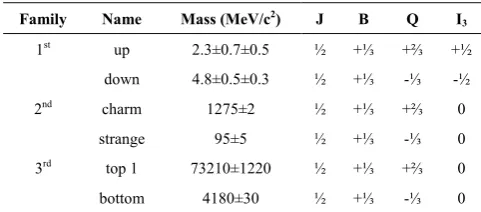
As presented in a prior paper [1], the quark/hadron impact on cosmic decoupling requires it to occur as a three stage process involving the quark families as listed below in Table 1. [2]
Table 1. Quark Family Attributes
Family Name Mass (MeV/c2) J B Q I 3
1st up 2.3±0.7±0.5 ½ +⅓ +⅔ +½
down 4.8±0.5±0.3 ½ +⅓ -⅓ -½ 2nd charm 1275±2 ½ +⅓ +⅔ 0
strange 95±5 ½ +⅓ -⅓ 0 3rd top 1 73210±1220 ½ +⅓ +⅔ 0
bottom 4180±30 ½ +⅓ -⅓ 0
where J is total angular momentum, B is baryon number, Q is electric charge, and I3 is Isospin. Since quarks are always
confined within hadrons, the chart data is indirectly derived from observations on particle based hadron collider experiments. The above table, which summarizes a list of relevant observed quark attributes, may be used then to analyze the role of quarks and hadrons at various stages of cosmic decoupling.
Recall first that a baryon particle such as a neutron can be viewed, from a quark viewpoint, as composed of two downs and one up, and a proton, as one down and two ups. Note also, however, that an isolated neutron particle set has only a mean lifespan of about 15 minutes [3] due to “weak interaction”
* Corresponding author:
[email protected] (Thomas A. Kriz)
Published online at http://journal.sapub.org/astronomy
Copyright © 2018 Scientific & Academic Publishing. All Rights Reserved
based Beta decay. But, by comparison, both the charm-strange family and especially the top-bottom family have significantly shorter life spans [4-7] and can be viewed as failed attempts to successfully hadronize during the beginning of a 3-stage cosmic decoupling process.
A second chart (Table 2) given below also defines the associated spin-½ lepton family particle attributes that are part of the atomic particle set that includes the above defined quark families. [8] The lepton life span data listed here also gives a close approximation of the life span attributes of Charm-Strange and Top-Bottom quark family groups during baryon based hadronization attempts.
Table 2. Associated Lepton Family Attributes
Family Name Mass (MeV/c2) Mean Life
1st electron 0.511 stable
2nd muon 106 2.2×10⁻⁶s
3rd tau 1784 3.4×10⁻²³s
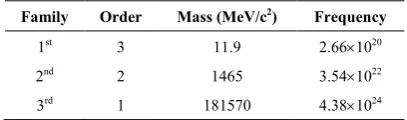
Table 3. Neutron-style Hadronization Attempts
Family Order Mass (MeV/c2) Frequency
1st 3 11.9 2.66×10²⁰
2nd 2 1465 3.54×10²²
3rd 1 181570 4.38×1024
Table 3 assumes that radiation has a frequency equivalent mass energy property defined by [9]
m=ωh/c2=2πfh/c2 (1)
where ω is angular frequency, f is frequency defined in
Hertz units, h is Planck's constsant, and c is the speed of light. Note also that the chart does not include binding energy for a neutron particle. If the 1-Up/2-Down quark set in quark family #1 for a neutron included the binding energy, the total energy requirement [10] would be 939.57 Mev/c2 at
approximately a mass equivalent cosmic radiation frequency of 2.27×10²³ Hz. It can be seen then that the neutron binding
energy requirements play a significant role during the matter formation based cosmic decoupling era, and are the major cause of baryon hadronization failure by quark families #2 and #3. [1] Thus, quark-antiquark pair based mesons outside of an atomic nucleus can then be shown to be important contributors to decay found during early stages of a three stage cosmic decoupling process. Other important decay contributors during cosmic decoupling also include massive weak interaction force carrying bosons W+, W-, and Z0, that
decay to lepton and meson particle forms, baryon-meson interactions that support quark annihilation, and massive quark based particle decay due to inadequate radiation based energy support levels. All of these decoupling-based decay processes are reviewed in the following.
2. Yukawa Meson Theory
Three years after the development of the “Uncertainty Principal” by Heisenberg in1932, Yukawa [11] found good use for it in the development of meson theory to characterize particle based nuclear forces. The usual starting point of the Uncertainty Principal in the development of meson theory [12] begins with an assertion that the location of a photon with momentum p and wavelength λ and frequency change Δν) cannot be predicted exactly, but has momentum of the order
Δp≥h/2πλ≥ħΔν (2) where h is Planck's constant and ħ is Planck's reduced constant. It can be seen from (2) that a larger wavelength λ
infers less uncertainty than shorter one. Since frequency change Δν=1/Δt, where Δt is time change, the corresponding impact of (2) on energy change ΔE is [13]
ΔE≥hΔν/2≥h/2Δt (3) The form in (3) then can be used to define a relation between meson particle mass and the maximum nuclear force impact range r within an atomic particle by noting that
Δt=r/v≈r/c (4) where ΔE?mc2, m is the mass of the meson, v is the velocity
of the meson and c is the speed of light. In turn, (2,3) then imply that
ΔEΔt≈mc2(r/c)≈h (5)
and that meson mass is
m≈h/rc. (6)
For example, note that a π meson (also known as a pion)
has total mass that is midway between that of an electron and the baryon (eg; a proton or neutron):
mπ=(6.528×10⁻¹⁹MeV/c2s)/(1.55×10-15m)(3×108m/s)
= 140 MeV/c2 (7)
It should also be noted that the measured mass of a pion particle is approximately 140 MeV/c2. [14]
Later in the late 1960s, after the development of quark theory, it was also found that all mesons could be defined as an unstable hadron composite, that decayed at various rates, made of a quark-antiquark pair. [15] In this regard, it is worth noting that there are currently around 140 known meson flavors involving quark-antiquark pairs. [16, 17] In the nucleus of an atom, mesons are typically exchanged within the range r term in (4,5) between neutrons and protons to govern nuclear force flow. Theoretically, however, as will be discussed here, some meson flavors outside of an atomic nucleus can also be viewed as forms that contribute to decay processes. Such mesons can also be seen also as composed of quark-antiquark pairs that are governed by (5), but with a range term r that is confined internally. Such mesons are therefore inherently unstable and thus Yukawa theory is extendable to decay process phenomena that also occurs outside of an atomic nucleus. The well publicized Higgs boson [18] and associated weak force carrier bosons can then be viewed as working together with meson quark-antiquark pairs where the range term defined in (4,5) is confined internally.
During the matter formation based cosmic decoupling era, because of baryon hadronization failure by quark families #2 and #3, quark-antiquark pair based mesons outside of an atomic nucleus can then be shown to play a significant role in decay processes found during early stages of a three stage cosmic decoupling process. Other important decay contributors during cosmic decoupling also include massive weak interaction force carrying bosons W+, W-, and Z0, that
decay to lepton and meson particle forms, barion-meson interactions that support quark annihilation, and massive quark based particle decay due to inadequate radiation based energy support levels.
3. Weak Interaction Model
stages of the cosmic decoupling process. This model that, includes massive force carrying bosons W+, W-, and Z0 that
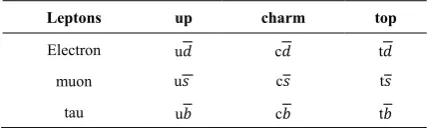
mediate the weak interaction, is also strongly related to “Higgs Mechanism” theory. Some interactions with quark-antiquark pairs can be seen in a chart, given below in Table 4, for the decay events triggered by the W+ boson
particle. The top quark based items listed in right-side column of the table, the existence of which have not been yet verified by particle collision experiments, are based on analytical results to be discussed latter in this paper.
Table 4. W Boson Interaction Based Decay Events
Leptons up charm top
Electron u𝑑 c𝑑 t𝑑
muon u𝑠 c𝑠 t𝑠
tau u𝑏 c𝑏 t𝑏
It can be seen that the quark-antiquark pairs listed in Table 4 are all meson particles. The decay width of the W+ boson
decay width to the mesons in the table is then proportional to the square of corresponding CKM matrix element [20-21] and the number of quark colors NC=3. The flavors of the leptons listed in the table are e+ μ+, and τ+. As examples of
Table 4 listed “up” based W+- boson triggered decay
processes, note that
d+W+__>u (8)
and
u+W-__>d. (9)
It should be noted, however, in the case of lepton results, although these interactions are usually epresented as a quark color change form as “d to u” defined by
d__>u+e-+νe, (10)
where e- is an electron and +ν
e is an antineutrino, they can equally be represented more causally, as an equivalent quark-antiquark annihilation process between d and d in a baryon-meson interaction
udd+u𝑑__>uud+W-, (11)
where W- then decays to become
W-__>e-+𝜈e. (12)
Similarly, during quark-antiquark annihilation interactions involving quark families # 2, and #3
css+c𝑠__>ccs+W-, (13)
and
tbb+t𝑏__>ttb+W-, (14)
where W- then decays instead to a quark families #2 muon
and #3 tau based leptons. Thus, all W+ and W- boson based
interactions with particle forms listed above in Table 4 can be viewed as involving an interaction with a meson particle that then also decays. Note, however, from Table 1, the process udd+ud __> uud+W- defined by (10-11) leads to
toward a stable lower energy state during cosmic decoupling,
whereas Equations (13-14) based interactions lead to unstable higher energy states css+cs__>ccs+W-, and
tbb+t𝑏__>ttb+W-.
On the other hand, note that the weak interaction boson Z0
is commonly associated with lepton particle collisions with scattered neutrinos that alter momenta and energy. As
implied by Equation (12), since the W+ and W- bosons are
involved in the production of neutrino particles, there is then a fixed quantum-based mass interaction relationship between the Z0 boson and the W bosons that is described by the Weinberg angle θW based relationship [22]
MW/MZ=cos θW (15)
where MW and MZ respectively are the masses of the W and
Z bosons, measured to be MW=80.385 GeV/c2 and
MZ=91.1876 GeV/c2 with decay width W: 2.085 GeV/c2 and
Z: 2.495 GeV/c2. [23] The decay half-life for both therefore
is approximately 3×10-25s. This is then followed by the decay
time of the mason in Table 4 that is triggered by the W and Z bosons during the earliest stage (eg; family #3) decoupling decay.
4. Other Quark Family #3 Decay
Processes
During the initial stage of decoupling, interactions between cosmic radiation and quark family # 3 fail to successfully hadronize due to very large quark sizes and an insufficient energy supply from the cosmic radiation source. [1] The comic energy level at that stage, however, is marginally sufficient to support temporary elementary level formation of “ttb”, and “tb” quark collectives, but seriously insufficient to support the required particle “binding energy” requirements. The quark collectives named above therefore decay, following decay process form rules which are well defined by meson decay attributes, the “weak interaction” [16, 17], and the associated Higgs mechanism. [18] The question then is what is the relationship between those processes and quark family #3 defined quark collectives?
The analysis model used here to determine the relationship between quark family #3 particles and the Higgs mechanism is taken from the quantum field theory text by Peskin and Schroeder [24]. The model initially assumes a unitary invariant gauge scalar field of parameter ϕ defined by
ϕ(x)=U(x)(√2)-1[0;υ+h(x)] (16)
where [0;ν+h(x)] is a two component column matrix, ν+h(x) is an arbitrary real valued two component spinor with the value of ν defined by the expectation <ϕ>, and h(x) is a fluctuating real valued field with expected value <h(x)>=0. It is also assumed that spontaneous symmetry breaking of the SU(2) group acts to transform group U(x) [25] and thereby produces a most general complex two-valued spinor in
that leads to an expectation value on ϕ can then be define as ℒ =|Dμ ϕ|2+μ2ϕ†ϕ-λ(ϕ†ϕ)2 (17)
In this case, the minimum potential energy of the vacuum occurs at
υ=(μ2/λ)½. (18)
In unitary gauge, the potential energy terms in (17) then take the Lagrangian form
ℒυ=-μ2h2-λυh3-¼λh4=-½m
h2h2-√mhh3-¼λh4 (19)
where h is Planck's constant, mh is the mass of the of the Higgs boson, and λ can be interpreted as a vacuum based coupling constant. It can be seen from (19) that
mh=√2μ=√2υλ½GeV/c2 (20)
where, so far, the numeric value of terms λ, μ, and υ still remain undefined numerically. Note, however, that the vacuum expectation term <ϕ>=2½υ in the ground state
analytically, and has a known measured value of approximately -250 GeV/c2 [26] from collision experiment
results. Thus, υ=−354 GeV/c2. Moreover, weak interaction
theory can also be associated with the Higgs field by noting that the four component scalar field (2x2) matrix for ϕ. that includes one zero boson. [27] mass photon related element and one element each for the W+, W-, and Z0 weak
interaction]. It should then be noted that the sum of the W+,
W-, and Z0 boson massesin this matrix is equal to 251 GeV/c2,
very closely equivalent to that of the measured value of the vacuum expectation of ϕ. This suggests that the vacuum coupling value of the λ term in Equation (20) is also closely
similar to the g coupling value for the W+, W-, and Z0
bosons, with
g=2mW//υ≈0.46, (21)
and
(g'2+g2)½=2m
Z//υ≈0.52. (22)
Thus, the coupling constant, at the heavy mass 2mυ=708 GeV/c2, is λ≈ 0.5/8≈0.0625 (or about 8 times smaller than
that for mZ) where λ½≈0.25, and implies that
mh=√2μ≈√2 (354)/4≈√2(88.5)≈125.2GeV/c2 (23)
which closely agrees with the measured value and its
predicted decay width of Г=4.21×10⁻³ GeV/c2 and a mean
lifetime of [28]
τ(mh)=h/Г≈1.56×10-22s. (24)
Thereby, the results in (20) then can also be related to the hadron “ttb”, and “t𝑏” quark collectives from the Family #3 quark group, by noting that the mass of quark collective “ttb”, equals 350 GeV/c2,andis approximately equivalent to the
mass of the above defined vacuum term υ, and mh is
approximately √2 smaller than the 177 GeV/c2 mass of the
meson tb quark collective. It should be noted here that both the “ttb”, and “t𝑏” quark collectives, due to their massive size, are also unstable and therefore decay to a W boson and a bottom quark with a predicted decay width [29].
Г≈(g2m
t2)(64πmW2)≈286 (25)
where mt is the mass of the top quark, mW mass of the W
boson, and the mass of bottom quark is seen as small. The mean lifetime of the “ttb”, and “tb” quark collectives is therefore predicted to be
τ(mt)=h/ Г≈6.49×10⁻²⁷s. (26)
Subsequent to the top quark decay, bb mesons, with mass 9.46 GeV/c2, form, and then decay with a mean lifetime of τ(bb)≈1.22×10⁻²⁰s. [30]
5. Conclusions
As shown above, the interaction between cosmic radiation and quark family #3 succeeds only in producing brief transient particles that decay and thereby fail to develop as stable particles. Some of these transient particles are unstable meson quark-antiquark pairs, that exist exterior to an atomic nucleus, with an impact range term that is confined internally. These are also frequently associated with other well-known decay processes, such as the weak interaction with its massive force carrying bosons W+, W-, and Z0, and Higgs
mechanism based processes that also produce only brief lifetime transient particles. The large size of quarks in family #3 also contribute decay hadronization attempts during the initial stage of decoupling to account for an additional decay mechanism that involves hadron based “ttb”, and “t𝑏” top and bottom-based quark collectives.
There are some novelties in the decay analysis themes presented here. One of these is the concept that quark color change process can be viewed as a quark annihilation process. Additional novelties concern the attributes of the weak interaction and associated Higgs mechanism features. It is shown analytically that the sum of the W+, W-, and Z0,
masses is equal to the mass value of a unitary invariant gauge scalar field expectation <ϕ> and that the Higgs boson coupling constant λ can be derived from the g couplings in the W+, W-, and Z0, boson set. These also can be related to
the quark attributes of quark family #3 in that the attribute of the top quark and bottom based collective ttb has an analytical relationship with the spontaneous symmetry broken vacuum attribute. Μoreover, the mass of the Higgs boson is exactly √2 times smaller than the 177 GeV/c2 mass
of the meson t𝑏 quark collective.
Thus, it can be seen that there are no stable particles that are generated by the interaction between cosmic radiation and quark family #3; only transient particles with a brief mean lifetime. All of these transient particles decay with a mean lifetime that is shorter than approximately 10-20s.
ACKNOWLEDGMENTS
The author wishes to express gratitude for the encouragement and critical review received during the early
Director of the Alpha Omega Research Foundation, and several other members of our group, now deceased: Prof. Behram Kursunoglu and Dr. Walter Rosenthal. Prof. Kursunoglu was the Director of the Theoretical Institute at the University of Miami (FL), and pursued graduate studies at Cambridge University under P.A.M. Dirac. Dr. Walter Rosenthal was one of the last students to pursue graduate studies in physics at the University of Berlin under Max Planck.
REFERENCES
[1] T.A. Kriz, 2017, An energy-based analysis of the quark-hadron impact on cosmic decoupling, American J. of Modern Phys., 6(6) 148-152.
[2] K.A. Olive et al., 2014, Review of particle physics, China Physics C, 38 (9), 090001.
[3] A. Beiser, 1995, Concepts of Moder, 5th ed., McGraw Hill, N.Y., p.482.
[4] S.W. Herb et al., 1977, Observations on dimuon resonance at 9,5 GeV in 400 GeV proton nucleus collisions, Phys. Rev. Letters, 39 (5) 252.
[5] S. Abachi et al., 1995, Search for high mass top quark production in pp collisions at 1.8 TEV, Phys. Rev. Letters, 74 (13) 2422-2436.
[6] F. Abe et al., 1995, Observation of top quark production in pp collisions with the collider detector at Fermilab, Phys. Rev. Letters, 74 (14) 2626-2631.
[7] K.W. Staley, 2004, The evidence for the top quark, Cambridge University Press, pp.31-33.
[8] A. Beiser, 1995, Concepts of Modern Physics, 5th ed., McGraw Hill, N.Y., p.482.
[9] A. Beiser, 1995, Concepts of Modern Physics, 5th ed., McGraw Hill, N.Y, p. 83.
[10] A. Beiser, 1995, Concepts of Modern Physics, 5th ed., McGraw Hill, N.Y., Phys. Const. (inside front cover). [11] A. Beiser, 1995, Concepts of Modern Physics, 5th ed.,
McGraw Hill, N.Y., pp.409-411.
[12] A. Beiser, 1995, Concepts of Modern Physics, 5th ed., McGraw Hill, N.Y., pp.111-112.
[13] A. Beiser, 1995, Concepts of Modern Physics, 5th ed., McGraw Hill, N.Y., p.411.
[14] A. Beiser, 1995, Concepts of Modern Physics, 5th ed,, McGraw Hill, N.Y., p.482.
[15] M. Gell-Mann, 1964, A schematic of baryons and mesons, Phys. Letters, 8(3) 214-215.
[16] C. Amsler et al., 2008, (Particle Data Group), Review of particle physics (Search for 4th generation quarks), Phys. Letters B 667(1): pp. 1-1340.
[17] W.E. Bureham and M. Jobes, 1995, Nuclear and Particle Physics, 2nd Ed., Longman, New York.
[18] P. Higgs, 1964, Spontaneous symmetry breakdown without massless bosons, Phys. Rev. Letters, 145 (4)1156-1163. [19] D. Griffiths, 1987, An Introduction to Elementary Particles,
John Wiley & Sons, New York, pp. 59-60.
[20] N Cabibbo, 1963, Unitary symmetry and leptonic decays, Phys. Rev. Letters, 10(12) 531-533Phys. Rev. Letters, 10(12) 531.
[21] M. Kobayashi et al., 1973, CP-violation in renormalizable theory of the weak interaction, Prog. of Theoretical Phys., 49(2) 652-657.
[22] D. Peskin and M. Schroeder, 1995, Introduction to Quantum Field Theory, Addison-Wesley, New York, p. 703.
[23] J. Beringer et al., 2012, 2012 review of particle physics- gauge and Higg's bosons, Phys. Rev. D, 806:1.
[24] D. Peskin and M. Schroeder, 1995, Introduction to Quantum Field Theory, Addison-Wesley, New York, p. 715.
[25] D. Peskin and M. Schroeder, 1995, Introduction to Quantum Field Theory, Addison-Wesley, New York, pp. 689, 700-701. [26] CERN Particle Data Group, Higgs Boson: theory and
searches, 12 July 2012.
[27] D. Peskin and M. Schroeder, 1995, Introduction to Quantum Field Theory, Addison-Wesley, New York, pp. 701-703. [28] Higgs Cross Section Working Group, 2012, Handbook of
LHC Cross Sections: 2. Differential Distributions. CERN Report 2. (Tables A1-A20).
[29] D. Peskin and M. Schroeder, 1995, Introduction to Quantum Field Theory, Addison-Wesley, New York, p. 749.