ISSN:2278 7496
DEVELOPMENT AND VALIDATION OF A STABILITY INDICATING
RP-HPLC ASSAY METHOD FOR DETERMINATION OF LAMOTRIGINE IN
TABLET FORMULATION
Rashid Ahmad *, Pushpendra Soni, Lavakesh Kumar Omray
Radharaman Institute of Pharmaceutical Sciences, Bhopal
*Corresponding Author’s E mail: [email protected]
Received 15 July 2018 Revised 19 July 2018; Accepted 20 July 2018, Available online 15 October 2018 ABSTRACT
The objective of the current study was to developed simple, precise and accurate isocratic reversed-phase stability indicating high performance liquid chromatography (HPLC) assay method and validated for determination of lamotrigine in solid pharmaceutical dosage forms. Isocratic RP-HPLC separation was achieved on a Thermo C18 column (250 mm x 4.6 mm i.d., 5 μm particle size) using mobile phase of Acetonitrile: Buffer (1.75 gm KH2PO4 in 1000 ml of water add 1 ml of TEA and adjust the pH 6 with OPA, 40:60, v/v) at a flow rate of 1.0 ml/min and the detection was carried out at 225 nm by using photo-diode array detector. The drug was subjected to oxidation, hydrolysis, photolysis and heat to apply stress condition. The method was validated for specificity, linearity, precision, accuracy, robustness and solution stability. The retention time was 5.013 + 0.3 min and the method was linear in the drug concentration range of 5-25 μg/ml with a correlation coefficient 0.999. The percentage relative standard deviation in accuracy and precision studies was found to be less than 2%. The accuracy (recovery) was between 99.830and 100.208 %. Degradation products produced as a result of stress studies did not interfere with detection of lamotrigine and the assay can thus be considered stability indicating.
Keywords: Lamotrigine, Method Development, Validation, RP-HPLC, Stability indicating INTRODUCTION
Stress testing is a part of developmental strategy under the International Conference on Harmonization (ICH) requirements and is carried out under more severe conditions than accelerated conditions. These studies serve to give information on drug’s inherent stability and help in the validation of analytical methods to be used in stability studies 1-3. It is suggested that stress testing should include the effect of temperature, light, oxidizing agents as well as susceptibility across a wide range of pH values. It is also recommended that analysis of stability sample should be done through the use of a validated stability testing methods. Lamotrigine (Fig.1), 6-(2,3-dichlorophenyl)-1,2, 4-triazine-3,5-diamine is a novel anticonvulsant drug used in the treatment of epilepsy, bipolar disorder and pain syndromes.
In psychiatry, there are several studies reporting the efficacy of lamotrigine in the treatment of bipolar disorder, schizophrenia, cocaine dependence, post-traumatic stress disorder and borderline personality disorder. In these studies, lamotrigine was seen to be well tolerated, to be an effective mood stabilizer and to be significantly more effective in schizophrenia when given as adjunctive therapy to clozapine.
However it requires medical attention when combined with other antipsychotics except for clozapine due to possible iatrogenic worsening of psychiatric symptoms. For epilepsy it is used to treat partial seizures, primary and secondary tonic-clonic seizures and seizures associated with Lennox-Gastaut syndrome. Lamotrigine also acts as a mood stabilizer. It is the first medication since lithium to be granted approval by the U.S. Food and Drug Administration (FDA) for the maintenance treatment of bipolar type I. chemically unrelated to other anticonvulsants, lamotrigine has relatively few side-effects and does not require blood monitoring in monotherapy. The exact way lamotrigine works is unknown. Some think that it is a Na+ (sodium) channel blocker, though it is interesting to note that lamotrigine shares very few side effects with other, unrelated anticonvulsants known to inhibit sodium channels, (e.g. oxcarbazepine), which may suggest that lamotrigine has a different mechanism of action. Lamotrigine is inactivated by hepatic glucuronidation 4-9. The USP describes an HPLC assay with UV detection for the assay of lamotrigine in pure and tablet form 10. On the other hand, the BP describes a non-aqueous acid-base titration for the assay of the pure drug 11. Moreover, techniques as HPLC [12, 13] and TLC [13] were used to quantify lamotrigine in the presence of its related impurities. The drug was also determined in tablet form using a TLC method 14. The Literature also contains a spectrophotometric direct UV method15 as well as a spectrofluorimetric one utilizing the reaction with o-phthalaldehyde 16 for its determination in tablet form. Pertaining to stability-indicating studies, 2 HPLC methods for the separation of the investigated drug from its forced degradation products were recently reported 15, 17. The method was validated in accordance with International Conference on Harmonization (ICH) guidelines 18. The aim of our investigation was to develop a validated LC method for the determination of lamotrigine in the
presence of its degradation products in pharmaceutical tablet dosage form.
Figure 1 Chemical structure of lamotrigine Materials and Methods
Instrument
Liquid chromatographic system from Waters model no 784 comprising of manual injector, water 515
binary pump for constant flow and constant pressure delivery and UV-Visible detector connected to
software Data Ace for controlling the instrumentation as well as processing the generated data. A Thermo
Reagents and chemicals
Lamotrigine were obtained as pure sample from Alembic Pharmaceuticals Ltd., Baroda (India), as gift
samples along with their analytical reports. HPLC grade methanol and acetonitrile was obtained from
Merck (India) limited. All other chemical used were of analytical grade. Triple distilled water was used
for whole experiment was generated in house. Tablet Lamepil 25mg IPCA Laboratories Pvt. Ltd, India
was purchased from local market.
Chromatographic conditions
The isocratic mobile phase consisted of Acetonitrile: Buffer (1.75 gm KH2PO4 in 1000 ml of water add
1 ml of TEA and adjust the pH 6 with OPA, 40:60, v/v) flowing through the column at a constant flow
rate of 1.0 ml/ min. The mobile phase was filtered through nylon 0.22 µm membrane filters and was
degassed before use (30 min).A Thermo (C-18) Column (5 µm, 250mm x 4.60mm) was used as the
stationary phase. By considering the chromatographic parameter, sensitivity and selectivity of method
for drugs, 225 nm was selected as the detection wavelength for UV-Visible detector.
Standard preparation
Standard stock solution
Accurately weighed 10 mg of lamotrigine was transferred into 10 ml volumetric flask, dissolved in 5ml
of Acetonitrile and volume was made up to 10ml with Acetonitrile to get concentration of solution 1000
g/ml (Stock-A), 5ml of stock-A was taken and diluted up to 50ml to get concentration of 100g/ml
(Stock-B).
Working standard solution
Working standard solutions were prepared by taking dilutions ranging from 5, 10,15,20,25 g/ml for
lamotrigine.
Sample preparation
For analysis of the tablet formulation, weight equivalent to weight 10mg of lamotrigine was transferred
to 10ml volumetric flask and dissolved Acetonitrile. The solution was shaking vigorously for 20mins and
filtered through Whatman filter paper no. 41, then volume was made up to mark with Acetonitrile. From
containing 100µg/ml. From the above solution 1ml of solution was taken and diluted to 10ml with
Acetonitrile to get a solution containing 10µg/ml of lamotrigine. The amounts of lamotrigine in tablet
formulation were calculated by extrapolating the value of area from the calibration curve. Analysis
procedure was repeated six times with tablet formulation.
Results and discussion
Chromatography
The mobile phase was chosen after several trials with methanol, isopropyl alcohol, acetonitrile, water,
and buffer solutions in various proportions and at different pH values. A mobile phase consisting of
acetonitrile: buffer (1.75 gm KH2PO4 in 1000 ml of water add 1 ml of TEA and adjust the pH 6 with
OPA, 40:60, v/v) was selected to achieve maximum separation and sensitivity. Flow rates between 0.5
and 1.5 min were studied. A flow rate of 1 ml/min gave an optimal signal-to-noise ratio with a reasonable
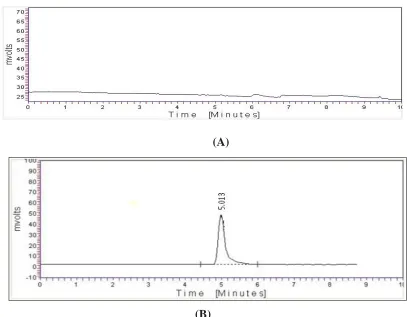
separation time. Using a reversed-phase C18 column, the retention times for lamotrigine was observed
to be 5.013 + 0.3 min. Total time of analysis was less than 7 min. The maximum absorption of lamotrigine
was detected at 225 nm, and this wavelength was chosen for the analysis Fig. 2.
(A)
(B)
System suitability
System suitability parameters such as number of theoretical plates, HETP and peak tailing are
determined. The results obtained are shown in Table 1. The number of theoretical plates for lamotrigine
was 3077.33.
Table 1 Results of system suitability parameters
Parameters Lamotrigine
AUC* 830.464
No. of Theoretical Plates* 3077.33 ± 21.00
Tailing Factor* 1.176
Retention time* 5.013
HETP* 0.252
Calibration range (μg/ml) 5-25 *Each value is the mean ± SD of six determinations
Linearity
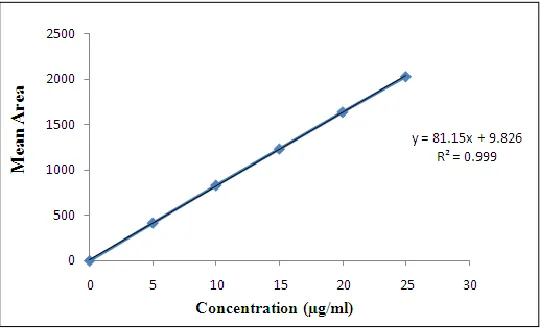
The calibration curve was linear over the concentration range of 5-25 μg/ml for lamotrigine Fig 3. The
linearity was represented by a linear regression equation as follows:
Y (lamotrigine) = 81.5conc. + 9.826 (r2 = 0.999)
Accuracy
Method accuracy was performed by adding known amounts of lamotrigine to the preanalysed synthetic
mixture solution and then comparing the added concentration with the found concentration. Three levels
of solutions were made which correspond to 80%, 100%, and 120% of the nominal analytical
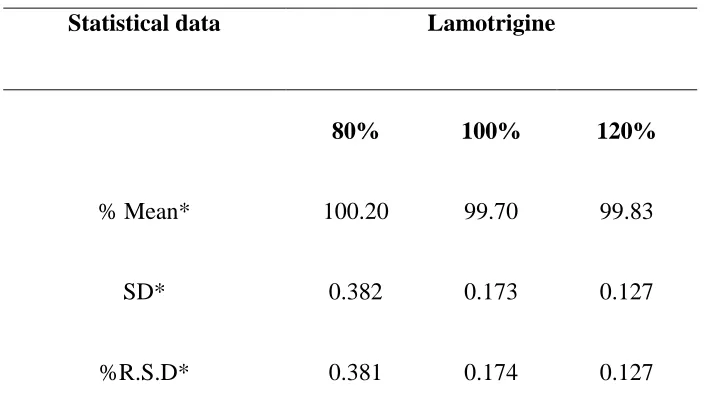
concentration (10μg/ml for lamotrigine). Each level was made in triplicate table 2. The mean percentage
recoveries obtained for lamotrigine was 100.20% and RSD was less than 2.
Table 2 Results of recovery study
Statistical data Lamotrigine
80% 100% 120%
% Mean* 100.20 99.70 99.83
SD* 0.382 0.173 0.127
%R.S.D* 0.381 0.174 0.127
*Mean of nine determinations (three replicates at three concentration level)
Precision
Repeatability
Five dilutions in three replicates were analyzed in the same day for repeatability and results were found
within acceptable limits (RSD < 2) as shown in table 3.
Intermediate precision
Five dilutions in three replicates were analyzed on two different days and by two analysts for day-to-day
and analyst-to-analyst variations, and results were found within acceptable limits (RSD < 2) as shown in
Table 3 Statistical data for precision
Statistical parameter Lamotrigine
Mean* S.D* R.S.D*
Repeatability 99.90 0.154 0.168
Intermediate Precision (I) (A day to day)
97.297 0.499 0.513
(II) Analyst to Analyst 99.98 0.145 0.148
Robustness 98.87 0.64 0.64
*Mean of 15 determinations (three replicates at five concentration level)
Robustness
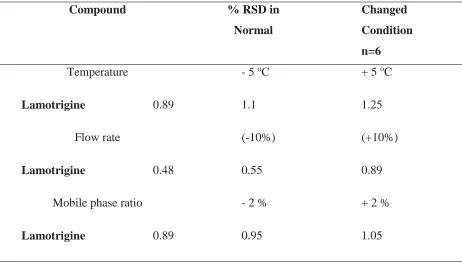
As per ICH norms, small, but deliberate variations in concentration of the mobile phase, temperature and
flow rate were made to check the method’s capacity to remain unaffected. The method is found robust
as RSD is again found < 2.0 table 4.
Table 4: Result of Robustness of Formulation
Compound % RSD in
Normal
Changed
Condition
n=6
Temperature - 5 oC + 5 oC
Lamotrigine 0.89 1.1 1.25
Flow rate (-10%) (+10%)
Lamotrigine 0.48 0.55 0.89
Mobile phase ratio - 2 % + 2 %
Analysis of Tablets
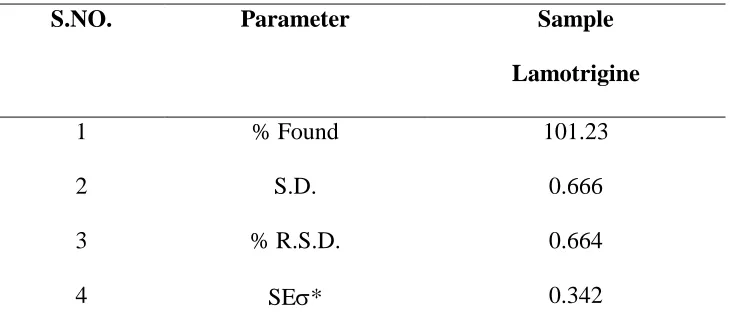
The concentration of lamotrigine in the tablet formulation was found to be 101%. The low values of %
RSD indicate that the method is precise and accurate in table 5.
Table 5 Results of tablet analysis
S.NO. Parameter Sample
Lamotrigine
1 % Found 101.23
2 S.D. 0.666
3 % R.S.D. 0.664
4 SE* 0.342
* Mean of nine determinations
Forced Degradation studies
In order to determine whether the method is stability indicating, forced degradation studies were
conducted on lamotrigine powder and the analysis was carried out by HPLC with a U.V. detector. 20µl
of each of forced degradation samples were injected at regular intervals Shown in Table 6.
Acid degradation
50 mg of lamotrigine sample was taken into a 50 ml round bottom flask, 50 ml of 0.1 M HCl solution
was added and contents were mixed well and kept for constant stirring for 8h at 80ºC. Samples were
withdrawn and diluted to get 10 µg/ml subjected to HPLC and calculate the percentage degradation using
calibration curve of lamotrigine.
Base degradation
50 mg of lamotrigine sample was taken into a 50 ml round bottom flask, 50 ml of 0.1 M NaOH solution
was added and contents were mixed well and kept for constant stirring for 8 h at 80ºC. Samples were
withdrawn and diluted to get 10µg/ml subjected to HPLC and calculate the percentage degradation using
Hydrolytic degradation
50 mg of lamotrigine sample was taken into a 50 ml round bottom flask, 50 ml of water was added and
the contents were mixed well and kept for constant stirring for 48 h at 80ºC. Samples were withdrawn
and diluted to get 10 µg/ml subjected to HPLC and calculate the percentage degradation using calibration
curve of lamotrigine.
Oxidative degradation
50 mg of lamotrigine sample was taken into a 50 ml round bottom flask, 50 ml of 3% hydrogen peroxide
solution was added, and contents were mixed well and kept for constant stirring for 24 hr at room
temperature. Samples were withdrawn and diluted to get 10 µg/ml subjected to HPLC and calculate the
percentage degradation using calibration curve of lamotrigine.
Thermal degradation
50 mg of lamotrigine sample was taken in to a petri dish and kept in oven at 50ºC for 4 weeks.
Photolytic degradation
The lamotrigine was exposed to sunlight during the daytime (70,000–80,000 lux) for 2 days.
Table 6 Forced degradation studies of lamotrigine
Stress conditions Drug recovered (%) Drug decomposed (%)
Standard drug 99.9 0
Acidic hydrolysis 86.45 13.55
Alkaline hydrolysis 92.12 7.88
Oxidative degradation 90.85 9.15
Thermal degradation 93.12 6.88
Conclusion
According to the ICH guidelines, the safety, quality, and/or efficacy of a drug substance is liable to
inadequate storage conditions. Therefore, the need for stability-indicating methods appears indispensable
to establish the stability and purity profiles of a drug substance. In this work, lamotrigine was exposed
to 7 different stress conditions among which considerable degradation occurred in acidic, basic, and
oxidative media. Lamotrigine appears more sensitive to acid degradation. The proposed HPLC method
was capable of quantifying low levels of lamotrigine and effectively resolving it from forced degradation
impurities. The developed HPLC assay was also applied to the analysis of tablets and the ensuing results
showed no statistically significance differences from those obtained by a reference method.
References
1. Bakshi M and Singh S. J .Pharm .Biomed .Anal. 2004; 24: 769-775.
2. Bakshi M, Singh B, Singh A and Singh S. J. Pharm. Biomed. Anal. 2001; 26(6): 891-897.
3. Bakshi M and Singh S. J. Pharm. Biomed. Anal. 2002; 28(6): 1011-1040.
4. Budavari S. The Merck index. An encyclopedia of chemicals. Drugs and Biologicals.13th edition.
New Jersey, U.S.A: Division of Merck and Co., Inc. Rahway. 2001.
5. Curia G, Biagini G, Perucca E and Avoli M. Lacosamide: a new approach to target voltage-gated
sodium currents in epileptic disorders. CNS Drugs. 2009; 23 (7): 555-558.
6. French JA, Kanner AM, Bautista J, et al. Efficacy and tolerability of the new antiepileptic drugs II:
Treatment of refractory epilepsy. Neurology. 2004; 62: 1261-1273.
7. Foye WO. Foye’s Principles of Medicinal Chemistry. Lippincott Williams & Wilkins, Philadelphia,
Pa, USA, 6th edition, 2007.
8. Dollery C. Therapeutic Drugs, Churchill Livingstone, London, UK, 2nd edition, 1999.
9. Sweetman SC. Martindale; The Complete Drug Reference, Pharmaceutical Press, London, UK,
36th edition, 2009.
10. The United States Pharmacopeia, 34th the National Formulary, 34th Revision, United States
Pharmacopeial Convention, Washington, DC, USA, 29th edition, 2010.
11. The British Pharmacopoeia, Her Majesty’s Stationary Office, London, UK, 2010.
12. Emami J, Ghassami N and Ahmadi F. Development and validation of a new HPLC method for
determination of lamotrigine and related compounds in tablet formulations. Journal of
13. Youssef NF and Taha EA. Development and validation of spectrophotometric, TLC and HPLC
methods for the determination of lamotrigine in presence of its impurity. Chemical and
Pharmaceutical Bulletin. 2007; 55(4): 541–545.
14. Sharma MC and Sharma S. Validated densitometric method for the quantification of lamotrigine in
dosage form. International Journal of PharmTech Research. 2011; 3(2): 1174–1178.
15. Martins MT, Paim CS and M Steppe. LC and UV methods for lamotrigine determination in
pharmaceutical formulation, Chromatography Research International, 2011; Article ID 860168.
16. El-Enany NM, El-Sherbiny DT, Abdelal AA and Belal FF. Validated spectrofluorimetric method
for the determination of lamotrigine in tablets and human plasma through derivatization with
o-phthalaldehyde, Journal of Fluorescence. 2010; 20 (2); 463–472.
17. Srinivasulu P, Mukkanti K, Reguri BR and Srinivas KSV. Development of a validated stability
indicating LC method for lamotrigine. Chromatographia. 2009; 70(1-2): 271–276.
18. ICH [Stability Testing of New Drug Substances and Products Q1A (R2)]. International Conference