Available Online at www.ijpret.com 79
INTERNATIONAL JOURNAL OF PURE AND
APPLIED RESEARCH IN ENGINEERING AND
TECHNOLOGY
A PATH FOR HORIZING YOUR INNOVATIVE WORK
A THEORETICAL EVALUATION OF EIGENVALUES AS A FUNCTION OF
APPLIED BIAS VOLTAGE OF TWO QDS WHEN THEY ARE TUNED INTO
EXACT RESONANCE WITH ONE ANOTHER
BHAV BHUTI NARAYAN MISHRA2, LALIT KUMAR MISHRA1
1. Department of Physics, Magadh University, Bodh-Gaya-824234(Bihar) 2. Lalita-Kalp-Latika, Anand Vihar colony, Mustafabad, Gaya-823001(Bihar)
Accepted Date: 05/10/2015; Published Date: 01/11/2015
\
Abstract: - Using the theoretical formalism of A. Lauchet etal (Phys. Rev 82B, 075305 (2010), we have theoretically studied a system consisti ng of two spatially separated self-assembled InGaAs quantum dots coupled to optical nano cavity mode. W e observe that due to their different size and compositional profiles, the two quantum dots exhibit markedly different DC Stark effects. We have theor eti cally evaluated the eigenvalues of two QDs as a function of applied bias voltage when they are tuned into exact resonance with one another. We have presented the evalua ted results of eigenvalues of (three branches of the double anticrossing of the two QDs) when they are detuned from the mode, λ0 (upper panel) λ1 (middle panel) λ2 (bottom panel). The evaluation has been perfor med with the help of equation (5). These results indicate the exact evolution of three branches as a function of Vapp. Our theoretical results indicate that eigenvalue is lowest in λ0 panel and largest in λ2 panel as a function of Vapp. Our theoretically evaluated results are in good agreement with the experimental data and also with other theoretical workers.
Keywords:Two semiconductor Quantum dots, Optical nano cavity, Cavity Quantum electrodynamics (CQED), Quantum optical non-linearties, Quantum confined Stark effects (QCSE), Photoluminescence (PL), Double dot-micropillar system, Double anti -crossing, Virtual photon emission, Excitonic transitions, Compositional profiles,
Electron and Hole wavefunctions , DC Stark effects, Exciton-photon coupling strength
.
Corresponding Author: MR. BHAV BHUTI NARAYAN MISHRA
Access Online On:
www.ijpret.com
How to Cite This Article:
Available Online at www.ijpret.com 80
INTRODUCTION
Quantum dots are extremely small semiconductor structures usually ranging from 2-10 nm (10-50 atoms) in diameter. At these small sizes materials behave differently giving quantum dots unprecedented tenability. These dots are semiconductor nanocrystals embedded in another semiconductor which presents a wide energy band gap between its valance and conduction states. This results in a three dimensional potential well that confine the carriers (electrons and holes) in the nano crystal. Here, the electron and hole motion is quantized in all the three spatial directions. This gives rise to discrete energy levels, each one accommodating up to two electrons and holes of opposite sign as in the case of single atoms. For this reason semiconductor quantum dots are often referred to as ‘artificial atoms’ that is a semiconductor analogue of a single atoms1,2. Quantum information science aims to explore the distinctive features of quantum physics especially superposition and entanglement, to enhance the functionality and power of information and communication technologies. It has been a progressing inter disciplinary field of research for last thirty years. It extends from the fundamental investigation of quantum phenomena to the experimental implementation of disruptive quantum-enabled technologies. In quantum information science, the information is encoded on a quantum bits consisting of any two level quantum system, its two states representing the degeits 0 and 1. Among quantum system, photons constitute a neutral choice for communications and metrology. This is a promising route for quantum simulation and computing. All these applications require ideally deterministic light source that can deliver on demand single photon, indistinguisble single photons or entangled photon pairs produced at high repetition rate. Several schemes have been established to produce such quantum states of light for example are attenuated lasers or non-linear optics. Presently, most experiments in quantum optics or photonic quantum information processing rely on non-linear optical sources. These sources allowing the preparation of time-beis3 or polarization4 entangled photons as well as heralded single photons5. Although down-conservation sources are still primarily employed due to high purity of the emitted quantum states of light, such sources suffer in particular from the probabilistic generation of photons combined with a trade-off between the repetition rate and the probability of emitting multiple photon pairs simultaneously.
Available Online at www.ijpret.com 81
quantum optics community14,15 . Much progress has been made with a number of spectacular demonstrations including efficient generation of non-classical light16, the observation and investigations of strong coupling phenomena17-23 and the possibilities to observe and exploit quantum optical non-linear ties24,25. These developments are all ingredients for the realization of solid state all-optical quantum networks, when quantum memory elements are coupled via single light quanta. Imamoglu etal.26 proposed that two spatially separated electron spins in QDs could be coherently coupled via a common optical cavity field. During last five years the strong coupling regime was reached for a single QDs and one observation was made with two dots coherently interacting with common cavity mode. This has provided a new way to entangle spatially separated quantum emitters via the electromagnetic quantum vacuum.
In an earlier paper27, we have theoretically evaluated the spectral function S(ω) of a system where two QDs are coherently coupled via an optical cavity mode. S(ω) were evaluated both as a function of applied bias voltage Vapp(V) and as a function of QDs energy(meV). Our
theoretically evaluated results are in good agreement with the other theoretical workers and also with the experimental data. We have also evaluated the temperature (K) for two mutually coupled QDs when they are resonance with the cavity mode as a function of wavelength (nm) for three values of magnetic field namely 5.5T, 5.75T and 5.9T. We observed that as the strength of magnetic field is reduced, each QD is coupled individually with cavity mode.
In this paper, we have evaluated the eigenvalues (probabilities) of three panels λ0 (upper panel)
λ1 (middle panel) λ2 (bottom panel) as a function of applied bias voltage Vapp. We have also
studied spectra in two cases (a) when obtained spectral signature could be due to two different single exciton transitions of the same quantum dot (b) by two different QDs one weakly and one strongly coupled to the cavity. Our obtained theoretical results are in good agreement with the other theoretical workers28,29.
MATERIALS AND METHODS
One extends the model for single QD exciton30 which includes two independently excitons coupled two independently excitons coupled to a common cavity mode
The Hamiltonian is written as
2
1
[ ( )]
2
n n n
n
z n c
n
H g a a a a
Available Online at www.ijpret.com 82
Where , n n
and n z
are the pseudo spin operators for the two level system consisting of
ground state 0 and a single exciton state Xn of the nth QD (n=1,2). n is exciton frequency, a+ and a are the creation and annihilation operators of photons in the cavity mode with frequency ωc and gn describes the strength of the dipole coupling between cavity mode and
exciton of the nth-QD. The incoherent loss and gain (pumping) of the dot cavity system is included in the master equation of the Lindblad form
[ , ] ( ) d i H dt (2) Where 2 1
( ) [ (2 )
2
n n n n n n
n n
(2 ) ( )
2 2
n n n n n n n n
n n
z z
P
(2 ) (2 )
2 2
c Pc
a a a a a a aa aa aa
(3)
Here n is the exciton decay rate, Pn is the rate at which excitons are created by a continuous
wave pump laser, n
is the pure dephasing rate of exciton in the nth-QD which accounts for
effects originating from high exciton powers or high temperatures, c is cavity loss, Pc is the incoherent pumping of the cavity31 and is the density matrix of the system
Assuming that most of the light escapes the system through the radiation pattern of the cavity and using the Wiener-Khintchine theorem, the spectral function is given by32
0
( ) lim Re exp[ ( r ) ] ( ) ( )
S t d i t a t a t
(4)
Available Online at www.ijpret.com 83
i t ( a
1 = 1 2 1 1 2 2 0 0 c g g
g g
( a
2 ) 1 2
) (5)
Where
c cic 6(a)
n nin 6(b)
( ) 2 c c c P 6(c) ( ) 2 c c n n P 6(d)
The exciton-phonon coupling strength g is calculated using the formula
1 2 2 2 2 ( ) [ ] 4 16 c n E
g
(7)
where ΔE is the minimum energy separation between the two modes.cand nare the cavity and exciton rates respectively. From the eigenstates of the emission eigen frequency, one obtains the degree of mixtures of each peaks in the spectrum i.e t he strength of the contributions of cavity mode, QD1 exciton and QD2 exciton to each individual eigen states. In this calculation, one puts the following data
Available Online at www.ijpret.com 84
g2 51eV
QD10.1eV
QD2 0.8eV
PQD11.5eV
PQD2 1.9eV
QD1 20 eV
QD2 9.8 eV
c 147eV
Pc 5.7eV (8)
Now in the case of study of optical properties of Quantum dot, the coupling strength between exciton-photon g is also calculated directly from the minimum energy splitting by similar type of formula as in equation (7)
1 2 2
2 2
( )
[ ]
4 16 c s
E
g
(9)
Where cand sare the cavity and exciton decay rate respectively. Now from the cavity Q, one can determine the cavity mode decay rate as
36.4 2
c
c GHz
Q
s 0.16GHz
One obtains the value of g1 and g2 as
g113.8GHz
Available Online at www.ijpret.com 85
where g1 and g2are the exciton-photon coupling strength of the state.
In the eigenvalues calculations, one has contributions from cavity modes, QD1 and QD2 to three different branches of the system λ0 (upper panel) λ1 (middle panel) λ2 (bottom panel). The
coupling occurs via a Raman type of transition. We have also obtained spectra assuming that the states QD1 and QD2 cannot coexist. This is the case for two different state of the same QD i.e exciton and charged exciton . In this case the spectral function is the sum of the spectra of two independent quantum states
S(ω)=S1(ω) + S2 (ω) (11)
This gives double peak close to the resonance.
RESULTS AND DISCUSSION
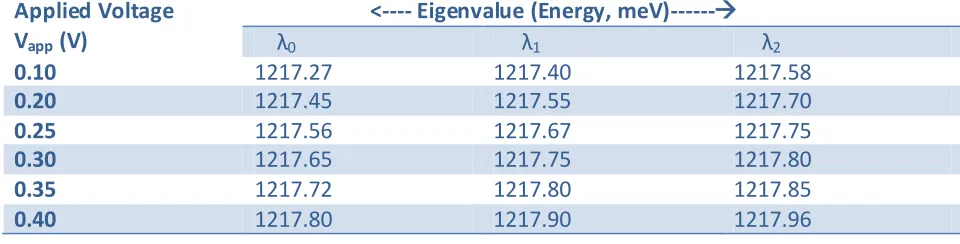
In this paper using the theoretical formulism of A. Laucht etal35, we have theoretically evaluated the eigenvalues of two QDs as a function of applied bias voltage when they are tuned into exact resonance with one another. In table T1, we have presented the evaluated results of eigenvalues of three branches of the double anticrossing of the two QDs when they are detuned from the mode, λ0 (upper panel) λ1 (middle panel) λ2 (bottom panel). The evaluation
has been performed with the help of equation (5). These results indicate the exact evolution of three branches as a function of Vapp. Our theoretical results indicate that eigenvalue is lowest in
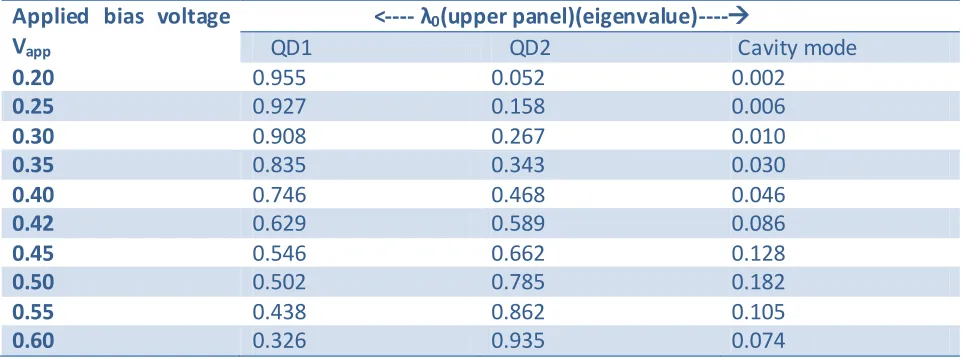
λ0 panel and largest in λ2 panel as a function of Vapp. In table T2, we have shown the theoretical
results of probability (eigenvalue) of normalized admixture of QD1, QD2 and cavi ty mode to the quantum states of the coupled system for upper panel λ0 as a function of Vapp (V). This is the
individual states for different detuning as a function of Vapp. Our theoretical results show that
the probability decreases in case of QD1 and increases for QD2. However for cavity mode probability is very small. Here QD1 state and cavity mode state have only weak contribution of QD2 close to resonance. In table T3, we repeated the same calculation for λ1 middle panel.
Here we observed that in this case probability is large for QD2 for small values of Vapp but
decreases up to 0.54V and then increases very fast. The probability of QD1 increases and have peak at 0.54V and then decreases. The probability of cavity mode is small in this case from 0 to 0.6V. The eigenvalue λ1 is a mixture of all three states for Vapp =0.43V and it becomes only like
QD1 for Vapp=0.48V after that it behaves only like QD2 for Vapp=0.6V. For large value of Vapp it
remains like QD2 since the system is strongly detuned. In table T4, we repeated the calculation for λ2 (bottom panel). Here cavity mode is large for small value of Vapp and then decreases up to
Available Online at www.ijpret.com 86
mode with QD2 and mixture of QD1 and QD2 for Vapp=0.58V. In table T5, we have shown the
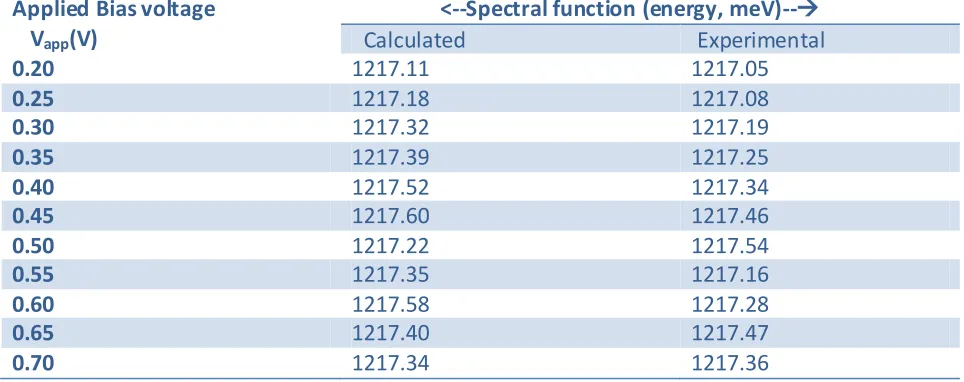
evaluated results of spectral function as a function of Vapp assuming that QD1 and QD2 cannot
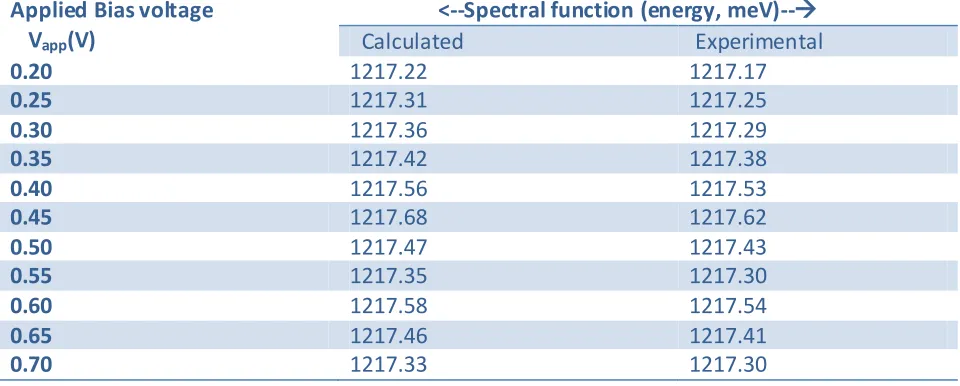
coexist at the same time. This is the two different states of same QD i.e. exciton and charged exciton. Calculated results were compared with the experimental data36. In table T6, we have shown the evaluated results of spectral function (energy meV) as a function of Vapp. Here we
have assumed that QD2 is only weakly coupled to the cavity mode with fixed value of g2
=32μV. Calculated results were compared with the experimental data36 and perfect agreement has been found37-43. There is some recent calculations44-55 which also reveals same type of behavior.
CONCLUSION
From the above theoretical analysis and investigations, we have come across the following conclusion
(1)In case of QDs tuning there is resonance with cavity mode the system is in state of coherent superposition for longer time. It has external very high mode Q-factors.
(2)In the investigation of observed spectral function two possibilities arise (a) two different single exciton transition to the same quantum dot. (b) two different QDs, one is weakly and other is strongly coupled to the cavity mode.
(3) In the case of QD2 weakly coupled to the cavity mode, no exciton- polaritons are found. Spectral functions are not affected by the cavity mode
Table T1 :An evaluated result of eigenvalue of the three branches of the double anticrossing of the two QDs when they are detuned from the mode, λ0 (upper panel) λ1 (middle panel) λ2
(bottom panel)
Applied Voltage Vapp (V)
<---- Eigenvalue (Energy, meV)---
λ0 λ1 λ2
0.10 1217.27 1217.40 1217.58
0.20 1217.45 1217.55 1217.70
0.25 1217.56 1217.67 1217.75
0.30 1217.65 1217.75 1217.80
0.35 1217.72 1217.80 1217.85
Available Online at www.ijpret.com 87
0.45 1217.85 1218.20 1218.37
0.50 1217.88 1218.32 1218.48
0.55 1217.90 1218.43 1218.62
0.60 1217.95 1218.54 1218.70
Table T2: An evaluated result of probability (eigenvalue) of normalized admixture of QD1, QD2 and cavity mode to the quantum state of the coupled system for upper panel λ0 as a
function of applied bias voltage Vapp(V). This is the individual states for different detuning as a
function of Vapp
Applied bias voltage Vapp
<---- λ0(upper panel)(eigenvalue)----
QD1 QD2 Cavity mode
0.20 0.955 0.052 0.002
0.25 0.927 0.158 0.006
0.30 0.908 0.267 0.010
0.35 0.835 0.343 0.030
0.40 0.746 0.468 0.046
0.42 0.629 0.589 0.086
0.45 0.546 0.662 0.128
0.50 0.502 0.785 0.182
0.55 0.438 0.862 0.105
0.60 0.326 0.935 0.074
Table T3: An evaluated result of probability (eigenvalue) of normalized admixture of QD1, QD2 and cavity mode to the quantum state of the coupled system for middle panel λ1 as a
function of applied bias voltage Vapp(V). This is the individual states for different detuning as a
function of Vapp
Applied bias voltage Vapp
<---- λ1(middle panel)(eigenvalue)----
QD1 QD2 Cavity mode
0.20 0.056 0.987 0.095
0.25 0.082 0.906 0.186
0.30 0.126 0.835 0.202
0.35 0.238 0.675 0.265
0.40 0.456 0.436 0.386
0.42 0.589 0.358 0.302
0.45 0.635 0.487 0.255
Available Online at www.ijpret.com 88
0.55 0.237 0.678 0.186
0.60 0.159 0.864 0.115
Table T4: An evaluated result of probability (eigenvalue) of normalized admixture of QD1, QD2 and cavity mode to the quantum state of the coupled system for bottom panel λ2 as a
function of applied bias voltage Vapp(V). This is the individual states for different detuning as a
function of Vapp
Applied bias voltage Vapp
<---- λ2 (bottom panel)(eigenvalue)----
QD1 QD2 Cavity mode
0.20 0.056 0.126 0.958
0.25 0.082 0.208 0.903
0.30 0.125 0.305 0.875
0.35 0.186 0.396 0.786
0.40 0.209 0.458 0.654
0.42 0.246 0.532 0.585
0.45 0.489 0.436 0.495
0.50 0.686 0.297 0.335
0.55 0.855 0.185 0.274
0.60 0.952 0.102 0.186
Table T5: An evaluated result of Spectral function (energy, meV) as a function of applied bias voltage Vapp (v) assuming that QD1 and QD2 cannot coexist at the same time We have
compared our theoretical results of spectral function with the experimental data36.
Applied Bias voltage Vapp(V)
<--Spectral function (energy, meV)--
Calculated Experimental
0.20 1217.11 1217.05
0.25 1217.18 1217.08
0.30 1217.32 1217.19
0.35 1217.39 1217.25
0.40 1217.52 1217.34
0.45 1217.60 1217.46
0.50 1217.22 1217.54
0.55 1217.35 1217.16
0.60 1217.58 1217.28
0.65 1217.40 1217.47
Available Online at www.ijpret.com 89
Table T6: An evaluated result of spectral function (energy, meV) as a function of applied bias
voltage Vapp (V) assuming that QD2 is only weakly coupled to the cavity mode with fixed g2
=32μV. We have compared our theoretical results of spectral function with the experimental data36.
Applied Bias voltage Vapp(V)
<--Spectral function (energy, meV)--
Calculated Experimental
0.20 1217.22 1217.17
0.25 1217.31 1217.25
0.30 1217.36 1217.29
0.35 1217.42 1217.38
0.40 1217.56 1217.53
0.45 1217.68 1217.62
0.50 1217.47 1217.43
0.55 1217.35 1217.30
0.60 1217.58 1217.54
0.65 1217.46 1217.41
0.70 1217.33 1217.30
REFERENCES:
1. B. Lounis, H. A. Bechtal, D. Gerion, P. Alivisatos and W. E. Moerner, Chem. Phys. Lett. 329, 399(2000)
2. P. Michler, A. Kiraz, C. Becher, W. V. Schoenfeld. E. Hu and A. Imamoglu, Science 290, 2282(2000)
3. J. Brendel, W. T.ttle, H. Zbinden and N. Gisin, Phys. Rev. Lett.(PRL) 82, 2594(1994)
4. P. G. Kwiat, K. Mattle, H. Weinfurther, A. Zeillinger and Y. Shih, Phys. Rev. Lett.(PRL) 75, 4337(1995)
5. S. Fasel, O. Alibart, S. Tanzilli, P. Baldi and H. Zbinden, Nrw J. Phys. 6,163(2004)
6. H. Kimble, M. Dagenais and L. Mandel, Phys. Rev. Lett.(PRL) 39, 691(1977)
7. P. Grangier, G. Roger and A. Aspect, Europhys. Lett. 1, 173(1986)
Available Online at www.ijpret.com 90
9. M. Keller, B. Lange, K. Hayasaka and H. Walter, Nature 431, 1075(2004)
10.T. Bashe, W. E. Moerner, M. Orrit and H. Talon, Phys. Rev. Lett.(PRL) 69, 1516(1992)
11.B. Lounis and W. E. Moerner, Nature 407, 491(2000)
12.C. Kurtsiefer, S. Mayer, P. Zorda and H. Weinfurther, Phys. Rev. Lett.(PRL) 85,290(2000)
13.A.Bereretos, R. Brouri, T. Gacoin and P. Grangier, Phys. Rev. A64, 061802(2001)
14.G. Khitrova, H. M. Gibbs, M. Kira, S. W. Koch and A. Scheir, Nat. Phys. 2, 81(2006)
15.A. Shields, Nature Photonics 1,215(2007)
16.C. Santori, D. Fattel, J. Vuckovic, G. S. Soloman and Y. Yamamoto, Nature 419, 594(2002)
17.J. P. Reithmaier, G. Sek, A. Loffier and A. Forchel, Nature 432, 197(2004)
18.T. Yoshie, A. Schirer, J. Hendrickson, O. B. Shehekin and D. G. Deppl, Nature 432, 200(2004)
19.E. Peer, P. Senellart, D. Martroce, J. Hown and J. Bloch, Phys. Rev. Lett.(PRL) 95, 067401(2005)
20.S. Reitzenetein, A. Loeffier, C. Hofman and A. Forchel, Opt. Lett. 31, 1738(2006)
21.A. Laucht, N. Hauke, J. M. Vills-Boas and J. J. Finley, Phys. Rev. Lett.(PRL)103, 087405(2009)
22.A. Laucht, M. Kaniber, A. Mohtashami, N. Hauke And J. J. Finley, Phys. Rev. B81, 241302(R)(2010)
23.H. Kim, D. Sridharan, T. C. Shen, G. S. Solomon and E. Waks, http//arxiv.org/abs/1101.0749 (2011)
24.D. Englund, A. Faraon, I. Fushman, N. Stoltz and J. Vuckovic, Nature 450, 857(2007)
25.D.Gerace, H. E. Tureci, A. Imamoglu and R. Fazio, Nature Physics 5, 281(2009)
26.A. Imamoglu, D. D. Awschalon, G. Burkard, D. Lose, M. Shirwin and A. Small, Phys. Rev. Lett.(PRL) 83, 4204(1999)
Available Online at www.ijpret.com 91
28.E. B. Flagy, A. Muller, S. V. Polyakov, A. Ling and G. S. Solomon, Phys. Rev. Lett. (PRL) 104, 137401(2010)
29.M. Winger, T. Volz, G. Tarel, S. Portolan, A. Badolato and V. Savona etal. Phys. Rev. Lett.(PRL) 103, 207403(2009)
30.M. O. Scully and M. S. Zubairy, Quantum Optics(Cambridge University Press, Cambridge, 1977)
31.J. H. Eberly and Wodkiewicz, J. Opt. Soc. Am. 67, 1252(1977)
32.H. J. Carmichael, R. J. Brecha, M. G. Raizen, H. J. Kimble and P. R. Rice, Phys. Rev. A40, 5516(1989)
33.A. Laucht, J. M. Villas-Boas, S. Stobbe, M. Kaniber and J. J. Finley, Phys. Rev. B82, 075305(2010)
34.Hyochul Kim, Deepak Sridharan, T. C. Shen , G. S. Soloman and E. Waks, Optics Express 19, 2589(2011)
35.A. Laucht, J. M. Villas-Boas, S. Stobbe, M. Kaniber and J. J. Finley, Phys. Rev. B82, 075305(2010)
36.A. Laucht, J. M. Villas-Boas, S. Stobbe, M. Kaniber and J. J. Finley, Phys. Rev. B81, 241302(R)(2010)
37.K. Hennessay, A. Badolato, M. Winger, D. Gerace and A. Imamoglu, Nature 445,896(2007)
38.M. Kaniber, A. Laucht, A. Neumann, J. M. Villas-Boas and J. J. Finley, Phys. Rev B77, 161303 (R)(2008)
39.M. H. Baier, A. Malko, E. Pelucchi, D. Y. Oberli and E. Kapon, Phys. Rev. B73,205321(2006)
40.B. Fain, I. Robert-Philip, A. Beveratos and J. C. Giard, Phys. Rev. Lett. (PRL) 108, 126808(2012)
41.A. Douse, A. Lemaltre, I. Sagnes, L. Lanco and P.Voisin, Phys. Rev. Lett(PRL) 103, 027401(2010)
Available Online at www.ijpret.com 92
43.M. Kaniber, A. Laucht, A. Neuman, J. M. Villas-Boas and J. J. Finley Phys. Rev. B78, 361303(2008)
44.S. Reitzenstein, S. Munch, P. Franeck, A. Loffer and T. L. Reinecke, Phys. Rev. B82, 121306(2010)
45.A. Reinhard, T. Volz, M. Winger, A. Bodolato and A. Imamoglu, Nat. Photon 6, 93(2012)
46.M. Munsch, N. S. Malik, E. Dupuy, A. Delga, J. Bleuse and J. Moerk, Phys. Rev. Lett.(PRL) 111, 239902(E)(2013)
47.Y-M He, Y. He, Y-J Wei, D. Wu and J-W Pan, Nat. Nanotechnol. 8,213(2013)
48.G. Juska, L. O. Mereni, A. Gocalinska and E. Pelucehi, Nat. Photon 7, 527(2013)
49.H. Jayakumar, A. Predojevic, T. Kauten, T. Huber and G. Weihs, Nat. Commun. 5, 4255(2014)
50.M. Muller, S. Bounonar, K. D. Jomes, M. Glan and P. Michler, Nat. Photon 8, 224(2014)
51.L. Monniello, A. Reigue, R. Hostein, R. Grousson and V. Voliots, Phys. Rev. B90, 041303(R)(2014)
52.A. K. Nowak, S. L. Portalupi, V. Giesz, I. Sagnen and P. Senellart, Nat. Commun. 5, 3240(2014)
53.G. Bulgarini, M. E.Reimer, M. B. Bavinck, K. D. Jones, D. Dalack and V. Zwiller, Nano Lett. 14, 4102(2014)
54.A. V. Tsukanov and I. Yu Kateiv, Rassian Microelectronics 44, 61(2015)