Available Online at www.ijpret.com 220
INTERNATIONAL JOURNAL OF PURE AND
APPLIED RESEARCH IN ENGINEERING AND
TECHNOLOGY
A PATH FOR HORIZING YOUR INNOVATIVE WORK
A NOVEL ALGORITHM FOR CRYPTOGRAPHIC KEY GENERATION BASED ON
SESSION AND STEGNOGRAPHY
MISS. VISHAKHA M. RAJURKAR1, DR. H R. DESHMUKH2
1. Student ME CSE, IBSS COE, Amravati, Maharashtra, India. 2. HOD CSE, IBSS COE, Amravati Maharashtra, India.
Accepted Date: 05/03/2015; Published Date: 01/05/2015
\
Abstract: Security is a crucial issue to be taken care while performing communication over
network. Securing the information means protecting it from unauthorized access. There are many methods in stegnography and cryptography that have been proposed for securing communication. Stegnography uses multimedia to deal with security but it has disadvantage that it increases the information size. The main objective of this study is to encrypt the information using a key that is generated from color image and the difference in the LSB of the image pixels. This key is used to encrypt and decrypt the messages that are exchanged between the sender and receiver. The length of the key varies according to the size of the message in the various sessions. This study proposes an algorithm for key generation using image features.
Keywords: Stegnography, Cryptography, Key, Session.
Corresponding Author: MISS. VISHAKHA M. RAJURKAR
Access Online On:
www.ijpret.com
How to Cite This Article:
Vishakha M. Rajurkar, IJPRET, 2015; Volume 3 (9): 220-225
Available Online at www.ijpret.com 221 INTRODUCTION
Now day’s computer networks are use to share resource and to exchange information. This computer network can be classified on the basis of protocol, topology and architecture. Widely known topologies are bus, ring, star, mesh and hybrid. We can also classify the network using architecture such as peer-to-peer and client-server. The cryptography is used to ensure the confidentiality and authenticity of the message that are exchange over the network. The encryption key must be long enough to protect it from cracking. But it is difficult to remember it and also storing key somewhere can be insecure. Many encryption algorithms have developed and many security mechanisms got proposed, but till today we are facing many problems related to security.
To overcome the security problems we can use another method called stegnography. Stegnography is a process of maintaining the secrecy of information by hiding the information in multimedia elements like image, video, animation etc. These elements can be stored in binary form. In our study we combine both cryptography and stegnography to greatly improve the security and also protect the information from the intruder.
Our study proposes a new algorithm to secure the communication between the sender and receiver. The algorithm uses a color RGB image and the difference in the LSB of the image pixels to generate the key that will be used in the encryption and decryption process. In our algorithm the length of key generated depends on the size of the message and the session type. The images in the database are considered for key generation according to various sessions. The proposed algorithm is simple to implement and use. In II section, we explained the existing work and methodology for key generation, encryption and decryption. We explained our proposed methodology in the section III. In section IV we concluded the paper.
2. LITERATURE REVIEW AND RELATED WORK
Available Online at www.ijpret.com 222
face features for key generation. Murli and Palraj [6], have proposed a new algorithm for generating True random numbers based on image which generates 256 bits key or higher for key exchange algorithm. Tanmay et al. [7], have developed a method for key generation based on sessions.
3. PROPOSED ALGORITHM
The objective of our study is to increase the security of the communication between sender and receiver. Our algorithm uses a color RGB image and the difference in the LSB of the image pixels to generate the key that will be used to encrypt the information that the sender wants to transmit over network. The color images are made of pixels which in turn are combinations of primary colors. A grayscale image has only one channel, but the RGB channel has three channels i.e. red, green and blue. In our algorithm we use any of these three channels.
Available Online at www.ijpret.com 223
Our algorithm is divided into five phases as shown in the table below
Phases Process
Phase 1 Database creation
Phase 2 Key generation
Phase 3 Encryption
Phase 4 Stego image creation
Phase 5 Decryption
Table 1: Phases in the algorithm
Phase 1: database creation
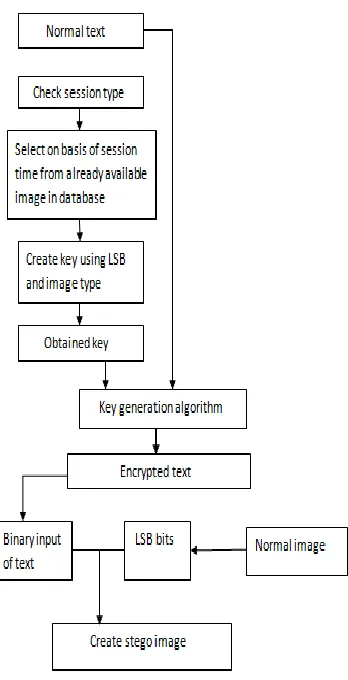
In this phase, a database of color RGB images is created. These images are then use in key generation process for encrypting/decrypting the information. The images in the database are used according to the session type. In case of hourly session, there are 24 images for 24 hours. In case of daily session, the database contains 7 images i.e. image per day. It is necessary that both sender and receiver must share common database of images.
Phase 2: key generation
A key is used to encrypt or decrypt the message. At the sender side, plain text is converted into cipher text using the key. At the receiver end, key is used to decipher the cipher text into plain text. Image is selected from the database on the basis of session (hourly or daily). Then the difference in the LSB of the image pixels is used to generate the secret key. This key is used by both the sender and receiver for encryption and decryption process respectively. The length of the key generated is not fixed and depends on the message size.
Phase 3: encryption
Encryption provides an extra layer of security over the sender-receiver communication. So we included encryption method to our proposed algorithm. The sender before embedding the message (plain text) into cover image encrypts the message using key generated in the above phase. It is necessary that both the sender and receiver use the same key for encryption and decryption.
Phase 4: creating stego image
Available Online at www.ijpret.com 224
Text is converted into the binary message. Then this binary message is store in the LSB of each image pixel one by one. The result of this merging is the stego image.
Phase 5: decryption
In this phase, the receiver decrypts the encrypted message with same key that was used for encryption. But before decrypting the message the receiver needs to extract the encrypted text from the stego image. After extracting the encrypted information, the receiver can then decrypt the information using the same key that was used to encrypt the message.
4. CONCLUSION
In this paper, we proposed a new algorithm that uses a color RGB image and the difference in the LSB of the image pixels to generate the key that will be used in the encryption and decryption process. This method makes changes to LSB of image pixels instead of MSB that makes job of intruder difficult. We also included encryption that provides an extra layer of security. The advantage of this algorithm is that the length of the key generated varies according to message length which in turn depends on session type. Moreover, one needs to know image database, color channel and session type to crack this algorithm.
5. REFERENCES
1. Birgit P tzmann, Information hiding terminology-results of an informal plenary meeting and additional proposals, Proc. of the First International Workshop on Information Hiding, vol. 1174, pp. 347-350. Springer, 1996.
2. Tawfiq S. Barhoom, Zakaria M. Abusilimiyeh, “A Novel Cryptography Method Based on Image for Key Generation”. Proceedings on the Palestinian International Conference on Information and Communication Technology, 2013-IEEE, pp: 71-76.
3. B. Santhi, K. S. Ravichandran, A. P. Arun and L. Chakkarapani, “A Novel Cryptographic Key Generation Method Using Image Features”. Proceedings on the Research Journal of Information Technology2nd International Conference on Adaptive Science & Technology, 2012, Pp: 88-92.
Available Online at www.ijpret.com 225
5. Lifang Wu, Xingsheng Liu, Songlong Yuan, Peng Xiao Tawfiq S. Barhoom, Zakaria M. Abusilimiyeh, “A Novel Key Generation Cryptosystem Based on Face Features”. Proceedings on ICSP, 2010-IEEE, Pp: 1675-1678.
6. P. Murali and R. Palraj, “True Random number generator method based on image for key exchange algorithm”, 2009 International Symposium on Computing, Communication and Control.
7. Tanmay, B., H. Sirshendu, M. Ayan and S.R. Bhadra Chaudhuri, 2011. A novel data encryption technique by genetic crossover of robust biometric key and session based password. Int. J. Network Secur. Appl. (IJNSA), 3(2): 111-120, DOI: 10.5121/ijnsa.2011.3209.