© Asian Journal of Pharmacology and Toxicology 2015 7 Received on: 27-12-2014
Accepted on: 30-12-2014 Published on: 25-02-2015
Corresponding Author
Priyona Roy Department of
Pharmacology,St. Joseph’s College of Pharmacy, Cherthala, Kerala, India Email: [email protected]
QR Code for Mobile users
CNS Activities of Hydroalcoholic Extract of Lawsonia
inermis Linn. Root
Priyona Roy*1, Thahimon P.A, Betty Carla, Aswathy C., Nancy Jose.
Department of Pharmacology,St. Joseph’s College of Pharmacy, Cherthala, Kerala, India
ABSTRACT
Lawsonia inermis L. (Lythraceae), popularly known as henna, is a small tree or shrub. Its root has been used in Philippian alternative medicine for hysteria and nervous disorders, but to our best knowledge no scientific study has been conducted on these activities. Therefore here an attempt is done to screen anxiolytic and antidepressant activity of hydroalcoholic extract of Lawsonia inermis L. root in albino mice. The extract, administered orally, was able to increase open arm exploration in elevated plus maze and increase nose poking rate in hole board test for anxiolytic activity.The same extract increase immobility time of mice subjected to forced swim test and tail suspension test for antidepressant activity. The screening test for antidepressant effect of the drug is not encouraging or negative. Therefore the data obtained from the study allows us to suggest
Lawsonia inermis root as an anxiolytic agent but not as an antidepressant. Preliminary phytochemical screening revealed the presence of carbohydrates, sterols, terpenoids, flavanoids, saponins and coumarins which are responsible for these pharmacological effects.
Keywords:Lawsonia inermis L., anxiety and depression
INTRODUCTION
The anxiolytics, antipsychotic, mood-stabilizing, and antidepressant agents are medications, intended to sedate, stimulate or modifying mood, thinking or behaviour, have a remarkable impact on psychiatric practice. The availability and use of these medications has grown since the late 1950s.Over 50% of adult
population will experience some type of
psychological disorder at some point in their life. Some degree of these disorders are part of normal life. Treatment is needed when it disproportionate to the situation and become excessive.The proposed study was aimed on anxiety and mood disorders.One of the main reasons behind these disorders is fluctuation of central neurotransmitters like GABA, glycine, norepinephrine, dopamine and serotonin. Drugs used for the treatment of psychiatric disorders act on these neurotransmitter receptors and produce desirable effect. Currently, most widely prescribed anxiolytics are benzodiazepines and antidepressants are MAO & serotonin inhibitors. However these modern medicine have some side effects. Ataxia, confusion, motor and cognitive impairment are the main side effect associated with benzodiazepines.
Antidepressant produce side effects like
gastrointestinal distress, insomnia, headache etc. Plant medicines are advantageous as being safer and less damaging to the human body than the synthetic drugs. Therefore the development of natural remedies with less side effects become acceptable. In Philippian traditional medicine root of Lawsonia
inermis L. (Lythraceae), popularly known as henna, administered orally for the treatment of hysteria and
other CNS disorders.Some activities like
abortifacient1 and anticancer 2 of root of L. inermis were already reported. But there is no scientific report for its CNS effects. So the present study was undertaken to investigate whether the administration of hydroalcoholic extract from root of Lawsonia
inermis L. produce behavioural modification in mice. Anxiolytic were assessed in the elevated plus maze & hole board test. Antidepressant effects were assessed by forced swim test and tail suspension test.
MATERIALS AND METHODS Plant materials
Preparation of 80% ethanolic extract of Lawsonia inermis root.
The collected roots were washed with water, cut into small pieces and dried under the shade. The dried plant material was milled to a fine powder using the commercial laboratory blender. The dried powder was extracted in a Soxhlet extractor with hydroethanol (80:20%).The extraction was continued for 72 hour or until the solvent in the thimble was cleared. Air dried the extract and was then stored in a desiccator & used for further investigations. The percentage yield was 4.7%
Preliminary phytochemical screening
Drugs and chemicals
Diazepam (Roche laboratories), Imipramine
(Novartis Ltd.) were used as standard drugs for anxiolytic and antidepressant activity respectively. Hydroalcoholic extract of L. inermis 200 & 400 mg/kg was suspended in 2% tween 80 .The standard drugs were dispersed in distilled water containing vehicle( 2% tween 80). All drugs were given orally in a volume of l ml /100g body weight of mice using an oral feeding tube. Fresh drug solutions were prepared on each day of the experiment.
Experimental animals & exposure conditions
The animal albino Wistar mice were purchased from Animal house, Gov. Veterinary College Mannuthy. The animals were fed with rat feed and water ad libitum. They were housed in clean poly propylene cages, under identical conditions of food, water and temperature. Male and female animals were kept in separate cages. They were exposed to 12 hours, light-dark cycle and the relative humidity was in the range of 61-76% and temperature range was 15-250C. All procedures were performed according to CPCSEA
guidelines after proper approval from the
Institutional Animal Ethics Committee (IAEC, proposal no. SJCP/IAEC/04/2014), St. Joseph’s College of Pharmacy, Cherthala.
Selection of dose of the extract
Dose of the extract was selected byacute oral toxicity
studies. Manjula et al; (2012) and other
researchers/literatures already reported that alcoholic extract of root was nontoxic up to dose 2000 mg/kg body weight and extract did not produce any mortality.5 Hence, 1/10th (200mg/kg) and 1/5th (400mg/kg) of this dose were selected for further studies.
Behavioural paradigms Anxiolytic activity Elevated plus maze test
The test has been proposed for selective identification of anxiolytic and anxiogenic drugs. Anxiolytic compounds, by decreasing anxiety, increase the open arm exploration time; anxiogenic compounds have the opposite effect. The apparatus consist of two open arms (16 x 5 cm for mice and 50 x 10 cm for rats), two closed arms (16 x 5 x 12 cm for mice and 50 x 10 x 40 cm for rats), and an open roof with the entire maze elevated (25 cm for mice and 50 cm for rats) from the floor.
Procedure:
Albino mice (20-25 gm) were taken and divided into four groups, each group comprised of 6 animals. Animals were fasted 18 h prior to the experiment.
Group I - control and was given vehicle (2% tween 80), p.o, Group II- standard and was given standard drug diazepam (2mg/kg, orally), dispersed in distilled water containing vehicle. Group III & ІV - test groups and were given L. inermis extract 200 and 400mg/kg, p. o respectively. Prior and after 60 minutes of drug administration the animals were placed individually in the centre of the maze, head facing towards open arms and the stop watch was
started and following parameters were notedfor 5 min. a) First preference of mice to open and closed arm, b) Number of entries in open and closed arms (an arm entry defined as the entry of fourpaws into the arm) c) Average time each animal spends in each arm. During the entire experiment, the animals were allowed to socialize. Every precaution was taken to ensure that no external stimuli could invoke anxiety in the animals.
Hole board test
It was proposed for the evaluation of curiosity. Number of nose poking into holes is considered as evaluating parameter.The hole-board has a sizeof 40 × 40 cm. Sixteen holes with a diameter of 3 cmeach are distributed evenly on the floor. The board iselevated to the height 25 cm, so that the mouse poking its nose into the hole does not see the bottom.
Procedure
Albino mice of weight between18 and 22 g are used.Animals were divided into four (I-ІV) groups, each group comprised of 6 animals. Group I - a negative control and was given vehicle (2% tween 80), p.o. Group II- positive control and was treated with standard drug, diazepam (2mg/kg, orally), dispersed in distilled water containing vehicle. Group
III & ІV - test groups and were given L. inermis 200 and 400 mg/kg respectively. At the start of the test, mouse was placed in the edge of the board. The number of nose poking into the holes during a 5 minutes period is taken as the measurement. It was measured by visual observation prior and 60, 120 and 180 minutes after drug administration. 6-11
Antidepressant activity Forced swim test
Behavioural despair was proposed as a model to test for antidepressant activity. It was suggested that mice or rats forced to swim in a restricted space from which they cannot escape. Then they produced to a characteristic behaviour of immobility. This behaviour reflects a state of despair which can be reduced by several agents which are therapeutically effective in human depression. A vertical Plexiglas cylinder (height: 40 cm; diameter: 18 cm, containing 15 cm of water maintained at 25 °C) was used as apparatus.
Procedure
Asian Journal of Pharmacology and Toxicology 2015
where the mice remain immobile for approximately 80% of the time. After swimming session the mice were removed and allowed to dry in a heated enclosure (32 °C) before being returned to their home cages. They are again placed in the cylinder 24 h later and the total duration of immobility is measured during a 5 minutes test. An animal is judged to be immobile whenever it remains floating passively in the water in a slightly hunched but upright position, its nose just above the surface.
Tail suspension test
The “tail suspension test” has been described as a facile means of evaluating potential antidepressants.
Procedure
Male albino mice weighing 20–25 g are used preferentially. Animals were divided into four groups, each group comprised of six animals. Group I – Control, received 2% tween 80, p. o Group II – Standard group, was treated with Imipramine 15mg/kg, p. o ,Group IІІ & IV – received L. inermis 200 & 400 mg/ kg, p. o, respectively. Animals were transported from the housing room to the testing area in their own cages and allowed to adapt to the new environment for 1hourbefore testing. For this test the mice were suspended on the edge of a shelf 58 cm above a table top by adhesive tape placed approximately 1 cm from the tip of the tail. The duration of immobility is recorded prior and after 60,120 & 180 minutes for a period of 5 minutes. Mice are considered immobile when they hang passively and completely motionless for at least 1 minutes.12-19 Statistical evaluation
The results were expressed as mean ± SEM. Statistical analyses of all the data obtained were evaluated using one-way ANOVA followed by Dunnett’s post –hoc multiple comparison test with SPSS Program ;Version 20. All the results were also expressed as graph by Graph Pad Prism software (V.5). P values < 0.05 were considered as statistically significant.
RESULTS
Phytochemical screening of plant extract
The preliminary phytochemical studies of extract revealed the presence of carbohydrate, steroids, terpenoids, flavanoids, saponins, tannins &
coumarins and absence of alkaloids. The obtained results were shown in table 1.
Table1: Preliminary phytochemical screening of L. inermis
CONSTITUENTS RESULT
Alkaloid -
Carbohydrate +
Sterols & terpenoids +
Cardiac Glycosides -
Flavanoids +
Saponins +
tannins +
Key: + (positive) means Present, - (negative) means absent
Elevated plus maze test
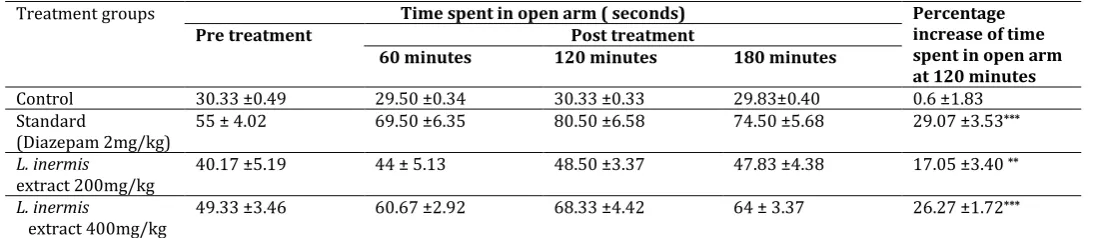
The open arm exploration effect of extract and diazepam were analysed by Dunnett‘t’ test. The results showed maximum effect at 120 minutes. So the statistical evaluation were done by using this data. The standard drug diazepam and L. inermis root extract 400 mg/kg significantly increased (P<0.001) percentage of time spent in open arm and these drugs significantly decreased (P<0.001) percentage of time spent in closed arm when compared to control. L.
inermis extract 200mg/kg was also significantly increased (P<0.01) percentage time spent in open arm and significantly decreased (P<0.01) these parameter in closed arm when compared to control. These results were shown in table 2 & 3.
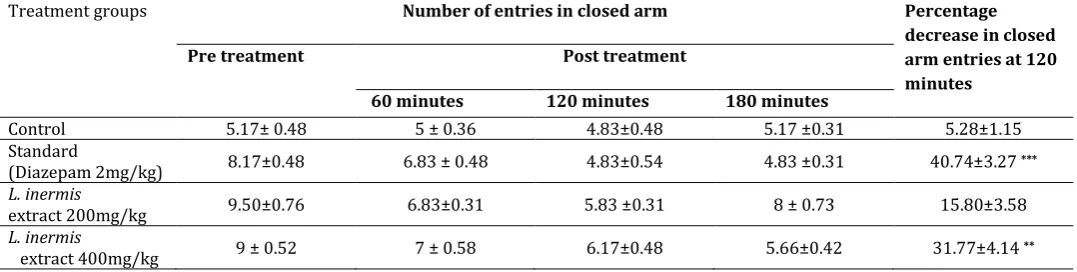
The effect of extract and diazepam on percentage of entries in arms were shown in table 4 & 5.The results showed that diazepam and 400 mg/kg extract increased the percentage of open arm entries significantly at P<0.001 and P<0.01 respectively and these significantly decreased the percentage of closed arm entries significantly at P< 0.001 and P<0.05 respectively. L. inermis 200 mg/kg significantly decreased (P<0.5) percentage of open arm entries but it didn’t show any significant change in percentage of closed arm entries.From these two results we can say that L.inermis (200 & 400 mg/kg) have open arm exploratory activity.
Treatment groups Time spent in open arm ( seconds) Percentage
increase of time spent in open arm at 120 minutes
Pre treatment Post treatment
60 minutes 120 minutes 180 minutes
Control 30.33 ±0.49 29.50 ±0.34 30.33 ±0.33 29.83±0.40 0.6 ±1.83
Standard
(Diazepam 2mg/kg)
55 ± 4.02 69.50 ±6.35 80.50 ±6.58 74.50 ±5.68 29.07 ±3.53***
L. inermis
extract 200mg/kg
40.17 ±5.19 44 ± 5.13 48.50 ±3.37 47.83 ±4.38 17.05 ±3.40 **
L. inermis
extract 400mg/kg
49.33 ±3.46 60.67 ±2.92 68.33 ±4.42 64 ± 3.37 26.27 ±1.72***
Table 2: Effect of hydro alcoholic extract of Lawsonia inermis root (200 & 400 mg/kg, p. o) and diazepam (2mg/kg) on time spent in open arm in elevated plus maze
Treatment groups Time spent in closed arm ( seconds) Percentage decrease of time spent in closed arm at 120 minutes
Pre treatment Post treatment
60 minutes 120 minutes 180 minutes
Control 95.17 ±4.01 94.33 ±3.58 94.50 ±3.25 95.50 ±3.35 0.53 ± 0.86
Standard
(Diazepam 2mg/kg) 95.67 ±1.91 83.83 ±1.58 76.17 ±2.0 81.83 ±5.33 20.20 ±2.06***
L. inermis
extract 200mg/kg 79.17 ±3.08 75.17 ±1.64 71.17 ±2.06 74.67 ±2.53 7.80 ±0.87**
L. inermis
extract 400mg/kg 100.67 ±1.15 94.17 ±2.04 88 ±1.57 87.17±3.29 12.59 ±0.96*** Table 3: Effect of hydro alcoholic extract of Lawsonia inermis root (200 & 400 mg/kg, p. o) and diazepam (2mg/kg) on time spent in closed arm in elevated plus maze.
All values are expressed as mean ± SEM, n=6, using one- way ANOVA followed by Dunnett ‘t’ test.*P< 0.05, ** P< 0.01, *** P< 0.001 – compared to normal control group
Treatment groups Number of entries in open arm Percentage
increase in open arm entries at 120 minutes
Pre treatment Post treatment
60 minutes 120 minutes 180 minutes
Control 3.67 ±0.33 4.17 ±0.31 3.83 ±0.31 3.5 ±0.22 3.33 ± 4.26
Standard
(Diazepam 2mg/kg) 2.83 ± 0.40 4 ± 0.52 8.67 ± 0.33 4.67 ±0.33 67.87 ± 3.50 ***
L. inermis
extract 200mg/kg 2.50 ± 0.43 3.33 ± 0.42 4.83 ± 0.48 3.33 ± 0.56 38.36 ± 4.17 *
L. inermis
extract 400mg/kg 2.17 ± 0.48 2.50 ± 0.56 4.17 ± 0.54 2.83 ± 0.31 49.45 ± 3.81** Table 4: Effect of hydro alcoholic extract of Lawsonia inermis root (200 & 400 mg/kg, p. o and diazepam (2mg/kg, p. o) on open arm entries in elevated plus maze
All values are expressed as mean ± SEM, n=6, using one- way ANOVA followed by Dunnett ‘t’ test.*P< 0.05, ** P< 0.01, *** P< 0.001 – compared to normal control group
Treatment groups Number of entries in closed arm Percentage
decrease in closed arm entries at 120 minutes
Pre treatment Post treatment
60 minutes 120 minutes 180 minutes
Control 5.17± 0.48 5 ± 0.36 4.83±0.48 5.17 ±0.31 5.28±1.15
Standard
(Diazepam 2mg/kg) 8.17±0.48 6.83 ± 0.48 4.83±0.54 4.83 ±0.31 40.74±3.27 ***
L. inermis
extract 200mg/kg 9.50±0.76 6.83±0.31 5.83 ±0.31 8 ± 0.73 15.80±3.58
L. inermis
extract 400mg/kg 9 ± 0.52 7 ± 0.58 6.17±0.48 5.66±0.42 31.77±4.14 ** Table 5: Effect of hydro alcoholic extract of Lawsonia inermis root (200 & 400 mg/kg, p. o) and diazepam (2mg/kg, p. o) on closed arm entries in elevated plus maze
All values are expressed as mean ± SEM, n=6, using one- way ANOVA followed by Dunnett ‘t’ test.*P< 0.05, ** P< 0.01, *** P< 0.001 – compared to normal control group.
Treatment groups Number of nose poking
Pre treatment Post treatment
60 minutes 120 minutes 180 minutes
Control 10.50 ± 1 11.50 ± 0.67 11.83 ± 0.79 10.83 ± 1
Standard
(Diazepam 2mg/kg)
12 ± 1.06 23.67± 1.84 32.83 ± 1.67 *** 1. 2.22
L. inermis
extract 200mg/kg
9.83 ± 0.79 18.17 ± 1.14 18.17 ±4.19 * 17.67 ± 4.17
L. inermis
extract 400mg/kg
11.83 ± 1.0 20.83 ± 1.78 27.83 ± 2.06 *** 25.33 1.43
Table 6: Effect of hydro alcoholic extract of Lawsonia inermis L. root (200 & 400 mg/kg, p. o) and diazepam (1mg/kg, p. o) on nose poking behaviour
Asian Journal of Pharmacology and Toxicology 2015
Treatment groups Duration of immobility ( seconds)
Pre treatment Post treatment
60 minutes 120 minutes 180 minutes
Control 85 ± 1.73 84.50 ± 1.92 83.67 ± 1.52 85.50 2.05
Standard
(Imipramine 15mg/kg) 89.50 ± 1.23 65.17±1.97 49.33±0.67 48.83 1.0 ***
L. inermis
extract 200mg/kg 83.50 ± 2.14 93.17 ± 2.07 98.17 ± 2.18 2.52
L. inermis
extract 400mg/kg 85.50 ± 5.69 102.33 ± 7.78 107.83 ± 7.91 113.00 ± 4.10 *
Table 7: Effect of hydro alcoholic extract of Lawsonia inermis root (200 & 400 mg/kg, p. o) and Imipramine (15mg/kg, p. o) on immobility time in forced swim test.
All values are expressed as mean ± SEM,n=6, using one- way ANOVA followed by Dunnett ‘t’ test.*P< 0.05, ** P< 0.01, *** P< 0.001 – compared to normal control
Treatment groups Duration of immobility ( seconds)
Pre treatment Post treatment
60 minutes 120 minutes 180 minutes
Control 67.50 ± 3.04 67.50 ± 2.75 68.16 ± 2.81 66.83 ± 2.79
Standard
(Imipramine 15mg/kg)
85.83 ± 3.50 52.83 ± 2.98 45.50 ± 2.84 42.17 ± 3.28***
L. inermis
extract 200mg/kg
50.83 ± 1.17 65.67 ± 2.18 69.33 ± 3.95 69.00 ± 4.31
L. inermis
extract 400mg/kg
67.33 ± 1.96 80.83 ± 4.96 85.33 ± 4.26 93.33 ± 4.67 **
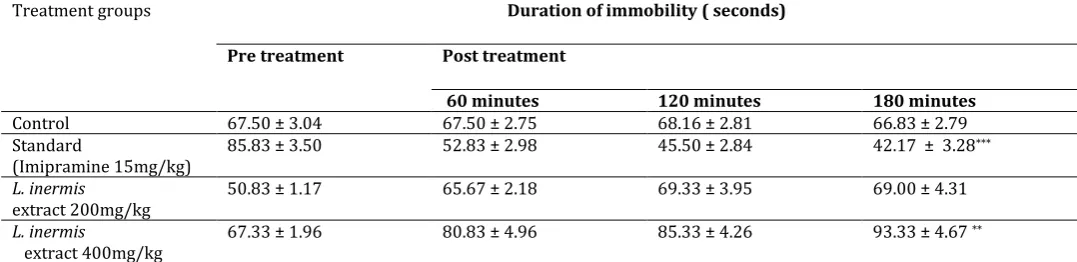
Table 8: Effect of hydro alcoholic extract of Lawsonia inermis L. root (200 & 400 mg/kg, p. o) and Imipramine (15mg/kg) on immobility time in tail suspension test
All values are expressed as mean ± SEM for six animals in each group using one- way ANOVA followed by Dunnett ‘t’ test.*P< 0.05, ** P< 0.01, *** P< 0.001 – compared to normal control93.33 ± 4.67
Hole board test
The effect of L. inermis (200 & 400mg/kg) and diazepam (2mg/kg) on nose poking behaviour in hole board test with mice is shown in table 6. This data shows a maximum effect at 120 minutes. So the statistics were done using data at 120 minutes. Diazepam (2mg/kg) and L. inermis 400 mg/kg treated groups showed increase in nose poking rate significantly at P<0.001, but L. inermis 200 mg/kg significantly increase this behaviour at P< 0.05 when compared to nose poking rate of normal control group.
Despair swim test
The results showed a maximum effect at 180 minutes. So the statistical evaluation was done by using this data. The animals treated with standard drug (Imipramine 15 mg/kg) showed significant (P<0.001) decrease in immobility time while the animals treated with L .inermis 400 mg/kg significantly increased (P<0.05) the immobility time when compared to control group. There were no significant difference between L. inermis 200mg/kg treated group’s and control group’s immobility time. The results are shown in table 7.
Tail suspension test
The effect of extract on immobility time in tail suspension test was shown in table 8.This showed a maximum effect at 180 minutes. So the further evaluation was done using the data at 180 minutes. The animals treated with standard drug (Imipramine 15 mg/kg) decreased immobility time significantly at P< 0.001.While the animals treated with L. inermis
400mg/kg significantly increased (P<0.01) immobility time. There were no significant difference between L. inermis 200mg/kg treated group’s and control group’s immobility time.
DISCUSSION AND CONCLUSION
Here two main CNS activities were evaluated, anxiolytic and antidepressant activities of hydroalcoholic extract of Lawsonia inermis root. In this work anxiolytic effects were screened by elevated plus maze test and hole board test.
Elevated plus maze test is a widely used animal model for testing anxiolytic activity. The notable parameters in this test are percentage of time spent in open & closed arm and percentage number of entries in these two arms. Anxiolytics increase percentage time spent and percentage number of entries in open arm while the anxiogenic decrease these parameters. The results of the present work demonstrate that L. inermis root extract (200 & 400 mg /kg, p.o) exhibited anxiolytic effect similar to that of reference drug diazepam 2mg/kg, p.o.L.inermis extract 400 mg /kg significantly increased percentage time spent & entries into open arm and it significantly decreased these parameters in closed arm while L. inermis extract 200 mg/kg doesn’t significantly decreased the percentage entries in closed arm. The results showed that more anxiolytic activity is produced by L. inermis extract 400 mg/kg.
inermis extract 200 & 400mg/kg significantly increase nose poking behaviour and these effects were similar to mice treated with reference drug diazepam1mg/kg. L. inermis extract 400mg/kg showed higher significant effect than L. inermis extract 200 mg/kg. This may be indicated that higher dose of L. inermis extract produce more anxiolytic effect.
In this study the antidepressant activity of L. inermis was evaluated by forced swim test and tail suspension test where duration of immobility is considered as screening parameter. Antidepressants decreased this parameter. Here immobility of extract and reference drug compared with control group’s effect. Results indicated that the immobility time of extract treated rats is increased significantly with increase in dose (400 mg/kg). There were no significant difference between L. inermis extract 200mg/kg treated group’s and control group’s immobility time. Based on these result we can say tha
t
L. inermis extract has no antidepressant activity at 200 & 400 mg/kg and it produce mild CNS depression at 400mg/kg.Many researchers suggest that the plants containing flavanoids, saponins, tannins, steroids, triterpenes and monoterpenes have pharmacological activities in CNS. They reported that saponins and flavanoids possess anxiolytic activity. Triterpenoids and monoterpenoids produce sedative properties.20-23The phytochemical screening of present study reports the presence of these constituents. These findings raised the possibility that the CNS effect of the extract may be exerted by the phytoconstituents present in the tested plant extract.
The result of the study indicated that L. inermis extract has anxiolytic activity but no antidepressant activity. These activities are in a dose dependent manner. It is well known that most of the antianxiety drugs like benzodiazepines are mild CNS depressants or it produce sedation as side effect. So it is suggested that CNS activity of L. inermis may be similar to that of benzodiazepines which targets GABAA receptors. The CNS depressant effect of extract is not confirmed because in hole board test and elevated plus maze test the extract didn’t show any change in locomotion. Therefore further studies using other behavioural measures such as pentobarbital induced sleeping test and rota rod test are needed to confirm its depressant effect.
Data obtained from various studies allows us to propose Lawsonia inermis L. root as anxiolytic agent and this validates its use in Ayurvedic & Philippians traditional medicine. The screening test for antidepressant effect of the drug is not encouraging or negative. The results are similar to anxiolytic activity with mild CNS depressant properties of various antianxiety agents like benzodiazepines. Further studies on Lawsonia inermis’s other extracts and its isolation will help us to identify the possible phytochemicals involved, and to establish a clear mode of action for the effects produced. The present
study revealed the basis of some traditional uses of the drug and ithelpsthe scientific people who search for nature remedies.
ACKNOWLEDGEMENT
We are thankful to management of St. Joseph’s College of Pharmacy, Cherthala for providing necessary facilities
REFERENCES
1. Rani S, R Manavalan and D Kilimozhi. Anti-ovulatory and abortifacient Potential of the ethanolic extract of henna roots in Rats, Research J. Pharmacology and Pharmacodynamics 2009; 1(1):18-20
2. PriyaS. Ilavenil, Kaleeswaran B, Srigopalram S, Ravikumar S. Effect of Lawsonia inermis on tumor expression induced by Dalton’s lymphoma ascites in Swiss albino mice Saudi J Biol Sci. 2011;18(4): 353–359 3. Trease GE, Evans WC. Phytochemical screening; A
Textbook of Pharmacognosy. 15thed. London: Bailiere Tindal Limited; 1989.p.191, 223, 336.
4. Kokate CK, Purohit AP, Gokhale SB. Text book of Pharmacognosy 33rd ed. Pune Nirali Prakashan pub.; 2007. P. 537-539.
5. Ravishah S, Manjula SN, Mruthunjaya K, Krishnanand et al., Hepatoprotective activity of roots of Lawsonia inermis against paracetamol and anti-tubercular drugs induced hepatotoxicity in rats. Int. J Pharm. 2012; 2(2): 306-316.
6. Gerhard Vogel H. Drug discovery and evaluation, Pharmacological assays, 2nd revised ed., New York: Springer-Verlag Berlin Hiedelberg; 1997;P. 393,434. 7. Xiu-Yan Wei a, Jing-Yu Yang a, Jin-Hui Wang b, Chun-Fu
Wu .Chlorogenic acid, a polyphenol from Prunus domestica (Mirabelle), with coupled anxiolytic and antioxidant effects. J of Neurological Sciences 2007; 262 ;77–84
8. Jeong-Hill Park, Hwa-Young Chab, Jeong- JuSeob, Jin-Tae Hongb, Kun Hanb, Ki-Wan Oh. Anxiolytic-like effects of ginseng in the elevated plus-maze model: Comparison of red ginseng and sun ginseng. Progress in Neuro-Psychopharmacology & Biological Psychiatry 2005; 29; 895 – 900.
9. Si Wei Chen , Wen Juan Wang , Wei Jing Li, Rui Wang, Yu Lei Li, Yan Ni Huang, Xin Liang. Anxiolytic-like effect of Asiaticoside in mice. Pharmacology, Biochemistry and Behaviour 2006; 85;339–344.
10. Huishan Han, Yuan Ma , Jae Soon Eun , Ri Hua Li , Jin-Tae Hong , Myung-Koo Lee, Ki-Wan Oh . Anxiolytic-like effects of sanjoinine A isolated from Zizyphi Spinosi Semen: Possible involvement of GABAergic transmission Pharmacology, Biochemistry and behaviour 2009; 92;206–213
11. Xiu-Yan Wei, Jing-Yu Yang , Jin-Hui Wang , Chun-Fu Wu. Anxiolytic effect of saponins from Panax quinquefolium in mice. Journal of Ethnopharmacology 2007; 111;613– 618.
12. Gerhard Vogel H. Drug discovery and evaluation, Pharmacological assays, 2nd revised ed., New York: Springer-Verlag Berlin Hiedelberg; 1997; 557-566. 13. Pawar Vinod , Anup Akhade, Shrikrishna Baokar,
Shivakumar .H3 Antidepressant-like effects of Acorus calamus in forced swimming and tail suspension test in mice Asian Pacific Journal of Tropical Biomedicine 2012; S17-S19.
14. Vimal Kant Sharma, Nagendra Singh Chauhan, Santram Lodhi, A.K. Singhai. Anti-depressant activity of Zizyphus xylopyrus. Int J of Phytomedicine 2009; 12
15. Parvathi M, and Ravishankar K. Evaluation of Antidepressant, Motor Coordination and Locomotor Activities of Ethanolic Root Extract of Clitoria ternatea .J of Natural Remedies 2013;13 (1); 20-23
Asian Journal of Pharmacology and Toxicology 2015
of Passiflora foetida leaves in mice, Int J of Pharmacy and Pharmaceutical Sciences 2011; 3(1) ; 112-115. 17. Karim Dolati, Hassan Rakhshandeh, Mohammad Naser
Shafei. Evaluation of antidepressant effect of ethanolic extract of Rosa damascene using forced swimming test .AJP 2012, 2(1); 46-51.
18. Umadevi. P, Murugan. S, Jennifer Suganthi. S, Subakanmani. S. Evaluation of antidepressant like activity of Cucurbita pepo seed extracts in rats. Int J Curr. Pharm Res 2011; 3(1) 108 -113.
19. Luthfun Nesa, Shirajum Munira, Shabnam Mollika, Md. Monirul Islam, Habibullahchoin, Aktar Uzzaman Chouduri, Nazmun Naher. Evaluation of analgesic, anti-inflammatory and CNS depressant activities of methanolic extract of Lawsonia inermis barks in mice .AJP, Vol. 4, No. 4, Jul-Aug 2014 287-296.
20. Masoumeh Emamghoreishi, Mohammad Khasaki, Maryam Fath Aazam. Coriandrum sativum: evaluation of its anxiolytic effect in the elevated plus-maze J. of Ethnopharmacology 2005. 96.365–370.
21. Maribel Herrera-Ruiz ,Yolanda Garc´ıa-Beltr´ana, Sergio Morab, Gabriela D´ıaz-V´eliz, Glauce S.B. Viana, Jaime Tortoriello, Guillermo Ram´ırez. Antidepressant and anxiolytic effects of hydroalcoholic extract from Salvia elegans. J. of Ethnopharmacology 2006; 107;53–58. 22. M. Herrera-Ruiza, J.E. Jime´nez- Ferrer. Anxiolytic and
antidepressant-like activity of a standardized extract from Galphimia glauca. Phytomedicine 13 (2006) 23–28. 23. Nesa L, Munira S, Mollika S, Islam MM, choin H, Chouduri AU, Naher N. Evaluation of analgesic, anti-inflammatory and CNS depressant activities of the methanolic extract of Lawsonia inermis barks in mice. Avicenna J Phytomed, 2014; 4 (4): 287-296.
Cite this article as:
Priyona Roy, Thahimon P.A, Betty Carla, Aswathy C., Nancy Jose. CNS Activities of Hydroalcoholic Extract of Lawsonia